CBSE Class 12 Sample Paper 2023 Solution Applied Maths
Finished viewing? Save it for later —
Download CBSE Class 12 Sample Paper 2023 Solution Applied Maths (PDF · 10 pages)About CBSE Class 12 Sample Paper 2023 Solution Applied Maths
CBSE Class 12 Sample Paper 2023 Solution Applied Maths is available here for free download. Published by CBSE for Class 12, this solution can be viewed online or downloaded as a PDF (10 pages). Candidates preparing for Class 12 can use CBSE Class 12 Sample Paper 2023 Solution Applied Maths to understand the exam pattern, the type of questions asked, and the overall difficulty level.
Frequently Asked Questions
How can I download CBSE Class 12 Sample Paper 2023 Solution Applied Maths?
Open this page and click the Download button to save CBSE Class 12 Sample Paper 2023 Solution Applied Maths as a PDF. It is completely free on AglaSem Docs.
Is CBSE Class 12 Sample Paper 2023 Solution Applied Maths free to download?
Yes. CBSE Class 12 Sample Paper 2023 Solution Applied Maths can be viewed online and downloaded as a PDF free of cost on AglaSem Docs.
How many pages does CBSE Class 12 Sample Paper 2023 Solution Applied Maths have?
CBSE Class 12 Sample Paper 2023 Solution Applied Maths contains 10 pages, which you can read online or download together as a single PDF.
Where can I find more Class 12 study material?
You can find more Class 12 question papers, sample papers, syllabus, and answer keys on AglaSem Docs.
CBSE Class 12 Sample Paper 2023 Solution Applied Maths – Text
Read the full text of this solution below — useful to quickly search, copy and reference the content online without downloading the PDF.
📄 View text version (10 pages)
Page 1
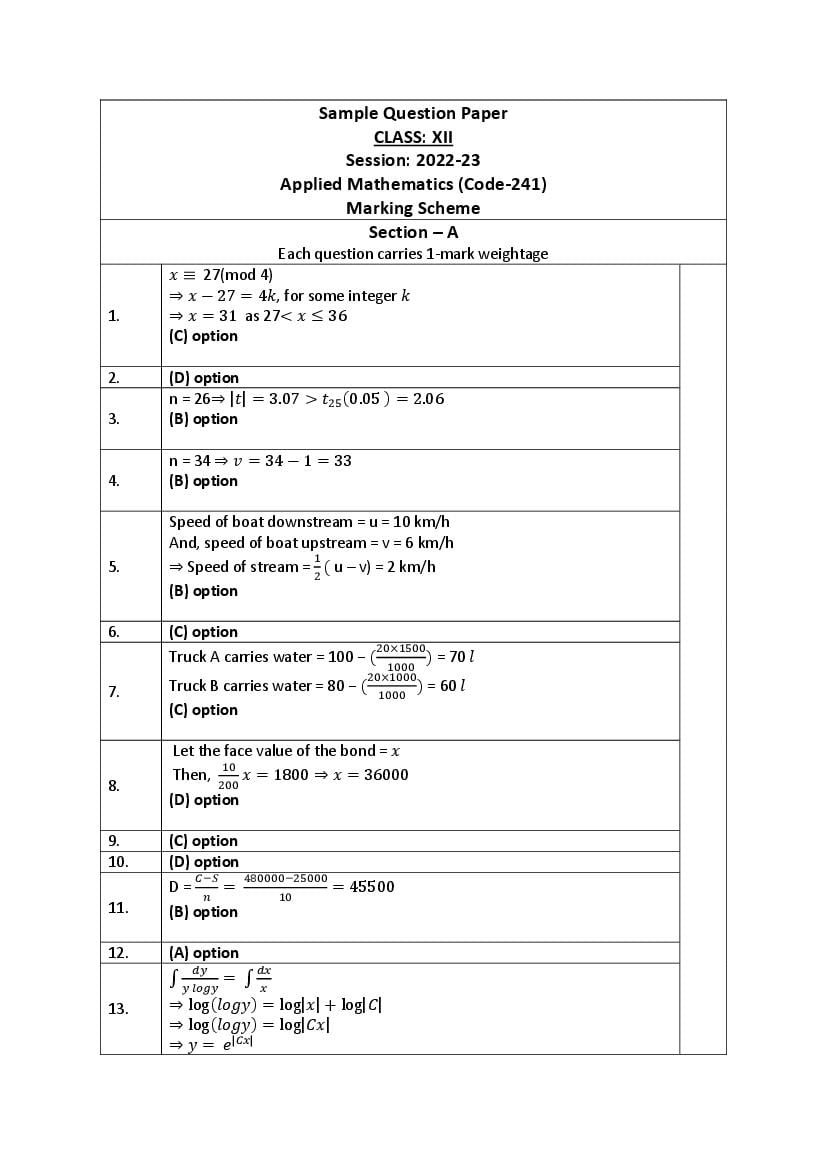
CLASS: XII
Session: 2022-23
Applied Mathematics (Code-241)
Marking Scheme
Section – A
Each question carries 1-mark weightage
𝑥 ≡ 27(mod 4)
⇒ 𝑥 − 27 = 4𝑘, for some integer 𝑘
1. ⇒ 𝑥 = 31 as 27< 𝑥 ≤ 36
(C) option
2. (D) option
n = 26⇒ |𝑡| = 3.07 > 𝑡25 (0.05 ) = 2.06
3. (B) option
n = 34 ⇒ 𝑣 = 34 − 1 = 33
4. (B) option
Speed of boat downstream = u = 10 km/h
And, speed of boat upstream = v = 6 km/h
1
5. ⇒ Speed of stream = ( u – v) = 2 km/h
2
(B) option
6. (C) option
20×1500
Truck A carries water = 100 – ( 1000 ) = 70 𝑙
20×1000
7. Truck B carries water = 80 – ( 1000 ) = 60 𝑙
(C) option
Let the face value of the bond = 𝑥
10
Then, 200 𝑥 = 1800 ⇒ 𝑥 = 36000
8.
(D) option
9. (C) option
10. (D) option
𝐶−𝑆 480000−25000
D= 𝑛 = = 45500
10
11. (B) option
12. (A) option
𝑑𝑦 𝑑𝑥
∫ 𝑦 𝑙𝑜𝑔𝑦 = ∫ 𝑥
13. ⇒ log(𝑙𝑜𝑔𝑦) = log|𝑥| + log|𝐶|
⇒ log(𝑙𝑜𝑔𝑦) = log|𝐶𝑥|
⇒ 𝑦 = 𝑒 |𝐶𝑥|
Page 2
1
60000 4 4
[( ) − 1] × 100 = [ √ 6 − 1] × 100
14. 10000
(C) option
15.
⇒ 180 : 300 = 3 : 5
(C) option
16. (D) option
17. (C) option
18. (B) option
P(Win in one game) = P(Lose in one game) = ½
1 4 1
⇒ P (Beena to win in 3 out of 4 games) = 4 𝐶3 . (2) = 4 = 25%
19. Assertion is correct and Reason is the correct explanation for it
(A)option
Effective rate of interest = Nominal rate – inflation rate = 12.5 – 2 = 10.5%
Assertion is correct
20. Reason is true but not supportive of assertion
(B) option
Section – B
Each question carries 2-mark weightage
21. P = 250000, R = 7500, 𝑖 = 𝑟/400
7500 × 400 1
⇒ 250000 = ⇒ 𝑟 = 12
𝑟
⇒ 𝑟 = 12 1
22. a−8=1⇒𝑎 = 9
2
3b = −2 ⇒ 𝑏 = − 3 1
−c + 2 = −28 ⇒ 𝑐 = 30
⇒ 2a + 3b − c = − 14 1
OR
2 1
Expanding C1, we get ∆ = 1(2𝑥 + 4) − 2(−4𝑥 − 20) = 86
⇒ 𝑥 2 + 4𝑥 − 21 = 0
∴ 𝑥 = 3, −7 1
23. Let the number of hardcopy and paperback copies be x and y respectively
1
⇒ Maximum profit Z = (72x + 40y) −(9600 + 56x + 28y) = 16x + 12y− 9600
Page 3
x + y ≤ 960
5x + y ≤ 2400
x, y ≥ 0
24. Speed of boat in still waters = 𝑥 km/h 1
Speed of stream = 𝑦 km/h
Distance travelled = 𝑑 km
𝑑
Time taken to travel downstream = 𝑥+𝑦
𝑑
Time taken to travel upstream = 𝑥−𝑦
2𝑑 𝑑 1
Then, = 𝑥−𝑦 ⇒ 𝑥 ∶ 𝑦 = 3: 1
𝑥+𝑦
OR 1
Param runs 5 m in 3 seconds
3
⇒ time taken to run 200 m = × 200 = 120 seconds
5
1
Anuj ‘s time = 120 – 3 = 117 seconds
25. 𝑉𝑓 = 437500, 𝑉𝑖 = 350000 1
𝑉𝑓 −𝑉𝑖
Nominal rate = × 100
𝑉𝑖
437500 − 350000 1
= × 100 = 25%
350000
Section – C
Each question carries 3-mark weightage
′ (𝑥)
26. 𝑓 = 𝑥 − 6𝑥 2 + 11𝑥 − 6 = (𝑥 − 1)(𝑥 − 2)(𝑥 − 3)
3
1
⇒ 𝑥 = 1,2,3
Strictly increasing in (1,2)∪(3,∞) 1
Strictly decreasing in (−∞,1)∪(2,3) 1
27.
2500 65
12700
Daily diet of team A = [2 3 ]
1 [1900 50] = [ ]
334 1.5
2000 54
Team A consumes 12700 calories and 334 g vitamin
2500 65
10300
[ ]
Daily diet of team B = 1 2 2 [1900 50] = [ ]
273
2000 54
1.5
Team B consumes 10300 calories and 273 g vitamin
28. 𝑑𝑥
∫
(1 + 𝑒 𝑥 )(1 + 𝑒 −𝑥 )
3
𝑒 𝑥 𝑑𝑥
= ∫ (1+𝑒 𝑥 )2
Page 4
= ∫ 𝑡 2 , where t = 𝑒 𝑥 + 1 and dt = 𝑒 𝑥 𝑑𝑥
−1
= +𝐶
𝑡
−1
= 1+𝑒 𝑥 + 𝐶
OR
𝑥 𝑙𝑜𝑔(1 + 𝑥 2 )𝑑𝑥
∫ 𝐼𝐼 , Integration by parts
𝐼
𝑑
= log (1 + 𝑥 2 ). ∫ 𝑥𝑑𝑥 − ∫[𝑑𝑥 log(1 + 𝑥 2 ) . ∫ 𝑥 𝑑𝑥] 𝑑𝑥
𝑥2 2𝑥 𝑥2
= 2 log (1 + 𝑥 2 ) − ∫[1+𝑥 2 . 2 ] 𝑑𝑥
𝑥2 𝑥3
= 2 log (1 + 𝑥 2 ) − ∫ 1+𝑥 2 𝑑𝑥
𝑥2 𝑥
= 2 log (1 + 𝑥 2 ) − ∫[𝑥 − 1 + 𝑥 2 ] 𝑑𝑥
𝑥2 𝑥2 1
= 2 log (1 + 𝑥 2 ) − 2 + 2 log (1 + 𝑥 2 ) + 𝐶
1
= 2 [(1 + 𝑥 2 )log (1 + 𝑥 2 ) − 𝑥 2 ] + 𝐶
29. Under pure competition, 𝑝𝑑 = 𝑝𝑠
8 𝑥+3
⇒ 𝑥+1 − 2 = 2
⇒ 𝑥 2 + 8𝑥 − 9 = 0 1.5
⇒ 𝑥 = −9, 1
∴𝑥=1
When 𝑥0 = 1 ⇒ 𝑝0 = 2
1
1 𝑥+3 𝑥 2 3𝑥 1
∴ Produce surplus = 2 − ∫0 2 𝑑𝑥 = 2 − [ 4 + 2 ] = 4 1.5
0
OR
2
𝑝 = 274 −𝑥
⇒ 𝑅 = 𝑝𝑥 = 274𝑥−𝑥 3
𝑑𝑅
= 274 − 3𝑥 2
𝑑𝑥 1.5
Given MR = 4 + 3𝑥
In profit monopolist market,
𝑑𝑅
MR = 𝑑𝑥 ⇒ 4 + 3𝑥 = 274 − 3𝑥 2
⇒ 𝑥 2 + 𝑥 − 90 = 0
Page 5
∴𝑥=9
When 𝑥0 = 9 ⇒ 𝑝0 = 193
9
∴ Consumer surplus = ∫0 (274 − 𝑥 2 )𝑑𝑥 − 193 × 9
9 1.5
𝑥3
= [274𝑥 − 3 ]
0
= 486
30. Purchase = ₹ 40,00,000
Down payment = 𝑥
Balance = 40,00,000 – 𝑥
9
𝑖= = 0.0075, n = 25 x 12 = 300 1
1200
E = ₹ 30,000
(4000000 − 𝑥) × 0.0075
⇒ 30000 =
1 − (1.0075)−300
(4000000 − 𝑥) × 0.0075
⇒ 30000 = 2
1 − 0.1062
⇒ 𝑥 = 424800
Down payment = ₹ 4,24,800
5
31. n = 10 x 2 = 20, S = 10,21,760, 𝑖 = = 0.025, R = ?
200
(1+𝑖)𝑛 −1 1.5
S =R [ ]
𝑖
(1+0.025)20 −1
⇒1021760 = R [ ]
0.025
1.6386−1
⇒1021760 = R [ ]
0.025
1021760×0.025
⇒R = [ ]
0.6386
⇒ R = ₹ 40,000 1.5
Mr Mehra set aside an amount of ₹ 40,000 at the end of every six months
Section – D
Each question carries 5-mark weightage
32. Probability of defective bucket = 0.03
n = 100
m = np = 100 x 0.03 = 3
Let X = number of defective buckets in a sample of 100 1
𝑚𝑟 𝑒 −𝑚
P (X = r) = , 𝑟 = 0,1,2,3, ….
𝑟!
30 𝑒 −3
(i) P (no defective bucket) = P(r = 0 ) = = 0.049 2
0!
(ii) P (at most one defective bucket) = P(r = 0, 1)
30 𝑒 −3 31 𝑒 −3 2
= +
0! 1!
Page 6
= 0.196
OR
X = scores of students, 𝜇 = 45, 𝜎 = 5
𝑋 − 𝜇 𝑋 − 45 1
∴𝑍= =
𝜎 5
(i) When X = 45, 𝑍 = 0
P (X > 45) = P (Z > 0) = 0.5
2
⇒ 50% students scored more than the mean score
(ii) When X = 30, 𝑍 = −3 and when X = 50, 𝑍 = 1
P (30< X< 50) = P ( -3< Z < 1) = P (-3< Z ≤ 1)
= P ( − 3 < 𝑍 ≤ 0) + 𝑃 (0 ≤Z <1)
= P (0 ≤ 𝑍 < 3) + 𝑃 (0 ≤Z <1) 2
= 0.4987 + 0.3413 = 0.84
⇒ 84% students scored between 30 and 50 marks
33. Let 𝑥 be the number of guests for the booking
Clearly, 𝑥 > 100 to avail discount
200 2
∴ Profit, P = [4800 − 10 (𝑥 – 100)] 𝑥 = 6800𝑥 – 20𝑥 2
𝑑𝑃
⇒ 𝑑𝑥 = 6800 – 40 𝑥 ⇒ 𝑥 = 170
1
𝑑2 𝑃
As 𝑑𝑥 2 = −40 < 0, ∀ 𝑥
1
A booking for 170 guests will maximise the profit of the company
And, Profit = ₹ 5,78,000 1
OR
P(x) = R(x) – C(x) 2
= 5x – (100 + 0.025x2)
⇒P’(x) = 5 – 0.05 x ⇒ 𝑥 = 100 1
As P’’(x) = −0.05 < 0, ∀ 𝑥 1
∴ Manufacturing 100 dolls will maximise the profit of the company
And, Profit = ₹ 1,50,000 1
34. Let the number of tables and chairs be 𝑥 and 𝑦 respectively
(Max profit) Z = 22𝑥 + 18𝑦
Subject to constraints:
𝑥 + 𝑦 ≤ 20 1.5
3𝑥 + 2𝑦 ≤ 48
𝑥, 𝑦 ≥ 0
Page 7
The feasible region OABCA is closed (bounded)
Corner points Z = 22 x + 18 y
O (0,0) 0
A (0,20) 360
B (8,12) 392 1.5
C (16,0) 352
Buying 8 tables and 12 chairs will maximise the profit
35.
1 2 3
A = [3 2 2]
2 3 2
2
⇒ |A| = 9 ⇒ A-1 exists
−2 5 −2
1
And A-1 = 9 [−2 −4 7 ]
5 1 −4
AX = B ⇒ 𝑋 = 𝐴−1 𝐵
−2 5 −2 85 15
1
⇒X = 9 [−2 −4 7 ] [105] = [20]
5 1 −4 110 10
3
⇒ 𝑝1 = 15, 𝑝2 = 20, 𝑝3 = 10
Section – E
Each Case study carries 4-mark weightage
36. CASE STUDY - I
2
Pipe C empties 1 tank in 20 h ⇒ 2/5 th tank in 5 × 20 = 8 hours
a) 1
1 1 1 1
Part of tank filled in 1 hour = 15 + 12 − 20 = 10 th
b) ⇒ time taken to fill tank completely = 10 hours 1
c) At 5 am, 2
Page 8
⇒pipe A is opened for ‘t’ hours
pipe B is opened for ‘t−3’ hours
And, pipe C is opened for ‘t−4’ hours
⇒ In one hour,
𝑡
part of tank filled by pipe A = 15 th
𝑡−3
part of tank filled by pipe B = 15 th
𝑡−4
and, part of tank emptied by pipe C = 15 th
𝑡 𝑡−3 𝑡−4
Therefore 15 + 12 − 20 = 1
⇒ 𝑡 = 10.5
Total time to fill the tank = 10 hours 30 minutes
OR
6 am, pipe C is opened to empty ½ filled tank
Time to empty = 10 hours
Time for cleaning = 1 hour
1 1 3
Part of tank filled by pipes A and B in 1 hour= 15 + 12 = 20th tank
20
⇒ time taken to fill the tank completely = 3 hours
20
Total time taken in the process = 10 + 1 + 3 = 17 hour 40 minutes
37. CASE STUDY - II
a)
Year Y X X2 XY
2015 35 -2 4 -70
2016 42 -1 1 -42
2017 46 0 0 0
2018 41 1 1 41
2019 48 2 4 96
212 10 25
∑𝑌 212 ∑ 𝑋𝑌 25
a = 𝑛 = 5 = 42.4 and b = ∑ 𝑋 2 = 10 = 2.5 2
𝑌𝐶 = 42.4 + 2.5𝑋
OR
Year Y 3-year moving average
2015 35 -
2016 42 41
2017 46 43
2018 41 45
2019 48 -
Page 9
𝑌2022 = 42.4 + 2.5(2022 − 2017) = 54.9
1
⇒ the estimated sales for year 2022 = ₹ 54,900
c) 𝑌𝐶 = 42.4 + 2.5𝑋
⇒ 67.4 = 42.4 + 2.5𝑋
1
⇒ 𝑋 = 10
Sales will be ₹ 67,400 in year (2017+ 10) = year 2027
38. CASE STUDY - III
a)
𝑘 2𝑘 3(1−𝑘) 4𝑘 1
+ 6 + + 2 =1⇒𝑘 =4 1
6 6
b) P (getting admission on applying at least 2 weeks ahead of application
deadline)
= P (X = 2,3,4)
1 3 1 23 1
= 12 + 8 + 2 = 24
1 23
[alternate method: 1 – P (X = 1) = 1 - 24 = 24 ]
c) X = week applied ahead of application deadline
X 1 2 3 4
P(X) 1 1 3 1
24 12 8 2
XP(X) 1 1 9 2
24 6 8
80 1 2
∴ E(X) = 24 = 3 3 weeks
OR
X = Scholarship money awarded for the week applied in, before the
deadline
Week 1 2 3 4
applied in
X 9600 12000 20000 50000
Page 10
24 12 8 2
XP(X) 9600 12000 60000 50000
24 12 8 2
∴ E(X) = ₹ 33,900
-------------------------------------
Document Details
| Board / Org | CBSE |
| Exam | Class 12 |
| Type | Solution |
| Pages | 10 |
| Updated | 22 Jul 2026 |