MAHA SET 2019 Question Paper 2 Library and Information Science
Finished viewing? Save it for later —
Download MAHA SET 2019 Question Paper 2 Library and Information Science (PDF · 48 pages)About MAHA SET 2019 Question Paper 2 Library and Information Science
MAHA SET 2019 Question Paper 2 Library and Information Science is available here for free download. Published by Maharashtra Exams for Maharashtra State Eligibility Test, this question paper can be viewed online or downloaded as a PDF (48 pages). Candidates preparing for Maharashtra State Eligibility Test can use MAHA SET 2019 Question Paper 2 Library and Information Science to understand the exam pattern, the type of questions asked, and the overall difficulty level.
Frequently Asked Questions
How can I download MAHA SET 2019 Question Paper 2 Library and Information Science?
Open this page and click the Download button to save MAHA SET 2019 Question Paper 2 Library and Information Science as a PDF. It is completely free on AglaSem Docs.
Is MAHA SET 2019 Question Paper 2 Library and Information Science free to download?
Yes. MAHA SET 2019 Question Paper 2 Library and Information Science can be viewed online and downloaded as a PDF free of cost on AglaSem Docs.
How many pages does MAHA SET 2019 Question Paper 2 Library and Information Science have?
MAHA SET 2019 Question Paper 2 Library and Information Science contains 48 pages, which you can read online or download together as a single PDF.
Where can I find more Maharashtra State Eligibility Test study material?
You can find more Maharashtra State Eligibility Test question papers, sample papers, syllabus, and answer keys on AglaSem Docs.
MAHA SET 2019 Question Paper 2 Library and Information Science – Text
Read the full text of this question paper below — useful to quickly search, copy and reference the content online without downloading the PDF.
📄 View text version (48 pages)
Page 1
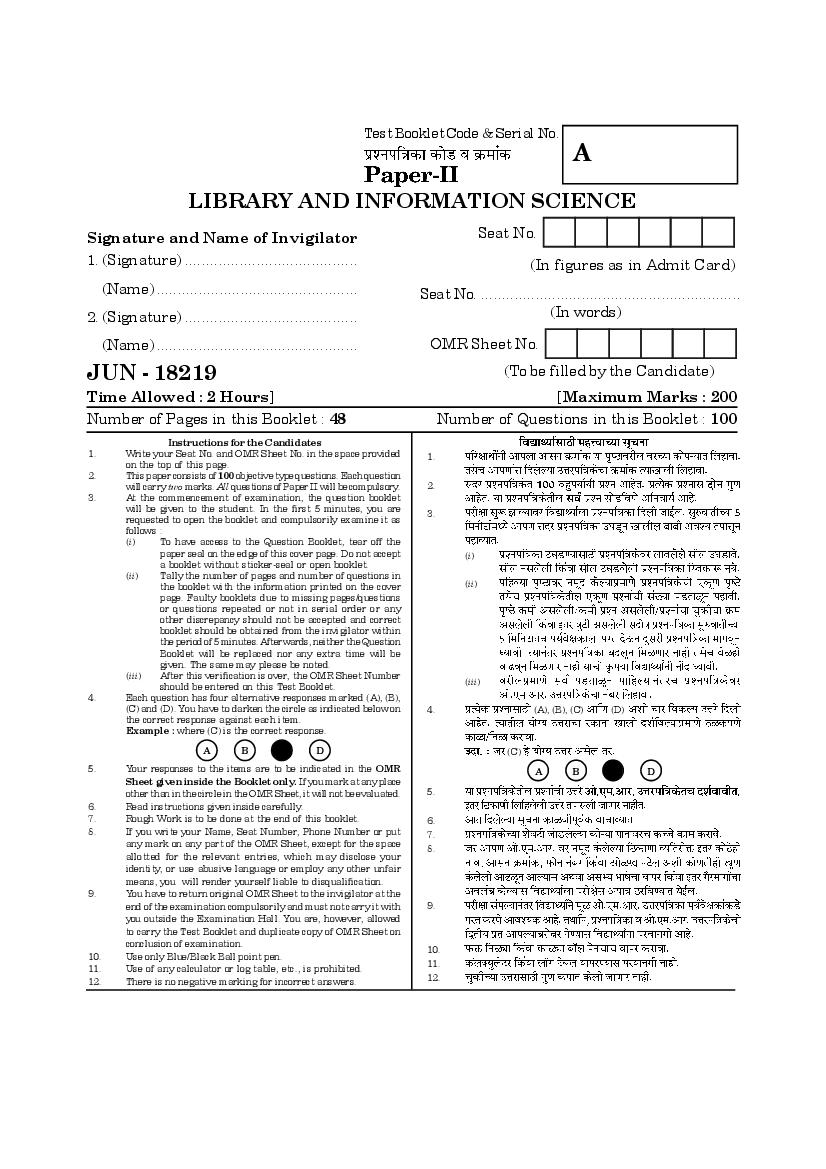
A
LIBRARY AND INFORMATION SCIENCE
Signature and Name of Invigilator Seat No.
1. (Signature) ......................................... (In figures as in Admit Card)
(Name) ................................................ Seat No. ..............................................................
2. (Signature) ......................................... (In words)
(Name) ................................................ OMR Sheet No.
JUN - 18219 (To be filled by the Candidate)
Time Allowed : 2 Hours] [Maximum Marks : 200
Number of Pages in this Booklet : 48 Number of Questions in this Booklet : 100
Instructions for the Candidates
1. Write your Seat No. and OMR Sheet No. in the space provided 1.
on the top of this page.
2. This paper consists of 100 objective type questions. Each question
will carry two marks. All questions of Paper II will be compulsory. 2.
3. At the commencement of examination, the question booklet
will be given to the student. In the first 5 minutes, you are 3.
requested to open the booklet and compulsorily examine it as
follows :
(i) To have access to the Question Booklet, tear off the
paper seal on the edge of this cover page. Do not accept (i)
a booklet without sticker-seal or open booklet.
(ii) Tally the number of pages and number of questions in
the booklet with the information printed on the cover (ii)
page. Faulty booklets due to missing pages/questions
or questions repeated or not in serial order or any
other discrepancy should not be accepted and correct
booklet should be obtained from the invigilator within
the period of 5 minutes. Afterwards, neither the Question
Booklet will be replaced nor any extra time will be
given. The same may please be noted.
(iii) After this verification is over, the OMR Sheet Number
(iii)
should be entered on this Test Booklet.
4. Each question has four alternative responses marked (A), (B),
(C) and (D). You have to darken the circle as indicated below on 4. (A), (B), (C) (D)
the correct response against each item.
Example : where (C) is the correct response.
A B D (C)
5. Your responses to the items are to be indicated in the OMR A B D
Sheet given inside the Booklet only. If you mark at any place
other than in the circle in the OMR Sheet, it will not be evaluated. 5.
6. Read instructions given inside carefully.
7. Rough Work is to be done at the end of this booklet. 6.
8. If you write your Name, Seat Number, Phone Number or put 7.
any mark on any part of the OMR Sheet, except for the space
8.
allotted for the relevant entries, which may disclose your
identity, or use abusive language or employ any other unfair
means, you will render yourself liable to disqualification.
9. You have to return original OMR Sheet to the invigilator at the
end of the examination compulsorily and must not carry it with 9.
you outside the Examination Hall. You are, however, allowed
to carry the Test Booklet and duplicate copy of OMR Sheet on
conclusion of examination.
10.
10. Use only Blue/Black Ball point pen.
11.
11. Use of any calculator or log table, etc., is prohibited.
12. There is no negative marking for incorrect answers. 12.
Page 2
Page 3
Paper II
II
Time Allowed : 120 Minutes] [Maximum Marks : 200
Note : This paper contains Hundred (100) multiple choice questions. Each question
carrying Two (2) marks. Attempt All questions.
(100) (2)
1. Who among the following have 1.
developed pre-coordinate indexing
systems ?
(i)
(i) S.R. Ranganathan
(ii)
(ii) Mortimer Taube
(iii)
(iii) Larry Page
(iv)
(iv) Derek Austin
(A) (i) (ii)
(A) (i) and (ii) are correct
(B) (i) and (iv) are correct (B) (i) (iv)
(C) (i) and (iii) are correct (C) (i) (iii)
(D) (ii) and (iv) are correct (D) (ii) (iv)
3 [P.T.O.
Page 4
correct sequence of bibliographical
elements in a reference entry of a
journal article :
(A) Author and year of publication; (A)
title of the article; title of the
journal; volume and issue
number; page numbers
(B) Author and year of publication, (B)
title of the article; volume and
issue number; title of the
journal; page numbers
(C) Author and year of publication; (C)
title of the article; page
numbers; volume and issue
number; title of the journal
(D) Author and year of publication, (D)
page numbers; title of the
article, title of the journal;
volume and issue number
3. Identify the modes of information 3.
generation :
(i)
(i) Observation
(ii)
(ii) Data
(iii)
(iii) Textbooks
(iv)
(iv) Thought process
(A) (i) (ii)
(A) (i) and (ii) are correct
(B) (ii) and (iii) are correct (B) (ii) (iii)
(C) (iii) and (iv) are correct (C) (iii) (iv)
(D) (i) and (iv) are correct (D) (i) (iv)
4
Page 5
Communication’ involves the
following steps :
(i)
(i) Publication
(ii) Discovery and Dissemination (ii)
(iii) Research, Data Collection and (iii)
analysis
(iv)
(iv) Stock verification
(A) (i) (iv)
(A) (i) and (iv) are correct
(B) (ii) (iv)
(B) (ii) and (iv) are correct
(C) (iii) and (iv) are correct (C) (iii) (iv)
(D) (i), (ii) and (iii) are correct (D) (i), (ii) (iii)
5. Arrange the following Acts 5.
according to their enactment year :
(i) The Right to Information Act
(i)
(ii) The Right to Education Act
(ii)
(iii) The Information Technology
Act (iii)
(iv) The Digital Millennium (iv)
Copyright Act
(A) (iv) (iii) (i) (ii)
(A) (iv) (iii) (i) (ii)
(B) (i) (ii) (iii) (iv)
(B) (i) (ii) (iii) (iv)
(C) (ii) (i) (iii) (iv) (C) (ii) (i) (iii) (iv)
(D) (iii) (iv) (i) (ii) (D) (iii) (iv) (i) (ii)
5 [P.T.O.
Page 6
‘Knowledge industry’ was introduced
1962
by Fritz Machlup in 1962.
(B) :
Statement (B) : A systematic
model of communication was 1992
developed by Watzlawick in 1992.
(A) (A) (B)
(A) Both (A) and (R) are true
(B) (A) (B)
(B) (A) is true but (B) is false
(C) (A) (B)
(C) Both (A) and (B) are false
(D) (A) is false but (B) is true (D) (A) (B)
7. Who is associated with information 7.
measure ?
(A)
(A) Melvil Deway
(B)
(B) S.R. Ranganathan
(C)
(C) C.A. Cutter
(D) Hartley (D)
8. Who expanded the Shannon and 8.
‘Weaver’s Linear model of
communication ?
(A)
(A) Shannon-Weaver
(B)
(B) Berlo
(C) George Gerbner (C)
(D) Harold Lasswell (D)
6
Page 7
Property’ day is celebrated on ...........
(A) March 26 (A) 26
(B) April 26 (B) 26
(C) May 26 (C) 26
(D) June 26 (D) 26
10. The term ‘Data’ came from which 10.
language ?
(A) Latin (A)
(B) French (B)
(C) Greek (C)
(D) Spanish (D)
11. Which is the database created by 11.
NISCAIR (Former INSDOC) :
(A) Medline (A)
(B) NUCSSI (B)
(C) Scopus (C)
(D) ULCSS (D)
12. INSDOC has developed .............. 12.
Library Automation Software.
(A) Granthalaya (A)
(B) Maitrayee (B)
(C) Libman (C)
(D) Libsys (D)
7 [P.T.O.
Page 8
Act in ............
(A) 2007 (A) 2007
(B) 1994 (B) 1994
(C) 2004 (C) 2004
(D) 1983 (D) 1983
14. Match the following : 14.
List I I
(a) Karnataka Public Libraries (a)
Act
(b)
(b) Andhra Pradesh Public
Libraries Act (c)
(c) Maharashtra State Public
Libraries Act (d)
(d) Madras Public Libraries Act II
List II (i) 1967
(i) 1967 (ii) 1960
(ii) 1960 (iii) 1948
(iii) 1948
(iv) 1965
(iv) 1965
(a) (b) (c) (d)
(a) (b) (c) (d)
(A) (i) (ii) (iv) (iii)
(A) (i) (ii) (iv) (iii)
(B) (iii) (iv) (i) (ii)
(B) (iii) (iv) (i) (ii)
(C) (iv) (ii) (i) (iii) (C) (iv) (ii) (i) (iii)
(D) (ii) (iii) (iv) (i) (D) (ii) (iii) (iv) (i)
8
Page 9
National Libraries ?
(i)
(i) England Library, Great Britain
(ii)
(ii) Library of Congress, USA
(iii) Bibliotheque Nationale de (iii)
France (iv)
(iv) National Diet Library, Japan
(A) (i), (ii), (iii)
(A) (i), (ii), (iii) are correct
(B) (ii), (iii), (iv)
(B) (ii), (iii), (iv) are correct
(C) (i), (iii), (iv) are correct (C) (i), (iii), (iv)
(D) (i), (ii), (iv) are correct (D) (i), (ii), (iv)
16. Which committees were appointed 16.
concerning medical libraries in
India ?
(i)
(i) Krishna Rao Committee
(ii)
(ii) Bhore Committee
(iii)
(iii) Sankaran Committee
(iv)
(iv) Ekbote Committee
(A) (i) and (iii) are correct (A) (i) (iii)
(B) (i) and (ii) are correct (B) (i) (ii)
(C) (iii) and (iv) are correct (C) (iii) (iv)
(D) (ii) and (iii) are correct
(D) (ii) (iii)
9 [P.T.O.
Page 10
Information Centres ?
(i) National Information Centre for
(i)
Food Science and Technology
(ii) National Information Centre for
(ii)
Management
(iii) National Information Centre for (iii)
Microbiology (iv)
(iv) National Information Centre for
Drugs and Pharmaceuticals
(A) (i), (ii), (iv)
(A) (i), (ii), (iv) are correct
(B) (ii), (iii), (iv)
(B) (ii), (iii), (iv) are correct
(C) (i), (iii), (iv)
(C) (i), (iii), (iv) are correct
(D) (i), (ii), (iii) are correct (D) (i), (ii), (iii)
18. Arrange the following Library 18.
Associations in order of their
establishment :
(i)
(i) IFLA
(ii)
(ii) ILA
(iii)
(iii) IASLIC
(iv)
(iv) ALA
(A) (i) (iv) (iii) (ii)
(A) (i) (iv) (iii) (ii)
(B) (iii) (ii) (iv) (i) (B) (iii) (ii) (iv) (i)
(C) (iv) (i) (ii) (iii) (C) (iv) (i) (ii) (iii)
(D) (ii) (iii) (i) (iv) (D) (ii) (iii) (i) (iv)
10
Page 11
following universities where Library
Science Education was started in
India : (i)
(i) Banaras Hindu University (ii)
(ii) Gujarat University (iii)
(iii) Madras University (iv)
(iv) Delhi University
(A) (ii) (iii) (i) (iv)
(A) (ii) (iii) (i) (iv)
(B) (i) (iii) (ii) (iv)
(B) (i) (iii) (ii) (iv)
(C) (iv) (iii) (i) (ii) (C) (iv) (iii) (i) (ii)
(D) (iii) (i) (iv) (ii) (D) (iii) (i) (iv) (ii)
20. Assertion (A) : The individual 20. (A) :
variable should be excluded in
information gathering and
information seeking bahaviour
studies. (R) :
Reason (R) : Systematic efforts to
know how information is gathered
and used by different categories of
users are known as user studies.
Codes : (A) (A) (R)
(A) (A) is true but (R) is false
(B) (A) (R)
(B) (A) is false but (R) is true
(C) (A) (R)
(C) Both (A) and (R) are false
(D) (A) (R)
(D) Both (A) and (R) are true
11 [P.T.O.
Page 12
library should have a chance of
finding its appropriate reader.
Reason (R) : Introduce an (R) :
arrangement in which books have
a chance of catching the attention
of readers.
Codes : (A) (A) (R)
(A) (A) is true but (R) is false
(B) (A) (R)
(B) (A) is false but (R) is true
(C) (A) (R)
(C) Both (A) and (R) are false
(D) Both (A) and (R) are true (D) (A) (R)
22. The weekly news digest ‘Facts on 22.
File’ covers :
(A) Indian events (A)
(B) American events (B)
(C) World events (C)
(D) British events (D)
23. ‘TechXtra’ is a ................ 23.
(i) Free Gateway Service (i)
(ii) Commercial Gateway Service (ii)
(iii) Learning resources in
(iii)
Engineering, Mathematics and
Computing
(iv) Source to find articles, books (iv)
and industrial new
(A) (i), (ii) and (iii) are true (A) (i), (ii) (iii)
(B) (ii), (iii) and (iv) are true (B) (ii), (iii) (iv)
(C) (i), (iii) and (iv) are true (C) (i), (iii) (iv)
(D) (i), (iii) and (iv) are false (D) (i), (iii) (iv)
12
Page 13
24.
(A) Database
(A)
(B) Online interactive tutorials
(C) Library of Technology and (B)
Social-Sciences
(C)
(D) Indexing and Abstracting
Service (D)
25. ‘‘Grey’’ Literature means ..............
25.
(A) Documents bound in grey cloth
(B) Literature which contains (A)
classified information
(B)
(C) Literature which is to be
published in future (C)
(D) Literature which is Semi-
(D)
published
26. Census of India is a .............. type of 26.
database.
(A) Numerical (A)
(B) Bibliographical (B)
(C) Full text (C)
(D) Pictorial
(D)
13 [P.T.O.
Page 14
geographical sources ?
(i) Gazetteers (i)
(ii) Atlases (ii)
(iii) Encyclopaedias (iii)
(iv) Year Books (iv)
(A) (i) (ii)
(A) (i) and (ii) are correct
(B) (iii) (iv)
(B) (iii) and (iv) are correct
(C) (ii) (iii)
(C) (ii) and (iii) are correct
(D) (ii) (iv)
(D) (ii) and (iv) are correct
28.
28. Match the following :
I
List I
(a)
(a) Origin of words
(b)
(b) Synonyms words
(c)
(c) How to install a gadget
(d)
(d) Address of Oxford University
II
List II
(i) World of Learning (i)
(ii) Dictionary of Etymology (ii)
(iii) Manual (iii)
(iv) Thesaurus (iv)
(a) (b) (c) (d) (a) (b) (c) (d)
(A) (ii) (i) (iv) (iii) (A) (ii) (i) (iv) (iii)
(B) (ii) (iii) (iv) (i) (B) (ii) (iii) (iv) (i)
(C) (ii) (iv) (i) (iii) (C) (ii) (iv) (i) (iii)
(D) (ii) (iv) (iii) (i) (D) (ii) (iv) (iii) (i)
14
Page 15
are alternative to search engines.
Reason (R) : Subject gateways do (R) :
not provide detailed description of
relevant information sources.
(A) (A) (R)
(A) Both (A) and (R) are true
(B) (A) (R)
(B) Both (A) and (R) are false
(C) (A) is true but (R) is false (C) (A) (R)
(D) (A) is false but (R) is true (D) (A) (R)
30. Arrange the following indexing 30.
sources according to the year of their
first publication :
(i)
(i) Biological abstracts
(ii)
(ii) Chemical abstracts
(iii) Index medicus (iii)
(iv) Poole’s index to periodical (iv)
literature
(A) (i) (ii) (iii) (iv)
(A) (i) (ii) (iii) (iv)
(B) (iv) (iii) (ii) (i)
(B) (iv) (iii) (ii) (i)
(C) (iv) (ii) (i) (iii) (C) (iv) (ii) (i) (iii)
(D) (i) (iv) (iii) (ii) (D) (i) (iv) (iii) (ii)
15 [P.T.O.
Page 16
middling and maximum’’ theories of
reference service ?
(A)
(A) Samuel Green
(B)
(B) Dr. S.R. Ranganathan
(C) S. Rothstein (C)
(D) F.W. Lancaster (D)
32. The concept of ‘‘Ask Library 32.
Anything’’ is originally initiated
by .......................
(A)
(A) LA
(B) ASLIB (B)
(C) SLA (C)
(D) ALA (D)
33. Which of the following are functions 33.
of intermediary ?
(i) Searching data and information (i)
(ii) Acquisition of library material (ii)
(iii) Analysing data and information (iii)
(iv) Manage library activities (iv)
efficiently
(A) (ii) and (iv) are correct (A) (ii) (iv)
(B) (i) and (ii) are correct (B) (i) (ii)
(C) (iii) and (iv) are correct (C) (iii) (iv)
(D) (i) and (iii) are correct (D) (i) (iii)
16
Page 17
intermediary shall possess
information analysis, retrieval and
communication skills.
Statement (B) : Most library (B) :
professionals working in research
and University libraries possess
these skills.
Codes : (A) (A) (B)
(A) Both (A) and (B) are false
(B) (A) (B)
(B) Both (A) and (B) are true
(C) (A) (B)
(C) (A) is true but (B) is false
(D) (A) (B)
(D) (A) is false but (B) is true
35. Statement (A) : Machine trans- 35. (A) :
lation is not a fully dependable
service.
(B) :
Statement (B) : Manual trans-
lation is fully dependable as it is
provided by Language and subject
experts.
(A) (A) (B)
(A) Both (A) and (B) are true
(B) (A) (B)
(B) Both (A) and (B) are false
(C) (A) (B)
(C) (A) is false but (B) is true
(D) (A) is true but (B) is false (D) (A) (B)
17 [P.T.O.
Page 18
List I List II I II
(a) NISCAIR (i) 1958 (a) (i) 1958
(b) DESIDOC (ii) 1970 (b) (ii) 1970
(c) SENDOC (iii) 1929 (c) (iii) 1929
(d) ICAR (iv) 2002 (d) (iv) 2002
(a) (b) (c) (d) (a) (b) (c) (d)
(A) (iv) (i) (ii) (iii) (A) (iv) (i) (ii) (iii)
(B) (ii) (iii) (iv) (i) (B) (ii) (iii) (iv) (i)
(C) (iii) (ii) (i) (iv) (C) (iii) (ii) (i) (iv)
(D) (i) (iv) (iii) (ii) (D) (i) (iv) (iii) (ii)
37. Identify the correct sequence of the 37.
following activities associated with
research data :
(i)
(i) Data collection
(ii)
(ii) Construction of frequency
tables (iii)
(iii) Cleaning of data (iv)
(iv) Presentation of data in charts.
(A) (i) (ii) (iv) (iii)
(A) (i) (ii) (iv) (iii)
(B) (i) (iii) (ii) (iv)
(B) (i) (iii) (ii) (iv)
(C) (ii) (iii) (i) (iv)
(C) (ii) (iii) (i) (iv)
(D) (iv) (ii) (i) (iii) (D) (iv) (ii) (i) (iii)
18
Page 19
forced by :
(i) Price escalation (i)
(ii) Government Orders (ii)
(iii) Information Explosion (iii)
(iv) Weather conditions (iv)
(A) (i) and (ii) are correct (A) (i) (ii)
(B) (iii) and (iv) are correct (B) (iii) (iv)
(C) (ii) and (iii) are correct (C) (ii) (iii)
(D) (i) and (iii) are correct (D) (i) (iii)
39. Match the following : 39.
List I I
(a) NICLAI (a)
(b) NICTAS (b)
(c) NICAMP (c)
(d) NICHEM (d)
List II II
(i) Textiles and allied subjects (i)
(ii) Machine tools (ii)
(iii) Chemical and allied industries (iii)
(iv) Leather Technology (iv)
(a) (b) (c) (d) (a) (b) (c) (d)
(A) (i) (iii) (ii) (iv) (A) (i) (iii) (ii) (iv)
(B) (iv) (i) (ii) (iii) (B) (iv) (i) (ii) (iii)
(C) (iii) (ii) (iv) (i) (C) (iii) (ii) (iv) (i)
(D) (ii) (iv) (iii) (i) (D) (ii) (iv) (iii) (i)
19 [P.T.O.
Page 20
with :
(A) Compilation of Encyclopedia (A)
(B) Compilation of Handbooks (B)
(C) Compilation of Dictionaries (C)
(D) Compilation of Directories (D)
41. Which one among the following is 41.
a publication of AGRIS ?
(A)
(A) Agriculture Index
(B)
(B) Agrindex
(C)
(C) Index Agriculture
(D) Agricultural Journal (D)
42. The input centre for INIS in India 42.
is ................
(A) DRDO (A)
(B) CSIR (B)
(C) TFIR (C)
(D) BARC (D)
43. Which of the following are not 43.
services of INFLIBNET ?
(i) SOUL (i)
(ii) World Cat (ii)
(iii) e-Sodh Sindhu (iii)
(iv) Translation (iv)
(A) (i) and (ii) are correct (A) (i) (ii)
(B) (iii) and (iv) are correct (B) (iii) (iv)
(C) (i) and (iii) are correct (C) (i) (iii)
(D) (ii) and (iv) are correct (D) (ii) (iv)
20
Page 21
Information received from the
Internet is to be evaluated.
Reason (R) : Anybody can publish (R) :
on the Internet.
(A) Both (A) and (R) are true (A) (A) (R)
(B) Both (A) and (R) are false (B) (A) (R)
(C) (A) is true, but (R) is false (C) (A) (R)
(D) (A) is false, but (R) is true (D) (A) (R)
45. Assertion (A) : A patient helps to 45. (A) :
maintain Intellectual Property
Rights on an invention.
(R) :
Reason (R) : A patent is a primary
source of information.
(A) (A) (R)
(A) Both (A) and (R) are true
(B) Both (A) and (R) are false (B) (A) (R)
(C) (A) is true, but (R) is false (C) (A) (R)
(D) (A) is false, but (R) is true (D) (A) (R)
46. Arrange the following steps of 46.
reference services in its right
sequence : (i)
(i) Query analysis
(ii)
(ii) Reference interview
(iii)
(iii) Formulation of search strategy
(iv)
(iv) Notification
(A) (ii), (iii), (i), (iv) (A) (ii), (iii), (i), (iv)
(B) (iii), (ii), (iv), (i) (B) (iii), (ii), (iv), (i)
(C) (i), (ii), (iii), (iv) (C) (i), (ii), (iii), (iv)
(D) (iv), (i), (ii), (iii) (D) (iv), (i), (ii), (iii)
21 [P.T.O.
Page 22
isolate ?
(A)
(A) History
(B)
(B) India
(C) Medicine (C)
(D) Law (D)
48. Emptying digit is used in colon 48.
classification to provide ...............
(A) Hospitality in chain (A)
(B) Hospitality in array (B)
(C) Hospitality in notation (C)
(D) Broken order (D)
49. Web OPACs are ............. 49.
(A) First generation OPACs
(A)
(B) Second generation OPACs
(B)
(C) Improvement over second
generation OPACs (C)
(D) Third generation OPACs (D)
50. AACR-I (1967) was prepared 50. -I (1967)
by .................
(a) The Library Association, London (a)
(b) American Library Association (b)
(c) The Library of Congress
(c)
(d) The Canadian Library Asso-
(d)
ciation
(A) (a), (b), (c) are correct (A) (a), (b), (c)
(B) (b), (c), (d) are correct (B) (b), (c), (d)
(C) (a), (c), (d) are correct (C) (a), (c), (d)
(D) (a), (b), (d) are correct (D) (a), (b), (d)
22
Page 23
The second and third laws of library
science imply which of the
(a)
following ?
(a) Library Catalogue should
provide access to collection of (b)
library.
(b) Catalogue should meat
requirements of all users (c)
without any discrimination.
(c) Only main entry is adequate to (d)
access the library collection.
(d) Analytical entries of documents
should be prepared to reveal
contents of documents.
(A) (a), (b), (c)
(A) (a), (b), (c) are correct
(B) (a), (c), (d)
(B) (a), (c), (d) are correct
(C) (b), (c), (d) are correct (C) (b), (c), (d)
(D) (a), (b), (d) are correct (D) (a), (b), (d)
52. Which among the following have 52.
used the term ‘Canon’ in naming
their normative principles for
classification ? (i)
(i) S.R. Ranganathan (ii)
(ii) W.C.B. Sayers (iii)
(iii) E.C. Richardson (iv)
(iv) Wyndham Hulme
(A) (i) (iii)
(A) (i) and (iii) are correct
(B) (ii) (iii)
(B) (ii) and (iii) are correct
(C) (iii) and (iv) are correct (C) (iii) (iv)
(D) (i) and (ii) are correct (D) (i) (ii)
23 [P.T.O.
Page 24
schemes in a sequence of their year
of publication :
(a)
(a) DDC
(b)
(b) CC
(c)
(c) Broad System of Ordering
(d)
(d) UDC
(A) (a) (d) (b) (c) (A) (a) (d) (b) (c)
(B) (a) (b) (c) (d) (B) (a) (b) (c) (d)
(C) (b) (c) (a) (d) (C) (b) (c) (a) (d)
(D) (c) (d) (a) (b) (D) (c) (d) (a) (b)
54. Arrange in logical order the facet 54.
indicators used in CC :
(a) Colon ( : ) (a) (:)
(b) Comma ( , ) (b) (,)
(c) Inverted comma ( ‘ ) (c) (‘)
(d) Semicolon ( ; ) (d) (;)
(e) dot ( . ) (e) (.)
(A) (a) (b) (c) (d) (e) (A) (a) (b) (c) (d) (e)
(B) (b) (d) (a) (e) (c) (B) (b) (d) (a) (e) (c)
(C) (c) (b) (a) (e) (d) (C) (c) (b) (a) (e) (d)
(D) (d) (c) (e) (a) (b) (D) (d) (c) (e) (a) (b)
24
Page 25
List I I
(a) Rules for dictionary catalog (a)
(b) AACR-II (1978)
(b) -II (1978)
(c) Prussian instructions
(c)
(d) British Museum Cataloguing
Rules (d)
List II II
(i) Anthony Panizzi
(i)
(ii) University of Michigan Press
(ii)
(iii) Canadian Committee on
Cataloguing (iii)
(iv) Charles Ammi Cutter (iv)
(a) (b) (c) (d)
(a) (b) (c) (d)
(A) (i) (ii) (iii) (iv)
(A) (i) (ii) (iii) (iv)
(B) (ii) (iii) (iv) (i)
(B) (ii) (iii) (iv) (i)
(C) (iii) (i) (iv) (ii)
(C) (iii) (i) (iv) (ii)
(D) (iv) (iii) (ii) (i)
(D) (iv) (iii) (ii) (i)
56. Assertion (A) : Library classi-
fication is the translation of names 56. (A) :
of specific subject.
Reason (R) : It is translation of (R) :
subject of book into artificial
language of ordinal numbers.
(A) (A) is true but (R) is false (A) (A) (R)
(B) (A) is false but (R) is true (B) (A) (R)
(C) Both (A) and (R) are true (C) (A) (R)
(D) Both (A) and (R) are false (D) (A) (R)
25 [P.T.O.
Page 26
could include ISBD.
Reason (R) : They are one and the
(R) :
same.
Select the correct answer from the
codes given below :
Codes : (A) (A) (R)
(A) (A) is true but (R) is false
(B) (A) (R)
(B) (A) is false but (R) is true
(C) (A) (R)
(C) Both (A) and (R) are true
(D) (A) (R)
(D) Both (A) and (R) are false
58. Assertion (A) : Dublin core was 58. (A) : 2009
published as ISO : 15836 in 15836
February 2009.
Reason (R) : Dublin core is a base (R) :
domain diagnostic standard which
can be easily understood and
implemented.
Select the correct answer from the
codes given below :
(A) (A) is true but (R) is false (A) (A) (R)
(B) (A) is false but (R) is true (B) (A) (R)
(C) Both (A) and (R) are true (C) (A) (R)
(D) Both (A) and (R) are false (D) (A) (R)
26
Page 27
states the essential job require-
ments, job duties, job responsibilities
and skills required to perform a
specific role is known as : (A)
(A) Job enrichment
(B)
(B) Job specification
(C)
(C) Job description
(D)
(D) Job analysis
60. The ADKAR model of change 60.
management is developed by ........ (ADKAR)
(A) Abraham Maslow (A)
(B) Jeff Hiatt (B)
(C) William Bridge (C)
(D) Philip Kotler (D)
61. Book Order Vigilance Pad (BOVP) 61.
is suggested by ..............
(A) S.R. Ranganathan (A)
(B) C.A. Cutter (B)
(C) Melvil Dewey (C)
(D) Michael Gorman (D)
27 [P.T.O.
Page 28
library employees in acquiring new
skills on a continuing basis.
(A) Total Quality Management
(A)
(B) Management Information
System (B)
(C) Financial Resources Manage-
(C)
ment
(D) Human Resources Development (D)
63. Gantt chart was developed by Henry 63.
L. Gantt in the year ..............
(A) 1917 (A) 1917
(B) 1928 (B) 1928
(C) 1915 (C) 1915
(D) 1978 (D) 1978
64. Assertion (A) : TQM promotes 64. (A) :
continuous improvement in library
services.
(R) :
Reason (R) : TQM is not helpful
to library and information services.
Codes : (A) (A) (R)
(A) (A) is false and (R) is true
(B) (A) (R)
(B) (A) is true and (R) is false
(C) Both (A) and (R) are true (C) (A) (R)
(D) Both (A) and (R) are false (D) (A) (R)
28
Page 29
List I I
(a) Principles of Librarianship (a)
(b) Singapore National Library (b)
(c) SWOT analysis (c)
(d) Managerial grid (d)
List II II
(i) Green building (i)
(ii) Donald Urquhart (ii)
(iii) Robert Blake and Jane Mouton (iii)
(iv) Reveal possibilities and (iv)
limitations for change
(a) (b) (c) (d) (a) (b) (c) (d)
(A) (ii) (i) (iv) (iii) (A) (ii) (i) (iv) (iii)
(B) (iii) (ii) (i) (iv) (B) (iii) (ii) (i) (iv)
(C) (i) (iii) (ii) (iv) (C) (i) (iii) (ii) (iv)
(D) (iv) (ii) (iii) (i) (D) (iv) (ii) (iii) (i)
29 [P.T.O.
Page 30
correct answer from the codes given
below :
I
List I
(a)
(a) Algorithm
(b)
(b) Flowcharts
(c)
(c) Program codes
(d)
(d) Program test
II
List II
(i) Instructions to the computer (i)
(ii) Debugging (ii)
(iii) Pictorially represented direction (iii)
lines
(iv)
(iv) Set of explicit and finite steps
(a) (b) (c) (d)
(a) (b) (c) (d)
(A) (ii) (iii) (iv) (i)
(A) (ii) (iii) (iv) (i)
(B) (iii) (i) (iv) (ii)
(B) (iii) (i) (iv) (ii)
(C) (iv) (iii) (i) (ii)
(C) (iv) (iii) (i) (ii)
(D) (i) (ii) (iv) (iii) (D) (i) (ii) (iv) (iii)
30
Page 31
correct answer from the codes given
below :
I
List I
(a)
(a) Boot virus
(b)
(b) Macro virus
(c) File virus (c)
(d) Polymorphic virus (d)
List II II
(i) Self-encrypted virus designed to (i)
avoid getting detected by
scanner
(ii)
(ii) Malware
(iii)
(iii) Infects the boot sector of floppy
disks or the master book record
(iv) Virus that spread in application (iv)
software
(a) (b) (c) (d)
(a) (b) (c) (d)
(A) (iv) (i) (ii) (iii)
(A) (iv) (i) (ii) (iii)
(B) (iii) (iv) (ii) (i)
(B) (iii) (iv) (ii) (i)
(C) (iii) (iv) (i) (ii)
(C) (iii) (iv) (i) (ii)
(D) (iv) (iii) (i) (ii) (D) (iv) (iii) (i) (ii)
31 [P.T.O.
Page 32
engines by their year of origin :
(i) Bing (i)
(ii) Yahoo (ii)
(iii) Ask (iii)
(iv) Google (iv)
(A) (i) (iii) (ii) (iv) (A) (i) (iii) (ii) (iv)
(B) (iii) (i) (iv) (ii) (B) (iii) (i) (iv) (ii)
(C) (ii) (iv) (iii) (i) (C) (ii) (iv) (iii) (i)
(D) (iv) (iii) (ii) (i) (D) (iv) (iii) (ii) (i)
69. Assertion (A) : Subject Gateways 69. (A) :
are suitable for users of all subjects
for finding information.
(R) :
Reason (R) : Subject Gateways are
developed by subject and computer
experts.
(A) (A) (R)
(A) (A) is true, but (R) is false
(B) (A) (R)
(B) (A) is false, but (R) is true
(C) (A) (R)
(C) Both (A) and (R) are true
(D) Both (A) and (R) are false (D) (A) (R)
32
Page 33
a combination of ............. and ...........
(i) RDF (i)
(ii) XML (ii)
(iii) HTTP (iii)
(iv) JAVA (iv)
(A) (i) and (ii) are correct (A) (i) (ii)
(B) (i) and (iv) are correct (B) (i) (iv)
(C) (ii) and (iv) are correct (C) (ii) (iv)
(D) (ii) and (iii) are correct (D) (ii) (iii)
71. Which of the following is not a 71.
transmission medium ?
(i)
(i) Modem
(ii)
(ii) Co-axial cables
(iii)
(iii) NIC
(iv)
(iv) Microwave system
(A) (i) (ii)
(A) (i) and (ii) are correct
(B) (ii) (iii)
(B) (ii) and (iii) are correct
(C) (iii) (iv)
(C) (iii) and (iv) are correct
(D) (ii) (iv)
(D) (ii) and (iv) are correct
72. Which technology uses electro- 72.
magnetic waves at radio frequencies
for data transmission ?
(A)
(A) Li-Fi
(B)
(B) Wi-Fi
(C) Optical cables (C)
(D) Co-axial cables (D)
33 [P.T.O.
Page 34
down the fibre is called ...........
(A) Attenuation
(A)
(B) Propagation
(B)
(C) Scattering
(C)
(D) Interruption (D)
74. Web search engines store
74.
information about many web pages
with the help of .............
(A) Web router (A)
(B) Web organizer (B)
(C) Web crawler (C)
(D) Web indexer (D)
75. Data encryption techniques are 75.
particularly used for ..........
(A) Protecting data in Data (A)
communication system
(B) Reduce storage space require- (B)
ment
(C) Enhances integrity (C)
(D) Decreases data integrity (D)
76. Which layer of the OSI model has 76.
the function of providing
authorization to the correct user ?
(A) Transport layer (A)
(B) Application layer (B)
(C) Presentation layer (C)
(D) Session layer (D)
34
Page 35
automation software deals with the
handling of number of concurrent
users ?
(A)
(A) Performance
(B)
(B) Customization
(C) Support (C)
(D) Integration (D)
78. Open DOAR was developed as a 78.
result of collaboration between ......... (Open DOAR)
(A) University of Nottingham and (A)
Lund University (B)
(B) Stanford University and MIT
University (C)
(C) Oxford University and
Cambridge University (D) (UNESCO)
(D) UNESCO and IFLA (IFLA)
79. Which digital archive constitutes 79.
equal number of participating
librarians and publishers in its
Board of Director ?
(A)
(A) LOCKSS
(B)
(B) CLOCKSS
(C)
(C) PMC
(D) Portico (D)
35 [P.T.O.
Page 36
data interchange on web ?
(A) RDF (A)
(B) RDF : S (B) :
(C) RDF : W (C) :
(D) RDF : D (D) :
81. Which of the components are 81.
covered in ‘‘WAMP’’ ?
(i) Windows (i)
(ii) Apache (ii)
(iii) MySQL (iii)
(iv) Python (iv)
(A) (i), (ii) and (iii) are correct (A) (i), (ii) (iii)
(B) (ii), (iii) and (iv) are correct (B) (ii), (iii) (iv)
(C) (i), (ii) and (iv) are correct (C) (i), (ii) (iv)
(D) (i), (iii) and (iv) are correct (D) (i), (iii) (iv)
36
Page 37
‘‘Trigger Event’’ means :
(i) When the publisher no longer
(i)
offers back issues
(ii) When a library stops (ii)
subscription to the e-contents (iii)
(iii) When a publisher ceases to
publish a title
(iv)
(iv) When the library deny to pay
for the e-contents stored in
archives
(A) (i) (ii)
(A) (i) and (ii) are correct
(B) (ii) (iii)
(B) (ii) and (iii) are correct
(C) (i) (iii)
(C) (i) and (iii) are correct
(D) (ii) and (iv) are correct (D) (ii) (iv)
37 [P.T.O.
Page 38
List I I
(a) Php My Library (a)
(b) Koha (b)
(c) ABCD (c)
(d) NewGenlib
(d)
List II
II
(i) Kapito communications
(i)
(ii) Polerio T. Babao III
(ii) III
(iii) Verus Solutions Pvt. Ltd.
(iii)
(iv) BIREME and Flemish
(iv)
Interuniversity Council,
Belgium
(a) (b) (c) (d)
(a) (b) (c) (d)
(A) (ii) (iv) (i) (iii) (A) (ii) (iv) (i) (iii)
(B) (ii) (i) (iv) (iii) (B) (ii) (i) (iv) (iii)
(C) (iii) (iv) (i) (ii) (C) (iii) (iv) (i) (ii)
(D) (iv) (iii) (ii) (i) (D) (iv) (iii) (ii) (i)
38
Page 39
premise is that multiple data sets
can be uniformly accessed and
interpreted facilitating knowledge
integration and sharing.
Reason (R) : The uniform interface (R) :
enables answering more complex
question by combining multiple
linked data sets.
(A) (A) (R)
(A) Both (A) and (R) are true
(B) (A) (R)
(B) Both (A) and (R) are false
(C) (A) is true, but (R) is false (C) (A) (R)
(D) (A) is false, but (R) is true (D) (A) (R)
85. Assertion (A) : Big data is a 85. (A) :
product of data being generated
constantly and rapidly.
(R) :
Reason (R) : Due to the
omnipresence of persoal computing
devices and smart phones,
indivdiuals generate massive
amount of data leading to Big data.
(A) (A) (R)
(A) Both (A) and (R) are true
(B) (A) (R)
(B) Both (A) and (R) are false
(C) (A) is true, but (R) is false (C) (A) (R)
(D) (A) is false, but (R) is true (D) (A) (R)
39 [P.T.O.
Page 40
planning steps in a proper logical
way.
(i)
(i) Putting your systems into
(ii)
place.
(ii) Describing existing library
services and technology. (iii)
(iii) Evaluating proposals and
selecting a system.
(iv)
(iv) Assessing needs and setting
priorities.
(A) (ii) (i) (iv) (iii)
(A) (ii) (i) (iv) (iii)
(B) (iii) (i) (iv) (ii) (B) (iii) (i) (iv) (ii)
(C) (iii) (ii) (i) (iv) (C) (iii) (ii) (i) (iv)
(D) (ii) (iv) (iii) (i) (D) (ii) (iv) (iii) (i)
40
Page 41
following chapters in a research
report ?
(i)
(i) Introduction
(ii) Findings and suggestions (ii)
(iii) Literature review (iii)
(iv) Data analysis and inter- (iv)
pretation
(A) (i) (iii) (ii) (iv)
(A) (i) (iii) (ii) (iv)
(B) (i) (ii) (iv) (iii) (B) (i) (ii) (iv) (iii)
(C) (i) (iii) (iv) (ii) (C) (i) (iii) (iv) (ii)
(D) (iv) (i) (ii) (iii) (D) (iv) (i) (ii) (iii)
88. Identify correct sequence of Steven’s
88.
four levels of measurement scales :
(i) Ordinal
(i)
(ii) Interval
(ii)
(iii) Nominal
(iii)
(iv) Ratio
(iv)
(A) (i) (ii) (iii) (iv)
(A) (i) (ii) (iii) (iv)
(B) (iii) (iv) (i) (ii)
(B) (iii) (iv) (i) (ii)
(C) (iii) (ii) (i) (iv)
(C) (iii) (ii) (i) (iv)
(D) (iii) (i) (ii) (iv)
(D) (iii) (i) (ii) (iv)
41 [P.T.O.
Page 42
List I I
(a) Statistical Bibliography (a)
(b) Librametry (b)
(c) Bibliometrics (c)
(d) Scientometrics (d)
List II II
(i) Allen Pritchard (i)
(ii) V.V. Nalimov (ii)
(iii) E.W. Hulme (iii)
(iv) S.R. Ranganathan (iv)
(a) (b) (c) (d) (a) (b) (c) (d)
(A) (ii) (i) (iii) (iv) (A) (ii) (i) (iii) (iv)
(B) (ii) (iii) (i) (iv) (B) (ii) (iii) (i) (iv)
(C) (iii) (iv) (ii) (i) (C) (iii) (iv) (ii) (i)
(D) (iii) (iv) (i) (ii) (D) (iii) (iv) (i) (ii)
42
Page 43
(i) Mostly provide qualitative data. (i)
(ii) Provide data in respondent’s (ii)
own words.
(iii) Provide data based on the pre-
(iii)
defined options provided by the
researcher
(iv) Generally get less response (iv)
(A) (i), (ii) and (iii) are correct (A) (i), (ii) (iii)
(B) (ii), (iii) and (iv) are correct (B) (ii), (iii) (iv)
(C) (i), (iii) and (iv) are correct (C) (i), (iii) (iv)
(D) (i), (ii) and (iv) are correct (D) (i), (ii) (iv)
91. .............. and .............. are the 91.
procedures for selecting samples
through simple random method.
(i) Identifying samples
conveniently (i)
(ii) Listing of participants category- (ii)
wise and choosing samples from
each category
(iii) Numbering all the elements of (iii)
the population and then
selecting samples using table of
random numbers
(iv)
(iv) Selecting samples by lottery
system
Codes : (A) (i) (iii)
(A) (i) and (iii) are correct
(B) (ii) (iv)
(B) (ii) and (iv) are correct
(C) (i) (ii)
(C) (i) and (ii) are correct
(D) (iii) and (iv) are correct (D) (iii) (iv)
43 [P.T.O.
Page 44
technique enables to collect data
about daily activities and
experiences of the respondents,
recorded by himself.
Reason (R) : The ‘diary’ technique (R) :
is the most used technique in Delphi
research.
(A) (A) (R)
(A) Both (A) and (R) are true
(B) (A) (R)
(B) Both (A) and (R) are false
(C) (A) (R)
(C) (A) is true but (R) is false
(D) (A) is false but (R) is true (D) (A) (R)
93. Assertion (A) : Techniques based 93. (A) :
on citation counting are not suitable
for assessing performance of a
researcher.
(R) :
Reason (R) : Assessment based on
the citation counting is not approved
by the UGC.
(A) (A) (R)
(A) Both (A) and (R) are true
(B) (A) (R)
(B) Both (A) and (R) are false
(C) (A) is true but (R) is false (C) (A) (R)
(D) (A) is false but (R) is true (D) (A) (R)
44
Page 45
assessment of ..............
(A) A Journal (A)
(B) A Thesis (B)
(C) An author (C)
(D) An article (D)
95. The current producer of Web of 95.
Science is .................
(A) Springer (A)
(B) Thomson Reuters (B)
(C) Clarivate analytics (C)
(D) Elsevier (D)
96. In ................. sampling method, 96.
researcher requests respondents to
help identify other potential
respondents
(A)
(A) Quota
(B)
(B) Convenience
(C) Snowball (C)
(D) Purposive (D)
45 [P.T.O.
Page 46
with .................
(A)
(A) Case study research
(B)
(B) Historical research
(C)
(C) Experimental research
(D) Survey research (D)
98. The ‘Methodology’ section of a 98.
research proposal includes .............
(i) Population and sample of the
(i)
research.
(ii) Results of the prior research. (ii)
(iii) Information about data (iii)
collection techniques and tools
to be used in research.
(iv)
(iv) Findings of the present
research.
(A) (i) (iii)
(A) (i) and (iii) are correct
(B) (ii) (iv)
(B) (ii) and (iv) are correct
(C) (ii) (iii)
(C) (ii) and (iii) are correct
(D) (iii) and (iv) are correct (D) (iii) (iv)
46
Page 47
List I I
(a) Research based on futuristic (a)
opinions of panel of experts.
(b) Research leading to
(b)
generalization based on
samples.
(c)
(c) Indepth research based on data
collected by using multiple tools
and techniques. (d)
(d) A research carried to test ‘cause
effect relationship’. II
List II
(i)
(i) Case study
(ii)
(ii) Experimental
(iii)
(iii) Survey
(iv)
(iv) Delphi
(a) (b) (c) (d)
(a) (b) (c) (d)
(A) (i) (ii) (iii) (iv) (A) (i) (ii) (iii) (iv)
(B) (iv) (iii) (ii) (i) (B) (iv) (iii) (ii) (i)
(C) (iv) (iii) (i) (ii) (C) (iv) (iii) (i) (ii)
(D) (i) (ii) (iv) (iii) (D) (i) (ii) (iv) (iii)
100. Identify the odd component from the 100.
following :
(A)
(A) Covert
(B)
(B) Close-ended
(C) Participatory (C)
(D) Non-participatory (D)
47 [P.T.O.
Page 48
48
Document Details
| Board / Org | Maharashtra Exams |
| Exam | Maharashtra State Eligibility Test |
| Type | Question Paper |
| Pages | 48 |
| Updated | 30 Apr 2026 |