MAHA SET 2019 Question Paper 2 Mathematical Science
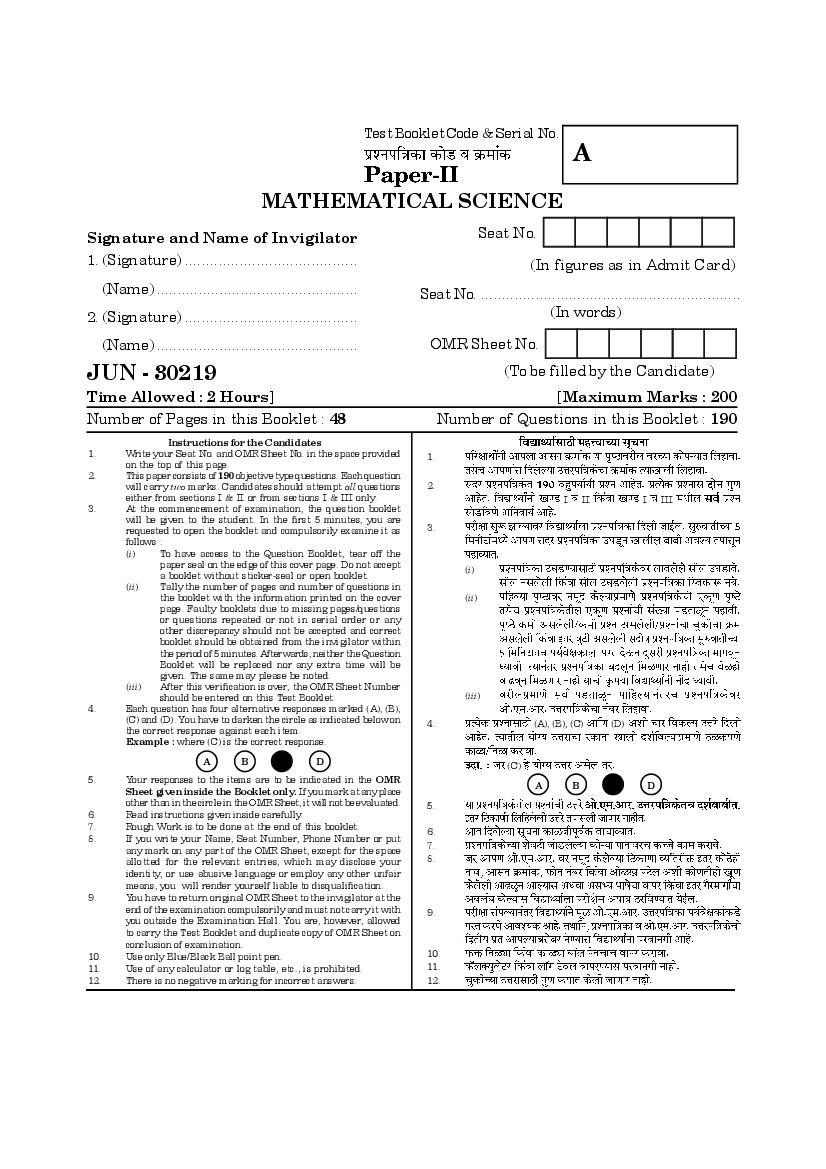
Finished viewing? Save it for later —
Download MAHA SET 2019 Question Paper 2 Mathematical Science (PDF · 48 pages)About MAHA SET 2019 Question Paper 2 Mathematical Science
MAHA SET 2019 Question Paper 2 Mathematical Science is available here for free download. Published by Maharashtra Exams for MAHA SET, this question paper can be viewed online or downloaded as a PDF (48 pages). Candidates preparing for MAHA SET can use MAHA SET 2019 Question Paper 2 Mathematical Science to understand the exam pattern, the type of questions asked, and the overall difficulty level.
Frequently Asked Questions
How can I download MAHA SET 2019 Question Paper 2 Mathematical Science?
Open this page and click the Download button to save MAHA SET 2019 Question Paper 2 Mathematical Science as a PDF. It is completely free on AglaSem Docs.
Is MAHA SET 2019 Question Paper 2 Mathematical Science free to download?
Yes. MAHA SET 2019 Question Paper 2 Mathematical Science can be viewed online and downloaded as a PDF free of cost on AglaSem Docs.
How many pages does MAHA SET 2019 Question Paper 2 Mathematical Science have?
MAHA SET 2019 Question Paper 2 Mathematical Science contains 48 pages, which you can read online or download together as a single PDF.
Where can I find more MAHA SET study material?
You can find more MAHA SET question papers, sample papers, syllabus, and answer keys on AglaSem Docs.
MAHA SET 2019 Question Paper 2 Mathematical Science – Text
Read the full text of this question paper below — useful to quickly search, copy and reference the content online without downloading the PDF.
📄 View text version (48 pages)
Page 1
A
MATHEMATICAL SCIENCE
Signature and Name of Invigilator Seat No.
1. (Signature) ......................................... (In figures as in Admit Card)
(Name) ................................................ Seat No. ..............................................................
2. (Signature) ......................................... (In words)
(Name) ................................................ OMR Sheet No.
JUN - 30219 (To be filled by the Candidate)
Time Allowed : 2 Hours] [Maximum Marks : 200
Number of Pages in this Booklet : 48 Number of Questions in this Booklet : 190
Instructions for the Candidates
1. Write your Seat No. and OMR Sheet No. in the space provided 1.
on the top of this page.
2. This paper consists of 190 objective type questions. Each question
will carry two marks. Candidates should attempt all questions 2.
either from sections I & II or from sections I & III only. I II I III
3. At the commencement of examination, the question booklet
will be given to the student. In the first 5 minutes, you are
requested to open the booklet and compulsorily examine it as 3.
follows :
(i) To have access to the Question Booklet, tear off the
paper seal on the edge of this cover page. Do not accept (i)
a booklet without sticker-seal or open booklet.
(ii) Tally the number of pages and number of questions in
the booklet with the information printed on the cover (ii)
page. Faulty booklets due to missing pages/questions
or questions repeated or not in serial order or any
other discrepancy should not be accepted and correct
booklet should be obtained from the invigilator within
the period of 5 minutes. Afterwards, neither the Question
Booklet will be replaced nor any extra time will be
given. The same may please be noted.
(iii) After this verification is over, the OMR Sheet Number
should be entered on this Test Booklet. (iii)
4. Each question has four alternative responses marked (A), (B),
(C) and (D). You have to darken the circle as indicated below on 4. (A), (B), (C) (D)
the correct response against each item.
Example : where (C) is the correct response.
A B D (C)
5. Your responses to the items are to be indicated in the OMR
A B D
Sheet given inside the Booklet only. If you mark at any place
other than in the circle in the OMR Sheet, it will not be evaluated. 5.
6. Read instructions given inside carefully.
7. Rough Work is to be done at the end of this booklet.
6.
8. If you write your Name, Seat Number, Phone Number or put
any mark on any part of the OMR Sheet, except for the space 7.
allotted for the relevant entries, which may disclose your 8.
identity, or use abusive language or employ any other unfair
means, you will render yourself liable to disqualification.
9. You have to return original OMR Sheet to the invigilator at the
end of the examination compulsorily and must not carry it with 9.
you outside the Examination Hall. You are, however, allowed
to carry the Test Booklet and duplicate copy of OMR Sheet on
conclusion of examination.
10. Use only Blue/Black Ball point pen. 10.
11. Use of any calculator or log table, etc., is prohibited. 11.
12. There is no negative marking for incorrect answers. 12.
Page 2
Page 3
Paper II
Time Allowed : 120 Minutes] [Maximum Marks : 200
Note : This Paper contains One Hundred Ninety (190) multiple choice questions
in THREE (3) sections, each question carrying TWO (2) marks. Attempt
all questions either from Sections I & II only or from Sections I &
III only. The OMR sheets with questions attempted from both the Sections
viz. II & III, will not be assessed.
Number of questions, sectionwise :
Section I : Q. Nos. 1 to 10, Section II : Q. Nos. 11 to 100,
Section III : Q. Nos. 101 to 190.
SECTION I 2. Let f(x, y) = |sin x – sin y| for
x, y R. Then :
1
1. Let for n N, I n = 0, ,
n
1 (A) f(x, y) |x| for all x, y
Jn = 0, , K n = (n, ) and
n
(B) f(x, y) |x – y| for all x, y
Ln = [n, ). Which of the following
sets is non-empty ?
(C) f(x, y) 0 for x y
(D) f(x, y) |y| for all x, y
(A) In
n 1
3. Limsup of the sequence
3 3 4 4
2, 2, , , , ........ is :
(B) Jn 2 2 3 3
n 1
(A) 3/2
(C) Kn
n 1
(B) 2
(C) 1
(D) Ln
n 1 (D) 0
3 [P.T.O.
Page 4
as likely to occur as a tail. If a coin
(A) e– /2
is tossed four times, what is the
(B) e–i /2 probability of getting two tails and
(C) e /2 two heads ?
(D) ei /2 3
(A)
8
5. Let V denote the vector space of
n × n symmetric complex matrices,
8
over R. Then dim V as a vector (B)
27
space over R is :
1
(A) n 2 (C)
8
n2 n
(B) 4
2 (D)
27
(C) n2 + n
8. Suppose A and B are mutually
(D) n2 – n
exclusive events having probabilities
6. Let T : Rn Rn be defined as P(A) = 0.25, P(B) = 0.35. What is
T e1 0 , T ej ej 1 , j = 2, ...., n the probability that A occurs but B
where e1, e2, ........, en is the does not ?
standard basis of Rn. Then :
(A) 0.1
(A) T is non-linear
(B) 0.25
(B) T is idempotent
(C) 0.4
(C) Ker T = {0}
(D) T is nilpotent (D) 0.6
4
Page 5
bounded feasible region (in shaded
is true with respect to the optimal
portion) for the problem :
solution of an LP problem ?
Max. z = 2x1 + x2 – 12,
x1, x2 0. (A) Every LP problem has an
optimal solution.
(B) Optimal solution of an LP
problem occurs only at an
extreme points of the convex
set of feasible solutions.
(C) If optimal solution exists, then
The objective function attains its there will be always at least one
maximum when :
at the corners of the set of
(A) x1 = 1 and x2 = 7
feasible solutions.
(B) x1 = 3 and x2 = 4
(D) Every feasible solution is an
(C) x1 = 3 and x2 = 3
(D) x1 = 3 and x2 = 5 optimal solution
5 [P.T.O.
Page 6
11. Let X and Y be bounded subsets of
x2 sin 1 / x , if 0 x 1
R and let Z = X Y. Then : f x
0, if x 0
(A) Z need not be bounded
(B) Sup Z = max {sup X, sup Y} Then :
(C) Z need not have supremum (A) f is not continuous at x = 0
(D) Z has maximum (B) f is continuous but not
differentiable at x = 0
12. Let f : [0, 1] R be continuous and
x 1
(C) f is differentiable but not of
f f for all x [0, 1]. Then : bounded variation
0 x
(D) f is of bounded variation
(A) f is strictly monotonic
15. Let A and B be two non-empty
(B) f is constant disjoint subsets of R and let
(C) f(t) = t for all t [0, 1] d(A, B) = inf{|a – b| : a A,
(D) f(t) = t2 for all t [0, 1] b B}. Then d(A, B) > 0 if :
13. Suppose f(x) is defined on [0, 1] as (A) A and B are open
follows : (B) A and B are closed
0, if x irrational (C) A is closed and B is compact
f x
1 / q, if x rational (D) A or B is singleton
p 16. The number of Mobius
and x = with (p, q) = 1. Then
q
f is : transformations which map the
real line onto the unit circle is :
(A) Riemann integrable
(A) 0
(B) Continuous at rational points
(B) 1
(C) Discontinuous at irrational
points (C) 2
(D) Discontinuous everywhere (D) Infinitely many
6
Page 7
represents : Then the number of elements of
(A) the line x = log(2019) order 2 in G is :
(B) the line y = 2019 (A) 2r for some 1 r n
(C) a circle (B) 2r + 1 for some 1 r n – 1
(D) a countable set (C) n if n is even
18. For z = x + iy, let f(z) = x2 + y2 + (D) n + 1 if n is odd
2xyi. Then : 22. Let H be a proper subgroup of the
(A) f is everywhere analytic
additive group (Q, +) of rational
(B) f is nowhere analytic
numbers. Then the quotient group
(C) f is analytic only at z = 0
Q/H must be :
(D) f is analytic at every point on
(A) finite of even order
the real axis and nowhere else
(B) finite of odd order
19. Let ! : [0, 1] C be defined by
(C) finite
!(t) = e4 it. Then :
(D) infinite
1 ez
dz 23. Let G be a group of order 61. Then
2 i
! z3
the number of subgroups of G is :
(A) 0
(A) 61
(B) 1
(B) 2
(C) 2
(C) 7
(D) 4 i
(D) 1
1 24. Let G be the group of invertible
20. Let f(z) = cosec for z 1,
z 1
2 × 2 matrices over the field
z C. Then at the point z = 1, Z2 = {0, 1}. Then the number of
f has : elements in G is :
(A) no singularity (A) 6
(B) a removable singularity (B) 2
(C) a pole (C) 4
(D) a non-isolated singularity (D) 8
7 [P.T.O.
Page 8
(A) Z[x] x
x z
(B) R(x) [y] T y ,
y z
(C) C[x, y] z
(D) Z 30 then the matrix representation of
26. Let W be the subspace of R 4 T with respect to standard bases of
spanned by the vectors [1 2 0 0]t, R3 and R2 is :
[0 1 2 0]t and [1 1 –2 0]t. The 1 0
dimension of the quotient space (A) 0 1
R4/W is :
1 1
(A) 1
1 0 1
(B) 2 (B)
0 1 1
(C) 3
0 1 1
(D) 4 (C)
1 0 1
27. Which of the functions defines
an inner product on C 2 ? Let 0 1
x = [x1, x2]t, y = [y1, y2]t ? (D) 1 0
(i) x, y x1 y2 1 1
(ii) x, y x1 y1 x2 y2 29. If a real matrix A has characteristic
polynomial (x – 1) (x2 + 1), then
(iii) x, y x1 y1 x2 y2
which of the following statements
(A) (ii) and (iii) about A is true ?
(B) (i) (A) A is diagonalizable over R
(B) A is triangulable over R
(C) (ii)
(C) A is nilpotent
(D) (iii) (D) A is invertible
8
Page 9
spaces and T L(V, W). If T has
matrix representation : differential equation :
2 1 i 3
"2 z "2 z
0
4 i 1 i i "x 2 "y 2
Which of the following matrices
represents the adjoint map T* ?
is :
2 1 i 3
(A)
4 i 1 i i (A) z x#1 x y y# 2 x y
2 4 i (B) z x#1 x y #2 x y
(B) 1 i 1 i
(C) z #1 x y #2 x y
3 i
2 4 i (D) z #1 x y x# 2 x y
(C) 1 i 1 i
33. An nth order linear ordinary
3 i
differential equation :
2 1 i 3
(D)
4 i 1 i i (A) has exactly n linearly
31. A set of all surfaces of revolution
independent solutions
with z-axis as the axis of revolution
is characterized by the partial
differential equation : (B) has at most n linearly
"z "z
(A) x y 0 independent solutions
"x "y
"z "z (C) has less than n independent
(B) x y 0
"x "y
"z "z solutions
(C) y x 0
"x "y
(D) has minimum n linearly
"z "z
(D) y x 0
"x "y independent solutions
9 [P.T.O.
Page 10
equation any one operator to any one machine
y1 – 2xy = xy2 is given in the following table :
is : Operators
2 I II III IV
1 x2
(A) ce U 10 5 13 15
2
1 V 3 9 18 3
1 x2 Machines
(B) ce W 10 7 3 2
2
1 X 5 11 9 7
1 x2
(C) ce The optimal assignment is :
2
(A) U II, V III, W I, X IV
2
1 2
(D) ce x (B) U II, V IV, W III, X I
2
(C) U III, V IV, W II, X I
35. Let D be the rectangle :
(D) U IV, V II, W III, X I
2
x, y R | x| 1,| y| 1 37. Consider the following LP problem :
Max. : Z = x1 + x2/2
and h and g are functions defined
on D given by : Subject to the constraints :
h(x, y) = xy2 and 3x1 + 2x2 12
g(x, y) = y2/3. 5x1 = 10
Then : x1 + x2 8
(A) Only h satisfies Lipschitz –x1 + x2 4 and
condition on D x1, x2 0.
(B) Only g satisfies Lipschitz Then the LP problem has :
condition on D (A) Feasible solution
(C) Both h and g satisfy Lipschitz (B) No feasible solution
condition on D (C) Degenerate feasible solution
(D) Neither h nor g satisfies (D) Non-degenerate feasible
Lipschitz condition on D solution
10
Page 11
problem has m constraints and n unbounded solution, then primal
non-negative variables. Then has :
consider the following two
statements about it : (A) No feasible solution
(I) The dual have n constraints and (B) Unbounded solution
m non-negative variables.
(II) The dual is a minimization (C) Feasible solution
problem. (D) None of the above
Which of the following is true ?
41. L et f : [a, b] R be a continuous
(A) Only (I) is true
(B) Only (II) is true function. Then which of the
(C) Both are true following statements is not true for
(D) Neither (I) nor (II) is true the image set of f, Im f ?
39. Consider the LP problem :
(A) Im f is unbounded
Max. : Z = 4x1 + 2x2
Subject to the constraints : (B) Im f has maximum
–x1 – x2 –3, (C) Im f is an interval
–x1 + x2 –2 and
x1, x2 0. (D) Im f has minimum
Then the dual of the above LP 42. The function f : R2 R2 defined
problem is : by f(x, y) = (2xy, x2 – y2) is one-one
Min. : W = py1 + qy2
on the set :
Subject to the constraints :
ry1 + sy2 4 (A) x, y R2 y 0
–y1 – y2 2
y1, y2 0, x, y R 2 x2 y2 1
(B)
where the values of p, q, r, s are :
(A) p = 3, q = –2, r = –1, s = –1 1 1
(C) x, y R2 x 1,| y|
(B) p = –3, q = –2, r = 1, s = –1 2 4
(C) p = 3, q = –2, r = 1, s = –1
(D) p = –3, q = 2, r = –1, s = 1 (D) R2
11 [P.T.O.
Page 12
equation f(x, y, z) = (xy, y + z) possible for an analytic function
and g : R2 R2 be defined as f on D = {z : |z| < 1} ?
g(x, y) = (x + y, y). Then the (A) f(D) = {z : |z| 1}
derivative D(g o f) (0, 0, 0) =
(B) f(D) = D
0 1 1 1
(A) (C) f(D) = z :| z|
1 1 1 2
(D) f(D) % R
0 1
46. Let f(z) and g(z) be two non-constant
(B) 1 1
analytic functions on a region G.
1 1 Then which of the following is
possible ?
0 1 1
(C) (A) f g is analytic
0 1 1
(B) f g is analytic
1 0 1 (C) f g is analytic
(D)
1 0 1
(D) fg & 0
44. Let f : C C be a bijective analytic 47. Let p be a prime number and Fp
be a finite field with p elements.
function. Then :
Then the unit group Fpx = Fp \{0}
(A) f must be a linear polynomial of Fp is simple if and only if :
(B) f $(z) = 0 for some z (A) p = 2
(B) p = 3
(C) f –1(z) may not be continuous
(C) p 5
(D) f –1(z) is continuous but may (D) p is of the form 2n + 1 for some
not be analytic n 2.
12
Page 13
in the quotient ring M be a Lebesgue measurable subset
A := R X, Y X 2 + Y 2 – 1 . Then of R with m(M) > 0. If N = L M
and O = (L M)\(L ( M), then :
the element x is :
(A) not irreducible in A (A) m(M) = m(N) = m(O)
(B) irreducible, but not prime in A (B) m(M) < m(N) = m(O)
(C) prime in A
(C) m(M) = m(N) < m(O)
(D) a unit in A
(D) m(M) < m(N) < m(O)
49. The quadratic form associated to
C
the trace form TrR : C × C R, 52. Let X be a metric space and Y ) X :
(x, y) Tr('XY), where 'XY : C C (A) If Y is dense in X, then X\Y is
is the R-linear map defined by nowhere dense in X
'XY(z) = xyz, is :
(B) If Y is nowhere in X, then X\Y
(A) X2 is dense in X
(B) Y2
(C) If Y is dense in X, then
(C) X2 + Y2
Int(Y) #
(D) X2 – Y2
(D) If Y is dense in X, then
50. With the induced topology by the
Int(X\Y) #
metric d(x, y) = |x – y|,
(A) R and Q are of second category 53. There is a non-abelian group of
(B) R is of second category and Q order :
is not (A) 49
(C) Q is of second category and R
(B) 41
is not
(D) Both R and Q are not of second (C) 15
category (D) 12
13 [P.T.O.
Page 14
1 1 3n
56. Let a n ! 2n and bn .
of groups as : n n2
(A) Z2 × Z2 × Z2 × Z3 × Z3 Then the sequences :
(B) Z36 × Z36
(A) an n , bn n l
(C) Z9 × Z8
(B) an n l and bn n * l
(D) Z2 × Z36
(C) an n * l and bn n l
55. Let p be a prime number and n, m
natural numbers with m divides n. (D) an n * l and bn n * l
Then the finite extension Fpn/Fpm
57. For any sequence (+ n ) of real
of finite fields is a :
numbers, define T(+n) : l2 l2 by
(A) Galois extension with abelian
but non-cyclic Galois group of T(+n) (ek) = +kek). The number of
n
order unitary operators of the form T(+n)
m
(B) Galois extension with cyclic
on l2 is :
n
Galois group of order
m
(A) finite, but more than 1
(C) Galois extension with abelian
but non-cyclic Galois group of (B) countably infinite
order nm
(C) uncountably many
(D) Galois extension with cyclic
Galois group of order nm (D) zero
14
Page 15
1 X = {(x, y) R2 : 0 |x| = |y| 1}
V f C 0, 1 : f t 0,t
2
Y = {(x, y) R2 : |x| + |y| = 1} and
and
Z = {(x, y) R2 : x2 + y2 = 1}
1
W f C 0, 1 : f t 0,t- .
2 be subspaces of the Euclidean space
If C[0, 1] is assigned the inner R2. Then :
product
(A) X is homeomorphic to Y and Z
1
f, g f t g t dt, (B) X is homeomorphic to Y, but
0
not Z
then :
(C) Y is homeomorphic to Z, but
(A) C[0, 1] is the orthogonal direct
not X
sum of V and W
(B) C[0, 1] is the direct sum of V (D) Z is homeomorphic to X, but
and W, but not the orthogonal not Y
direct sum
61. Let X be a second countable space
(C) C[0, 1] is a sum of V and W,
and f : X Y be continuous open
but not a direct sum
surjective map. Then :
(D) C[0, 1] is not the sum of V
and W (A) Y is second countable
59. Let . be the topology generated by (B) Y is separable, but not second
{(a, ) : a R} on R. In this topology, countable
the closure of {0} in R is :
(C) Y is first countable but not
(A) {0}
separable
(B) (– , 0]
(C) [0, ) (D) Y is separable, but not first
(D) R countable
15 [P.T.O.
Page 16
(I) Every bounded lattice is in the disc
complete.
D = {(r, /)/0 r < R, – < / }
(II) Every Boolean lattice is a
distributive lattice. such that u is continuous in closed
(III) Every complete lattice is disc D and satisfies :
bounded.
u(R, /) = cos, |/| /3
Then which of the following is
true ? = 0, /3 < |/| .
(A) Only (III) is true
The mean value theorem gives the
(B) Only (II) and (III) are true
value of u(0, 0) as :
(C) Only (II) is true
(A) 3 2
(D) All are true
63. Let G be a simple graph with (B) 0
degree of every vertex an even
number 2. Then G is : (C) 3
(A) bipartite
1
(D)
(B) disjoint union of cycles 2
(C) Hamiltonian
66. The equation
(D) Without a cut vertex
30u + 4uxy – u2 = 1
64. Two boys and two girls are lined up
randomly in a row. What is the is :
probability that the girls and boys
alternate ? (A) Linear
(A) 2/3 (B) Hyperbolic
(B) 1/2
(C) Parabolic
(C) 1/3
(D) 3/4 (D) Elliptic
16
Page 17
Cauchy problem :
non-holonomic constraints has r
utt – uxx = x + t2 degrees of freedom, then :
u(x, 0) = cos x, ut(x, 0) = 3 (A) r = 3n – k
Then the solutions u 1 and u 2 (B) r = n – k
satisfy :
(C) r > 3n – k
(A) u1 & 2u2
(D) r < 3n – k
(B) u1 + u2 & 0
72. The Lagrangian of a particle of mass
(C) u1 – u2 & 0
m in spherical polar co-ordinates is
(D) u1u2 = 1 given by :
68. Square of any integer is of the 1
form : L m r2 r 2/2 r 2 sin 2 / #2 mgl cos /
2
(A) 3k or 3k – 1 The quantity that is conserved is :
(B) 4k or 4k – 1 "L
(A)
(C) 5k or 5k + 1 "r
(D) 3k or 3k – 2 "L
(B)
69. The last two digits of 3123 are : "/
(A) 47 "L
(C)
"#
(B) 67
(C) 27 "L
(D)
"r
(D) 87
73. If the Hamiltonian of the dynamical
70. Which of the following natural
system is given by H = pq, then
numbers cannot be written as a sum
of 2 squares ? as t .
(A) 405 (A) q , p 0
(B) 1111 (B) q 0, p 0
(C) 117 (C) q , p
(D) 164 (D) q 0, p
17 [P.T.O.
Page 18
body about a fixed point in the dimensional flow are given by
absence of any net torque and
u = y2 – x2, v = 2xy. The stream
Ixx = Iyy imply that the z-component
function 4 and the velocity potential
of the angular velocity :
# of the flow are :
(A) satisfies simple harmonic
motion x3 y3
(A) # = xy2 + , 4 = + x2y
(B) is constant 3 3
(C) is always zero
y3 x3
(D) is a function of time (B) # = – x2y, 4 = xy2 –
3 3
75. If q denotes velocity field of an
incompressible fluid in motion, x3 y3
(C) # = – xy2, 4 = x2y –
then the mass conservation will 3 3
not imply : y3 x3
(A) 1q 0 (D) # = + x y, 4 = xy +
2 2
3 3
"2 78. In two-dimensional fluid flow
(B) 1q 0
"t consider a doublet of strength 5
"2 placed at z = z0 and inclination +
(C) 1 2q 0
"t to the positive x-axis. The image of
(D) 1 3 q 0 this doublet in a straight line is :
76. If the velocity components of a (A) a doublet of strength 5 placed
at z = –z0 and inclination + to
possible fluid motion are u = 2cxy,
the positive x-axis.
v = c(a2 + x2 – y2) where a, c are
(B) a doublet of strength 5 placed
non-zero constants, then the stream
at z = – z0 and inclination
function # is : 6 6 + to the positive x-axis.
(A) –cx2y (C) a doublet of strength 5 placed
at z = –z 0 and inclination
2 2 y3
(B) c x y a y 6 6 + to the positive x-axis.
3
(D) a doublet of strength 5 placed
(C) 2cxy at z = – z0 and inclination + to
(D) c(a2 + x2 – y2) the positive x-axis.
18
Page 19
81. The Gaussian curvature of
form of a surface patch are
Edu 2 + 2Fdudv + Gdv 2 and the hyperbolic paraboloid
Ldu 2 + 2Mdudv + Ndv 2 x2 y2
z 0 is :
respectively. Then the Gaussian 2 3
curvature of the patch is : (A) always < 0
E F (B) always > 0
(A) det
F G
(C) always 0
L M
(B) det (D) positive at some points and
M N
negative at some points
E F L M
(C) det · det
F G M N 82. The variational problem of
extremizing the functional
L M E F
(D) det det 2z
M N F G I[y(x)] = y$ 2 y2 dx , y(0) = 1,
0
80. Let v be a unit speed smooth curve y(2z) = 1
in R3 with tangent t , normal n ,
binormal b . Then : has :
(A) t $ is orthogonal to t and b (A) a unique solution
(B) t $ is orthogonal to b and n
(B) exactly two solutions
(C) t $ is orthogonal to t and n
(C) an infinitely many solutions
(D) t $ is not orthogonal to any of
t or n or b (D) no solution
19 [P.T.O.
Page 20
extremum of the functional (I) Every initial value problem can
zx2 z2y 2 zf x, y dx dy be reduced to a Fredholm
D integral equation.
must satisfy : (II) Every boundary value problem
(A) Laplace equation can be reduced to a Volterra
(B) Heat equation integral equation.
(C) Wave equation Then :
(D) Poisson equation
(A) Only (I) is correct
84. The curve which extremizes the
(B) Only (II) is correct
functional
(C) Both (I) and (II) are correct
/4
I[y(x)] = y$$ 2 y2 x2 dx (D) Both (I) and (II) are wrong
0
87. Iterated kernel K m (t, s) of the
under the conditions y(0) = 0,
integral equation
1
y$(0) = 1, y( /4) = y$( /4) = is : t
2
u t 1 ' et s
u s ds
(A) y(x) = 1 – cos x 0
(B) y(x) = tan x is :
(C) y(x) = cos x m 1
t s
(D) y(x) = sin x (A)
m 1!
85. The shortest arc connecting two
points on the surface of a sphere is et s
(B)
called : m 1!
(A) a great circle arc
m 1
t s
(B) a catenary (C) et s
m 1!
(C) a catenoid of revolution
(D) a cycloid (D) (t – s)et – s
20
Page 21
t
y$ = 1 + xy, y(0) = 2,
u t a sin t 2 cos t s u s ds the value of y(0.1) by Euler’s method
0 with n = 0.1 is :
is : (A) 2.1
(A) u(t) = a sin t (B) 2.0
(B) u(t) = a cos t (C) 2.2
(C) u(t) = ate–t (D) 2.4
(D) u(t) = at2e–t 92. Let L{f(t)} = F(s) and u(t – a) be
a unit step function. Then
89. Which of the following is not
L{f(t – a) u(t – a)} is :
correct ?
(A) e–as F(s)
(A) 0 1 01
e as
(B) 1 0 1 1 1 (B) F(s)
s
2 1 2 (C) eas F(s)
(C) 5 1 7
4
1 1
eas
(D) F(s)
(D) 7 E2 E 2 s
90. The first approximation of the root 93. Fourier sine transform of
lying between 0 and 1 of the
e at
equation f(t) = , a > 0
t
x3 + 3x – 1 = 0
by Newton-Raphson method with is :
initial approximation x0 = 0, is : 2 s
(A) tan 1
1 a
(A)
2
2 s
1 (B) sin 1
(B) a
3
2 s
1 (C) tan
(C) a
4
1 2 s
(D) (D) sin
5 a
21 [P.T.O.
Page 22
satisfies the differential equation :
y$$ – 4y$ + 4y = 0 modular lattices on 5 elements is :
with initial condition y(0) = 0, (A) 3
y$(0) = 3. Then the Laplace transform (B) 4
of y(t) is :
(C) 5
3
(A) 2 (D) 2
s 2
97. Consider the following statements :
3 (I) Every distributive lattice
(B) 2
s 2 is complemented and
3.5 complementation is unique.
(C) 2
s 2 (II) Every modular lattice
3.5 is complemented and
(D) 2 complementation is unique
s 2
95. Consider the transportation problem Then which of the following is
m n true ?
Min. z = 8 8 cij xij (A) (I) is true but (II) is not true
i 1 j 1 (B) (II) is true but (I) is not true
Subject to :
n
(C) Neither (I) is true nor (II) is true
8 xij ai , i = 1, 2, ....., m, (D) Both statements are true
j 1 98. Let (R, M, 5) be a Lebesgue measure
m space. Define :
8 xij b j , j = 1, 2, ....., n and xij 0
i 1 ' A sin x d5
The existence of a feasible solution A
of the transportation problem is
possible : Which of the following statements
m n is true ?
(I) if 8 ai 8 bj (A) ' defines a measure on R
i 1 j 1
m n (B) ' defines a signed measure on
(II) if and only if 8 ai 8 bj
R
i 1 j 1
Then which of the following is (C) ' does not define a signed
true ?
(A) Only (I) is true measure
(B) Only (II) is true (D) ' defines a signed measure on
(C) Both are true
(D) None of them is true R but not a measure
22
Page 23
with Lebesgue measure 5. Define
101. The 90m sample percentile of 80
!1 A f x dx where :
A observations is 6. Suppose 6 is added
f(x) = e–x for x > 1
to the 7 largest observations and
= 0 otherwise
3 is subtracted from the remaining
and !2 A g x dx where
A observations. The 90 m sample
g(x) = e–1 for 0 x 1 percentile of the modified 80
= 0 otherwise
observations is :
Then :
(A) The measure !1 is absolutely
(A) 12
continuous with respect to !2
(B) The measure !2 is absolutely (B) 3
continuous with respect to !1
(C) !1 and !2 are mutually singular (C) 6
measures
(D) 9
(D) 5 is absolutely continuous with
respect to both !1 and !2 102. For two random variables x and y
100. Consider the following two
covariance between 2x and y,
statements for a Lebesgue
measurable function f : [0, 1] R. cov(2x, y) = 4. Hence, cov(5x – 2,
(P) f is Lebesgue integrable. 2y – 5) is :
(Q) |f| is Lebesgue integrable.
Then which of the following is (A) 40
true ?
(B) 0
(A) (P) 9 (Q)
(B) (Q) 9 (P) (C) 10
(C) (P) : (Q)
(D) (P) 9 (Q) and (Q) 9 (P) (D) 20
23 [P.T.O.
Page 24
normal random variables with mean
identically distributed random
51 and 52 respectively and common
variance ;2. For 0 < + < 1 if the variables with probability mass
100+th quantile of x is larger than function given below :
100+th quantile of y, then :
k 1 0 1 2
(A) 51 = 52
P X k 0.2 0.3 0.1 0.4
(B) 51 > 52
(C) 51 < 52 Then P[X1 + X2 = 0/X2 = 1, X3 = 2]
(D) Nothing can be said about the is :
relationship between 51 and 52 (A) 0.11
104. If P(A|B) = P(B), then : (B) 0.13
(A) P(B|A) = P(A) (C) 0.2
(B) A and B are independent events (D) 0.3
(C) P2(A) P(B) 107. Let M V (t) denote the mgf of a
(D) P2(B) P(A) random variable V.
105. The probability mass function of a Suppose X and Y are two
random variable X is given by : independent r.v.s. whose mgf exists.
Let Z = X + Y and W = XY. Then
k 0 1 2 3 which of the following is true for all
P X k 0.2 0.1 p q t (–h, h) for some h > 0.
(A) M Z (t) = M X (t) M Y (t) and
where p 0 and q 0.
MW(t) = MY(tx) fX(x) dx
Which of the following is feasible ? (B) M Z (t) = M X (t) M Y (t) and
(A) E[X] = 1.2 MW(t) = MX(t) + MY(t)
(C) M Z (t) = M X (t) + M Y (t) and
(B) E[X] = 2.1
MW(t) = MX(t) MY(t)
(C) E[X] = 2.8
(D) MZ(t) = MY(t + x) fX(x) dx
(D) E[X] = 3.4 and MW(t) = MX(t) MY(t)
24
Page 25
normal random variable is <p. Then,
such that E[Y/X = x] = x2 and X is
the pth quantile of a chi-square
standard normal r.v. Then which of random variable with 1 degree of
freedom is :
the following is false ?
(A) <2p
(A) E[Y] = 1
(B) <12 p
(B) cov(X, Y) = 0 2
(C) <(1 p)/2
(C) Corr(X, Y) > 0 (D) 2<
111. Suppose (X, Y) is a two-dimensional
(D) E[X2Y] = 3 random vector with range (0, ) ×
{1, 2}, such that for any A ) (0, )
109. Suppose X1, X2, X3 are independent
and y = 1, 2,
and identically distributed random
1
P X A, Y = y ye yx dx.
variables each having exponential 2
A
distribution with mean /. Suppose Then, which of the following
statements is false ?
Y1, Y2, Y3 is the corresponding order (A) The distribution of (X, Y) is
neither discrete nor absolutely
statistics. Then, E(Y1) is :
continuous.
(B) The marginal distribution
5/
(A) function of X is F(x) = 1 –
6
(1/2) [e–x + 2e–2x], 0 < x < .
/ (C) The random variable X is
(B)
6 having an absolutely continuous
distribution with density
/
(C) function (1/2) [e–x + 2e–2x].
3
(D) The marginal distribution of Y
(D) / is P(Y = y) = 1/2, y = 1, 2.
25 [P.T.O.
Page 26
limit for / and T2 be a 100 · +%
normal distribution with mean
upper confidence limit for /. Let
vector 5 and dispersion matrix V.
1
P[T1 < T2] = 1 and < + < 1. Then
Then which of the following has a 2
chi-square distribution ? a 100(2+ – 1)% confidence limit for
/ is :
(A) (X – 5)$ V(X – 5)
(A) [T1, T2)
(B) (X – 5)$ V–1(X – 5) T1 T2
(B) ,
+ +
(C) exp{(X – 5)$ V(X – 5)}
T2 T1
(D) exp{(X – 5)$ V–1(X – 5)} (C) ,
+ +
113. Let X1, X2, ......., Xn be a random (D) [(2+ – 1)T1, +T2]
sample from N(/, 1) where / ) [a, b] 115. Suppose X has a distribution with
and a < b are real numbers. probability mass function that of
discrete uniform on {–1, 0, 1} under
Then which of the following
H0 and U(–1, 1) under H1. Then the
statements about the Maximum
test function
Likelihood Estimator (MLE) of / is
1 if x 0
correct ? # x
0 if x 0
(A) MLE of / does not exist.
has size :
(B) MLE of / is X . (A) Not properly defined since H0
is discrete and H1 is continuous
(C) MLE of / exists but it is not X .
(B) 1/3
(D) MLE of / is an unbiased
(C) 0
estimator of /.
(D) 1/2
26
Page 27
sample from the distribution of X
useful for obtaining uniformly
with mean 5 and variance ;2. The
minimum variance unbiased
test statistic to test H0 : ; 2 ;02
estimator of a parametric function ?
against H1 : ; 2 - ;02 is given by
(A) Neyman-Pearson theorem
2
= Xi X
(B) Basu’s theorem Tn = . Then the null
;02
(C) Rao-Blackwell theorem distribution of Tn is :
(A) > 2n 1 if X has normal
(D) R a o - B l a c k w e l l - L e h m a n n -
distribution
Scheffe theorem (B) > 2n 1 irrespective of distri-
117. Let X1, X2, ......., Xn be a random bution of X
(C) t distribution with (n – 1)
sample from uniform (/, 5/). Define
degrees of freedom
X(1) = min{X1, ......., Xn} and X(n) = (D) F distribution if X has normal
max{X1, X2, ......., Xn}. Maximum distribution
likelihood estimator of / is : 119. X is a normal (5, ;2) random variable
and a 95% confidence interval for 5
X1 is constructed based on a sample of
(A)
5 size n. Suppose the length of the
Xn interval is L1. If instead the variance
(B) of X is ;12 - ; 2 the length of the 95%
5
confidence interval constructed
Xn using the same technique will be :
(C) max ,X1
5 (A) equal to L1
(B) smaller than L1
Xn (C) larger than L1
(D) min ,X1
5 (D) larger or smaller than L1
27 [P.T.O.
Page 28
correlation coefficient between X1 sample from bivariate population
and (X2, X3). Then which of the where all Xi’s are distinct and all Yi’s
following statements cannot be are distinct i = 1, ......, 9. If the
true ? number of concordance pairs is 9,
(A) R1.23 is a maximum correlation the Kendall’s sample correlation
between X1 and (aX2 + a3X3) coefficient is :
where a1 and a2 are any real (A) –1/4
numbers. (B) –1/2
(C) +1/2
(B) R1.23 is a simple correlation
(D) +1/4
between X1 and X̂ 1 , where X̂1
123. The following failure rates have
is a line of best fit based on X2
been observed for certain type of
and X3.
light bulbs :
(C) R1.23 = –0.4
Week 1 2 3 4 5
(D) R1.23 = 0.4 Probabilities of
failing by the 0.10 0.25 0.50 0.80 1
121. A frequency data is classified in 9 end of week
classes and Gamma distribution is
fitted to it after estimating the If the cost of failure replacement is
parameters. If a >2 goodness of fit Rs. 20 per bulb and the cost of group
test is to be used without combining replacement is Rs. 500, what is the
the classes, the degrees of freedom optimal replacement interval ?
associated with >2 test are : (Assume that the group has 1000
bulbs.)
(A) 9
(A) One week
(B) 8
(B) Two weeks
(C) 7 (C) Three weeks
(D) 6 (D) Four weeks
28
Page 29
(EOQ), primarily : N = 2n units. A sample of size 2 is
(A) minimizes the set-up cost drawn as follows :
(B) reduces shortages (i) The population is randomly
divided into 2 groups each of
(C) balances carrying and ordering
size n.
costs
(ii) From each of the two groups
(D) All of the above
as obtained above, one unit is
125. Consider the two M/M/1 queuing
drawn with probability 1/n.
systems Q1 and Q2, where :
These two units form the sample.
Q 1 : arrival rate ', service rate 5
Then, the correct statement is :
Q2 : arrival rate '2, service rate 52.
(A) The sample is a stratified
It is known that ' < 5. Let L(si) be sample with two strata.
the number of customers in the
(B) The sample mean is not an
system in the equilibrium state,
unbiased estimator of the
i = 1, 2. Then :
population mean.
(A) L(1)
s L(2)
s
(C) The sample is a SRSWOR of
(B) L(1)
s L(2)
s size 2.
(C) L(1) (2)
s - Ls (D) The sample is not randomly
(D) The two cannot be compared obtained.
29 [P.T.O.
Page 30
design with model :
designs : a stratified sample scheme
with SRSWOR within each stratum Eyij = 5 + +i + ij i 1, ......, p
and a SRSWOR. Both have the j 1, ......, ni
ij ~ N(0, ; ) and
same sample size. We are interested 2
in estimating the population mean. independently distributed, a
2 2
Let Vprop and VSRS be the p
corresponding variances of the usual
parametric function c5 8 di+i
i 1
estimators of the population mean.
where c and d1, ......., dp are known
Then, constants is estimable if and only if :
2 2 (A) c = 0
(A) Vprop < VSRS
p
2 2
(B) Vprop = VSRS (B) 8 di 0, c > 0
2 2 i 1
(C) Vprop > VSRS
p
(D) 2
Vprop 2
VSRS (C) c = 0, 8 di - 0
i 1
128. A completely randomized design has p
n plots and 10 treatments. While (D) 8 di c
calculating the F-ratio for assessing i 1
equality of treatment effects, the 130. Under a Latin-Square design with
V treatments, which of the following
experimenter forgot to divide the statements is not correct ?
numerator and denominator sums of (A) It can accommodate three
squares by corresponding degrees of sources of heterogeneity
freedom. But the statistician said (B) It requires exactly V 3
experimental units
that the calculated F-ratio is correct.
(C) The elementary (pairwise)
Hence n is equal to : contrasts among column effects,
among row effects and among
(A) 10 treatment effects are all
estimated with common
(B) 20
variance
(C) 30 (D) The degrees of freedom
associated with error are equal
(D) 19 to (V – 2) (V – 1)
30
Page 31
and let fn : ? R , be a sequence
Let 5 be a non-negative, finitely
of extended Borel measurable
additive set function on F.
functions. Suppose |f n | 100,
Suppose {An} is a sequence of disjoint
, n = 1, 2, ......., and lim fn f a.e.
n
sets such that An F.
n 1
5. Then, which of the following
Then which of the following
statements is false ?
statements is always correct ?
(A) | f | d5 lim inf | fn | d5
? n
(A) 8 5 An 5 An
n 1 n 1
(B) lim | fn | d5 | f | d5
n
(B) 8 5 An 5 An
n 1 n 1
(C) lim sup| fn | d5 | f | d5
n
(C) 8 5 A nc 5 A nc n
n 1 n 1
(D) lim
n
8 | fk | d5
k 1
(D) 8 5 An 5 An
8 | fk |d5
n 1 n 1
k 1
31 [P.T.O.
Page 32
135. Let {Xn, n 1} be a sequence of
integers and F = {#, {1}, {2}, {1, 2},
{1}c, {2}c, {1, 2}c, ?},
independent identically distributed
where Ac denotes the complement of
the set A. Let R = (– , ) and B random variables with finite (non-
the Borel ;-field of R.
Which of the following functions f zero) fourth moment.
from (?, F) to (R, B) is measurable ?
(A) f(k) = k, k = 1, 2, ..... Let Yn = X12 ......... X 2n n
(B) f(1) = 1, f(2) = 2, f(3) = 1,
f(k) = 0, k 4
Which of the following is true ?
(C) f(k) = 1 if k is odd and
f(k) = 2 if k is even
As n , n Yn E X 12 .
(D) f(1) = 2, f(2) = 3, f(k) = 10,
k 3
(A) Converges in distribution to a
134. Let {X n , n 1} be a sequence
of independent identically
chi-square r.v. with 1 degree of
distributed random variables.
Define Wn = cos X 2n . freedom.
Then which of the following is
always true ? (B) Converges in distribution to a
(A) Both the sequences {Xn} and
{Wn} satisfy the strong law of standard normal r.v.
large numbers.
(B) The sequence {Xn} satisfies the (C) Converges in distribution to a
strong law of large numbers.
(C) Neither the sequence {Xn} nor normal r.v.
{Wn} satisfy the strong law of
large numbers. (D) Converges to a r.v. degenerate
(D) The sequence {Wn} satisfies the
at zero.
strong law of large numbers.
32
Page 33
by : variables and X is a random variable
such that P lim X n X 1.
y xy n
e , 0 x , 0 y 2
f x, y 2 Then which of the following may
0 , otherwise not hold ?
(A) lim P |X n X|> 1/2 0
Consider the statements : n
(B) P lim exp X n exp X 1
(I) The conditional density n
of X given Y = 1,
(C) lim E |X n X|2 0
1 x n
e , 0 x
f x|1 2 (D) lim P X n x P X x at
n
0 , otherwise
all continuity points x of
P[X x]
(II) E[X|Y = 1] = 1
138. Let {X n } be a sequence of
(III) P[X 2|Y = 1] = 1 – e–2 independent random variables.
Define An = [Xn n–1].
Which of the above statements are
true ? Let E = Ak
n 1 k n
(A) All the three Then which of the following is
always correct ?
(B) (I) and (II) only
(A) P(E) = 0
(B) P(E) is either 0 or 1
(C) (I) and (III) only
(C) P(E) = 1
(D) (II) and (III) only (D) 0 < P(E) < 1
33 [P.T.O.
Page 34
random variable X is :
E X 2n for all n.
0, if x 0,
Which of the following is not always
F x x / 2, if 0 x 1,
true ?
1, if x 1.
(A) E[Xn] is a constant for all n.
Then, which of the following
(B) X 2n is not a Fn-martingale statements is not correct ?
(A) P(–1 < X 1/2) = 1/4
n
(B) E(X) = 1/6
(C) W n = 8 X k is not a F n -
k 1 (C) E(X) = 3/4
martingale (D) P(X = 1) = 1/2
142. Suppose X is an arbitrary random
(D) E X 2n is constant for all n. variable and g(·) is a non-negative
Borel function on R. If g(·) is even
140. Suppose a distribution function and non-decreasing on [0, ), then
for every a > 0.
F:R [0, 1] of a random variable
(A) P[|X| a] E(g(x))/g(a)
X is as follows :
(B) P[|X| a] E(g(x))/g(a)
0, if x 0, (C) P[|X| a] E(g(x))/g(a)
(D) P[|X| a] E(g(x))/g(a)
1 / 4, if 0 x 1,
143. Suppose X follows Cauchy
F x 1 / 2, if 1 x 2, distribution with location parameter
1/2 x 2 / 2, if 2 x 3, 5 and scale ;. Then the
characteristic function of X is :
1, if x 3.
(A) exp it5 ;|t|
Then E(X) is :
1 2 2
(B) exp it5 ; t
(A) 5/6 2
(B) 2/3
(C) exp it5 ;t
(C) 3/2
2 2
(D) exp ; i t 5
(D) 7/6
34
Page 35
independent random variables problem with @ = {/ 1 , / 2 } and
having Poisson distribution with D = {d 1 , d 2 , d 3 , d 4 }. The risk
means '1 and '2 respectively. Then, functions are given by :
the conditional distribution of X
given X + Y and X + Y given X are //d d1 d2 d3 d4
respectively : /1 4 1 5 2
/2 1 2 3 3
'1
(A) Binomial x y; and
'1 '2
Then :
Poisson with parameter '2; but
taking values X, (X + 1), ......, (A) d1 is minimax
(B) d2 is minimax
(B) Negative binomial with
(C) d3 is minimax
'1
parameters x y;
'1 '2 (D) d4 is minimax
and Poisson with parameter
146. Let X be a Poisson random
'1 + '2.
variable with parameter / = E(X),
0 < / < . Consider the Bayesian
'1
(C) Poisson with mean procedure for estimation of /. Then,
'1 '2
the conjugate prior for / :
and Poisson with parameter '1
(A) (/) + e–/
(D) Geometric with parameter A
(B) (/) + /+6 – 1 e–/ 6 +, A > 0
'1
and Poisson with (C) (/) + e–+/ /' – 1 6 +, ' > 0
'1 '2
parameter ' – 1 + '2, but taking 1
(D) (/) +
values X, (X + 1), ......, 1 /2
35 [P.T.O.
Page 36
sam pl e fr om U (/, / + 1). Which of
distribution with mean /, X2 has
the following statistic is not a
exponential distribution with mean
maximum likelihood estimator
//2 and X1 and X2 are independent. of / ?
Which of the following statements (A) X(1)
is not correct ? (B) X(n) – 1
(A) X1 + X2 is sufficient for / (C) X(n)
(B) X1 + 2X2 is sufficient for / X (1) X ( n)
(D) 0.5
2
(C) X1 + 2X2 is complete for /
150. The distributions of X under H0 and
(D) (X1 + 2X2)/2 is unbiased for / H1 are given by :
148. Suppose {X1, X2, ......, Xn} is a random
x 1 2 3 4
sample from Poisson P(/)
H0 0.25 0.25 0.25 0.25
distribution, / > 0. Which of the H1 0.17 0.17 0.17 0.32
following statements is not correct ?
The most powerful test at level
(A) Sample mean X n is unbiased + = 0.05 is given by :
for / (A) reject H0 if X = 4
(B) Sample variance S2n is unbiased (B) reject H0 with probability 0.25
for / if X = 4
(C) reject H0 with probability 0.2
(C) 0.3 X n + 0.7 S2n is unbiased
if X = 4
for /
(D) reject H0 with probability 0.32
(D) X 2n S2n is unbiased for / if X = 4
36
Page 37
independent and identically unbiased estimator of the parametric
distributed random variables with functional /(F) based on a random
mean 5 and variance ;2. Suppose sample X1, X2 , ......, Xn from F.
n Suppose U is the U-statistics
1 2
S2n
n
8
1i
Xi Xn . Then corresponding to S. Then, which of
1
the following statements is true ?
which of the following statements is
not true ? (A) EF(U) > EF(S)
(A) Sn is unbiased for ;
(B) EF(U) < EF(S)
(B) S2n is unbiased for ;2
(C) Sn is consistent for ; (C) VF(U) VF(S)
(D) S2n is consistent for ;2
(D) VF(U) > VF(S)
152. Suppose {X 1 , X 2 , ......, X n } are
independent and identically 154. Let X1, X2, ......, Xn be independent
distributed random variables with Poisson (') random variables and
mean zero and variance ;2. Then
1 n
the asymptotic distribution of T1 8 I Xi
ni 1
0 , T2 e X
n
n 8 Xi
i 1 Then, the asymptotic relative
Tn n
efficiency ARE(T1, T2) is :
8 X 2i
i 1
(A) e–'
is :
(A) t distribution (B) (e' – 1)
(B) N(0, 1) distribution
(C) (e' – 1)/(' – 1)
(C) N(0, 1/;2) distribution
(D) degenerate at 0 (D) (e' + 1)
37 [P.T.O.
Page 38
where
/ such that n Tn / N 0, 1 in
p 1 2 2 2
distribution and Tn BB / . Let
2 1 2 2
=
Tn* be an estimator of / be given 2 2 1 2
2 2 2 1
by :
c is positive definite.
Tn* Tn c - 0.
n
Then which of the following
Then :
statements is true ?
(A) Tn* is not a consistent estimator
(A) X1 + X2, X2 + X3, X3 + X4 have
of /
D all same distributions
(B) n Tn* / BB a normal
2
X1 X2
(B) ~ F11
distribution 2
X1 X3
2 2
X1 X3 X2 X4
(C) Tn* is consistent for / (C) ~ > 22
2
2
(D) E Tn* / 0 as n (D) = Xi ~ N(0, 4)
38
Page 39
identically distributed random
vectors with common distribution
X1 3 X1 3 Np(0, =), = = ((;ij)) is a +ve definite
X2 =
X1 otherwise n
matrix. Let S = ((Sij)) = 8 U j U $j .
j 1
Then which of the following
Then which of the following
statements is correct ? statements is not true ?
n
(A) X 1 and X 2 are negatively
(A) 8 Sii ~ constant > 2n
correlated i 1
(B) X 1 and X 2 are positively (B) S11 + S22 ~ constant >22
correlated (C) S11 ~ constant >12
(C) X 1 and X 2 are perfectly (D) S11 + S12 ~ constant >22
correlated 160. Let # X (t) be the characteristic
function of X ~ N3 (5, =). Then
(D) X1 and X2 have joint normal EX1 X 22 X 3 is given by :
distribution
( 1)4 "4 # X t
158. Let (X1, X2) ~ N2(5, =) where = (A)
"t1"t22"t3
t 0
is a +ve definite matrix. Then
which of the following has a
( 1)3 "3# X t
singular normal distribution where (B)
"t1"t2"t3
t1 1, t2 2, t3 1
X3 = X1 – 2X2 ?
(A) X1 + X3, X1 – X2 ( 1)3 "4 # X t
(C)
"t1"t22"t3
(B) X1 – X3, X2 – X3 t1 1, t2 2, t3 1
(C) X1, X3 "4 # X t
(D)
"t1"t22"t3
(D) X2, X3 t1 1, t2 2, t3 1
39 [P.T.O.
Page 40
random variables with common (A) may be used to predict the value
of Y if the corresponding values
variance ;2. Further E(Y1) = /2 – /1,
of regressor X are given
E(Y2) = E(Y3) = /2 + /3. Then : (B) indicates a cause-effect
relationship between response
(A) /1 – /2 is not estimable
variable Y and regressors
(B) /1 + /2 is not estimable (C) can be determined only if a
satisfactory relationship exists
(C) /1 + /3 is not estimable between response variable Y
and regression
(D) /2 + /3 is not estimable
(D) all the above statements are
162. In a simple linear regression of Y true
on X based on n observations. 164. In a multiple linear regression
n model Yi = B0 + B1Xi1 + ...... + BpXip
The fitted values of Yi’s are Yi ,
+ Ci with E(Ci) = 0, Var(Ci) = ;2,
i = 1 ..... n respectively. Then : i = 1, ...., n.
n n (A) Mean regression Sum of
8 Yi 8 Yin Squares (SS) is an unbiased
i 1 i 1
estimator of ;2
(A) always (B) Mean regression SS and Mean
Error SS are unbiased and
(B) only if the regression equation Mean total SS is a biased
is Y = B0 + B1X + C estimator of ;2
(C) Mean total SS is unbiased
(C) if and only if the regression
estimator of ;2
equation is Y = B0 + B1X + C
(D) Mean total SS and Mean
(D) if the regression equation is regression SS are unbiased
Y = B0 + B1X + C estimators of ;2
40
Page 41
E(Ci) = 0, Var(Ci) = ;2 and where 167. Let r y / x denote the ratio of the
xi = i, i = 1, 2, 3. The Best Linear
Unbiased estimators of B0 and B1. sample means of the variable y and
(A) do not exist
(B) exist and are uncorrelated with of the auxiliary variable x. The
each other
(C) exist and are independent of sample is a SRSWOR sample of size
each other
(D) exist and are positively n. Let f = n/N and X be the
correlated with each other
population mean of the auxiliary
166. A probability proportional to size
(PPS) without replacement sample
of size 2 is to be drawn from a variable x. Let R = Y/X . By
population of N = 3 units. Let
z1 = 1/4, z2 = 1/4, z3 = 1/2. The considering Cov r, x , the bias of r,
i-th unit is selected with probability
zi, i = 1, 2, 3. If the first unit selected
as an estimator of R, is given by :
is i, then the j-th unit is selected for
inclusion in the sample with
1 f
probability zj /(1 – zi), j i. Then, the (A)
n
probability that the third unit is the
population is included in the sample 1 f
(B)
is given by : nR
(A) 1
1 f
(C) R
(B) 1/2 n
(C) 5/6
1
(D) Cov r, x
(D) 2/3 X
41 [P.T.O.
Page 42
methods of estimation, all based on
of a BIBD with parameters (v, b, r,
SRSWOR of the same sample size.
I Sample mean II Ratio estimator k, '), then :
III Regression estimator. Let the
corresponding variances be denoted (A) rank (NN$) = v
by V12 , V22 and V32 . Assuming that
(B) rank (NN$) = b
the sample size is sufficiently large,
we have : (C) rank (NN$) = v – 1
(A) V12 V32 V22 (D) rank (NN$) = b – 1
(B) V32 V22 V12
171. 8 treatments are arranged in a row-
(C) V32 V12 V22
column design as given below :
(D) None of the above
169. The incidence matrix of a block 1 2 3 4
design is given by :
5 6 7 8
1 1 0 0 3 8 1 6
0 0 1 0 7 4 5 2
N=
0 1 0 1
Hence it is a :
0 1 0 1
Hence the design is : (A) Latin Square Design
(A) connected and not orthogonal
(B) Youden Square Design
(B) not connected and not
orthogonal (C) Quasi-Latin Square Design
(C) not connected and orthogonal
(D) Incomplete Block Design
(D) connected and orthogonal
42
Page 43
174. Given a time series Xt = Xt – 1 + Zt,
treatments A, B, C, D each at two
levels, the treatment combinations where X0 is distributed like Zt and
were allotted in two blocks of 8 plots
Zt’s are iid N(0, ;2). Which of the
each as below :
Block I 1 a c ac bd abd bcd abcd following statements is true ?
Block II b ab bc abc d ad cd acd
(A) V X t| t 1
Hence the treatment combination
which is confounded is :
(B) {Xt} is stationary
(A) ABCD
(B) ACD (C) E(Xt) = t
(C) BCD
(D) Cov(Xt, Xs) = ;|t – s|
(D) ABD
173. Let {Xt} be a time series defined as 175. What will be the variance of (X1 +
Xt = A sin (Dt + B), where E(A) = 0,
Var(A) = 1, B ~ Uniform (– , ) and X2 + X3)/3, if X1, X2 and X3 are from
A and B are independent. Then, h-
an AR(1) series Xt = 1/2Xt – 1 + Zt,
lag covariance function r(h) is :
where Zt ~ iid normal (0, 1) ?
1
(A) cos (Dh)
2
(A) 9/18
1
(B) sin (Dh)
2
(B) 8/18
1
(C) cos (Dh + 4)
2 (C) 16/18
1
(D) sin (Dh + 2) (D) 13/18
2
43 [P.T.O.
Page 44
S = {1, 2, 3, 4} with the transition homogeneous Poisson process with
probability matrix given by : rate '. Then :
min s, t
1 2 3 4 (A) Cov(X(s), X(t)) =
st
1 0 0 0 1
'
2 0 0 0 1 (B) Cov(X(s), X(t)) =
' 1
P=
1 1
3 0 0 max s, t
2 2 (C) Cov(X(s), X(t)) =
s, t
4 0 0 1 0
min s, t
(D) Cov(X(s), X(t)) =
st
Then :
178. Consider a Markov chain on
S = {0, 1, 2, ......}. The transition
(A) lim pij(n) exists for all (i, j) and
n probabilities are given by :
the limit is independent of i 1 1
p00 p01
2 2
(B) lim pij(n) does not exist for all and for i 1,
n
(i, j) and there is a unique
1 1
pii 1 pii 1
2 2
stationary distribution Then :
(A) all states are persistent non-null
(C) there does not exist any (B) there exists a persistent non-
null state
stationary distribution
(C) there exists a unique stationary
distribution
(D) there exist infinitely many
(D) all states are transient or
stationary distributions persistent null
44
Page 45
{Xn, n 0}. Let X0 = 1 and assume exponentially distributed with mean
life 200 hours. The design of the
that E 8 X n . Then, the component is modified after which
/ the mean life has increased to 400
extinction probability : hours. What is the amount of
(A) equals 0 increase in reliability at 800 hours ?
(Let a = e–2.)
(B) lies in (0, 1)
(A) a
(C) does not exist
(B) a2
(D) 1 (C) a(1 – a)
180. Death rates are standardised to : (D) (1 – a)/a
(A) obtain an estimate of ideal rates 183. If the failure rate function r of a
t
(B) eliminate the differential component is r(t) = ,t 0; then
1 t
influence of one or more
its survival function is :
variables
(A) e–t
(C) adjust them with registration of
(B) te–t
deaths
(C) 1 – e–t
(D) obtain correct estimate of actual
(D) (1 + t)e–t
rates
184. If the lead time is m periods and
181. Which one of the following
usage rate is u, the re-order stock
population growth model is not
level is given by :
specified correctly ?
(A) Q/2
(A) Pt = P0(1 + rt)
Q
(B) Pt = P0 ert (B) – m
u
(C) Pt = K/(1 + ea + bt) (C) m
(D) Pt = BCt (D) m · u
45 [P.T.O.
Page 46
will occur when :
(A) If x0 is an optimal solution to
(A) t = 0 the primal, then dual has a
(B) t = u/Q feasible solution.
(C) t = Q/u (B) If x0 is an optimal solution to
(D) Q = S the primal, then the optimal
solution to the dual is given by
186. In a M/M/K queueing system the
departure rate 5n when there are B–1 CB where B is the optimal
n customers in the system is : basis of the primal.
(A) 5 (C) If dual has an unbounded
solution, then primal has an
(B) n5
infeasible solution.
(C) n5 if n k and 0 if n > k
(D) Dual simplex method always
(D) n5 if n k and nk if n > k leads to degenerate basic
187. For a certain dynamic programming feasible solution.
problem, the recurrence equation
190. Consider the LPP :
for optimal solution is found to be
f1(c) = c Maximize : Z = 3x1 + 5x2
fk(c) = max x · fk – 1(c – x) for Subject to : x1 4,
0 x c
x2 6,
k > 1.
3x1 + 2x2 18,
What is the value of f2(5) ?
x1, x2 0
(A) 25
The first stage in the dynamic
(B) 25/2 programming algorithm to solve the
(C) 25/4 above problem involves :
(D) 125/27 (A) Maximizing 3x 1 subject to
188. When a positive integer is divided x1 4
into 5 parts, the maximum value of (B) Maximizing 3x 1 subject to
their product is :
3x1 + 2x2 18
(A) 5K
(C) Maximizing 5x 2 subject to
(B) (K/5)5 3x1 + 2x2 18
(C) (5K)5 (D) Maximizing 5x 2 subject to
(D) 5 + K x2 6 and 3x1 + 2x2 18
46
Page 47
47 [P.T.O.
Page 48
48
Document Details
| Board / Org | Maharashtra Exams |
| Exam | MAHA SET |
| Type | Question Paper |
| Pages | 48 |
| Updated | 30 Apr 2026 |