CBSE Class 12 Sample Paper 2023 Solution Biotechnology
Finished viewing? Save it for later —
Download CBSE Class 12 Sample Paper 2023 Solution Biotechnology (PDF · 9 pages)About CBSE Class 12 Sample Paper 2023 Solution Biotechnology
CBSE Class 12 Sample Paper 2023 Solution Biotechnology is available here for free download. Published by CBSE for Class 12, this solution can be viewed online or downloaded as a PDF (9 pages). Candidates preparing for Class 12 can use CBSE Class 12 Sample Paper 2023 Solution Biotechnology to understand the exam pattern, the type of questions asked, and the overall difficulty level.
Frequently Asked Questions
How can I download CBSE Class 12 Sample Paper 2023 Solution Biotechnology?
Open this page and click the Download button to save CBSE Class 12 Sample Paper 2023 Solution Biotechnology as a PDF. It is completely free on AglaSem Docs.
Is CBSE Class 12 Sample Paper 2023 Solution Biotechnology free to download?
Yes. CBSE Class 12 Sample Paper 2023 Solution Biotechnology can be viewed online and downloaded as a PDF free of cost on AglaSem Docs.
How many pages does CBSE Class 12 Sample Paper 2023 Solution Biotechnology have?
CBSE Class 12 Sample Paper 2023 Solution Biotechnology contains 9 pages, which you can read online or download together as a single PDF.
Where can I find more Class 12 study material?
You can find more Class 12 question papers, sample papers, syllabus, and answer keys on AglaSem Docs.
CBSE Class 12 Sample Paper 2023 Solution Biotechnology – Text
Read the full text of this solution below — useful to quickly search, copy and reference the content online without downloading the PDF.
📄 View text version (9 pages)
Page 1
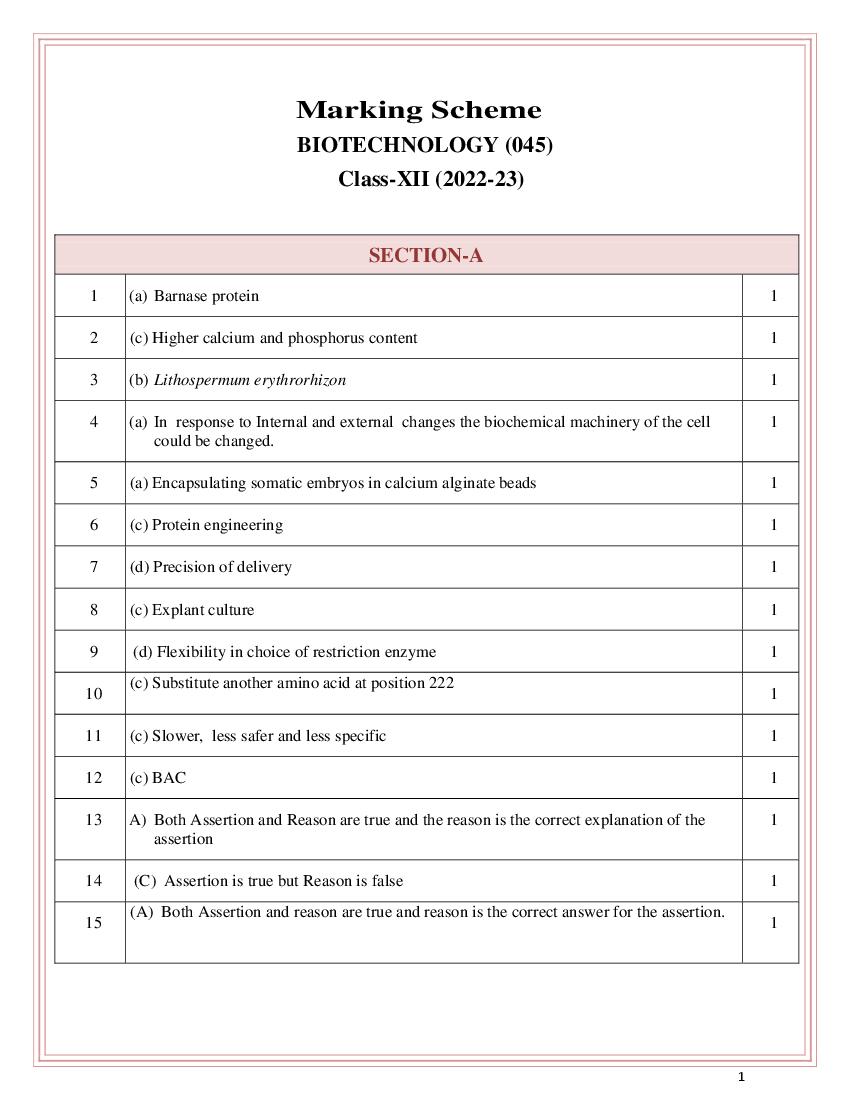
BIOTECHNOLOGY (045)
Class-XII (2022-23)
SECTION-A
1 (a) Barnase protein 1
2 (c) Higher calcium and phosphorus content 1
3 (b) Lithospermum erythrorhizon 1
4 (a) In response to Internal and external changes the biochemical machinery of the cell 1
could be changed.
5 (a) Encapsulating somatic embryos in calcium alginate beads 1
6 (c) Protein engineering 1
7 (d) Precision of delivery 1
8 (c) Explant culture 1
9 (d) Flexibility in choice of restriction enzyme 1
(c) Substitute another amino acid at position 222
10 1
11 (c) Slower, less safer and less specific 1
12 (c) BAC 1
13 A) Both Assertion and Reason are true and the reason is the correct explanation of the 1
assertion
14 (C) Assertion is true but Reason is false 1
(A) Both Assertion and reason are true and reason is the correct answer for the assertion.
15 1
1
Page 2
assertion
SECTION-B
17 Tissue Plasminogen Activator (tPA)
Diagram /Flow chart ( Either one )
1
Flow chart
1
2
Page 3
It helps in production of mutants e.g. disease resistance in Potato
OR
Organogenesis
If auxins are high in the medium, it promotes rooting while if cytokinins are high, shoot
formation is promoted.
19 G amino acid is most conserved 1
A amino acid is most variable. 1
20 Essential amino acids and BCAA profile: Essential amino acids are those amino acids 1
which have to be obtained from food and cannot be made in our cells.
The branched chain amino acids (BCAA) are essential for the biosynthesis of muscle 1
proteins. They help in increasing the bio-availability of high complex carbohydrates
intake and are absorbed by muscle cells for anabolic muscle building activity.
Biological value (BV) measures the amount of protein nitrogen that is retained by the
body from a given amount of protein nitrogen that has been consumed. It has been
observed that the BV of whey proteins is the highest compared to rice, wheat, soya and
egg proteins.
Protein efficiency ratio (PER)- PER is used as a measure of growth expressed in terms
of weight gain of an adult by consuming 1g of food protein. The PER value of the
following proteins are arranged in decreasing order- whey,milk, casein, soya, rice, wheat.
(Any two)
21 a) Production of MoAb (0.5 mark) 2
b) This technology has revolutionized the area of diagnostics and antibody-based
therapies.
1) The availability of monoclonal antibodies has helped in the early detection of many
infectious diseases like hepatitis and AIDS.
2) Therapeutic mAb –
OKT3 Therapeutic mAb - Herceptin OKT-3 is monab-CD3, an immunosuppressant
drug given intravenously to reverse the acute rejection of transplanted organs such as
the heart, kidney and liver.
Herceptin (trastuzumab) is a monoclonal antibody approved for therapy of early-
stage breast cancer that is Human Epidermal growth factor Receptor 2-positive
(HER2+). (1.5 marks)
3
Page 4
22 (a) In chymotrypsinogen, the substrate binding site is blocked and hence the enzyme 1+2
is inactive. In-situ activation of trypsin involves a proteolytic cut in
chymotrypsinogen which results in a conformational change, exposing the
substrate binding pocket.
(b) Asp 102, His 57 and Ser 195 lie in this order forming a charge relay;
The negatively charged aspartate carboxylate residue pulls the Ser –OH proton through
His, leaving it with a negative charge Ser195 becomes acidic due to the unique
constellation of the three amino acid residues because the protein has folded uniquely
in space
OR
½x6
Protein fingerprinting/ peptide mapping
23 ½x6
Crop Gene Improved Character
Canola (A) Barnase Barstear Hybrid production
Corn (B) BtCrylA(c) Insect Resistance
Cotton (C) BtCrylA(c) Insect Resistance
Papaya (D) Coat protein Virus Resistance
Potato (E) BtCrylllA & Coat protein Insect & virus control
Soyabean EPSP synthase Weed control
4
Page 5
Helps to maintain the shape and size of cells.
Salt, glucose and amino acids (any two) are the major ingredients that determine
osmolality of the medium.
25 (a) →BLAST search→ Find out→ homologous sequences in other organisms by 1
looking for gene sequence of given proteolytic enzyme.
(b) Look for conserved domain and find whether belongs to domain of 1
Chymotrypsin or to other family of proteins
(c) ALI database can be used for Phylogenetic (Evolutionary) analysis and
alignment of proteins. 1
26 R.E. type II recognizes a specific DNA sequence and cut within the sequence 1
generating sticky/flush ends. In recombinant DNA technology, we use type II RE as
they are highly specific in their action.
Alu I with the restriction site (One strand) 5‟ AGCT‟3 and Sma 1 with the
restriction site 5 „CCC GGG‟ 3 (flush ends) (One strand) 1
The functions of a) Alkaline phosphatase b) DNA ligase.
*The role of alkaline phosphatase is to prevent self re-ligation of the vector ½
*The role of DNA ligase is to make 3‟-5‟ phosphodiester bond. ½
1
27 : i) UniGene database
1
ii) Homologene database 1
iii. RefSeq database
28 a) p BR 322 1
b) LEU2 gene codes for an enzyme required for the synthesis of amino acid leucine. 1
Yeast cells having this plasmid can grow on a medium lacking leucine and hence ½
can be selected e.g. Yep ½
5
Page 6
29 (a) The molecular ions are generated either by a loss or gain of a charge (e.g. electron 1
ejection, protonation or deprotonation)
(b) Mass spectrometry is used in- 1
(i) Obtaining protein structural information such as peptide mass or amino acid
sequence
(ii) Identifying the type and location of amino acid modification within proteins.
(any one)
(c) (c)m/z= (M+ nH)n+/ n+ 2
For n=5, m/z= 10,000+ 5/5= 2001
For n=4,m/z= 10,000+ 4/4= 2501
For n=3, m/z= 10,000+ 3/3= 3334.3
For n=2, m/z= 10,000+ 2/2=5001
OR
n+ +
(c) m/z= (M+ nH) / n
For n=6, m/z= 20,000+ 6/6= 3334.33
For n=7, m/z= 20,000+7/7=2858.14
30 a) As generation time is inversely related to specific growth rate, hence bacterial 1
culture marked “X” with generation time 20s will proliferate rapidly.
b) n = 3.3 (Log 107 – Log 104) 1
= 3.3 ( 7 – 4 )
= 10
c) First calculate the number of divisions the population must have undergone to
increase from 108 to 1014 in 4 hours.
n = 3.3 (Log 1014 – Log 108)
= 3.3 (6 ) 2
= 19.8
td = 240 minutes / 20
= 12 minutes
OR
c) (i) Measurement of Dry mass and Wet mass
(ii) Using spectrophotometer
(iii) Using Slide counting Chamber
(iv) Using Coulter chamber
(Any two)
6
Page 7
31
Proteins Animal cell line used Therapeutic use ½ x10
Erythropoietin CHO cells Anemia
Factor VIII CHO cells Hemophilia A
Follicle Stimulating CHO cells Infertility
Hormone (FSH)
Interleukin 2 (IL 2) CHO cells Cancer therapy
Monoclonal antibodies Hybridoma cells Cancer therapy &
(mAbs) Autoimmune diseases
OR
(a) (i) A defined medium has known chemicals, of fixed composition and can sup-
2
port growth of selected cells.Serum is an essential component of animal cell
culture media and is a source of growth factors and hormones.
(ii) Anchorage dependent cells grow as adherent cells whereas anchorage-inde-
pendent cells grow as suspension cultures.
(b) Most common buffering system used to maintain pH in animal cell Culture is
Bicarbonate-CO2system.Carbon dioxide from cells or atmosphere interacts 2
with water and leads to drop in pH.
H2O + CO2《----》H2CO3 《-----》( H+) + HCO3-1
Increase in Bicarbonate concentration neutralizes the effect of increased Carbon
dioxide according to the following equation:
NaHCo3 ---> Na+ + HCO3-1
The increased HCO3- ions derive the above equation to its left until equilibrium is
1
reached at pH 7.4
Advantages :
i) pH is important to maintain in balance/ enzyme functions/ binding of
hormones/growth factors to cell surface receptors/Ion balance (Any two)
32 (a) TaqDI 1
(b) 5' AATGC 3' and 5' GATTC 3' 1
(c) Palindromic means the DNA sequence reads same when read from 5' to 3'. The ½
Restriction enzyme is a homodimer.
As it cuts both the strands of DNA simultaneously in 5' to 3' direction. ½
(d) Foreign DNA can be inserted into bacteriophage single stranded, circular DNA
of 6407 bp without disrupting any of the essential genes
2
M13 is a filamentous phage which infects E. coli having a pilus (protrusion) which
is selectively present in cells containing a F plasmid (called F+ cells).
7
Page 8
a)
b) Replica plating. ½
● Host cells are first plated (master plate) on solid media with the desired
antibiotic overnight.
● Velvet paper is aligned, pressed on master plate. ½*5
● With the same alignment it is pressed onto the replica plate.
● Keep it overnight ,transformed colonies will not grow in replica plate
● The colonies having insert can easily be scored off from master plate by
comparing the two plates.
33 (a) Recombinant insulin is an intracellular protein so we need to process the cell 1
mass and not the fermentation broth.
(b) Strain improvement is done in order to maximize metabolite production by: 1
i) Mutant selection : There are two methods - Physical method & Chemical
Method
ii) Genetic engineering
1
(c) i) It has strong inducible promoters
ii) It is capable of making post-translational modifications similar to those
performed by human cells
iii) Downstream processing is simpler as Pichia does not secrete its own proteins
into the fermentation medium. 1x2
(Any two)
OR
8
Page 9
Baffle flask: One of the simplest ways is to produce a V- shaped notch or indentation in
the sides of the flask. Such flasks are called baffle flasks . This improves
the growth of the microbes by improving the efficiency of oxygen transfer
due to increased turbulence of the agitated culture medium.
Shakers: Continuous agitation of the culture medium also greatly improves the
efficiency of the oxygen transfer and this improves the growth of the
microbes. In the laboratory, this is done by the use of shakers . Shakers
may be end-to-end type or rotatory type. These may be designed for use at
the ambient temperature or in a controlled temperature environment
(incubator shaker).
b)
1. Production of whole microbial cells (for food, vaccines)
1x2
2. Production of primary metabolites (acids, alcohol)
3. Production of secondary metabolites (antibiotics)
4. Biotransformation reactions (enzymatic, steroid)
5. Exploitation of metabolism (microbial leaching, biodegradable waste treatment)
6. Synthesis of recombinant proteins (therapeutic proteins) Bioremediation/fermented
food items/ recombinant proteins (Any two )
c) Viable Plate Count is the best method since it does not count dead microbial cells. 1
9
Document Details
| Board / Org | CBSE |
| Exam | Class 12 |
| Type | Solution |
| Pages | 9 |
| Updated | 22 Jul 2026 |