CBSE Class 12 Horticulture Question Paper 2020
Finished viewing? Save it for later —
Download CBSE Class 12 Horticulture Question Paper 2020 (PDF · 11 pages)About CBSE Class 12 Horticulture Question Paper 2020
CBSE Class 12 Horticulture Question Paper 2020 is available here for free download. Published by CBSE for Class 12, this question paper can be viewed online or downloaded as a PDF (11 pages). Candidates preparing for Class 12 can use CBSE Class 12 Horticulture Question Paper 2020 to understand the exam pattern, the type of questions asked, and the overall difficulty level.
Frequently Asked Questions
How can I download CBSE Class 12 Horticulture Question Paper 2020?
Open this page and click the Download button to save CBSE Class 12 Horticulture Question Paper 2020 as a PDF. It is completely free on AglaSem Docs.
Is CBSE Class 12 Horticulture Question Paper 2020 free to download?
Yes. CBSE Class 12 Horticulture Question Paper 2020 can be viewed online and downloaded as a PDF free of cost on AglaSem Docs.
How many pages does CBSE Class 12 Horticulture Question Paper 2020 have?
CBSE Class 12 Horticulture Question Paper 2020 contains 11 pages, which you can read online or download together as a single PDF.
Where can I find more Class 12 study material?
You can find more Class 12 question papers, sample papers, syllabus, and answer keys on AglaSem Docs.
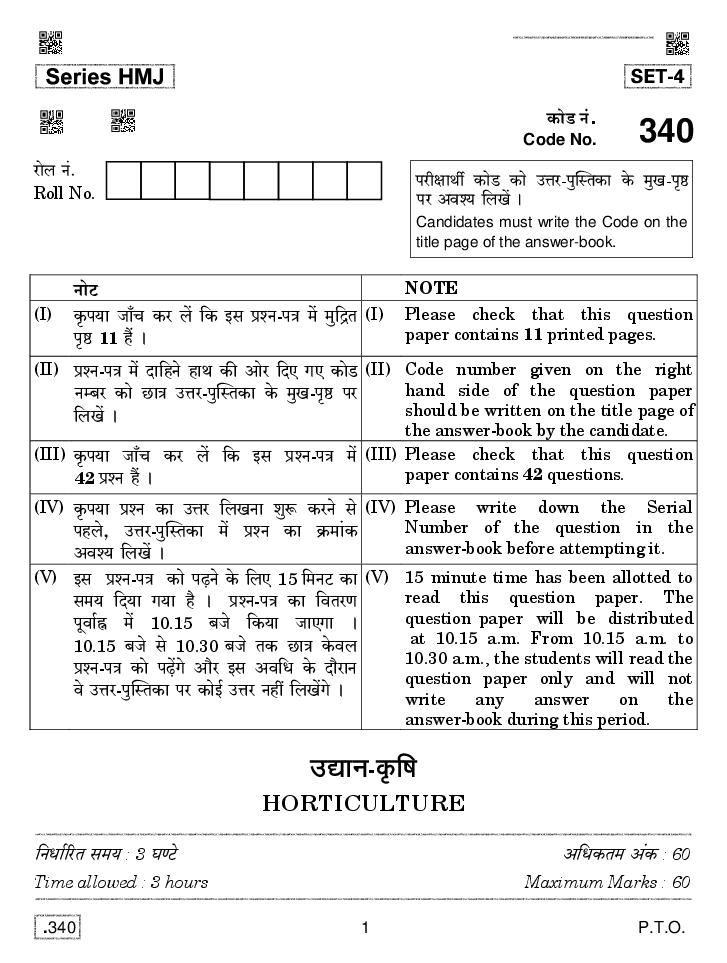
CBSE Class 12 Horticulture Question Paper 2020 – Text
Read the full text of this question paper below — useful to quickly search, copy and reference the content online without downloading the PDF.
📄 View text version (11 pages)
Page 1
Code No. 340
amob Z§. narjmWu H$moS >H$mo CÎma-nwpñVH$m Ho$ _wI-n¥ð
Roll No. >na Adí` {bIo§ &
Candidates must write the Code on the
title page of the answer-book.
ZmoQ> NOTE
(I) H¥$n`m Om±M H$a b| {H$ Bg àíZ-nÌ _o§ _w{ÐV (I) Please check that this question
n¥ð> 11 h¢ & paper contains 11 printed pages.
(II) àíZ-nÌ _| Xm{hZo hmW H$s Amoa {XE JE H$moS (II) Code number given on the right
>Zå~a H$mo N>mÌ CÎma-nwpñVH$m Ho$ _wI-n¥ð> na hand side of the question paper
{bI| & should be written on the title page of
the answer-book by the candidate.
(III) H¥$n`m Om±M H$a b| {H$ Bg àíZ-nÌ _| (III) Please check that this question
>42 àíZ h¢ & paper contains 42 questions.
(IV) H¥$n`m àíZ H$m CÎma {bIZm ewê$ H$aZo go (IV) Please write down the Serial
nhbo, CÎma-nwpñVH$m _| àíZ H$m H«$_m§H$ Number of the question in the
Adí` {bI| & answer-book before attempting it.
(V) Bg àíZ-nÌ H$mo n‹T>Zo Ho$ {bE 15 {_ZQ >H$m (V) 15 minute time has been allotted to
g_` {X`m J`m h¡ & àíZ-nÌ H$m {dVaU read this question paper. The
nydm©• _| 10.15 ~Oo {H$`m OmEJm & question paper will be distributed
10.15 ~Oo go 10.30 ~Oo VH$ N>mÌ Ho$db at 10.15 a.m. From 10.15 a.m. to
10.30 a.m., the students will read the
àíZ-nÌ H$mo n‹T>|Jo Am¡a Bg Ad{Y Ho$ Xm¡amZ question paper only and will not
do CÎma-nwpñVH$m na H$moB© CÎma Zht {bI|Jo & write any answer on the
answer-book during this period.
CÚmZ-H¥${f
HORTICULTURE
{ZYm©[aV g_` : 3 KÊQ>o A{YH$V_ A§H$ : 60
Time allowed : 3 hours Maximum Marks : 60
.340 1 P.T.O.
Page 2
{ZåZ{b{IV {ZX}em| H$mo ~hþV gmdYmZr go n{‹T>E Am¡a CZH$m g™Vr go nmbZ H$s{OE :
(a) Bg àíZ-nÌ _| Xmo IÊS> h¢ IÊS> H$ … amoOJma H$m¡eb Am¡a IÊS> I … {df` H$m¡eb &
(b) IÊS> H$ … amoOJma H$m¡eb (10 A§H$)
(i) {XE JE 6 àíZm| _| go {H$Ýht 4 àíZm| Ho$ CÎma Xr{OE & àË`oH$ àíZ 1 A§H$ H$m h¡ &
(ii) {XE JE 5 àíZm| _| go {H$Ýht 3 àíZm| Ho$ CÎma Xr{OE & àË`oH$ àíZ 2 A§H$ H$m h¡ &
(c) IÊS> I … {df` H$m¡eb (50 A§H$)
(i) {XE JE 12 àíZm| _| go {H$Ýht 10 àíZm| Ho$ CÎma Xr{OE & àË`oH$ àíZ 1 A§H$ H$m h¡ &
(ii) {XE JE 7 àíZm| _| go {H$Ýht 5 àíZm| Ho$ CÎma Xr{OE & àË`oH$ àíZ 2 A§H$ H$m h¡ &
(iii) {XE JE 7 àíZm| _| go {H$Ýht 5 àíZm| Ho$ CÎma Xr{OE & àË`oH$ àíZ 3 A§H$ H$m h¡ &
(iv) {XE JE 5 àíZm| _| go {H$Ýht 3 àíZm| Ho$ CÎma Xr{OE & àË`oH$ àíZ 5 A§H$ H$m h¡ &
(d) Bg àíZ-nÌ _| 42 àíZ em{_b h¢ {OZ_| go 30 àíZm| Ho$ CÎma XoZo h¢ &
(e) g^r àíZm| Ho$ {deof ^mJ /IÊS> H$mo ghr H«$_ _| H$s{OE &
(f) A{YH$V_ g_` 3 K§Q>o h¡ &
IÊS> H$
(amoOJma H$m¡eb) (10 A§H$)
{XE JE 6 àíZm| ‘| go {H$Ýht 4 àíZm| Ho$ CÎma Xr{OE & à˶oH$ àíZ 1 A§H$ H$m h¡ & 14=4
1. H$_©Mm[a`m| _| _________ H$s H$_r go T>oa gmao ZH$mamË_H$ Ed§ VwÀN> ~mV| OÝ_ boVr h¢ & 1
(A) ~mVMrV
(B) ~hg
(C) {dMmam|
(D) Z¡{VH$Vm
2. ‘ñd`§-{Z`§ÌU’ `m ‘ñd`§-{Z`_Z’ H$mo ñd`§-_________ ^r H$hVo h¢ & 1
3. ‘ñd`§-à~§YZ’ EH$ Eogm JwU h¡ {Oggo AZoH$ n[apñW{V`m| _| _Zwî` Ho$ AmdoJ, _________
Ed§ ~Vm©d à^mdr T>§J go {Z`§{ÌV {H$E OmVo h¢ & 1
.340 2
Page 3
Read the following instructions very carefully and strictly follow them :
(a) This question paper consists of two parts viz. Section A : Employability
Skills and Section B : Subject Skills.
(b) Section A : Employability Skills (10 Marks)
(i) Answer any 4 questions out of the given 6 questions of 1 mark each.
(ii) Answer any 3 questions out of the given 5 questions of 2 marks each.
(c) Section B : Subject Skills (50 Marks)
(i) Answer any 10 questions out of the given 12 questions of 1 mark each.
(ii) Answer any 5 questions from the given 7 questions of 2 marks each.
(iii) Answer any 5 questions from the given 7 questions of 3 marks each.
(iv) Answer any 3 questions from the given 5 questions of 5 marks each.
(d) This question paper contains 42 questions out of which 30 questions are to
be answered.
(e) All questions of a particular part/section must be attempted in the correct
order.
(f) The maximum time allowed is 3 hours.
SECTION A
(Employability Skills) (10 Marks)
Answer any 4 questions out of the given 6 questions of 1 mark each. 14=4
1. Lack of _________ can generate a lot of negativity and animosity among
employees. 1
(A) Negotiation
(B) Argument
(C) Ideas
(D) Ethics
2. ‘Self-control’ or ‘Self-regulation’ is also known as ‘Self- _________.’ 1
3. Self-management is the ability to regulate one’s emotions, _________ and
behaviour effectively in different situations. 1
.340 3 P.T.O.
Page 4
AnZmVo h¢ ? 1
(A) _ob H$m°nr
(B) _ob BÝgQ>©
(C) _ob ÁdmBZ
(D) _ob _O©
5. A{Z`mo{OV IarXXmar H$hbmVr h¡ 1
(A) Cn^moŠVm IarXXmar
(B) O_mZV
(C) AmdoJ IarXXmar
(D) VwbZmË_H$ IarXXmar
6. O¡go hr h_mao Mmam| Amoa ì`mßV dmVmdaU h_mao OrdZ Ho$ g^r nhbwAm| H$mo à^m{dV H$aVm
h¡, d¡go hr h_mao g^r X¡{ZH$ {H«$`mE± ^r _________ H$mo à^m{dV H$aVr h¢ & 1
{XE JE 5 àíZm| _| go {H$Ýht 3 àíZm| Ho$ CÎma Xr{OE & àË`oH$ àíZ 2 A§H$ H$m h¡ & 23=6
7. _m¡{IH$ ~mVMrV go hmoZo dmbo {H$Ýht Xmo Agw{dYmAm| (hm{Z`m|) H$mo {b{IE & 2
8. ñd`§-à~§YZ Ho$ A§VJ©V ‘AmË_-{dídmg’ Ed§ ‘g_ñ`m-{ZdmaU’ H$mo g_PmBE & 2
9. ñ_mQ>©\$moÝg Ho$ Xmo àM{bV Am°naoqQ>J {gñQ>_ Ho$ Zm_ {b{IE & 2
10. Q>r_-~ZmZo H$s {H$Ýht Xmo Cn`mo{JVmAm| (bm^m|) H$mo {JZmBE & 2
11. BH$mo{gñQ>_ (Ecosystem) {H$go H$hVo h¢ ? 2
.340 4
Page 5
persons in MS Word ? 1
(A) Mail Copy
(B) Mail Insert
(C) Mail Join
(D) Mail Merge
5. Unplanned shopping is known as 1
(A) Consumer shopping
(B) A warranty
(C) Impulse buying
(D) Comparison shopping
6. As environment around us affects all aspects of our life, so all our
day-to-day activities also affect the _________. 1
Answer any 3 questions out of the given 5 questions of 2 marks each. 23=6
7. Write any two disadvantages of verbal communication. 2
8. Describe ‘self-confidence’ and ‘problem-solving’ under self-management. 2
9. Write two popular operating systems for smartphones. 2
10. Enlist any two benefits of team building. 2
11. What is an ecosystem ? 2
.340 5 P.T.O.
Page 6
({df¶ H$m¡eb) (50 A§H$)
{XE JE 12 àíZm| ‘| go {H$Ýht 10 àíZm| Ho$ CÎma Xr{OE & à˶oH$ àíZ 1 A§H$ H$m h¡ & 110=10
12. ^maVr` H¥${f AZwg§YmZ n[afX² Ho$ A§VJ©V ‘nwîn-{dkmZ AZwg§YmZ {ZXoemb`’ {H$g gZ² _|
Ama§^ hþAm ? 1
(A) 2000
(B) 2005
(C) 2010
(D) 2013
13. S>m°. `ed§V qgh na_ma Am¡Úm{ZH$s Ed§ dm{ZH$s {díd{dÚmb`, Zm¡Zr, gmobZ -173230
({h_mMb àXoe) gZ² _________ _| ñWm{nV hþAm Wm & 1
14. gmYmaUV`m A§V…J¥hmoÚmZ Ho$ _________ n[ajoÌ _| hr ‘\$moH$b ßdmB§Q>’ ~Zm`m OmVm h¡ & 1
15. O_rZr gVh go ZrMo ~Zm`o J`o CÚmZ H$mo Š`m H$hVo h¢ ? 1
(A) _me© CÚmZ
(B) noìS> CÚmZ
(C) g§Ho$Z CÚmZ
(D) Q>oaog CÚmZ
16. CAD H$m {dñV¥V ê$n h¡ _________ & 1
17. bm°Z à~§YZ _| gmYmaU Ed§ ~ma-~ma hmoZo dmbr à{H«$`m H$m¡Z-gr h¡ ? 1
(A) _m°qdJ
(B) aoqH$J
(C) amoqbJ
(D) ñnmBqH$J
18. H¡$ŠQ>mB Ed§ AÝ` agrbo nm¡Yo ______________ go _____________% AmЩVm na AÀN>o
MbVo h¢ & 1
.340 6
Page 7
(Subject Skills) (50 Marks)
Answer any 10 questions out of the given 12 questions of 1 mark each. 110=10
12. When was the Directorate of Floricultural Research in ICAR started ? 1
(A) 2000
(B) 2005
(C) 2010
(D) 2013
13. Dr. Yashwant Singh Parmar University of Horticulture and Forestry,
Nauni, Solan-173230 (H.P.) was established in _________. 1
14. Focal point is commonly created in _________ area of a home garden. 1
15. The garden laid below the ground level is called 1
(A) Marsh garden
(B) Paved garden
(C) Sunken garden
(D) Terrace garden
16. CAD is the abbreviated form of _________. 1
17. Which is the most common and frequent operation in lawn management ? 1
(A) Mowing
(B) Raking
(C) Rolling
(D) Spiking
18. Cacti and other succulent plants do well in a humidity range of _________
to _________%. 1
.340 7 P.T.O.
Page 8
20. Am°{H©$S> H$m g~go ~‹S>m OrZg _________ h¡ Omo àH¥${V _| erVmoîU h¡ Am¡a {OgH$s H$moB©
2000 àOm{V`m± h¢ & 1
21. AmBHo$~¡Zm Ho$ àW_ ñHy$b H$m Zm_ _________ Wm & 1
22. {ZåZ{b{IV _m¡g_r nm¡Ym| _| go H$m¡Z-gm dm`w ewîH$Z Ho$ {bE Cn`wº$ ahoJm ? 1
(A) EoZm\o$brg
(B) nona âbmda
(C) ñQ´>m° âbmda
(D) Cn`w©ŠV g^r
23. H$Q >âbmdg© Ho$ {bE Jwbm~ Ho$ \y$b H$mo V~ H$mQ>Vo h¢ O~ Cg_| _________ go
_________ n§Iw{‹S>`m± IwbZo bJVr h¢ & 1
{XE JE 7 àíZm| ‘| go {H$Ýht 5 àíZm| Ho$ CÎma Xr{OE & à˶oH$ àíZ 2 A§H$ H$m h¡ & 25=10
24. ^maV, OmnmZ Am¡a B§½b¡ÊS>> Ho$ amîQ´>r` \y$bm| Ho$ Zm_ ~VmBE & 2
25. ~m‹S> ~ZmZo Ho$ {bE Xmo Cn`wŠV nm¡Ym| Ho$ d¡km{ZH$ Zm_ ~VmBE & 2
26. bm°Z bJmZo Ho$ {bE EH$ CîUH${Q>~§Yr`, d EH$ erVmoîU Obdm`w dmbr Kmgm| Ho$ Zm_
~VmBE & 2
27. {H$Ýht Xmo Eogo nm¡Ym| Ho$ Zm_ ~VmBE Omo CZ H$_am| _| AÀN>o MbVo h¢ Am¡a Ohm± {XZ H$m
Vmn_mZ h_oem bJ^J 18 – 24 gopëg`g J_© hmoVm h¡ & 2
28. {Z`m©V hoVw Jwbm~ Ho$ Xmo H$Q >âbmda {H$ñ_m| Ho$ Zm_ {b{IE & 2
29. ewîH$ \y$bm| Ho$ Xmo à_wI Am`mVH$ Xoem| Ho$ Zm_ ~VmBE & 2
30. H$Q>mB© níMmV² àr-Hy$qbJ hoVw, ½b¡{S>Amobg Ho$ H$Q> âbmdg© H$mo {H$g Kmob _|, {H$VZr gm§ÐVm
Am¡a Vmn_mZ na aIVo h¢ ? 2
.340 8
Page 9
20. The largest orchid genus is _________ which is temperate in nature and
has some 2000 species. 1
21. The first school of Ikebana was _________. 1
22. Which of the following annuals is most suitable for air drying ? 1
(A) Anaphalis
(B) Paper flower
(C) Straw flower
(D) All of the above
23. Roses for cut flowers are harvested when its _________ to _________
petals begin to unfold. 1
Attempt any 5 questions from the given 7 questions of 2 marks each. 25=10
24. Name the National flower of India, Japan and England. 2
25. Mention scientific names of two plants suitable for making hedge. 2
26. Name one grass for tropical, and one for temperate areas for lawn
making. 2
27. Name two such plants that survive well in rooms and where day
temperature remains nearly 18 – 24C hot. 2
28. Write two cut flower varieties of roses for export purposes. 2
29. Name two leading dry flower importing countries. 2
30. For pre-cooling, gladiolus cut flowers after harvesting are kept at what
temperature, and in which solution and with what concentration ? 2
.340 9 P.T.O.
Page 10
31. emo^mH$a nm¡Ym-amonU gm_J«r H$m CËnmXZ Š`m EH$ CÚ{_Vm Ho$ ê$n _| g\$b à`mg
hmoJm ? 3
32. J¥h-^y{Z_m©U Ho$ gm_mÝ` H$m`m] H$s gyMr ~ZmBE & 3
33. nŠH$s ~mJdmZr {H$go H$hVo h¢ ? Bgo H¡$go ~ZmVo h¢ Am¡a Bg_| {H$Z nm¡Ym| H$mo bJmVo h¢ ? 3
34. Am°Q>moHo$S> Š`m h¡ ? 3
35. bm°Z Kmg _| _moB§J Š`m| H$aVo h¢ ? BgH$s {d{Y {b{IE & 3
36. g§a{jV IoVr Ûmam ^maV _| H$m¡Z-H$m¡Z go H$Q> âbmdg© CJm`o OmVo h¢ ? nmobrhmCg _| Oo~©am
Ho$ nmXn-KZËd Ed§ {XZ-amV Vmn_mZ H$s Amdí`H$Vm H$mo ~VmBE & 3
37. \y$bm| H$s ‘nm°Q>-nyar’ {H$go H$hVo h¢ Am¡a Bgo H¡$go ~ZmVo h¢ ? 3
{XE JE 5 àíZm| ‘| go {H$Ýht 3 àíZm| H$m CÎma Xr{OE & à˶oH$ àíZ 5 A§H$ H$m h¡ & 53=15
38. XbXbr CÚmZ H$mo n[a^m{fV H$s{OE Am¡a ~VmBE {H$ BÝh| CÚmZ _| H$hm± ~ZmVo h¢ & BZ_|
bJZo dmbo VrZ Cn`wŠV nm¡Ym| Ho$ Zm_ ~VmBE & 5
39. aOZrJ§Ym Ho$ \y$bm| H$s Cn`mo{JVm, BgH$m KamZm (\¡${_br), BgH$s Xmo {H$ñ_m| Ho$ Zm_, {_Å>r
Ho$ àH$ma Ed§ Obdm`{dH$ Amdí`H$VmE± VWm g§dY©Z {d{Y`m| Ho$ ~mao _| ~VmBE & 5
40. \y$bm| H$s g§a{jV IoVr Š`m| H$aVo h¢ ? 5
41. nwîn ì`dñWm Ho$ ~w{Z`mXr A§XmOm| H$m dU©Z H$s{OE & 5
42. JwbZma Ho$ \y$bm| H$s H$Q>mB© AdñWm, BgHo$ ñn§XZ CnMma, nwîn-^ÊS>maU, Ed§ ~mJdmZr
(loUrH$aU) H$m dU©Z H$s{OE & 5
.340 10
Page 11
31. Will production of ornamental planting materials be a successful option
as an enterprise ? 3
32. Enlist general functions of home landscaping. 3
33. What is a paved garden ? How is it made and what plants are planted
there ? 3
34. What is AutoCAD ? 3
35. Why is mowing done in lawns ? Write its methods. 3
36. Which cut flowers are grown under protected cultivation in India ? State
the plant density and day/night temperature requirements of Gerbera in
the polyhouse. 3
37. What is ‘pot-pourris’ of flowers and how is it prepared ? 3
Attempt any 3 questions from the given 5 questions of 5 marks each. 53=15
38. Define bog/marsh garden and state where in the garden these are
created. Also name three plants suitable for planting in such gardens. 5
39. State the floral uses of Tuberose, its family, names of its two varieties,
soil types and climatic requirements, and its propagation methods. 5
40. Why is protected cultivation of flowers done ? 5
41. Describe the basic styles of flower arrangement. 5
42. Describe the flower harvesting stage of Carnations, its pulsing treatment,
storage of flowers, and grading. 5
.340 11 P.T.O.
Document Details
| Board / Org | CBSE |
| Exam | Class 12 |
| Type | Question Paper |
| Pages | 11 |
| Updated | 22 Jul 2026 |