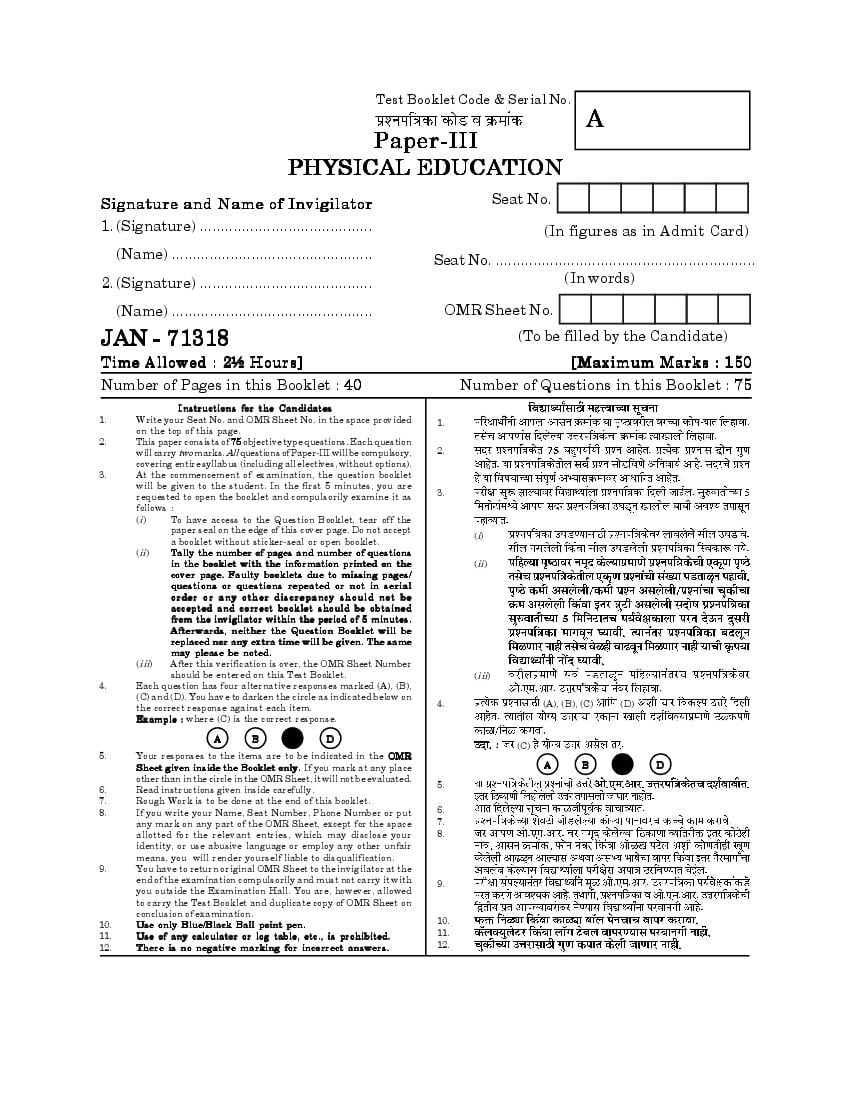
MAHA SET 2018 Question Paper 3 Physical Education
Finished viewing? Save it for later —
Download MAHA SET 2018 Question Paper 3 Physical Education (PDF · 40 pages)About MAHA SET 2018 Question Paper 3 Physical Education
MAHA SET 2018 Question Paper 3 Physical Education is available here for free download. Published by Maharashtra Exams for MAHA SET, this question paper can be viewed online or downloaded as a PDF (40 pages). Candidates preparing for MAHA SET can use MAHA SET 2018 Question Paper 3 Physical Education to understand the exam pattern, the type of questions asked, and the overall difficulty level.
Frequently Asked Questions
How can I download MAHA SET 2018 Question Paper 3 Physical Education?
Open this page and click the Download button to save MAHA SET 2018 Question Paper 3 Physical Education as a PDF. It is completely free on AglaSem Docs.
Is MAHA SET 2018 Question Paper 3 Physical Education free to download?
Yes. MAHA SET 2018 Question Paper 3 Physical Education can be viewed online and downloaded as a PDF free of cost on AglaSem Docs.
How many pages does MAHA SET 2018 Question Paper 3 Physical Education have?
MAHA SET 2018 Question Paper 3 Physical Education contains 40 pages, which you can read online or download together as a single PDF.
Where can I find more MAHA SET study material?
You can find more MAHA SET question papers, sample papers, syllabus, and answer keys on AglaSem Docs.
MAHA SET 2018 Question Paper 3 Physical Education – Text
Read the full text of this question paper below — useful to quickly search, copy and reference the content online without downloading the PDF.
📄 View text version (40 pages)
Page 1
A
PHYSICAL EDUCATION
Signature and Name of Invigilator Seat No.
1. (Signature) ......................................... (In figures as in Admit Card)
(Name) ................................................ Seat No. ..............................................................
2. (Signature) ......................................... (In words)
(Name) ................................................ OMR Sheet No.
JAN - 71318 (To be filled by the Candidate)
Time Allowed : 2½ Hours] [Maximum Marks : 150
Number of Pages in this Booklet : 40 Number of Questions in this Booklet : 75
Instructions for the Candidates
1. Write your Seat No. and OMR Sheet No. in the space provided 1.
on the top of this page.
2. This paper consists of 75 objective type questions. Each question
will carry two marks. All questions of Paper-III will be compulsory, 2.
covering entire syllabus (including all electives, without options).
3. At the commencement of examination, the question booklet
will be given to the student. In the first 5 minutes, you are
requested to open the booklet and compulsorily examine it as 3.
follows :
(i) To have access to the Question Booklet, tear off the
paper seal on the edge of this cover page. Do not accept
(i)
a booklet without sticker-seal or open booklet.
(ii) Tally the number of pages and number of questions
in the booklet with the information printed on the (ii)
cover page. Faulty booklets due to missing pages/
questions or questions repeated or not in serial
o rder or any other discre pancy should not be
accepted and correct booklet should be obtained
from the invigilator within the period of 5 minutes.
Afterwards, neither the Question Booklet will be
replaced nor any extra time will be given. The same
may please be noted.
(iii) After this verification is over, the OMR Sheet Number
should be entered on this Test Booklet. (iii)
4. Each question has four alternative responses marked (A), (B),
(C) and (D). You have to darken the circle as indicated below on
the correct response against each item. 4. (A), (B), (C) (D)
Example : where (C) is the correct response.
A B D
(C)
5. Your responses to the items are to be indicated in the OMR
Sheet given inside the Booklet only. If you mark at any place A B D
other than in the circle in the OMR Sheet, it will not be evaluated.
5.
6. Read instructions given inside carefully.
7. Rough Work is to be done at the end of this booklet.
8. If you write your Name, Seat Number, Phone Number or put 6.
any mark on any part of the OMR Sheet, except for the space 7.
allotted for the relevant entries, which may disclose your 8.
identity, or use abusive language or employ any other unfair
means, you will render yourself liable to disqualification.
9. You have to return original OMR Sheet to the invigilator at the
end of the examination compulsorily and must not carry it with 9.
you outside the Examination Hall. You are, however, allowed
to carry the Test Booklet and duplicate copy of OMR Sheet on
conclusion of examination.
10. Use only Blue/Black Ball point pen. 10.
11. Use of any calculator or log table, etc., is prohibited. 11.
12. There is no negative marking for incorrect answers. 12.
Page 2
Page 3
Paper III
III
Time Allowed : 2½ Hours] [Maximum Marks : 150
Note : This Question Paper contains Seventy Five (75) multiple choice questions,
each question carries Two (2) marks. Attempt All questions.
(75) (2)
1. President ................................. was 1.
instrumental in public school of
USA to include physical education
in their curriculum.
(A) B. Obama (A)
(B) John F. Kennedy (B)
(C) Ronald Regan (C)
(D) Clinton (D)
2. ............................. gland is responsible 2.
for emotional arousal.
(A)
(A) Adrenal
(B)
(B) Thyroid
(C) Pancreas (C)
(D) Hypothalamus (D)
3 [P.T.O.
Page 4
sports : ‘A Philosophical Inquiry’ is
written by :
(A)
(A) Liner
(B)
(B) Edger
(C) Bucher (C)
(D) Weiss (D)
4. Which is not a method to obtaining 4.
the somatotype ?
(A) Anthropometric method (A)
(B) Photoscopic method (B)
(C) Rating form (C)
(D) Classic method (D)
5. The Palestinian terrorist killed 5.
two members of the Israeli athletic
squad in the ...................................
olympic.
(A)
(A) Montreal
(B)
(B) Moscow
(C) Mexico (C)
(D) Munich (D)
4
Page 5
heart rate is : (A)
(A) RHR + MHR
(B) 120 + Age ÷ Height (B) 120 + ÷
(C) 220 – Age (C) 220 –
Height (cm)
(D) × HR (D) ×
Weight
7. The Raj Kumari Amrit Kaur 7.
Coaching Scheme origin in the
year :
(A) 1952
(A) 1952
(B) 1953
(B) 1953
(C) 1954 (C) 1954
(D) 1955 (D) 1955
8. The first gymnastic school was 8.
established in :
(A) France (A)
(B) USA (B)
(C) Germany (C)
(D) China (D)
5 [P.T.O.
Page 6
banned by I.O.C. as doping
substance ?
(1)
(1) Alcohol
(2)
(2) Analgesics
(3) Anabolic steroid (3)
(4) Amphetamine (4)
Find the correct answer from the
codes given below :
(A) (1), (2) (4)
(A) (1), (2) and (4)
(B) (2), (3) (4)
(B) (2), (3) and (4)
(C) (3) and (4) (C) (3) (4)
(D) (1) and (3) (D) (1) (3)
10. Slow twitch muscle fibers are 10.
characterised by :
(I) Greater cross-sectional area (I)
(II) Greater Kreb cycle enzymatic (II)
capacity
(III)
(III) Low nerve conduction velocity
(IV)
(IV) Greater glycolytic capacity
Select the right combination :
(A) (I), (II) (IV)
(A) (I), (II) and (IV)
(B) (II), (III) and (IV) (B) (II), (III) (IV)
(C) (II) and (III) (C) (II) (III)
(D) (II) and (IV) (D) (II) (IV)
6
Page 7
the correct answer from the codes
given below :
-I -II
List-I List-II
(a) (1)
(a) Amphetamines (1) Heart rate
(b) (2)
(b) Beta-blockers (2) Alertness
(c) Erythropoietin (3) Urine (c) (3)
formation (d) (4)
(d) Alkaline salts (4) Haemoglobin
(5)
(5) pH level
Codes :
(a) (b) (c) (d)
(a) (b) (c) (d)
(A) (2) (1) (4) (5)
(A) (2) (1) (4) (5)
(B) (2) (3) (4) (5)
(B) (2) (3) (4) (5)
(C) (1) (4) (5) (3) (C) (1) (4) (5) (3)
(D) (2) (1) (5) (3) (D) (2) (1) (5) (3)
12. Maximal volume of air forcefully 12.
expired after one maximal
inspiration is ............................. .
(A) Tidal volume (A)
(B) VO2 max (B) VO2
(C) Vital capacity (C)
(D) Second wind (D)
7 [P.T.O.
Page 8
labelled as Assertion (A) and the
(R)
other labelled as Reason (R) :
(A) :
Assertion (A) :
In a cardiac cycle the diastolic phase
is larger than the systolic phase.
Reason (R) :
(R) :
An individual with a heart rate of
74
74 beats per minute would have a
diastolic phase of 0.44 sec. and 0.44
systolic phase of 0.37 seconds. 0.37
Which one of the following is
correct ?
(A) (A) (R) (R)
(A) Both (A) and (R) are true and
(R) is the correct explanation (A)
of (A)
(B) (A) (R)
(B) Both (A) and (R) are not correct
(C) (A) (R)
(C) (A) is true, but (R) is false
(D) (A) (R) (A)
(D) (A) is true, but (R) is not the
correct explanation of (A)
8
Page 9
the muscle fiber spreads in T-tubules
releasing .......................... from
reticulum.
(A) ADP (A)
(B) ATP (B)
(C) Ca++ (C) Ca++
(D) Cl– (D) Cl–
15. Painful muscular contractions 15.
caused by prolonged exposure to
environmental heat, is known as :
(A) Heat syncope (A)
(B) Heat exhaustion (B)
(C) Heat cramps (C)
(D) Heat stroke (D)
9 [P.T.O.
Page 10
labelled as Assertion (A) and the
(A) (R)
other labelled as Reason (R) :
(A) :
Assertion (A) :
Fitness is that state which
characterised the degree to which
sportsman functions at optimum.
Reason (R) :
(R) :
Fitness is an individual matter
implies the ability to live most
effectively with potential.
In context with two sentences
find the correct answer from the
following :
(A) Both (A) and (R) are true and
(R) is the correct explanation (A) (A) (R) (R)
of (A) (A)
(B) Both (A) and (R) are true and (B) (A) (R) (R)
(R) is not the correct explanation
(A)
of (A)
(C) (A) (R)
(C) (A) is true and (R) is false
(D) (A) is false and (R) is true (D) (A) (R)
10
Page 11
exert enough tension to shorten
sufficiently to cause full ROM in
both joints at same time is called
.............................. .
(A)
(A) Passive insufficiency
(B)
(B) Biarticulate
(C)
(C) Multiarticulate
(D) Active insufficiency (D)
18. Two forces of 10 N and 18 N are 18. 10 18
pulling an object towards east and
another 26 N force was towards west
26
was acting on same object. Calculate
the direction and resultant force :
(A) 54
(A) 54 N—West
(B) 12
(B) 12 N—West
(C) 24
(C) 24 N—East
(D) 2 N—East (D) 2
11 [P.T.O.
Page 12
inertia and angular velocity is ....... .
(A) Angular velocity (A)
(B) Angular acceleration (B)
(C) Angular momentum (C)
(D) Angular projection (D)
20. With constant linear velocity, 20.
angular velocity of a Gymnast
increases :
(A) By increasing radius (A)
(B) By decreasing radius (B)
(C) By increasing radius and
(C)
velocity
(D) No change in radius (D)
21. The ............................... effect is the 21.
commonly observed effect in which
a spinning ball curves away from its
principle flight path.
(A)
(A) Buoyancy effect
(B)
(B) Physical effect
(C) Magnus effect (C)
(D) Magnitude effect (D)
12
Page 13
manipulation technique ?
(A) Clapping (A)
(B) Kneeding (B)
(C) Pinching (C)
(D) Pounding (D)
23. Match the List-I with List-II and 23. -I -II
select the correct option using the
codes given below :
-I -II
List-I List-II
(a) (1)
(a) Kyphosis (1) Freely movable
(b) (2)
(b) Massaging (2) Thoracic region
(c) (3)
(c) Lordosis (3) Effleurage
(d) (4)
(d) Diarthrosis (4) Lumbar region
Codes :
(a) (b) (c) (d)
(a) (b) (c) (d)
(A) (2) (3) (4) (1)
(A) (2) (3) (4) (1)
(B) (1) (2) (3) (4) (B) (1) (2) (3) (4)
(C) (2) (3) (1) (4) (C) (2) (3) (1) (4)
(D) (3) (4) (2) (1) (D) (3) (4) (2) (1)
13 [P.T.O.
Page 14
labelled as Assertion (A) and the
(A) (R)
other labelled as Reason (R) :
Assertion (A) :
(A) :
Degree of stability depends on area
of base.
Reason (R) :
Lowering centre of gravity increases (R) :
degree of stability.
In the context of the above two
statements, which one of the
following is correct ?
(A) Both (A) and (R) are right, but
(R) is not the correct explanation (A) (A) (R) (R)
of (A)
(A)
(B) Both (A) and (R) are right and
(B) (A) (R) (R)
(R) is the correct explanation
(A)
of (A)
(C) (A) (R)
(C) (A) is right but (R) is wrong
(D) (A) is wrong but (R) is right (D) (A) (R)
14
Page 15
the correct option using the codes
given below :
-I -II
List-I List-II
(a) Insight Theory (1) Motivation (a) (1)
(b) Attribution (2) Aggression (b) (2)
Theory
(c) (3)
(c) Drive Theory (3) Personality
(d) (4)
(d) Psychodynamic (4) Learning
Theory
Codes : (a) (b) (c) (d)
(a) (b) (c) (d)
(A) (1) (4) (3) (2)
(A) (1) (4) (3) (2)
(B) (2) (3) (4) (1)
(B) (2) (3) (4) (1)
(C) (4) (1) (2) (3)
(C) (4) (1) (2) (3)
(D) (3) (2) (1) (4) (D) (3) (2) (1) (4)
15 [P.T.O.
Page 16
one labelled as Assertion (A) and
(R)
the other is Reason (R) and select
the correct answer from the codes
(A) :
given below :
Assertion (A) :
Socialization takes place through
participation in games and sports. (R) :
Reason (R) :
Games and sports inculcate social
habits.
Codes :
(A) (A) (R)
(A) (A) is true, but (R) is false
(B) (A) (R)
(B) (A) is false, but (R) is true
(C) Both (A) and (R) are false (C) (A) (R)
(D) Both (A) and (R) are true (D) (A) (R)
16
Page 17
the correct answer from the codes
given below :
-I -II
List-I List-II
(a) (1)
(a) Social Contact (1) Karl Groos
Theory of Play
(b) (2)
(b) Catharsis Theory (2) Plato
of Play
(c) (3)
(c) Self-expression (3) Aristotle
Theory of Play
(d) (4)
(d) Instinct Theory (4) Bernard S.
of Play Mason
Codes :
(a) (b) (c) (d)
(a) (b) (c) (d)
(A) (2) (3) (4) (1)
(A) (2) (3) (4) (1)
(B) (3) (2) (1) (4) (B) (3) (2) (1) (4)
(C) (4) (1) (2) (3) (C) (4) (1) (2) (3)
(D) (1) (2) (3) (4) (D) (1) (2) (3) (4)
17 [P.T.O.
Page 18
one labelled as Assertion (A) and
(R)
the other is Reason (R) and select
the correct answer from the codes
given below : (A) :
Assertion (A) :
There exists a positive relationship
between cohesion and performance
(R) :
in team sport.
Reason (R) :
Assessment of task cohesion and
social cohesion measures the
relationship of cohesion and
performance of a team.
Codes : (A) (A) (R)
(A) (A) is right and (R) is wrong
(B) (A) is wrong and (R) is right (B) (A) (R)
(C) Both (A) and (R) are right and
(R) is the correct explanation
(C) (A) (R)
of (A)
(R) (A)
(D) Both (A) and (R) are right, but
(R) is not the correct explanation (D) (A) (R)
of (A) (R) (A)
18
Page 19
sport is explained by theoretical
approaches of :
(I)
(I) Cognitive theory
(II)
(II) Social learning theory
(III)
(III) Self-perception theory
(IV)
(IV) Operant conditioning theory
Find the correct combination :
(A) (II) and (I) (A) (II) (I)
(B) (III) and (IV) (B) (III) (IV)
(C) (II) and (IV) (C) (II) (IV)
(D) (I) and (III) (D) (I) (III)
30. Anxiety reduction techniques are : 30.
(I) Progressive-relaxation tech- (I)
nique
(II)
(II) Positive reinforcement
(III)
(III) Autogenic training
(IV)
(IV) Goal setting
Find the correct combination :
(A) (IV) (II)
(A) (IV) and (II)
(B) (I) and (IV) (B) (I) (IV)
(C) (II) and (III) (C) (II) (III)
(D) (I) and (III) (D) (I) (III)
19 [P.T.O.
Page 20
the correct option using the codes
given below :
-I -II
List-I List-II
(a) (1)
(a) Carron’s situa- (1) Personality
tional theory
(b) (2)
(b) Phenomenolo- (2) Emotion
gical theory
(c) Catastrophe (3) Aggression (c) (3)
Theory
(d) (4)
(d) Social learning (4) Leadership
theories
Codes :
(a) (b) (c) (d)
(a) (b) (c) (d)
(A) (4) (1) (2) (3)
(A) (4) (1) (2) (3)
(B) (2) (3) (1) (4)
(B) (2) (3) (1) (4)
(C) (3) (2) (4) (1) (C) (3) (2) (4) (1)
(D) (1) (4) (3) (2) (D) (1) (4) (3) (2)
20
Page 21
the approaches adopted to study
personality in sports :
(I)
(I) Trait approach
(II)
(II) Situation approach
(III)
(III) Psychodynamic approach
(IV)
(IV) Interactional approach
Codes :
(A) (I), (III), (IV), (II)
(A) (I), (III), (IV), (II)
(B) (IV), (II), (I), (III)
(B) (IV), (II), (I), (III)
(C) (II), (IV), (III), (I) (C) (II), (IV), (III), (I)
(D) (III), (I), (II), (IV) (D) (III), (I), (II), (IV)
33. A National Plan of Physical 33.
Education for training of teachers of
physical education was first formed
in the year ............................. .
(A) 1947
(A) 1947
(B) 1956
(B) 1956
(C) 1920
(C) 1920
(D) 1914 (D) 1914
21 [P.T.O.
Page 22
body for promotion of sports in the
country ?
(A)
(A) SAI
(B)
(B) LNCPE
(C) NSNIS (C)
(D) NCTE (D)
35. Which one of the following is not an 35.
ethics of a good teacher ?
(A) He may not be in suitably
dressed (A)
(B) He must check up the physical
arrangements and keep
(B)
equipment ready for lesson
(C) He must cultivate good
speaking voice
(C)
(D) He must have mastery over
lesson (D)
36. Which among the following institutes 36.
of physical education is given the
status of Deemed University ?
(A) YMCA, Madras (Chennai) (A)
(B) Sports Authority of India (B)
(C) LNIPE, Gwalior (C)
(D) NSNIS, Patiala (D)
22
Page 23
form the content of curriculum in
physical education ?
(A) Combatives (A)
(B) Rhythmics (B)
(C) Apparatus activities (C)
(D) All of the above (D)
38. The core domains of academic and 38.
professional courses are :
(A) Cognitive domain (A)
(B) Affective domain (B)
(C) Psychomotor domain (C)
(D) All of the above (D)
39. Which of the following should be 39.
considered guideline for the
scheduling of physical activity ?
(A) Time span (A)
(B) Strength of faculty (B)
(C) Adequacy of infrastructure and
(C)
equipment
(D)
(D) All of the above
23 [P.T.O.
Page 24
scope of health education ?
(A) Health services (A)
(B) Health instruction (B)
(C) Health hazards (C)
(D) Healthful living (D)
41. Match the Nutrients and Foods 41.
given below :
(a) Carbohydrates (1) Milk products (a) (1)
(b) Fats (2) Common salt (b) (2)
(c) Proteins (3) Fruits (c) (3)
(d) Minerals (4) Pulses (d) (4)
Codes :
(a) (b) (c) (d) (a) (b) (c) (d)
(A) (1) (3) (4) (2) (A) (1) (3) (4) (2)
(B) (3) (1) (4) (2) (B) (3) (1) (4) (2)
(C) (4) (2) (1) (3) (C) (4) (2) (1) (3)
(D) (1) (3) (2) (4) (D) (1) (3) (2) (4)
24
Page 25
42.
obesity :
(A) Increase in size of adipose
tissue
(A)
(B) Decrease in size of adipose
tissue (B)
(C) Increase in number of adipose
tissue (C)
(D) Decrease in number of adipose
(D)
tissue
43. Match the Occupational Health 43.
Hazards with Reasons for diseases :
(a) Physical (1) Poisonous gases
(a) (1)
Hazards
(b) Chemical (2) Parasitic agents (b) (2)
Hazards
(c) (3)
(c) Biological (3) Job satisfaction
Hazards (d) (4)
(d) Mechanical (4) Cold (e) (5)
Hazards
(e) Psycho-social (5) Machinery
Hazards
Codes : (a) (b) (c) (d) (e)
(a) (b) (c) (d) (e)
(A) (1) (3) (2) (5) (4)
(A) (1) (3) (2) (5) (4)
(B) (4) (2) (1) (5) (3)
(B) (4) (2) (1) (5) (3)
(C) (3) (2) (1) (4) (5)
(C) (3) (2) (1) (4) (5)
(D) (4) (1) (2) (5) (3) (D) (4) (1) (2) (5) (3)
25 [P.T.O.
Page 26
called hydrophobia ?
(A) Tetanus (A)
(B) Rabies (B)
(C) Malaria (C)
(D) Tuberculosis (D)
45. School health record should 45.
maintain the following :
(i) Primary health care (i)
(ii) Uniform record (ii)
(iii) Dental record (iii)
(iv) Transportation record (iv)
(A) (i) and (ii) are correct (A) (i) (ii)
(B) (ii) and (iii) are correct (B) (ii) (iii)
(C) (i) and (iii) are correct (C) (i) (iii)
(D) (ii) and (iv) are correct (D) (ii) (iv)
46. A child plays when he is full of 46.
emotion and thereby to release the
emotions is the base of ................ .
(A) Cathartic theory (A)
(B) Social contact theory (B)
(C) Psycho-analytic theory (C)
(D) Recreation theory (D)
26
Page 27
are :
(i)
(i) Games and sports
(ii)
(ii) Politics
(iii)
(iii) Musical activities
(iv)
(iv) Dance activities
(A) (ii), (iii) (iv)
(A) (ii), (iii) and (iv) are correct
(B) (i), (iii) and (iv) are correct (B) (i), (iii) (iv)
(C) (ii), (iv) and (i) are correct (C) (ii), (iv) (i)
(D) (i), (ii) and (iii) are correct (D) (i), (ii) (iii)
48. In regard to tapering, it is true 48.
that :
(A)
(A) Tapering usually consists of a
period of reduced training
volume and frequency but
maintained intensity
(B) Tapering can be applied to all (B)
types of training
(C) Tapering allows for recovery
(C)
from accumulated fatigue and
may also promote further
training adaptations
(D) All of the above are true (D)
27 [P.T.O.
Page 28
developmental periods called :
(A) Micro cycle (A)
(B) Training session (B)
(C) Meso-cycle (C)
(D) Training schedule (D)
50. The value of training depends on 50.
the ............................... readiness of
individual athletes.
(A)
(A) Training concept
(B)
(B) Coaching concept
(C)
(C) Physiological
(D) Team (D)
51. ................................ is an emotional, 51.
behavioural and physical condition
that occurs when the volume and
intensity of an individual’s exercise
exceeds.
(A)
(A) Adaptation
(B) Conditioning (B)
(C) Overtraining (C)
(D) Recovery (D)
28
Page 29
information on the ........................,
frequency, duration and sequencing
of the training session.
(A)
(A) Practice
(B)
(B) Adaptation
(C) Intensity (C)
(D) Competition (D)
53. The basic movements of any sport 53.
or event is :
(A) Skill (A)
(B) Style (B)
(C) Technique (C)
(D) Exercise (D)
54. The aim of technique training in the 54.
second phase of skill acquisition
is :
(A) To achieve rough coordination (A)
(B) To achieve fine coordination (B)
(C) To achieve mastery over the
(C)
technique
(D) To achieve style (D)
29 [P.T.O.
Page 30
means and forms of successful
formulation of competition activity
in a sport is :
(A)
(A) Tactic
(B)
(B) Technique
(C) Style (C)
(D) Strategy (D)
56. Consider the following statements, 56. (A)
one labelled as Assertion (A) and (R)
the other is Reason (R) and select
correct answer from the codes given
below :
(A) :
Assertion (A) :
Type-II error is accepting the null
hypothesis when it false.
(R) :
Reason (R) :
This error is due to false
interpretation of data.
Codes :
(A) (A) is right but (R) is wrong (A) (A) (R)
(B) Both (A) and (R) are right (B) (A) (R)
(C) (A) is wrong but (R) is right (C) (A) (R)
(D) Both (A) and (R) are wrong (D) (A) (R)
30
Page 31
the observer become a part of the
observational situation ? (A)
(A) Observation with intervention (B)
(B) Field observation (C)
(C) Longitudinal observation (D) (cross-sectional)
(D) Cross-sectional observation
58. If we toss three coins, probability of 58.
three heads will be : (head)
1 1
(A) (A)
8 8
2 2
(B) (B)
8 8
3 3
(C) (C)
8 8
4 4
(D) (D)
8 8
59. A sociometric test is a social research 59.
instrument for diagnosing, under-
standing and evaluating the
structure of :
(A)
(A) Institution
(B)
(B) Organization
(C)
(C) Group
(D) Organism (D)
31 [P.T.O.
Page 32
of research, are a representation of :
(A) Reality (A)
(B) Facts (B)
(C) Processes (C)
(D) Procedures (D)
61. Who among the following are 61.
considered to be initiators as well as
consumers of action research ?
(A)
(A) The teaching faculty
(B)
(B) Subjects involved in the study
(C)
(C) Researchers themselves
(D) The school administration (D)
62. The simplest and the most common 62.
employed version of the randomized
groups design uses :
(A) Only one treatment plus a
control (A)
(B) Only one treatment and no
(B)
control
(C)
(C) One control and two treatments
(D) Only a control and no treatment (D)
32
Page 33
gathering techniques is not used
in case study ?
(A)
(A) Observation
(B)
(B) Measurement
(C) Interview (C)
(D) Personality inventory (D)
64. Which of the following is systematic 64.
error while administering psycho-
motor test ? (systematic error)
(A) Subjects emotional state (A)
(B) Inappropriate warm-up (B)
(C) Incorrect sequence of test (C)
(D) Faulty equipment (D)
65. Which of the following statements 65.
is not correct ?
(A)
(A) Formative evaluation takes
place at the end of semester
(B) Standardized tests are quite (B)
reliable and valid
(C) Teacher made tests are (C)
constructed for local use
(D) It is difficult to grade reliably
(D)
and objectively through
subjective tests
33 [P.T.O.
Page 34
choice given below :
(I) Used double barreled question. (I)
(II) Make sure the questionnaire (II)
items should not match your
research objective.
(A) (I) (II)
(A) Both (I) and (II) are correct
(B) (I) (II)
(B) (I) is correct and (II) is wrong
(C) (II) (I)
(C) (II) is correct and (I) is wrong
(D) (I) (II)
(D) Both (I) and (II) are wrong
67. Validity of a test designed to 67.
measure a construct such as self-
esteem is best described by which of
the following ?
(A)
(A) Score from the test correlate
highly with most intelligence
test
(B)
(B) Score from the test correlate
highly with most tests of
different constructs
(C)
(C) Score from the test are not
correlated with anything
(D) Scores from the test have a
(D)
relatively strong and positive
correlation with other tests of
the same construct (i.e. with
other measures of self-esteem)
34
Page 35
68. A-D
paragraph below and decide which
of the option A-D is correct ?
“Three components make up the
multiple choice question : The item
is an incomplete sentence or a
question; the distractors are the in
incorrect option and the answer is (A)
the correct option.”
(A) The word “Three” should be
(B)
replaced by “Five”
(B) The word “distracters” should be
replaced by “stem”
(C)
(C) The word “Item” should be
replaced by “stem”
(D)
(D) The word “incomplete” should be
replaced by “complete”
35 [P.T.O.
Page 36
set of response categories to the
question ?
“What is your current age ?”
(1) 1-5
(1) 1-5
(2) 5-10
(2) 5-10
(3) 10-20 (3) 10-20
(4) 20-30 (4) 20-30
(5) 30-40 (5) 30-40
(A) The categories are not mutually (A)
exclusive
(B)
(B) The categories are not exhaustive
(C) (A) (B)
(C) Both (A) and (B) are problems
(D)
(D) There is no problem with the
above set of response categories
70. Calculate Waist Hip ratio for the 70. 85
measurements given : 90
Waist of Mr. ‘A’ is 85 cm and Hips
is 90 cm ?
(A) 0.82
(A) 0.82 cm
(B) 0.84
(B) 0.84 cm
(C) 0.86
(C) 0.86 cm
(D) 0.94 cm (D) 0.94
36
Page 37
the following question ?
“Do you think it is good idea for
children to study physical education
and nutrition in primary school ?”
(A) A leading question is used in
(A)
this stem
(B) Double barreled question is
(B)
used in the stem
(C) A loaded question is used in this
(C)
stem
(D) There is no problem with the
stem (D)
72. Which of the following should a 72.
supervisor use minimally to achieve
his objective ?
(A)
(A) Inspiration
(B)
(B) Incentive
(C)
(C) Assurance
(D) Authority (D)
37 [P.T.O.
Page 38
field of human interaction is :
(A) Coordination (A)
(B) Coexistence (B)
(C) Cooperation (C)
(D) Co-action (D)
74. Match List-I with List-II and select 74. -I -II
the correct answer from the codes
given below :
-I -II
List-I List-II
(a) (1)
(a) Intramural (1) Visitation
(b) (2)
(b) Finance (2) Competition
(c) (3)
(c) Supervision (3) Reappropriate
(d) (4)
(d) Infrastructure (4) Layout
Codes :
(a) (b) (c) (d)
(a) (b) (c) (d)
(A) (2) (3) (1) (4)
(A) (2) (3) (1) (4)
(B) (3) (2) (4) (1)
(B) (3) (2) (4) (1)
(C) (4) (1) (3) (2) (C) (4) (1) (3) (2)
(D) (1) (4) (2) (3) (D) (1) (4) (2) (3)
38
Page 39
the correct option using the codes
given below :
-I -II
List-I List-II
(a) 1936 (1)
(a) 1936 (1) London
(b) 1948 (2)
(b) 1948 (2) Berlin
(c) 1980 (3)
(c) 1980 (3) Seoul
(d) 1988 (4)
(d) 1988 (4) Moscow
(5)
(5) Los Angeles
Codes :
(a) (b) (c) (d)
(a) (b) (c) (d)
(A) (1) (2) (5) (4)
(A) (1) (2) (5) (4)
(B) (2) (4) (1) (5) (B) (2) (4) (1) (5)
(C) (4) (3) (2) (1) (C) (4) (3) (2) (1)
(D) (2) (1) (4) (3) (D) (2) (1) (4) (3)
39 [P.T.O.
Page 40
40
Document Details
| Board / Org | Maharashtra Exams |
| Exam | MAHA SET |
| Type | Question Paper |
| Pages | 40 |
| Updated | 30 Apr 2026 |