CBSE Class 12 History Question Paper 2019 Set 1 Solutions
Finished viewing? Save it for later —
Download CBSE Class 12 History Question Paper 2019 Set 1 Solutions (PDF · 18 pages)About CBSE Class 12 History Question Paper 2019 Set 1 Solutions
CBSE Class 12 History Question Paper 2019 Set 1 Solutions is available here for free download. Published by CBSE for Class 12, this solution can be viewed online or downloaded as a PDF (18 pages). Candidates preparing for Class 12 can use CBSE Class 12 History Question Paper 2019 Set 1 Solutions to understand the exam pattern, the type of questions asked, and the overall difficulty level.
Frequently Asked Questions
How can I download CBSE Class 12 History Question Paper 2019 Set 1 Solutions?
Open this page and click the Download button to save CBSE Class 12 History Question Paper 2019 Set 1 Solutions as a PDF. It is completely free on AglaSem Docs.
Is CBSE Class 12 History Question Paper 2019 Set 1 Solutions free to download?
Yes. CBSE Class 12 History Question Paper 2019 Set 1 Solutions can be viewed online and downloaded as a PDF free of cost on AglaSem Docs.
How many pages does CBSE Class 12 History Question Paper 2019 Set 1 Solutions have?
CBSE Class 12 History Question Paper 2019 Set 1 Solutions contains 18 pages, which you can read online or download together as a single PDF.
Where can I find more Class 12 study material?
You can find more Class 12 question papers, sample papers, syllabus, and answer keys on AglaSem Docs.
CBSE Class 12 History Question Paper 2019 Set 1 Solutions – Text
Read the full text of this solution below — useful to quickly search, copy and reference the content online without downloading the PDF.
📄 View text version (18 pages)
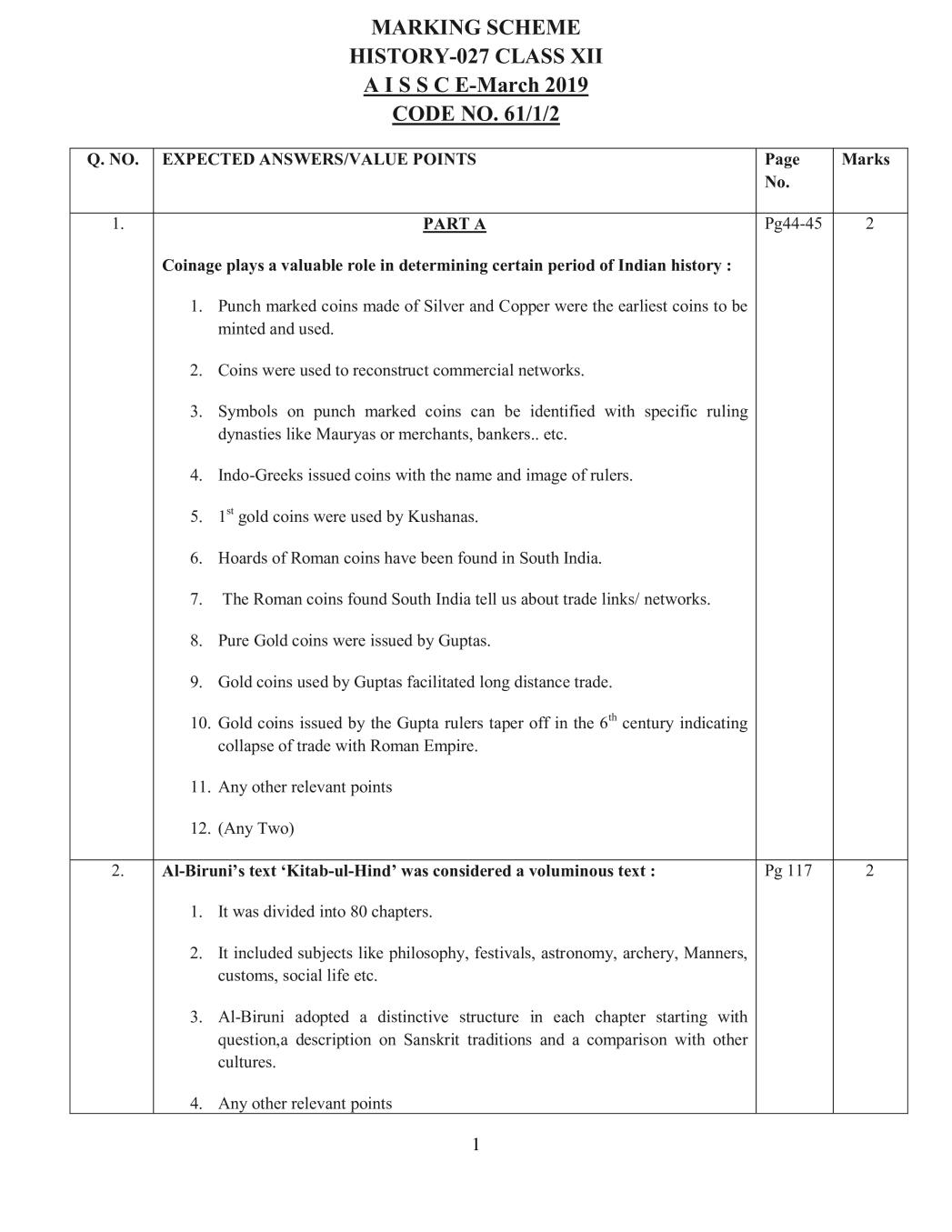
Page 1
HISTORY-027 CLASS XII
A I S S C E-March 2019
CODE NO. 61/1/2
Q. NO. EXPECTED ANSWERS/VALUE POINTS Page Marks
No.
1. PART A Pg44-45 2
Coinage plays a valuable role in determining certain period of Indian history :
1. Punch marked coins made of Silver and Copper were the earliest coins to be
minted and used.
2. Coins were used to reconstruct commercial networks.
3. Symbols on punch marked coins can be identified with specific ruling
dynasties like Mauryas or merchants, bankers.. etc.
4. Indo-Greeks issued coins with the name and image of rulers.
5. 1st gold coins were used by Kushanas.
6. Hoards of Roman coins have been found in South India.
7. The Roman coins found South India tell us about trade links/ networks.
8. Pure Gold coins were issued by Guptas.
9. Gold coins used by Guptas facilitated long distance trade.
10. Gold coins issued by the Gupta rulers taper off in the 6th century indicating
collapse of trade with Roman Empire.
11. Any other relevant points
12. (Any Two)
2. Al-Biruni’s text ‘Kitab-ul-Hind’ was considered a voluminous text : Pg 117 2
1. It was divided into 80 chapters.
2. It included subjects like philosophy, festivals, astronomy, archery, Manners,
customs, social life etc.
3. Al-Biruni adopted a distinctive structure in each chapter starting with
question,a description on Sanskrit traditions and a comparison with other
cultures.
4. Any other relevant points
1
Page 2
3. Features of towns built by Mughals in India during the 16th and the 17th Pg 318 1+1=2
Century:
1. The Mughal towns were centres of imperial administration and control.
2. The monumental buildings in the towns were famous for their imperial
grandeur and wealth.
3. Residence in Mughal cities was a symbol of status and prestige.
4. Emperor lived in a fortified palace.
5. These towns had mosques, tombs, gardens, bazars etc.
6. The Mughal mansabdars and jagirdars lived in these cities.
7. They were centres for the production of exclusive handicrafts for the king
and the nobles.
8. They were markets for the people and the army.
9. The imperial army was located in the imperial capital.
10. Important Mughal cities were Agra, Delhi, Lahore, Fatehpur Sikri etc.
11. Any other relevant point.
12. (Any two points)
OR
New Black Town:
Pg 332- 1+1=2
1. This town housed native weavers, artisans and middlemen and interpreters 335 and
who played a role in company’s trade. 343
2. This town resembles traditional Indian town.
3. The town had living quarters, temple and bazaar.
4. It had narrow lanes and by lanes.
5. The black town was inhabited by Native Indians.
6. The Black Town was located outside the Fort.
7. The Black Town was dirty, overcrowded, unplanned, unhealthy.
8. No attention was paid to public health in Black Towns.
2
Page 3
10. Any other relevant point.
11. (Any two points)
4. PART B Pg 13- 4
14
Harappans had contacts with West Asia:
1. Harappans got their copper from Oman
2. Chemical analysis shows that Omani copper and Harappan artifacts had
traces of nickel.This suggests they have a common origin.
3. A large Harappan jar has also been found at Omani sites.
4. Mesopotamian texts tell us about to copper coming from Magan (Oman)
5. Other archaeological finds suggest of long distance contact eg Harappan
seals, beads, dice.. etc.
6. Communication with Oman and other west Asian countries was by sea route.
7. Any other relevant point.
8. (Any Four)
5. Administrative features of Mauryan Empire :
1. Mauryan Empire was a Monarchy.
2. There were 5 major political centres. Pg32-35 4
3. The capital was Pataliputra and provincial centres were Taxila, Ujjajini,
Tosali and Suvarnagiri.
4. The Empire extended from North West India to Andhra Pradesh,Orissa and
Uttarakhand.
5. The administration was strongest around the capital and provincial centres.
6. The provincial centres like Taxila and Ujjain were located on long distance
trade routes and Suvarnagiri was near Gold mine in Karnataka.
7. The army protected long distance movement of people and food.
8. Megasthenes mentions a committee for coordinating military activity.
9. There were officials to superintendent rivers, measure land, inspect canals,
monitor huntsmen..etc
3
Page 4
11. The officials superintended occupations connected with land.. etc.
12. The officials were given power to reward and punish those under their
supervision.
13. Arthashastra gives details of administrative set up.
14. Special officers called the Dhamma Mahamattas were appointed to spread
the message of Dhamma.
15. Any other relevant points
(Any 4)
6. Mahanvami Dibba of Vijaynagara was a centre of elaborate rituals.
1. Mahanavami Dibba is a platform with a base of 11,000 sq ft and a height of
40 ft.
2. It supported a wooden structure.
Pg 180- 4
3. The base of the platform is covered with relief carvings. 181
4. Rituals associated with the structure concluded with the Dussehra, Durga
Puja or Navaratri.
5. The kings displayed their prestige, power on the occasion.
6. The images were worshipped.
7. The state horse was worshipped.
8. A ceremony of sacrificing animals.
9. Dances, Wrestling matches.
10. Processions of decorated horses, elephants, Chariots, Soldiers,
11. Ritual presentations of Nayakas before the king.
12. The king inspected the armies of Nayakas.
13. Gifts, tributes were given by Nayakas to the king.
14. The Mahanavami Dibba remains an enigma for many scholars.
15. Any other relevant points
(To be assessed as a whole)
4
Page 5
Assembly. 20
1. N G Ranga was a socialist leader.
2. He wanted the minorities to be interpreted in economic terms.
3. The real minorities were the poor and downtrodden.
4. Legal rights given by the constitution were meaningless for the poor people
in the villages.
5. He said it was essential to create conditions where rights could be enjoyed.
6. The poor are depressed and suppressed.
7. The tribal traditional laws are violated and their lands are snatched by
merchants.
8. The tribals are treated like slaves.
9. The money lenders exploited the poor tribals.
10. The zamindars exploited poor villagers.
11. The poor peasant and the tribals do not get even basic education.
12. Poor people need protection.
13. Poor people need a ladder.
14. Any other relevant points
(To be assessed as a whole)
8. American Civil War : Pg 280- 4
282
1. Because of American Civil War, the American export of cotton to Britain
fell short.
2. Britons sent messages to India to grow cotton.
3. The ryots in Bombay Deccan promised loan for growing cotton. India was
suitable for cotton growth.
4. The Ryots had access to limitless credit
5. Cotton production expanded in Bombay Deccan.
6. Some Rich peasants did gain but poor peasants fell into heavy debt.
7. Moneylenders made the lives of ryots miserable.
5
Page 6
9. The moneylender was devious and deceitful and exploited the peasant.
10. The moneylenders violated the customary norms..
11. The credit flow to the ryots was stopped after the civil war.
12. Many ryots lost their lands, homes and resources to the moneylender.
13. Any other relevant point.
14. (To be assessed as a whole)
OR
The religious divisions were hardly noticeable during the uprising Pg 301 4
1. The 1857 rebellion was seen as war in which both Hindus and Muslims
equally to lose or gain.
2. The proclamations appealed to all sections of people irrespective of their
caste or creed.
3. The proclamations issued by the Muslim princes or in their names addressed
the Hindu sentiments.
4. The Ishtahars harked back to pre-British days when Hindu-Muslim unity and
coexistence was glorified.
5. The proclamations issued in the name of Bahadur Shah appealed both to the
people to join the fight under the standard of both Mahavir and Mohammad.
6. The British tried to create a rift among them but failed.
7. The religious divisions were hardly noticeable during the uprising.
8. Any other relevant point.
(To be assessed as a whole)
6
Page 7
1. Mughals had cultural and intellectual contacts with Iran.
2. Persian was used in the court of Iran.
3. Iranians and Central Asian migrants sought positions in the Mughal Courts.
4. Persian was elevated to a language of the Mughal empire.
5. The use of persian language became a symbol of power and prestige.
6. It was the language of the elite.
7. It was spoken by the king and royal household.
8. It was language of the administration at all levels.
9. Official histories were written in persian eg.Akbar Namah ..etc.
10. Persian became indianised by absorbing from indian languages.
11. Urdu sprang from Persian.
12. Many texts were translated into Persian eg. Babur Namah, Mahabharata..etc
13. Any other relevant point.
(To be assessed as a whole)
OR
Centre of Mughal Power was the King’s Court: Pg237 4
1. The physical arrangement of the court focused on the king
2. The takht was the Axis Mundi.
3. The canopy on the throne was the symbol of kingship.
4. Status and hierarchy was well defined.
5. Specific places were assigned to countries according to their importance in
the eyes of the emperor.
6. No one was allowed to move from his allocated position without permission.
7. Forms of address, courtesies and speech were specified. Any violation was
punished.
8. Forms of salutation indicated a person’s status in the hierarchy.
7
Page 8
10. Jharokha Darshan.
11. Meetings with nobles in the Diwan-i-Khas.
12. Special occasions and festivals were celebrated in the court.
13. Titles were granted to men of merit.
14. Awards and gifts were given by the king to nobles and others in the court.
15. The countries visited the king empty handed.
16. The king negotiated with the ambassadors of different countries in the court.
17. Mansabdars were an important part of the Mughal court.
18. In Mughal court, political alliances and relations were forged.
19. Status and hierarchies were well defined.
20. Political system was devised by the Mughal courts.
21. Imperial structure of military power was defined by the Mughal Courts.
22. Any other relevant point.
(To be assessed as a whole)
10. PART C Pg 197- 4
200
The Chronicle of Ain-i-Akbari :
1. Ain is a mine of information regarding agricultural aspects of Mughal rule.
2. It recorded meticulously the arrangements made by the state to develop
agriculture.
3. It explains the ways to collect land revenue.
4. It records the arrangements made by the state to ensure cultivation.
5. The aim of Ain was to present a vision of Akbar’s empire where social
harmony prevailed.
6. It gives the arrangements made by the state to regulate the relation between
the landowners and the state.
7. Any revolt against the Mughal State was predestined to fail.
8. It gives a view of the peasants from the top.
8
Page 9
Gujarat, Maharasthra, Rajasthan.. etc.
10. Any other relevant point.
11. Any two points
Irrigation and Technology:
1. Monsoons remained the backbone of Indian economy.
2. Artificial system of irrigation was devised.
3. Canal irrigation was developed along with Persian wheels.
4. Wooden plough with iron tip was used to till the land.
5. A drill was used to plant seeds.
6. Any other relevant point.
7. Any Two points
Pg211-
OR 13
The Role of Zamindars :
1. The Zamindars were landowners and enjoyed certain social and economic
privileges.
2. Milkiyat
3. They performed certain services to the state.
4. Caste was one factor the elevated their status.
5. Zamindars often collected revenue on behalf of the state.
6. They also had control over military resources.
7. Most of the Zamindars had fortresses.
8. They had small military contingents.
9. They belonged to Brahmin,Rajput,Intermediate castes,and Muslims as well.
10. Zamindaris were consolidated in a slow process
11. Zamindars spearheaded the colonization of agricultural lands.
12. They monetized the economy of the countryside.
9
Page 10
14. Zamindars often received support from the peasant in their struggle against
the state.
15. The Zamindars are seen as paternal figures and patrons.
16. The bhakti saints do not see them as exploiters of peasants.
17. Any other relevant point.
18. To be assessed as a whole.
11 Ideal of Patriliny and gendered Access to property from 6th Cent BCE to 6th Pg 55, 4
Cent CE : 56, 58
1. Under patriliny, sons could claim the resources (including the throne in the
case of the kings) of their fathers when the latter died.
2. The war of Mahabharata was a fought over the issue of patriliny.
3. It was feud over land and power between two warring cousins of the Kuru
family.
4. This ideal existed even before war.
5. Most of the dynasties followed this rule.
6. Sometimes when there was no son, then brothers succeeded.
7. If there were no brothers, kinsmen claimed the throne.
8. In exceptional cases women such as Prabhavati Gupta exercised power.
9. Any other relevant point.
Gendered Access to property :
1. After the death of the father, paternal estate was equally divided among sons.
2. Women could not claim any share.
3. Women could have only Stridhan.
4. Prabhavati Gupta was an exception when a woman claimed the resources of
her father.
5. Manusmriti warned women against honouring wealth, family property and
valuables without husband’s permission.
6. Women acquired wealth during the ritual of marriage, bridal processions, as
a token of affection from her brother, mother or father as a gift from her
10
Page 11
7. Any other relevant point.
(to be assessed as a whole)
OR
Elements considered by historians to analyse Mahabharata:
1. Language – Sanskrit used in Mahabharata is simpler than the Vedas.
2. Narrative section contains perceptions about social norms.
3. Didactic sections include stories.
4. Narrative section may have a social message.
5. The didactic and the narrative sections are not water tight.
6. Didactic sections were added later.
7. The historians give consideration to the kind of texts-whether meant for
chanting rituals or telling stories.
8. They find out the author and the ideas that shaped the text.
9. They study the intended audience for the text.
10. They find out the possible date of the text.
11. They find out the place where the text was composed.
12. They study the content of the text and undertstand their historical
significance.
13. The historians agree that the Mahabharata was meant to be dramatic.
14. It is a difficult task to analyse the complex text of Mahabharata. Under the
leadership of a noted Indian Sanskritist, V.S. Sukthankar, team of scholars
started preparing a critical edition of the Mahabharata.
15. It meant collecting Sanskrit manuscripts of the text, written in a variety of
scripts, from different parts of the country.
16. The team worked out a method of comparing verses from each manuscript.
17. Common verses from most sections were selected and published in several
volumes,
18. The project took 47 years to complete. They found out that there were
11
Page 12
19. The manuscripts were found from Kashmir and Nepal to Kerala and Tamil
Nadu studied.
20. Regional variations in the ways in which the text had been transmitted over
the centuries were documented in footnotes.. etc.
21. The variations are reflective of the complex processes that shaped early (and
later) social histories
22. When issues of social history were explored, the belief that everything that
was laid down in these texts was actually practiced was not always true and
that they were also questioned and occasionally even rejected.
23. Any other relevant point.
(to be assessed as a whole)
Quit India Movement was a mass movement bringing into its ambit hundreds of 8
thousands of ordinary Indians.
12
1. The Quit India Movement was launched in August 1942 by Gandhiji.
Pg 363-
2. The slogan was Do or Die and British leave India. 364
3. It was the third major movement against British Rule.
4. Gandhiji was jailed.
5. Strikes and acts of sabotage were organized all over the country.
6. Jayaprakash Narayan organized resistance.
7. Independent governments were set up at Satara and Medinipur.
8. The British suppressed the movement with force.
9. It took more than a year to suppress the movement.
10. Thousands of Indians joined the mass movement.
11. Large number of students left their colleges to go to jail.
12. Congress leaders were sent to jail.
13. Jinnah expanded his influence over Muslims in Punjab and Sind.
14. In 1944, Gandhiji was released from prison.
15. Congress started negotiations with the League.
12
Page 13
17. (To be assessed as a whole)
OR
Pg363-
The worst is over but Indians need to work collectively for the equality of all 64
classes and creeds:
1. On 26th Jan 1948, Gandhiji spoke these words at a prayer meeting.
2. He had the hope that geographically and politically India was divided into
two but the people will remain friends and brothers forever and respect and
help each other.
3. The months after Independence was called as the ‘finest hour’ of Gandhiji by
many scholars.
4. He went to the riot ridden areas of Bengal, Calcutta and Delhi.
5. His meetings were disrupted by angry refugees.
6. Gandhi was concerned about minorities in India as well as Pakistan.
7. He appealed to the Sikhs, the Hindus and the Muslims to forget their past
and live in peace.
8. Due to the initiative of Gandhiji and Nehru, the Rights of Minorities
Resolution was passed by the Congress.
9. Gandhiji was a one man army in his efforts to restore communal harmony.
10. Gandhiji believed that people’s hearts could be changed with Non-Violence.
11. Gandhiji came to Delhi in Sep 1947 and addressed the Sikhs at Sisganj
Gurudwara to bring peace. Gandhiji started a fast to bring about a change in
the hearts of people.
12. Any other relevant points
(To be assessed as a whole)
PART D
The Muslim League Resolution of 1940:
13 13.1 (a) Major demand of league was autonomy for Muslim majority areas of the
subcontinent.
(b) The areas of Muslim majority in North West and Eastern Zone should be
grouped together to constitute independent states.
13
Page 14
(d )Any other relevant point
(e )(To be assessed as a whole) 2+3+2=
7
13.2
(a)The outcome of provincial elections of 1937 and the attitude of congress
thereafter.
(b) They wanted autonomous and sovereign zones for Muslims
Pg 387
(c) They wanted geographically contiguous units demarcated into regions.
(d) Muslim majority areas can be made autonomous.
(e )Two nation theory
(f) They felt that only a Muslim majority province will ensure the protection and
preservation of Muslim culture.
(e )Any other relevant point
(f )(To be assessed as a whole)
13.3
(a)This was an ambiguous resolution because it never demanded Pakistan in clear
terms.
Muslim League Resolution of 1940
(a) They wanted autonomous for Muslims and sovereign zones for Muslims
(b) They wanted geographically contiguous units demarcated into regions.
(c) Muslim majority areas can be made autonomous.
OR
A small basket of grapes: 2+2+3=
7
13.1 Khushdeva Singh was a doctor,specialist in curing T.B and posted at
Dharampur (H.P).
Attitude of the people of Karachi towards Kushdeva Singh:
i. They loved them.
ii. They had respect for him.
14
Page 15
iv. They were generous with their hospitality.
v. They presented him with a small basket of grapes.
13.2 On Karachi airport many people came to receive him . They gave much of their
time to him and had lunch with him. He was very happy.
13.3 He was overwhelmed with love and generosity he received at Karachi airport.
Kushdeva Singh had showered love and compassion on the people and return he got
love and respect from his friends at Karachi.
A prayer to Agni:
14 14.1 There were tradition of thought , religious belief and practices
(a) Rigveda consists of hymns in praise of various deities especially Agni , Indra and Pg 84 2+2+3=
Soma. 7
(b) Hymns (Mantras) were chanted
(c) Sacrifices were performed .
14.2 The people prayed to Agni for cattle, sons, good health, long life ..etc.
14.3 Vedic Sanskrit is a special type of Sanskrit in which verses are composed.
14.1 Vedic Sanskrit is significant because :
i. It was used to compose verses from the Vedas.
ii. It was a special kind of Sanskrit taught to men belonging to priestly families.
(Two points)
14.2 Two Vedic traditions of religious beliefs and practices :
i. Sacrifices or Yajnas
ii. Ashwamedha
iii. Vajapeya
iv. Rajasuya
v. Chanting of mantras
vi. Prayers to Gods, Agni, Varuna and Indra
(Any two points)
15
Page 16
i. To appeal to Gods for abundant food.
ii. To appeal to Gods for cows.
iii. To appeal to Gods for abundant wealth.
iv. To appeal to God for nourishment.
v. To append to God for Sons.
vi. To appeal to God for long life.
(Any two points)
The One Lord:
15 15.1 (a) Kabir described ultimate reality as Allah, Pir , Khuda , Hazrat, Ram, Rahim, Pg 387 2+2+3=
Karim, Kishan, Hari. 7
(b) God is called by many names but he is one and the same.
(c) To him the ultimate reality is Alakh and Nirakar.
(d) He used terms like Atman and Brahman.
(e)He used words with mystical connnotation like Shabda or Shunya
(f) He is a Nirguna Bhakti saint.
(g) Any other relevant point
(To be assessed as a whole)
15.2 People waste their lives in disputation between Allah and Ram. In fact he is one.
(a) People think that there are many Gods.
(b) Kabir says that there is one God who is called by many names.
(c) Some think that their God is pleased when a Goat is killed and other feel that his
is pleased when a Cow is killed. Both are wasting their lives in disputation.
(d) Any other relevant point.
(To be assessed as a whole)
15.3Kabir believed in one God who prevails everywhere . God can be realized
through recitation of Namsimran, Zikr, Ishq.
(Any other relevant point on lyrical beauty of the poem withor without example or
16
Page 17
(To be assessed as a whole)
PART E
16 Filled in map attached
For the Visually Impaired
16.1 Territories under Babur
Delhi, Agra, Panipat, Amber, Ajmer, Lahore, Goa
16.2 Important centres of the national movement :
Champaran, Kheda, Ahmedabad, Benaras, Amritsar, Chauri Chaura, Lahore,
Bardoli, Dandi, Bombay (Quit India Resolution), Karachi.
OR
16.2 Mature Harappan sites :
Harappa, Banawali, Kalibangan, Balakat, Rakhigadi, Dholavira, Nageshwar, Lothal,
Mohenjodaro, Chanhudaro, Kot Diji.
17
Page 18
Document Details
| Board / Org | CBSE |
| Exam | Class 12 |
| Type | Solution |
| Pages | 18 |
| Updated | 09 Jun 2026 |