Manipur Board Class 12 Syllabus 2027 Agriculture
Finished viewing? Save it for later —
Download Manipur Board Class 12 Syllabus 2027 Agriculture (PDF · 7 pages)About Manipur Board Class 12 Syllabus 2027 Agriculture
Manipur Board Class 12 Syllabus 2027 Agriculture is available here for free download. Published by Manipur Board for Class 12, this syllabus can be viewed online or downloaded as a PDF (7 pages). Candidates preparing for Class 12 can use Manipur Board Class 12 Syllabus 2027 Agriculture to understand the exam pattern, the type of questions asked, and the overall difficulty level.
Frequently Asked Questions
How can I download Manipur Board Class 12 Syllabus 2027 Agriculture?
Open this page and click the Download button to save Manipur Board Class 12 Syllabus 2027 Agriculture as a PDF. It is completely free on AglaSem Docs.
Is Manipur Board Class 12 Syllabus 2027 Agriculture free to download?
Yes. Manipur Board Class 12 Syllabus 2027 Agriculture can be viewed online and downloaded as a PDF free of cost on AglaSem Docs.
How many pages does Manipur Board Class 12 Syllabus 2027 Agriculture have?
Manipur Board Class 12 Syllabus 2027 Agriculture contains 7 pages, which you can read online or download together as a single PDF.
Where can I find more Class 12 study material?
You can find more Class 12 question papers, sample papers, syllabus, and answer keys on AglaSem Docs.
Manipur Board Class 12 Syllabus 2027 Agriculture – Text
Read the full text of this syllabus below — useful to quickly search, copy and reference the content online without downloading the PDF.
📄 View text version (8 pages)
Page 1
Manipur Board Class 12
Syllabus 2027
Agriculture
EXAM YEAR TYPE SUBJECT
Manipur Class 12 2027 Syllabus Agriculture
Notes · Sample Papers · Previous Year Papers · Mock Tests
Page 2
.co s e m
s em l a
a ag
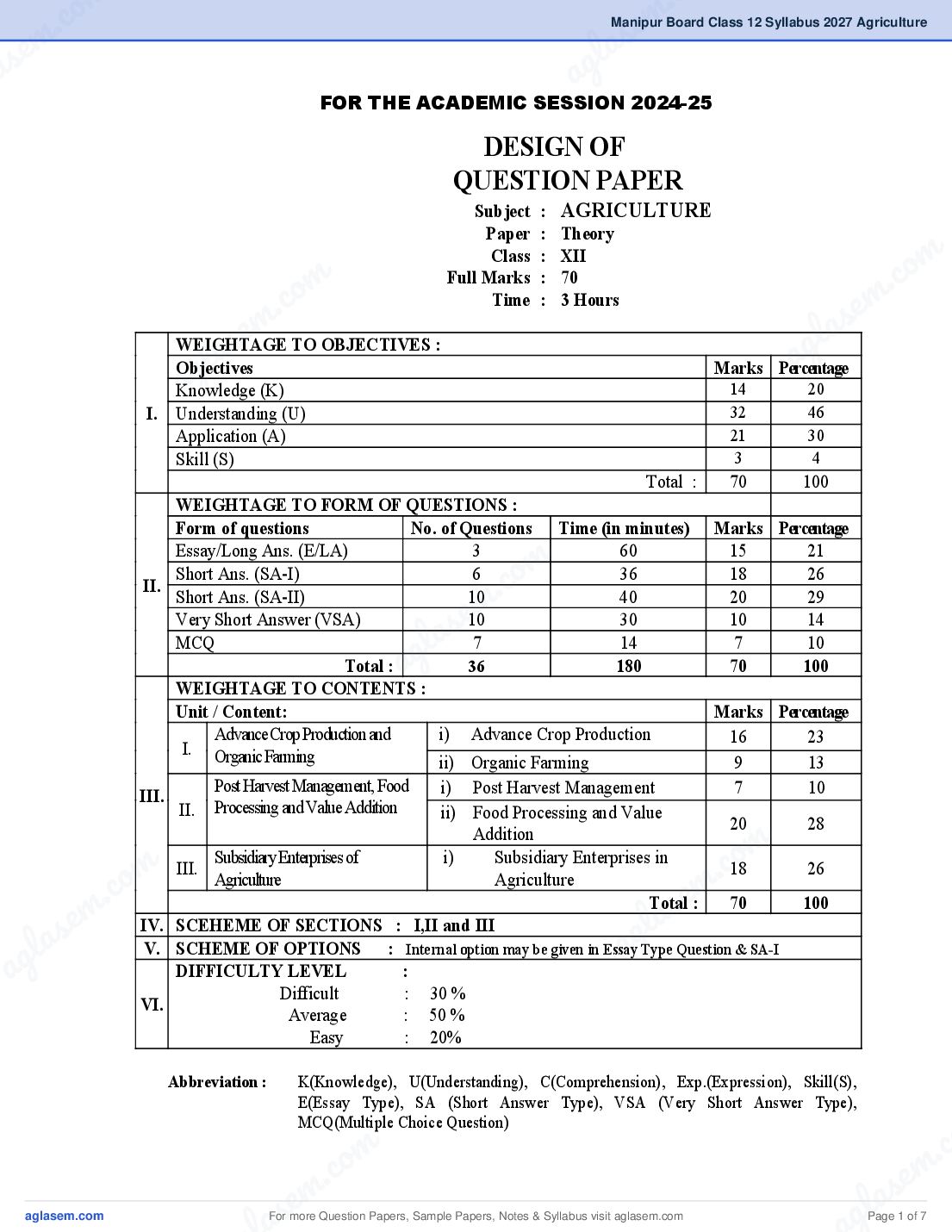
FOR THE ACADEMIC SESSION 2024-25
DESIGN OF
QUESTION PAPER
Subject : AGRICULTURE
Paper : Theory
Class : XII m
om
Full Marks : 70 . co
. c Time : 3 Hours
e m
e m l as
as
WEIGHTAGE TO OBJECTIVES :
l a g
ag
Objectives
Knowledge (K)
Marks Percentage
14 20
I. Understanding (U) 32 46
Application (A) 21 30
Skill (S) 3 4
Total : 70 100
WEIGHTAGE TO FORM OF QUESTIONS :
Form of questions No. of Questions Time (in minutes) Marks Percentage
Essay/Long Ans. (E/LA) 3 60 15 21
m
.co
Short Ans. (SA-I) 6 36 18 26
II.
Short Ans. (SA-II) 10
e m 40 20 29
Very Short Answer (VSA)
MCQ l as 10
7
30
14
10
7
14
10
Total : ag 36 180 70 100
WEIGHTAGE TO CONTENTS :
Unit / Content: Marks Percentage
Advance Crop Production and i) Advance Crop Production 16 23
I. Organic Farming
ii) Organic Farming 9 13
Post Harvest Management, Food i) Post Harvest Management 7 10
III.
II. Processing and Value Addition ii) Food Processing and Value
20 28
Addition
m
m III.
Subsidiary Enterprises of i) Subsidiary Enterprises in
18 26 .co
.co m
Agriculture Agriculture
m Total : 70 s e 100
s e IV. SCEHEME OF SECTIONS : I,II and III
g la
g la V. SCHEME OF OPTIONS : Internal option may be given in Essay Type Question & SA-I a
a DIFFICULTY LEVEL
Difficult
:
: 30 %
VI.
Average : 50 %
Easy : 20%
Abbreviation : K(Knowledge), U(Understanding), C(Comprehension), Exp.(Expression), Skill(S),
E(Essay Type), SA (Short Answer Type), VSA (Very Short Answer Type),
MCQ(Multiple Choice Question)
m . c
c. o s e m
s em
Page 1 of 7
Page 3
DESIGN OF
QUESTION PAPER
Subject : AGRICULTURE
Paper : Theory
Class : XII
Full Marks : 70
Time : 3 Hours
WEIGHTAGE TO OBJECTIVES :
Objectives Marks Percentage
Knowledge (K) 10 15
Understanding (U) 35 50
I.
Application (A) 21 30
Skill (S) 04 05
70 100
Total :
WEIGHTAGE TO FORM OF QUESTIONS :
No. of Time
Form of questions Marks Percentage
Questions (in minutes)
Essay/Long Ans. (E/LA) 03 60 15 21
II. Short Ans. (SA-I) 06 37 18 26
Short Ans. (SA-II) 10 40 20 29
Very Short Answer (VSA) 07 21 07 10
MCQ 10 22 10 14
Total : 36 180 70 100
WEIGHTAGE TO CONTENTS :
Unit / Content: Marks Percentage
i) Advance Crop
Advance Crop Production and 16 23
A Production
Organic Farming
ii) Organic Farming 9 13
i) Post Harvest
7 10
Post Harvest Management, Food Management
III. B
Processing and Value Addition ii) Food Processing and
20 28
Value Addition
Subsidiary Enterprises of i) Subsidiary Enterprises
C. 18 26
Agriculture in Agriculture
70 100
Total :
IV. SCEHEME OF SECTIONS : A, B and C
V. SCHEME OF OPTIONS : Internal option may be given in Essay Type Question
DIFFICULTY LEVEL :
Difficult : 35 % of the total marks
VI.
Average : 50 % of the total marks
Easy : 15 % of the total marks
Abbreviation : K(Knowledge), U(Understanding), C(Comprehension), Exp.(Expression),
Skill(S), E(Essay Type), SA (Short Answer Type), VSA (Very Short Answer
Type), MCQ(Multiple Choice Question)
For more Question Papers, Sample Papers, Notes & Syllabus visit Page 2 of 7
Page 4
.co s e m
s em l a
a ag
AGRICULTURE
Theory
Class XII
m
One paper
om
Time :3 hours 70 marks
. co
. c em
Section e m Titles
Marks
l as
I l as
Advanced Crop Production and Organic Farming ag
Unitwise Total
ag Unit I : Advance Crop Production 16
Unit II: Organic Farming 09 25
II Post-Harvest Management, Food Processing and Value Addition
Unit III: Post-Harvest Management 07
Unit IV: Food Processing and Value Addition 20 27
III Subsidiary Enterprises of Agriculture UnitUnit
V: Subsidiary Enterprises in Agriculture 18 18
Total 70
o m
c
. -I
e m
SECTION
Unit- I: Advanced Crop Productionl a s
a g of essential plant nutrients. Classification of essential
Soil fertility, productivity and concept
plant nutrients.
Roles and functions of essential plant nutrients, their important deficiency symptoms.
Introduction to manure, fertilizers, Bio-fertilizers, their methods of application. Concept of
Integrated Nutrient Management (INM).
Various irrigation methods. Concept of precision and pressure irrigation - Drip and sprinkler
irrigation.
Methods of insect pest and disease management - Chemical, Biological and Mechanical.
Concept of Integrated Pest Management (IPM).
m
m
c. oUnit - II: Organic Farming m .co
m s e
s e Concept, history and importance of Organic farming.
g a for the promotion
lSchemes
g la a
Important food products grown organically. Important Government
a of organic farming in our country. Kitchen gardening.
m . c
c. o s e m
s em
Page 3 of 7
Page 5
Unit III: Post Harvest Management
Post harvesting management of fruits, vegetables and flowers, cereals, pulses and oilseeds.
Important Government schemes for food sector.
Unit IV: Food Processing and Value Addition
Principles and methods of food processing and preservation. Benefits of food processing.
Important value added products from fruits, vegetables, cereals, pulses and oil seeds.
Preparation of jam, jelly, ketchup, , pickles, juice.
Flowers and their harvesting: important processed flower products, packaging, storage and their
marketing.
Concept of safe food and important food regulations.
SECTION-III
Unit V: Subsidiary Enterprises in Agriculture
Important subsidiary enterprises based on Agriculture including Horticulture and their
importance in the socio-economic status of an individual.
Mushroom, their nutritional status and methods of production
Beekeeping and its important usage and importance of Honey, Wax and Royal jelly.
Preparation of Bio-pesticides (plant based), Organic manures (composts) and Vermicomposting.
*****
For more Question Papers, Sample Papers, Notes & Syllabus visit Page 4 of 7
Page 6
.co s e m
s em l a
a ag
AGRICULTURE
CLASS XII
(PRACTICAL)
One Practical Paper 30 Marks Time: 3 Hours
m
Section
om Titles Marks . co
. c em
I
e
Advanced Crop Production and Organic Farming
m
08
l as
II
as Post-Harvest Management, Food Processing and Value Addition
l Subsidiary Enterprises in Agriculture
06
a g
g
III
a Collection and Visit Report
IV
06
05
V Viva Voce 05
Total 30
SECTION: I
Unit I: Advanced Crop Production and Organic Farming
(a) Soil sampling and determination of Soil pH.
m
.co
(b) Determination of soil organic carbon content.
(c) Preparation of nursery and seed beds.
e m
(d) Seed treatment with fungicides and Bio-fertilizers.
as
(e) (e) Identification of different types of chemical fertilizers, composts, bio-fertilizers.
l
ag
(f) Calculation of fertilizer requirement of crops (for wheat, rice and maize) based on their nutrient
needs.
(g) Preparation of FYM and Compost.
(h) Calibration & dusters for pest control.
(i) Determination of moisture content of crop seeds (wheat, rice, maize and mustard).
(j) To find out 100-grain weight of crop seeds (wheat, rice, maize and mustard).
(k) Visit to a crop field and compare healthy plant with a diseased and insect affected plant.
(l) Calculation of different types of Insecticides, Fungicides and Herbicides.
SECTION: II
m
m Post-Harvest Management , Food Processing and Value Addition m
c. o Unit(a)II: Visit .co
m s e
s e to Bakery Unit, Local Chakki.
g l a
la
(b) Preparation of Jam, Jelly, ketchup and Morabba
a
ag
(c) Drying of fruits, vegetables and flowers.
(d) Preparation of pickles.
(e) Identification of fresh and aged vegetables and fruits.
(f) Visit to cold storage and record the storage of various fruits and vegetables.
(g) Harvesting and packaging of flowers.
(h) Preparation of flower arrangements such as garland and rangoli.
(i) Visit to a flower mandi and record the activities in the mandi.
(j) Visit to a local fruit market and record the activities in the market.
m . c
c. o s e m
s em
Page 5 of 7
Page 7
Unit III: Subsidiary Enterprises in Agriculture
(a) Preparation of plant based bio-pesticides (neem)
(b) Visit to Mushroom production unit.
(c) Visit to nearby apiary and record the process of beekeeping.
(d) Observe the characteristics of different bee products (honey and wax).
(e) Visit to a vermicomposting unit.
(f) Observe the characteristics of compost.
Notes:
1) The students have to prepare a report on the visits recording their observations on the subject.
2) In case of practical of fruit and vegetable preservation and methods of production of value
added products from fruits and vegetables, the student will have to write the procedure adopted
and the necessary precautions to be taken in the answer sheet provided.
SECTION – IV
Report on the Visits
The student have to prepare a report of their visit to different organizations and submit to Subject
teacher for the evaluation. The report must contain the student’s original work and observations.
SECTION – V
Viva Voce
Students can be asked questions based on:
(i) Identification of objects.
(ii) Visit Report analysis.
(iii) Experiences in their field visits, etc.
A range of 5 to 10 questions can be asked depending on the response of the student. Evaluation 5x1=5 Or
should be based on number of questions answered. Evaluator should stick to the time and ½x10=5 number
of questions.
For more Question Papers, Sample Papers, Notes & Syllabus visit Page 6 of 7
Page 8
.co s e m
s em l a
a ag
PRESCRIBED TEXT BOOKS FOR CLASSES XI AND XII:
1. Handbook of Animal Husbandry
Published by : Directorate of Information and Publications of Agriculture, Indian Council
of Agricultural Research, Krishi Anusandhan Bhavan, Pusa, New Delhi – 110012.
m
om
2. A Text Book of Animal Husbandry by G.C. Banerjee . co
. c
Published by Oxford & IBH Publishing Co. Pvt. Ltd., New Delhi.
e m
e m l as
as
3. Hand Book of Agriculture – ICAR publication
l ag
ag or
Hand Book of Agriculture by S.C. Panda,
Published by : J.V. Publishing House, Jodhpur.
4. A text book of Plant Breeding by Purohit & Purohit,
Published by : J.V. Publishing House, Jodhpur.
5. A text book of Genetics by Purohit & Purohit,
Published by : J.V. Publishing House, Jodhpur.
o m
c
6. A text book of Production Technology of.fruits crops by Prasad & Raju,
e mJodhpur.
l as
Published by : J.V. Publishing House,
ag of Vegetables & Flowers by Prasad , Raju & Bhardwaj,
7. A text book of Production Technology
Published by : J.V. Publishing House, Jodhpur
8. A text book of Field Crops by Mukund Joshi,
Published by : PHI Learning Private Ltd., Delhi.
*****
m
m .co
m .co s e m
s e g la
g la a
a
m . c
c. o s e m
s em
Page 7 of 7
Document Details
| Board / Org | Manipur Board |
| Exam | Class 12 |
| Type | Syllabus |
| Pages | 7 |
| Updated | 04 Nov 2026 |