Manipur Board Class 12 Syllabus 2027 Statistics
Finished viewing? Save it for later —
Download Manipur Board Class 12 Syllabus 2027 Statistics (PDF · 7 pages)About Manipur Board Class 12 Syllabus 2027 Statistics
Manipur Board Class 12 Syllabus 2027 Statistics is available here for free download. Published by Manipur Board for Class 12, this syllabus can be viewed online or downloaded as a PDF (7 pages). Candidates preparing for Class 12 can use Manipur Board Class 12 Syllabus 2027 Statistics to understand the exam pattern, the type of questions asked, and the overall difficulty level.
Frequently Asked Questions
How can I download Manipur Board Class 12 Syllabus 2027 Statistics?
Open this page and click the Download button to save Manipur Board Class 12 Syllabus 2027 Statistics as a PDF. It is completely free on AglaSem Docs.
Is Manipur Board Class 12 Syllabus 2027 Statistics free to download?
Yes. Manipur Board Class 12 Syllabus 2027 Statistics can be viewed online and downloaded as a PDF free of cost on AglaSem Docs.
How many pages does Manipur Board Class 12 Syllabus 2027 Statistics have?
Manipur Board Class 12 Syllabus 2027 Statistics contains 7 pages, which you can read online or download together as a single PDF.
Where can I find more Class 12 study material?
You can find more Class 12 question papers, sample papers, syllabus, and answer keys on AglaSem Docs.
Manipur Board Class 12 Syllabus 2027 Statistics – Text
Read the full text of this syllabus below — useful to quickly search, copy and reference the content online without downloading the PDF.
📄 View text version (8 pages)
Page 1
Manipur Board Class
12 Syllabus 2027
Statistics
EXAM YEAR TYPE SUBJECT
Manipur Class 12 2027 Syllabus Statistics
Notes · Sample Papers · Previous Year Papers · Mock Tests
Page 2
m .co
m .co s e m
se g l a
a
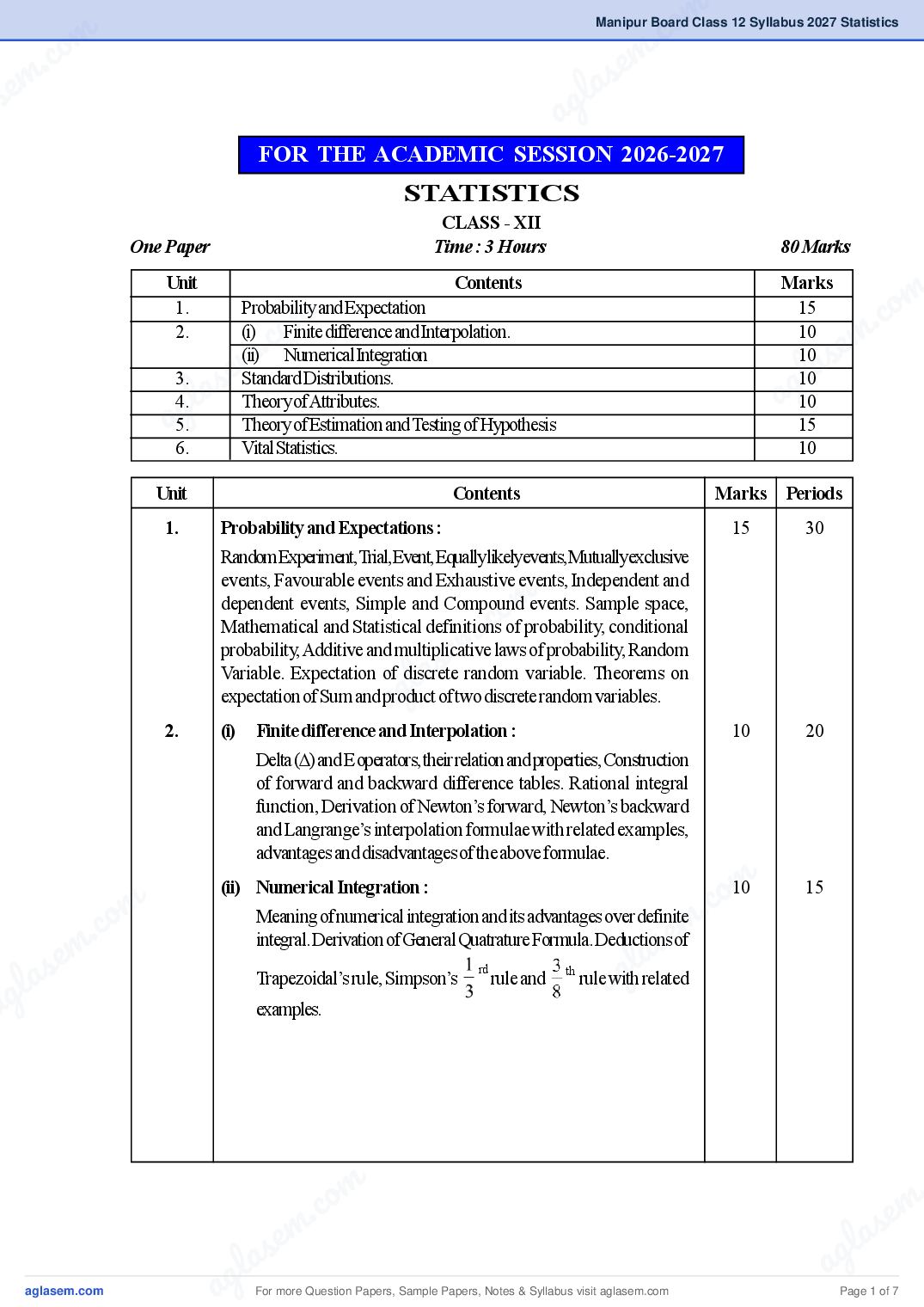
FOR THE ACADEMIC SESSION 2026-2027
STATISTICS
CLASS - XII
One Paper Time : 3 Hours 80 Marks
Unit Contents Marks
m
1. Probability and Expectation
m 15
.co
2.
m .co
(i) Finite difference and Interpolation.
(ii) Numerical Integration
10
10 s e m
s e l a
ag
3. Standard Distributions. 10
g
4.l a Theory of Attributes. 10
a5. Theory of Estimation and Testing of Hypothesis 15
6. Vital Statistics. 10
Unit Contents Marks Periods
1. Probability and Expectations : 15 30
Random Experiment,Trial, Event, Equallylikelyevents, Mutuallyexclusive
events, Favourable events and Exhaustive events, Independent and
m
.co
dependent events, Simple and Compound events. Sample space,
Mathematical and Statistical definitions of probability, conditional
e m
probability, Additive and multiplicative laws of probability, Random
las
Variable. Expectation of discrete random variable. Theorems on
ag
expectation of Sum and product of two discrete random variables.
2. (i) Finite difference and Interpolation : 10 20
Delta () and E operators, their relation and properties, Construction
of forward and backward difference tables. Rational integral
function, Derivation of Newton’s forward, Newton’s backward
and Langrange’s interpolation formulae with related examples,
advantages and disadvantages of the above formulae.
(ii) Numerical Integration :
o m
10 15
m Meaning of numerical integration and its advantages over definite .
c
m .co s
integral. Derivation of General Quatrature Formula. Deductionseofm
s e a
glrelated
la rulea
rd th
Trapezoidal’s rule, Simpson’s rule and with
ag examples.
m .
.co s e m
s em l a
g la ag
a For more Question Papers, Sample Papers, Notes & Syllabus visit Page 1 of 7
Page 3
3. Standard distributions : 10 15
Bernoulli trial, Derivation of Binomial and Poisson distribution and their
means and variances. Normal distribution, its importance and some basic
properties (without derivation).
4. Theory of Attributes : 10 20
Concept of attribute, positive and negative classes, order of classes,
number of classes, class frequencies upto 3 (three) attributes,
independence, association and consistency of attributes. Yule’s
coefficient of association and Contigency table.
5. Theory of Estimation and Testing of Hypothesis : 15 25
Concept of estimation, biased and unbiased estimators, simple and
composite hypothesis, Null hypothesis, Alternative hypothesis.
Critical and non-critical regions. Concept of type I and type II errors,
Level of significance, concept of degrees of freedom. Test of
significance for small sample based on student’s t, Fisher’s t X2 (chi
square) and F.
6. Vital Statistics : 10 25
Meaning of Vital Statistics and its uses. Methods of obtaining Vital
Statistics. Measurement of Mortality RatesCDR, SPDR and STDR.
Measurement of fertility and reproductive ratesCBR, GRR, TFR
and NRR, construction of complete life-table.
PRESCRIBED TEXTBOOKS :
1. Fundamental of Mathematical Statistics
By : S.C. Gupta and V.K. Kapoor (Shultan Chand & Sons)
2. Fundamental of Applied Statistics
By : S.C. Gupta and V.K. Kapoor (Shultan Chand & Sons)
3. Calculus of Finite Difference
By : H.C. Saxena (S. Chand & Co. Ltd.)
For more Question Papers, Sample Papers, Notes & Syllabus visit Page 2 of 7
Page 4
m .co
m .co s e m
se g l a
a
DESIGN OF
QUESTION PAPER
Subject : STATISTICS
Class : XII
Full Mark : 80
m
.co
Time : 3 Hours
om m
. c
WEIGHTAGE TO OBJECTIVES:
Objectives m s e
s e Marks Percentage
l a
a
Knowledge(K) 15
ag
12
I
g l
Understanding (U) 40 50
aApplication (A) 24 30
Skill (S) 04 05
Total : 80 100
WEIGHTAGE TO FORMS OF QUESTIONS:
Time
FORM OF QUESTIONS No. of questions Marks Percentage
(in minutes)
Essay/Long Answer (E/LA) 06 67 30 37
II Short Answer (SA-I) 03 27 12 15
Short Answer (SA-II) 04
m 27 12 15
.co
Short Answer (SA-III) 05 23 10 13
Very Short Answer(VSA)
e m06 13 06 07
MCQ
Total:la
s 10
34
23
180
10 13
100
WEIGHTAGE TO CONTENT:ag
80
Unit CONTENTS : Marks Percentage
1 Probability and Expectation 15 18.75
(i) Finite difference and Interpolation 10 12.50
2
(ii) Numerical Integration 10 12.50
3 Standard Distributions 10 12.50
4 Theory of Attributes 10 12.50
5 Theory of Estimation and Testing of Hypothesis 15 18.75
m
.co
6 Vital Statistics 10 12.50
m Total: 80 100
c. o IV SCHEME OF SECTIONS : NIL
s e m
e m SCHEME OF OPTIONS
a
: Internal option in one SA-I (case study question), two in SA-II, one
l
las V
VI DIFFICULTY LEVEL :
in SA-III and three in E/LA
ag
ag Difficult : 30% of the total marks
Average : 50% of the total marks
Easy : 20% of the total marks
Special Instruction: 1) Two questions of MCQ will be Assertion-Reason type question.
2) First option will be (a) & second option will be (b) in the internal
option
Abbreviation : K(Knowledge),U(Understanding), A (Application), Skill(S), E(Essay Type),
SA (Short Answer Type), VSA (Very Short Answer Type), MCQ(Multiple
m .
.co
Choice Question)
e m
em l as
las ag
ag For more Question Papers, Sample Papers, Notes & Syllabus visit Page 3 of 7
Page 5
Periodic Tests (Best 2 out of 3 tests conducted) 10 Marks
Field/Project Works 10 Marks
Conduct of Periodic Tests:
Periodic Test is a Pen and Paper assessment which is to be conducted by the respective
subject teacher. The format of periodic test must have questions items with a balance mix,
such as, very short answer (VSA), short answer (SA) and long answer (LA) to effectively
assess the knowledge, understanding, application, skills, analysis, evaluation and synthesis.
Depending on the nature of subject, the subject teacher will have the liberty of incorporating
any other types of questions too. The modalities of the PT are as follows:
a) Mode: The periodic test is to be taken in the form of pen-paper test.
b) Schedule: In the entire Academic Year, three Periodic Tests in each subject
may be conducted as follows:
Test Pre-Mid-Term (PT-I) Mid-Term (PT-II) Post Mid-Term (PT- III)
Tentative Month July-August November December-January
This is only a suggestive schedule and schools may conduct periodic tests as per their
convenience.
c) Average of Marks: Once schools complete the conduct of all the three periodic tests,
they will convert the weightage of each of the three tests into ten marks each for
identifying best two tests. The best two will be taken into consideration and the average
of the two shall be taken as the final marks for PT.
d) The school will ensure simple documentation to keep a record of performance
FOR PROJECT WORK/ FIELD WORK:
i) The Project Work/Field Work shall be assigned by the subject teacher(s) in
accordance with the prescribed Class XII syllabus of the COHSEM.
(ii) Where the number of students exceeds twenty (20), different topics should be
assigned to different groups, each group comprising of not more than 20 students.
(iii) The Project Work/Field Work report shall be handwritten and submitted to
the concerned department of the institution on or before 31st December of the
academic year.
___
For more Question Papers, Sample Papers, Notes & Syllabus visit Page 4 of 7
Page 6
m .co
m .co s e m
se g l a
a
FROM THE ACADEMIC SESSION 2027-2028
STATISTICS
Theory
CLASS- XII
One Paper Time: 3 Hours 70 Marks
Unit No. Contents Marks
m
.co
1 Mathematical Preliminaries 10
m
.co
2 Theory of Probability 10
3 Probability distributions and Mathematical Expectation
e
10m
4
m
Standard Distributions
e l as 9
5
6
l as
Theory of Attributes
Theory of Estimation and Testing of Hypothesis
ag
9
12
7
ag
Vital Statistics 10
Unit Contents Marks Period
1 Mathematical Preliminaries: 10 20
Basic concepts of Set, Types of Sets (Empty, Singleton, Finite, Infinite, Universal, Equal sets; Set
operations: Union of sets, Intersection of sets, complement of sets, difference of sets; Laws of sets
(without proof): commutative law, associative law, distributive law, De-Morgan’s laws of two sets;
Venn diagram (up to two sets); Permutations and Combinations, their properties and applications;
Concept of functions, Domain, Co-domain and Range of a function; Concept of Differentiation,
Additive Rule and Product Rule of Differentiation (without proof); Concept of Integration and its
fundamental theorems (statement only).
2 Theory of Probability:
m 10 20
.co
Random Experiment, Sample space, Trial, Event, Equally likely events, Mutually exclusive events and
Exhaustive events, Favourable Cases, Independent events, Simple and Compound events,
e m
Complementary events, Mathematical and Statistical definitions of probability, Conditional probability,
3 s
Additive and Multiplicative laws of probability and their applications.
la
Probability distributions and Mathematical Expectation: 10 20
ag
Random Variable (discrete and continuous) and its probability distribution, Probability mass function
(p.m.f.), Probability density function (p.d.f.), Cumulative distribution function of a random variable,
Properties of distribution functions (without proof); Mathematical Expectation of a random variable
(both discrete and continuous); Properties of Expectation –(i) E (a) = a, and (ii) E (aX) = a E(X);
Addition and Multiplication theorems of expectation of two random variables.
4 Standard distributions: 9 15
Bernoulli, Binomial and Poisson distributions; their means, variances and recurrence relations for
probabilities; Normal distribution – basic concept and its p.d.f., importance and chief characteristics
(without proof).
5 Theory of Attributes: 9 15
Concepts of attribute, positive and negative classes, contrary and ultimate classes, order of classes,
m
number of classes, class frequencies upto 3(three) attributes, independence, association and consistency
.co
of attributes, Yule’s coefficient of association and Contingency table (for only two attributes).
m
.co
6 Theory of Estimation and Testing of Hypothesis: 12 25
e m
Estimation: Idea of Inference, Concept of estimation, Point estimation, Estimator and estimate, biased
e m l as
and unbiased estimators; Testing of Hypothesis: Simple and composite hypotheses, Null and
las Alternative hypotheses, Critical and non-critical regions, Concept of type-I and type-II errors, Level of
ag
significance, Power of a test, concept of degrees of freedom, Test of significance for small sample
ag based on t-test for (i) single mean, (ii) difference of two means, and (iii) paired-t; 𝜒2 (𝐶ℎ𝑖−𝑠𝑞𝑢𝑎𝑟𝑒) test
for the variance of a Normal population; F-test for equality of variances of two Normal populations.
7 Vital Statistics: 10 20
Meaning of Vital Statistics and its uses; Methods of obtaining Vital Statistics; Measurement of Mortality
Rates – CDR, SDR and STDR; Measurement of fertility and reproductive rates – CBR, GFR, SFR,
ASFR, TFR and their applications; Sex Ratio.
PRESCRIBED TEXTBOOKS:
1. Fundamentals of Mathematical Statistics 2. Fundamentals of Applied Statistics
By: S.C. Gupta and V.K. Kapoor [Sultan Chand & Sons] By: S.C. Gupta and V.K. Kapoor [Sultan Chand & Sons]
3.
m
NCERT Mathematics Textbook for Class–XI 4. NCERT Mathematics Textbook for Class-XII
.
c. o s e m
s em l a
g la ag
a For more Question Papers, Sample Papers, Notes & Syllabus visit Page 5 of 7
Page 7
Practical
CLASS–XII
Full Mark–30
Time–3 hours
LIST OF PRACTICALS
1. Checking whether a given coin or dice is unbiased or not by tossing/throwing
repeatedly.
2. Fitting of Binomial and Poisson distributions and computation of expected
frequencies, mean and variance.
3. Calculation of expected class frequencies based on the given data for attributes.
4. Test of Consistency of data upto two attributes. Testing of independence and
association of two attributes.
5. Yule’s coefficient of association (Q) and its interpretation.
6. t–test for (i) single mean, (ii) difference of two means, (iii) Paired-t.
7. 𝜒2test for the variance of a Normal Population.
8. F–test for the equality of variances of two Normal Populations.
9. Calculation of CDR, DR and STDR.
10. Calculation of CBR, GFR, SFR, ASFR, TFR and Sex Ratio.
NOTE: Components of Practical.
1. To attempt any 3 (three) experiments out of 5 (five) (3×7=21 marks)
experiments.
2. Note Book. (5 marks)
3. Viva–voce (4 marks)
Total: 30 marks
For more Question Papers, Sample Papers, Notes & Syllabus visit Page 6 of 7
Page 8
m .co
m .co s e m
se g l a
a
DESIGN OF
QUESTION PAPER
Subject : STATISTICS
Paper : Theory
Class : XII
Full Mark : 70
m
.co
Time : 3 Hours
m
.co
WEIGHTAGE TO OBJECTIVES
m s e m
Objectives
se
Marks Percentage
l a
ag
Knowledge (K) 10 14
I la Understanding (U) 35 50
ag Application (A)
Skill (S)
21
4
30
6
Total: 70 100
WEIGHTAGE TO FORMS OF QUESTIONS:
Time (in
Form of Questions No. of Question Marks Percentage
minute)
Essay/Long Answer (E/LA) 3 39 15 21
II Short Answer (SA-I) 6 46 18 26
Short Answer (SA-II) 10 51 20 29
Very Short Answer (VSA) 7
m 18 7 10
MCQ
Total:
m
10
36 .co 26
180
10
70
14
100
WEIGHTAGE TO CONTENT:
s e
UNIT
g la
CONTENTS Marks Percentage
1
2
Mathematical Preliminaries
Theory of Probability
a 10
10
14
14
III 3 Probability Distributions and Mathematical Expectation 10 14
4 Standard distributions 9 13
5 Theory of Attributes 9 13
6 Theory of Estimation and Testing of Hypothesis 12 18
7 Vital Statistics 10 14
Total : 70 100
IV SCHEME OF SECTIONS :NIL
m
.co
SCHEME OF OPTIONS : i) Internal option will be given in 2 (two) Essay Type Questions
m V ii) Internal option will be given in 3 (three) Questions of SA-I including
m .co one case study/source based question.
s e m
s e VI
DIFFICULTY LEVEL :
Difficult : 30% of total mark
g l a
g la Average : 50% of total mark a
a Easy : 20% of total mark
Special Instruction: 1) Two questions of MCQ will be assertion-reason type question.
2) One question of SA-I will be case study/source based question.
3) First option will be (a) & second option will be (b) in the internal option
Abbreviation : K(Knowledge),U(Understanding), A (Application), Skill(S), E(Essay Type),
SA (Short Answer Type), VSA (Very Short Answer Type), MCQ(Multiple Choice Question)
m .
.co s e m
s em l a
g la ag
a For more Question Papers, Sample Papers, Notes & Syllabus visit Page 7 of 7
Document Details
| Board / Org | Manipur Board |
| Exam | Class 12 |
| Type | Syllabus |
| Pages | 7 |
| Updated | 04 Nov 2026 |