NCERT Solutions Class 4 Maths Chapter 9 Equal Groups
Finished viewing? Save it for later —
Download NCERT Solutions Class 4 Maths Chapter 9 Equal Groups (PDF · 103 pages)About NCERT Solutions Class 4 Maths Chapter 9 Equal Groups
NCERT Solutions Class 4 Maths Chapter 9 Equal Groups is available here for free download. Published by NCERT for Class 4, this solution can be viewed online or downloaded as a PDF (103 pages). Candidates preparing for Class 4 can use NCERT Solutions Class 4 Maths Chapter 9 Equal Groups to understand the exam pattern, the type of questions asked, and the overall difficulty level.
Frequently Asked Questions
How can I download NCERT Solutions Class 4 Maths Chapter 9 Equal Groups?
Open this page and click the Download button to save NCERT Solutions Class 4 Maths Chapter 9 Equal Groups as a PDF. It is completely free on AglaSem Docs.
Is NCERT Solutions Class 4 Maths Chapter 9 Equal Groups free to download?
Yes. NCERT Solutions Class 4 Maths Chapter 9 Equal Groups can be viewed online and downloaded as a PDF free of cost on AglaSem Docs.
How many pages does NCERT Solutions Class 4 Maths Chapter 9 Equal Groups have?
NCERT Solutions Class 4 Maths Chapter 9 Equal Groups contains 103 pages, which you can read online or download together as a single PDF.
Where can I find more Class 4 study material?
You can find more Class 4 question papers, sample papers, syllabus, and answer keys on AglaSem Docs.
NCERT Solutions Class 4 Maths Chapter 9 Equal Groups – Text
Read the full text of this solution below — useful to quickly search, copy and reference the content online without downloading the PDF.
📄 View text version (60 pages)
Page 1
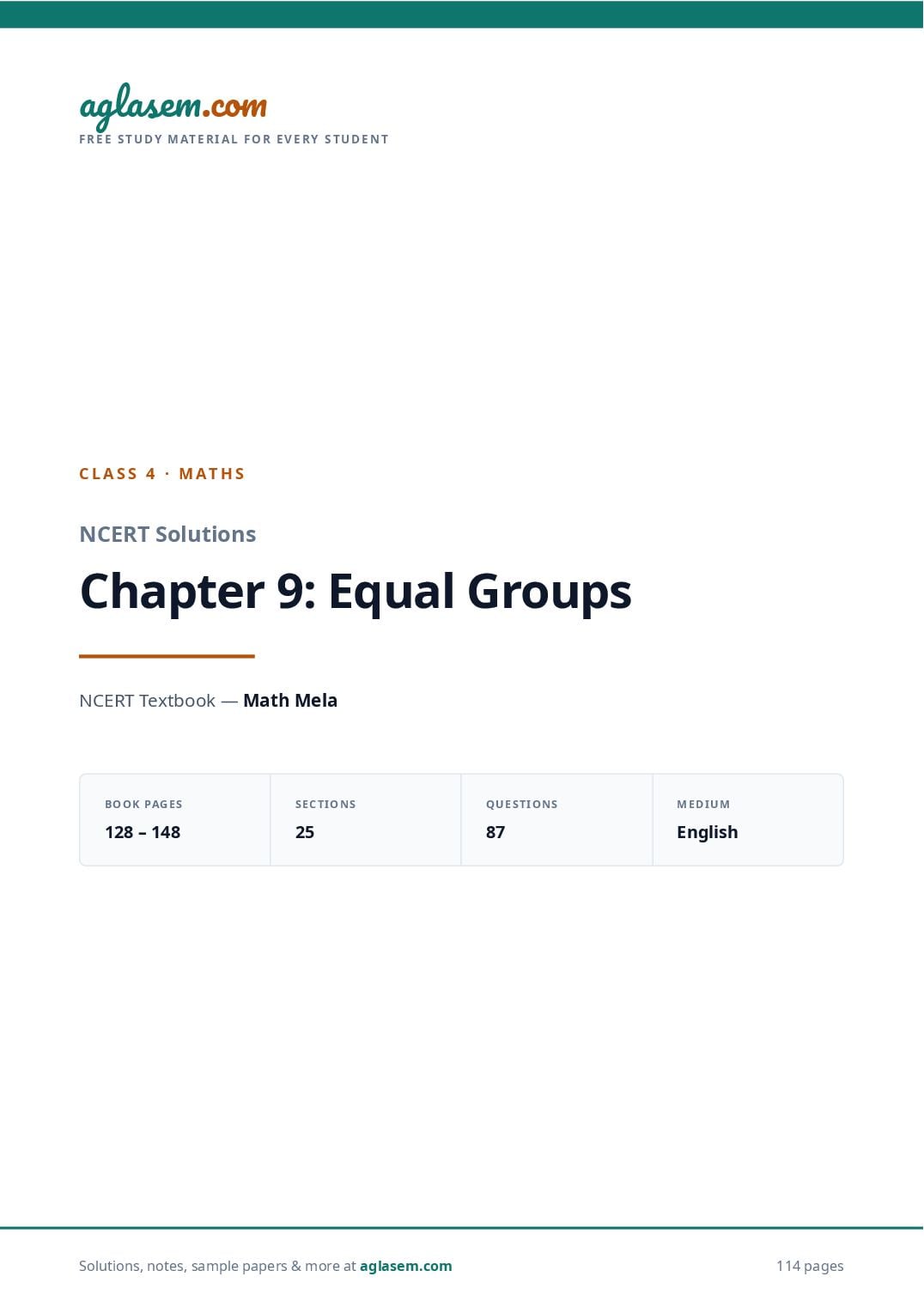
C L A S S 4 · M AT H S
NCERT Solutions
Chapter 9: Equal Groups
NCERT Textbook — Math Mela
BOOK PAGES SECTIONS QUESTIONS MEDIUM
128 – 148 25 87 English
Solutions, notes, sample papers & more at 114 pages
Page 2
CLASS 4 · MATHS · MATH MELA
NCERT Solutions — Chapter 9: Equal Groups
Chapter 9 of Math Mela turns counting into multiplication and division. Animals skip count along a number
path, cupcakes sit in rows and columns, and wheels and legs are shared into equal groups.
TEXTBOOK BOOK PAGES
Math Mela (Class 4) 128 – 148
SECTIONS QUESTIONS
25 87
MEDIUM
English
Animal Jumps — Page 128
Fill in the blank spaces with the appropriate numbers
Q1 The frog jumps 3 steps at time. Which numbers will the frog touch? Will it touch 67?
These numbers are multiples of 3.
0 3 6 12
18
The frog’s path. The frog starts at 0 and lands on every third number.
The frog touches 0, 3, 6, 9, 12, 15, 18, 21, 24, 27, 30, 33 … — it skip counts in 3s.
Start at 0.
0 → 3 → 6 → 9 → 12 → 15 → 18 → 21 → 24 → 27 → 30 → 33
The missing numbers on the path are 9, 15, 21, 24, 27, 30, 33.
Will it touch 67? Count in 3s near 67: 60, 63, 66, 69. The frog jumps over 67.
Page 1 of 114
Page 3
So the frog will not touch 67.
Why it happens: Every number the frog lands on is made of equal groups of 3. 66 is
22 groups of 3, but 67 has 1 left over, so no jump lands there.
Q2 The squirrel jumps 4 steps at a time. Which numbers will the squirrel touch? How
many times should the squirrel jump to reach 60? These numbers are multiples of
___.
0 4 8 12
The squirrel’s path. It starts at 0 and lands on every fourth number.
The squirrel touches 0, 4, 8, 12, 16, 20, 24, 28, 32, 36, 40 … — it skip counts in 4s.
4, 8, 12, 16, 20, 24, 28, 32, 36, 40, 44, 48, 52, 56, 60
Count the jumps: 60 = 15 fours
So the squirrel needs 15 jumps.
These numbers are multiples of 4.
Tip: 10 jumps take the squirrel to 40. From 40, five more jumps of 4 add 20, and 40 +
20 = 60.
Animal Jumps — Page 129
Page 2 of 114
Page 4
The rabbit and the kangaroo
Q1 The rabbit jumps 6 steps at a time. Which numbers will the rabbit touch? What is
the smallest 3-digit number on which the rabbit will land? How many times did the
rabbit jump to reach this number? These numbers are multiples of ___.
0 6 12 18
The rabbit’s path. It starts at 0 and lands on every sixth number.
The rabbit touches 0, 6, 12, 18, 24, 30, 36, 42, 48, 54, 60 … — it skip counts in 6s.
Near 100: 90, 96, 102
96 is less than 100 and 102 is more than 100.
So the smallest 3-digit number the rabbit lands on is 102.
102 = 17 sixes, so the rabbit jumped 17 times.
These numbers are multiples of 6.
Why it happens: The rabbit can land only on numbers made of whole groups of 6.
100 is not made of whole 6s, so the rabbit steps over it to 102.
Page 3 of 114
Page 5
Class 4 Maths Chapter 9 Equal Groups
a g l AglaSem · NCERT Solutions
co m
m.
The kangaroo jumps 8 steps at a time. Which numbers will the kangaroo touch?
e
Q2
comwill touch? l
These numbers are multiples of ___. Are there numbers that both the rabbit and the
g as
. a
em
kangaroo
a s
a gl
com
m . ag
l a se
0 8 ag 16
co m
em.
m l as
m .co a g
l a se
a g The kangaroo’s path. It starts at 0 and lands on every eighth number.
m a s
m .co
The kangaroo touches 0, 8, 16, 24, 32, 40, 48, 56, 64, 72, 80 … — it skip counts in 8s.
agl
l a se
g
These numbers are multiples of 8.
a
Rabbit: 6, 12, 18, 24, 30, 36, 42, 48, 54, 60, 66, 72
co m
m .
m
Kangaroo: 8, 16, 24, 32, 40, 48, 56, 64, 72
as e
. conumbers: a g l
e m
Same 24, 48, 72, 96 …
as
agl Yes. Both animals land on 24, 48, 72 and 96.
se m
com g l a
m . a
ase
Tip: These shared numbers are the common multiples of 6 and 8. They come after
agl
every 24 steps.
co m
m .
m as e
.co a g l
se m
g l a
a c
m .
m a s e
e m . co agl
g l as
a
co m
m .
m ase
.co
a g l Page 4 of 114
Page 6
Q3 To reach 48, how many times did the rabbit jump? _______ How many times did the
Kangaroo jump to reach the same number? _______ What did you observe? Share
your thoughts.
0 6 12 18
The rabbit’s path. It starts at 0 and lands on every sixth number.
0 8 16
The kangaroo’s path. It starts at 0 and lands on every eighth number.
Rabbit jumps 6 at a time: 6, 12, 18, 24, 30, 36, 42, 48
48 = 8 sixes, so the rabbit jumped 8 times.
Kangaroo jumps 8 at a time: 8, 16, 24, 32, 40, 48
48 = 6 eights, so the kangaroo jumped 6 times.
What we observe: the bigger the jump, the fewer the jumps needed.
Why it happens: Both animals cover the same 48 steps. The rabbit uses 8 groups of
6 and the kangaroo uses 6 groups of 8 — and 8 × 6 and 6 × 8 are both 48.
Page 5 of 114
Page 7
Animal Jumps — Page 130
Jumping to 60
Q1 To reach 60, how many times did the frog jump? _______ How many times did the
rabbit jump to reach the same number? __________ What do you observe? Share your
thoughts.
0 3 6 12
18
The frog’s path. The frog starts at 0 and lands on every third number.
0 6 12 18
The rabbit’s path. It starts at 0 and lands on every sixth number.
Frog jumps 3 at a time: 3, 6, 9, … , 57, 60
60 = 20 threes, so the frog jumped 20 times.
Rabbit jumps 6 at a time: 6, 12, 18, … , 54, 60
60 = 10 sixes, so the rabbit jumped 10 times.
We observe that the rabbit needs exactly half as many jumps as the frog.
Page 6 of 114
Page 8
Why it happens: One rabbit jump of 6 is the same as two frog jumps of 3. So the
rabbit finishes in half the number of jumps.
Common Multiples — Page 130
Common multiples, the cat and the rat, and a number hunt
Q1 Which numbers do both the frog and the squirrel touch? A few common multiples of
3 and 4 are _____________________________.
0 3 6 12
18
The frog’s path. The frog starts at 0 and lands on every third number.
0 4 8 12
The squirrel’s path. It starts at 0 and lands on every fourth number.
Frog (3s): 3, 6, 9, 12, 15, 18, 21, 24, 27, 30, 33, 36
Squirrel (4s): 4, 8, 12, 16, 20, 24, 28, 32, 36
A few common multiples of 3 and 4 are 12, 24, 36, 48 and 60.
Page 7 of 114
Page 9
Why it happens: 12 is 4 groups of 3 and also 3 groups of 4. After that the two
animals meet again every 12 steps.
Q2 Which numbers do both the rabbit and the kangaroo touch? A few common
multiples of 6 and 8 are ________________________.
0 6 12 18
The rabbit’s path. It starts at 0 and lands on every sixth number.
0 8 16
The kangaroo’s path. It starts at 0 and lands on every eighth number.
Rabbit (6s): 6, 12, 18, 24, 30, 36, 42, 48, 54, 60, 66, 72
Kangaroo (8s): 8, 16, 24, 32, 40, 48, 56, 64, 72
A few common multiples of 6 and 8 are 24, 48, 72 and 96.
Check it yourself: 24 = 4 sixes and 24 = 3 eights. Both animals land there.
Page 8 of 114
Page 10
Class 4 Maths Chapter 9 Equal Groups
a g l AglaSem · NCERT Solutions
co m
m.
If the cat and the rat land on the same number, the cat will catch the rat. The cat is
se
Q3
o m l a
now on 6 and the rat on 12. When the cat jumps 3 steps forward, the rat jumps 2
c
steps.forward. g
m a
Will the cat catch the rat? If yes, at which number?
l a se
a g
co m
cat
e m . rat ag
g l as
a
1 2 3 4 5 6 7 8 9 10 11 12 13 14 15
. com29
em
16 17 18 19 20 21 22 23 24 25 26 27 28 30
m l as
.co a g
a s em The number track. The cat is on 6 and the rat is on 12.
ag l
Yes, the cat catches the rat at 24.
m a s
.co agl
Let us write where each one is after every jump.
m
CATg l ase
JUMP
a (+3) RAT (+2)
m
start 6 12
. co
e m
m as
1 9 14
. c o a g l
2m
a s e 12 16
agl 3 15 18
se m
com g l a
.
4 18 20
m a
ase
a24gl
5 21 22
6 24
co m
m .
e
Both reach 24 after 6 jumps.
m l as
.co
m Why it happens: The cat is 6 steps behind. In each jump the cat gains 3 − 2 = 1 step. a g
s e
agla So after 6 jumps the gap of 6 becomes 0 and they meet at 24.
.c
s e m
m a
e m . co agl
g l as
a
co m
m .
m as e
.co
a g l Page 9 of 114
Page 11
Q4 Find multiplication and division sentences below. Shade the sentences. How many
can you find? Two examples are done for you.
3 4 2 7 4 9 8 2
4 2 10 20 5 2 2 4
12 8 0 6 4 8 8 1
3 2 6 2 2 6 16 2
2 3 6 18 6 5 3 1
10 3 4 1 12 2 7 14
2 0 2 2 6 10 7 2
20 5 8 2 2 5 10 2
The number grid in the book. Read across a row or down a column.
Read three boxes in a row (left to right) or three boxes in a column (top to bottom). We found 17
sentences.
Across the rows:
Row 2: 2 × 10 = 20 and 2 × 2 = 4
Row 3: 8 ÷ 8 = 1
Row 4: 3 × 2 = 6
Row 5: 2 × 3 = 6 and 3 × 6 = 18
Row 6: 2 × 7 = 14
Row 8: 2 × 5 = 10
Down the columns:
Column 1: 3 × 4 = 12 and 10 × 2 = 20
Column 2: 4 × 2 = 8
Column 3: 4 × 2 = 8
Column 4: 1 × 2 = 2
Column 5: 2 × 6 = 12 and 12 ÷ 6 = 2
Column 6: 5 × 2 = 10
Column 7: 2 × 8 = 16
Page 10 of 114
Page 12
Note: In our copy of the book the two “examples done for you” are not printed with
any shading, so all 17 sentences are listed above. You may also find a few more if
your teacher lets you read a row from right to left.
Gulabo’s Garden — Page 131
Multiplication statement
Q1 Gulabo’s garden has lily flowers. Each lily flower has 3 petals. How many petals are
there in 12 flowers? Show how you found your answer. Petals in 10 lilies 10 × 3 petals
= 30 petals. Petals in 2 lilies __________. Petals in 12 lilies __________.
Gulabo’s 12 lily flowers. Each flower has 3 petals.
There are 36 petals in 12 lily flowers.
12 flowers = 10 flowers + 2 flowers
Petals in 10 lilies = 10 × 3 = 30 petals
Petals in 2 lilies = 2 × 3 = 6 petals
Petals in 12 lilies = 30 + 6 = 36 petals
Multiplication statement: 12 × 3 = 36
Here 12 is the number of groups (multiplier), 3 is the group size (multiplicand) and 36 is the
product.
Page 11 of 114
Page 13
Why it happens: Breaking 12 into 10 and 2 makes the work easy, because tens are
quick to count. Both parts are put back together at the end.
Q2 In a hibiscus flower there are 5 petals. Gulabo counted all the petals and found
them to be 80. How many flowers did she have? 5 petals is 1 flower. 10 petals are 2
flowers. 50 petals are 10 flowers. Then, 80 petals are _______ flowers.
Hibiscus flowers. Each flower has 5 petals.
Gulabo had 16 flowers.
80 ÷ 5 flowers
50 petals are 10 flowers.
80 − 50 = 30 petals are still left.
30 petals are 6 flowers (because 6 × 5 = 30).
10 + 6 = 16 flowers
Check: 16 × 5 = 80 ✓
Why it happens: Every flower uses up 5 petals. So we keep taking away groups of 5
from 80 and count how many groups we took away.
Gulabo’s Garden — Page 132
Page 12 of 114
Page 14
Rows, columns and arrays
Q1 Gulabo plants some marigold saplings in a box as shown in the picture.
Gulabo’s box of marigold saplings.
There are ______ saplings in each row. There are ______ rows. How many saplings has
she planted? How did you calculate it? Mathematical Statement _________________
Gulabo’s box of marigold saplings.
She has planted 36 saplings.
There are 12 saplings in each row.
There are 3 rows.
Skip count in 12s: 12, 24, 36
Mathematical statement: 3 × 12 = 36
Page 13 of 114
Page 15
Class 4 Maths Chapter 9 Equal Groups
a g l AglaSem · NCERT Solutions
co m
m.
Why it happens: Every row has the same number of saplings. So 3 equal rows of 12
m as e
l
can be added as 12 + 12 + 12, which is the same as 3 × 12.
m .co a g
l a se
a g
Q2 “Dailyfresh” supermarket has kept boxes of strawberries in a big tray. How many
co m
ag
boxes of strawberries does the supermarket have? Show how you found them.
m .
as e
a g l
co m
em.
m l as
m .co a g
l a se
a g
m a s
em
.co agl
a s
agl
The big tray of strawberry boxes. The dashed line splits it into two parts.
There are _______ columns of strawberry boxes. There are _______ boxes in each
co m
m .
as e
column. There are _______ boxes in all. Mathematical Statement _________________
m
.co a g l
se m
l a
ag
se m
com g l a
m . a
ase
agl
co m
m .
m as e
.co a g l
se m
g l a
a c
m .
m a s e
co agl
The big tray of strawberry boxes. The dashed line splits it into two parts.
m .
ase
a g l
The supermarket has 96 boxes of strawberries.
co m
m .
m ase
.co
a g l Page 14 of 114
Page 16
There are 16 columns of boxes.
There are 6 boxes in each column.
The dashed line splits the tray into 10 columns and 6 columns.
10 columns: 10 × 6 = 60 boxes
6 columns: 6 × 6 = 36 boxes
60 + 36 = 96 boxes
Mathematical statement: 16 × 6 = 96
Tip: Splitting 16 into 10 and 6 is the same trick we used for the lilies. Tens first, then
the rest.
Q3 Radha runs a bakery shop. She bakes 18 cupcakes in one tray of the size shown
below. a) Complete arranging the cupcakes in the two trays given below.
The two baking trays from the book. The first tray has been started.
Page 15 of 114
Page 17
The two baking trays as they are printed in the book.
Each tray holds 18 cupcakes in 3 rows of 6.
Both trays filled: 3 rows of 6 cupcakes in each tray.
The book has already drawn the first row of 6 and the first column of 3.
So the tray is 3 rows × 6 columns.
3 × 6 = 18 cupcakes in one tray.
Why it happens: In an array every row holds the same number. Once we know one
row has 6 and there are 3 rows, the rest of the tray must match.
Gulabo’s Garden — Page 133
Page 16 of 114
Page 18
Radha’s baking trays
Q1 b) She can use two such trays in her oven at a time. How many cupcakes can she
make in one attempt? _______
Both trays filled: 3 rows of 6 cupcakes in each tray.
She can make 36 cupcakes in one attempt.
1 tray = 18 cupcakes
2 trays = 18 + 18
2 × 18 = 36 cupcakes
Why it happens: Two equal trays are two equal groups, so we double the 18
cupcakes of one tray.
Page 17 of 114
Page 19
Q2 c) Today she has received a special order. She has made 108 cupcakes. How many
trays has she baked?
Both trays filled: 3 rows of 6 cupcakes in each tray.
She has baked 6 trays.
One tray holds 18 cupcakes, so we find 108 ÷ 18.
Take away trays of 18:
18, 36, 54, 72, 90, 108
Count them: 1, 2, 3, 4, 5, 6
Check: 6 × 18 = 108 ✓
Tip: Skip counting in 18s is easy if you jump in twos of trays: 2 trays = 36, 4 trays =
72, 6 trays = 108.
Page 18 of 114
Page 20
Class 4 Maths Chapter 9 Equal Groups
a g l AglaSem · NCERT Solutions
co m
m.
d) She has another square baking tray. She can bake 36 mini cupcakes in such a
e
Q3
m l as
.co
tray. Complete the arrangement below.
a g
se m
g l a
a
co m
e m . ag
g l as
a
co m
em.
m l as
m .co a g
l a se
ag
m a s
m .co agl
l a se
a g
co m
m .
m as e
.co a g l
se m
g l a
a
se m
com g l a
m . a
ase
agl
The square baking tray from the book, with the first row and the first column started.
m
Number of columns: _______ Number of cupcakes in each column: _______
Multiplication statement _______
. co
em
com g l as
. a
sem
a
agl c
m .
m a s e
e m . co agl
g l as
a
co m
m .
m ase
.co
a g l Page 19 of 114
Page 21
The square baking tray as it is printed in the book.
The tray is a square, so it has the same number of rows and columns.
Page 20 of 114
Page 22
The square tray filled with 36 mini cupcakes.
Number of columns: 6
Number of cupcakes in each column: 6
Multiplication statement: 6 × 6 = 36
Why it happens: The book has drawn 6 cupcakes along the top and 6 down the side.
A square tray must have equal rows and columns, and 6 sixes make 36.
Page 21 of 114
Page 23
Q4 Find different ways of arranging the following numbers of cupcakes in rows and
columns in your notebook. 36, 8, 12, and 24
For each number, look for two numbers that multiply to give it. Each pair is one arrangement.
CUPCAKES WAYS (ROWS × COLUMNS)
36 1 × 36, 2 × 18, 3 × 12, 4 × 9, 6 × 6
8 1 × 8, 2 × 4
12 1 × 12, 2 × 6, 3 × 4
24 1 × 24, 2 × 12, 3 × 8, 4 × 6
Every pair can also be turned around, like 12 rows of 3 instead of 3 rows of 12.
Sample answer: 24 cupcakes can be set in 4 rows of 6, or 3 rows of 8, or 2 rows of 12, or 1 long
row of 24.
Why it happens: An array works only when every row holds the same number. So
the two side numbers must multiply to give the total.
The Doubling Magic — Page 134
Magician Anvi doubles the flowers
Q1 She pulled out 23 flowers, bright and gay! She smiled and said, "Now watch and see,
How many flowers will there be?" How many flowers are there now? ______________
The flowers Anvi pulled out of her coat.
There are 46 flowers now.
Page 22 of 114
Page 24
The flowers after the magic — two rows just like the first one.
Anvi made one more row exactly like the first row.
23 + 23 = 46
Or 2 × 23 = 46 flowers
Why it happens: Doubling means making two equal groups. Two groups of 23 is the
same as 2 × 23.
Q2 What magic did Anvi do? Complete the table.
FLOWERS 23 10 51 95 150 199 425 500
BEFORE
MAGIC
Flowers 46 222 410 500
after magic
FLOWERS 23 10 51 95 150 199 425 500 ? ? ?
BEFORE MAGIC
Flowers after magic 46 ? ? ? ? ? ? ? 222 410 500
The table as it is printed in the book.
Anvi’s magic is doubling — she makes every group twice as big.
BEFORE 23 10 51 95 150 199 425 500 111 205 250
After 46 20 102 190 300 398 850 1000 222 410 500
The completed table.
Page 23 of 114
Page 25
Class 4 Maths Chapter 9 Equal Groups
a g l AglaSem · NCERT Solutions
co m
e m.
10 + 10 = 20 51 + 51 = 102 95 + 95 = 190
m l as
.co
150 + 150 = 300 199 + 199 = 398
m a g
l a se
g
425 + 425 = 850 500 + 500 = 1000
aFor the last three we go backwards (halving):
co m
. ag
222 is double of 111 410 is double of 205 500 is double of 250
e m
g l as
a
Tip: To double a number, double the hundreds, the tens and the ones, then add
them up. 199 → 200 + 180 + 18 = 398.
co m
em.
m l as
.co a g
a s em
l
a) Double of 32 =_____ b) Double of 14 =_____ c) Double of 26 =_____ d) Double of 17 =_____
g
Q3
a e) Double of 39 =_____ f) Double of 45 =_____
m a s
m .co agl
l a se
a) 32 + 32 = 64 a g
b) 14 + 14 = 28
co m
m .
c) 26 + 26 = 52
as e
. co+m17 = 34 a g l
sem
d) 17
a e) 39 + 39 = 78
agl
f) 45 + 45 = 90
se m
com g l a
m . a
ase
agl
Doubling is the same as multiplying by 2.
Why it happens: 26 is 20 + 6. Double the 20 to get 40, double the 6 to get 12, and 40
co m
+ 12 = 52.
m .
m as e
.co a g l
se m
g l a
a c
m .
m a s e
e m . co agl
g l as
a
co m
m .
m ase
.co
a g l Page 24 of 114
Page 26
Q4 Guess what will be the ones digit of the following numbers when doubled. Write the
ones digit in the space provided. a) 28 ______ b) 56 ______ c) 45 ______ d) 17 ______
NUMBER DOUBLE ONES DIGIT
28 56 6
56 112 2
45 90 0
17 34 4
Double each number and look at its last digit.
The ones digits are 6, 2, 0 and 4.
Why it happens: Only the ones digit decides the answer. Double 8 is 16 → ones digit
6. Double 6 is 12 → ones digit 2. Double 5 is 10 → ones digit 0.
Q5 Give examples of numbers that when doubled give the following digits in the ones
place. a) 0 _______ b) 2 _______ c) 4 _______ d) 6 _______ e) 8 _______ Can we get 3, 5, 7, 9 as
the ones digit after doubling?
ONES DIGIT WANTED SOME NUMBERS THAT WORK CHECK
0 5, 10, 15, 20, 25 5 → 10, 15 → 30
2 1, 6, 11, 16, 21 1 → 2, 16 → 32
4 2, 7, 12, 17, 22 2 → 4, 17 → 34
6 3, 8, 13, 18, 23 3 → 6, 18 → 36
8 4, 9, 14, 19, 24 4 → 8, 19 → 38
Sample answers — many other numbers also work.
No, we can never get 3, 5, 7 or 9 as the ones digit after doubling.
Page 25 of 114
Page 27
Why it happens: Doubling makes two equal groups, so the answer is always an
even number. Even numbers end only in 0, 2, 4, 6 or 8.
Q6 What do we notice about the numbers that we get after doubling? Even or Odd?
Every number we get after doubling is an even number.
2 × 7 = 14 2 × 13 = 26 2 × 25 = 50
14, 26 and 50 all end in 4, 6 and 0 — all even.
Why it happens: A doubled number can be split into two equal groups with nothing
left over. That is exactly what an even number is.
In-text Questions — Page 135
Page 26 of 114
Page 28
The multiplication chart
Q1 Fill each square in the chart by multiplying the row number by the column number.
1 2 3 4 5 6 7 8 9 10
1
2
3
4
5
6
7
8
9
10
The multiplication chart from the book: 10 rows and 10 columns, with the green squares
and the diagonal line marked.
× 1 2 3 4 5 6 7 8 9 10
1
2
3
Page 27 of 114
Page 29
4
5
6
7
8
9
10
The blank chart printed in the book.
Multiply the row number by the column number for every square.
× 1 2 3 4 5 6 7 8 9 10
1 1 2 3 4 5 6 7 8 9 10
2 2 4 6 8 10 12 14 16 18 20
3 3 6 9 12 15 18 21 24 27 30
4 4 8 12 16 20 24 28 32 36 40
5 5 10 15 20 25 30 35 40 45 50
6 6 12 18 24 30 36 42 48 54 60
7 7 14 21 28 35 42 49 56 63 70
8 8 16 24 32 40 48 56 64 72 80
9 9 18 27 36 45 54 63 72 81 90
10 10 20 30 40 50 60 70 80 90 100
The completed multiplication chart.
Row 4, column 7 → 4 × 7 = 28
Row 9, column 6 → 9 × 6 = 54
Page 28 of 114
Page 30
Class 4 Maths Chapter 9 Equal Groups
a g l AglaSem · NCERT Solutions
co m
m.
Tip: Fill a whole row by skip counting. Row 6 is 6, 12, 18, 24, 30, 36, 42, 48, 54, 60.
m as e
.co a g l
se m
g l a
a
co m
e m . ag
g l as
a
co m
em.
m l as
m .co a g
l a se
a g
m a s
m .co agl
l a se
a g
co m
m .
m as e
.co a g l
se m
g l a
a
se m
com g l a
m . a
ase
agl
co m
m .
m as e
.co a g l
se m
g l a
a c
m .
m a s e
e m . co agl
g l as
a
co m
m .
m ase
.co
a g l Page 29 of 114
Page 31
Q2 What do you notice about the numbers shaded in green? Why is this happening?
1 2 3 4 5 6 7 8 9 10
1
2
3
4
5
6
7
8
9
10
The multiplication chart from the book: 10 rows and 10 columns, with the green squares
and the diagonal line marked.
× 1 2 3 4 5 6 7 8 9 10
1 1 2 3 4 5 6 7 8 9 10
2 2 4 6 8 10 12 14 16 18 20
3 3 6 9 12 15 18 21 24 27 30
4 4 8 12 16 20 24 28 32 36 40
Page 30 of 114
Page 32
5 5 10 15 20 25 30 35 40 45 50
6 6 12 18 24 30 36 42 48 54 60
7 7 14 21 28 35 42 49 56 63 70
8 8 16 24 32 40 48 56 64 72 80
9 9 18 27 36 45 54 63 72 81 90
10 10 20 30 40 50 60 70 80 90 100
The chart with the green squares marked in orange.
The green numbers come in matching pairs, one on each side of the diagonal line.
ONE SQUARE ITS PARTNER NUMBER
1×2 2×1 2
2×3 3×2 6
2×5 5×2 10
3×8 8×3 24
4 × 10 10 × 4 40
Each green pair gives the same product.
Why it happens: 3 rows of 8 dots and 8 rows of 3 dots are the same dots, just
turned around. So 3 × 8 and 8 × 3 must both be 24.
Page 31 of 114
Page 33
Q3 Share the patterns that you notice in the table.
1 2 3 4 5 6 7 8 9 10
1
2
3
4
5
6
7
8
9
10
The multiplication chart from the book: 10 rows and 10 columns, with the green squares
and the diagonal line marked.
× 1 2 3 4 5 6 7 8 9 10
1 1 2 3 4 5 6 7 8 9 10
2 2 4 6 8 10 12 14 16 18 20
3 3 6 9 12 15 18 21 24 27 30
4 4 8 12 16 20 24 28 32 36 40
Page 32 of 114
Page 34
5 5 10 15 20 25 30 35 40 45 50
6 6 12 18 24 30 36 42 48 54 60
7 7 14 21 28 35 42 49 56 63 70
8 8 16 24 32 40 48 56 64 72 80
9 9 18 27 36 45 54 63 72 81 90
10 10 20 30 40 50 60 70 80 90 100
The completed multiplication chart.
Here are some patterns we can see.
Every row is a skip-counting list. Row 4 goes 4, 8, 12, 16, … , adding 4 each time.
Row 10 ends in 0 every time: 10, 20, 30, … , 100.
Row 5 ends in 5, 0, 5, 0, 5, 0 …
The chart is the same on both sides of the corner-to-corner line.
The numbers 1, 4, 9, 16, 25, 36, 49, 64, 81, 100 sit on that line.
Row 9 numbers have digits that add to 9: 18 → 1 + 8 = 9, 27 → 2 + 7 = 9.
Try this: Cover a row, skip count aloud, then check the chart.
Page 33 of 114
Page 35
Class 4 Maths Chapter 9 Equal Groups
a g l AglaSem · NCERT Solutions
co m
m.
Are the numbers in row 7 the same as the numbers in column 7? In general, are the
e
Q4
comthis happen?
numbers in a given row the same as the numbers in the corresponding column?
g l as
. a
em
Why does
a s
a gl
. com ag
e m4 5
as
1 2 3 6 7 8 9 10
a g l
1
co m
m.
2
m as e
.co a g l
sem
3
a
agl 4
m a s
.co agl
5
se m
6
g l a
a
7
co m
m .
8
as e
. com a g l
m
ase
9
agl
m
10
a se
.com a g l
m
ase
agl
The multiplication chart from the book: 10 rows and 10 columns, with the green squares
and the diagonal line marked.
co m
m .
as e
. com a g l
sem
a
agl c
.
× 1 2 3 4 5 6 7 8 9 10
s e m
m a
.co agl
1 1 2 3 4 5 6 7 8 9 10
se m8
2 2 4
g l a6 10 12 14 16 18 20
3 6
a 9 12 15 18 21 24 27 30
3
co m
m .
m as e
.co
a g l Page 34 of 114
Page 36
4 4 8 12 16 20 24 28 32 36 40
5 5 10 15 20 25 30 35 40 45 50
6 6 12 18 24 30 36 42 48 54 60
7 7 14 21 28 35 42 49 56 63 70
8 8 16 24 32 40 48 56 64 72 80
9 9 18 27 36 45 54 63 72 81 90
10 10 20 30 40 50 60 70 80 90 100
Row 7 and column 7 of the chart.
Yes. Row 7 and column 7 hold exactly the same numbers.
Row 7: 7, 14, 21, 28, 35, 42, 49, 56, 63, 70
Column 7: 7, 14, 21, 28, 35, 42, 49, 56, 63, 70
This happens for every row and its matching column.
Why it happens: Row 7 column 3 means 7 × 3 and row 3 column 7 means 3 × 7.
Turning an array of dots sideways does not change how many dots there are, so
both are 21.
Page 35 of 114
Page 37
Q5 Is there a row where all answers (products) are even numbers? Which rows have
this property?
1 2 3 4 5 6 7 8 9 10
1
2
3
4
5
6
7
8
9
10
The multiplication chart from the book: 10 rows and 10 columns, with the green squares
and the diagonal line marked.
× 1 2 3 4 5 6 7 8 9 10
1 1 2 3 4 5 6 7 8 9 10
2 2 4 6 8 10 12 14 16 18 20
3 3 6 9 12 15 18 21 24 27 30
Page 36 of 114
Page 38
4 4 8 12 16 20 24 28 32 36 40
5 5 10 15 20 25 30 35 40 45 50
6 6 12 18 24 30 36 42 48 54 60
7 7 14 21 28 35 42 49 56 63 70
8 8 16 24 32 40 48 56 64 72 80
9 9 18 27 36 45 54 63 72 81 90
10 10 20 30 40 50 60 70 80 90 100
The completed multiplication chart.
Yes. Rows 2, 4, 6, 8 and 10 have only even products.
Row 2: 2, 4, 6, 8, 10, 12, 14, 16, 18, 20 — all even
Row 6: 6, 12, 18, 24, 30, 36, 42, 48, 54, 60 — all even
Why it happens: These are the even rows. An even number of things can always be
shared into two equal groups, and taking many copies of it keeps it even.
Page 37 of 114
Page 39
Q6 Is there a row having only odd numbers as products?
1 2 3 4 5 6 7 8 9 10
1
2
3
4
5
6
7
8
9
10
The multiplication chart from the book: 10 rows and 10 columns, with the green squares
and the diagonal line marked.
× 1 2 3 4 5 6 7 8 9 10
1 1 2 3 4 5 6 7 8 9 10
2 2 4 6 8 10 12 14 16 18 20
3 3 6 9 12 15 18 21 24 27 30
4 4 8 12 16 20 24 28 32 36 40
Page 38 of 114
Page 40
Class 4 Maths Chapter 9 Equal Groups
a g l AglaSem · NCERT Solutions
co m50
m.
5 5 10 15 20 25 30 35 40 45
m 12 l a se54
.co ag
6 6 18 24 30 36 42 48 60
a s em7
gl
7 14 21 28 35 42 49 56 63 70
a
8 8 16 24 32 40 48 56 64 72 80
co m
e m . ag
as
9 9 18 27 36 45 54 63 72 81 90
10 10 20 30 g l
a 40 50 60 70 80 90 100
The completed multiplication chart.
co m
em.
as
No. There is no such row.
m l
.co a g
a s em1: 1, 2, 3, 4, 5 … — even numbers appear
gl
Row
a Row 5: 5, 10, 15, 20, 25 … — even numbers appear
m a s
m .co agl
l a se
Why it happens: Every row has a column 2, a column 4 and so on. Any number
a g
multiplied by an even number gives an even answer, so no row can be all odd.
co m
m .
m as e
.co a g l
se m
g l a
a
se m
com g l a
m . a
ase
agl
co m
m .
m as e
.co a g l
se m
g l a
a c
m .
m a s e
e m . co agl
g l as
a
co m
m .
m ase
.co
a g l Page 39 of 114
Page 41
Q7 Are there rows that have both even and odd numbers? What do you notice? Why is
it so?
1 2 3 4 5 6 7 8 9 10
1
2
3
4
5
6
7
8
9
10
The multiplication chart from the book: 10 rows and 10 columns, with the green squares
and the diagonal line marked.
× 1 2 3 4 5 6 7 8 9 10
1 1 2 3 4 5 6 7 8 9 10
2 2 4 6 8 10 12 14 16 18 20
3 3 6 9 12 15 18 21 24 27 30
Page 40 of 114
Page 42
4 4 8 12 16 20 24 28 32 36 40
5 5 10 15 20 25 30 35 40 45 50
6 6 12 18 24 30 36 42 48 54 60
7 7 14 21 28 35 42 49 56 63 70
8 8 16 24 32 40 48 56 64 72 80
9 9 18 27 36 45 54 63 72 81 90
10 10 20 30 40 50 60 70 80 90 100
The completed multiplication chart.
Yes. Rows 1, 3, 5, 7 and 9 — the odd rows — have both even and odd numbers.
Row 3: 3, 6, 9, 12, 15, 18, 21, 24, 27, 30
odd, even, odd, even, odd, even … the two keep taking turns.
Why it happens: An odd number times an odd number stays odd, but an odd
number times an even number becomes even. The columns go odd, even, odd,
even, so the answers do too.
Page 41 of 114
Page 43
Q8 Are there more even numbers in the chart or odd numbers? How do you know?
1 2 3 4 5 6 7 8 9 10
1
2
3
4
5
6
7
8
9
10
The multiplication chart from the book: 10 rows and 10 columns, with the green squares
and the diagonal line marked.
× 1 2 3 4 5 6 7 8 9 10
1 1 2 3 4 5 6 7 8 9 10
2 2 4 6 8 10 12 14 16 18 20
3 3 6 9 12 15 18 21 24 27 30
4 4 8 12 16 20 24 28 32 36 40
Page 42 of 114
Page 44
5 5 10 15 20 25 30 35 40 45 50
6 6 12 18 24 30 36 42 48 54 60
7 7 14 21 28 35 42 49 56 63 70
8 8 16 24 32 40 48 56 64 72 80
9 9 18 27 36 45 54 63 72 81 90
10 10 20 30 40 50 60 70 80 90 100
The completed multiplication chart.
There are many more even numbers.
Rows 2, 4, 6, 8, 10 are fully even → 5 × 10 = 50 even numbers
Rows 1, 3, 5, 7, 9 have 5 even numbers each → 5 × 5 = 25 even numbers
Even numbers in all = 50 + 25 = 75
Odd numbers in all = 100 − 75 = 25
Why it happens: A product is odd only when both the row and the column are odd.
That happens in just 25 of the 100 squares.
In-text Questions — Page 136
Page 43 of 114
Page 45
Class 4 Maths Chapter 9 Equal Groups
a g l AglaSem · NCERT Solutions
Patterns in the multiplication chart
co m
em.
m l as
.co
Colour the common multiples of the following numbers. Use different colours for
a g
emitem. a) 2 and 3 b) 4 and 8 c) 7 and 9. Share your observations regarding the
Q1
a s
each
agl numbers that are common multiples in each case.
com
e m . ag
g l as
1 2 a 3 4 5 6 7 8 9 10
co m
m.
1
m as e
.co 2
a g l
se m
g l a
a 3
m a s
.co agl
4
se m
5
g l a
a
6
co m
m .
m
7
as e
.co a g l
a s em 8
agl
9
se m
com g l a
10
m . a
ase
agl
The multiplication chart from the book: 10 rows and 10 columns, with the green squares
co m
m .
e
and the diagonal line marked.
m l as
.co a g
a s em
agl ANSWER
.c
s e m
m a
.co agl
× 1 2 3 4 5 6 7 8 9 10
se m4
1 1 2
g l a3 5 6 7 8 9 10
2 2 4
a 6 8 10 12 14 16 18 20
co m
m .
m as e
.co
a g l Page 44 of 114
Page 46
3 3 6 9 12 15 18 21 24 27 30
4 4 8 12 16 20 24 28 32 36 40
5 5 10 15 20 25 30 35 40 45 50
6 6 12 18 24 30 36 42 48 54 60
7 7 14 21 28 35 42 49 56 63 70
8 8 16 24 32 40 48 56 64 72 80
9 9 18 27 36 45 54 63 72 81 90
10 10 20 30 40 50 60 70 80 90 100
The completed multiplication chart.
a) Common multiples of 2 and 3 are the numbers in the 6 times table.
Multiples of 2: 2, 4, 6, 8, 10, 12, 14, 16, 18 …
Multiples of 3: 3, 6, 9, 12, 15, 18 …
Common: 6, 12, 18, 24, 30, 36, 42, 48, 54, 60, 66, 72, 78, 84, 90, 96
b) Common multiples of 4 and 8 are the numbers in the 8 times table: 8, 16, 24, 32, 40, 48, 56,
64, 72, 80.
c) Common multiples of 7 and 9: only 63 appears in this chart (7 × 9 and 9 × 7). The next one is
126, which is bigger than 100.
Why it happens: A number that is in both lists must hold whole groups of each. For
2 and 3 the smallest such number is 6, for 4 and 8 it is 8, and for 7 and 9 it is 63.
Page 45 of 114
Page 47
Q2 Observe the pattern in the ones digits of the products in row 5? Observe the ones
digit of the products in other rows also. What patterns do you notice?
1 2 3 4 5 6 7 8 9 10
1
2
3
4
5
6
7
8
9
10
The multiplication chart from the book: 10 rows and 10 columns, with the green squares
and the diagonal line marked.
× 1 2 3 4 5 6 7 8 9 10
1 1 2 3 4 5 6 7 8 9 10
2 2 4 6 8 10 12 14 16 18 20
3 3 6 9 12 15 18 21 24 27 30
Page 46 of 114
Page 48
4 4 8 12 16 20 24 28 32 36 40
5 5 10 15 20 25 30 35 40 45 50
6 6 12 18 24 30 36 42 48 54 60
7 7 14 21 28 35 42 49 56 63 70
8 8 16 24 32 40 48 56 64 72 80
9 9 18 27 36 45 54 63 72 81 90
10 10 20 30 40 50 60 70 80 90 100
Row 5 of the chart.
In row 5 the ones digit goes 5, 0, 5, 0, 5, 0, 5, 0, 5, 0 — it repeats after two steps.
ROW ONES DIGITS OF THE PRODUCTS
2 2, 4, 6, 8, 0, 2, 4, 6, 8, 0
4 4, 8, 2, 6, 0, 4, 8, 2, 6, 0
5 5, 0, 5, 0, 5, 0, 5, 0, 5, 0
6 6, 2, 8, 4, 0, 6, 2, 8, 4, 0
10 0, 0, 0, 0, 0, 0, 0, 0, 0, 0
The ones digits repeat in every row.
Why it happens: After 10 steps of the same size we come back to a ten, so the ones
digits start over. Rows 2, 4, 6 and 8 repeat after 5 steps; row 5 after 2 steps.
Page 47 of 114
Page 49
Q3 Here is row 8 of the chart: 8, 16, 24, 32, 40, 48, 56, 64, 72, 80. The ones digit of the
products are: 8, 6, 4, 2, 0, 8, 6, 4, 2, 0. Do you see a repeating pattern here? Guess the
ones digit of the following products. Verify your answer by multiplying. 11 × 8 _____
12 × 8 _____ 13 × 8 _____
1 2 3 4 5 6 7 8 9 10
1
2
3
4
5
6
7
8
9
10
The multiplication chart from the book: 10 rows and 10 columns, with the green squares
and the diagonal line marked.
× 1 2 3 4 5 6 7 8 9 10
1 1 2 3 4 5 6 7 8 9 10
2 2 4 6 8 10 12 14 16 18 20
Page 48 of 114
Page 50
Class 4 Maths Chapter 9 Equal Groups
a g l AglaSem · NCERT Solutions
co m30
m.
3 3 6 9 12 15 18 21 24 27
m8 l a se36
.co ag
4 4 12 16 20 24 28 32 40
a s em5
gl
5 10 15 20 25 30 35 40 45 50
a
6 6 12 18 24 30 36 42 48 54 60
co m
e m . ag
s
7 7 14 21 28 35 42 49 56 63 70
g l a
8 8 16 24 a 32 40 48 56 64 72 80
m
.co
9 9 18 27 36 45 54 63 72 81 90
se m 90
10
com
10 20 30 40 50 60 70
g l a
80 100
m . a
ase
l The block 8, 6, 4, 2, 0 keeps repeating.
Row 8 of the chart.
agYes.
m a s
.co agl
PRODUCT GUESS (ONES DIGIT) MULTIPLY AND CHECK
se m
g l a
a
11 × 8 8 88
12 × 8 6 96
com
m .
as e
13 × 8 4 104
c o m g l
Them . a
s e guesses match the real products.
agla
10 × 8 = 80, so 11 × 8 = 80 + 8 = 88
se m
com g l a
12 × 8 = 88 + 8 = 96
m . a
ase
agl
13 × 8 = 96 + 8 = 104
co m
Why it happens: Adding 8 each time changes the ones digit in the same order again
m .
m as e
l
and again, so the pattern never breaks.
m .co a g
l a se
ag
.c
s e m
m a
e m . co agl
g l as
a
co m
m .
m as e
.co
a g l Page 49 of 114
Page 51
Q4 In row 8 of the chart, there is no number whose ones digit is 1. What other digits do
not appear as the ones digit?
1 2 3 4 5 6 7 8 9 10
1
2
3
4
5
6
7
8
9
10
The multiplication chart from the book: 10 rows and 10 columns, with the green squares
and the diagonal line marked.
× 1 2 3 4 5 6 7 8 9 10
1 1 2 3 4 5 6 7 8 9 10
2 2 4 6 8 10 12 14 16 18 20
3 3 6 9 12 15 18 21 24 27 30
Page 50 of 114
Page 52
4 4 8 12 16 20 24 28 32 36 40
5 5 10 15 20 25 30 35 40 45 50
6 6 12 18 24 30 36 42 48 54 60
7 7 14 21 28 35 42 49 56 63 70
8 8 16 24 32 40 48 56 64 72 80
9 9 18 27 36 45 54 63 72 81 90
10 10 20 30 40 50 60 70 80 90 100
Row 8 of the chart.
The digits 1, 3, 5, 7 and 9 never appear as the ones digit in row 8.
Row 8 ones digits: 8, 6, 4, 2, 0, 8, 6, 4, 2, 0
Only 0, 2, 4, 6, 8 show up.
Why it happens: Every number in row 8 is a group of 8s, so it is even. Even numbers
can never end in an odd digit.
Page 51 of 114
Page 53
Q5 Is there a row in which all the digits from 0 to 9 appear as the ones digit? Which
rows have this property?
1 2 3 4 5 6 7 8 9 10
1
2
3
4
5
6
7
8
9
10
The multiplication chart from the book: 10 rows and 10 columns, with the green squares
and the diagonal line marked.
× 1 2 3 4 5 6 7 8 9 10
1 1 2 3 4 5 6 7 8 9 10
2 2 4 6 8 10 12 14 16 18 20
3 3 6 9 12 15 18 21 24 27 30
Page 52 of 114
Page 54
4 4 8 12 16 20 24 28 32 36 40
5 5 10 15 20 25 30 35 40 45 50
6 6 12 18 24 30 36 42 48 54 60
7 7 14 21 28 35 42 49 56 63 70
8 8 16 24 32 40 48 56 64 72 80
9 9 18 27 36 45 54 63 72 81 90
10 10 20 30 40 50 60 70 80 90 100
The completed multiplication chart.
Yes. Rows 1, 3, 7 and 9 have all ten digits as ones digits.
ROW ONES DIGITS
1 1, 2, 3, 4, 5, 6, 7, 8, 9, 0
3 3, 6, 9, 2, 5, 8, 1, 4, 7, 0
7 7, 4, 1, 8, 5, 2, 9, 6, 3, 0
9 9, 8, 7, 6, 5, 4, 3, 2, 1, 0
Each of these rows uses every digit from 0 to 9 exactly once.
Why it happens: 1, 3, 7 and 9 share no factor with 10. So their jumps land on a fresh
ones digit each time until all ten are used.
Page 53 of 114
Page 55
Class 4 Maths Chapter 9 Equal Groups
a g l AglaSem · NCERT Solutions
co m
m.
It can be seen in row 8 that 0 appears as the ones digit two times. ___ × 8 gives 0 as
e
Q6
m l as
.co
the ones digit. What numbers can go in the box? Give 5 examples of such numbers.
a g
se m
g l a
a
1 2 3 4
. com5 6 7 8 9 10
ag
e m
g l as
a
1
m
2
co
em.
m 3
l as
m .co a g
l a se 4
a g
5
m a s
m.co agl
se
6
g l a
7 a
co m
8
m .
m as e
.co 9
a g l
se m
g l a
a 10
se m
com g l a
m . a
ase
agl
The multiplication chart from the book: 10 rows and 10 columns, with the green squares
and the diagonal line marked.
co m
m .
m as e
.co l
a g
a s em ×
gl
1 2 3 4 5 6 7 8 9 10
a c
m .
e
1 1 2 3 4 5 6 7 8 9 10
m a s
2 2 4 6
e m . c8o 10 12 14 16 18 20
agl
g l as
3 3 6
a 9 12 15 18 21 24 27 30
co m
m .
m as e
.co
a g l Page 54 of 114
Page 56
4 4 8 12 16 20 24 28 32 36 40
5 5 10 15 20 25 30 35 40 45 50
6 6 12 18 24 30 36 42 48 54 60
7 7 14 21 28 35 42 49 56 63 70
8 8 16 24 32 40 48 56 64 72 80
9 9 18 27 36 45 54 63 72 81 90
10 10 20 30 40 50 60 70 80 90 100
Row 8 of the chart.
Any multiple of 5 can go in the box.
NUMBER IN THE BOX ×8 ONES DIGIT
5 40 0
10 80 0
15 120 0
20 160 0
25 200 0
Five numbers that work.
Why it happens: 5 × 8 = 40 already ends in 0. Every extra group of 5 eights adds
another 40, so the answer keeps ending in 0.
Page 55 of 114
Page 57
Q7 Is there a row in which 0 appears as the ones digit only once? Which rows have this
property?
1 2 3 4 5 6 7 8 9 10
1
2
3
4
5
6
7
8
9
10
The multiplication chart from the book: 10 rows and 10 columns, with the green squares
and the diagonal line marked.
× 1 2 3 4 5 6 7 8 9 10
1 1 2 3 4 5 6 7 8 9 10
2 2 4 6 8 10 12 14 16 18 20
3 3 6 9 12 15 18 21 24 27 30
Page 56 of 114
Page 58
4 4 8 12 16 20 24 28 32 36 40
5 5 10 15 20 25 30 35 40 45 50
6 6 12 18 24 30 36 42 48 54 60
7 7 14 21 28 35 42 49 56 63 70
8 8 16 24 32 40 48 56 64 72 80
9 9 18 27 36 45 54 63 72 81 90
10 10 20 30 40 50 60 70 80 90 100
The completed multiplication chart.
Yes. In rows 1, 3, 7 and 9 the digit 0 appears only once — at the last number.
ROW NUMBERS ENDING IN 0
1 10
3 30
7 70
9 90
2 10 and 20 (twice)
5 10, 20, 30, 40, 50 (five times)
Only the rows 1, 3, 7 and 9 have a single 0 ending.
Why it happens: A product ends in 0 only when it is a whole number of tens. For
rows 1, 3, 7 and 9 that first happens at the 10th step, and the row stops there.
Page 57 of 114
Page 59
Q8 What do you notice about the answers for Questions 11 and 13? Share in the grade.
× 1 2 3 4 5 6 7 8 9 10
1 1 2 3 4 5 6 7 8 9 10
2 2 4 6 8 10 12 14 16 18 20
3 3 6 9 12 15 18 21 24 27 30
4 4 8 12 16 20 24 28 32 36 40
5 5 10 15 20 25 30 35 40 45 50
6 6 12 18 24 30 36 42 48 54 60
7 7 14 21 28 35 42 49 56 63 70
8 8 16 24 32 40 48 56 64 72 80
9 9 18 27 36 45 54 63 72 81 90
10 10 20 30 40 50 60 70 80 90 100
The completed multiplication chart.
Both questions give the same four rows: 1, 3, 7 and 9.
All ten digits appear → rows 1, 3, 7, 9
0 appears only once → rows 1, 3, 7, 9
Why it happens: If a row uses each digit just once, then 0 also comes just once. So
the two answers have to be the same rows.
Multiples of Tens — Page 137
Page 58 of 114
Page 60
Class 4 Maths Chapter 9 Equal Groups
a g l AglaSem · NCERT Solutions
Counting wheels in tens
co m
e m.
m l as
.co
Let us count the number of wheels in tricycles. Number of wheels in 10 tricycles
a g
em3 wheels in each is 10 × 3 wheels = ______ wheels. Number of wheels in 10 more
Q1
a s
with
a gl tricycles with 3 wheels in each is 10 × 3 wheels = _______ wheels. Number of wheels in
20 tricycles with 3 wheels in each is 20 × 3 wheels = ______ + _____ = ______ wheels.
co m
e m . ag
as
a g l
co m
em.
m l as
m .co a g
l a se
a g
m
10 tricycles. Each tricycle has 3 wheels.
a s
m .co agl
l a se
ag
10 tricycles: 10 × 3 = 30 wheels
m
10 more tricycles: 10 × 3 = 30 wheels
. co
e m
as
20 tricycles: 20 × 3 = 30 + 30 = 60 wheels
m l
.co a g
a s em
gl
So 10 × 3 = 30 and 20 × 3 = 60.
a
Why it happens: 20 tricycles are just two sets of 10 tricycles. Two sets of 30 wheels
se m
com g l a
. a
make 60 wheels.
m
ase
agl
co m
m .
m as e
.co a g l
se m
g l a
a c
m .
m a s e
e m . co agl
g l as
a
com
m .
m as e
.co
a g l Page 59 of 114
Document Details
| Board / Org | NCERT |
| Exam | Class 4 |
| Type | Solution |
| Pages | 103 |
| Language | english |
| Updated | 13 Oct 2026 |