Manipur Board Class 12 Syllabus 2027 Anthropology
Finished viewing? Save it for later —
Download Manipur Board Class 12 Syllabus 2027 Anthropology (PDF · 8 pages)About Manipur Board Class 12 Syllabus 2027 Anthropology
Manipur Board Class 12 Syllabus 2027 Anthropology is available here for free download. Published by Manipur Board for Class 12, this syllabus can be viewed online or downloaded as a PDF (8 pages). Candidates preparing for Class 12 can use Manipur Board Class 12 Syllabus 2027 Anthropology to understand the exam pattern, the type of questions asked, and the overall difficulty level.
Frequently Asked Questions
How can I download Manipur Board Class 12 Syllabus 2027 Anthropology?
Open this page and click the Download button to save Manipur Board Class 12 Syllabus 2027 Anthropology as a PDF. It is completely free on AglaSem Docs.
Is Manipur Board Class 12 Syllabus 2027 Anthropology free to download?
Yes. Manipur Board Class 12 Syllabus 2027 Anthropology can be viewed online and downloaded as a PDF free of cost on AglaSem Docs.
How many pages does Manipur Board Class 12 Syllabus 2027 Anthropology have?
Manipur Board Class 12 Syllabus 2027 Anthropology contains 8 pages, which you can read online or download together as a single PDF.
Where can I find more Class 12 study material?
You can find more Class 12 question papers, sample papers, syllabus, and answer keys on AglaSem Docs.
Manipur Board Class 12 Syllabus 2027 Anthropology – Text
Read the full text of this syllabus below — useful to quickly search, copy and reference the content online without downloading the PDF.
📄 View text version (9 pages)
Page 1
Manipur Board Class 12
Syllabus 2027
Anthropology
EXAM YEAR TYPE SUBJECT
Manipur Class 12 2027 Syllabus Anthropology
Notes · Sample Papers · Previous Year Papers · Mock Tests
Page 2
.co s e m
s em l a
a ag
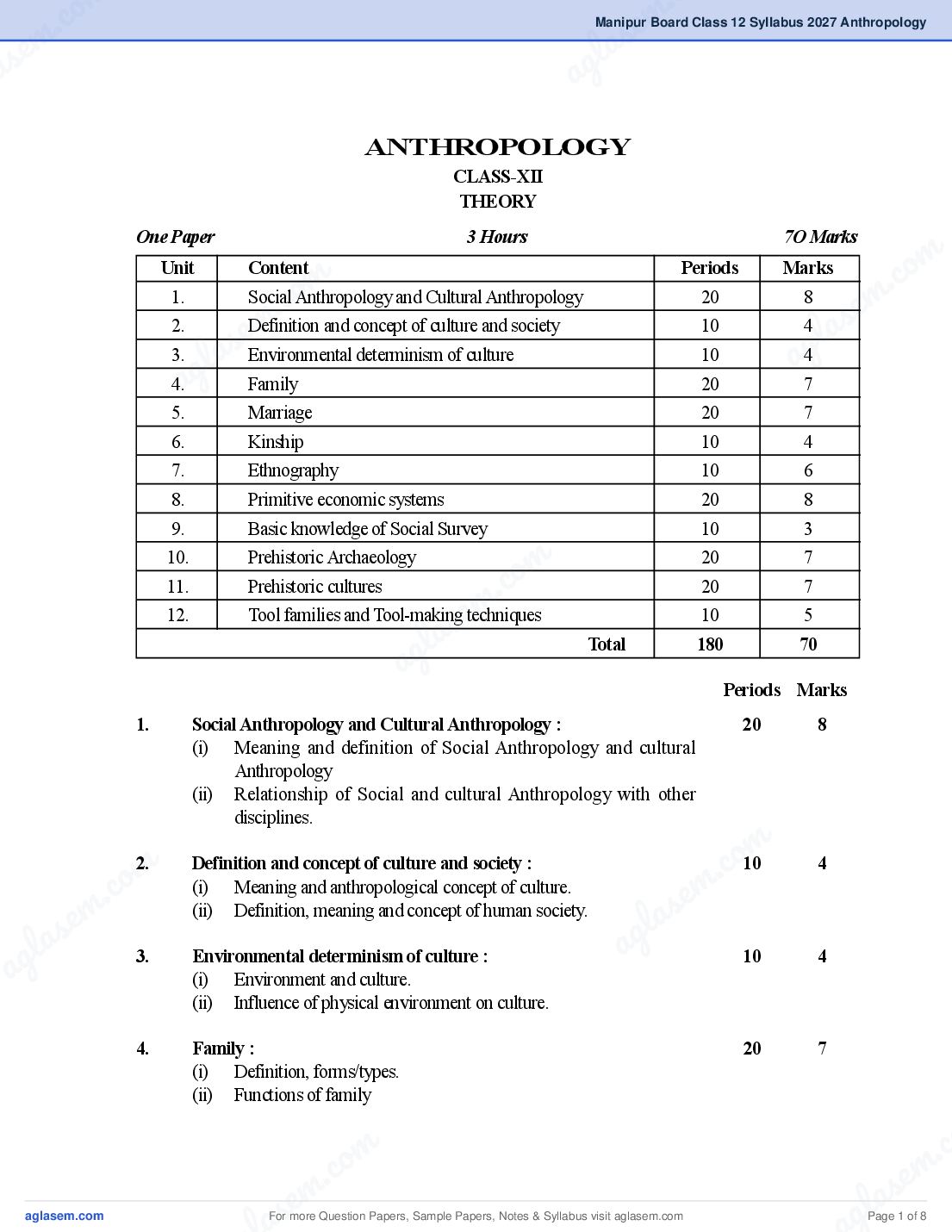
ANTHROPOLOGY
CLASS-XII
THEORY
One Paper 3 Hours 7O Marks
m
Unit Content
o m Periods Marks
. co
1. SocialcAnthropology
. and Cultural Anthropology 20 8
e m
2.
e m and concept of culture and society
Definition 10 4
l as
3. s
la Environmental determinism of culture 10 ag
4
4.ag Family 20 7
5. Marriage 20 7
6. Kinship 10 4
7. Ethnography 10 6
8. Primitive economic systems 20 8
9. Basic knowledge of Social Survey 10 3
10. Prehistoric Archaeology
m 20 7
11. Prehistoric cultures c. o 20 7
Tool families and Tool-making e m
12.
l as techniques 10 5
ag
Total 180 70
Periods Marks
1. Social Anthropology and Cultural Anthropology : 20 8
(i) Meaning and definition of Social Anthropology and cultural
Anthropology
(ii) Relationship of Social and cultural Anthropology with other
disciplines.
m
om
2. Definition and concept of culture and society : c. o10 4
. c (i) Meaning and anthropological concept of culture.
e m
e m (ii) Definition, meaning and concept of human society.
las
las ag
ag 3. Environmental determinism of culture :
(i) Environment and culture.
10 4
(ii) Influence of physical environment on culture.
4. Family : 20 7
(i) Definition, forms/types.
(ii) Functions of family
m . c
c. o s e m
s em
For more Question Papers, Sample Papers, Notes & Syllabus visit
gl a
Page 1 of 8
Page 3
(i) Definition, forms/types.
(ii) Ways of acquiring mates in tribal societies with special reference to
India.
6. Kinship : 10 4
(i) Definition and types.
(ii) Degrees of kinship.
(iii) Usages of kinship
7. Ethnography : 10 6
(i) Meaning and definition of ethnography.
(ii) A study of social organisation of the Tangkhul Nagas.
8. Primitive economic system : 20 8
(i) General characteristics of primitive economic systems.
(ii) Food Gathering - hunting and fishing.
(iii) Food Producing - domestication of animals and agriculture.
9. Basic knowledge of Social Survey : 10 3
Importance of schedule and questionnaire.
10. Prehistoric Archaeology : 20 7
(i) Nature and definition of Prehistoric Achaeology.
(ii) Scope of prehistoric Archaeology.
(iii) Preliminary knowledge of geological time scale and Pleistocene
climatic conditions, the great ice age.
(iv) Brief outline on the methods of dating the past - Stratigraphy, typology
and C14.
11. Prehistoric cultures : 20 7
(i) A brief outline of the following Prehistoric cultures of Europe
Paleolithic, Mesolithic and Neolithic periods.
(ii) A comparative study of the salient features of Paleolithic and Neolithic
cultures.
12. Tool families and Tool-making techniques. 10 5
(i) Tool families Chopper, Hand axes, cleavers, Scrapers, Points,
Blades, Awl/Barer, Graver/Burin, Microliths, bone tools and Celt’s.
(ii) Tool Making - techniques of manufacturing core and flake tools,
primary and secondary flaking, pressure flaking, grinding and
polishing. Materials used in making prehistoric tools.
Total = 180 70
For more Question Papers, Sample Papers, Notes & Syllabus visit Page 2 of 8
Page 4
.co s e m
s em l a
a ag
ANTHROPOLOGY
CLASS-XII
PRACTICAL
One Paper 3 Hours 3O Marks
m
om
Prehistory and Survey Methods
. co
.
Group A : Prehistoryc e m
m
e l as
1.
a s
Identification of tools (representing each industrial phase)
l (three periods of one half hours duration each) g
4 Marks
a
g
a Drawing and descriptions of tools (general shape, size,
2. 10 Marks
Probable tool-type, age and uses)
Palaeolithic tools : (i) Chopper
(ii) Pear-shaped
(iii) Cleaver
(iv) Scraper
(v) Blade m
.co
(vi) Baton-de-commandement
m
e
(vii) Bone needle
s
l a
(i) g Micro blades
Mesolithic tools :
a Trapeze
(ii)
(iii) Lunate
Neolithic : (i) Axe type of celt
(ii) Adze type of celt
(iii) Rectilinear shoulder celt
(24 Periods of one and half hours duration each)
m
m 3. .co
m .co Viva Voce
s em 4 Marks
s e 4. Laboratory Note Book
g la 4 Marks
g la a
a
m . c
c. o s e m
s em
For more Question Papers, Sample Papers, Notes & Syllabus visit
gl a
Page 3 of 8
Page 5
5. A students is required to collect relevant data in the household survey schedules which
are being provided by the Department concerned from at least 10 families of a locality.
A type out report based on the analysis of the schedules should be submitted to the
Department along with the used schedules for the purpose of final assessment at the
time of examination. The report should contain the following accounts :
(i) Introductory note on the locality,
(ii) Tables showing the size of household population,
Marital status, Literacy and Household Income,
(iii) Concluding remarks.
Every student should submit the ten duly filled in household schedules along with the
typed out report at the time of examination.
Distribution of Marks 6 Marks
(i) Field Report 4
(ii) Ten filled-in household schedules 2
6. Viva Voce on the field-report. 2 Marks
For more Question Papers, Sample Papers, Notes & Syllabus visit Page 4 of 8
Page 6
.co s e m
s em l a
a ag
PRESCRIBED TEXTBOOKS :
1. An Introduction to Social Anthropology
By D.N. Majumdar and T.N. Madan,
Published by Mayur Paperbacks,
A-95, Sector-5, NOIDA - 201301
m
2.
om
Anthropology for Beginners Part I & II . co
. c e m
By R.C. Das,
em l as
l as
Published by Sangam Prakash,
Rajgarh Road, Guwahati - 3. ag
g
a3. Introducing Social and Cultural Anthropology
By Hemendra Nath Banerjee,
K.K. Publications Calcutta - 73
4. Anthropology - The Study of Man
By Indrani Basu Roy,
Published by S. Chand & Company Ltd.,
Ram Nagar, New Delhi - 110055.
m
5. Pre-historic Arcaeology
By D.K. Battacharya,
m .co
Hindustan Publishing Corporation,s e
l a
ag
Delhi - 7.
6. Stone Age Tools
By Sankala, H.D. Deccan College Post Graduate and Research Institute, Pune.
7. Methods of Social Survey and Research
By S.R. Bajpai,
Published by Kitab Ghar,
Acharyanagar, Kanpur - 3.
8. Social and Cultural Life of the Nagas (The Tangkhul Nagas) m
m By M. Horam,
.co
m .co B.R. Publishing Corporation, Delhi.
s e m
s e 9. The Naga Tribes of Manipur
g la
g la By T.C. Hodson, a
a Low Price Publications, Delhi.
m . c
c. o s e m
s em
For more Question Papers, Sample Papers, Notes & Syllabus visit
gl a
Page 5 of 8
Page 7
DESIGN OF
QUESTION PAPER
Subject : ANTHROPOLOGY
Paper : Theory
Class : XII
Full Mark : 70
Time : 3 Hours
WEIGHTAGE TO OBJECTIVES
Objectives Marks Percentage
Knowledge (K) 14 20
I Understanding (U) 32 46
Application (A) 21 30
Skill (S) 3 4
Total : 70 100
WEIGHTAGE TO FORM OF QUESTIONS:
Form of Questions No. of Question Time (in minute) Marks Percentage
Essay/Long Answers (E/LA) 3 60 15 21
Short Answers (SA-I) 6 36 18 26
II Short Answers SA-II) 10 40 20 29
Very Short Answers (VSA) 10 30 10 14
MCQ 7 14 7 10
Total: 36 180 70 100
WEIGHTAGE TO CONTENT:
UNIT/CONTENTS : Marks
1. Social Anthropology and Cultural Anthropology. 8
2. Definition and concept of cultural & society 4
3. Environmental determinism of culture 4
4. Family 7
5. Marriage 7
III 6. Kinship 4
7. Ethnography 6
8. Primitive Economic System 8
9. Basic Knowledge of Social Survey 3
10. Prehistoric Archaeology 7
11. Prehistoric Cultures 7
12. Tool families and Tool making techniques 5
Total : 70
IV SCHEME OF SECTIONS : Nil
V SCHEME OF OPTIONS : Internal option may be given in Essay Type Question & SA-I.
VI DIFFICULTY LEVEL :
Difficult : 30%
Average : 50%
Easy : 20%
Abbreviation : K(Knowledge), U(Understanding ), C(Comprehension), Exp.(Expression), Skill(S),
E(Essay Type), SA (Short Answer Type), VSA (Very Short Answer Type),
MCQ(Multiple Choice Question)
For more Question Papers, Sample Papers, Notes & Syllabus visit Page 6 of 8
Page 8
.co s e m
s em l a
FROM THE ACADEMIC SESSIONg2025-26
a a
DESIGN OF
QUESTION PAPER
Subject : ANTHROPOLOGY
Paper : Theory
Class : XII
Full Mark : 70
Time : 3 Hours
m
WEIGHTAGE TO OBJECTIVES
om . co
Objectives
. c Marks Percentage
em
Knowledge(K)
em 10 15
l as
I
l as
Comprehension/Understanding(C/U)
Expression (Exp)
35
21
50
30
ag
Skillg(S)
a Total :
4
70 100
5
WEIGHTAGE TO FORMS OF QUESTIONS:
Time
Form of Questions No. of Question Marks Percentage
(in minute)
Essay/Long Answers (E/LA) 3 52 15 21
II Short Answers (SA-I) 6 54 18 26
Short Answers SA-II) 10 50 20 29
Very Short Answers (VSA) 7 14 7 10
MCQ 10
m 10 10 14
WEIGHTAGE TO CONTENT:
Total: 36
m .co 180 70 100
UNIT CONTENTS
s e Marks Percentage
1. l a
Social Anthropology and Cultural Anthropology. 8 11
2.
3.
ag
Definition and concept of cultural & society
Environmental determinism of culture
4
4
6
6
4. Family 7 10
5. Marriage 7 10
III 6. Kinship 4 6
7. Ethnography 6 9
8. Primitive Economic System 8 11
9. Basic Knowledge of Social Survey 3 4
10. Prehistoric Archaeology 7 10
11. Prehistoric Cultures 7
m 10
m
12. Tool families and Tool making techniques
c. IVo SCHEME OF SECTIONS : Total :
5
70
m.co 7
100
m V SCHEME OF OPTIONS : TOTAL
s e
s e 50% in SA-I, 100% in Essay.
g la
g la VI DIFFICULTY LEVEL :
a
a Difficult
Average
:
:
30% of the total marks
50% of the total marks
Easy : 20% of the total marks
Abbreviation : K(Knowledge), U(Understanding ), C(Comprehension), Exp.(Expression), Skill(S),
E(Essay Type), SA (Short Answer Type), VSA (Very Short Answer Type),
MCQ(Multiple Choice Question)
N.B.: Assertion and reasoning: 2(two) Questions in MCQ.
Source Based Question: 1(one) Question in SA-I
m . c
c. o s e m
s em
For more Question Papers, Sample Papers, Notes & Syllabus visit
gl a
Page 7 of 8
Page 9
QUESTION PAPER/UNIT TEST
Subject : ANTHROPOLOGY (Practical)
Class : XII
Full Marks : 30
Time : 3 Hours
Sl. Form of Nature of Exercise Skill to be tested
No. Exercise
Manipu- Observa- Drawing Repor- Related Total Estimated
lative tional skill ting Under- Marks Time
Skill Skill Skill standing (Mins.)
1. Short Identification of 2 0 0 0 2 4 30
Prehistoric Tools
2. Major Drawing and 1 1 6 1 1 10 120
description of tools
3. Class Lab. Note book - - 2 2 - 4 -
Record
4. Field Outdoor experiment 3 0 0 3 - 6 -
Survey Household Survey
technique
5. Short Viva Voce 0 0 0 0 6 6 30*
Total 6 1 8 6 9 30 180
*Thirty minutes are alloted for Viva Voce during which the examiner should make an assessment of the
knowledge of outdoor experiment by putting related questions along with the general viva voce.
For more Question Papers, Sample Papers, Notes & Syllabus visit Page 8 of 8
Document Details
| Board / Org | Manipur Board |
| Exam | Class 12 |
| Type | Syllabus |
| Pages | 8 |
| Updated | 04 Nov 2026 |