Kerala SET 2018 Feb Question Paper Botany
Finished viewing? Save it for later —
Download Kerala SET 2018 Feb Question Paper Botany (PDF · 14 pages)About Kerala SET 2018 Feb Question Paper Botany
Kerala SET 2018 Feb Question Paper Botany is available here for free download. Published by Kerala Exams for Kerala SET, this question paper can be viewed online or downloaded as a PDF (14 pages). Candidates preparing for Kerala SET can use Kerala SET 2018 Feb Question Paper Botany to understand the exam pattern, the type of questions asked, and the overall difficulty level.
Frequently Asked Questions
How can I download Kerala SET 2018 Feb Question Paper Botany?
Open this page and click the Download button to save Kerala SET 2018 Feb Question Paper Botany as a PDF. It is completely free on AglaSem Docs.
Is Kerala SET 2018 Feb Question Paper Botany free to download?
Yes. Kerala SET 2018 Feb Question Paper Botany can be viewed online and downloaded as a PDF free of cost on AglaSem Docs.
How many pages does Kerala SET 2018 Feb Question Paper Botany have?
Kerala SET 2018 Feb Question Paper Botany contains 14 pages, which you can read online or download together as a single PDF.
Where can I find more Kerala SET study material?
You can find more Kerala SET question papers, sample papers, syllabus, and answer keys on AglaSem Docs.
Kerala SET 2018 Feb Question Paper Botany – Text
Read the full text of this question paper below — useful to quickly search, copy and reference the content online without downloading the PDF.
📄 View text version (14 pages)
Page 1
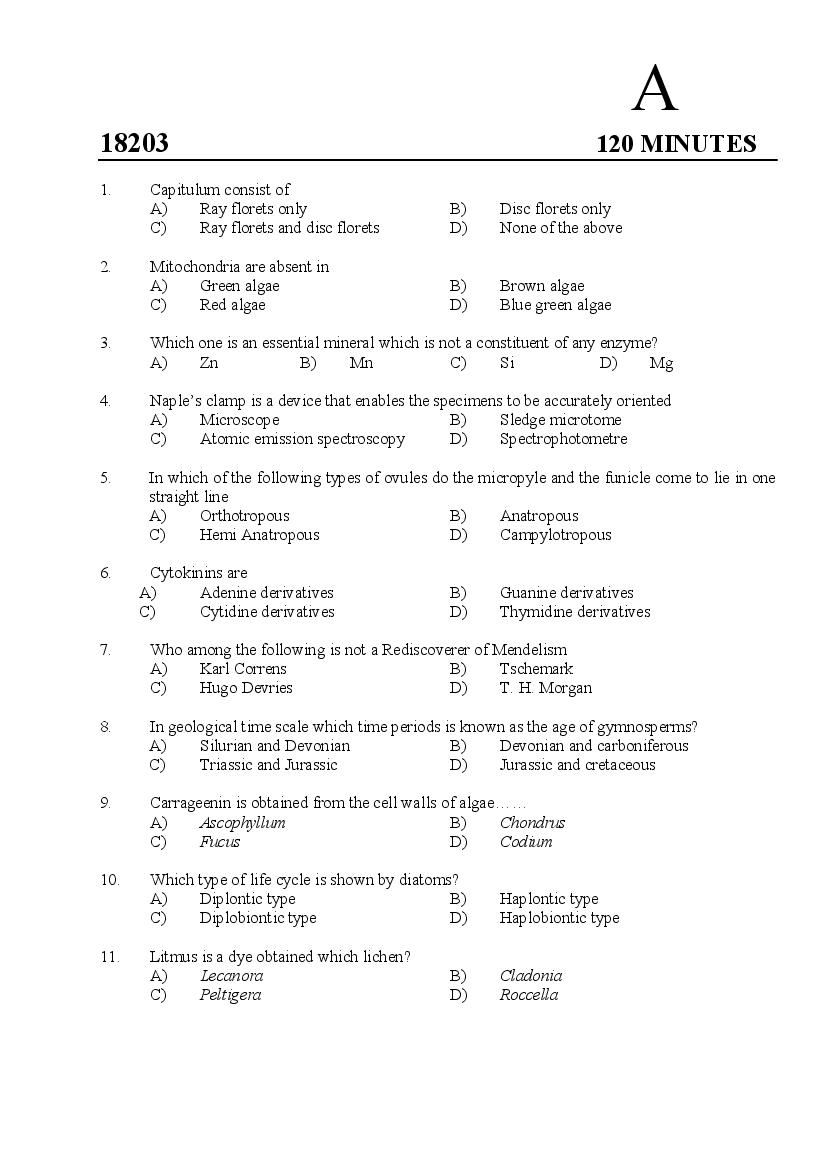
18203 120 MINUTES
1. Capitulum consist of
A) Ray florets only B) Disc florets only
C) Ray florets and disc florets D) None of the above
2. Mitochondria are absent in
A) Green algae B) Brown algae
C) Red algae D) Blue green algae
3. Which one is an essential mineral which is not a constituent of any enzyme?
A) Zn B) Mn C) Si D) Mg
4. Naple’s clamp is a device that enables the specimens to be accurately oriented
A) Microscope B) Sledge microtome
C) Atomic emission spectroscopy D) Spectrophotometre
5. In which of the following types of ovules do the micropyle and the funicle come to lie in one
straight line
A) Orthotropous B) Anatropous
C) Hemi Anatropous D) Campylotropous
6. Cytokinins are
A) Adenine derivatives B) Guanine derivatives
C) Cytidine derivatives D) Thymidine derivatives
7. Who among the following is not a Rediscoverer of Mendelism
A) Karl Correns B) Tschemark
C) Hugo Devries D) T. H. Morgan
8. In geological time scale which time periods is known as the age of gymnosperms?
A) Silurian and Devonian B) Devonian and carboniferous
C) Triassic and Jurassic D) Jurassic and cretaceous
9. Carrageenin is obtained from the cell walls of algae……
A) Ascophyllum B) Chondrus
C) Fucus D) Codium
10. Which type of life cycle is shown by diatoms?
A) Diplontic type B) Haplontic type
C) Diplobiontic type D) Haplobiontic type
11. Litmus is a dye obtained which lichen?
A) Lecanora B) Cladonia
C) Peltigera D) Roccella
Page 2
A) Fimbriae B) Pili
C) Mesosomes D) Flagellin
13. Which among the following is not a prophylactic method?
A) Protection B) Eradication
C) Introduction D) Exclusion
14. The first virus demonstrated to cause cancer is
A) Rous sarcoma virus B) Mouse mammary tube virus
C) Feline Leukemia virus D) Avian Leukosis virus
15. Labellum in Orchidaceae comes to anterior side by the twisting of the ovary through 1800.
This process is called
A) Adnation B) Articulation
C) Resupination D) Attenuation
16. Which of the following region has maximum diversity?
A) Mangrooves B) Temperate rainforest
C) Taiga D) Coral reefs
17. Bioinformatics tool CLUSTAL is a
A) Program that compares nucleotide sequences to sequence database.
B) Computation phylogenetic package of programs for drawing evolutionary trees.
C) Computer program series widely used for multiple sequence alignment.
D) Free open source software for rapid database searching with sequence patterns and
protein motif identification.
18. Which of the following is considered as a noncovalent bond?
A) Electrostatic interactions B) Hydrogen bonds
C) Van der waals interactions D) All of the above
19. Techniques that can be used to elucidate information about protein shape are
A) X-ray crystallography B) NMR spectroscopy
C) SDS-PAGE D) A and B
20. Which among the following is not a plant fossil?
A) Archaeopteryx B) Lepidocarpon
C) Lepidodendron D) Rhynia
21. Gyrase is a
A) Type ll topoisomerase found in eukaryotes
B) Type ll topoisomerase found in prokaryotes
C) Type l A topoisomerase present in all cells
D) Type l B topoisomerase present in prokaryotes
2
Page 3
DNA- binding regulatory protein?
A) ά helix B) β bend
C) Triple helix D) Zinc finger
23. Which among the following are products of light reaction and reactants of Calvin cycle?
A) NADP+ and CO2 B) NADPH and ATP
+
C) NADP , ATP and CO2 D) NADPH and O2
24. Identify the incorrect pair if any
A) Nitrogen fixers in soil- Azotobacter
B) Symbiotic nitrogen fixers- Rhizobium
C) Ammonifying bacteria- Escherichia coli
D) Nitrogen fixers in water- Nostoc
25. Grafting is not successful in monocots compared to dicots due to
A) Absence of cambium for secondary growth
B) Vascular bundle seen in a scattered manner
C) Presence of cork cambium
D) Xylem vessels arranged in an end to end manner
26. Which of the following dimer formation is most common?
A Cytidine dimer B) Thymine dimer
C) Both A and B D) None of the above
27. In gymnosperms the endosperm is
A) Triploid B) Haploid
C) Polyploid D) Diploid
28. Gynobasic style is the characteristic feature of which of the following family?
A) Lamiaceae B) Solanaceae
C) Asteraceae D) Ranunculaceae
29. Which of the following is a bacterial transcription inhibitor?
A) Aphidicolin B) Camptothecin
C) Rifamycin D) Ciproflaxacin
30. Which enzyme in gluconeogenesis is seen in both mitochondria and cytosole?
A) PEP carboxy kinase B) Pyruvate carboxylase
C) Pyruvate kinase D) Malate dehydogenase
31. First successful gene therapy was done for which of the following disorder?
A) Turner syndrome B) Hemophelia
C) SCID D) Jacobson syndrome
3
Page 4
A) Succinate dehydrogenase B) Succinyl CoA synthatase
C) Malate dehydrogenase D) Citrate synthase
33. Which of the following is called green mould?
A) Aspergillus B) Rhizopus
C) Pencillium D) Mucor
34. Vallecular canals and Carinal canals are the characteristic features of which of the following
pteridophyte?
A) Equisetum B) Ophioglossum
C) Psilotum D) Selaginella
35. Plant growth hormone auxin is synthesized from which of the following amino acid?
A) Tryptophan B) Proline
C) Histidine D) Arginine
36. Which of the following is a basic dye?
A) Congored B) Crystal violet
C) Eosin D) Nigrosin
37. Ac/Ds elements in Maize are examples of which transposable elements?
A) Retro transposones
B) Short Interspersed Nuclear Element (SINE)
C) Long Interspersed Nuclear Element (LINE)
D) Composite transposons
38. Siliqua is the characteristic fruit of which of the following family?
A) Fabaceae B) Brassicaceae
C) Caryophyllaceae D) Lamiaceae
39. Which one of the following is an imino acid?
A) Pepsine B) Proline
C) Cystein D) Histidine
40. Auxospores are specialized spores produced at the key stages in the life cycle of:
A) Diatoms B) Chlorella C) Nitella D) Ulothrix
41. Which one of the following is NOT a second messenger in cell signaling?
A) cAMP B) Ca2+ C) Cyclin D D) IP3
42. Species with wide geographical ranges of distribution, that develop locally adapted
populations are known as
A) Ecological species B) Ecotypes
C) Ecophenes D) Sub species
4
Page 5
A) Polygalacturonase B) Lactamase
C) Adenosine deaminase D) Glutathion transferase
44. The reserve food material in Bacillariophyceae (Diatoms) is
A) Laminarin B) Chrysolaminarin
C) Floridian starch D) Starch
45. Which of the following enzyme is responsible for the photoreactivation of DNA?
A) Photoligase B) Photoreductase
C) Photooxidase D) Photolyase
46. Which pollutant will cause black foot disease?
A) As B) Zn C) Pb D) Hg
47. The scaly membraneous perianth of graminae is
A) Radicle B) Spathe C) Panicle D) lodicule
48. Which among the following is a xerophytic bryophyte?
A) Sphagnum B) Funaria C) Porella D) Riccia
49. A synthetic form of opium was developed by Germany during world war -2 is known as
A) Prednisole B) Cortisone C) Methadone D) Polyheroin
50. Paracytic stomata is the characteristic feature of which family?
A) Rubiaceae B) Ranunculaceae
C) Cyperaceae D) Malvaceae
51. Match the following:
a. Arachis hypogea 1 Nutmeg
b. Myristicafragrans 2. Henna
c. Lawsoniainermis 3. White dammar
d. Vateriaindica 4. Ground nut
A) a-1, b-4, c-2, d-3 B) a-2 , b-4, c-1, d-3
C) a-4, b-1, c-2, d-3 D) a-3, b-4, c-2, d-1
52. The evidence of DNA as genetic material was provided based on the transduction
experiments on bacteriophages. The scientists associated with this are
A) Hershey and Chase B) Avery et al
C) Griffith D) Tatum
53. Where is the headquarters of IUCN located?
A) New York B) Switzerland
C) Washington D) Paris
5
Page 6
A) Carolus Linnaeus B) A.L.de Jussieu
C) A.P.de Candolle D) Benthem and Hooker
55. The catalytic part of bacterial RNA polymerase is
A) α B) β C) σ D) ω
56. A base substitutional mutation, where mutation in a codon leads to the production of stop
codon is called
A) Neutral mutation B) Silent mutation
C) Non sense mutation D) Reverse mutation
57. Oligomycin is an inhibitor of which of the following component in electron transport chain?
A) Complex 1 B) Complex 4
C) ATP synthase D) Complex 2
58. Which of the following is a C3 plant?
A) Maize B) Sugarcane
C) Amaranthus D) Rice
59. Finger like projections in synergids used to attract male gametes towards the egg cell to fuse
is
A) Filiform apparatus B) Germtube
C) Mesosomes D) Fimbria
60. Which of the following represent the last stage of sporophytic generation in plants
A) Microspore tetrad B) Sporemother cell
C) Zygote D) Archesporium
61. Use of pollutant accumulating plant to remove metals or organics from soil by concentrating
them in the harvestable plant part is called
A) Rhizofilteration B) Phytodegradation
C) Phytoextraction D) Bioleaching
62. α and β tubulins are the monomers of which of the following cytoskeletal element?
A) Microtubules B) Microfilaments
C) Intermediary filaments D) Actin filaments
63. Which of the following is the fastest way for membrane transport?
A) Pump B) Antiporter
C) Ion channel D) Symporter
64. Late blight of potato is caused by which of the following pathogen?
A) Phytophthora infestans B) Colletotrichumfalcatum
C) Xanthomonasoryzae D) Pythium debaryanum
6
Page 7
A) Leptotene B) Pachytene C) Diakinesis D) Diplotene
66. Greatest producers of organic matter on earth are
A) Crop plants B) Forest
C) Plants of the land area D) Phytoplankton of ocean
67. Phototropic and geotropic movements are linked to
A) Gibberellins B) Enzymes
C) Auxin D) Cytokinin
68. The reduction of disulphide bonds of protein molecules during SDS-PAGE is accomplished
by the addition of
A) Ammonium perslphate B) TEMED
C) Bis acrylamide D) 2- Mercaptoethanol
69. A part of DNA which codes for a single polypeptide chain is known as
A) Mucon B) Recon C) Cistron D) Intron
70. Actinomorphic, pentamerous, hypogynous flowers with monadelphous stamen are
characterstic features of
A) Sterculiaceae B) Malvaceae
C) Ranunculaceae D) Rosaceae
71. Which among the following is not a measure of dispersion?
A) Variance B) Range
C) Median D) Standard deviation
72. The enzyme reverse transcriptase was discovered by
A) Watson B) Kornberg
C) Temin and Baltimore D) Kary B Mullis
73. Which among the following statement is incorrect?
A) Plasmid is present in all bacteria
B) ‘F’ factor is a type of conjugate plasmid
C) Plasmids are present in some eukaryotes
D) Plasmid of unknown function is cryptic plasmid
74. Pick the odd ones
1. In photoperiodism perception of stimulus is confined to young expanded leaves.
2. Photoperiodism not only prepares the plant for flowering but initiates flowering.
3. Cytokinins can substitute the requirement of long photoperiods in long day plants.
4. Promotion of flowering by red light could be reversed by far red radiation.
5. Photoperiodism is mediated through vernalin which induces florigen synthesis.
A) 2 and 5 only B) 1 and 4 only C) 3 and 5 only D) 2 and 3 only
7
Page 8
1. Membranes usually have no charge on their outer surface.
2. The so called resting nucleus is not really resting.
3. Lysosomes convert cellular polymers to monomers.
4. Chloroplast and mitochondria in the cell take energy from food to make ATP.
A) 1, 2 and 3 are true B) 2 only is true
C) 2 and 3 are true D) 1, 2, 3, and 4 are true
76. Match the following:
a. Succession on rock 1. Lithosere
b. Succession on sand 2. Psammosere
c. Succession on salt marsh 3. Halosere
d. Succession on water 4. Hydrosere
A) a- 2, b- 1, c-3, d-4 B) a- 1, b-2, c-4, d- 3
C) a- 4, b-3, c- 2, d-1 D) a- 1, b-2, c-3, d-4
77. Soft wood are -----
A) Wood of gymnosperms B) Wood with few xylem
C) Wood used for paper making D) Wood of monocots
78. For a double stranded DNA according to Chargaff’s rule which of the following ratios
always equal 1?
1. A/G 2. C/T 3. C/G 4. (A+G)/(C+T)
A) 1 & 2 only B) 2 & 4 only C) 1 & 4 only D) 3 & 4 only
79. Which of the following statements are correct?
1. Cork cambium and vascular cambium are lateral meristems responsible for secondary
growth of stem.
2. Pith and cortex do not differentiate in monocot stem.
3. Sieve tubes are suited for translocation of food because they possess broader lumen
and perforated cross walls.
4. Pericycle of root produces lateral root.
5. In monocot leaf mesophyll cells are differentiated into palisade and spongy tissue.
A) 1, 2, 3 and 4 are correct
B) 2, 3, 4 and 5 are correct
C) 1, 2, 4 and 5 are correct
D) All the given statements are correct
8
Page 9
the number of molecules have dissociated into single strands. Tm will be maximal at
A) Low ionic strength and high DNA concentration
B) High ionic strength and high DNA concentration
C) High ionic strength and low DNA concentration
D) Low ionic strength and low DNA concentration
81. Match the following diseases and causative organisms:
a. Damping off 1. Ustilago
b. Rust 2. Pythium
c. Smut 3. Plasmopara
d. Downy mildew 4. Puccinia
A) a-2, b-4, c-1, d- 3 B) a-4, b-3, c-1, d- 2
C) a-1, b-4, c-3, d- 2 D) a-4, b-1, c-2, d- 3
82. Match the following:
a. Family 1. Dicot
b. Order 2. Polygala indica
c. Species 3. Polygalales
d. Genus 4. Polygalaceae
e. Class 5. Polygala
A) a-4, b-3, c-2, d-5, e-1 B) a-1, b-4, c-2, d-3, e-5
C) a-4, b-1, c-5, d-3, e-2 D) a-4, b-3, c-2, d-1, e-5
83. Which of the statement/ statements is/ are incorrect
1. Pure line selection is also called as single plant selection
2. Mutation breeding involves exposing seeds to chemicals or radiations to generate
mutants of desirable traits.
3. Horizontal resistance is used to denote the resistance conveyed by a single gene to a
disease or pest.
4. Ideo type is a biological model which is expected to perform or behave in a
predictable manner within a defined environment.
A) 4 only B) 1 and 4 only C) 3 only D) 1, 2 and 3 only
84. Which of the following statement regarding Ramachandran plot is not true?
A) Almost all the peptide bonds in proteins are cis.
B) The restriction of ɸ and Ψ angles limits structures accessible to unfolded form of
protein.
C) A configuration that has ɸ = 90°and Ψ = 90° is disallowed.
D) Three quarters of possible (ɸ, Ψ) combinations are excluded by their steric clashes.
9
Page 10
velocity ……..
A) [S] would need to be equal to KM
B) [S] would need to be equal to 1/2 KM
C) [S] would need to be equal to 3 KM
D) [S] would need to be equal to 3/4 KM
86. Floral meristem can be distinguished from vegetative meristem by
A) Small size and decreased frequency of cell division
B) Large size and decreased frequency of cell division
C) Large size and increased frequency of cell division
D) Small size and increased frequency of cell division
87. Which of the following statements regarding DNA, histones and RNA are true?
A) All cells have the same amount of DNA and histones but different amount of RNA.
B) All cells have the same amount of DNA but different amount of histones and RNA.
C) All cells have different amount of DNA and histones but same amount of RNA.
D) In all cells the amount of DNA, RNA and histones will be constant.
88. Which of the following statements about the mitochondrial ATP synthesizing complex are
correct?
A. It contains more than 10 subunits.
B. It is located in the inter membrane space of mitochondria
C. It contains a sub assembly that constitute the H+ channel
D. It is sensitive to oligomycin inhibition
E. It translocates ATP through the mitochondrial membrane
A) A and B are correct B) A, C and D are correct
C) B and E are correct D) All are correct.
89. In a random sample of 400 individuals in a population with alleles of traits in Hardy-
Weinberg equilibrium. Where 36 individuals are homozygous for allele ‘a’, how many
individuals in the sample are expected to carry at least one allele ‘A’?
A) 36 B) 168
C) 364 D) 196
90. The classical example of maternal effect is
1. Plastid inheritance in Mirabilis jalappa.
2. Male sterility
3. Coiling of Shell in Limnaeaperegra
4. Pigment in Ephestiakuehniella
A) 1 and 2 only B) 2 and 3 only
C) 3 and 4 only D) 2, 3 and 4 only
10
Page 11
a. Thrombin 1. X chromosome inactivation
b. Cajal bodies 2. Anticoagulant
c. Dosage compensation 3. Blood clotting cascade
d. Heparin 4. Biogenesis of telomerase enzyme
A) a-3, b-4, c-1, d-2 B) a-1, b-3, c-2, d-4
C) a-2, b-1, c-3, d-4 D) a-3, b-2, c-4, d-1
92. Here are few statements regarding nitrogenase enzyme. Which one of them is NOT true?
A) Nitrogenase enzyme is active only in the absence of oxygen
B) Nitrogenase enzyme is a complex of three subunits namely dinitrogenase,
dinitrogenase reductase and nitrate reductase.
C) The enzyme converts N2 into ammonia
D) Leg haemoglobin will scavenge the oxygen molecule and make anoxygenic condition
for working of the enzyme.
93. Here are few statements regarding peptide bond. Choose the combination of statements
which are TRUE?
1. Peptide bond is planar in nature
2. Normal peptide bond length is 1.27A0
3. A peptide bond is formed between the COO- group of one amino acid with the
NH+3 group of the adjacent amino acid
4. Peptide bond is polar in nature
A) 1, 2 & 3 only B) 3 only C) 1 & 3 only D) 1, 3 & 4 only
94. In fowl the comb pattern shows non-epistatic interaction. When a walnut combed fowl was
crossed with pea combed fowl, the progeny segregated as 3 walnut: 3pea: 1 rose:1 single.
The genotype of walnut and pea are:
A) RrPpXrrPP B) RRPpXrrPp C) RrPPXrrPp D) RrPpXrrPp
95. Genotypic and phenotypic ratio remains the same in which of the following
A) Intermediate dominance B) Resessive epistasis
C) Complementary gene interaction D) Dominant epistasis
96. In a trihybrid cross, the total number of progeny is 1000. The observed double cross overs are
6 and 4 in number. The distances between the genes are 20 and 25cM. Find the interference
operating in this region.
A) 0.5 B) No interference C) 0.8 D) 0.2
97. Which of the following is true about Lamarckism?
1. Nature tends to increase the size of living organisms and their component parts.
2. The production of new organ in the body is the result of a new need felt by organism.
3. Increase in number leads to struggle for existence among organisms.
4. Constant use leads to better development and disuse degeneration of organs.
A) 1, 2, 3 & 4 B) 2, 3 & 4 only C) 1, 3 & 4 only D) 1, 2 & 4 only
11
Page 12
light?
A) S-V-W-D-F-G-Y-W-A B) Q-L-D-F-T-L-D-G-Y
C) Q-L-F-D-F-G-Y-F-A D) S-V-W-D-F-G-Y-T-G
99. Depending upon the size and centromere position the 46 chromosomes in humans have been
divided into ------ number of groups
A) 6 B) 5 C) 7 D) 10
100. A man with blood group ‘A’ marries a lady with blood group ‘AB’. Which among the
following progeny is not possible in this case?
A) A group B) AB group
C) O group D) B group
101. Which of the following statements regarding the stem of bamboo is correct?
A) Radial, endarch, closed, limited number of vascular bundles
B) Collateral, endarch, closed, many vascular bundles
C) Collateral, exarch. closed, many vascular bundles
D) Radial, exarch, open, limited number of vascular bundles
102. How many meiotic divisions is need for the development of 64 spores?
A) 16 B) 48 C) 64 D) 24
103. According to Telome theory of Zimmermann which of the following series led to the
evolution of megaphyllous leaves:
A) Over topping - planation - syngenesis
B) Over topping - syngenesis - planation
C) Over topping - planation - reduction
D) Over topping - reduction - syngenesis
104. Which of the following is not true about the C4 pathway in plants?
A) Malate is decarboxylated to release CO2 in the cytosol of mesophyll cells.
B) Oxaloacetate formation is catalyzed by PEP carboxylase.
C) Oxaloacetate is rapidly converted to malate in mesophyll chloroplasts.
D) CO2 enters Calvin cycle by condensing with Ribulose- 1, 5-bisphosphate.
105. Which of the following are the demerits of Engler and Prantle system of classification?
1. Derivation of parietal placentation from axile placentation.
2. Derivation of bisexual flower from unisexual flower.
3. Orchids were considered to be highly evolved than grasses.
4. Derivation of entomophily from anemophily.
5. Families with inferior ovary have been treated in the last Archichlamydeae
and sympetalae.
A) 1, 2 and 4 only B) 2, 3 and 4 only
C) 2, 3, 4 and 5 only D) All the above
12
Page 13
A) Concentration of toxic contaminants in root, stem and foliage of plant.
B) Degradation of contaminant molecule by plant enzymes.
C) Release of nutrients by plants to microbes in rhizosphere which are active in
biodegradation of contaminant molecule.
D) The conversion and storage of contaminant by plants in a form which is not
bioavailable
107. Which among the following does not use sequence alignment?
A) BLAST B) CLUSTAL
C) Pair wise alignment D) Draw Tree
108. Which of the following statements correctly describes the biosynthetic pathway for purine
nucleotides?
A) The nitrogen ring in the purine base that is bonded to ribose in the nucleotide is
derived originally from glycine.
B) The first enzyme in the path is aspartate transcarbamoylase.
C) Purines deoxynucleotide are made by the same path as ribonucleotides by reduction
of the ribose moiety.
D) The purine rings are first synthesized then condensed with ribose phosphate.
109. The process of double fertilization involves
A) Fertilization of two eggs in the same embryo sac by two male gametes brought by two
pollen tubes
B) Fertilization of two eggs in the same embryo sac by two sperms brought by the same
pollen tube
C) Fertilization of the egg and the central cell by two sperms brought by the same pollen
tube
D) Fertilization of the egg and the central cell by two sperms brought by the different
pollen tube
110. Which among the following molecular marker is not PCR based?
A) STMS B) ISSR C) RFLP D) AFLP
111. Which statement correctly describes the electrophoresis of DNA fragments?
A) Larger fragment of DNA move more rapidly to the anode than smaller fragments.
B) Positively charged fragments of DNA move to the anode.
C) Small negatively charged fragments of DNA move rapidly to the cathode.
D) Smaller fragments of DNA move more rapidly than larger fragments.
112. Which of the following gives rise to genetic variation in a population?
1. Crossing over and independent assortment in meiosis
2. Different environmental conditions
3. Random mating and fertilization
4. Mutation
A) 1, 2, 3 and 4 B) 1, 2 & 3 only C) 1, 3 & 4 only D) 2, 3 & 4 only
13
Page 14
A) Intergeneric hybridization B) Intraspecific hybridization
C) Intervarietal hybridization D) Natural hybridization
114. The marker which in not exploiting microsatellite variation
A) SSR B) STMS C) SNP D) ISSR
115. The progress and changes during cell division has to be monitored in an experiment. The
microscope that is the most suited for this purpose is
A) Transmission electron microscopy B) Scanning electron microscopy
C) Phase contrast microscopy D) Flourescent microscopy
116. Among the following, find the pair that is wrongly matched
A) Chromosome theory of inheritance - Sutton and Boveri
B) Linkage map - Sturtevent
C) Mitochondria - Altmann
D) Chromosomes - Chistian de Duve
117. Match the following
a. Aggregate fruits 1. Euphorbiaceae
b. Cyathium 2. Annonaceae
c. Oblique placentation 3. Asclepiadaceae
d. Pollinium 4. Solanaceae
A) a-1, b-2, c-3, d-4 B) a-2, b-1, c-4, d-3
C) a-2, b-3, c- 4, d-1 D) a-1, b-2, c-4,d -3
118. Among the following, find the histones associated within the nucleosome
A) H2A, H2B, H3 and H4 B) H1, H2a, H2Band H3
C) H1, H2A, H2B and H4 D) H1, H2, H3 and H4
119. In cell cycle the order of stages are in this chronology
A) Mitosis, Cytokinesis, G1, S, G2 B) Mitosis, Cytokinesis, S, G1, G2
C) Mitosis, Cytokinesis, G1, G2, S D) Cytokinesis, Mitosis, G1, G2, S
120. In Snapdragon, red flower colour is incompletely dominant over white, the heterozygous
condition giving pink flowers. However, long pollen is completely dominant over short.
When a pure breeding red long plant was crossed with white short plant, what are the ratios
of progenies expected in F2?
A) 6 pink long:3 red long: 3 white long: 2 pink short: 1 red short: 1 white short
B) 6 red long: 3 pink long: 3 pink short: 2 white long: 1 red short: 1 white short
C) 9 red long: 3 red short: 3white long: 1 white short
D) 6 pink long: 3 pink short: 3 red long: 1 white short
********************
14
Document Details
| Board / Org | Kerala Exams |
| Exam | Kerala SET |
| Type | Question Paper |
| Pages | 14 |
| Updated | 23 Oct 2026 |