Kerala SET 2018 Feb Question Paper Islamic History
Finished viewing? Save it for later —
Download Kerala SET 2018 Feb Question Paper Islamic History (PDF · 11 pages)About Kerala SET 2018 Feb Question Paper Islamic History
Kerala SET 2018 Feb Question Paper Islamic History is available here for free download. Published by Kerala Exams for Kerala SET, this question paper can be viewed online or downloaded as a PDF (11 pages). Candidates preparing for Kerala SET can use Kerala SET 2018 Feb Question Paper Islamic History to understand the exam pattern, the type of questions asked, and the overall difficulty level.
Frequently Asked Questions
How can I download Kerala SET 2018 Feb Question Paper Islamic History?
Open this page and click the Download button to save Kerala SET 2018 Feb Question Paper Islamic History as a PDF. It is completely free on AglaSem Docs.
Is Kerala SET 2018 Feb Question Paper Islamic History free to download?
Yes. Kerala SET 2018 Feb Question Paper Islamic History can be viewed online and downloaded as a PDF free of cost on AglaSem Docs.
How many pages does Kerala SET 2018 Feb Question Paper Islamic History have?
Kerala SET 2018 Feb Question Paper Islamic History contains 11 pages, which you can read online or download together as a single PDF.
Where can I find more Kerala SET study material?
You can find more Kerala SET question papers, sample papers, syllabus, and answer keys on AglaSem Docs.
Kerala SET 2018 Feb Question Paper Islamic History – Text
Read the full text of this question paper below — useful to quickly search, copy and reference the content online without downloading the PDF.
📄 View text version (11 pages)
Page 1
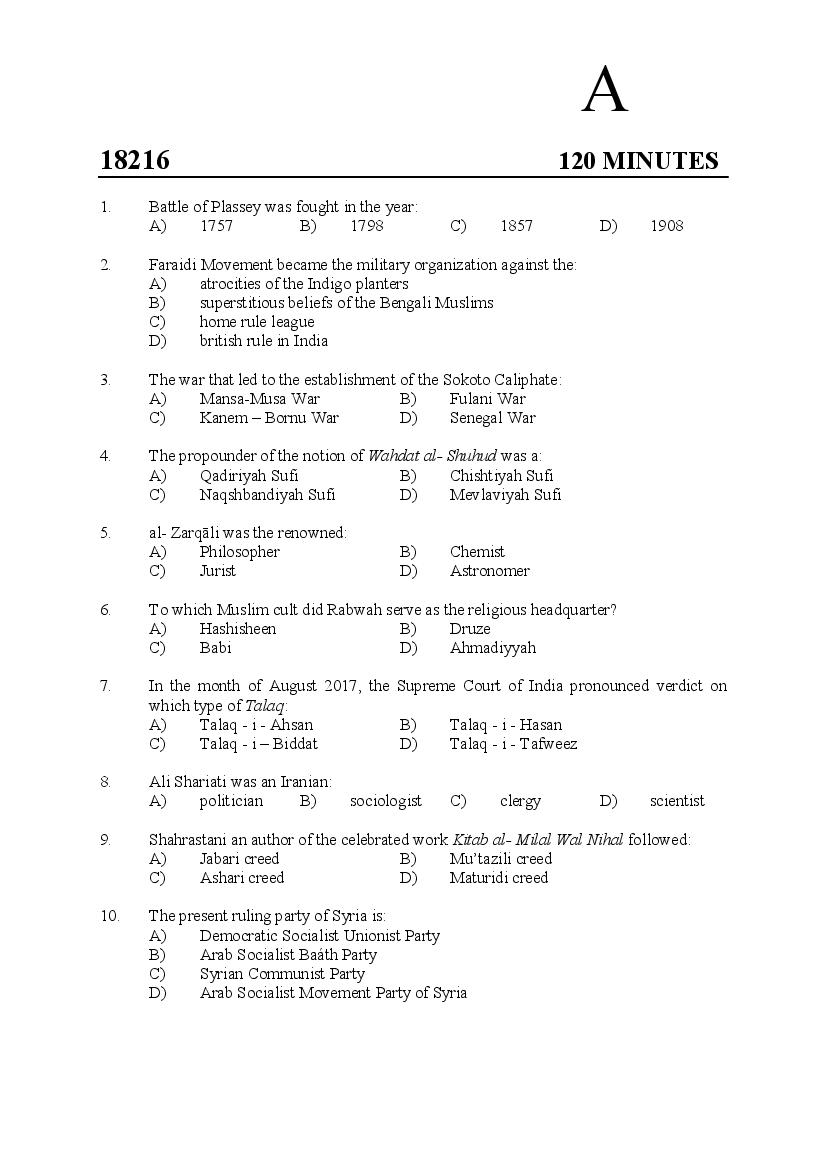
18216 120 MINUTES
1. Battle of Plassey was fought in the year:
A) 1757 B) 1798 C) 1857 D) 1908
2. Faraidi Movement became the military organization against the:
A) atrocities of the Indigo planters
B) superstitious beliefs of the Bengali Muslims
C) home rule league
D) british rule in India
3. The war that led to the establishment of the Sokoto Caliphate:
A) Mansa-Musa War B) Fulani War
C) Kanem – Bornu War D) Senegal War
4. The propounder of the notion of Wahdat al- Shuhud was a:
A) Qadiriyah Sufi B) Chishtiyah Sufi
C) Naqshbandiyah Sufi D) Mevlaviyah Sufi
5. al- Zarqāli was the renowned:
A) Philosopher B) Chemist
C) Jurist D) Astronomer
6. To which Muslim cult did Rabwah serve as the religious headquarter?
A) Hashisheen B) Druze
C) Babi D) Ahmadiyyah
7. In the month of August 2017, the Supreme Court of India pronounced verdict on
which type of Talaq:
A) Talaq - i - Ahsan B) Talaq - i - Hasan
C) Talaq - i – Biddat D) Talaq - i - Tafweez
8. Ali Shariati was an Iranian:
A) politician B) sociologist C) clergy D) scientist
9. Shahrastani an author of the celebrated work Kitab al- Milal Wal Nihal followed:
A) Jabari creed B) Mu’tazili creed
C) Ashari creed D) Maturidi creed
10. The present ruling party of Syria is:
A) Democratic Socialist Unionist Party
B) Arab Socialist Baáth Party
C) Syrian Communist Party
D) Arab Socialist Movement Party of Syria
Page 2
A) Jasmine Revolution
B) October Revolution
C) Tahrir Square Revolution
D) All of the Above
12. Tipu Sultan took the services of ------ in improvising artillery and war strategy:
A) Portuguese B) Dutch C) French D) Ottoman
13. An Epithet Lisan al- Din was associated with:
A) ibn Khatib B) ibn Kathir C) ibn Khaldun D) ibn Taymiyah
14. The capital of Faruqi Dynasty was:
A) Malwa B) Hyderabad C) Burhanpur D) Hussainabad
15. Baghdad was founded by Abu Jafar al- Mansur in the year:
A) 756 AD B) 762 AD C) 768 AD D) 780 AD
16. Tabiyun al Kalam was authored by:
A) Mirza Asadullah Khan Ghalib
B) Muhammad Hadi Ruswa
C) Sir Syed Ahmad Khan
D) Maulana Qasim Nanotvi
17. From which Abbasid Caliph the Ottoman took over the Caliphate:
A) al- Mustansir B) al- Mu’tamid
C) al- Aziz D) al- Mutawakil III
18. Barmakids were:
A) a family of the Abbasid Priest
B) a family of the Abbasid Cavalry
C) a family of the Abbasid Governors
D) a family of the Vizier
19. The duration for which Mughal Emperor remained out of power in the wake of Surid
Invasion:
A) 1530 – 1540 AD B) 1535 – 1550 AD
C) 1540 – 1555 AD D) 1540 – 1570 AD
20. Jamal al- Din Afghani visited the Indian City of:
A) Delhi B) Lucknow C) Burhanpur D) Hyderabad
21. The last revealed Surah of the Holy Qur’ān:
A) Nasr B) Nās C) Kauthar D) Ikhlas
22. Who headed the Muslim contingent to Abyssinia in the migration of 615 AD?
A) Abd Allah ibn Jahsh B) Jafar bin Abi Talib
C) Sa’ad bin Abi Waqqas D) Abd al- Rahman bin Awf
2
Page 3
A) Bayt al- Ridhwan B) Gazwah - i - Khaybar
C) Fath i Makkah D) Sanat al- Wufud
24. Charge of Nepotism was levelled against:
A) Hadhrat Abu Bakr B) Hadhrat Umar
C) Hadhrat Uthman D) Hadhrat Ali
25. Grozny is the capital of:
A) Chechnya B) Azerbaijan
C) Turkmenistan D) Serbia
26. Aghlabid rule on behalf of Abbasids was in the region of:
A) Multan B) Sijistan C) Ifiqiyah D) Arabia
27. After the Caliphate of Al- Mamun the Abbasid capital was shifted to:
A) Hashmiyah B) Kufah C) Basrah D) Samarra
28. Cyprus is situated in the:
A) Arabian Sea B) Mediterranean Sea
C) Arctic Sea D) Red Sea
29. Sultanate of Malacca was founded by:
A) Sultan Iskandar Shah B) Sultan Mahmud Shah
C) Sultan Mansur Shah D) Sultan Aauddin Riayat Shah
30. Patani is the province with Muslim majority in:
A) Mongolia B) Thailand C) Vietnam D) Srilanka
31. ‘The Shaykh of the Translators’ during the Abbasid period was:
A) Hubaysh ibn al- Hasan B) Isa ibn Yahya
C) Hunayn ibn Ishaq D) Musa ibn Khalid
32. Ilkhanid dynasty was founded by:
A) Genghis Khan B) Hulagu Khan
C) Ghazan Khan D) Tughril Bey
33. The first Sanusi ‘Zawiyah’ anywhere in the world was established in:
A) Abu Qubays B) Jaghbub C) Cyrenaica D) Cairo
34. Amir Mu’awiyah was proclaimed Caliph at:
A) Damascus B) Madinah C) Kufah D) Jerusalem
35. Who was the champion of the Riddah Wars?
A) Aswad Ansi B) Khalid bin Walid
C) Sa’ad bin Abi Waqqas D) Ikrimah bin Jahl
3
Page 4
A) Umayyad Caliph B) Abbasid Caliph
C) Fatimid Caliph D) Sokoto Caliph
37. According to the Muslim scholars Majusis are:
A) Jews B) Christians
C) Zoroastrians D) None of the above
38. In Islamic history Saqālibah meant:
A) Abyssinian Slave B) Turkish Slave
C) Indian Slave D) Spanish Slave
39. Kitāb al- ‘Ayn is the work concerning:
A) Arabic dictionary B) Treatise on Eye
C) Administrative skills D) Biographies
40. Caliph Jafar al- Mansur assigned the name of Baghdad as:
A) Madinat al- Mansur B) Madinat al- Dawlah
C) Madinat al- Salam D) Madinat al- Abbasiyah
41. Under the Abbasids Diwan al- Barid was:
A) Audit and accounts department
B) Postal department
C) Revenue department
D) External affairs department
42. According to the military organization Haras were:
A) Cavalry B) Infantry
C) Caliphal bodyguard D) Commander in Chief
43. Wadi al- Sughd lies between:
A) Tashkent and Bukhara B) Samarqand and Bukhara
C) Amu Darya and Syr Darya D) Khwarzim and Cremia
44. Abd al- Rahman ibn Muljam was a:
A) Khariji B) Mu’tazali C) Ashari D) Shi’i
45. Which among the following mentioned in the Qur’ān was not a prophet?
A) Luqman B) Sulaiman C) Hud D) Salih
46. Marshal G. S. Hodgson authored:
A) The Spirit of Islam B) Islamic Revivalism
C) The Venture of Islam D) Islam: A True Religion
47. Ilm al- Umran is a:
A) A study about the family of Prophet Isa
B) A science of sociology
C) A branch of medical science developed by the Arab Muslims
D) None of the above
4
Page 5
A) Austria B) Belgium C) Germany D) Netherland
49. Muhammad Abduh was exiled to ----- in context of Urabi revolt:
A) Lebanon B) Iraq C) Syria D) Beirut
50. Abd al- Rahman al- Kawakibi was:
A) An Egyptian thinker B) An Iraqi thinker
C) A Syrian thinker D) A Yemeni thinker
51. Maulavi Chiragh Ali was associated with:
A) Sir Syed Ahmad Khan B) Shah Waliullah Dehlavi
C) Maulana Qasim Nanotavi D) Muhammad Ali Jinnah
52. Epithet Imam Rabbani is associated with:
A) Ibn Arabi B) Shihabuddin Suhrawardi
C) Najmuddin Nishapuri D) Shaykh Ahmad Sirhindi
53. Kerala Nadvahul Mujahideen is a:
A) Barelvi organization B) Salafi organization
C) Sufi organization D) Terrorist organization
54. Tuh-fat al- Mujahideen was authored by:
A) Sheik Shahabuddeen B) Sheik Zeinuddeen
C) Sheik Talaluddeen D) None of the above
55. Ibn Batutah records ------ number of quarter/s exclusive for Muslim traders at
Pantalayini Kollam:
A) 5 B) 4 C) 3 D) 2
56. As per the 1871 census report Mappilas were defined as:
A) Indigenous Mohammedan B) Hybrid Mohammedan
C) Inter-racial Mohammaden D) Arabo-Mapilla Mohammaden
57. ‘Kizhippanam” literally means:
A) Purse money B) Auction amount
C) Purchase amount D) None of the above
58. Duff Muttu is a:
A) Tax imposed on Muslims of Kerala
B) Musical instrument of Arabian origin
C) Religious culture of Muslim of Kerala
D) Muslim tribe of Kerala
59. Ar Raheeq al- Maktoom is the celebrated Sirah work by:
A) Syed Sulayman Nadvi B) Shibli Numani
C) Thanaullah Amritsari D) Safiur Rahman Mubarakpuri
5
Page 6
A) Asrar - i – Khudi B) Armughan - i – Hijaz
C) Tohfa al- Islam D) Zarb - i - Kaleem
61. According to the orientalist Guillaume “the last great philosopher of Islam before
Averroes” was:
A) ibn Sina B) ibn Rushd
C) al- Shahrastani D) al- Farabi
62. ‘Mafātih al- asrār wa masābih al- abrār’ is a classical tafsir work by:
A) Baihaqi B) al- Tabari
C) al- Suyuti D) al- Shahrastani
63. Which among the following personalities upheld the doctrine of ‘Intermediate
Position’?
A) Ghaylan al- Dimashqi B) Wāsil bin Atā
C) Hasan al- Basri D) Abdullah bin Umar
64. The Arabian Nights was translated into English by:
A) Sir Richard F. Burton B) Sir Arthur Canon Doyle
C) Sir William Muir D) Sir Ross Masud
65. Which part of Arabian Peninsula is called as “al- Rab’ al- Khāli”?
A) Northern desert B) Southern desert
C) Eastern desert D) Western desert
66. The Alphabet system of writing was exclusively popularized by:
A) Chaldeans B) Assyrians
C) Phoenicians D) Abyssinians
67. Arabian Peninsula is situated in ------ part of Asia.
A) North-Eastern B) North-Western
C) South-Eastern D) South-Western
68. Which steppe-land is referred as al- Samāwah?
A) Bādiyat al- Irāq B) Bādiyat al- Misr
C) Bādiyat al- Sha’m D) Bādiyat al- Yaman
69. al- Istakhri was the geographer of:
A) 9th century AD B) 10th century AD
C) 11th century AD D) 12th century AD
70. Which among the following is regarded as ‘Wine of Islam’?
A) Zam Zam B) Coffee
C) Qahwa D) Tea
6
Page 7
A) Date-Palm B) Coconut C) Grape D) Olive
72. Which among the following were considered as the supreme virtues during pre-
Islamic Arabia?
A) Diyāfah B) Hamāsah
C) Muru’ah D) All of the above
73. The warring parties of Harb al- Basus were:
A) Banu Hawazin and Banu Khuzaa’
B) Banu Taghlib and Banu Akhtal
C) Banu Bakr and Banu Taghlib
D) Banu Akhtal and Banu Hashim
74. Apart from Bā’idah which one of the following was the traditional genealogy?
A) Bāqiyah B) Bāsiqah C) Thamudaei D) Ādites
75. Priest-Kings of the Sabaean Kingdom held the title of:
A) Muhaffiz B) Mukhatib C) Mukarrib D) Mutallib
76. The last Himyarite King Dhu-Nuwās by faith was a:
A) Zoroastrian B) Jew
C) Nestorian Christian D) None of the Above
77. Ancient city of Palmyra/Tadmor is presently situated in:
A) Iraq B) Syria C) Yemen D) Jordan
78. Who among the following poets of Saba - i - Mu‘allaqāt fought in the battle of
Halimah?
A) al- Nābighah al- Dhubiyāni B) Imru’ al- Qays
C) Hassān ibn Thābit D) Labid
79. The pre-Islamic battle in which Prophet Muhammad (SAW) also participated:
A) Days of Fijār B) Days of Bu‘āth
C) Harb al- Basus D) Days of Dāhis
80. According to Ibn Hisham who among the following was the importer of Idol Hubal at
Makkah?
A) Imru’ al- Qays B) ‘Antarah ibn- Shaddād al- ‘Absi
C) Pliny D) ‘Amr ibn Luhayy
81. Ibn Battutah was:
A) Yemeni Traveller B) Andalusian Traveller
C) Syrian Traveller D) Moroccan Traveller
82. Madinah is situated approximately ----- miles ------ of Makkah:
A) 200, east B) 250, south C) 300, north D) 350, west
7
Page 8
A) Jabal Shām B) Jabal al- Nur
C) Jabal al- Marwa D) Jabal al- Safa
84. Sanat al- Wufud occurred in:
A) 5th year after Hijrah B) 9th year after Hijrah
C) 12th year after Hijrah D) 30th year after Hijrah
85. Sulh al- Kul was introduced by:
A) Babur B) Humayun
C) Akbar D) Shaykh Ahmad Sirhindi
86. Spain was conquered by Muslim during the Caliphate of:
A) Amir Muáwiyah B) Marwan bin Hakam
C) Abdul Malik bin Marwan D) Walid bin Abdul Malik
87. Al- Iqtisad fi al- I’tiqad is the celebrated work of:
A) Ibn Hawqal B) Ibn Taimiya
C) al- Mawardi D) al- Ghazali
88. The Tafsir work of Sir Syed Ahmad Khan was based on creed of:
A) Mu’tazilah B) Ashariyah
C) Maturidiyah D) Zahiriyah
89. Who among the following was the founder of Turkish Nationalism?
A) Midhat Pasha B) Ziya Gokalp
C) Mustafa Kemal Pasha D) Sultan Abdul Hamid
90. Sanaá is the capital city of:
A) Libya B) Yemen C) Namibia D) Ghana
91. Who among the following is regarded as the architect of modern Egypt?
A) Muhammad Ali B) Muhammad Abduh
C) Hasan al- Banna D) Napoleon Bonaparte
92. Which among the following cities is not part of Central Asia?
A) Bishkek B) Tashkent C) Ulan Bator D) Bukhara
93. ‘Dirayat’ is the methodology for the scrutiny of Hadith on the basis of:
A) narrators of Hadith B) Place of narration of Hadith
C) compiler of Hadith work D) rationality of the text of Hadith
94. Which of the following emphasized on political dominance of Islam?
A) Maulana Husain Ahmad Madani
B) Sayyid Ahmad Khan
C) Maulana Amin Ahsan Islahi
D) Maulana Maududi
8
Page 9
A) al- Ghazali B) Ibn Rushd
C) Ibn Hazm D) Ibn Tufayl
96. Solar-Hijri Calendar is an official calendar of:
A) India B) Iran C) Pakistan D) Egypt
97. The Mu’tazili Scholar whose discourse resulted in the emergence of Asharism:
A) Abu Ali al- Jubbai B) Wasil bin Ata
C) Abdul Jabbar ibn Ahmad D) Amr ibn Ubayd
98. Ibn Rushd belonged to:
A) 10th century B) 11th century
C) 12th century D) 13th century
99. Multaqa al- Abhur belongs to:
A) Hanafi rite B) Maliki rite
C) Shafií rite D) Hanbali rite
100. The work not authored by Allama Iqbal:
A) The Reconstruction of Religious Thought in Islam
B) The Development of Metaphysics of Persia
C) Armughan - i - Hijaz
D) Bagh - o - Bahar
101. An Epithet “Duhat al- Islam” was associated with:
A) Ali bin Abi Talib B) Amir Muáwiyah
C) Amr bin al- Ās D) Hajjaj bin Yusuf Thaqafi
102. The city referred as Antakya is:
A) Anatolia B) Antioch
C) Ankara D) Asia Minor
103. Arabic name of Spanish city Toledo:
A) Toleytalah B) Taifa
C) Tarifa D) Tarabalus
104. Ethnically Qajars were:
A) Persians B) Turks C) Arabs D) Mongols
105. Mathematical principle of Algebra is a contribution of:
A) al- Tabarah B) al- Maghribi
C) al- Khazini D) al- Khwarizmi
106. al- Zahrawi was Latinised as:
A) Albucasis B) Alzuqasis C) Geber D) Algazel
9
Page 10
A) al- Masudi B) Omar Khayyam
C) al- Beruni D) Masud bin Mahmud
108. The Persian ruler who fought with the Mughals was:
A) Sultan Selim Yavuz B) Sultan Nader Shah
C) Shah Abbas D) Raza Shah Pahlavi
109. Which among the following statement is incorrect with regard to the Muslims
settlement in Spain?
A) The Muslims patronised advanced knowledge of Medicine and Sciences.
B) The Muslims left behind a distinct artistic and architectural style.
C) The Muslims suppressed and persecuted the Jewish community.
D) The Muslims presence caused other European states to develop feudal
defences more effectively.
110. Battle of Hattin was fought in the year:
A) 1096 AD B) 1187 AD C) 1258 AD D) 1453 AD
111. Tarikh - i – Firishta is:
A) an account of the History of India
B) an account of the History of the Angels
C) an account of the History of the Muslim religious scholars
D) an account of the Delhi Sultanate
112. Hulagu Khan the destructor of the Abbasid Empire by faith was:
A) Nestorian Christian B) Hindu
C) Muslim D) Zoroastrian
113. Which Muslim Dynasty checked the advancement of Mongols at the Battle of Ayn
Jalut?
A) Marinid B) Mamluk
C) Murabitun D) Muwahhidun
114. Yeni Cheri force was commissioned by:
A) Sultan Usman Bey B) Sultan Murad I
C) Sultan Muhammad II D) Sultan Sulayman the Magnificent
115. The goal of the Crusaders was to:
A) conquer Asia Minor
B) increase papal territories
C) retake Jerusalem from the Muslims
D) share Jerusalem with the Ottomans
116. The Dynasty that preceded the Mughals was:
A) Aibakids B) Seljukids C) Lodis D) Adil Shahis
10
Page 11
A) Tarain B) Tours
C) Panipat D) Haldi Ghati
118. Hayy ibn Yaqdhan is a philosophical treatise of:
A) Ibn Bajah B) Al- Ghazali
C) Al- Farabi D) Ibn Tufayl
119. Pick-out the odd one:
A) Battle of Badr B) Battle of Ahzab
C) Battle of Yamamah D) Battle of Khaybar
120. Wahhabiyah Movement was launched in:
A) 13th century B) 15th century
th
C) 16 century D) 18th century
__________________
11
Document Details
| Board / Org | Kerala Exams |
| Exam | Kerala SET |
| Type | Question Paper |
| Pages | 11 |
| Updated | 23 Oct 2026 |