Kerala SET 2018 Feb Question Paper Social Work
Finished viewing? Save it for later —
Download Kerala SET 2018 Feb Question Paper Social Work (PDF · 17 pages)About Kerala SET 2018 Feb Question Paper Social Work
Kerala SET 2018 Feb Question Paper Social Work is available here for free download. Published by Kerala Exams for Kerala SET, this question paper can be viewed online or downloaded as a PDF (17 pages). Candidates preparing for Kerala SET can use Kerala SET 2018 Feb Question Paper Social Work to understand the exam pattern, the type of questions asked, and the overall difficulty level.
Frequently Asked Questions
How can I download Kerala SET 2018 Feb Question Paper Social Work?
Open this page and click the Download button to save Kerala SET 2018 Feb Question Paper Social Work as a PDF. It is completely free on AglaSem Docs.
Is Kerala SET 2018 Feb Question Paper Social Work free to download?
Yes. Kerala SET 2018 Feb Question Paper Social Work can be viewed online and downloaded as a PDF free of cost on AglaSem Docs.
How many pages does Kerala SET 2018 Feb Question Paper Social Work have?
Kerala SET 2018 Feb Question Paper Social Work contains 17 pages, which you can read online or download together as a single PDF.
Where can I find more Kerala SET study material?
You can find more Kerala SET question papers, sample papers, syllabus, and answer keys on AglaSem Docs.
Kerala SET 2018 Feb Question Paper Social Work – Text
Read the full text of this question paper below — useful to quickly search, copy and reference the content online without downloading the PDF.
📄 View text version (17 pages)
Page 1
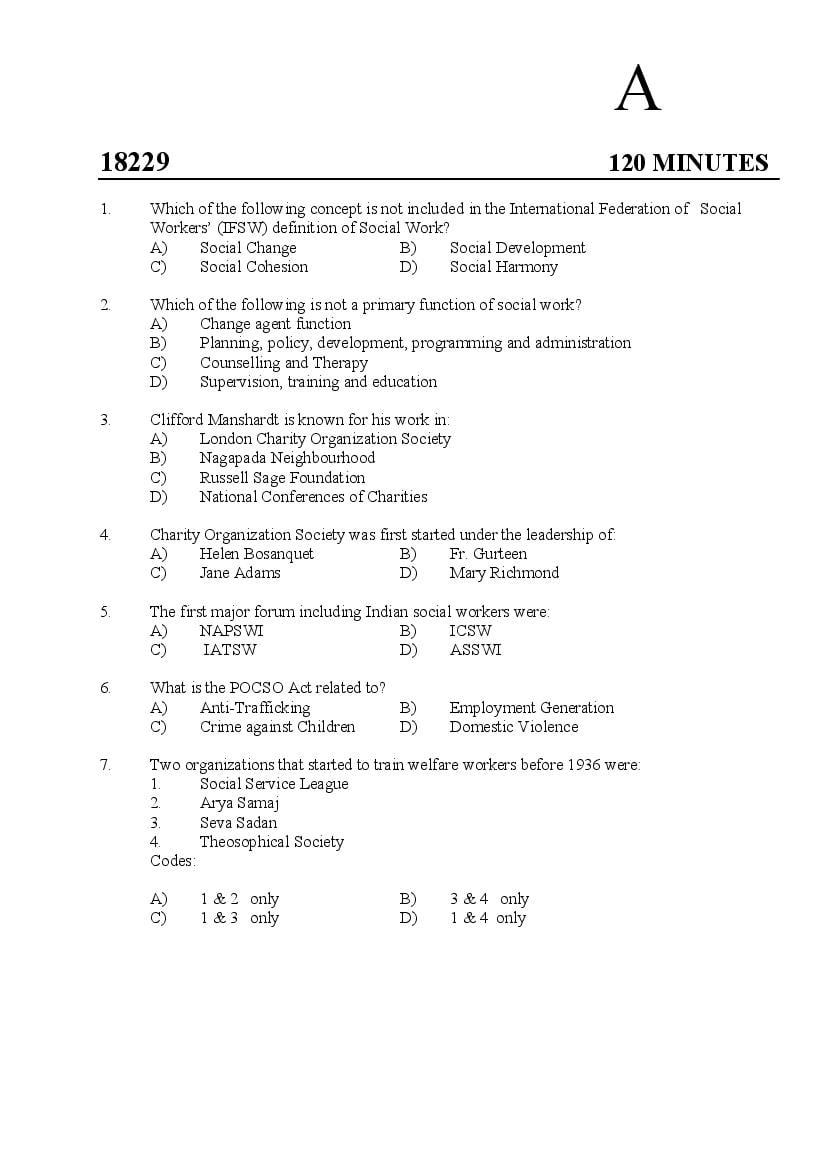
18229 120 MINUTES
1. Which of the following concept is not included in the International Federation of Social
Workers’ (IFSW) definition of Social Work?
A) Social Change B) Social Development
C) Social Cohesion D) Social Harmony
2. Which of the following is not a primary function of social work?
A) Change agent function
B) Planning, policy, development, programming and administration
C) Counselling and Therapy
D) Supervision, training and education
3. Clifford Manshardt is known for his work in:
A) London Charity Organization Society
B) Nagapada Neighbourhood
C) Russell Sage Foundation
D) National Conferences of Charities
4. Charity Organization Society was first started under the leadership of:
A) Helen Bosanquet B) Fr. Gurteen
C) Jane Adams D) Mary Richmond
5. The first major forum including Indian social workers were:
A) NAPSWI B) ICSW
C) IATSW D) ASSWI
6. What is the POCSO Act related to?
A) Anti-Trafficking B) Employment Generation
C) Crime against Children D) Domestic Violence
7. Two organizations that started to train welfare workers before 1936 were:
1. Social Service League
2. Arya Samaj
3. Seva Sadan
4. Theosophical Society
A) 1 & 2 only B) 3 & 4 only
C) 1 & 3 only D) 1 & 4 only
Page 2
Assertion (A) : Victims of social exclusion and social discrimination have got the
benefit of social work services
Reason (R) : Social Work is concerned with social work administration and social
action
A) (A) and (R) are correct and (R) is a correct explanation of (A)
B) (A) and (R) are correct but R is not a correct explanation of (A)
C) (A) is true but (R) is false
D) (A) is false but (R) is true
9. Arrange the following concepts in the right chronological order:
1. Community Development 2. Philanthropy
3. Right based approach 4. Sustainable Development
5. Participation
A) 2, 4, 3, 1, 5 B) 4, 2, 5, 1, 3 C) 2, 1, 5, 3, 4 D) 5, 4, 1, 2, 3
10. Match the concepts in List-I with their propagators in List-II
List-I List-II
a. Social Work Ethics 1. Murali Desai
b. Gandhian Social Work 2. K.D. Gangrade
c. Social Work Research 3. Federick Reamer
d. Ideologies for Social Work 4. P. Ramachandran
a b c d
A) 2, 1, 4, 3
B) 3, 2, 4, 1
C) 3, 4, 2, 1
D) 2, 3, 4, 1
11. Dr. B.R. Ambedkar termed Article 32 as the heart and soul of the Indian Constitution.
Which Fundamental right does this article contain?
A) Right to Equality
B) Right to constitutional remedies
C) Right to elementary education
D) Right to freedom of religion
12. Which of the following is not related to Adoption in India?
A) CARA B) CWC C) CRY D) DCPU
13. YMCA was established in 1844 by:
A) Miss Roberts B) Mrs. Kinnird
C) William Kilpatrick D) George William
2
Page 3
A) 1993 B) 1995 C) 1998 D) 1991
15. The notice period under Special Marriage Act is:
A) 30 days B) 45 days C) 60 days D) 90 days
16. Arrange Criminal Courts in the decreasing order of their power:
1. Judicial Magistrate 2. Sessions Court
3. Chief Judicial Magistrate
A) 3, 2, 1 B) 1, 2, 3 C) 2, 3, 1 D) 3, 1, 2
17. The Universal Declaration of Human Rights does not deal with:
A) Right to life B) Right to asylum
C) Right to nationality D) Right to housing
18. Mary Weil is associated with:
A) Case Work B) Group Work
C) Community Organization D) Social Welfare Administration
19. Arrange the following Acts in the order of the year of passing, starting from the earliest to the
latest:
1. Right to Information Act
2. Juvenile Justice Care and Protection Act
3. Domestic Violence Act
4. Sexual Harassment at women at work place Act
A) 4, 2, 1, 3 B) 2, 3, 1, 4 C) 4, 3, 1, 2 D) 1, 3, 4, 2
20. Match Concepts in List-I and the Acts they are related to in List-II:
List-I List-II
a. Abetment 1. Prisons Act
b. Summons 2. Criminal Procedure Code
c. Parole 3. Indian Penal Code
d. Legal aid 4. Legal Service Authorities
a b c d
A) 3, 2, 1, 4
B) 3, 2, 4, 1
C) 2, 4, 3, 1
D) 4, 3, 1, 2
21. Any relatively stable pattern of social behavior refers to:
A) Social functions B) Theories
C) Social structure D) Positivism
3
Page 4
A) Politics B) Religion C) Health D) Kinship
23. What is the term for a status that has exceptional importance for social identity, often
shaping a person’s entire life?
A) Role B) Ascribed status
C) Achieved status D) Master status
24. Two founders of Sociology who had radically different views on society- one more
conservative and focused on sociology as a science, the other more critical and focused on
change, were:
A) C. Wright Mills and Robert Merton
B) Jane Adams and Peter Blau
C) Emile Durkheim and Robert Merton
D) Auguste Comte and Karl Marx
25. Which concept is the following example related to: Immigrants becoming part of host
culture?
A) Accommodation B) Assimilation
C) Socialization D) Institutionalization
26. Chandi Prasad Bhatt was awarded the Ramon Magsaysay Award in 1982, and Sundarlal
Bahuguna was awarded the Right to Livelihood Award in 1987, and Padma Vibhushan in
2009, in connection with the:
A) Narmada Bachao Andolan B) Chipko Movement
C) Mahar movement D) Peasant Movement
27. Which perspective of social stratification views social inequality as the domination of
some categories of people by others?
A) Symbolic interactionism B) Sociocultural evolution
C) Social-conflict D) Structural functionalism
28. What type of Social Movement seeks limited social change for the entire society?
A) Revolutionary B) Redemptive
C) Deprivation D) Alternative
29. Match the authors in List-I with their books in List-II:
List-I List-II
a. Emile Durkheim 1. The Sociological Imagination
b. C. Wright Mills 2. Thoughts on the Nature of Mass Movements
c. Eric Hoffer 3. Economy and Society
d. Adam Smith 4. On Suicide: A study in Sociology
a b c d
A) 2, 1, 3, 4
B) 4, 1, 2, 3
C) 4, 2, 1, 3
D) 1, 2, 3, 4
4
Page 5
List-I List-II
a. The experience of isolation and misery 1. Anomie
arising from powerlessness
b. A practice of judging another culture by 2. Alienation
standards of one’s own culture
c. Technology that supports an information 3. Postindustrialism
based economy
d. A condition in which society provides 4. Ethnocentrism
little moral guidance to individuals
a b c d
A) 3, 1, 4, 2
B) 2, 3, 1, 4
C) 2, 4, 3, 1
D) 4, 2, 1, 3
31. What was the HDI of India in 2016?
A) 0.624 B) 0.524 C) 0.673 D) 0.523
32. The MGDs were replaced by the:
A) Global Development Goals B) Sustainable Development Goals
C) World Development Goals D) Green Development Goals
33. Which organization replaced GATT in 1995?
A) TRIPS B) ADB C) WTO D) GATS
34. HDI and PQLI have as common:
A) Standard of Living B) Basic Literacy
C) Infant Mortality D) Life Expectancy
35. As per the recommendation of which committee did Panchayati Raj System assume its
present form of three tier system of local governance:
A) GVK Rao Committee B) Ashok Mehta Committee
C) Sarkaria Commission D) Balwant Rai Mehta Committee
36. Flexner and his speech became important in social work because:
A) He questioned the base of social work as a profession
B) He outlined the components of a profession
C) He described the relevance of social case work
D) He established the first professional association for social workers
37. Which of the following is true regarding HPI?
1. It stands for Human Progress Indicator
2. While HDI measures achievement, HDI measures deprivation
3. It was replaced by MPI
A) 1, 2 & 3 B) 1 & 2 only C) 2 & 3 only D) 1 & 3 only
5
Page 6
Assertion (A): Disarmament will create Peace dividend
Reason (R): Defense industries are based on opportunity cost
A) (A) and (R) are correct and (R) is a correct explanation of (A)
B) (A) and (R) are correct but R is not a correct explanation of (A)
C) (A) is true but (R) is false
D) (A) is false but (R) is true
39. Match the concepts in List-I with their components in List-II
List-I List-II
a. Economic Systems 1. Management, taxes, government policy, interest
rates and labour costs
b. Economic Factors 2. Deflation, depression, inflation, recession
c. Factors of production 3. Market, centrally planned, mixed
d. Economic Crises 4. Land, labour, capital, entrepreneurship
a b c d
A) 3, 4, 1, 2
B) 3, 1, 4, 2
C) 3, 2, 4, 1
D) 3, 2, 1, 4
40. In Economics, Elasticity of Supply and Demand is defined as the responsiveness of one
variable to another. There are four different types of elasticity. Match the 4 types (List-I) with
their meanings (List- II).
List-I List-II
a. Price elasticity of demand 1.
Degree of responsiveness of consumers to
change in income
b. Income elasticity of demand 2. Responsiveness of market supply to changes in
the price of the product
c. Cross elasticity of demand 3. The responsiveness of consumers to changes in price
d. Elasticity of supply 4. The responsiveness of consumers of one particular
good to changes in prices of another type of good
a b c d
A) 2, 1, 3, 4
B) 1, 2, 4, 3
C) 3, 2, 4, 1
D) 3, 1, 4, 2
41. The correct sequence of Piaget’s stages of cognitive development are:
A) Preoperational, Sensorimotor, Concrete operational, Formal operations
B) Sensorimotor, Preoperational, Concrete operational, Formal operations
C) Formal operations, Sensorimotor, Preoperational, Concrete operational
D) Concrete operational, Preoperational, Sensorimotor, Formal operations
6
Page 7
A) Abraham Maslow and Carl Rogers
B) Alfred Adler and Carl Jung
C) John Bowlby and Mary Ainsworth
D) William James and John Dewey
43. What is Baumrind known for?
A) Memory B) Aggression
C) Parenting styles D) Gender identity
44. Who propounded Zone of Proximal development?
A) Piaget B) Kohlberg C) Erickson D) Vygotsky
45. Play is for children and work is for adults. Which of the following is NOT an important
outcome of play?
A) Cognitive master B) Emotional development and regulation
C) Overcoming negativism D) Language development
46. Which concept is Havighurst associated with?
A) Cognitive Dissonance B) Social Child
C) Development Task D) Self Concept
47. Which of the following sub-stages are associated with Kohlberg’s post-conventional
stage of moral development?
1. Obedience and Punishment Orientation
2. Social Contract orientation
3. Authority and Social-order maintaining
4. Universal Ethical Principles
Codes
A) 1 & 3 only B) 2 & 4 only C) 3 & 4 only D) 2 & 3 only
48. Assertion (A): According to Freud, we are only aware of a small part of our
personality
Reason (R): Id operates in the conscious part of the brain, whereas ego and
superego in the preconscious and unconscious part.
A) (A) and (R) are correct and (R) is a correct explanation of (A)
B) (A) and (R) are correct but R is not a correct explanation of (A)
C) (A) is true but (R) is false
D) (A) is false but (R) is true
49. According to Kübler-Ross, the most common order of emotional reactions in
preparing for death is:
A) anger, depression, bargaining, denial, acceptance.
B) denial, anger, bargaining, depression, acceptance.
C) anger, depression, denial, bargaining, acceptance.
D) depression, anger, denial, bargaining, acceptance
7
Page 8
develop on successful resolution of these stages.
List –I List-II
a. Trust Vs. Mistrust 1. Will
b. Autonomy Vs. Shame and Doubt 2. Competence
c. Initiative Vs. Guilt 3. Hope
d. Industry Vs. Inferiority 4. Purpose
a b c d
A) 3, 2, 4, 1
B) 3, 4, 1, 2
C) 1, 3, 4, 2
D) 3, 1, 4, 2
51. Which of the following is not a defense mechanism?
A) Negation B) Displacement C) Projection D) Argument
52. Token economy is a technique which is based in:
A) Behaviourism B) Psychoanalysis
C) Cognitive Therapy D) Client-Centered Therapy
53. ‘Unconditional positive regard’ was propounded by:
A) Erickson B) Jung C) Rogers D) May
54. Nietzsche’s starting point was the notion ‘God is dead’ and he called upon people to
break free from moral restraint and discover their ‘free will’. Which approach is this?
A) Humanistic B) Personal-construct theory
C) Existential Approach D) Person-centered
55. The least important issue to be handled in Geriatric Counselling is:
A) Identity Crisis B) Relationships
C) Grief and Dying D) Health
56. Theory X and Y is related to which concept:
A) Decision making B) Staffing
C) Motivation D) Communication
57. ‘Two-chair work’ is a concept in which approach?
A) Behavioural B) Kleinian Approach
C) Functional Approach D) Gestalt Therapy
58. Rational Emotive Behavioural Therapy was established in 1955 by:
A) Karen Horney B) Albert Ellis
C) Levi-Strauss D) Melanie Klein
8
Page 9
(List-II) with:
List-I List-II
a. Behavioural Therapy 1. Decontamination, Redecision,
Rechilding, Relearning, Reorientation
b. Cognitive Therapy 2. Umwelt, Mitwelt, Eigenwelt, Ueberwelt
c. Gestalt Therapy 3. Socratic questioning, Distancing,
Reattribution, Decatastrophizing
d. Transaction Analysis 4. Exposure, Aversion, Social Skills Training
a b c d
A) 4, 3, 2, 1
B) 3, 4, 2, 1
C) 4, 2, 3, 1
D) 1, 2, 3, 4
60. Match defense mechanisms in List-I with their meaning in List-II:
List-1 List-II
a. Introjections 1. Turning distressing thoughts to physical disorders
b. Denial 2. Detaching thought from feeling
c. Isolation 3. Unconsciously emulating aspects of others
d. Conversion 4. Rejecting the existence of distressing aspects
of external world
a b c, d
A) 1, 3, 4, 2
B) 3, 4, 2, 1
C) 1, 3, 2, 4
D) 3, 2, 4, 1
61. Who described the principles of social case work relationship?
A) Mary Richmond B) Felix Biestek
C) Jane Addams D) Helen Pearlman
62. Which stage is the engagement stage of Sipron associated with?
A) Exploration B) Intervention C) Treatment D) Intake
63. Which of the following is not associated with case work relationship?
A) Transference B) Genuineness C) Clarification D) Acceptance
64. The least likely outcome of Supervision in Case Work is:
A. Evaluation of the process B. Development of the worker
C. Reference of the client D. Monitoring by the agency
65. N-Vivo is a software in:
A) Quantitative research B) Qualitative research
C) Case Recording D) Project Management
9
Page 10
A) COS Buffalo, COS London, Beveridge Report, New York School of Philanthropy
B) COS London, COS Buffalo, New York School of Philanthropy, Beveridge Report
C) Beveridge Report, COS London, COS Buffalo, New York School of Philanthropy
D) Beveridge Report, COS Buffalo, COS London, New York School of Philanthropy
67. Which of the following concepts are associated to the Elizabethan Poor Law?
1. Poor Law Guardians 2. House of Industry
3. House of Correction 4. Almoners
5. Poor Law Commission
A) 1, 2, 3 & 5 only B) 2, 3, & 5 only
C) 1, 2 & 3 only D) 1 & 4 only
68. Match the books under List-I with their authors in List-II
List-I List-II
a. What is Social Case Work? 1. Gordon Hamilton
b. Social Case Work: Problem-solving approach 2. Mary Richmond
c. Case Work: A Psychosocial Therapy 3. Helen Pearlman
d. Principles of Casework Recording 4. Woods and Hollis
a b c d
A) 1, 4, 3, 2
B) 2, 3, 4, 1
C) 1, 3, 2, 4
D) 3, 4, 2, 1
69. The Pincus-Minahan (1973) approach, the most publicized systems model in social
work literature, indicates four basic systems in social work practice as provided in List I.
Match their meanings in List II
LIST- I LIST-II
a. Change agent 1. Those with whom the social worker works to
accomplish the tasks and achieve the goals
b. Client System 2. The people, agencies, and organizational practices that
the worker wishes to change in some measurable way to
reach the goals
c. Target system 3. The people who sanction or ask for services
d. Action System 4. Professionals who are employed specifically for the
purpose of creating planned change
a b c d
A) 3, 4, 1, 2
B) 2, 1, 3, 4
C) 4, 3, 2, 1
D) 1, 2, 3, 4
10
Page 11
List-I List-II
a. Humanistic Model 1. Jessy Taft
b. Crisis Intervention Model 2. Rollo May
c. Functional Model 3. A.R. Robert
d. Solution-focused model 4. Shazer and Berg
a b c d
A) 2, 1, 3, 4
B) 1, 3, 2, 4
C) 4, 3, 1, 2
D) 2, 3, 1, 4
71. A group whose primary purpose is to foster mutual aid is called:
A) Socialization group B) Growth group
C) Therapy group D) Support group
72. Shared expectations and beliefs about appropriate ways to act in a social situation,
such as a group, are called:
A) Social systems B) Sanctions
C) Role expectations D) Norms
73. Which of the following has not authored a book on Social Group Work?
A) Trecker B) Coyle
C) Addams D) Konopka
74. The worker or a member demonstrating behaviours in a particular situation so that
others in the group can observe what to do and how to do it is called:
A) Role playing B) Rehearsing
C) Coaching D) Modeling
75. The power that enables a group worker to sanction, punish or deny access to resources and
privileges is called:
A) Connection power B) Expert power
C) Coercive power D) Legitimate power
76. Pointing out the here and now of group interaction and helping the members to be
aware of that interaction is called:
A) Making group process explicit
B) Responding
C) Attending
D) Clarifying content
77. Lewin’s leadership styles do not include:
A) Authoritarian B) Autocratic
C) Laissez Faire D) Democratic
11
Page 12
Assertion (A): Group Cohesion does not always lead to performance of groups
Reason (R): Group performance is dependent on many factors
A) (A) and (R) are correct and (R) is a correct explanation of (A)
B) (A) and (R) are correct but R is not a correct explanation of (A)
C) (A) is true but (R) is false
D) (A) is false but (R) is true
79. Which model of Social Action operates entirely within legal frameworks?
A) Institutional Model B) Social Institutional Model
C) Social Model D) Populist Model
80. Match concepts related to patterns of group interaction (List-I) with their meaning (List-II):
List-I List-II
a. Maypole 1. members take turns talking
b. Round Robin 2. all members take responsibility for communicating,
contribute meaningfully to topic
c. Hot Seat 3. leader is central figure, communication from leader to
member and member to leader
d. Free floating 4. back & forth between leader and one member
a b c d
A) 3, 1, 4, 2
B) 4, 1, 3, 2
C) 4, 2, 3, 1
D) 3, 2, 4, 1
81. Which of the following is not Rothman’s model of community practice?
A) Locality Development B) Social Planning
C) Social Policy D) Social Action
82. Jane Addams was associated with:
A) London COS B) Buffalo COS
C) Hull House D) National Conference of Charities
83. Which was the first Settlement House Movement?
A) University Settlement B) Toynbee Hall
C) Greenwich House D) Chicago Hull House
84. Which was the year of Lane Report, after which Community Organization began to be
systematically studied?
A) 1939 B) 1947 C) 1936 D) 1940
85. ‘Reveille for Radicals’ was written by:
A) Jane Addams B) Jack Rothman
C) Saul Alinsky D) Robert Lane
12
Page 13
A) Arthur Dunham B) Murray G. Ross
C) H. Y. Siddiqui D) Jack Rothman
87. Which of the following are strategies for social action?
1. Collaboration, Competition and Disruption
2. Bargaining and Confrontation
3. Institutional, institutional social, social institutional
4. Direct Action, non-cooperation, intervention
A) 1, 2 & 4 only B) 1 & 2 only
C) 1 & 4 only D) All of the Above
88. Assertion and Reasoning:
Assertion (A): Poverty, insanitation, prostitution and drunkenness…These evils are
beyond the capacity of social workers (UGC, 1965)
Reason (R): Social work in India started by adopting a western model
A) (A) and (R) are correct and (R) is a correct explanation of (A)
B) (A) and (R) are correct but R is not a correct explanation of (A)
C) (A) is true but (R) is false
D) (A) is false but (R) is true
89. Which of the following is not a concept related to Community power structure?
A) Opportunist B) Elites C) Pluralistic D) Influentials
90. Match the Principles of Social Action in List-I with their meanings in List-II
List-I List-II
a. Credibility Building 1. Educational, persuasive, facilitative, power
b. Legitimization 2. Movement as a moral-imperative
c. Dramatization 3. Emotional appeal to masses
d. Multiple Strategies 4. Public image for leadership
a b c d
A) 1, 2, 3, 4
B) 2, 4, 3, 1
C) 4, 2, 3, 1
D) 3, 4, 2, 1
91. Which of the Acts cannot be used for NGO registration?
A) Societies Registration Act B) Factory Act
C) Wakf Act D) Companies Act
92. What was the major difference between Taylor’s and Fayol’s theories?
A) Training Vs. Planning
B) Science Vs. Administration
C) Individual Worker Vs. Total Organization
D) Work Vs. Manage
13
Page 14
A) Hawthorne studies B) Skinner experiments
C) Classical studies D) Theory X and Y
94. What does Gulick’s and Urwick’s acronym POSDCORB stand for?
A) An Administrative model B) Qualities of an administrator
C) Functions of a manager D) Ethics of a Manager
95. Max Weber is known for his views on:
A) Leadership B) Bureaucracy C) Rewards D) Production
96. Arrange the steps of creative decision making in sequential order:
A) Incubation, Illumination, Deliberation, Saturation, Accommodation
B) Saturation, Deliberation, Incubation, Illumination, Accommodation
C) Illumination, Deliberation, Saturation, Incubation, Accommodation
D) Deliberation, Incubation, Illumination, Accommodation, Saturation
97. Span of Control is:
A) The authority given to manager to control workers
B) The limits of the authority of a supervisor
C) The number of subordinates an administrator can direct effectively
D) The assignment of power to subordinates
98. Which of the following is not connected to Staff Appraisal?
A) MBO B) Critical Incident
C) 360 Degree D) Evaluation
99. Which of the following does not feature among Fulmer’s 5 Cs of Communication?
A) Conciseness B) Clarity
C) Continuity D) Completeness
100. Match the Social Welfare Institutions (List-I) with their area of functioning (List-II)
List-I List-II
a. Ministry of Social Justice and Empowerment 1. Promoting Voluntarism
b. Ministry of Women and Child Development 2. Senior Citizens and Addicts
c. Central Social Welfare Board 3. Child Rights
d. National Institute of Social Defense 4. Disadvantaged populations and
disabled
a b c d
A) 4, 3, 1, 2
B) 4, 3, 2, 1
C) 3, 2, 1, 4
D) 2, 4, 1, 3
101. Currently there are 3 research paradigms. They are:
A) Quantitative, Qualitative, Mixed
B) Descriptive, explorative and experimental
C) Science, Social Science and Humanities
D) Ontology, Epistemology, Axiology
14
Page 15
A) Snowball B) Judgement
C) Lottery D) Convenience
103. Theory is defined as:
A) A testable statement of the relationship between two or more variables
B) A set of logically related propositions intended to explain a range of phenomena
C) A representation of a system that allows for investigation of the properties of the
system and, in some cases, prediction of future
D) An idea or mental image which corresponds to some distinct entity or class of entities,
or to its essential features
104. Box plots are used to depict:
A) Standard deviation B) Normality
C) Interquartile range D) Correlation
105. Generalizability to other subjects can be done if the study has:
A) Internal validity B) Statistical conclusion validity
C) Construct validity D) External validity
106. The significance level reported in a research study can be explained by which of the
following?
A) Importance of the results to the benefit of society
B) A statistical method
C) Risk associated with not being cent percent confident the difference is due to the
treatment
D) Importance of the results to an individual
107. Royce has proposed certain models for Programme evaluation, in his book ‘Research
Methods in Social Work’. Which of the following is odd-one-out among the models proposed
by David Royce?
1. Hammond 2. Discrepancy 3. Judicial
4. CIPP 5. Quasi- experimental 6. Client-satisfaction
A) 4 B) 5 C) 6 D) None
108. The purpose of stratified random sampling is to make certain that
A) every member of the population has an equal chance of being selected for the sample
B) the sample proportionately represents individuals from different categories of the
population
C) the participants chosen for the study are the ones most likely to react to the treatment
D) the sample is more representative of the target population than the accessible
population
109. Collecting information regarding crime control from several countries would be a good
example of a / an ------
A) international approach B) content analysis
C) comparative approach D) field research
15
Page 16
List-I List-II
a. Phenomenology 1. The effect of Naltrexone medication in alcoholics
b. Ethnography 2. How do patients reflect about their health care
experience?
c. Survey 3. Understanding the matrimonial practices of Naikar
tribes
d. Experiment 4. The customer satisfaction of Aqua Guard customers in
Cochin
a, b, c, d
A) 2, 3, 4, 1
B) 2, 4, 3, 1
C) 1, 2, 3, 4
D) 4, 3, 1, 2
111. At which stage should Project sustainability be ensured?
A) Problem Identification B) Project Design
C) Project Implementation D) Project Termination
112. Evaluation has 4 types of focus. Of these, which type of focus concentrates on the views of
multiple stakeholders?
A) Objective B) Decision C) Users D) Response
113. The expansion for SMART is:
A) S-simple, M-manageable, A-affordable, R- risk-free, T- transferable
B) S- strategy, M- mission, A- action, R- resource, T- tool
C) S-specific, M- measurable, A- achievable, R-realistic, T- time bound
D) S- self-sufficient, M- motivated, A- active, R- ready, T- timely
114. Arrange the steps in Monitoring Cycle:
A) Assessment of Progress, Identification of Problems, Collection of Information,
Analysis and decision making, Implementing corrective measures
B) Identification of Problems, Analysis and decision making, Collection of Information,
Assessment of Progress and Implementing corrective measures
C) Collection of Information, Assessment of Progress, Identification of Problems,
Analysis and decision making, Implementing corrective measures
D) Identification of Problems, Collection of Information, Assessment of Progress,
Analysis and decision making, Implementing corrective measure
115. Variance analysis represents:
A) The future of the project B) The value of work
C) The rate of work D) All of the above
116. Which of the following appraisals ensure the accessibility, infrastructure, manpower,
knowhow for implementation etc.?
A) Technical B) Market C) Management D) Profitability
16
Page 17
approach to Social Cost Benefit Analysis?
A) Demand Vs. Supply B) Consumption Vs. uncommitted social income
C) Cost price Vs. Selling price D) All of the above
118. Whose definition of Social Case Work is the result of a thesis which analyzed 34 previous
definitions?
A) Hollis B) Hamilton C) Towle D) Bowers
119. Which of the below characteristics of a monitoring indicator ensures that the measurement
describes the nature and extend of change?
A) Simple and Measurable B) Relevant
C) Valid and Reliable D) Cost effective
120. Match Project Management tools (List-I) with the project phases (List-II) in which they are
used:
List-I List-II
a. CPM 1. Problem Identification
b. PRA 2. Project Design
c. SCBA 3. Project Appraisal
d. LFA 4. Project Implementation
a b c d
A) 2, 1, 3, 4
B) 2, 4, 1, 3
C) 1, 3, 4, 2
D) 4, 1, 3, 2
_______________________
17
Document Details
| Board / Org | Kerala Exams |
| Exam | Kerala SET |
| Type | Question Paper |
| Pages | 17 |
| Updated | 23 Oct 2026 |