Kerala SET 2018 Feb Question Paper Gandhian Studies
Finished viewing? Save it for later —
Download Kerala SET 2018 Feb Question Paper Gandhian Studies (PDF · 13 pages)About Kerala SET 2018 Feb Question Paper Gandhian Studies
Kerala SET 2018 Feb Question Paper Gandhian Studies is available here for free download. Published by Kerala Exams for Kerala SET, this question paper can be viewed online or downloaded as a PDF (13 pages). Candidates preparing for Kerala SET can use Kerala SET 2018 Feb Question Paper Gandhian Studies to understand the exam pattern, the type of questions asked, and the overall difficulty level.
Frequently Asked Questions
How can I download Kerala SET 2018 Feb Question Paper Gandhian Studies?
Open this page and click the Download button to save Kerala SET 2018 Feb Question Paper Gandhian Studies as a PDF. It is completely free on AglaSem Docs.
Is Kerala SET 2018 Feb Question Paper Gandhian Studies free to download?
Yes. Kerala SET 2018 Feb Question Paper Gandhian Studies can be viewed online and downloaded as a PDF free of cost on AglaSem Docs.
How many pages does Kerala SET 2018 Feb Question Paper Gandhian Studies have?
Kerala SET 2018 Feb Question Paper Gandhian Studies contains 13 pages, which you can read online or download together as a single PDF.
Where can I find more Kerala SET study material?
You can find more Kerala SET question papers, sample papers, syllabus, and answer keys on AglaSem Docs.
Kerala SET 2018 Feb Question Paper Gandhian Studies – Text
Read the full text of this question paper below — useful to quickly search, copy and reference the content online without downloading the PDF.
📄 View text version (13 pages)
Page 1
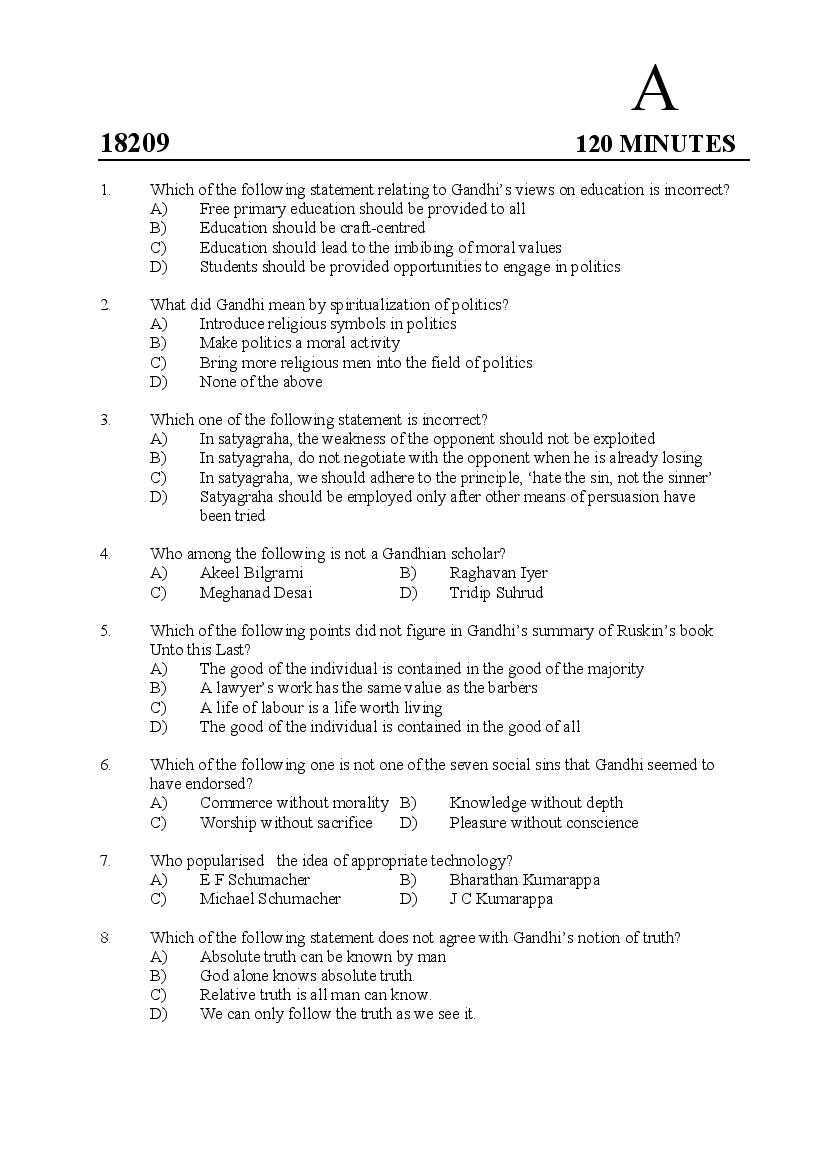
18209 120 MINUTES
1. Which of the following statement relating to Gandhi’s views on education is incorrect?
A) Free primary education should be provided to all
B) Education should be craft-centred
C) Education should lead to the imbibing of moral values
D) Students should be provided opportunities to engage in politics
2. What did Gandhi mean by spiritualization of politics?
A) Introduce religious symbols in politics
B) Make politics a moral activity
C) Bring more religious men into the field of politics
D) None of the above
3. Which one of the following statement is incorrect?
A) In satyagraha, the weakness of the opponent should not be exploited
B) In satyagraha, do not negotiate with the opponent when he is already losing
C) In satyagraha, we should adhere to the principle, ‘hate the sin, not the sinner’
D) Satyagraha should be employed only after other means of persuasion have
been tried
4. Who among the following is not a Gandhian scholar?
A) Akeel Bilgrami B) Raghavan Iyer
C) Meghanad Desai D) Tridip Suhrud
5. Which of the following points did not figure in Gandhi’s summary of Ruskin’s book
Unto this Last?
A) The good of the individual is contained in the good of the majority
B) A lawyer’s work has the same value as the barbers
C) A life of labour is a life worth living
D) The good of the individual is contained in the good of all
6. Which of the following one is not one of the seven social sins that Gandhi seemed to
have endorsed?
A) Commerce without morality B) Knowledge without depth
C) Worship without sacrifice D) Pleasure without conscience
7. Who popularised the idea of appropriate technology?
A) E F Schumacher B) Bharathan Kumarappa
C) Michael Schumacher D) J C Kumarappa
8. Which of the following statement does not agree with Gandhi’s notion of truth?
A) Absolute truth can be known by man
B) God alone knows absolute truth.
C) Relative truth is all man can know.
D) We can only follow the truth as we see it.
Page 2
follows winter"?
A) rights of man B) duties of man
C) rights and duties of man D) rights and duties of men and women
10. Which of the following statement relating to Gandhi is not correct?
A) Gandhi was a believer in Advaita
B) Gandhi believed that if one man gains spiritually, the whole world gains with
him
C) Gandhi did not concern himself with urban affairs
D) Gandhi drew a distinction between economics and ethics
11. Which of the following statement relating to caste and untouchability is incorrect with
respect to Gandhi?
A) Gandhi called the untouchable as Harijans
B) Gandhi believed that untouchability had no divine sanction
C) Gandhi saw the four fold varna system and the four fold caste system as
identical
D) Gandhi founded Harijan Service Association in 1933
12. Identify the women’s organization which has a distinctly Gandhian influence on it?
A) Self-Employed Women’s Association
B) All India Democratic Women’s Association
C) Indian Harijan Women’s Association
D) All India Women Khadi Weavers association
13. Who is the author of the book ‘The Power of Nonviolence’ (1935)?
A) Krishnalal Shridharani B) Richard Gregg
C) Gene Sharp D) Jean Bondurant
14. The leader who drew on Christ and Gandhi in shaping nonviolent struggle
A) Nelson Mandela B) Cesar Chavez
C) Betty Williams D) Martin Luther King Jr.
15. Who said: "Gandhi's very vocabulary, in its exaggerated idealization of women as
'sisters of mercy' and 'mothers of entire humanity' reveals the bias of a benevolent
patriarch."?
A) Madhu Kishwar B) Usha Thakkar
C) Sujatha Patel D) Vandana Shiva
16. The greatness of Gandhi lies in his:
A) Love for animals B) Simplicity in life
C) Non-violent attitude D) Respect for Women’s rights
17. Gandhian economics is based on the idea of:
A) Rejection of the concept of the human being as a rational actor
B) Emphasizing want rather than need
C) Acceptance of materialism
D) Rejection of all forms of machinery
2
Page 3
A) Aparigraha and Ahimsa B) Swadesi and Swaraj
C) Dharma and Karma D) Satyagraha and Constructive Programme
19. Who among the following wrote on Gandhi’s religious thought?
A) J D Sethi B) Romesh Diwan
C) Margaret Chatterjee D) Amritananda Das
20. The slogan promoted by Vinoba Bhave
A) Jai Jagat B) Do or Die
C) Jai Jawan, Jai Kisan D) Garibi Hatao
21. Who among the following is associated with the Chipko Movement?
A) H N Bahuguna B) Baba Amte
C) Mahesh Bhatt D) Gaura Devi
22. Sarva Dharma Sama Bhava means
A) Equality of all religions
B) Equality of Religions and Equal Respect for Religions
C) Equality of all ideologies and viewpoints
D) Equality and equal respect for all ideologies and viewpoints
23. What is cultural violence?
A) Violent stories and images of different cultures
B) Violence carried out on cultural symbols by anti-socials
C) The attitudes and beliefs promoting violence
D) Removal of all traces of an oppressive structure
24. Who distinguished between positive and negative peace?
A) Johan Galtung B) Kenneth Boulding
C) Thomas Weber D) John Burton
25. Peace Studies is:
A) The study of the causes of violence and the conditions of peace
B) The study of war and peace treaties
C) The study of why people engage in violence
D) The study of the statistics relating to wars
26. Who among the following is not a peace educator?
A) Pierre Bourdieu B) Frederic Frobel
C) Maria Montessori D) Pestalozzi
27. Which of the following is not a quality required of a mediator?
A) Comprehension ability B) Good drafting skills
C) Good listening skills D) Good memory
3
Page 4
A) Litigator B) Mediator C) Arbitrator D) Adjudicator
29. Who was Fatima Meer?
A) South African Writer and Gandhian Activist
B) Saudi Arabian activist
C) Indian Gandhian activist
D) Revolutionary activist of African National Congress
30. Community of Ark of Lanza Del Vasto is mainly based in
A) Italy B) Spain C) Germany D) France
31. Who wrote the book ‘Gandhi and Group Conflict’?
A) Arne Naess B) Maria Mies
C) Vandana Shiva D) Dennis Meadows
32. Which of the following central universities has a Department of Peace Studies?
A) Central University of Karnataka
B) Central University of Rajasthan
C) Central University of Sikkim
D) Central University of Bihar
33. Who is the convenor of the Gram Sabha in Kerala?
A) Ward Member B) President
C) Secretary D) Kudumbasree CDS Chairperson
34. Capitalism is a form of
A) Personal Violence B) Cultural Violence
C) Structural Violence D) Economic Violence
35. The organization which publishes the quarterly journal Gandhi Marg?
A) Gandhi Smrithi and Darsan Samithi, New Delhi
B) Gandhi Smarak Nidhi
C) Gandhi Bhavan, University of Delhi
D) Gandhi Peace Foundation, New Delhi
36. The National Council of Rural Institutes is based in:
A) Hyderabad B) New Delhi C) Bangalore D) Ahmedabad
37. Tahrir Square is in:
A) Egypt B) China C) Iran D) Tunisia
38. The Sermon on the Mount in the New Testament reminded Gandhi of:
A) Mathew Arnold’s Song Celestial
B) Shamal Bhatt's "For a bowl of water, give a goodly meal"
C) Ruskin’s Unto this Last
D) Buddha
4
Page 5
A) Peace can be pursued by everyone
B) Peace can be established in all societies
C) Democracies are more peaceful
D) Autocracies are more peaceful
40. The Baliapal Movement was against?
A) An aluminum factory B) A nuclear power plant
C) A car factory D) A missile testing centre
41. Which of the following staments relating to Nyaya Panchayat and Gram Nyayalaya is
incorrect?
A) Nyaya Panchayat and Gram Nyayalaya are village level courts with judges
B) Nyaya Panchayat has elected members deciding on disputes unlike Gram
Nyayalaya
C) Nyaya Panchayats did not have lawyers’ presence in them unlike Gram
Nayaylaya
D) Nyaya Panchayats draw on customs and traditions to settle disputes unlike
Gram Nyayalaya which has an element of professionalism about it.
42. Who was critical of Gandhi’s views on nationalism and held that they are alien to India?
A) B R Ambedkar B) Sardar Patel
C) Jawaharlal Nehru D) Rabindranath Tagore
43. Which of the following was not an issue of difference between Gandhi and Thoreau?
A) Over the connection between civil disobedience and reform
B) Over the use of violence
C) Role of virtue in resistance politics
D) On the duty to resist an unjust state
44. The Upas Tree is
A) a poisonous tree found in the parts of Gujarat
B) a thorny tree found in Afghanistan
C) a poisonous tree found in Java
D) a thorny tree found in South Africa
45. Who described Gandhian nonviolence as a “sort of moral jiu jiutsu”?
A) Gene Sharp B) Richard Gregg
C) Jean Bondurant D) Brian Martin
46. Which of the following statement relating to Swadesi is incorrect?
A) Swadeshi is that spirit in us which restricts us to the use and service of our
immediate surroundings to the exclusion of the more remote.
B) Service of immediate neighbours is its focus
C) Religious conversion does not agree with the swadesi
D) Swadesi postulates the absence of all forms of international trade
5
Page 6
A) Rajmohan Gandhi B) Gene Sharp
C) John Galtung D) Geoffrey Ostergaard
48. Who wrote the book “Conquest of Violence”?
A) Martin Green B) Jean Bondurant
C) Douglas Allen D) Ronald Terchek
49. Which of the following is not a characteristic feature of Gandhian State?
A) Dcentralised state
B) Secular state
C) Interdependent state
D) A state that does not engage in trade with other states
50. The author of the book Return to the Source?
A) Eknath Easwaran B) Mark Shepard
C) Lanza Del Vasto D) Geoffrey Ostergaard
51. According to Jean Bondurant, of all the elements that constitute satyagraha, -------- is
the least acceptable to a Western mind
A) Dharma B) Satya
C) Self-suffering D) Nishkama karma
52. Identify the South African leader who was committed to nonviolence as a principle?
A) Albert Luthuli B) Steve Biko
C) Nelson Mandela D) Oliver Tambo
53. Who founded the Sarva Seva Sangh in 1923?
A) Bharathan Kumarnappa B) Jamnalal Bajaj
C) Siddharaj Dadda D) J B Kripalani
54. Why did B R Ambedkar leave the Harijan Sevak Sangh?
A) Because of temperamental differences with Gandhi
B) Because of ideological differences with Gandhi
C) Because of Ambedkar’s insistence that the leadership of the Sangh should be
in the hands of the Dalits
D) Because of other preoccupations
55. Gandhi said ‘power can be obtained through two means.’ What are they?
A) By threats and incentives
B) By the fear of punishment and by acts of love
C) By brute force and by law
D) By wealth and by force
6
Page 7
A) self-limiting
B) immediate aggravation of conflict
C) exploiting the weakness of the adversary
D) withholding information about the strategies to be adopted in order to confuse the
enemy.
57. The organization founded by Khan Abdul Gaffar Khan is known as ---------
A) Khudai Khidmatgar B) Servants of India Society
C) Frontier Guard D) Followers of God
58. The Greek word for peace is
A) Salam B) Shalom C) Eirene D) Ping
59. Which booklet was published by Shriman Narayan Agarwal?
A) Gandhian Plan for the Economic Development of India?
B) Gandhian Economic Thought
C) Gandhi Today
D) Relevance of Gandhi for our Times
60. “A letter to a Hindoo” was written by
A) John Maynard Keynes B) Leo Tolstoy
C) John Ruskin D) Albert Einstein
61. When was Gandhi's first Satyagraha launched?
A) 1913 B) 1912 C) 1911 D) 1914
62. Who among the following is known as the matriarch of peace studies?
A) Birjit Brock Utne B) Caroline Stephenson
C) Christine Sylvester D) Elise Boulding
63. Which of the following is not generally seen as a peace church?
A) Quakers B) Mennonites C) Amish D) Catholic
64. Which country witnessed the rise of Alternative Dispute Resolution Movement?
A) The United States B) The UK
C) Norway D) Australia
65. A mechanism for resolving conflicts whereby the disputants identify their grievances and
demands, fix a procedural process, and willingly submit the decision of outcomes, which
are to be final and binding, to an external entity is known as
A) Mediation B) Adjudication
C) Arbitration D) Facilitated Problem Solving
66. Interventionist efforts towards preventing the escalation and negative effects, especially
violent ones, of ongoing conflicts is known as
A) Conflict Resolution B) Conflict management
C) Conflict Transformation D) Conflict escalation
7
Page 8
previously engaged in a conflict or dispute into feelings of acceptance and even
forgiveness of past animosities or detrimental acts is known as
A) Conflict Resolution B) Mediation
C) Reconciliation D) Remorse
68. A situation where the gains of one party are inversely related to the losses of another
party is known as
A) Zero Sum Game B) Non Zero Sum Game
C) A Dyadic Game D) A Nomadic Game
69. Which of the following statement is untrue about the Journal of Peace Research?
A) The Journal of Peace Research was established in 1964
B) Kenneth Boulding was the founder editor of the journal
C) The Journal was owned by Peace Research Institute, Oslo
D) The Journal started with a broad understanding of peace
70. Which of the following statement relating to conflict transformation is not true?
A) The term ‘conflict transformation’ is a relatively new invention within the
broader field of peace and conflict studies.
B) It has a broader meaning than conflict management and resolution
C) John Paul Lederach has played a key role in popularizing the idea of conflict
transformation
D) Conflict transformation is most suitable in symmetric conflicts.
71. Sudamapuri was the old name of which town?
A) Parabend B) Kathiawar
C) Bharuch D) Porbander
72. Who among the following was not a sibling of Gandhi?
A) Devdas B) Karsandas C) Raliatbehn D) Laxmidas
73. Which of the following statement related to Gandhi’s father is incorrect?
A) Gandhi’s father was the Prime Minister of Rajkot state
B) He would discuss religion and politics with the visitors
C) He would carry out domestic chores such as slicing vegetables while
discussing politics
D) He had a passion for horse riding
74. Approximately what percentage of marks did Gandhi obtain in the matriculation
examination?
A) 40 % B) 50 % C) 60 % D) 70 %
75. To which sect of the Modh bania caste did Putlibhai belong?
A) Pushtimagri B) Pranami. C) Ghanchi D) Sahu
76. Who wrote the book A Plea for Vegetarianism?
A) Edward Arnold B) Edward Carpenter
C) Henry Salt D) Leo Tolstoy
8
Page 9
A) Natal Indian Ambulance Corps
B) Servants of India Society
C) Indentured Labourers’ Welfare Association
D) Natal Indian Congress
78. Who among the following did not influence Gandhi?
A) Henry Salt B) Cardinal Newman
C) Raichandbhai D) Deen Dayal Upadhyaya
79. Which of the following statements about Kasturba is incorrect?
A) Kasturba was 6 months older than Gandhi
B) Kasturba’s original name was Kasturba Makanji Kapadia
C) Kasturba was illiterate at the time of her marriage
D) Kasturba’s father was the Diwan of Saurashtra
80. Henry David Thoreau wrote
A) On Civil Disobedience B) The Kingdom of God is within you
C) Unto this Last D) What is Art?
81. Who wrote Gandhi Before India?
A) Anthony Parel B) Ramachandra Guha
C) Bhikhu Parekh D) Romilla Thapar
82. When did Gandhi bring his family to South Africa?
A) 1895 B) 1897 C) 1896 D) 1898
83. Which of the following events did not take place in 1906?
A) Zulu Rebellion
B) Mass meeting at Empire Theatre, Johannesberg
C) Taking of vow of celibacy
D) Start of Passive Resistance
84. Tolstoy Farm was established near
A) Johannesberg B) Durban C) Pretoria D) Pietermaritzburg
85. Order the following events chronologically:
Writes Hind Swaraj, Reads Unto this Last, Zulu Rebellion, Launches Indian Opinion
A) Reads unto this Last, Writes Hind Swaraj , Launches Indian Opinion , Zulu
Rebellion
B) Launches Indian Opinion, Reads Unto this Last, Zulu Rebellion, Writes Hind
Swaraj
C) Reads Unto this Last, Launches Indian Opinion, Zulu Rebellion, Writes Hind
Swaraj
D) Zulu Rebellion, Reads Unto this Last, Writes Hind Swaraj, Launches Indian
Opinion
9
Page 10
South Africa?
A) Rai Bahadur B) Rai Sahib
C) Kaiser I Hind D) Rao Sahib
87. Which of the following work was translated into English by Gandhi himself?
A) From Yeravada Mandir B) Hind Swaraj
C) Satyagraha in South Africa D) Key to Health
88. What is the meaning of Hijrat as a Satyagraha technique?
A) Hijrat is a permanent voluntary migration when one is subjected to grievous
oppression
B) Hijrat is a permanent forced migration of oppressed people
C) Hijrat is a temporary voluntary migration of the oppressed people
D) Hijrat is a temporary forced migration of the oppressed people
89. Which of the following is not one of the emblems of modern civilization identified by
Gandhi in Hind Swaraj?
A) Railways B) Doctors C) Lawyers D) Motor Cars
90. Hard on the problem, but soft on the person denotes a ------- approach to negotiation
A) Soft B) Hard C) Principled D) Neutral
91. Who wrote the famous book, Getting to Yes: negotiating Agreement without Giving in?
A) Roger Fisher and Johan Galtung
B) Roger Fisher and William Ury
C) Peter Wallensteen and John Burton
D) Louis Kreisberg and Kenneth Boulding
92. In the ABC triangle of Conflict developed by Galtung C stands for :
A) Convergence B) Contradiction
C) Cooperation D) Concatenation
93. A conflict in which one party is stronger than the other party is known as
A) Symmetric conflict B) Symptomatic conflict
C) Asymmetric conflict D) Asymptomatic conflict
94. The Nelson Mandela Institute of Peace and Conflict Studies is based in
A) Jawaharlal Nehru University B) Benares Hindu University
C) Calcutta University D) Jamia Millia Islamia
95. According to Gandhiji, Religion means
A) Established ritualistic religion
B) Worship of Gods
C) Surrender of oneself to God
D) Ordered moral governance of the universe.
10
Page 11
A) Hind Swaraj B) Key to Health
C) Satyagraha in South Africa D) From Yeravda Mandir
97. When was All India Spinners Association founded?
A) 1924 B) 1923 C) 1925 D) 1926
98. Civil Disobedience without -------- was described by Gandhi as equivalent to a
paralysed hand attempting to lift a spoon
A) Swadesi
B) Swaraj
C) Constructive Programme
D) Sarvodaya
99. The term Military- industrial complex was coined by:
A) Dwight Eisenhower B) Richard Nixon
C) Henry Kissinger D) Jimmy Carter
100. Which book was written by Betty Reardon?
A) Bananas, Beaches and Bases
B) Sexism and the War System
C) Building a Global Civil Culture
D) Cultures of Peace: The hidden side of History
101. Who among the following is the main advocate of the conflict transformation
approach in dealing with conflicts?
A) Kenneth Boulding B) John Paul Lederach
C) James Berkowitz D) Jay Rothman
102. Fill in the blank portion :“My idea of village Swaraj is that it is a complete ----------,
independent of its neighbours for its own vital wants and yet interdependent for many
others in which dependence is necessary”.
A) Republic B) Democracy C) State D) Country
103. Who among the following leaders had serious apprehensions about the introduction of
Panchayati Raj in India after independence?
A) Dr B R Ambedkar B) Vinoba Bhave
C) Sardar Patel D) Jawaharlal Nehru
104. Arrange chronologically the following three events
1. Founding of Harijan Sevak Sangh
2. Chauri Chaura incident 3. Bardoli Satyagrah
A) 1, 2, 3 B) 3, 2, 1 C) 2, 3, 1 D) 1, 3, 2
105. Which of the following is not a book/booklet written by Gandhi?
A) Satyagraha in South Africa
B) From Yeravada Mandir
C) Key to Naturopathy
D) Constructive Programme: Its Meaning and Place
11
Page 12
A) Gandhi’s early childhood was spent in Porbander
B) Gandhi’s later childhood was spent in Rajkot
C) Gandhi married at the age of 14
D) Gandhi’s early attempts to teach Kasturba to read and write failed
107. Which of the following book was not written by Gandhi?
A) An autobiography: The Story of my Experiments with Truth
B) Hind Swaraj
C) Satyagraha in South Africa
D) Swadesi
108. Which of the following book did not influence Gandhi?
A) Das Capital
B) The Kingdom of God is within you
C) Unto this Last
D) Civilisation: Its cause and Cure
109. Where did Gandhi set up his first Indian Ashram?
A) Wardha B) Sevagram C) Ahmedabad D) Porbander
110. Which of this statement relating to civil disobedience is incorrect?
A) Civil disobedience is the inherent right of a citizen
B) One who gives up civil disobedience ceases to be a man
C) Civil disobedience can be uncivil in special circumstances
D) Civil disobedience is a sacred duty against a lawless state
111. Bread Labour means
A) To earn one’s livelihood by engaging in manual labour
B) To engage in labour for making bread
C) To engage in very hard physical labour
D) Entire family including children engaged in manual labour
112. Which of the following statement relating to Swadesi is incorrect?
A) Swadesi is consumption of goods produced in the rural areas only
B) Swadesi is service of immediate neighbours and environment
C) Swadesi is use of things produced in the neighbourhood
D) Swadesi does not mean the end of all forms of trade
113. The word denoting non-possession is
A) Aparigraha B) Asteya
C) Sarvodaya D) Nishkama Karma
114. “Means may be likened to a seed and the end to a tree”. What did Gandhi mean by this?
A) Means are less important than ends
B) As long as the end is good any means can be used
C) Ends can be realized regardless of the means employed
D) It is only by employing moral means that we can attain moral ends
12
Page 13
A) Machines that do not deprive labour and adds to efficiency were welcome
B) All machines are bad
C) Machines that destroy man’s individuality are bad
D) The craze for machinery tended to concentrate economic power in the hands
of few
116. Which of the following statement of Gandhi on women is true?
A) Woman must cease to consider herself the object of man's lust
B) Woman must refuse to adorn herself for men including her husband
C) A wife can devote herself to a noble purpose even against the will of her
husband
D) All of the above
117. Rama Rajya stands for:
A) Rama’s State
B) An Ideal State
C) A Hindu State
D) A State with a religious person as the head of the state
118. According to Gandhi
A) The medium of instruction in educational institutions should be English
B) The medium of instruction should be vernacular language
C) The medium of instruction should be Hindi
D) Freedom should be given to select any medium of instruction
119. Satyagraha literally means:
A) Holding fast to truth B) Being truthful in thought
C) Not telling lies D) Remaining truthful as far as possible
120. If Satyagraha is one side of a coin, which of the following constitutes the other side
A) Sarvodaya B) Swadesi
C) Constructive Programme D) Trusteeship
_____________________
13
Document Details
| Board / Org | Kerala Exams |
| Exam | Kerala SET |
| Type | Question Paper |
| Pages | 13 |
| Updated | 23 Oct 2026 |