Kerala SET 2018 Feb Question Paper Mathematics
Finished viewing? Save it for later —
Download Kerala SET 2018 Feb Question Paper Mathematics (PDF · 11 pages)About Kerala SET 2018 Feb Question Paper Mathematics
Kerala SET 2018 Feb Question Paper Mathematics is available here for free download. Published by Kerala Exams for Kerala SET, this question paper can be viewed online or downloaded as a PDF (11 pages). Candidates preparing for Kerala SET can use Kerala SET 2018 Feb Question Paper Mathematics to understand the exam pattern, the type of questions asked, and the overall difficulty level.
Frequently Asked Questions
How can I download Kerala SET 2018 Feb Question Paper Mathematics?
Open this page and click the Download button to save Kerala SET 2018 Feb Question Paper Mathematics as a PDF. It is completely free on AglaSem Docs.
Is Kerala SET 2018 Feb Question Paper Mathematics free to download?
Yes. Kerala SET 2018 Feb Question Paper Mathematics can be viewed online and downloaded as a PDF free of cost on AglaSem Docs.
How many pages does Kerala SET 2018 Feb Question Paper Mathematics have?
Kerala SET 2018 Feb Question Paper Mathematics contains 11 pages, which you can read online or download together as a single PDF.
Where can I find more Kerala SET study material?
You can find more Kerala SET question papers, sample papers, syllabus, and answer keys on AglaSem Docs.
Kerala SET 2018 Feb Question Paper Mathematics – Text
Read the full text of this question paper below — useful to quickly search, copy and reference the content online without downloading the PDF.
📄 View text version (11 pages)
Page 1
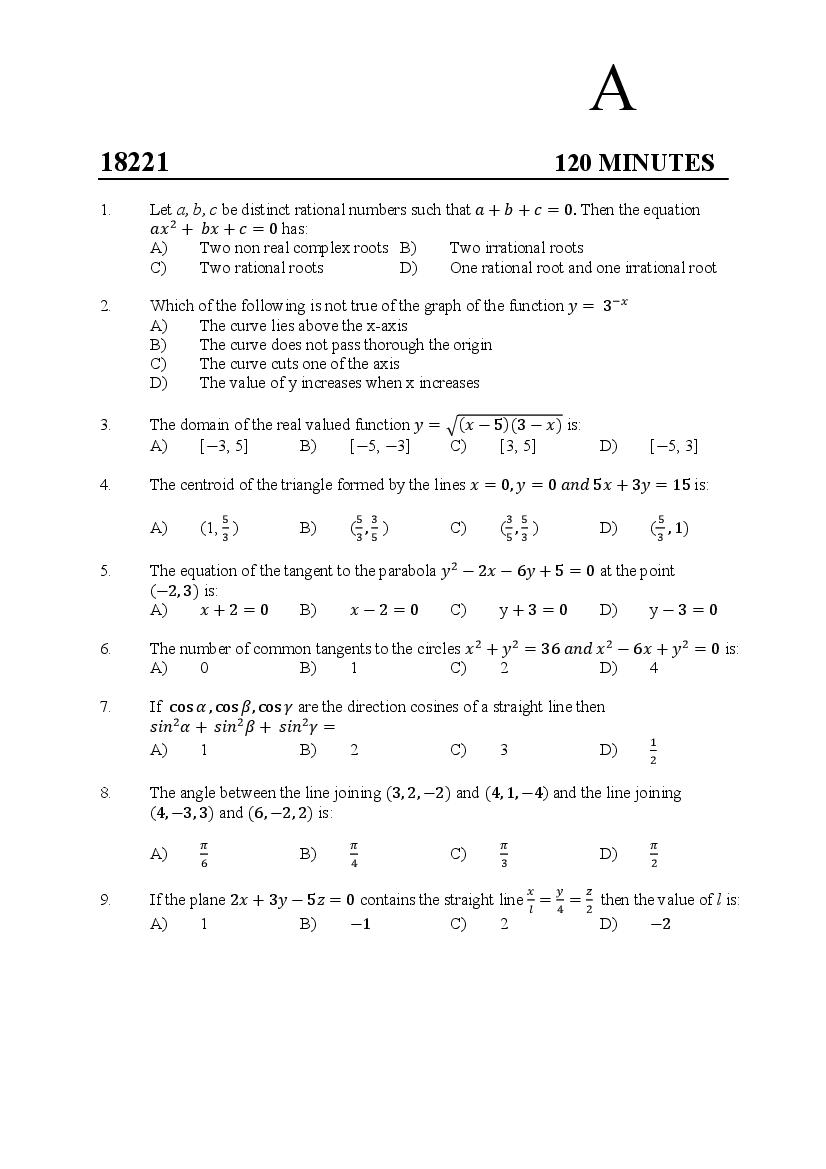
18221 120 MINUTES
1. Let a, b, c be distinct rational numbers such that + + = 0. Then the equation
+ + = 0 has:
A) Two non real complex roots B) Two irrational roots
C) Two rational roots D) One rational root and one irrational root
2. Which of the following is not true of the graph of the function = 3
A) The curve lies above the x-axis
B) The curve does not pass thorough the origin
C) The curve cuts one of the axis
D) The value of y increases when x increases
3. The domain of the real valued function = ( − 5)(3 − ) is:
A) [−3, 5] B) [−5, −3] C) [3, 5] D) [−5, 3]
4. The centroid of the triangle formed by the lines = 0, =0 5 + 3 = 15 is:
A) (1, ) B) ( , ) C) ( , ) D) ( , 1)
5. The equation of the tangent to the parabola − 2 − 6 + 5 = 0 at the point
(−2, 3) is:
A) +2=0 B) −2=0 C) y+3 =0 D) y−3 =0
6. The number of common tangents to the circles + = 36 −6 + = 0 is:
A) 0 B) 1 C) 2 D) 4
7. If cos , cos , cos are the direction cosines of a straight line then
+ + =
A) 1 B) 2 C) 3 D)
8. The angle between the line joining (3, 2, −2) and (4, 1, −4) and the line joining
(4, −3, 3) and (6, −2, 2) is:
A) B) C) D)
9. If the plane 2 + 3 − 5 = 0 contains the straight line = = then the value of l is:
A) 1 B) −1 C) 2 D) −2
Page 2
A) A local minimum at = 1
B) A local maximum at = 1
C) A local minimum at = 1 and a local maximum at =1
D) Neither local maximum nor local minimum
11. ∫ (1 − ) =
A) B) 7 C) D)
12. The area bounded by the curve = ⎪ + 2⎪, the x-axis and the straight lines = 3,
= −3
A) 3 square units B) 5 square units
C) 13 square units D) 21 square units
13. A fair die is thrown twice. The sum of numbers appearing is observed to be 8. The
conditional probability that 3 has appeared at least once is:
A) B) C) D)
14. Let = − 1 − . Then lim → =
A) 0 B) 1 C) D)
15. The limit of the series ∑ ( )!
A) B) + C) D)
1, − ≤ ≤
16. Let ( )=
0, ℎ .
Then which of the following is true about the sequence ( )
A) ( ) converges to 0 for all
B) ( ) converges to 1 for all
C) ( ) converges to 1 for all ∈ (0, 1)
D) ( ) converges to 0 for all ∈ (0, 1)
17. For the surface z 2 x 4 4 xy y 2 , the origin is
A) a saddle point B) a minimum point
C) a maximum point D) None of these types of points
2
Page 3
0
( )=
− ( ) ℎ
Then which of the following is true about + .
A) Continuous at 0 and discontinuous at 1
B) Continuous at 1 and discontinuous at 0
C) Continuous at 0 and discontinuous at
D) Continuous at and discontinuous at 0
19. Let , be functions defined on [0, ] as follows:
sin 0 ≤ ≤ /2
( )=
0, ℎ
sin 0< ≤ /2
( )=
0, ℎ
Then which of the following is true.
A) is of bounded variation and is not of bounded variation in [0, ]
B) is of bounded variation and is not of bounded variation in [0, ]
C) and are of bounded variation in [0, ]
D) is not of bounded variation and is not of bounded variation in [0, ]
/
20. Let ( ) = +1 ( ) = sin . Then ∫ ( ) ( )=
A) 0 B) C) D) 2
21. Let { : ∈ } be a collection of Lebesgue measurable sets and let m denote Lebesgue
measure. Then which of the following is not necessarily true
A) (∩ ) = lim → ( ) ⊆ for all n
B) (∩ )= ( ) ⊆ for all n
C) (∪ ) = lim → ( ) ⊆ for all n
D) (∪ )= ( ) ⊆ for all n
22. If = then ⎪ ⎪=
√
A) B) C) D) √5
3
Page 4
necessarily true.
A) At least one is not real B) At most two roots are real
C) At least two roots are real D) If ≠ 1 and if is real then = −1.
24. If the radius of convergence of the power series ∑ is 2 then the radius of
convergence of ∑ is
A) 1 B) 2 C) √2 D) 4
25. Which of the following function has a removable singularity at = 0.
A) ( )= / B) ( ) = sin ( )
C) ( )= D) ( )=
26. Let be the circle ⎪ ⎪ = 2. Then ( )∫ =
A) 0 B) e C) + 1 D) –1
27. The order of (1, 2) in the group ⨁ is
A) 6 B) 8 C) 12 D) 16
28. Which of the following groups is isomorphic to ⨁
A) ⨁ B) ⨁ C) ⨁ D)
29. Let be a group of order 49. Then
A) is Abelian B) is cyclic
C) is non- Abelian D) ( ) has order 7
30. Let be the symmetric group on three symbols. Then the order of the commutator
subgroup of is
A) 1 B) 2 C) 3 D) 6
31. Let ℚ* denote the multiplicative group of non zero rationals. Let H be the subgroup
generated by . Then which of the following pairs of cosets are equal.
A) 2 3 B)
C) D)
4
Page 5
homomorphism given by ( ) = . Then the order of ℚ*/ ker is
A) 1 B) 2 C) 4 D) infinite
33. Let G be a group of order 40 and H, K be subgroups of order 5 and 20 respectively. Then
which of the following is true?
A) H and K are normal subgroups of G
B) H is a normal subgroup of G and K is not normal in G
C) H is not normal in G and K is normal in G
D) H is not normal in G and K is also not normal in G
34. The number of elements in the group of units of the ring is:
A) 25 B) 20 C) 10 D) 5
35. The number of zeros of the polynomial − 5 + 6 in the ring is:
A) 2 B) 3 C) 4 D) 5
36. The characteristic of the ring x is:
A) 6 B) 8 C) 24 D) 48
37. Which of the following is a solution for x in the congruence relation (127) ≡ mod (12)?
A) 1 B) 2 C) 5 D) 7
38. Let be the set of all polynomials given by
= { + + + +2 ∶ , , }. Check the validityof the
following statements about
i. 1 is not a zero of any polynomial in A
ii. 2 is not a zero of any polynomial in A
iii. 3 is not a zero of any polynomial in A
iv. 4 is not a zero of any polynomial in A
A) i and ii only are true B) iii and iv only are true
C) ii and iii only are true D) i and iv only are true
39. Let be the field of integers mod 3. Let be a zero of + + 2 and ( ) be the
Splitting field of + + 2 over . Then =
A) 1 B) 2 C) 1+ D) 1+
40. The degree of the splitting field of − 2 over the rationals is:
A) 3 B) 4 C) 5 D) 6
41. Let A be a 5 x 5 nilpotent matrix. Which of the following is necessarily true of A?
A) A is invertible
B) 0 is the only eigen value of A
C) At least one row of A has all entries zero
D) All diagonal entries of A are zero
5
Page 6
= 1 and det = 1, = 0 and = for all other ( , ) and det = −1, =2
and = for all other ( , ). Then det =
A) 0 B) 1 C) 2 D) 3
43. Which of the following matrix is row equivalent to the 3 x 3 identity matrix?
2 1 0 1 −1 0 0 1 1 1 2 1
A) 1 1 0 B) 0 1 0 C) 1 0 0 D) 2 1 1
1 1 1 1 0 0 1 1 1 3 3 2
44. Let be a 5 x 5 matrix of rank 4. Then the system of linear equations = 0 has
A) Exactly one non zero solution
B) Exactly 4 non zero solutions
C) No non zero solutions
D) Infinitely many non zero solutions
45. Let be a 4 x 4 matrix such that + − = 0 where is the identity matrix. Which of
the following is not necessarily true?
A) is invertible B) + is invertible
C) + is invertible D) − is invertible
3
46. Let = ℤ be the 3–dimensional vector space over the field ℤ . Then which of the
3
following is a linearly independent set in
A) { (1, 2, 0), (0, 1, 1), (1, 1, 0) }
B) { (1, 2, 0), (1, 1, 1), (2, 0, 1) }
C) { (1, 2, 0), (1, 0, 1), (0, 2, 2) }
D) { (1, 2, 0), (2, 1, 2), (2, 1, 1) }
47. Let be the subspace of ℝ spanned by { (1, 2, 1), ( 1, 3, 1) }. Then which of the
following is in .
A) (1, 5, 2) B) (2, 3, 2) C) (2, 5, 3) D) (3, 5, 7)
48. Let be the subspace of ℝ spanned by (0, 1, 1). Then which of the following pairs of
vectors belong to the same element in the quotient space ℝ / .
A) (1, 2, 1) and (1, 0, -1) B) (1, 1, 2) and (1, -1, 1)
C) (1, -1, 1) and (1, -2, 1) D) (1, 2, -1) and (1, 1, 0)
49. Let be the line joining (1, 1) and (2, -1) in the plane ℝ . Then which of the following
points lie on the line parallel to and passing through the origin.
A) (1, 2) B) (2, 1) C) (-1, 1) D) (-1, 2)
6
Page 7
A) ( , , )=( + , − , )
B) ( , , ) = (1+ , 1− , )
C) ( , , )=(2 + , 3 + , 2 )
D) ( , , ) = ( 2 + 3 , 2 − 3 , 1)
51. Let ∶ ℝ → ℝ be defined by ∶ ( , , , ) = ( − , − , − , 0). Then
dimension of null space of is:
A) 0 B) 1 C) 2 D) 3
52. Let ∶ ℝ → ℝ be a linear transformation which is represented by the
1 0 0 0
Matrix 1 1 2 0 . Then which of the following is true
0 0 1 0
A) is one to one and onto B) is one to one and not onto
C) is onto but not one to one D) is not one to one and not onto
1 1 0 0 0
01 0 0 0
53. Which of the following is the minimal polynomial of the matrix 0 0 21 0
0 0 0 2 0
0 0 0 0 2
A) ( − 1) ( − 2) B) ( − 1) ( − 2)
C) ( − 1) ( − 2) D) ( − 1) ( − 2)
0
54. For which of the following values of and the matrix 0 0 is diagonalizable.
0 0
A) = 0, =1 B) = 1, =1
C) = 1, = −1 D) = 0, =0
55. The GCD of the numbers 2 x 3 x 5 x 13 and 2 x 3 x 5 x 13 is
A) 390 B) 6 x 65 C) 6 x 65 D) 6 x 65
56. Let ∅ denote the Euler totient function. Then ∅ (1024) =
A) 1023 B) 512 C) 256 D) 64
57. Which of the following is true?
A) 2 ≡1( 21) B) 2 ≡ −1 ( 21)
C) 2 ≡ −1 ( 21) D) 2 ≡1( 21)
7
Page 8
A) No solution
B) Exactly one solution ( 35)
C) Exactly two solutions ( 35)
D) Exactly six solutions ( 35)
59. Which of the following is the differential equation of the family of curves =4 ( + )
A) =2 + ( ) B) =2 − ( )
C) =2 + ( ) D) =2 − ( )
60. The solution of the differential equation:
cos( − ) = ( − ) − ( − ) is
A) ( − ) + cos ( − ) =
B) ( − ) − cos ( − ) =
C) ( − )=
D) cos ( − ) =
61. The Wronskian of the solutions of the equation − = 0 is
A) 2 B) 2 C) −2 D) 2
62. The Bessel function ( )=
A) − ( ) B) −2 ( ) C) (− ) D) ( )
63. The number of regular singular points of the function:
( + −6 ) + + ( − 2) = 0 is
A) 0 B) 1 C) 2 D) 3
64. The integral of the equation − + − = 0 is
A) − = B) − =
C) + = D) + =
65. If + + = is parabolic then the value of is
A) sin 2 B) cos 2 C) 2 sin D) 2 cos
66. The complete integral of the equation:
= ( − )+ ( − ) is
A) = + + ( + ) B) = + − ( + )
C) = + − D) = + +
8
Page 9
A) ( , )= ⎪ − ⎪+⎪ − ⎪
B) ( , )=( − ) +( − )
C) ( , )= ( − ) +( − )
D) ( , ) = max { ⎪ − ⎪, ⎪ − ⎪}
68. Let = { 1, 2, 3, 4, 5} and , , be topologies on given as follows.
= , ∅, {1, 2} , = , ∅, {1}, {1, 2} and is the discrete topology.
Then which of the following is true
A) and are metrizable
B) and are metrizable
C) is metrizable and is not metrizable
D) is not metrizable and is metrizable
69. Let ℝ be the space of all reals with discrete topology. Let ℝ + be the subspace of all positive
reals and ℚ+ be the subspace of all positive rationals. Then which of the following is true
A) The closure of ℚ+ in ℝ is ℝ +
B) The closure of ℝ + in ℝ is ℝ + ∪ {0}
C) The interior of ℚ+ in ℝ is ℚ+
D) The interior of ℝ +in ℝ is ℚ +
70. Let be the space of all continuous real valued functions on [0, 1] with metric given by
( , )= ⎪ ( )− ( )⎪. Let
:0 ≤ ≤ 1/2 ∶ 0≤ ≤ 1/2
( )= and ( )=
∶ 1/2 ≤ ≤1 ∶ 1/2 ≤ ≤1
Then ( , ) =
A) 0 B) 1 C) ¼ D) ¾
71. Let be the topology on the reals R for which { (−∞, a) ∶ a > 0} is a base. Let ( ), ( )
be sequences where = (−1) and = (−1) + 1. Then which of the following is true
in ( , ).
A) ( ) converges to 1 and ( ) converges to 2
B) ( ) converges to −1 and ( ) converges to 2
C) ( ) converges to 1 and ( ) converges to 0
D) ( ) converges to −1 and ( ) converges to 0
9
Page 10
true about a continuous function ∶ ℝ → ℚ
A) can be both one to one and onto
B) can be one to one and not onto
C) can be onto but not one to one
D) can not be one to one and can not be onto
73. Let be the real line with usual topology and = ℝ with discrete topology. Which of the
following ∶ x → x is continuous?
A) ( , )=( + , + )
B) ( , )=( + , )
C) ( , ) = ( + 1, )
D) ( , ) = ( , + 1)
74. Let = (1, 1, 1, … ) and = (1, , , ...) be sequences. With the usual notations which of
the following is true.
A) B)
C) D)
75. Let be the normal linear space ℝ with norm ∥ ∥ and Y = { (0, y, z) : y, z ∈ }.
Let ∶ / → be defined by (( , , ) + ) = ( , 0, 0). Then ∥ ∥ =
A) 0 B) 1 C) 2 D) ½
76. Let = be the normed linear space with norm ∥ ∥ . Let ∶ → be defined by
( , , ) = ( , + , + + ). Then which of the following is not true.
A) is closed and continuous but not open
B) is closed and open but not continuous
C) is closed, continuous and open
D) is closed but not continuous and not open
77. Let be the Hilbert space . Then the set orthogonal to the point (1, 1) in is:
A) The set of points on the straight lines = 0 and y= 0.
B) The set of points on the straight lines + y = 0.
C) The set of points on the straight lines − y = 0.
D) The set of points on the straight lines − y = 1.
78. Let be the Hilbert space and , ∈ be such that ∥ ∥ = 7 and ∥ ∥ = 1 and
∥ + ∥ = 8. Then ∥ − ∥ =
A) 6 B) 5 C) 4 D) √2
10
Page 11
( ) ( )
( 1 , 2 , … )) = (1) − (2). Let = (0, 0, … , 0, 1, 0, … ) where 1 occurs in the nth
position. Then which of the following is true.
A) ∑ ⎪ ( )⎪ ≤ √2 B) ∑ ⎪ ( )⎪ ≤ 2
C) ∑ ⎪ ( )⎪ ≤ 1 D) ∑ ⎪ ( )⎪ ≤
80. Let be the complex Hilbert space C3 and the operator on be represented by the matrix
1 0 0
0 0 . Then which of the following is true.
0 0 −1
A) is self adjoint and unitary
B) is not self adjoint and not unitary
C) is self adjoint but not unitary
D) is unitary but not self adjoint
______________________
11
Document Details
| Board / Org | Kerala Exams |
| Exam | Kerala SET |
| Type | Question Paper |
| Pages | 11 |
| Updated | 23 Oct 2026 |