Goa Board Class 9 Sample Paper 2026 Mathematics (E)
Finished viewing? Save it for later —
Download Goa Board Class 9 Sample Paper 2026 Mathematics (E) (PDF · 52 pages)About Goa Board Class 9 Sample Paper 2026 Mathematics (E)
Goa Board Class 9 Sample Paper 2026 Mathematics (E) is available here for free download. Published by Goa Board for Class 9, this sample paper can be viewed online or downloaded as a PDF (52 pages). Candidates preparing for Class 9 can use Goa Board Class 9 Sample Paper 2026 Mathematics (E) to understand the exam pattern, the type of questions asked, and the overall difficulty level.
Frequently Asked Questions
How can I download Goa Board Class 9 Sample Paper 2026 Mathematics (E)?
Open this page and click the Download button to save Goa Board Class 9 Sample Paper 2026 Mathematics (E) as a PDF. It is completely free on AglaSem Docs.
Is Goa Board Class 9 Sample Paper 2026 Mathematics (E) free to download?
Yes. Goa Board Class 9 Sample Paper 2026 Mathematics (E) can be viewed online and downloaded as a PDF free of cost on AglaSem Docs.
How many pages does Goa Board Class 9 Sample Paper 2026 Mathematics (E) have?
Goa Board Class 9 Sample Paper 2026 Mathematics (E) contains 52 pages, which you can read online or download together as a single PDF.
Where can I find more Class 9 study material?
You can find more Class 9 question papers, sample papers, syllabus, and answer keys on AglaSem Docs.
Goa Board Class 9 Sample Paper 2026 Mathematics (E) – Text
Read the full text of this sample paper below — useful to quickly search, copy and reference the content online without downloading the PDF.
📄 View text version (52 pages)
Page 1
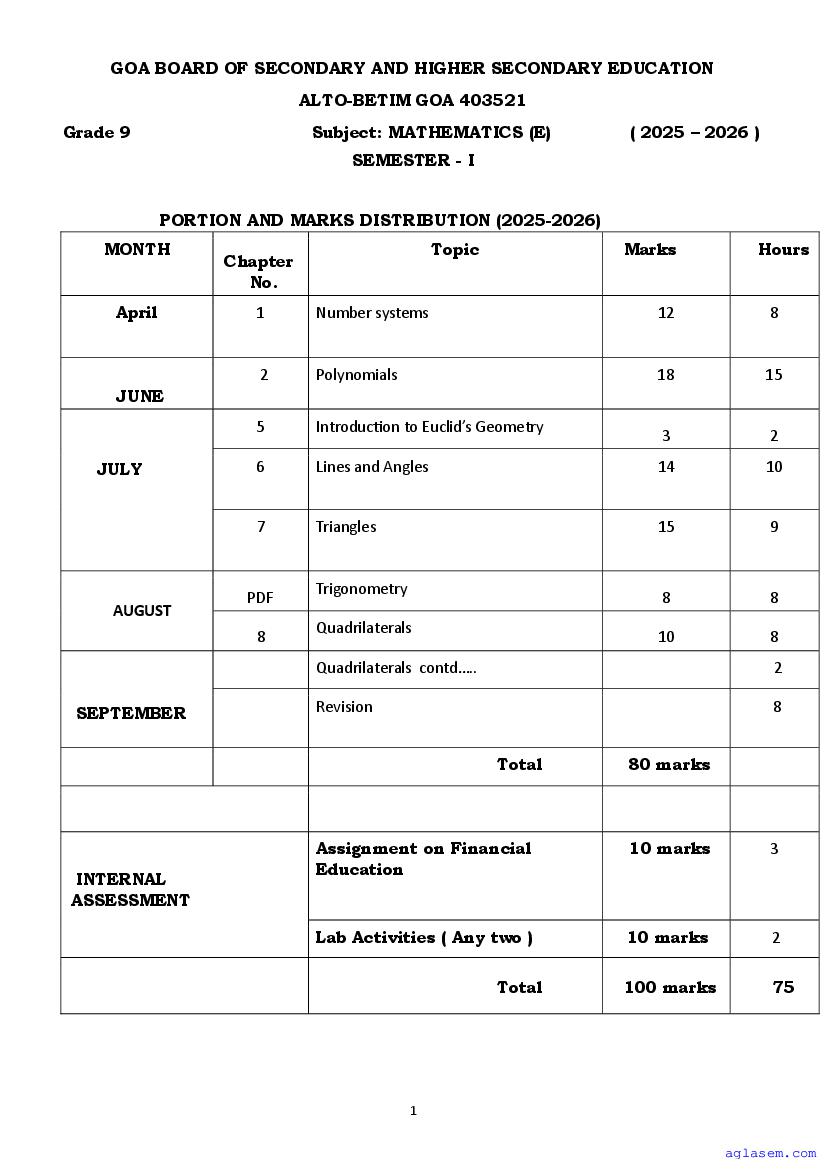
ALTO-BETIM GOA 403521
Grade 9 Subject: MATHEMATICS (E) ( 2025 – 2026 )
SEMESTER - I
PORTION AND MARKS DISTRIBUTION (2025-2026)
MONTH Topic Marks Hours
Chapter
No.
April 1 Number systems 12 8
2 Polynomials 18 15
JUNE
5 Introduction to Euclid’s Geometry
3 2
JULY 6 Lines and Angles 14 10
7 Triangles 15 9
Trigonometry
PDF 8 8
AUGUST
Quadrilaterals
8 10 8
Quadrilaterals contd….. 2
SEPTEMBER Revision 8
Total 80 marks
Assignment on Financial 10 marks 3
Education
INTERNAL
ASSESSMENT
Lab Activities ( Any two ) 10 marks 2
Total 100 marks 75
1
Page 2
ALTO-BETIM GOA 403521
Grade 9 Subject: MATHEMATICS (E) ( 2025 – 2026 )
SEMESTER – II
PORTION AND MARKS DISTRIBUTION (2025-2026 )
MONTH Topic Marks Hours
Chapter
No.
OCTOBER PDF Logarithms 10 8
3 Coordinate Geometry 3 3
NOVEMBER
4 Linear Equations in 2 variables 8 9
DECEMBER 10 Circles 14 10
12 Heron’s Formula 14 10
JANUARY
14 Statistics
15 11
FEBRUARY 13 Surface Areas and Volumes 16 12
MARCH Revision 8
Total 80 marks
Assignment on Experimental 10 marks 3
verification of properties /
INTERNAL theorems on circles using
ASSESSMENT Geoboard
Lab Activities ( Any two ) 10 marks 2
Total 100 marks 75
2
Page 3
ALTO-BETIM GOA 403521
Rationalised syllabus 2025 – 2026
Grade 9 Subject : Mathematics
Chapter Units Included Units Deleted
1. Number 1.1 Introduction 1.4 Representing Real
systems 1.2 Irrational Numbers Numbers on the Number
1.3 Real Numbers and their Decimal Expansions Line
1.5 Operations on Real Numbers
1.6 Laws of Exponents for Real Numbers
2. Polynomials 2.1 Introduction
2.2 Polynomials in One Variable
2.3 Zeroes of a Polynomial ____
2.4 Remainder Theorem
2.5 Factorisation of Polynomials
2.6 Algebraic Identities
3. Co - ordinate 3.1 Introduction
geometry 3.2 Cartesian System
3.3 Plotting a Point in the Plane if its Coordinates ____
are given
4. Linear equations 4.1 Introduction
in two variables 4.2 Linear Equations
4.3 Solution of a Linear Equation
4.4 Graph of a Linear Equation in Two Variables
4.5 Equations of Lines Parallel to x-axis and y-axis ____
5. Introduction to 5.1 Introduction 5.3 Equivalent Versions
Euclid's geometry 5.2 Euclid's Definitions, Axioms and Postulates of Euclid's Fifth Postulate
6. Lines and Angles 6.1 Introduction
6.2 Basic Terms and Definitions
6.3 Intersecting Lines and Non-intersecting Lines
6.4 Pairs of Angles
Theorem (to prove): Thm 6.1
6.5 Parallel Lines and a Transversal
6.6 Lines Parallel to the same Line
6.7 Angle Sum Property of a Triangle ____
Theorem (to prove): Thm 6.7
3
Page 4
6.3, Thm 6.4, Thm 6.5, Thm 6.6, Thm 6.8
7. Triangles 7.1 Introduction 7.6 Inequalities in a
7.2 Congruence of Triangles Triangle
7.3 Criteria for Congruence of Triangles
7.4 Some Properties of a Triangle
Theorems (to prove): Thm 7.2 , Thm 7.3
7.5 Some More Criteria for Congruence of Triangles
Theorems (Motivate – without proof): Thm 7.1, Thm
7.4, Thm 7.5
8. Quadrilaterals 8.1 Introduction
8.2 Angle Sum Property of a Quadrilateral
8.3 Types of Quadrilaterals
8.4 Properties of a Parallelogram
Theorem (to prove): Thm 8.1
8.5 Another Condition for a Quadrilateral to be a
Parallelogram
8.6 The Midpoint Theorem
Theorems (Motivate – without proof): Thm 8.2, Thm
8.3, Thm 8.4, Thm 8.5, Thm 8.6, Thm 8.7, Thm 8.8
9. Areas of FULL CHAPTER
Parallelograms
10. Circles 10.1 Introduction Ex 10.3
10.2 Circles and its Related Terms Ex 10.5 from sum no. 7
10.3 Angle Subtended by a Chord at a Point onwards
Theorems (to prove): Thm 10.1 , Thm 10.2
10.4 Perpendicular from the Centre to a Chord
Theorems (to prove): Thm 10.3 , Thm 10.4
10.5 Circle through three Points
10.6 Equal Chords and their Distances from the Centre
10.7 Angle Subtended by an Arc of a Circle
10.8 Cyclic Quadrilaterals
Theorems (Motivate – without proof):
Thms: 10.5, 10.6 , 10.7 , 10.8 , 10.9 , 10.10 , 10.11
11. Constructions FULL CHAPTER
12.Heron's Formula 12.1 Introduction
12.2 Area of a Triangle – by Heron's Formula
12.3 Application of Heron's Formula in finding
Areas of Quadrilaterals ____
4
Page 5
Volumes 13.3 Surface Area of a Right Circular Cylinder Cuboid and a Cube
13.4 Surface Area of a Right Circular Cone 13.6 Volume of a
13.5 Surface Area of a Sphere & Hemisphere Cuboid and a Cube
13.7 Volume of a Right Circular Cylinder
13.8 Volume of a Right Circular Cone
13.9 Volume of a Sphere & Hemisphere
14. Statistics 14.1 Introduction 14.4 (A) Bar Graphs
14.2 Collection of Data
14.3 Presentation of Data
14.4 Graphical Representation of Data-
14.5 Measures of Central Tendency
15. Probability FULL CHAPTER
* Trigonometry (PDF) Full PDF ___
* Logarithms (PDF) Revised pdf ( will be uploaded on Goa Board website
before the start of the second semester) ___
5
Page 6
ALTO-BETIM GOA 403521
Mapping Syllabus with Curricular Goals and Competencies
2025 – 2026
Grade 9 Sub: Mathematics (E)
Sr. Chapter Curricular Competencies
No Goals
1. Number Systems CG-1 C-1.1
CG-2 C-2.1
2. Polynomials CG-3 C-3.1
C-3.2
3. Introduction to Euclid’s CG-4 C-4.1
Geometry CG-7 C-7.1
CG-10 C-10.1
C-10.2
4. Lines and Angles CG-4 C-4.1
C-4.2
C-7.3
5. Triangles CG-4 C-4.1
C-4.2
CG-7 C-7.3
6. Quadrilaterals CG-4 C-4.1
C-4.2
CG-7 C-7.3
7. Trigonometry CG-4 C-4.6
8. Logarithms CG-9 C-9.1
C-9.3
9. Coordinate Geometry CG-4 C-4.5
CG-10 C-10.1
10. Linear Equations in two CG-3 C-3.2
variables CG-8 C-8.1
11. Circles CG-4 C-4.1
C-4.3
12. Heron’s Formula CG-5 C-5.1
CG-10 C-10.1
13. Surface Areas and Volumes CG-5 C-5.2
CG-8 C-8.2
C-8.3
14. Statistics CG-6 C-6.1
CG-8 C-8.1
CG-11 C-11.1
6
Page 7
Grade 9 Sub: Mathematics (E)
Chapter Name Learning Outcomes
and
Serial No.
1. Number The learner
Systems • Applies logical reasoning in classifying real numbers,
proving their properties and using them in different
situations.
• Differentiates rational and irrational numbers based on
decimal representation.
• Understands the operations on irrational numbers and
applies to solve the numericals.
• Represents real numbers on the number line.
• Rationalises the denominator of real numbers.
• Extends the understanding of powers(radical powers)
and exponents to real numbers.
• Applies the extended laws of exponents to simplify
expressions.
2. Polynomials The learner
• Identifies/Classifies polynomials among algebraic
expressions .
• Understands the concept of degree of polynomials.
• Understands the concept of zeros of a polynomial and
applies it to find zeros of any given polynomial.
• Applies the remainder theorem to find the remainder
when a polynomial is divided by a linear polynomial.
• Finds the factors of a polynomial using factor theorem.
Factorises polynomials by applying appropriate algebraic
identities.
3.Introduction to The learner
Euclid’s • Understands Euclid’s contribution in Plane Geometry.
Geometry Defines axioms , postulates theorems with reference to
Euclidean Geometry
4.Lines and The learner
Angles • Develops understanding of basic terms and definitions
related to lines and angles.
• States various axioms and theorems of parallel and
intersecting lines and applies them to solve geometric
problems.
States and applies angle sum property and exterior angle
property to various geometrical situations.
5.Triangles The learner
• Derives proofs of mathematical statements particularly
related to geometrical concepts , like triangles by
7
Page 8
them.
• Understands the criteria of congruency of triangles.
Applies various criteria of congruency of triangles to
solve related problems
6. Quadrilaterals The learner
• Identifies various types of quadrilaterals.
• Analyses and applies properties of parallelogram to prove
various relationships.
Applies midpoint theorem to solve problems.
7. Trigonometry The learner
• Demonstrates an understanding of the relationship
between the sides of a triangle and the trigonometric
ratios :sine ,cosine and tangent.
• Evaluates trigonometric expressions using values of
trigonometric ratios for standard angles.
• Derives the relationship between sin𝜃 and cos𝜃.
Applies the relationship for solving problems.
8. Logarithms The learner
• Understands the concepts of logarithm.
• Writes given number using scientific notations.
• Find characteristic of a number using scientific form.
• Finds logarithm and antilogarithm of numbers using log
tables.
• Understands and applies laws of logarithms to simplify
algebraic expressions
Applies logarithms to solve real life problems
9. Coordinate The learner
Geometry • Understands the concept of Cartesian system of
coordinates.
• Develops strategies to locate points in a Cartesian plane.
• Finds abscissa and ordinate of a point in a Cartesian
plane.
Plots the given points in a Cartesian plane
10.Linear The learner
Equations in two • Identifies and models real life situations into a linear
variables equation in two variables.
• Develops the understanding of infinitely many solutions
of a linear equation in two variables.
• Relates the algebraic and graphical representations of a
linear equation in two variables.
Represents the linear equation in one and two variables
as a straight line in the Cartesian plane.
8
Page 9
• Recollects the knowledge of different terms related to
circles.
• Derives proofs of theorems related to circles by applying
axiomatic approach.
Applies theorems to solve problems.
12.Heron’s The learner
Formula • Computes area of a triangle using Heron’s formula.
• Applies The concept of Heron’s formula in real life
situations.
13. Surface The learner
Areas and • Derives formulae for surface areas and volumes of
Volumes different solid objects like cubes , cuboids , right circular
cylinders , cones spheres and hemispheres.
• Applies formulae to solve problems.
Applies the formulae to find surface areas and volumes
of the objects found in surrounding areas.
14. Statistics The learner
• Represents the data as frequency distribution table (
grouped or ungrouped) and graphically as bar graphs ,
histograms and frequency polygons.
• Analyses and interprets the data represented using
various forms.
• Computes mean , median and mode for ungrouped data.
Applies the concepts in real life situations.
3.6.1 Pedagogy for Mathematics
3.6.1.1 Instructional practices
c.
d.
e.
f.
g.
h.
3.6.1.2 Some suggested methods of teaching
b.
c.
d.
e.
3.6.1.3 Integrating Mathematics with other Curricular Areas
a.
b.
c.
9
Page 10
The revised Bloom’s taxonomy includes the following levels:
• Remembering: Exhibit memory of previously learned material by recalling facts ,
terms , basic concepts and answers.
• Understanding: Demonstrate understanding of facts and ideas by organizing
,comparing , translating , interpreting , giving descriptions and stating main ideas.
• Applying ; Solve problems to new situations by applying acquired knowledge ,
facts , techniques and rules in a different way.
• Analysing : Examine and break information into parts by identifying motives and
causes. Make inferences and find evidence to support generalization.
• Evaluating : Present and defend opinions by making judgements about
information , validity of ideas, or quality of work based on asset of criteria.
• Creating : Compile information together in a different way by combining elements in
a new pattern or proposing alternative solutions.
10
Page 11
ALTO-BETIM GOA 403521
Grade 9 MATHEMATICS LABORATORY ACTIVITIES ( 2025-2026 )
--------------------------------------------------------------------------------------------------------------------------
ROLE OF MATHEMATICS LABORATORY IN TEACHING - LEARNING
The Mathematics Laboratory allows and encourages the students to think, discuss with each other
and the teacher, and assimilate the concepts in a more effective manner.
It enables the teacher to demonstrate, explain and reinforce abstract mathematical ideas by using
concrete objects, models, charts, graphs, pictures etc
There is no second opinion that for effective teaching and learning. ‘Learning by Doing’ is of great
importance as the experiences gained remain permanently affixed in the mind of the child.
This PDF has 8 activities for STD IX which can be done in the class and some are selected from the
LABORATORY MANUAL IN MATHEMATICS AT SECONDARY STAGE.
It is based on the National Education policy (NEP)2020.
Activities for the two terms are as follows:
Activities
FIRST TERM 1, 2, 3, 4 (any two)
SECOND TERM 5, 6, 7, 8 (any two)
Students should maintain a file of the activity done.
NOTE: High-achieving students or students with keen interest in the subject can be
motivated and encouraged to complete as many activities as per their interest with
teacher’s guidance by referring to the laboratory manual online as follows:
1.Visit ncert.nic.in
2.Publications
3.Laboratory Manual
4.Standardwise Maths activities
11
Page 12
Sr. No. List of Activities
1 To make a square root spiral by paper folding
2 To verify the algebraic identity:
( a + b + c )2 = a2 + b2 + c2 + 2ab + 2bc + 2ca
3 To verify experimentally the different criteria for congruency of triangles using
triangle cut outs
4 To verify the midpoint theorem using paper cutting and pasting
5 To plot a set of points on the Cartesian plane to create an artistic picture
6 Drawing Histogram and Frequency Polygon for a real life situation (Eg. Heights of a
Group of Students )
7 Exploring Pythagoras Theorem using regular polygons and semicircle
8 Exploring Volume of an Open-Top Box Made from a Square Sheet.
12
Page 13
OBJECTIVE
To make a square root spiral by paper folding.
MATERIALS REQUIRED
Rectangular blank sheet of paper , geometry box , coloured pencils etc
METHOD OF CONSTRUCTION:
1. Take a rectangular blank sheet of paper and mark a point O on it.
2. Draw a horizontal line OP = 1 unit using a ruler and a pencil.
3. Fold and press the paper along OP in such a way that the crease OP is formed.
4. Form a crease perpendicular to OP. Unfold and draw PA = 1 unit on the new
crease formed.
5. Form a crease joining OA so that right - angled triangle OPA is formed. See Fig.
1 (a)
6. Form a crease perpendicular to OA , unfold and draw BA = 1 unit on the crease
formed.
7. Join OB so that right - angled triangle OAB is formed .
B
1
A
A
1
1
O P
1
O 1 P
(a) (b)
Fig. 1
8. In the same way , unfold and draw BC = 1 unit perpendicular to OB and so
on .
13
Page 14
In right - angled triangle OPA ,
OA2 = OP2 + PA2
𝑂𝐴 = √1² + 1²
𝑂𝐴 = √2 𝑢𝑛𝑖𝑡𝑠
OBSERVATION :
1. In right - angled triangle OAB ,
𝑂𝐵 = √𝑂𝐴2 + 𝐴𝐵 2
= =
2. In right - angled triangle OBC ,
𝑂𝐶 = √𝑂𝐵² + 𝐵𝐶 2
= =
Continuing like this , we observe that lengths of hypotenuses OA, OB
, OC , OD ,… are
, …respectively.
APPLICATION :
The shape so formed by performing the activity is a square root spiral.
Through this activity, existence of irrational numbers can be illustrated.
Alternate method: https://youtu.be/i_MNzAJFK0c?si=8fhUGjqBtjS-6nEO
14
Page 15
OBJECTIVE
To verify the algebraic identity :
( a + b + c )2 = a2 + b2 + c2 + 2ab + 2bc + 2ca
MATERIALS REQUIRED
Coloured papers , adhesive, scissors ,geometry box etc.
METHOD OF CONSTRUCTION
1. Cut out a square of side a units from a coloured paper ( see Fig. 1 )
2. Cut out a square of side b units from a coloured paper ( see Fig. 2 )
3. Cut out a square of side c units from a coloured paper ( see Fig. 3 )
4. Cut out two rectangles of dimensions a × b , two rectangles of dimensions b×c
and two rectangles of dimensions c × a square units from a coloured paper ( see Fig. 4 )
a b
c
a b c
Fig.1 Fig. 2 Fig. 3
Fig. 4
15
Page 16
From the arrangement of squares and rectangles in Fig. 5 , a square ABCD is
obtained whose side is ( a + b + c ) units.
Area of square ABCD = ( a + b + c ) 2
Therefore , ( a + b + c ) 2 = sum of the areas of all the squares and rectangles shown
in Fig. 1 to Fig. 4
= a2 + ab + ac + ab + b2 + bc + ac + bc + c2
= a2 + b2 + c2 + 2ab + 2bc + 2ca
Here , area is in square units.
On actual measurement :
a = …………….., b = ………………, c = …………......,
So , a2 = ………………, b2 = …………….., c2 = …………….,
ab = ……………., bc = …………….., ca = ……………..,
2ab = …………….., 2bc = ……………., 2ca = ……………., a+b+c =
…………….., ( a + b + c ) 2 = ……………..,
Therefore , ( a + b + c )2 = a2 + b2 + c2 + 2ab + 2bc + 2ca
APPLICATION: The identity may be used for
1. simplification/factorisation of algebraic expressions
2. calculating the square of a number expressed as a sum of three convenient numbers.
16
Page 17
(by Prof. V.S.S.Sastry Kolar)
17
Page 18
OBJECTIVE
To verify experimentally the different criteria for congruency of triangles
using triangle cut-outs
MATERIALS REQUIRED
Chart paper , scissors , cutter , geometry box , pencil / sketch pens , coloured glazed
papers etc
METHOD OF CONSTRUCTION
Take a chart paper of a convenient size.
1.Make a pair of triangles ABC and DEF in which AB = DE,BC = EF, AC =DF on a glazed paper
and cut them out . ( see Fig. 1 )
2.Make a pair of triangles GHI and JKL in which GH =JK , GI = JL,
∠𝐺 = ∠ J on a glazed paper and cut them out . ( see Fig.2)
3. Make a pair of triangles PQR and STU in which QR = TU , ∠Q = ∠T , ∠R = ∠U on a
glazed paper and cut them out. ( see Fig. 3 )
4.Make two right triangles XYZ and LMN in which hypotenuse YZ=
hypotenuse MN and XZ = LN on a glazed paper and cut them out .
( see Fig. 4)
A D
B C E F
Fig.1
18
Page 19
G H J K
Fig.2
Fig. 4
DEMONSTRATION
1.Superimpose ∆ABC on ∆DEF and see whether one triangle covers the other triangle or
not by suitable arrangement . See that ∆ABC covers ∆DEF completely only under the
correspondence A ↔ D , B ↔ E , C ↔ F.
So , ∆ABC ≅ ∆DEF , if AB = DE , BC= EF and AC = DF.
This is SSS criterion for congruency.
2. Similarly , establish ∆GHI ≅ ∆JKL , if GH =JK , ∠𝐺 = ∠ J and GI = JL . This is SAS
criterion for congruency.
3.Establish ∆PQR ≅ ∆STU , if QR = TU , ∠Q = ∠T and ∠R = ∠U. This is ASA
criterion for congruency.
4.In the same way , ∆XYZ ≅ ∆LMN , if hypotenuse YZ = hypotenuse MN and XZ = LN. This
is RHS criterion for right triangles.
19
Page 20
1. In ∆ABC and ∆DEF
AB = DE = ……, BC = EF =………, AC = DF = ………,
On actual measurement
∠A = …………………., ∠D = ………………….,
∠B = …………………., ∠E = ………………….,
∠C = …………………., ∠F = ………………….,
Therefore , ∆ABC ≅ ∆DEF
2.In ∆GHI and ∆JKL
GH = JK = ……..,GI = JL = ……,∠G = ∠J = …………,
On actual measurement
HI = …………………, KL = ……………………,
∠I = ……………………., ∠L = ………………….,
∠H = …………………., ∠K = ………………….,
Therefore , ∆GHI ≅ ∆JKL
3.In ∆PQR and ∆STU
QR = TU = ………, ∠Q = ∠T = ………,∠R = ∠U = ………………….,
On actual measurement
PQ = ……,ST = ………., PR = .. .……, SU = ……….,
∠P =……….., ∠S = ………..,
Therefore , ∆PQR ≅ ∆STU
4.In ∆XYZ and ∆LMN , ∠X = ∠L = 900
hypotenuse YZ = hypotenuse MN = ………, XZ = LN = ……………,
On actual measurement
LM = …………, XY = …………, ∠Y=…………,∠M = …………,
∠N = ……………, ∠Z = ………………….,
Therefore , ∆XYZ ≅ ∆LMN.
Note: Students should find out why the SSA congruence rule is not possible, as the sides can be
located in two different parts of the triangles and not corresponding sides of the two triangles.
APPLICATION
These criteria are useful in solving a number of problems in geometry.
These criteria are also useful in solving some practical problems such as finding
width of a river without crossing it .
20
Page 21
OBJECTIVE
To verify the mid-point theorem for a triangle using paper cutting and pasting
Midpoint theorem
A straight line joining the mid-points of any two sides of a triangle is parallel to the
third side and is equal to half of it.
MATERIALS REQUIRED
Coloured sheet , tracing paper, geometry box, a pair of scissors, adhesive or fevicol etc.
METHOD OF CONSTRUCTION
1. Draw ∆ABC on a sheet of paper and obtain the mid-points P , Q and R of sides AB , AC
and BC respectively by paper folding
2. Join P and Q by folding and making a crease PQ ( see Fig. 1 )
3. Make a replica of ∆APQ and cut it out.
DEMONSTRATION
Superimpose AQ over QC , so that QP falls along CB ( see Fig. 2 )
A A
P Q P Q(A)
C
R B R C
(P) (Q)
Fig. 1 Fig. 2
OBSERVATION
1. ∠AQP covers or superimposes ∠ exactly .
2. They form angles on PQ and BC , AC being a transversal.
3. Thus , is parallel to BC.
4. Also , P coincides with R.
= BC
APPLICATION
Mid-point theorem is verified and it is useful in solving a number of geometrical
problems.
21
Page 22
OBJECTIVE
To create a hidden picture by plotting and joining points with given coordinates on the Cartesian plane.
MATERIALS REQUIRED
• Cardboard, White paper, scissor, Pencil, Adhesive, Graph paper (squared paper), Geometry box
METHOD OF CONSTRUCTION
1. Take a cardboard of a suitable size and paste a white sheet on it.
2. Paste a graph paper neatly on the white sheet.
3. Draw two perpendicular axes, X’OX (horizontal) and Y’OY (vertical), representing the Cartesian
plane.
4. Plot the given points A, B, C, ... with coordinates such as (a, b), (c, d), (e, f), etc.
5. Join the points in the specified order: A → B → C → D → ... → A, to form a closed figure.
6. The figure will reveal a hidden image.
DEMONSTRATION
By plotting and joining the points as instructed, a hidden image of a ‘______________’ (e.g., kite, house,
tree) appears on the graph.
OBSERVATION
• Coordinates of the points:
A = (____, ____), B = (____, ____), C = (____, ____),= (____, ____), ...
• Hidden picture formed: _________________________
22
Page 23
This activity enhances understanding of:
• Cartesian coordinates and plotting of points
• Shapes formed by connecting coordinates
• Practical uses such as road maps, classroom layouts, and blueprint design.
N.B : Teachers are requested to provide coordinates for hidden pictures, or students may create their own
sets of coordinates that form a picture (e.g., a house, bird, animal, fish, vase, etc.) when joined.
******************************###******************************
23
Page 24
OBJECTIVE
To draw a Histogram and Frequency Polygon for the heights of a group of students.
MATERIALS REQUIRED
Graph paper, pencil, ruler, eraser, notebook.
METHOD OF CONSTRUCTION
1. Data Collection:
- Measure and record the heights of 30 students in your class (in cm).
2. Organize Data into Class Intervals:
- Form suitable class intervals, e.g., 140–145 cm, 145–150 cm, etc.
3. Prepare a Frequency Table:
- Count how many students fall into each height group.
4. Draw the Histogram:
- Draw class intervals on the x-axis and frequencies on the y-axis.
- Draw rectangles (bars) without gaps. The height of each bar should represent the frequency of the
corresponding class interval.
5. Draw the Frequency Polygon:
- Find the midpoints of each class interval.
- Plot points as (midpoint, frequency).
- Connect the points using straight lines.
- Extend the polygon by joining the first and last points to the x-axis at height 0.
24
Page 25
Class Interval (Height in cm) Frequency (No. of Students)
140 – 145 3
145 – 150 6
150 – 155 10
155 – 160 7
160 – 165 4
Graph Work:
1. Histogram:
• Draw bars for each class interval with heights equal to their frequencies.
• Note: There should be no gaps between the bars.
2. Frequency Polygon:
• Midpoints: 142.5, 147.5, 152.5, 157.5, 162.5
• Plot the points: (142.5, 3), (147.5, 6), (152.5, 10), (157.5, 7), (162.5, 4)
• Connect the points with straight lines.
• Join the first and last points to the x-axis at height 0.
N.B : The above activity is just an example using mock data. Teachers are requested to help students
use real data such as their weights, heights, marks in Semester -1 Mathematics, etc. for statistics
activities.
*******************************###*******************************
25
Page 26
OBJECTIVE
To explore the Pythagoras Theorem using areas of regular polygons (such as equilateral triangles,
squares, hexagons) and semicircles constructed on the sides of a right-angled triangle.
MATERIALS REQUIRED
• Cardboard, White paper, Coloured paper Compass, Protractor, Ruler, Pencil, Scissors, Glue
METHOD OF CONSTRUCTION
1. Draw a right-angled triangle ABC (right-angled at B) on cardboard.
2. Construct regular shapes (square, equilateral triangle, hexagon, or semicircle) on each side AB,
BC, and AC.
3. Ensure the shapes are constructed such that each shares a side with the triangle.
4. Calculate or cut and paste shapes on each side showing the area.
5. Demonstrate that:
Area on AB + Area on BC = Area on AC
(i.e., sum of areas on the legs = area on the hypotenuse).
6. Repeat for different regular polygons and semicircles.
DEMONSTRATION
By constructing the same regular polygon (e.g., squares or semicircles) on each side of a right triangle,
it can be visually shown that the area on the hypotenuse equals the sum of areas on the other two
sides—thus proving the Pythagoras Theorem in a geometric and visual way.
26
Page 27
After constructing the regular polygons (e.g., squares, equilateral triangles, hexagons, and semicircles)
on each side of the right-angled triangle, the following observations were made:
• The combined area of the shapes on the two shorter sides (legs) is equal to the area of the shape
on the hypotenuse, regardless of the type of regular polygon or semicircle used.
• This visual and area-based approach confirms the Pythagoras Theorem:
(Area on side AB) + (Area on side BC) = (Area on side AC)
• The result holds true consistently across different shapes, reinforcing the geometric truth of the
theorem.
APPLICATION
• Enhances visual understanding of the Pythagoras Theorem.
• Helps understand the concept of area in regular polygons.
• Useful in architectural design, geometry-based problem solving, and spatial understanding.
• Encourages creativity and application of mathematics in real-world geometry.
************************************* ### *************************************
27
Page 28
OBJECTIVE:
To explore how the volume of an open-top box changes when squares of different sizes are cut from each
corner of a square sheet and the sides are folded up to form the box.
MATERIALS REQUIRED:
• Square sheets of paper or card (12 inches × 12 inches)
• Ruler, Pencil, Scissors
METHOD OF CONSTRUCTION:
6. Take a square sheet of size 12 inches × 12 inches.
7. Cut equal squares from each corner. Try cutting squares of side 1 inch, 2 inches, 3 inches, etc.
8. Fold up the flaps formed by the remaining edges to form an open-top box.
9. The height of the box will be equal to the side of the square cut from each corner.
10. Use the formula to calculate the volume of the box:
Volume = length × breadth × height
where,
- height = 𝑥 (cut size)
- length = 12 − 2 𝑥
- breadth = 12 − 2 𝑥
DEMONSTRATION:
Construct several boxes by cutting squares of side:
- 1 inch
- 2 inches
- 3 inches
- 4 inches
- …
Calculate volume for each case using the formula above.
28
Page 29
Cut Size Length Breadth Height Volume
(inches) (in) (in) (in) (cubic in)
1 __ __ __ __
2 __ __ __ __
3 __ __ __ __
4 __ __ __ __
…
APPLICATION:
This activity demonstrates a practical optimization problem. It shows how changing one dimension affects
the others and the overall volume. This concept is useful in packaging design, waste reduction and
engineering solutions where material usage and space optimization are important.
Conclusion: ( To be written by students ) :
Through this activity, I observed that …..
*******************************###*******************************
29
Page 30
ALTO- BETIM , GOA 403521
Grade 9 Subject: MATHEMATICS Yr: 2025 - 2026
SEMESTER I : ASSIGNMENT ( FINANCIAL EDUCATION ) Max.Marks: 10
Topic: BANKING
INSTRUCTIONS:
1) Prepare a portfolio with the help of the guidelines given below.
2) Visit a Bank and obtain the following information required for the assignment.
Sr. No. Banking Marks
1. Cover page design of the LOGO and SLOGAN of the Bank visited. 1
2. Index ½
3. Functions of a Bank and Importance of Saving. ½
4. Types of Bank accounts and their advantages. 1
Type of Bank Loans.
5. Find the eligibility criteria and documents required for taking an 1
educational loan.
6. Documents required for opening a Bank Account. ½
Calculation of maturity amount on a Recurring Deposit.
For eg: You deposited ₹200 per month in Bank A for 2 years under the
7. Recurring Deposit Scheme. ½
Find the maturity value at the end of 2 years. (Write
the formula and show the calculations)
Calculation of maturity amount on a Fixed Deposit.
For eg: You deposited ₹5000 in Bank A for 2 years under the fixed deposit scheme.
8.
Find the Maturity value at the end of 2 years. 1½
(Write the formula and show the calculations).
9. Fill up a withdrawal slip, deposit slip and a xerox of a cheque. 1½
10. Acknowledgement. ½
11. Bibliography. ½
TOTAL 10
30
Page 31
ALTO- BETIM , GOA 403521
Grade 9 Subject: MATHEMATICS Yr : 2025 - 2026
SEMESTER II : ASSIGNMENT ( GEOBOARD ) Max.Marks: 10
Topic : Exploring circle theorems using Geoboard
Objective:
- To explore and illustrate basic circle theorems using a self-made circular Geoboard.
- To develop conceptual understanding through hands-on activity.
Materials Required:
• Wooden board/cardboard (20cm×20cm or 25cm×25cm)
• Small nails or push pins
• Protractor, ruler, compass, pencil/Markers
• Rubber bands or coloured threads
• Chart/notebook for observations
Steps to Make the Geoboard:
i. Find a central point on the board and using a compass draw a circle with centre O .
ii. Mark evenly spaced points around the circle’s circumference .
( e.g. every 15° for 24 points)
iii. Insert small nails or push pins at each marked point.
iv. Use rubber bands or coloured threads to create chords and other shapes to
demonstrate circle properties.
Concepts & Theorems to Demonstrate/Investigate/Explain Using Geoboard:
1. Equal chords of a circle are equidistant from the centre
• Make two chords AB and CD of equal length.
• Verify that perpendiculars from the centre of the circle to both the chords are equal.
2. The perpendicular from the centre of a circle to a chord bisects the chord.
• Make a chord XY.
• Verify that the perpendicular from the centre of the circle bisects the chord.
31
Page 32
• Make an arc PB subtending ∠POB at the centre O and ∠PQB at point Q on
the remaining part of the circle.
• Measure inscribed ∠PQB and central ∠POB
• Verify that the inscribed angle is half of the central angle .
3.2. Angle in a Semicircle theorem
• Make a diameter EF.
• Choose a point D on the circle and measure ∠EDF
• Verify that ∠EDF = 90°
4. Angles in the same segment are equal.
• Make a chord MN .
• Choose two more points S and T on the circle.
• Measure ∠MSN and ∠MTN .
• Check that both angles are equal.
5. Opposite angles of a cyclic quadrilateral sum to 180°.
• Take four points A , B , C and D on the circle .
• Connect them in order : A-B , B-C , C-D , D-A to form a quadrilateral.
• Find the measure of each pair of opposite angles .
• Verify that ; ∠ABC + ∠CDA = 180° and ∠BCD + ∠DAB= 180°
Conclusion: (to be written by the student): …………
*******************************************************
NOTE:
❖ Use the Geoboard to illustrate each theorem with rubber bands/ coloured threads and
measure/observe relationships using a scale.
❖ Draw diagrams of each, showing the measured data and label them neatly.
❖ # Teachers can guide students to measure angles using paper folding techniques and record their
findings in a tabular form.
INSTRUCTIONS:
1) Prepare a Geoboard with the help of the guidelines given above .
2) Explain the Concepts & Theorems Using Geoboard.
Sr. No. Criteria Marks
1. Geoboard Construction 5
2. Presentation / Explanation of concepts on circles using Geoboard
5
Total
10
l
*****************************************************
32
Page 33
ALTO-BETIM GOA 403521
DESIGN OF THE QUESTION PAPER (2025-2026)
SEMESTER-I
Subject : MATHEMATICS (E)
Time : 3 hrs Grade : 9 Max. Marks : 80
*******************************************************************************************
The weightage or the distribution of marks over different dimensions of the
question paper shall be as follows:
1. Weightage to the Learning objectives :
Sr. No. Learning Objectives Marks Percentage of Marks
1. Remembering and 50 62.5%
Understanding
2. Applying 20 25%
3. Analysing , Evaluating 10 12.5%
and Creating
Total 80 100%
2.Weightage to the different areas of Content :
Chapter No. Topic Marks
1 Number systems 12
2 Polynomials 17
5 Introduction to Euclid’s Geometry 03
6 Lines and Angles 14
7 Triangles 15
8 Quadrilaterals 10
PDF Trigonometry 09
Total 80
33
Page 34
Sr. No. Form of Questions Marks for Number of Total
each question questions Marks
1. Very Short Answer Type (VSA) 1 20 20
2. Short Answer Type I (SA-I) 2 11 22
3. Short Answer Type II (SA-II) 3 10 30
4. Long Answer Type (LA) 4 2 08
Total 43 80
4. The expected time for different type of questions would be as fo follows:
Sr. No. Form of Questions Approx. time Number Approx. time
for each of for each form
question in questions of questions in
mins (t) (n) mins (t) x (n)
1. Very Short Answer Type (VSA) 2 20 40
2. Short Answer Type I (SA-I) 3 11 33
3. Short Answer Type II (SA-II) 8.5 10 85
4. Long Answer Type(LA) 11 02 22
Total 43 180
4. Weightage to difficulty level of questions:
Sr. No. Estimated difficulty level of questions Percentage
1. Easy 20%
2. Average 60%
3. Difficult 20%
Total 100%
5. Number of Questions:
There will be 43 questions
______________________________________________________________________________
34
Page 35
Grade 9
Objectives
Sr.
No. Topic Remembering & Understanding Applying Analysing , Evaluating & Creating Total
VSA SAI SAII LA VSA SAI SAII LA VSA SAI SAII LA
1mk 2mk 3mk 4mk 1mk 2mk 3mk 4mk 1mk 2mk 3mk 4mk
1 Number 1(1) 22(2) 32(3) 12(1) 21(2) 7(12)
systems 2(1) 24(2)
2 Polynomials 3(1) *23(2) 33(3) 13(1) 19(1) 42(4 9(17)
4(1) 25(2) )
*27(2)
5 Introduction 5(1) 28(2) 2(3)
to Euclid’s
Geometry
6 Lines and 6(1) 26(2) *34(3) 14(1) 39(3) 31(2) 8(14)
Angles 7(1) 15(1)
7 Triangles 8(1) 35(3) 40(3) 43(4 20(1) 6(15)
*36(3) )
8 Quadrilaterals 9(1) 29 (2) 37(3) 16(1) 41(3) 5(10)
PDF Trigonometry 10(1) 30(2) 38(3) 17(1) 6(9)
11(1) 18(1)
Total 11(11) 9(18) 7(21) 0(0) 7(7) 0(0) 3(9) 1(4) 2(2) 2(4) 0(0) 1(4)
27(50) 11(20) 5(10) 43(80)
NOTE: Figures outside the bracket indicate the question number and figures within the bracket
indicate marks .
*Indicates internal choice to be provided.
This is a model Blueprint, paper setter may make changes in the
objectives chapter wise.
*****************************************************
35
Page 36
ALTO – BETIM GOA 403521
MODEL QUESTION PAPER ( 2025-2026)
SEMESTER I
SUBJECT: MATHEMATICS (E)
TIME : 3 Hrs GRADE 9 MAX. MARKS : 80
INSTRUCTIONS:
i. This question paper consists of 43 questions. All questions are compulsory.
ii. This question paper is divided into four Sections.- A , B , C and D.
iii. In Section A , question numbers 1 to 20 are multiple choice questions (MCQs)
and question numbers 19 and 20 are
Assertion – Reason based questions of 1 mark each.
iv. In Section B , question numbers 21 to 31 are short answer type I (SA-I) questions
carrying 2 marks each.
v. In Section C , question numbers 32 to 41 are short answer type II
(SA-II) questions carrying 3 marks each.
vi. In Section D , question numbers 42 and 43 are long answer (LA) questions
carrying 4 marks each.
vii. There is no overall choice . However , an internal choice has been provided in two
questions of 2 marks each in Section B and two questions of 3 marks each in
Section C.
viii. In the question on construction, the drawing should be clear and exactly as per
given measurement. The construction lines and arcs should also be maintained.
ix. Use of calculator is NOT permitted.
Section A (1 mark each)
Select and write the correct alternative from those given below each statement for
question 1 to 20:
1. The decimal representation of a rational number is :
• always terminating
• either terminating or repeating
• either terminating or nonrepeating
• neither terminating nor repeating
2. Which of the following is an irrational number
•
√24 • √𝟓 × √𝟓
√6
• √𝟓 × √3
4
• √9
36
Page 37
• 0 • 1 • 2 • 3
4. When 𝑥 3 − 5𝑥 + 4 is divided by 𝑥 + 1 the remainder is :
• 0 • 8 • 9 • 10
5. How many dimensions does a plane surface have ?
• 0 • 1 • 2 • 3
6. The sum of the angles formed on the same of a straight line at a point is :
• 90° • 180° • 270° • 360°
7. Which of the following statements is true ?
• all adjacent angles are supplementary.
• vertically opposite angles are always supplementary.
• if two lines intersect , adjacent angles are always equal.
• vertically opposite angles are always equal.
8. In ∆PQR ,if QP = QR , S is the midpoint of PR and ∠PRQ = 35°, then ∠PQS is :
• 35° • 55° • 70° • 110°
9. If the diagonals of a quadrilateral bisect at right angles , the figure is a :
• trapezium • rectangle
• parallelogram • rhombus
10. The value of tan 30° is :
• 0 •
1
• 1 • √3
√3
11. In the figure , the value of cos𝜃 is : √5
2
• 3 √5 𝜃
• 2
2
3 3
• •
√5
2
3
12. The real number that lies between 2 and 3 on the number line is :
• √3 • √4 • √7 • √10
13. If 𝑥+y =5 and 𝑥 2 +𝑦 2=111 then the value of 𝑥 3 +𝑦 3 is :
• 115 • 220 • 555 • 770
14. If the difference between two supplementary angles is 60° , then the smaller angle is :
• 30° • 60° • 90° • 110°
37
Page 38
exterior angle is :
• 110° • 120° • 130° • 230°
3
16. One side of the parallelogram is 2.4cm and the other side is times of the first side , then
2
the perimeter of the parallelogram is :
• 7.8 cm • 10.8 cm • 12 cm • 14.4 cm
17. If A is an acute angle and 𝑠𝑖𝑛 2A + 𝑠𝑖𝑛2 65° = 1 , then the value of A is :
• 0 • 65
• 25 • 1
1−𝑡𝑎𝑛2 45°
18. The value of 1+𝑡𝑎𝑛2 45° is same as the value of :
• sin 0° • cos 0° • tan 45° • tan 90°
Directions :
In Q. No. 19 and 20, a statement of Assertion (As) is followed by a statement of
Reason (R). Select the correct option from the following :
• Both, Assertion (As) and Reason (R) are true. Reason (R) explains
Assertion (As) completely.
• Both , Assertion (As) and Reason (R) are true . Reason (R) does not
explain Assertion (As).
• Assertion (As) is true but Reason (R) is false.
• Assertion (As) is false but Reason (R) is true.
19. Assertion (As) : The remainder when p(𝑥) = 𝑥 3 − 2𝑥 2 + 3𝑥 is divided by
9
by 2𝑥+1 is 8 .
Reason (R) : If a polynomial p(𝑥) is divided by a𝑥 − b , the remainder is
b
the value of p(𝑥) at 𝑥 = a
20. Assertion (As): In ∆ABC and ∆PQR , If AB = PQ , AC = PR and ∠ BAC = ∠PQR
then , ∆ABC ≅ ∆PQR
Reason (R) : Both triangles are congruent by SSS congruence rule
Section B ( 2 marks each )
21. Represent √7.3 on the number line.
22. ̅̅̅̅ in the form 𝑝 , where p and q are integers and q≠ 0.
Express 0. 54 𝑞
23. Factorise the following quadratic polynomial by splitting the middle term .
4𝑥 2 − 11𝑥 + 6
OR
6𝑥 2 + 7𝑥 − 5
38
Page 39
24. Evaluate : 54 × 25 2 ÷ 1254
25. Find the value of k , if 𝑥 + √2 is a factor of p(𝑥) = 3√2𝑥 2 +5𝑥+√2
D X E
26. Given : In ∆XYZ , a line DE is drawn through the point X 4 5
1
and parallel to side YZ to form the angles
∠ 4 and ∠ 5 as shown in the figure.
2 3
Prove that : ∠ 1 + ∠ 2 + ∠3 = 180°
Y Z
27. Expand using a suitable identity : ( 5a − 7b + 3c )2
OR
Evaluate using a suitable identity : 103 × 105
C
28. Given : In the adjoining figure ,
X and Y are the midpoints of AC and BC respectivelyX Y
and AX = CY. Type equation here.
Prove that : AC = BC A B
29. Given : In the adjoining figure , S R
PR is a diagonal of parallelogram PQRS.
Prove that : ∆PQR ≅ ∆RSP
P Q
30. Evaluate the following trigonometric expression using known numerical values of
trigonometric ratios :
7𝑠𝑖𝑛245° + 2𝑐𝑜𝑠 260° 𝑡
𝑙
31. Given : In the adjoining figure ,
Line t is a transversal of lines l and m.
Find the value of y for which lines l and m 𝑚
will be parallel to each other.
Section C ( 3 marks each)
32. Simplify :
4 + √13 4 − √13
+ 4+
4 − √13 √13
39
Page 40
and find the quotient and remainder.
A C E
34. Given : In the adjoining figure ,
AG ∥ CH ∥ EF, ∠ EAB = 90° and ∠ BEF = 65°. 65°
Find : D
i) ∠ CED B
ii) ∠ EDC G H F
iii) ∠ DBG
OR
Given : In the adjoining figure , X
Y
XY ∥ ZW , ∠ ZXY = 90°, ∠ YZW = 35° and ∠ WYZ = 50°
Find : 50°
i) ∠ XZY
ii) ∠ XYZ
iii) ∠ YWU 35°
Z
U W
P
35. Given : ∆ PQR is an isosceles triangle such that PQ = PR
and ray PS is the bisector of ∠ QPR.
Prove that : ∠ Q = ∠ R
Q R
S
A
36. Given : In the adjoining figure , BA ⊥ AC and ED ⊥ DF
such that AB = DE and BF = EC
E C
Prove that : DF = AC F B
D
OR
Given : In the adjoining figure ,
∠ BCD = ∠ ADC and ∠ ACB = ∠ BDA A B
Prove that : AD = BC
C D
40
Page 41
of the sides AB , BC , CD and DA respectively.
AC is a diagonal. D
R
If SR =5.2cm and QR = 6.4 cm, C
then find the lengths of AC , PQ and PS. S
A Q
P
B
38. In ∆ LMN , ∠ M = 90° , LM = 8cm and MN =15cm. L
Find :
i) length of LN
ii) value of sin N
iii) value of tan L M N
A
39. Given : In the adjoining figure ,
the sides AB and AC of ∆ABC are produced
to points P and Q respectively. 𝑥 y
If bisectors BO and CO B C
of ∠CBP and ∠BCQ respectively, meet at O , then
P Q
1
Prove that : ∠BOC = 2 (𝑥 + y)
O
40. Given : In the adjoining figure ,
∠ 𝑥 = ∠ 𝑦 and AB = CB. D
𝑥
B
Prove that : AE = CD
𝑦
E
C
41. In the figure given below,
AD and BE are the medians of ∆ABC and DF ∥ BE.
1
Prove that : CF = 4 AC.
41
Page 42
42. Factorise the polynomial : 𝑎3 + 13𝑎2 + 32a + 20
43. Given : In the adjoining figure ,
In ∆ ABC , D is a point on side AC such
DE = DF , AD = CD ,
DE⊥AB at E and DF⊥CB at F.
Prove that : AB = BC
***********************************************
42
Page 43
ALTO-BETIM GOA 403521
DESIGN OF THE QUESTION PAPER (2025-2026)
SEMESTER II
Subject : MATHEMATICS (E)
Time : 3 hrs Grade 9 Max. Marks :80
***********************************************************************************
The weightage or the distribution of marks over different dimensions of the
question paper shall be as follows:
1. Weightage to the Learning objectives :
Sr. No. Learning Objectives Marks Percentage of Marks
1. Remembering and 50 62.5%
Understanding
2. Applying 18 22.5%
3. Analysing , Evaluating 12 15%
and Creating
Total 80 100%
2.Weightage to the different areas of Content :
Chapter No. Topic Marks
PDF Logarithms 10
3 Coordinate Geometry 03
4 Linear Equations in Two Variables 08
10 Circles 14
12 Heron’s Formula 14
13 Surface Areas and Volumes 16
14 Statistics 15
Total 80
43
Page 44
Sr. No. Form of Questions Marks for Number of Total
each question questions Marks
1. Very Short Answer Type (VSA) 1 20 20
2. Short Answer Type I (SA-I) 2 11 22
3. Short Answer Type II (SA-II) 3 10 30
4. Long Answer Type (LA) 4 2 08
Total 43 80
4. The expected time for different type of questions would be as
follows:
Sr. No. Form of Questions Approx. time Number Approx. time
for each of for each form
question in questions of questions in
mins (t) (n) mins (t) x (n)
1. Very Short Answer Type (VSA) 2 20 40
2. Short Answer Type I (SA-I) 3 11 33
3. Short Answer Type II (SA-II) 8.5 10 85
4. Long Answer Type(LA) 11 02 22
Total 43 180
5. Weightage to difficulty level of questions:
Sr. No. Estimated difficulty level of questions Percentage
1. Easy 20%
2. Average 60%
3. Difficult 20%
Total 100%
6. Number of Questions:
There will be 43 questions
________________________________________________________________________________
44
Page 45
GRADE 9
Objectives
Chp.
No. Topic Remembering & Understanding Applying Analysing , Evaluating & Total
Creating
VSA SAI SAII LA VSA SAI SAII LA VSA SAI SAII LA
1mk 2mk 3mk 4mk 1mk 2mk 3mk 4m 1mk 2mk 3mk 4mk
k
PDF Logarithms 1(1) 25(2) 39(3) 6(10)
2(1) 26(2)
3(1)
3 Coordinate 4(1) 24(2) 2(3)
Geometry
4 Linear 5(1) 28(2) 14(1) 32(3) 5(8)
Equations 6(1)
in two
variables
10 Circles 7(1) 21(2) *33(3) 15(1) 40(3) 19(1) 8(14)
8(1) 27(2)
12 Heron’s 9(1) 29(2) 34(3) 16(1) 43(4 20(1) 7(14)
Formula *31(2) )
13 Surface 10(1) 22 (2) *35(3) 17(1) 41(3) 36(3) 8(16)
areas and *23(2) 18(1)
Volumes
14 Statistics 11(1) 30(2) 37(3) 42(4) 7(15)
12(1) 38(3)
13(1)
Total 13(13) 11(22) 5(15) 0(0) 5(5) 0(0) 3(9) 1(4) 2(2) 0(0) 2(6) 1(4)
29(50) 9(18) 5(12) 43(80)
NOTE: Figures outside the bracket indicate the question number and figures within the bracket
indicate marks .
*Indicates internal choice to be provided.
This is a model Blueprint, paper setter may make changes in the
objectives chapter wise.
*********************************
45
Page 46
ALTO – BETIM GOA 403521
MODEL QUESTION PAPER ( 2025-2026 )
SEMESTER II
SUBJECT: MATHEMATICS (E)
TIME : 3 Hrs GRADE 9 MAX. MARKS : 80
INSTRUCTIONS:
x. This question paper consists of 43 questions. All questions are compulsory.
xi. This question paper is divided into four Sections.- A , B , C and D.
xii. In Section A , question numbers 1 to 20 are multiple choice questions (MCQs)
and question numbers 19 and 20 are Assertion – Reason based
questions of 1 mark each.
xiii. In Section B , question numbers 21 to 31 are short answer type I (SA-I) questions
carrying 2 marks each.
xiv. In Section C , question numbers 32 to 41 are short answer type II
(SA-II) questions carrying 3 marks each.
xv. In Section D , question numbers 42 and 43 are long answer (LA) questions
carrying 4 marks each.
xvi. There is no overall choice . However , an internal choice has been provided in two
questions of 2 marks each in Section B and two questions of 3 marks each in
Section C.
xvii. Graph paper will be supplied on request.
xviii. Logarithm and Antilogarithm tables are printed on the last pages of the question
paper.
xix. Use of calculator is NOT permitted.
Section A (1 mark each)
Select and write the correct alternative from those given below each statement for question 1
to 20:
1. If 𝑎 𝑥 = 𝑛, then :
• 𝑎 = 𝑙𝑜𝑔𝑥 𝑛 • n = 𝑙𝑜𝑔𝑎 𝑥
• 𝑥 = log 𝑛 𝑎 • 𝑥 = 𝑙𝑜𝑔𝑎 n
2. The value of l𝑜𝑔3 81 𝑖𝑠 :
• 9 • 18
• 4 • 27
3. The value of log222 is :
• 1 • 4
• 2 • 8
46
Page 47
• in 1st quadrant • on the 𝑥 - axis
• at the origin • on the 𝑦 - axis
5. Which of the following equations represent a linear equation in two variables?
• 𝑥² + y = 5 • 𝑥 + 2y = 5
• 𝑥 + y² = 5 • 𝑥y = 5
6. The value of k , if 𝑥 = 2 and y = −1 is a solution of the equation 2𝑥 – y = k is :
• 1 • –2
• 3 • 5
7. If two chords AB and CD are equidistant from the centre then :
• AB < CD • AB = CD
• AB > CD • AB = ½ CD
8. In the figure , O is the centre of the circle. If ∠ ABC = 20° , then the measure of
∠ AOC is :
• 10° • 40°
• 20° • 60° O
B
20°
A
C
9. The semi-perimeter of a triangle with sides of length 20 cm, 15cm, and 9 cm is :
• 88cm • 22cm
• 44 cm • 15 cm
10. In a right circular cylinder , if the radius is doubled and the height is halved , then
the curved surface area will be :
• halved • same
• doubled • 4 times
11. The mean of first five natural numbers is :
• 1 • 5
• 3 • 15
12. The class mark of the class 90 − 120 :
• 90 • 105
• 100 • 115
13. The range of the data 18 , 17 , 20 , 29 , 6 , 12 , 35 is :
• 20 • 35
• 29 • 41
47
Page 48
half the entry fee. If on a particular day 20 adults visited the monument and
the total revenue generated was ₹720, then the number of children who
visited the monument on that day is :
• 6 • 10
• 8 • 12
15. In ∆ABC , ∠B is a right angle , AC = 13cm and AB = 5cm . A circle is drawn with A
as centre and AC as radius. The length of the chord of this circle passing
through C and B is :
• 5cm • 13cm
• 12cm • 24cm
16. An isosceles right triangle has an area of 8 cm2. The length of its hypotenuse is:
• 2√6 cm • 4√2 cm
• 4 cm • 4√3cm
17. If the volume and the base area of a right circular cone are 48 cm 3 and 12cm2
respectively , then the height of the cone is :
• 3cm • 12cm
• 6cm • 9cm
18. If radii of the two spheres are in the ratio 4:3 and the sum of their radii is 7, then
the difference of their surface areas, taking π = 22/7 is :
• 88cm2 • 22cm2
• 44cm2 • 28cm2
Directions :
In Q. No. 19 and 20, a statement of Assertion (As) is followed by a statement of
Reason (R). Select the correct option from the following :
• Both, Assertion (As) and Reason (R) are true. Reason (R) explains
Assertion (As) completely.
• Both , Assertion (As) and Reason (R) are true . Reason (R) does not
explain Assertion (As).
• Assertion (As) is true but Reason (R) is false.
• Assertion (As) is false but Reason (R) is true.
19. Assertion (As) : Two diameters of a circle intersect each other at right angles .
Then the quadrilateral formed by joining their end-points is a
square.
Reason ( R ) : Equal chords subtend equal angles at the centre.
48
Page 49
triangle is 9 cm.
√3
Reason (R) : The height of an equilateral triangle is × side.
2
Section B ( 2 marks each ) Q
21. Given : PQ and RS are equal chords of a circle with centre O.
P S
Prove that : ∠POQ = ∠ROS O
R
22. A cylindrical tube, open at both ends is made of metal. The internal diameter of
the tube is 10.4 cm and its length is 25 cm. The thickness of the tube is 8 mm.
Find the volume of the metal used in making the tube.
23. Find the volume of a sphere whose surface area is 154cm2.
OR
The total surface area of a solid hemisphere is 5940 cm2. Find the diameter of
the hemisphere .
24. In the adjoining figure , ∆ABC is an isosceles triangle.
Find the coordinates of its vertices and the distance
between points B and C .
25. If log 49.83 = 1.6975 and antilog 2.6528 = 449.5, then find the value of:
i) antilog 3̅. 6975 ii) log 0.4495
26. Using the logarithmic table find the value of :
i) log 3.258 ii) antilog 2.2792
27. In the adjoining figure , points E , F , G and H lie on the circle with centre O.
If EH is a diameter and ∆ OEF is an equilateral triangle then find the values
of 𝑥 and y . H
O 𝑥
𝑦 G
E
F
49
Page 50
Answer the following questions based on the above situation.
i. Represent this situation as a linear equation in two variables, where 𝑥 is the cost of
a pen and y is the cost of a pencil.
ii. If the cost of a pen is ₹20, find the cost of a pencil.
29. A table runner is made by stitching 18 congruent triangular pieces of cloth of two
different colours, each piece measuring 10cm , 25cm and 25cm. How much cloth of each
colour is required for the table runner?
30. The following observations are arranged in ascending order :
6 , 8 ,9 , 15 , 𝑥 , 𝑥+2 , 𝑥+6 , 22 , 25 , 29 .
If the median is 17 , find the value of 𝑥.
31. Find the cost of levelling the ground which is in the form of a triangle having sides 51m ,
37m and 20m at the rate of ₹10 per m2 .
OR
Find the cost of painting a triangular sheet having sides 12cm ,16cm and 20cm at the
rate of ` ₹1.5 per cm2 .
Section C ( 3 marks each )
32. Draw the graph of the linear equation 3𝑥 – y = 5
Rewrite and complete the following table.
( Plot at least 3 points for this line on a graph paper )
3𝑥 – y = 5
𝑥
y
33. In the adjoining figure , points X , Y , Z and W lie on the circle with centre O.
If XZ is a diameter and ∠ ZYW = 50° then , Y
Find : i) ∠WXZ
i) ∠XWZ 50°
ii) ∠XZW O
X Z
W
OR
In the adjoining figure , points P , R , Q and T lie on the circle.
O is the centre of the circle and PQ is a diameter.
If ∠PQR = 60° and ∠ PQT = 40° then , R
Find : i) ∠ PRQ
ii) ∠ QPR O 60°
P Q
iii) ∠ 𝑃𝑅𝑇 40°
T
50
Page 51
2. Using Heron’s formula, find the area of the triangle.
35. The height of a cone is 16cm and its base radius is 12cm . Find the curved surface area
and the total surface area of the cone (take 𝜋 = 3.14)
OR
How many litres of milk can a hemispherical bowl of diameter 10.5cm hold ?
36. A corn cob shaped some what like a cone , has the radius of its broadest end as 3.5 cm
and length ( height ) as 24cm . If each 1cm 2 of the surface of the cob carries an average of
3 grains, find the number of grains you would find on the entire cob.
37. The weekly savings (in rupees) of 30 students of class IX are as follows:
38 , 42 , 40 , 35 , 72 ,32 , 57 , 62 ,59 , 80 , 84 , 73 , 65 , 40 , 76 ,
40 , 38 , 60 , 58 , 38 , 54 ,39 ,50 , 44 , 71 , 83 , 45 , 38 , 80 , 77.
Represent the data given above using tally marks in a grouped frequency distribution table
taking class intervals as 30-40 , 40-50 …
38. The following table shows the ages of the patients admitted in a hospital during the year
2024.
Rewrite and complete the table given below and find the mean age of the patients.
Age in years Number of 𝑓𝑖 𝑥𝑖
𝑥𝑖 patients
𝑓𝑖
10 06
20 11
30 21
40 23
50 14
60 05
∑𝑓𝑖 = ∑𝑓𝑖 𝑥𝑖 =
39. Evaluate the following expression by using the logarithm method.
256.7 × 0.5091
40. Two chords of lengths 6cm and 8cm of a circle are parallel to each other and are on the
same side of its centre . If the distance between the chords is 1cm , find the radius of the
circle.
41. A cone with a radius of 5cm is completely filled with water. If this water is poured into a
cylindrical container of radius 10cm , the water level in the cylinder rises by 2cm. Find the
height of the cone.
51
Page 52
42. The following table gives the monthly consumption of electricity of 50 consumers of a
locality.
Draw a histogram and a frequency polygon to represent the given data.
Monthly consumption No of consumers
(in units) fi
150- 160 10
160-170 16
170-180 12
180-190 8
190-200 4
43. The sides of a triangular park are 18 m, 24 m, and 30 m. Inside the park, a triangular
flower bed is constructed such that its sides are half the length of the park’s sides.
Calculate:
(i) The area of the park using Heron’s formula.
(ii) The area of the flower bed.
(iii) Find the ratio between the two areas.
*********************************************************************************
52