Kerala SET 2019 Jul Question Paper _1_
Finished viewing? Save it for later —
Download Kerala SET 2019 Jul Question Paper _1_ (PDF · 13 pages)About Kerala SET 2019 Jul Question Paper _1_
Kerala SET 2019 Jul Question Paper _1_ is available here for free download. Published by Kerala Exams for Kerala SET, this question paper can be viewed online or downloaded as a PDF (13 pages). Candidates preparing for Kerala SET can use Kerala SET 2019 Jul Question Paper _1_ to understand the exam pattern, the type of questions asked, and the overall difficulty level.
Frequently Asked Questions
How can I download Kerala SET 2019 Jul Question Paper _1_?
Open this page and click the Download button to save Kerala SET 2019 Jul Question Paper _1_ as a PDF. It is completely free on AglaSem Docs.
Is Kerala SET 2019 Jul Question Paper _1_ free to download?
Yes. Kerala SET 2019 Jul Question Paper _1_ can be viewed online and downloaded as a PDF free of cost on AglaSem Docs.
How many pages does Kerala SET 2019 Jul Question Paper _1_ have?
Kerala SET 2019 Jul Question Paper _1_ contains 13 pages, which you can read online or download together as a single PDF.
Where can I find more Kerala SET study material?
You can find more Kerala SET question papers, sample papers, syllabus, and answer keys on AglaSem Docs.
Kerala SET 2019 Jul Question Paper _1_ – Text
Read the full text of this question paper below — useful to quickly search, copy and reference the content online without downloading the PDF.
📄 View text version (13 pages)
Page 1
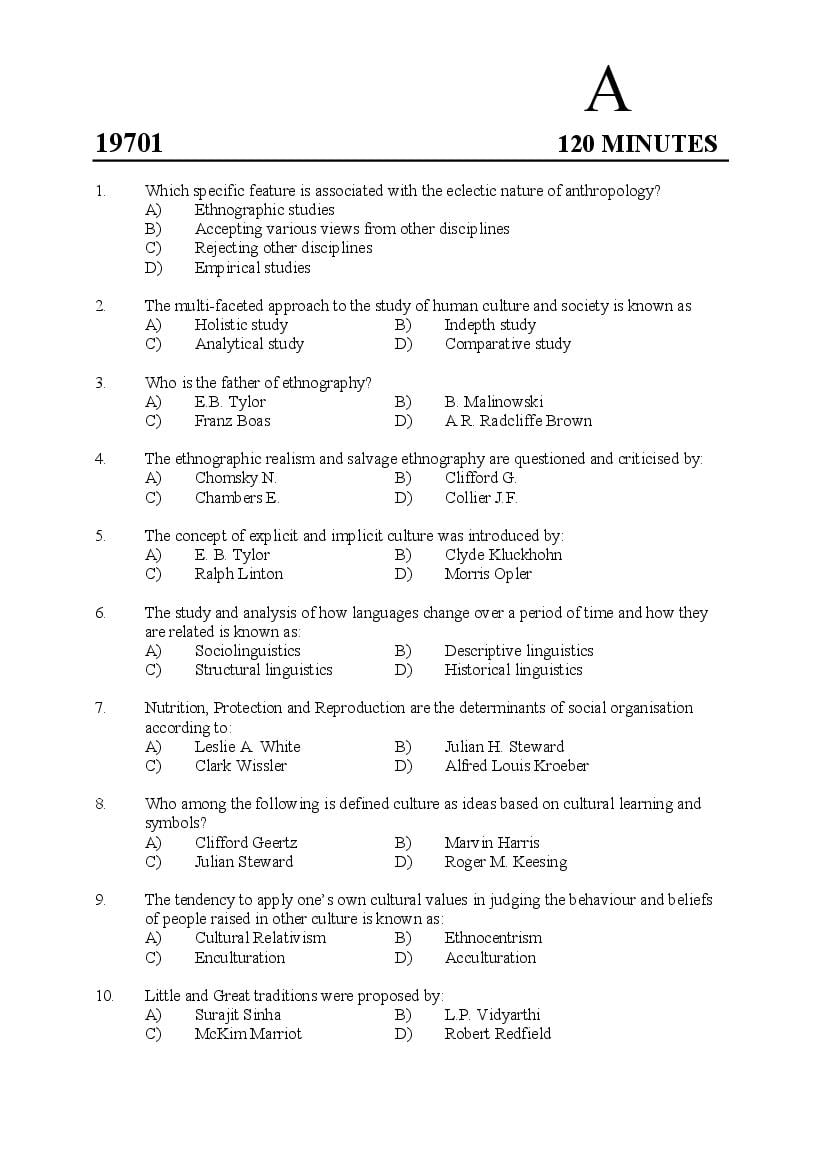
19701 120 MINUTES
1. Which specific feature is associated with the eclectic nature of anthropology?
A) Ethnographic studies
B) Accepting various views from other disciplines
C) Rejecting other disciplines
D) Empirical studies
2. The multi-faceted approach to the study of human culture and society is known as
A) Holistic study B) Indepth study
C) Analytical study D) Comparative study
3. Who is the father of ethnography?
A) E.B. Tylor B) B. Malinowski
C) Franz Boas D) A.R. Radcliffe Brown
4. The ethnographic realism and salvage ethnography are questioned and criticised by:
A) Chomsky N. B) Clifford G.
C) Chambers E. D) Collier J.F.
5. The concept of explicit and implicit culture was introduced by:
A) E. B. Tylor B) Clyde Kluckhohn
C) Ralph Linton D) Morris Opler
6. The study and analysis of how languages change over a period of time and how they
are related is known as:
A) Sociolinguistics B) Descriptive linguistics
C) Structural linguistics D) Historical linguistics
7. Nutrition, Protection and Reproduction are the determinants of social organisation
according to:
A) Leslie A. White B) Julian H. Steward
C) Clark Wissler D) Alfred Louis Kroeber
8. Who among the following is defined culture as ideas based on cultural learning and
symbols?
A) Clifford Geertz B) Marvin Harris
C) Julian Steward D) Roger M. Keesing
9. The tendency to apply one’s own cultural values in judging the behaviour and beliefs
of people raised in other culture is known as:
A) Cultural Relativism B) Ethnocentrism
C) Enculturation D) Acculturation
10. Little and Great traditions were proposed by:
A) Surajit Sinha B) L.P. Vidyarthi
C) McKim Marriot D) Robert Redfield
Page 2
A) Sororate B) Levirate
C) Both Sororate and Levirate D) None of these
12. The husbands of a woman are brothers in
A) Fraternal polyandry
B) Nonfraternal Polyandry
C) In fraternal and Nonfraternal Polyandry
D) None of these
13. Find out the correct answer sequences for the descriptions provided from 1 to 4:
1. The son stays and the daughter leaves and so that the married couple lives
with or near the husband’s parents.
2. Either the son or the daughter leaves and so that the married couple lives with
or near either the wife’s or the husband’s parents.
3. The daughter stays and the son leaves and so that the married couple lives with
or near the wife’s parents.
4. Both son and daughter normally leave, but the son and his wife settle with or
near his mother’s brother.
A) Patrilocal – Matrilocal – Bilocal – Avunculocal
B) Patrilocal – Bilocal – Matrilocal – Avunculocal
C) Matrilocal- Bilocal – Avunculocal – Patrilocal
D) Bilocal – Patrilocal – Avunculocal – Matrilocal
14. The Iroquois system of kinship terminology was identified by:
A) G.P. Murdock B) W.H.R. Rivers
C) L.H. Morgan D) Leslie A. White
15. The analogy of organism to construe social structure was put forward by:
A) B. Malinowski B) Radcliffe Brown
C) Raymond Firth D) Claude Levi Strauss
16. Omaha system of kinship terminology is based on:
A) With patrilineal descent B) With matrilineal descent
C) With bilateral kindred D) With unilineal descent
17. Most of the Chiefdoms are characterised by:
A) Less populated
B) Densely populated
C) Both less populated and densely populated
D) None of the above
18. The term nomadic community is derived from:
A) Hunting gathering communities
B) Fishing communities
C) Pastoral communities
D) Shifting cultivation communities
2
Page 3
A) Nomadic movement of communities
B) Regular cyclic movement of nomadic communities
C) Irregular movement of nomadic communities
D) Occasional movement of nomadic communities
20. The first full-length study of a peasant community using modern anthropological
research methods was conducted by:
A) Raymond Firth B) Robert Redfield
C) Raymond Dart D) Robert Lynton
21. The book entitled ‘The Origin of Species’, written by Charles Darwin, was published in:
A) 1869 B) 1859 C) 1879 D) 1889
22. A change in the molecular structure or DNA code of a gene is called:
A) Mitosis B) Meiosis
C) Mutation D) Cell division
23. Which among the following is the correct answer for Orthogenesis?
A) Successive members of an evolutionary series become increasingly modified in
a single undeviating direction
B) Successive members of an evolutionary series become not increasingly
modified in a single undeviating direction
C) Successive members of an evolutionary series become modified in multiple
direction
D) Successive members of an evolutionary series become modified in single
deviating direction
24. The presence of epicanthic fold is considered as a racial feature of ----.
A) Dravidian B) Aryan
C) Proto Australoid D) Mongoloid
25. Who discovered Australopithecus?
A) Raymond A. Dart B) Robert M. Yerkes
C) Adolph Schultz D) Earnest Hooton
26. Who discovered Homo habilis from Olduvai Gorge?
A) Louis Leakey B) Clark Howell
C) Kelley E.A. D) A. Montagu
27. The ABO blood system was identified by:
A) Charles Darwin B) Karl Landsteiner
C) Gregor Mendel D) Lamark
28. The Rh system of blood was developed in ----.
A) 1910 B) 1920 C) 1930 D) 1940
29. In which among the following period the Anthropoids originated?
A) Pliocene B) Miocene C) Oligocene D) Eocene
3
Page 4
A) Primatology B) Paleoanthropology
C) Physical Anthropology D) Palaeontology
31. Match the following:
List I List II
1. Palaeolithic a. Savegery
2. Neolithic b. Higher Barbarism
3. Copper Age c. Babarism
4. Early Bronze Age d. Civilization
A) 1-a, 2-c, 3-b, 4-d B) 1-b, 2-a, 3-c, 4-d
C) 1-b, 2-c, 3-d, 4-a D) 1-a, 2-b, 3-d, 4-c
32. The average cranial capacity of human is -----.
A) 1025 cm3 B) 1925 cm3 C) 935 cm3 D) 1325 cm3
33. Java Man belongs to the genus and species:
A) Homo erectus B) Homo habilis
C) Homo sapiens D) None of the above
34. The bones Radius and Ulna are located on:
A) Fore arm B) Upper arm C) Lower limbs D) Upper limbs
35. In a cell, which among the following component is responsible for the production of
energy?
A) Cytoplasm B) Cell membrane
C) Nucleus D) Mitochondria
36. Read the following statements and choose the correct options.
1. The movement of genes from one population to another is called gene flow.
2. The random factor in evolution is called genetic drift.
A) 1 and 2 are correct.
B) 1 and 2 are incorrect.
C) 1 is correct and 2 is incorrect.
D) 1 is incorrect and 2 is correct.
37. Match the following:
List I List II
1. Claude Levi Strauss a. Primitive Polynesian Economy
2. B. Malinowski b. The Social organization of Australian Tribes
3. A R Radcliffe Brown c. Crime and custom in savage society
4. Raymond Firth d. Savage Mind
A) 1-c, 2-d, 3-a, 4-b B) 1-c, 2-d, 3-b, 4-a
C) 1-d, 2-c, 3-b, 4-a D) 1-b, 2-d, 3-c, 4-a
38. Anatomically, the modern forms of Homo sapiens were first evolved in:
A) Asia B) Africa C) Europe D) America
4
Page 5
A) Charles Darwin B) Charles Lyell
C) Lamarck D) Thomas Malthus
40. Binomial nomenclature was introduced by:
A) Erasmus Darwin B) Carolus Linnaeus
C) Comte de Buffon D) John Ray
41. The concepts of Ethos and Eidos of culture was proposed by:
A) Robert Redfield B) A.L. Kroeber
C) Morris Opler D) Ralph Linton
42. An example for Religion Theory of civilization’s emergence:
A) Tikal B) Mesopotamia
C) Egypt D) Harappa
43. The theory, Tribe-Caste Continuum was proposed by:
A) L.P. Vidyarthi B) McKim Marriot
C) Surajit Sinha D) M.N. Srinivas
44. The Sadhu Jana Paripalana Sangham was founded for the social and economic
advancement of the Pulayas in:
A) 1903 B) 1907 C) 1914 D) 1915
45. The dance form Kuchupudi originated in ----.
A) Kerala B) Andhra Pradesh
C) Karnataka D) Tamil Nadu
46. Which among the following is the numerically dominant tribal group of Kerala?
A) Kurichiyas B) Muthuvan C) Paniyas D) Mannan
47. Which among the following is not a Particularly Vulnerable Tribal Group (PVTG) of
Kerala?
A) Koragas B) Cholanaickan
C) Kattunaickan D) Irulas
48. Match the following:
List I List II
1. Kwakitul a. Evans Pritchard
2. Samoa b. W H R Rivers
3. Papuans c. Franz Boas
4. Nuer d. Margaret Mead
A) 1-c, 2-d, 3-b, 4-a B) 1-a, 2-d, 3-c, 4-b
C) 1-b, 2-a, 3-d, 4-c D) 1-d, 2-b, 3-a, 4-c
49. The theory of Sanskritisation was developed through the book:
A) Social Change in Modern India
B) Remembered Village
C) Religion and Society among the Coorgs of South India
D) The Dominant Caste and Other Essays
5
Page 6
1. The process of modernisation is considered as an antonym of tradition.
2. Modernisation has not been conceived as a transition from the pre-industrial to
the industrial social system.
A) 1 and 2 are correct.
B) 1 and 2 are incorrect.
C) 1 is correct and 2 is incorrect.
D) 1 is incorrect and 2 is correct.
51. The evolution of family through 15 stages were proposed by
A) Marvin Harris B) L.H. Morgan
C) W.H.R. Rivers D) George Murdock
52. Read the following statements and choose the correct options.
1. The downward devolution of great tradition to little tradition is Parochialisation
2. The upward movement of little tradition to great tradition is not Pariacholisation
A) 1 and 2 are correct.
B) 1 and 2 are incorrect.
C) 1 is correct and 2 is incorrect.
D) 1 is incorrect and 2 is correct.
53. Find out the correct sequence of Folk -Urban Continuum:
A) Merida–Tusik – Dzitas – Chan Kom
B) Merida – Chan Kom – Dzitas – Tusik
C) Merida – Dzitas – Tusik – Chan Kom
D) Merida– Dzitas – Chan Kom – Tusik
54. Non Formal Education has become a full-fledged scheme of education since:
A) National Policy on Education (1968)
B) National Policy on Education (1986)
C) National Policy on Education (1992)
D) National Policy on Education (2016)
55. How many scheduled languages are there in India?
A) 20 B) 22 C) 18 D) 24
56. L.P. Vidyarthi introduced the concept Nature-Man- Spirit Complex based on his study on:
A) Melar B) Santhal C) Ghonds D) Mundas
57. In Kerala, the Police firing on Muthanga tribal agitation occurred in-----.
A) 1991 B) 1996 C) 2003 D) 2006
58. The process of uniting the sub-castes of a major caste is known as:
A) Caste Fission B) Caste Mobility
C) Caste Fusion D) Intermixing of castes
59. Indo-European family of language belongs to----.
A) Austro-Asiatic B) Aryan
C) Dravidian D) Semito-Hamitic
6
Page 7
studies” is marked with the publication of:
A) Ananda Krishna Iyer B) A. Aiyappan
C) Sir. Henry Sumnar Maine D) Edgar Thurston
61. The functional approach to the study of culture of a given time is referred to as:
A) Diachronic study
B) Synchronic study
C) Both diachronic and synchronic study
D) None of the above
62. Match the following:
List I List II
1. Egyptologist a. Structuralism
2. Cultural Materialism b. American Distributionism
3. Cultural Core c. Infrastructure, Structure, Superstructure
4. Binary oppositions d. British Diffusionism
A) 1-d, 2-c, 3-b, 4-a B) 1-b, 2-c, 3-d, 4-a
C) 1-d, 2-b, 3-a, 4-c D) 1-c, 2-a, 3-b, 4-d
63. Who among the following introduced Genealogical method?
A) G.E. Smith B) W.J. Perry C) L.A. White D) W.H.R. Rivers
64. The terms emic and etic were coined by:
A) Franz Boas B) Kenneth Pike
C) Edward Sapir D) Marvin Harris
65. Who among the following is widely credited for developing participant observation as
a serious method of social research?
A) Malinowski B) Radcliffe Brown
C) Raymond Firth D) Goldberg
66. Who among the following is the advocate of Participatory Rural Appraisal (PRA)?
A) James Blair B) Robert Chambers
C) Clifford Geertz D) Leslie A. White
67. The systematic study of semantic domain is called:
A) Componential analysis B) Comparative analysis
C) Systematic analysis D) Semantic analysis
68. The discovery of the meaning of texts through constant interpretation and
reinterpretation is -----.
A) Phenomenology
B) Hermeneutics
C) Both Hermeneutics and Phenomenology
D) None of these
7
Page 8
1. Validity refers to the accuracy of data and findings in a research.
2. Reliability refers to the variations in accuracy of a research.
A) 1 and 2 are correct.
B) 1 and 2 are incorrect.
C) 1 is correct and 2 is incorrect.
D) 1 is incorrect and 2 is correct.
70. The method used by Ruth Benedict to study the Japanese culture:
A) Participant Observation B) Study of culture at a distance
C) Intensive fieldwork D) Use of questionnaires
71. Why is the literature review essential for a research?
A) It helps to give a research problem
B) It analyses a research area
C) It helps to identify gaps in research
D) It analyses various literature
72. What is Haphazard Sampling?
A) Convenience Sampling B) Purposive Sampling
C) Quota Sampling D) Stratified Random Sampling
73. Who among the following was called as an arm chair scholar?
A) J.J. Bachofen B) James Frazer
C) R.R. Marret D) Henry Maine
74. The content analysis method was used by:
A) Margaret Mead B) B. Malinowski
C) Ruth Benedict D) Robert Redfield
75. The Kula system was studied in detail by:
A) Radcliffe Brown B) C.G. Seligman
C) W.H.R. Rivers D) B. Malinowski
76. The book ‘Structure and Function in Primitive Society’ was written by:
A) Radcliffe Brown B) B. Malinowski
C) Robert Redfield D) Raymond Firth
77. The relevance of myth and its analysis was extensively done by:
A) James Frazer B) Margaret Mead
C) Franz Boas D) Claude Levi Strauss
78. Trait list approach was used during ----,
A) Cultural Evolution B) Cultural Diffusion
C) Cultural Change D) Cultural Materialism
79. The cultural theory and psychological theory are used in ---- concept to explain how
human beings embody the culture.
A) Patterns of culture B) National Character
C) Cultural Character D) Model Personality
8
Page 9
List I List II
1. Jarawas a. Andhra Pradesh
2. Kadars b. Jharkhand
3. Oraon c. Kerala
4. Chenchus d. Andaman Islands
A) 1-d, 2-b, 3-c, 4-a B) 1-d, 2-a, 3-c, 4-b
C) 1-d, 2-c, 3-a, 4-b D) 1-d, 2-c, 3-b, 4-a
81. People encounter the environment with their cultures and wherein the environment is
passive in shaping cultures, which is theorized as:
A) Environmental Determinism
B) Cultural Ecology
C) Environmental Possibilism
D) Ethnoecology
82. Read the following statements and choose the correct options:
1. Biological anthropology is a scientific discipline related to the biological
aspects of human beings, their extinct hominid ancestors particularly from an
evolutionary perspective.
2. Biological anthropology does not focus on non-human primates.
A) 1 and 2 are correct
B) 1 and 2 are incorrect
C) 1 is correct and 2 is incorrect
D) 1 is incorrect and 2 is correct
83. The concept of culture area is associated with:
A) British Diffusion B) German Diffusion
C) Continental Diffusion D) American Diffusion
84. The Age and Area concept was proposed by:
A) A.L. Kroeber B) Clark Wissler
C) Julian Steward D) Fritz Graebner
85. The book entitled ‘A Scientific Theory of Culture’ was written by:
A) A.R. Radcliffe Brown B) A.L. Kroeber
C) Ruth Benedict D) B. Malinowski
86. The ethical standpoint of Cultural Relativism was proposed by:
A) Franz Boas B) Ruth Benedict
C) Margaret Mead D) A.L. Kroeber
87. The first full-length study on a peasant community using modern anthropological
research was carried out by:
A) Surajit Sinha B) L.P. Vidyarthi
C) McKim Marriot D) Robert Redfield
9
Page 10
A) James Frazer B) Karl Bucher
C) Seligman D) David Masson
89. The concept of survival was introduced by:
A) A.L. Kroeber B) Marvin Harris
C) Herbert Spencer D) L.H. Morgan
90. The two theoretical models, the actual social structure and the general social structure
were proposed by:
A) Claude Levi Strauss B) A.R. Radcliffe Brown
C) Evans-Pritchard D) Alfred Louis Kroeber
91. The Apollonian and Dionysian view on culture was applied by:
A) Ruth Benedict B) Margaret Mead
C) Franz Boas D) Clark Wissler
92. The book ‘The Sex and Temperament in Three Primitive Societies’ was written by:
A) Ralph Linton B) Cora-Du-Bois
C) A. Kardiner D) Margaret Mead
93. A distinct method that aims to understand how members of other cultures perceive and
interact with their own filter of cognition:
A) Ethnography B) Ethnology
C) New Ethnography D) None of the above
94. Who among the following is known as an Egyptologist?
A) William James Perry B) Grafton Elliot Smith
C) Friedrich Ratzel D) Fritz Graebner
95. Binary opposition is related to
A) Structuralism B) Post Structuralism
C) Ethnoscience D) New Ethnography
96. The archaeological periods are correlated with the cultural development in
demonstrating the cultural evolution in a new pattern by
A) Julian H. Steward B) V. Gordon Childe
C) Franz Boas D) Melville J. Herskovits
97. Author of the book ‘Development Anthropology’:
A) Jean Pierrie Oliver de Sardan
B) Riall W. Nolan
C) David Lewis and Kathy Gardner
D) Arturo Escobar
10
Page 11
1. The inclusion of disadvantaged and marginalized groups has been a central
element throughout the history of anthropological approaches to development.
2. The above focus of Development anthropology is shared with other fields such
as gender studies and political economy, where researchers also noted that
large, institutionally-driven development initiatives were controlled by elites
and did not trickle down to reach those on the margins.
A) 1 and 2 are correct.
B) 1 and 2 are incorrect.
C) 1 is correct and 2 is incorrect.
D) 1 is incorrect and 2 is correct.
99. Who among the following is best known for developing a form of semiotic analysis known
as deconstruction?
A) Carl Jung B) Michael Foucault
C) Clifford Geertz D) Jacques Derrida
100. What is the meaning of dogmatic principles of classical evolutionists?
A) Continuous progression
B) Step by step progression
C) Both continuous and step by step progression
D) None of the above
101. The term ‘cultural ecology’ was coined by:
A) Clark Wissler B) Roy A. Rappaport
C) Julian Steward D) Andrew P. Vayda
102. In terms of the Ecological Anthropological theory, the environment is active in
shaping cultures and it is referred to as:
A) Environmental possibilism B) Environmental determinism
C) Ecosystem D) Ecological Niche
103. The cross-cultural study of how people perceive and manipulates their environment
come under:
A) Ethno ecology B) Cultural ecology
C) Population ecology D) Systems ecology
104. The co-existence of different medical practices within a society is called:
A) Medical Anthropology B) Ethno medicine
C) Medical pluralism D) Different medical systems
105. Malinowski turned into an anthropologist as he became inspired by reading the
literature of:
A) E. B. Tylor B) James Frazer
C) L.H. Morgan D) W.H.R. Rivers
106. Epidemiology is an area of:
A) Forensic anthropology B) Cultural anthropology
C) Biological anthropology D) Medical anthropology
11
Page 12
1. Medical anthropologists examine how the health of individuals, larger social
formations, and the environment are affected by interrelationships between
humans and other species
2. Medical anthropologists do not examine the cultural norms and social
institutions.
A) 1 and 2 are correct.
B) 1 and 2 are incorrect.
C) 1 is correct and 2 is incorrect.
D) 1 is incorrect and 2 is correct.
108. The sub-discipline economic anthropology was well developed with the studies of:
A) A.R. Radcliffe Brown B) Karl Marx
C) Melville J. Herskovits D) B. Malinowski
109. The opposition between substantivist and formalist economic models was first
proposed by:
A) B. Malinowski B) Karl Polanyi
C) M.J. Herskovits D) Paul Bohannan
110. The tribe permitted for hunting in India even today:
A) Kadars B) Yanadi C) Jarawas D) Khonds
111. Among which of the following tribe, the female infanticide were practised?
A) Irula B) Badaga C) Kota D) Toda
112. What is Swidden cultivation?
A) Terrace cultivation B) Slash and burn cultivation
C) Settled cultivation D) Occasional cultivation
113. Which among the following tribal community is well known for their agricultural
practise?
A) Paniyas B) Cholanaickans
C) Kurumbas D) Kurichiyas
114. The book ‘The Division of Labour in a Society’ was written by:
A) E. Durkheim B) H. Spencer C) A. Smith D) M. Mead
115. The concept culture climax was proposed by:
A) Clark Wissler B) A.L. Kroeber
C) Andrew P. Vaidya D) Leslie A. White
116. Which among the following is considered as the earliest stages of human cultural
evolution?
A) Fishing B) Herding C) Hunting D) Cultivating
117. The pastoral community Nuer was studied by:
A) Margaret Mead B) Evans Pritchard
C) Beals and Hoijer D) Leslie A. White
12
Page 13
involved in exploiting environment is related to:
A) Ecological Niche B) System ecology
C) Cultural ecology D) Population ecology
119. The first extended application of the concept of Gift Exchange was made in
anthropology by:
A) B. Malinowski B) Marcel Mauss
C) Raymond Firth D) Emile Durkheim
120. The Jajmani system of Rampur village in Delhi was studied by:
A) Oscar Lewis B) N.S. Reddy
C) William Wiser D) S.C. Dube
_____________________
13
Document Details
| Board / Org | Kerala Exams |
| Exam | Kerala SET |
| Type | Question Paper |
| Pages | 13 |
| Updated | 23 Oct 2026 |