Kerala SET 2019 Jul Question Paper _3_
Finished viewing? Save it for later —
Download Kerala SET 2019 Jul Question Paper _3_ (PDF · 16 pages)About Kerala SET 2019 Jul Question Paper _3_
Kerala SET 2019 Jul Question Paper _3_ is available here for free download. Published by Kerala Exams for Kerala SET, this question paper can be viewed online or downloaded as a PDF (16 pages). Candidates preparing for Kerala SET can use Kerala SET 2019 Jul Question Paper _3_ to understand the exam pattern, the type of questions asked, and the overall difficulty level.
Frequently Asked Questions
How can I download Kerala SET 2019 Jul Question Paper _3_?
Open this page and click the Download button to save Kerala SET 2019 Jul Question Paper _3_ as a PDF. It is completely free on AglaSem Docs.
Is Kerala SET 2019 Jul Question Paper _3_ free to download?
Yes. Kerala SET 2019 Jul Question Paper _3_ can be viewed online and downloaded as a PDF free of cost on AglaSem Docs.
How many pages does Kerala SET 2019 Jul Question Paper _3_ have?
Kerala SET 2019 Jul Question Paper _3_ contains 16 pages, which you can read online or download together as a single PDF.
Where can I find more Kerala SET study material?
You can find more Kerala SET question papers, sample papers, syllabus, and answer keys on AglaSem Docs.
Kerala SET 2019 Jul Question Paper _3_ – Text
Read the full text of this question paper below — useful to quickly search, copy and reference the content online without downloading the PDF.
📄 View text version (16 pages)
Page 1
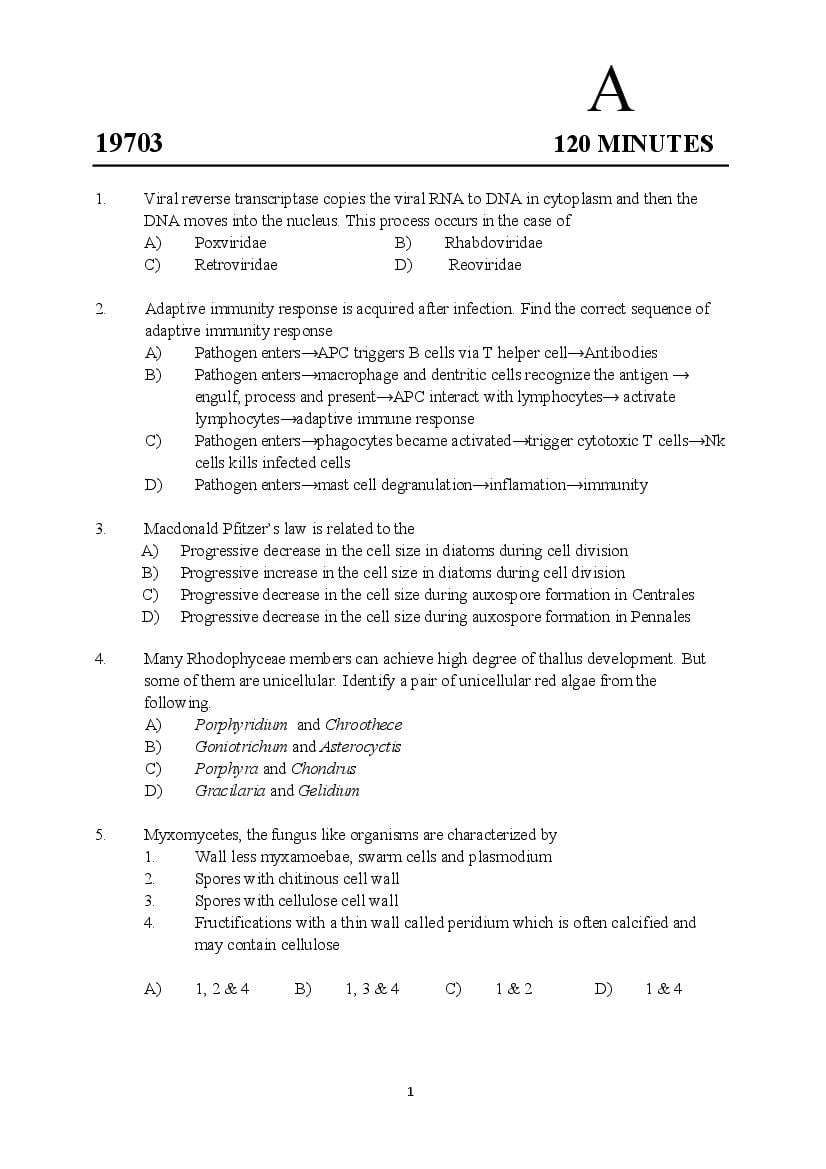
19703 120 MINUTES
1. Viral reverse transcriptase copies the viral RNA to DNA in cytoplasm and then the
DNA moves into the nucleus. This process occurs in the case of
A) Poxviridae B) Rhabdoviridae
C) Retroviridae D) Reoviridae
2. Adaptive immunity response is acquired after infection. Find the correct sequence of
adaptive immunity response
A) Pathogen enters→APC triggers B cells via T helper cell→Antibodies
B) Pathogen enters→macrophage and dentritic cells recognize the antigen →
engulf, process and present→APC interact with lymphocytes→ activate
lymphocytes→adaptive immune response
C) Pathogen enters→phagocytes became activated→trigger cytotoxic T cells→Nk
cells kills infected cells
D) Pathogen enters→mast cell degranulation→inflamation→immunity
3. Macdonald Pfitzer’s law is related to the
A) Progressive decrease in the cell size in diatoms during cell division
B) Progressive increase in the cell size in diatoms during cell division
C) Progressive decrease in the cell size during auxospore formation in Centrales
D) Progressive decrease in the cell size during auxospore formation in Pennales
4. Many Rhodophyceae members can achieve high degree of thallus development. But
some of them are unicellular. Identify a pair of unicellular red algae from the
following.
A) Porphyridium and Chroothece
B) Goniotrichum and Asterocyctis
C) Porphyra and Chondrus
D) Gracilaria and Gelidium
5. Myxomycetes, the fungus like organisms are characterized by
1. Wall less myxamoebae, swarm cells and plasmodium
2. Spores with chitinous cell wall
3. Spores with cellulose cell wall
4. Fructifications with a thin wall called peridium which is often calcified and
may contain cellulose
A) 1, 2 & 4 B) 1, 3 & 4 C) 1&2 D) 1&4
1
Page 2
List I List II
a. Agaricus bisporous 1. Puff ball
b. Amanita phalloides 2. Death cap
c. Lycoperdon sps. 3. Oyster mushroom
d. Pleurotus sajor-caju 4. Button mushroom
A) a- 1 b-2 c-3 d-4 B) a- 4 b-2 c-3 d-1
C) a-4 b-2 c-1 d-3 D) a -3 b-4 c-2 d-1
7. Cyphellae, Cephalodia, Isidia and Soredia are certain specialized structures associated
with thalli of:
A) Certain Algae B) Some Fungi
C) Lichens D) Certain Bryophytes
8. The spore dispersal mechanism of Funaria?
A) Pseudo elaters B) elaters
C) Peristomial teeth D) No special mechanism
9. Which among the following is a pteridophyte without the differentiation into true
leaves and roots?
A) Azolla B) Marselia
C) Lepidodendron D) Rhynia
10. Which of the following stelar types in Pteridophytes has leaf traces?
A) Protostele B) Siphonostele C) Dictyostele D) Both B and C
11. Which one of the following Gymnosperms is a profusely branching shrub?
A) Ginkgo biloba B) Ephedra distachya
C) Gnetum gnemon D) Welwitschia mirabilis
12. The general pollination mechanism in gymnosperms is:
A) Entomophily B) Anemophily C) Malacophily D) Chiropteriphily
13. The plant genus of Samara fruit type is:
A) Acacia B) Capsella C) Dioscorea D) Calotropis
14. Rule of priority of ICBN states that
A) The earliest applicable, properly published name is the correct one
B) Botanical nomenclature is independent of zoological nomenclature
C) Scientific names of taxonomic groups are treated as Latin regardless of their
derivation
D) The application of names of taxonomic groups is determined by means of
nomenclatural types
2
Page 3
A) Dianthus B) Dorstenia C) Poinsettia D) Ficus
16. Match the following:
List I List II
a. Nymphaeaceae 1. pollinia
b. Brassicaceae 2. trifid style
c Dipterocarpaceae 3. laminar stamen
d. Asclepiadaceae 4. siliqua
A) a- 3 b-1 c-4 d-2 B) a- 4 b-2 c-3 d-1
C) a-4 b-2 c-1 d-3 D) a-3 b-4 c-2 d-1
17. Head office of NBPGR is at:
A) New Delhi B) Mumbai C) Kolkata D) Chennai
18. Indigo is obtained from several species of Indigofera. In the plant the dye occurs as a
colourless glycoside in the
A) seeds B) fruit C) leaves D) bark
19. Investigating plants used by societies in various parts of the world is known as
Ethnobotany. The father of ethnobotany is
A) Richard Evans Schultes B) Jacques Cartier
C) Frank Cushing D) John William Harshberger
20. Match the following
List I List II
a. Heart wood 1. Gymnosperms
b. Hard wood 2. Recently formed wood
c Sapwood 3. Angiosperms
d. Soft wood 4. Tyloses
A) a-3 b-1 c-4 d-2 B) a- 4 b-2 c-3 d-1
C) a-4 b-2 c-1 d-3 D) a-4 b-3 c-2 d-1
21. Many amphivasal vascular bundles are distributed in the ground tissue after the
anomalous secondary thickening in the stem of
A) Dracaena B) Boerhaavia C) Bignonia D) Mirabilis
22. Fumaria type, Cucurbita type, Lathyrus type and Anemarrhena type are related to
A) Nodal anatomy B) Root-stem transition
C) Floral anatomy D) Anomalous secondary thickening
3
Page 4
List I List II
a. Rotary microtome 1. diamond knife
b. Sledge microtome 2. for cutting frozen samples
c Cryotome 3. serial sections of paraffin embedded materials
d. Ultratome 4. to take sections of wood and hard materials
A) a- 3 b-1 c-4 d-2 B) a- 4 b-2 c-3 d-1
C) a-3 b-4 c-2 d-1 D) a-4 b-3 c-2 d-1
24. A technique that uses the process of sublimation to change a solvent in frozen state
directly to vapour state
i. Cryosurgery & cryometry
ii. Freeze drying
iii. Lyophilization
A) i only B) ii only C) ii & iii only D) i & iii only
25. Which is the correct explanation for the binding of Coomassie Brilliant Blue to
proteins?
A) It binds to proteins through ionic interactions between sulfonic acid groups and
positive protein amine groups through Van der Waals attractions.
B) It binds to proteins through ionic interactions with peptide bonds
C) It binds to proteins through Van der Waals attractions between sulfonic acid
groups and through ionic interactions to positive protein amine groups..
D) None of the above
26. Identify the non recurrent type of apomixis from the following
A) Adventive embryony B) Diplospory
C) Apospory D) Parthenogenesis
27 Sporopollenin is the major component of
A) Exine of pollen grains B) Intine of pollen grains
C) Pollenkitt D) Prokaryotic spores
28. Which of the following is not true about embryo rescue?
A) It is used to assist in the development of plant embryos that might not survive to
become viable plants
B) Embryo rescue was first done by Guha and Maheswary
C) The most widely used embryo rescue procedure is embryo culture
D) It allows the development of many intergeneric hybrids
4
Page 5
and Photosystem II in plants is known as
A) Core complex B) F0- F1 complex
C) Rieske center D) Quantasomes
30. In which of the following subtype/s of C4 photosynthesis the oxaloacetate formed is
reduced in the chloroplast to produce malate?
A) NADP- malic enzyme type B) NAD- malic enzyme type
C) PCK type D) Both A and B
31. The cation channels called shaker channels (K+ channels) in Arabidopsis is an example for
A) Water channels B) Voltage- gated channels
C) Electrogenic pumps D) Electroneutral pumps
32. Which of the following regarding apoplastic phloem loading is not correct?
A) Sucrose moves from a mesophyll cell into the cell wall adjoining a companion cell
B) Companion cells are with wall ingrowths
C) Sucrose is transported by a sucrose-proton symporter into the companion cell
D) From the companion cells sucrose diffuses through branched plasmodesmata
into the sieve tube.
33. Find the correct statement with respect to the nitrogenase enzyme in biological
nitrogen fixation
A) Component I of the enzyme is an Fe-protein(nitrogenase reductase)
B) Component II of the enzyme is a Mo-Fe protein (nitrogenase)
C) The enzyme is located in the cortical cells of the host plant in symbiotic
nitrogen fixation
D) During enzyme activity the electron flow is from Fd component II
component IN2 NH3
34. GS-GOGAT pathway in plants is associated with
A) Transport of the amides- glutamine and asparagine from the roots
B) Symbiotic nitrogen fixation
C) Fixation of ammonia
D) Conversion of nitrates to nitrites
35. Glycolate from photorespiration is the precursor for the formation of the amino acids
A) Glycine and serine B) Glutamine and arginine
C) Asparagine and glutamine D) Glycine and glutamine
36. The enzyme associated with cyanide insensitive respiration:
A) Succnic dehydrogenase B) Malate dehydrogenase
C) Pyruvate dehydrogenase D) External NAD (P)H dehydrogenase
5
Page 6
A) collapse of cell wall due to drying
B) Breakage of water columns under tension within the xylem
C) Membrane and protein destabilization
D) Ion toxicity
38. The photoreceptor protein which regulates high fluence blue light mediated hypocotyl
and stem elongation, anthocyanin biosynthesis, stomatal opening, chloroplast
movement and regulation of flowering time is:
A) Phytochrome A B) Phytochrome B
C) Cryptochrome D) Phototropin
39. Synthesis of the aromatic amino acids Phenyl alanine, Tyrosine and Tryptophan occurs
through:
A) Terpenoid pathway B) Malonic acid pathway
C) Shikimate pathway D) Isoprenoid pathway
40. The Acid Growth hypothesis proposed by Rayle and Cleland (1970) and Hager,
Menzel and Cross (1971) explains the mechanism of action of:
A) Auxins B) Gibberrellins C) Cytokinins D) Abscisic acid
41. The reducing equivalents (NADPH) for the fixation of ammonia in roots are supplied by
oxidation of carbohydrates through -------pathway.
A) Glycolysis B) Citric acid cycle
C) Cyanide resistant respiration D) Oxidative pentose phosphate pathway
42. The Proton gradient in mitochondria develops across the ----.
A) Matrix B) Inner membrane
C) Inter membrane space D) Outer membrane
43. Identify the simplest and most widely used method to determine the amount of protein
or nucleic acid in a given solution:
A) Spectrophotometry B) Gas liquid chromatography
C) Nuclear magnetic resonance D) Mass spectroscopy
44. Match the following phytohormones in List I with their physiological functions in List II
List I List II
a. Auxins 1. Stomatal closing during water stress
b. Gibberellins 2. Counteraction of apical dominance
c. Cytokinins 3. Root initiation
d. Abscisic acid 4. Stem elongation
A) a-1, b-3, c-2, d-4 B) a-1,b-3, c-4, d-2
C) a-3, b-1, c-2, d-4 D) a-3,b-4, c-2, d-1
6
Page 7
A) The CO2 acceptor is a five carbon aldo compound
B) The first stable compound is 3-PGA
C) Photorespiration high
D) Eighteen ATP molecules utilized for the synthesis of one molecule of glucose
46. Rice is an example for a short day plant. Read the following statements regarding
flowering in rice and point out the correct ones:
I) In rice the genes Heading- date1and Heading- date 3a control flowering
II) Rice plant flowers when the night exposure is 8- 10 hrs
III) The inhibition of flowering in rice is under the control of photo conversion
of phytochrome from Pr to Pfr on exposure to red light
IV) A subsequent exposure to FR light which photo converts the pigment back to
the physiologically inactive Pr form, restores the flowering response
A) I and II only B) I, II and III C) I, III and IV D) III and IV only
47. Yang cycle is specifically associated with the synthesis of:
A) Ethylene from ACC
B) ABA from xanthoxal
C) Methionine from S- adenosyl 5- methyl thioadenosine
D) Gibberellins from isopentenyl pyrophosphate
48. The most abundant transport protein in the plants is:
A) SLAC1 anion transporter associated with guard cells,
B) Triose phosphate-phosphate translocator of chloroplasts
C) Cation-H+ antiporter
D) ZIP metal transporters which mediate uptake of Fe, Mn & Zn ions into plants
49. A specific function of the essential element Potassium is:
A) translocation of carbohydrates
B) oxygen evolution during photosynthesis
C) second messenger in metabolic regulation
D) stomatal movements
50. Identity the genes in Arabidopsis thaliana involved in mutation of floral organs which
convert petals into sepals and stamens into carpels:
A) Apetala 1 and Apetala 2 B) Apetala 3 and Pistillata
C) Apetala 3 and Agamous D) Plena and Farinelli
51. The common measurement unit of water potential is:
A) Pixel B) Pascal C) Pi D) µ mol
7
Page 8
A) Pyramidal B) Tetrahedral
C) Angular or bent D) Linear
53. How many hydrogen bonds are formed by the following DNA sequence?
5’-CGATCCTAAGGTT-3’
A) 16 B) 18 C) 21 D) 32
54. The major precursor for the biosynthesis of glucose in gluconeogenesis is
A) Propionate B) glucogenic amino acids
C) Pyruvate D) malate
55. Which amino acid can adopt phi and psi angles in all four quadrants of the
Ramachandran plot?
A) alanine B) Glycine C) Lysine D) Aspartic acid
56. Identify the Omega- 3 family of fatty acid from the following
A) Linoleic acid B) Gamma –Linoleic acid
C) Arachidonic acid D) Docosahexaenoic acid
57. Match the following
List I List II
a Saturated fatty acid 1 Sterculic acid
b Unsaturated fatty acid 2 13-methyl-tetradecanoate acid
c Branched chain fatty acid 3 Butyric acid
d Cyclic fatty acid 4 Oleic acid
A) a-2, b-3, c-4, d-1 B) a-4, b-3, c-2, d-1
C) a-4, b-3, c-1, d-2 D) a-3, b-4, c-2 d-1
58. What is the final product of purine degradation in mammals?
A) Guanine B) Hypoxamine C) uric acid D) None of these
59. An important feature of Vitamin B1:
A) Sunshine vitamin B) Antibiotic vitamin
C) Antiaging factor D) Antinuritic factor
60. Receptor proteins that detect molecules outside the cell and activate internal signal
transduction pathways and ultimately cellular responses are called ------.
A) Serpentine receptors B) Steroid receptors
C) Adhesion receptors D) Receptor enzymes
61. In competitive inhibition
8
Page 9
B) Km increases Vmax normal
C) Km decreases Vmax normal
D) KM decreases Vmax increases
62. Identify the group which contain Essential amino acids only:
i.valine, leucine, isoleucine, methionine, lysine
ii. Alanine, Proline, Glycine, serine
iii.Glutamine, Aspargine, cysteine, serine, Glycine
iv. leucine, isoleucine, methionine, lysine, phenyl alanine
A) iii, & iv B) ii & iii C) i & iii D) i & iv
63. The proteins destined to be secreted move through the secretory pathway in the
Sequence
A) mitochondria Smooth endoplasmic reticulum Rough endoplasmic
reticulum Golgi cisternae Secretory vesicle Cell surface
B) Smooth endoplasmic reticulum Golgi transport vesicle Golgi cisternae
Secretory vesicle Cell surface
C) Rough endoplasmic reticulum Golgi transport vesicle Golgi Cisternae
Secretory vesicle Cell surface
D) Rough endoplasmic reticulum Golgi Cisternae Golgi transport vesicle
Secretory vesicle Cell surface
64. Many natural resins are used as mounting media for permanent slide preparations.
Select the correct statement related to natural resins:
i. Canada balsam is an oleoresin extracted from the bark of Abiesbalsamea
ii. Canada balsam is soluble in xylene and harden very quickly.
iii. DPX is a natural resin
iv. Canada balsam has a refractive index of 1.54
A) i & iv B) ii & iii C) i & iii D) i & ii
65. Which of the following plant cells undergo programmed cell death to become functional?
A) Root cap cell B) Xylem vessel C) Guard cell D) Sieve tube
66. Which of the following provides morphological evidence of genetic recombination during
meiosis?
A) Synapsis B) Chaismata
C) Terminalization D) Bivalent formation
67. According to the pressure flow hypothesis proposed by Ernst Munch
9
Page 10
A) Transpiration pull B) An osmotically generated pressure gradient
C) pH gradient D) ATP- dependent pressure flow pump
68. Choose the correct sequence of DNA replication
A) Recognition of origin of initiation point→Unwindling double
helix→RNA priming→Synthesis of leading and lagging strand
B) Unwindling double helix→ Recognition of origin of initiation point→ RNA
priming→Synthesis of leading and lagging strand
C) RNA priming→ Unwindling double helix→ Recognition of origin of initiation
point→ synthesis of leading and lagging strand
D) Unwindling double helix→RNA priming→ Recognition of origin
69. The bending movement of cilia and flagella
A) are associated with microtubules and kinesins
B) are produced when dynein motors pull adjacent microtubule doublets past
each other
C) involves dynein action on microfilaments
D) involves myosin action on intermediate filaments
70. Which among the following is not an example of transmembrane transport between
different subcellular compartments?
A) Transport from stroma into thylakoid space
B) Transport from the cytoplasm into the lumen of the endoplasmic reticulum
C) Transport from endoplasmic reticulum into the Golgi complex
D) Transport from mitochondrial inter membrane space into the mitochondrial matrix
71. Balbiani rings occur in
A) Lamp brush chromosomes B) Polytene chromosomes
C) B chromosomes D) Autosomes
72. Which of the following experiments was not involved in identifying DNA as the
genetic material?
A) Luria–Delbruck experiment
B) Experiment of Avery, Macleod and McCarthy
C) Griffith’s experiment
D) Hershey-Chase experiment
73. Find out the characteristic specific to a composite transposon:
A) It can cause sequence changes within a genome by the movement to a new site
B) Its transposition may have direct effects on gene expression
C) It carries markers such as drug resistance in the central region
D) It has inverted terminal repeats
74. What is true about telomerase enzyme?
10
Page 11
B) Telomerase is a ribonucleoprotein enzyme
C) In the absence of telomerase telomeres shorten during each cell division
D) All the above
75. Which of the following is true about RNA polymerases in eukaryotes?
A) RNA polymerase I produces rRNA, RNA polymerase II produces hnRNA and
RNA polymerase III produces tRNA and other small RNAs
B) RNA polymerase I produces rRNA, RNA polymerase II produces and
processes mRNA and RNA polymerase III produces tRNA
C) RNA polymerase I produces rRNA, RNA polymerase II produces hnRNA and
RNA polymerase III produces only tRNA.
D) RNA polymerase I produces mRNA, RNA polymerase II produces tRNA and
RNA polymerase III produces rRNA
76. Which of the following is not a DNA binding protein motif?
A) Copper finger motif B) Helix-turn-helix
C) Helix-loop-helix D) Leucine zippers
77. Which of the following is not a process in the processing of hnRNA?
A) Addition of methylated cap at the 5’ end
B) RNA splicing
C) Polyadenylation of 3’ end
D) Hammerhead formation
78. Identify the correct general features of genetic code:
A) The code is triplet, degenerate, nonoverlapping, commaless, ambiguous and universal
B) The code is triplet, degenerate, nonoverlapping, commaless, non-ambiguous and
universal
C) The code is triplet, non-degenerate, non-overlapping, commaless, ambiguous and
universal
D) The code is triplet, degenerate, overlapping, commaless, non-ambiguous and universal
79. The lac operon has three structural genes z, y and a. Which of the following is not true
about them?
A) Gene lac Z codes for the enzyme β Galactosidase
B) Gene lac Y codes for the enzyme β Galactose permease
C) Gene lac A codes for the enzyme β Galactose transacetylase
D) Gene lac Z codes for the enzyme α Galactosidase
80. In RNA silencing
11
Page 12
B) hnRNA inhibits expression of a gene
C) snRNA inhibits expression of a gene
D) ssRNA inhibits expression of a gene
81. Polydactyly in humans is produced by a dominant gene P. Consider the following
statements and find which is not true.
A) Some heterozygous Pp individuals are not polydactylous
B) In the same person polydactyly is expressed differently in hands and feet
C) Polydactyly has 100% penetrance
D) Polydactyly has variable expressivity
82. Besides monohybrid crosses and dihybrid crosses Mendel performed test crosses also.
A test cross is the:
A) mating of an incompletely known genotype to a genotype which is homozygous
recessive at all the loci under consideration
B) mating of an incompletely known genotype to a genotype which should be
completely homozygous recessive.
C) mating of an incompletely known genotype to a genotype which is completely
homozygous dominant
D) mating of an incompletely known genotype to any one of the parents
83. Map distance between genes a and b is 20 while distance between a and c is 8 map units.
Genes c and b are 12 map units apart. Then which of the following statement is true?
A) Total length of the genetic map is 20 map units
B) Total length of the genetic map is 28 map units
C) The gene sequence is acb
D) A and C are true
84. Gene pool is:
A) The hypothetical pool of all the alleles of all the loci in the gametes produced by
a Mendelian population from which the next generation will arise
B) Pool of all the alleles of all the loci in all the individuals of a species
C) Pool of all the alleles of all the loci in a Mendelian population which are
completely transmitted to the next generation
D) Pool of all the alleles of all the loci in all the individuals of a species which are
transmitted to the next generation
85. A random mating population of 1000 individuals has 960 individuals of dominant
phenotype with respect to a diallelic Mendelian locus with complete dominance. What
is the frequency of the recessive allele of the locus in the population?
A) 0.8 B) 0.4 C) 0.2 D) 0.02
86. Live attenuated vaccines contain:
12
Page 13
B) The killed version of the germ that causes a disease
C) Specific pieces of the germ — like its protein, sugar, or capsid
D) A toxin made by the germ that causes a disease.
87. The mode of energy flow in the eco system is -----.
A) Unidirectional B) Multidirectional
C) Bidirectional D) Circular
88. The correct sequence of Sewage treatment process is:
A) Chlorination→aeration→release into natural waters
B) Particulate settling→aeration→break down of organic
matter→chlorination→reverse osmosis→release into natural water
C) Break down of organic matter→aeration→release into natural waters
D) Chlorination→ break down of organic matter→ aeration→ Particulate
settling→ release into natural waters
89. Identify the ozone-depleting substances (ODSs) from the following:
A) PAN B) SO2
C) Chlorofluro carbon D) None of these
90. Species that occur in different geographical regions separated by barriers are called
A) Allopatric B) Sympatric C) Peripatric D) Sibling
91. Author of Ecology, Community and Lifestyle:
A) Aldo Leopold B) Rachel Carson
C) James Lovelock D) Arne Naess
92. Which of the following methods is most efficient in converting polluted water into
drinking water?
A) Bioremediation B) Reverse osmosis
C) Osmosis D) Chlorination
93. Identify the bio indicator of SO2 pollution from the following:
A) Orchids B) Water hyacinth
C) Lichen D) Aloe vera
94. What is meant by alpha diversity?
A) The diversity within a particular area or ecosystem
B) A comparison of diversity between ecosystems
C) Geographic-scale species diversity
D) Global species diversity
95. Which of the following radioactive isotope can cause bone cancer?
A) Cobalt-60 B) Radium-226
C) Thorium-232 D) Strontium-90
13
Page 14
Trade in Endangered Species of Wild Fauna and Flora)?
A) CITES is an international agreement between governments
B) CITES was drafted as a result of a resolution adopted in 1963 at a meeting of
members of IUCN
C) On 1 July 1975 CITES entered in force
D) CITES has been among the conservation agreements with the lowest
membership
97. Which is key characteristic of organic farming?
A) Protecting the long term fertility of soils by maintaining organic matter levels
B) Nitrogen self-sufficiency through the use of biological nitrogen fixation
C) Weed, disease and pest control relying primarily on crop rotation and natural
predators
D) All the above
98. Biogas is:
A) Pure methane
B) Methane and carbon dioxide
C) A mixture of gases containing mainly methane and carbon dioxide
D) None of the above
99. Which of the following is not a plant commonly found in the tropical evergreen forests
of Malabar?
A) Dipterocarpus indicus B) Hopea parviflora
C) Vateria indica D) Rhododendron nilgiricum
100. Which of the following cannot be considered as a palaeoendemic?
A) Ginkgo biloba (restricted to China and Japan)
B) Sequoia sempervirens (confined to coastal valleys of California, U.S.A.)
C) Metasequoia (Confined to Single valley in China)
D) Bombax malabarica (Bombacaceae)
101. According to the Big-bang theory present universe originated about -----.
A) 13.7 billion years ago B) 4.5 billion years ago
C) 4.6 billion years ago D) 13.7 trillion years ago
102. A book written by Alfred Russel Wallace:
A) The Descent of Man, and Selection in Relation to Sex
B) The Malay Archipelago
C) The Expression of the Emotions in Man and Animals
D) On the Origin of Species
103. Which of the following uses the mutation rate of biomolecules to deduce the time in
prehistory when two or more life forms diverged?
A) Neutral theory of molecular evolution
B) Molecular clock hypothesis
C) Concerted evolution
D) C-value paradox
14
Page 15
A) The first-generation methods enabled sequencing of clonal DNA populations
B) The second-generation massively increased throughput by parallelizing many
reactions
C) The third-generation methods allow direct sequencing of single DNA
molecules
D) All the above
105. Haploid produced from a diploid species (2n=2x)
A) Mono haploid B) Dihaploid
C) Trihaploid D) Doubled haploid
106. The most abundant genetic diversity in the genomes is revealed by:
A) RFLP B) RAPD C) AFLP D) SNP
107. The GM crop Golden Rice was genetically modified to produce almost 20 times more
beta-carotene. The foreign gene for beta-carotene accumulation were derived from:
A) the daffodil Narcissus pseudonarcissus and the bacterium Erwinia uredovora
B) carrot Daucus carota
C) carrot Daucus carota and the bacterium Erwinia uredovora
D) the bacterium Erwinia uredovora
108. Select the correct statement regarding the peptides in the Ramachandran Plot:
A) The sequence of the peptide can be deducted
B) It is not possible to conclude whether a peptide adopts entirely helix or entirely
sheet conformation
C) Peptides that are unstructured will have all the backbone dihedral angles in th
disallowed regions
D) The occurrence of a beta-turn conformation in a peptide can be deducted.
109. In pruning care should be taken to avoid
A) Cutting at internodes B) Cutting in dry season
C) Cutting in flowering season D) All the above
110. What is a terrarium?
A) A miniature garden grown in glass vessels, bottles and dishes
B) A garden in the terrace
C) A method of terrace cultivation
D) All the above
111. ------ is not a practice in Bonsai Culture.
A) Tap root pruning B) Wiring
C) Frequent fertilizing D) Aging
112. According to Vavilov’s Centers of Origin concept Rice, Chick pea and Coconut
originated in the:
A) Asia Minor Centre B) Hindustan Centre
C) Central American Centre D) South American Centre
15
Page 16
A) The breeder must define the ideotype to be developed:
B) Yield is not the basis of selection
C) It may involve introgression of desirable genes from unimproved gene pool
D) All the above
114. If disease resistance in a crop is pathotype-specific and controlled by major genes it is
called:
A) Vertical resistance B) Horizontal resistance
C) Tolerance D) None of the above
115. Which of the following is a disease caused by an alga?
A) False smut of paddy B) Red rust of tea
C) Coffee rust D) Yellow vein mosaic of ladies finger
116. Phytosanitary certificate is associated with:
A) Seed certification B) Glass house cultivation
C) Plant quarantine D) Animal quarantine
117. The mean, median and mode are same in:
A) Right skewed distribution B) Left skewed distribution
C) Normal distribution D) None of the above
118. The electron optics involves:
A) Glass lenses B) Quartz lenses
C) Diamond lenses D) Magnetic lenses
119. Which of the following cell cycle checkpoints is mainly associated with DNA damage
and chromosome duplication?
A) Phase G1 B) Phase G2 C) Phase G0 D) Phase M
120. Genome annotation is:
A) The process of identifying the locations of genes and all of the coding regions
in a genome and determining their function.
B) An explanation of the context of the specific genome sequencing
C) An aspect of structural genomics
D) An aspect of pharmacogenomics
_______________________
16
Document Details
| Board / Org | Kerala Exams |
| Exam | Kerala SET |
| Type | Question Paper |
| Pages | 16 |
| Updated | 23 Oct 2026 |