NIFT Sample Paper 2022 for B.Des
Finished viewing? Save it for later —
Download NIFT Sample Paper 2022 for B.Des (PDF · 38 pages)About NIFT Sample Paper 2022 for B.Des
NIFT Sample Paper 2022 for B.Des is available here for free download. Published by NIFT for National Institute of Fashion Technology Entrance Examination, this sample paper can be viewed online or downloaded as a PDF (38 pages). Candidates preparing for National Institute of Fashion Technology Entrance Examination can use NIFT Sample Paper 2022 for B.Des to understand the exam pattern, the type of questions asked, and the overall difficulty level.
Frequently Asked Questions
How can I download NIFT Sample Paper 2022 for B.Des?
Open this page and click the Download button to save NIFT Sample Paper 2022 for B.Des as a PDF. It is completely free on AglaSem Docs.
Is NIFT Sample Paper 2022 for B.Des free to download?
Yes. NIFT Sample Paper 2022 for B.Des can be viewed online and downloaded as a PDF free of cost on AglaSem Docs.
How many pages does NIFT Sample Paper 2022 for B.Des have?
NIFT Sample Paper 2022 for B.Des contains 38 pages, which you can read online or download together as a single PDF.
Where can I find more National Institute of Fashion Technology Entrance Examination study material?
You can find more National Institute of Fashion Technology Entrance Examination question papers, sample papers, syllabus, and answer keys on AglaSem Docs.
NIFT Sample Paper 2022 for B.Des – Text
Read the full text of this sample paper below — useful to quickly search, copy and reference the content online without downloading the PDF.
📄 View text version (37 pages)
Page 1
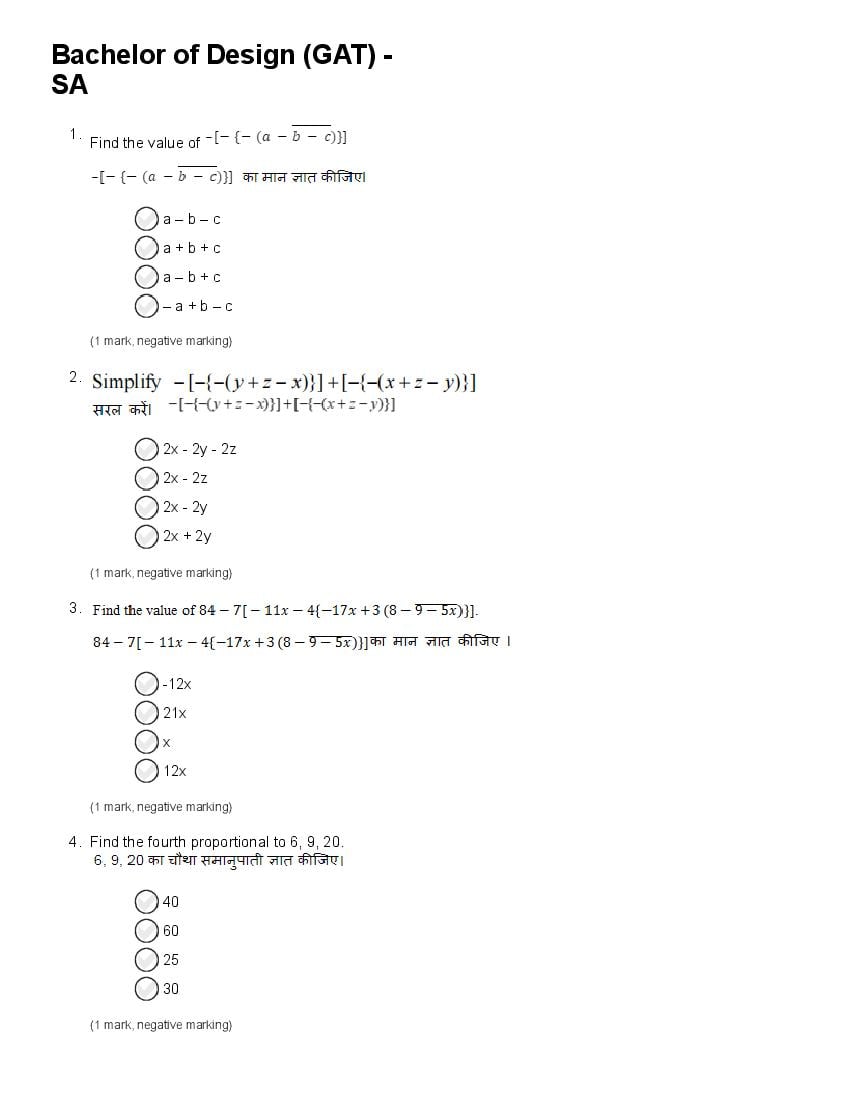
SA
1.
Find the value of
a–b–c
a+b+c
a–b+c
–a+b–c
2.
2x - 2y - 2z
2x - 2z
2x - 2y
2x + 2y
3.
-12x
21x
x
12x
4. Find the fourth proportional to 6, 9, 20.
40
60
25
30
Page 2
30km/h. The speed of the motor ship in stagnant water is
12km/h
18 km/h
30km/h
15 km/h
6. Two numbers are in the ratio 5:6. If 20 is added to each of them, the ratio becomes 7:8. The numbers are
55, 66
40, 48
50, 60
25, 30
7. A person took a loan of Rs. 10,000 at x% simple interest and after 5 years he pays a total of Rs. 14,250.
Then x is
6.5
8
7.5
8.5
8. A rope 1.98 cm long was cut into parts so that one part turned out to be 20% longer than the other part. The
lengths are
101 cm, 97 cm
120 cm, 78 cm
Page 3
110 cm, 88 cm
9.
10.
5:3
3:5
8:5
5:8
11. Find two numbers such that the mean proportional between them is 6 and the third proportional to them is
48.
(2, 18)
(3, 18)
(3, 12)
(4, 9)
12. A seller offers a TV for Rs. 27,000 cash down or Rs. 3000 cash down and 18 equal monthly installment of
Page 4
13. Due to fall in rate of interest from 12% to 10.5% p.a. simple interest a money lender’s income diminishes by
Rs. 900. Find the capital.
Rs. 45,000
Rs. 55,000
Rs. 60,000
Rs. 40,000
14. Salim saves 14% of his salary while Manjur saves 22%. If both get the same salary and Manjur saves Rs.
1540, then the savings and salary of Salim are
Rs. 980, Rs. 5000
Rs. 980, Rs. 6000
Rs. 980, Rs. 8000
Rs. 980, Rs. 7000
15. It takes 3 days for Mr. X to go from place A to place B. On the first day he travelled 30% of the entire
distance; on the second day 60% of the remaining distance. After the first two days it remains for Mr. X to
travel by 5 km less than the distance he covered during the first day. What is the distance between A and B?
Page 5
250 km
150 km
300 km
16. What is the last digit of the product of 11, 12, 13, 14, 15, 16, 17, 18, and 19?
0
9
1
5
17. 200 men are employed in a job to complete it by 35 days. After 15 days, it is seen that only 2/7th portion of
the job has been finished. The number of men to be further employed to complete the job within the
stipulated time is
75
50
375
175
18. Two-fifth of X’s money is equal to Y’s, and seven-ninth of Y’s money is equal to Z’s; in all they have Rs. 770.
How much X has?
Rs. 320
Rs. 180
Page 6
Rs. 140
19. Two bottles contain mixture of milk and water in the ratio of 5:1 and the other in the ratio 9:1. In what
proportion the quantities from the two should be mixed together so that the mixture thus formed may contain
milk and water in the ratio of 8:1?
1:8
1:5
5:1
2:5
20. At 12 noon X starts to walk at 6 km an hour and at 1:30 p.m. Y follows on horseback at 8 km an hour. When
will Y overtake X?
4-30 p.m
5 p.m.
6 p.m.
5-30 p.m.
21. Find the missing term: KPA, LQB, MRC, NSD, ?
OTE
PSE
OSE
PTE
22. There are six persons A, B, C, D, E and F in a circle. C is facing to D. D is to the right of B and left of E. E is
to the left of A. F is to the right of C. If A exchanges his position with F and B with D, then who is to the left of
A?
Page 7
C
F
A
23. R and K are good in football and cricket. S and R are good in football and golf. G and K are good in
volleyball and cricket. S, G and M are good in tennis and golf. Who is good in football, volleyball and cricket?
G
S
K
R
24. At what angle the hands of a clock are inclined at 15 minutes past 6?
25. What is the time of the mirror image of a clock when the original time is 8 minutes past 12?
10.54
6.52
11.25
Page 8
26. Which two signs should be interchanged in the following equation to make it correct?
27. Select the correct combination of mathematical signs to replace * signs and to balance the following
equations.
28. ‘Pitch’ is related to ‘Cricket’, in same way ‘Court’ is related to
Football
Race
Page 9
Boeing
29. Find the missing number: 4, 5, 8, 13, 20, ?
29
27
28
30
30. Find the missing term: PON, RQP, TSR, VUT, ?
WXV
XWV
XWZ
XWU
31. There are five persons A, B, C, D and E in a row. B is to the right of C and A is to the left of D and right of B,
C is to the right of E. Who is in the middle?
C
E
B
D
32. How many times do the hands of a clock make a right angle with each other during 24 hours?
48
22
Page 10
44
33. Find the odd one among the following:
Win – Lose
Success – Failure
Gain – Profit
Spend – Earn
34. Insert the missing number
18 25 4
16 20 3
6 15 ?
3
20
16
4
35. Insert the missing letter
O
M
Page 11
Q
36. Which country won the Cricket World Cup in 1983?
India
Pakistan
England
West Indies
37. The author of the book “Home in the World” is
Ruskin Bond
Kaushik Basu
Amartya Sen
Amitav Ghosh
38. Who was the captain of Indian Women’s Hockey team for Tokyo Olympics 2020?
Rani Rampal
Deep Grace Ekka
Savita Punia
Page 12
39. What is the rank of India in the Global Peace Index (GPI) 2021?
130
134
132
135
40. NASA refers to
North Atlantic Space Agency
National Aeronautics and Space Administration
National Airborne and Space Agency
Northern Airborne and Space Agency
41. Parakram Diwas is observed to celebrate the birth anniversary of
Sardar Vallabhbhai Patel
Atal Bihari Vajpayee
Subhas Chandra Bose
A.P.J. Abdul Kalam
Page 13
Sulphur Phosphorus Matter
Sulphur Particulate Matter
Solid Particulate Matter
Suspended Particulate Matter
43. Where is CSIR-Central Glass and Ceramic Research Institute situated?
New Delhi
Nagpur
Lucknow
Kolkata
44. Hollywood is located in
London
Paris
Florida
Page 14
45. The world’s highest plateau is
Deccan
Tibetan
Bolivian
Canadian
46. Which of the following won “Oscar Award 2020” for best film?
Parasite
Avenger
Joker
Gully Boy
47. The capital of Somalia is
Ankara
Page 15
Juba
Mogadishu
48. Finland is known as
Land of Midnight Sun
Land of Thousand Lakes
Land of Thunderbolt
Land of Golden Fleece
49. In banking system the abbreviation SWIFT stands for
Society for Worldwide Interbank Financial Transformations
Society for Worldwide Interbank Financial Telecommunications
Society of World Interbank Financial Telecommunications
Society for World Interbank Financial Telecommunications
Page 16
Bangladesh-Russia-India-China-South Africa
Britain-Russia-India-China-South Africa
Brazil-Russia-India-China-South Africa
Brazil-Russia-India-China-South Korea
51. Though he makes Biblical references throughout "The Raven," Poe does not allude to the Bible because he
is religious. Rather, he does this because he wishes to invoke the Bible’s dramatic and philosophical weight.
For instance, in line 89 the narrator asks the raven, "Is there—is there balm in Gilead?" In ancient Arabia,
the balm of Gilead was a salve produced from the tree Commiphora gileadensis. The balm was used to treat
the dry, scratchy skin common in Arabia’s desert climate. (The substance currently marketed as "balm of
Gilead," a compound made from the gum of the North American balsam poplar tree, is unlikely to be the
subject of Poe’s reference.) The balm is more famous, however, because of its mention in the book of
Jeremiah, a reference that readers during Poe’s time would have easily recognized. As God punishes
Jeremiah’s people for their years of sin and disobedience, Jeremiah utters the phrase "is there no balm in
Gilead?" The meaning of Jeremiah’s question is not literally "is there an ointment that can heal our skin," but
something more philosophical: "Is there anything we can do to relieve the suffering of God’s punishment?"
This philosophical question about the nature of relief from suffering is the one Poe invokes in "The Raven."
The narrator is suffering greatly from the loss of his lover Lenore, and this suffering seems hopeless until the
mysterious raven appears. The narrator interprets the raven as an omen of Lenore’s future return, but Poe’s
reference to the balm of Gilead signals to the reader that the narrator’s hope is futile. Just as Jeremiah’s
people had no hope of evading God’s power or punishment, so does the narrator have no hope of reuniting
with his lost Lenore. Furthermore, by comparing the profound suffering depicted in the book of Jeremiah to
the narrator’s pining for Lenore, Poe emphasizes just how delusional the narrator really is.
The author most likely places the sentence “The substance currently marketed as ‘balm of Gilead,’ a
compound made from the gum of the North American balsam poplar tree, is unlikely to be the
subject of Poe’s reference” in parentheses because it represents a
a direct quotation from another source
a departure from the main idea
the main idea of the passage
a controversial statement
52. Though he makes Biblical references throughout "The Raven," Poe does not allude to the Bible because he
is religious. Rather, he does this because he wishes to invoke the Bible’s dramatic and philosophical weight.
For instance, in line 89 the narrator asks the raven, "Is there—is there balm in Gilead?" In ancient Arabia,
Page 17
the dry, scratchy skin common in Arabia’s desert climate. (The substance currently marketed as "balm of
Gilead," a compound made from the gum of the North American balsam poplar tree, is unlikely to be the
subject of Poe’s reference.) The balm is more famous, however, because of its mention in the book of
Jeremiah, a reference that readers during Poe’s time would have easily recognized. As God punishes
Jeremiah’s people for their years of sin and disobedience, Jeremiah utters the phrase "is there no balm in
Gilead?" The meaning of Jeremiah’s question is not literally "is there an ointment that can heal our skin," but
something more philosophical: "Is there anything we can do to relieve the suffering of God’s punishment?"
This philosophical question about the nature of relief from suffering is the one Poe invokes in "The Raven."
The narrator is suffering greatly from the loss of his lover Lenore, and this suffering seems hopeless until the
mysterious raven appears. The narrator interprets the raven as an omen of Lenore’s future return, but Poe’s
reference to the balm of Gilead signals to the reader that the narrator’s hope is futile. Just as Jeremiah’s
people had no hope of evading God’s power or punishment, so does the narrator have no hope of reuniting
with his lost Lenore. Furthermore, by comparing the profound suffering depicted in the book of Jeremiah to
the narrator’s pining for Lenore, Poe emphasizes just how delusional the narrator really is.
In the passage given the word "Salve" is a synonym of
salvation
solvent
none of these
ointment
53. Though he makes Biblical references throughout "The Raven," Poe does not allude to the Bible because he
is religious. Rather, he does this because he wishes to invoke the Bible’s dramatic and philosophical weight.
For instance, in line 89 the narrator asks the raven, "Is there—is there balm in Gilead?" In ancient Arabia,
the balm of Gilead was a salve produced from the tree Commiphora gileadensis. The balm was used to treat
the dry, scratchy skin common in Arabia’s desert climate. (The substance currently marketed as "balm of
Gilead," a compound made from the gum of the North American balsam poplar tree, is unlikely to be the
subject of Poe’s reference.) The balm is more famous, however, because of its mention in the book of
Jeremiah, a reference that readers during Poe’s time would have easily recognized. As God punishes
Jeremiah’s people for their years of sin and disobedience, Jeremiah utters the phrase "is there no balm in
Gilead?" The meaning of Jeremiah’s question is not literally "is there an ointment that can heal our skin," but
something more philosophical: "Is there anything we can do to relieve the suffering of God’s punishment?"
This philosophical question about the nature of relief from suffering is the one Poe invokes in "The Raven."
The narrator is suffering greatly from the loss of his lover Lenore, and this suffering seems hopeless until the
mysterious raven appears. The narrator interprets the raven as an omen of Lenore’s future return, but Poe’s
reference to the balm of Gilead signals to the reader that the narrator’s hope is futile. Just as Jeremiah’s
people had no hope of evading God’s power or punishment, so does the narrator have no hope of reuniting
with his lost Lenore. Furthermore, by comparing the profound suffering depicted in the book of Jeremiah to
the narrator’s pining for Lenore, Poe emphasizes just how delusional the narrator really is.
As used near the end of the passage, which is the best synonym for futile?
pointless
reckless
immature
inaccessible
Page 18
is religious. Rather, he does this because he wishes to invoke the Bible’s dramatic and philosophical weight.
For instance, in line 89 the narrator asks the raven, "Is there—is there balm in Gilead?" In ancient Arabia,
the balm of Gilead was a salve produced from the tree Commiphora gileadensis. The balm was used to treat
the dry, scratchy skin common in Arabia’s desert climate. (The substance currently marketed as "balm of
Gilead," a compound made from the gum of the North American balsam poplar tree, is unlikely to be the
subject of Poe’s reference.) The balm is more famous, however, because of its mention in the book of
Jeremiah, a reference that readers during Poe’s time would have easily recognized. As God punishes
Jeremiah’s people for their years of sin and disobedience, Jeremiah utters the phrase "is there no balm in
Gilead?" The meaning of Jeremiah’s question is not literally "is there an ointment that can heal our skin," but
something more philosophical: "Is there anything we can do to relieve the suffering of God’s punishment?"
This philosophical question about the nature of relief from suffering is the one Poe invokes in "The Raven."
The narrator is suffering greatly from the loss of his lover Lenore, and this suffering seems hopeless until the
mysterious raven appears. The narrator interprets the raven as an omen of Lenore’s future return, but Poe’s
reference to the balm of Gilead signals to the reader that the narrator’s hope is futile. Just as Jeremiah’s
people had no hope of evading God’s power or punishment, so does the narrator have no hope of reuniting
with his lost Lenore. Furthermore, by comparing the profound suffering depicted in the book of Jeremiah to
the narrator’s pining for Lenore, Poe emphasizes just how delusional the narrator really is.
Based on information in the passage, it can be inferred that the author would most likely
characterize Poe’s attitude toward suffering in “The Raven” as
philosophical
religious
disrespectful
delusional
55. Though he makes Biblical references throughout "The Raven," Poe does not allude to the Bible because he
is religious. Rather, he does this because he wishes to invoke the Bible’s dramatic and philosophical weight.
For instance, in line 89 the narrator asks the raven, "Is there—is there balm in Gilead?" In ancient Arabia,
the balm of Gilead was a salve produced from the tree Commiphora gileadensis. The balm was used to treat
the dry, scratchy skin common in Arabia’s desert climate. (The substance currently marketed as "balm of
Gilead," a compound made from the gum of the North American balsam poplar tree, is unlikely to be the
subject of Poe’s reference.) The balm is more famous, however, because of its mention in the book of
Jeremiah, a reference that readers during Poe’s time would have easily recognized. As God punishes
Jeremiah’s people for their years of sin and disobedience, Jeremiah utters the phrase "is there no balm in
Gilead?" The meaning of Jeremiah’s question is not literally "is there an ointment that can heal our skin," but
something more philosophical: "Is there anything we can do to relieve the suffering of God’s punishment?"
This philosophical question about the nature of relief from suffering is the one Poe invokes in "The Raven."
The narrator is suffering greatly from the loss of his lover Lenore, and this suffering seems hopeless until the
mysterious raven appears. The narrator interprets the raven as an omen of Lenore’s future return, but Poe’s
reference to the balm of Gilead signals to the reader that the narrator’s hope is futile. Just as Jeremiah’s
people had no hope of evading God’s power or punishment, so does the narrator have no hope of reuniting
with his lost Lenore. Furthermore, by comparing the profound suffering depicted in the book of Jeremiah to
the narrator’s pining for Lenore, Poe emphasizes just how delusional the narrator really is.
The author argues that Poe mentions the balm of Gilead in order to
describe how dry, itchy skin was treated in Arabia’s desert climate
argue that the narrator’s suffering is universal
emphasize the delusional nature of the narrator
demonstrate his own religious convictions
Page 19
is religious. Rather, he does this because he wishes to invoke the Bible’s dramatic and philosophical weight.
For instance, in line 89 the narrator asks the raven, "Is there—is there balm in Gilead?" In ancient Arabia,
the balm of Gilead was a salve produced from the tree Commiphora gileadensis. The balm was used to treat
the dry, scratchy skin common in Arabia’s desert climate. (The substance currently marketed as "balm of
Gilead," a compound made from the gum of the North American balsam poplar tree, is unlikely to be the
subject of Poe’s reference.) The balm is more famous, however, because of its mention in the book of
Jeremiah, a reference that readers during Poe’s time would have easily recognized. As God punishes
Jeremiah’s people for their years of sin and disobedience, Jeremiah utters the phrase "is there no balm in
Gilead?" The meaning of Jeremiah’s question is not literally "is there an ointment that can heal our skin," but
something more philosophical: "Is there anything we can do to relieve the suffering of God’s punishment?"
This philosophical question about the nature of relief from suffering is the one Poe invokes in "The Raven."
The narrator is suffering greatly from the loss of his lover Lenore, and this suffering seems hopeless until the
mysterious raven appears. The narrator interprets the raven as an omen of Lenore’s future return, but Poe’s
reference to the balm of Gilead signals to the reader that the narrator’s hope is futile. Just as Jeremiah’s
people had no hope of evading God’s power or punishment, so does the narrator have no hope of reuniting
with his lost Lenore. Furthermore, by comparing the profound suffering depicted in the book of Jeremiah to
the narrator’s pining for Lenore, Poe emphasizes just how delusional the narrator really is.
Based on information in the passage, it can be inferred that
the narrator will eventually be reunited with his lost love, Lenore
readers during Poe’s time were more likely to have read the Bible than today’s readers
the book of Jeremiah contains the most profound depiction of suffering in the Bible
ravens are often interpreted as an omen foreshadowing a lover’s return
57. In one of the most rousing pamphlets of all time, Thomas Paine expounded on the need for American
independence. It was “common sense,” Paine alleged, forging his place in the pantheon of America’s
founders alongside such luminaries as Jefferson, Washington, and Adams. However, unlike those three
men, Paine did not enjoy celebrity at the time of his death. Instead of being lionized, Paine was vilified by the
very same individuals who once passed his pamphlet around as the gospel truth. But it was not Common
Sense that got him excommunicated from the American canon; rather, it was his final work, The Age of
Reason.
To understand The Age of Reason, one needs to understand the context. After the Revolutionary War, Paine
returned to his native England before his controversial, proFrench Revolution leanings made him
increasingly unpopular. Paine immigrated to France, where he was so revered that he helped draft two
separate French constitutions. However, the French Revolution was a far more violent and turbulent conflict
than was the American Revolution, with dozens of leaders jockeying for power and killing each other to get
it. Paine ended up in prison during one fluctuation of power but turned this vicissitude into an opportunity. It
was while he was in prison that Paine wrote The Age of Reason, his religious text.
The Age of Reason is not an inherently atheistic text, though that is how it was interpreted. Rather, the text
espouses the same religious ideals that defined the Enlightenment, especially those ideals of the French
Revolution, with its disestablishment of the Catholic Church as a national institution. Paine returned to
America in 1802 and quickly fell out of favor in the new nation. Americans saw The Age of Reason as
expressly anti-Christian, even though the actual philosophy of the text is closer to the deism practiced by
Thomas Jefferson and other Founding Fathers. But America of 1802 was very different from the America of
the Revolution, as the Second Great Awakening was just rising. In this new, devoutly Protestant nation, men
like Paine were not welcome, nor would have men like Jefferson been, if Jefferson had not adapted to the
times and modified his public statements on religion. Jefferson, unlike Paine, had the good sense—politically
speaking—to not publish his religious beliefs. Thus, Jefferson, unlike Paine, was able to publicly, at least,
keep up with the times. Paine, on the other hand, was ostracized and denied the corridors of political power
Page 20
Ultimately, Paine was punished for being an anachronism in a world that passed him by. In 1809, Paine died
in New York, largely forgotten and certainly not celebrated. And today, while Americans commemorate
Common Sense, most schoolchildren know nothing of the man who wrote it.
In paragraph 1 the author makes use of words most commonly associated with which of the
following?
religion
history
politics
patriotism
58. In one of the most rousing pamphlets of all time, Thomas Paine expounded on the need for American
independence. It was “common sense,” Paine alleged, forging his place in the pantheon of America’s
founders alongside such luminaries as Jefferson, Washington, and Adams. However, unlike those three
men, Paine did not enjoy celebrity at the time of his death. Instead of being lionized, Paine was vilified by the
very same individuals who once passed his pamphlet around as the gospel truth. But it was not Common
Sense that got him excommunicated from the American canon; rather, it was his final work, The Age of
Reason.
To understand The Age of Reason, one needs to understand the context. After the Revolutionary War, Paine
returned to his native England before his controversial, proFrench Revolution leanings made him
increasingly unpopular. Paine immigrated to France, where he was so revered that he helped draft two
separate French constitutions. However, the French Revolution was a far more violent and turbulent conflict
than was the American Revolution, with dozens of leaders jockeying for power and killing each other to get
it. Paine ended up in prison during one fluctuation of power but turned this vicissitude into an opportunity. It
was while he was in prison that Paine wrote The Age of Reason, his religious text.
The Age of Reason is not an inherently atheistic text, though that is how it was interpreted. Rather, the text
espouses the same religious ideals that defined the Enlightenment, especially those ideals of the French
Revolution, with its disestablishment of the Catholic Church as a national institution. Paine returned to
America in 1802 and quickly fell out of favor in the new nation. Americans saw The Age of Reason as
expressly anti-Christian, even though the actual philosophy of the text is closer to the deism practiced by
Thomas Jefferson and other Founding Fathers. But America of 1802 was very different from the America of
the Revolution, as the Second Great Awakening was just rising. In this new, devoutly Protestant nation, men
like Paine were not welcome, nor would have men like Jefferson been, if Jefferson had not adapted to the
times and modified his public statements on religion. Jefferson, unlike Paine, had the good sense—politically
speaking—to not publish his religious beliefs. Thus, Jefferson, unlike Paine, was able to publicly, at least,
keep up with the times. Paine, on the other hand, was ostracized and denied the corridors of political power
he had once helped make possible.
Ultimately, Paine was punished for being an anachronism in a world that passed him by. In 1809, Paine died
in New York, largely forgotten and certainly not celebrated. And today, while Americans commemorate
Common Sense, most schoolchildren know nothing of the man who wrote it.
Based on its use in paragraph 1, it can be inferred that which of the following would be an example
of a pantheon?
a history of the most important era in American politics
a ranking of American presidents
a collection of the best baseball players of all time
a canon of important works of literature
Page 21
independence. It was “common sense,” Paine alleged, forging his place in the pantheon of America’s
founders alongside such luminaries as Jefferson, Washington, and Adams. However, unlike those three
men, Paine did not enjoy celebrity at the time of his death. Instead of being lionized, Paine was vilified by the
very same individuals who once passed his pamphlet around as the gospel truth. But it was not Common
Sense that got him excommunicated from the American canon; rather, it was his final work, The Age of
Reason.
To understand The Age of Reason, one needs to understand the context. After the Revolutionary War, Paine
returned to his native England before his controversial, proFrench Revolution leanings made him
increasingly unpopular. Paine immigrated to France, where he was so revered that he helped draft two
separate French constitutions. However, the French Revolution was a far more violent and turbulent conflict
than was the American Revolution, with dozens of leaders jockeying for power and killing each other to get
it. Paine ended up in prison during one fluctuation of power but turned this vicissitude into an opportunity. It
was while he was in prison that Paine wrote The Age of Reason, his religious text.
The Age of Reason is not an inherently atheistic text, though that is how it was interpreted. Rather, the text
espouses the same religious ideals that defined the Enlightenment, especially those ideals of the French
Revolution, with its disestablishment of the Catholic Church as a national institution. Paine returned to
America in 1802 and quickly fell out of favor in the new nation. Americans saw The Age of Reason as
expressly anti-Christian, even though the actual philosophy of the text is closer to the deism practiced by
Thomas Jefferson and other Founding Fathers. But America of 1802 was very different from the America of
the Revolution, as the Second Great Awakening was just rising. In this new, devoutly Protestant nation, men
like Paine were not welcome, nor would have men like Jefferson been, if Jefferson had not adapted to the
times and modified his public statements on religion. Jefferson, unlike Paine, had the good sense—politically
speaking—to not publish his religious beliefs. Thus, Jefferson, unlike Paine, was able to publicly, at least,
keep up with the times. Paine, on the other hand, was ostracized and denied the corridors of political power
he had once helped make possible.
Ultimately, Paine was punished for being an anachronism in a world that passed him by. In 1809, Paine died
in New York, largely forgotten and certainly not celebrated. And today, while Americans commemorate
Common Sense, most schoolchildren know nothing of the man who wrote it.
This passage is best described as a(n)
analysis of Thomas Paine’s work in historical context
historic analysis of the end of the Enlightenment
celebration of American patriots
defense of Thomas Paine’s lifework and time in France
60. In one of the most rousing pamphlets of all time, Thomas Paine expounded on the need for American
independence. It was “common sense,” Paine alleged, forging his place in the pantheon of America’s
founders alongside such luminaries as Jefferson, Washington, and Adams. However, unlike those three
men, Paine did not enjoy celebrity at the time of his death. Instead of being lionized, Paine was vilified by the
very same individuals who once passed his pamphlet around as the gospel truth. But it was not Common
Sense that got him excommunicated from the American canon; rather, it was his final work, The Age of
Reason.
To understand The Age of Reason, one needs to understand the context. After the Revolutionary War, Paine
returned to his native England before his controversial, proFrench Revolution leanings made him
increasingly unpopular. Paine immigrated to France, where he was so revered that he helped draft two
separate French constitutions. However, the French Revolution was a far more violent and turbulent conflict
than was the American Revolution, with dozens of leaders jockeying for power and killing each other to get
it. Paine ended up in prison during one fluctuation of power but turned this vicissitude into an opportunity. It
was while he was in prison that Paine wrote The Age of Reason, his religious text.
The Age of Reason is not an inherently atheistic text, though that is how it was interpreted. Rather, the text
espouses the same religious ideals that defined the Enlightenment, especially those ideals of the French
Revolution, with its disestablishment of the Catholic Church as a national institution. Paine returned to
Page 22
expressly anti-Christian, even though the actual philosophy of the text is closer to the deism practiced by
Thomas Jefferson and other Founding Fathers. But America of 1802 was very different from the America of
the Revolution, as the Second Great Awakening was just rising. In this new, devoutly Protestant nation, men
like Paine were not welcome, nor would have men like Jefferson been, if Jefferson had not adapted to the
times and modified his public statements on religion. Jefferson, unlike Paine, had the good sense—politically
speaking—to not publish his religious beliefs. Thus, Jefferson, unlike Paine, was able to publicly, at least,
keep up with the times. Paine, on the other hand, was ostracized and denied the corridors of political power
he had once helped make possible.
Ultimately, Paine was punished for being an anachronism in a world that passed him by. In 1809, Paine died
in New York, largely forgotten and certainly not celebrated. And today, while Americans commemorate
Common Sense, most schoolchildren know nothing of the man who wrote it.
According to the passage, which of the following provides an accurate order of the places Paine
lived during his lifetime?
America, England, France, America, England
England, America, France, America, England
England, America, England, France, America
America, England, France, America
61. In one of the most rousing pamphlets of all time, Thomas Paine expounded on the need for American
independence. It was “common sense,” Paine alleged, forging his place in the pantheon of America’s
founders alongside such luminaries as Jefferson, Washington, and Adams. However, unlike those three
men, Paine did not enjoy celebrity at the time of his death. Instead of being lionized, Paine was vilified by the
very same individuals who once passed his pamphlet around as the gospel truth. But it was not Common
Sense that got him excommunicated from the American canon; rather, it was his final work, The Age of
Reason.
To understand The Age of Reason, one needs to understand the context. After the Revolutionary War, Paine
returned to his native England before his controversial, proFrench Revolution leanings made him
increasingly unpopular. Paine immigrated to France, where he was so revered that he helped draft two
separate French constitutions. However, the French Revolution was a far more violent and turbulent conflict
than was the American Revolution, with dozens of leaders jockeying for power and killing each other to get
it. Paine ended up in prison during one fluctuation of power but turned this vicissitude into an opportunity. It
was while he was in prison that Paine wrote The Age of Reason, his religious text.
The Age of Reason is not an inherently atheistic text, though that is how it was interpreted. Rather, the text
espouses the same religious ideals that defined the Enlightenment, especially those ideals of the French
Revolution, with its disestablishment of the Catholic Church as a national institution. Paine returned to
America in 1802 and quickly fell out of favor in the new nation. Americans saw The Age of Reason as
expressly anti-Christian, even though the actual philosophy of the text is closer to the deism practiced by
Thomas Jefferson and other Founding Fathers. But America of 1802 was very different from the America of
the Revolution, as the Second Great Awakening was just rising. In this new, devoutly Protestant nation, men
like Paine were not welcome, nor would have men like Jefferson been, if Jefferson had not adapted to the
times and modified his public statements on religion. Jefferson, unlike Paine, had the good sense—politically
speaking—to not publish his religious beliefs. Thus, Jefferson, unlike Paine, was able to publicly, at least,
keep up with the times. Paine, on the other hand, was ostracized and denied the corridors of political power
he had once helped make possible.
Ultimately, Paine was punished for being an anachronism in a world that passed him by. In 1809, Paine died
in New York, largely forgotten and certainly not celebrated. And today, while Americans commemorate
Common Sense, most schoolchildren know nothing of the man who wrote it.
As used in paragraph 2, the word vicissitude most nearly means
philosophy
Page 23
change
opportunity
62. In one of the most rousing pamphlets of all time, Thomas Paine expounded on the need for American
independence. It was “common sense,” Paine alleged, forging his place in the pantheon of America’s
founders alongside such luminaries as Jefferson, Washington, and Adams. However, unlike those three
men, Paine did not enjoy celebrity at the time of his death. Instead of being lionized, Paine was vilified by the
very same individuals who once passed his pamphlet around as the gospel truth. But it was not Common
Sense that got him excommunicated from the American canon; rather, it was his final work, The Age of
Reason.
To understand The Age of Reason, one needs to understand the context. After the Revolutionary War, Paine
returned to his native England before his controversial, proFrench Revolution leanings made him
increasingly unpopular. Paine immigrated to France, where he was so revered that he helped draft two
separate French constitutions. However, the French Revolution was a far more violent and turbulent conflict
than was the American Revolution, with dozens of leaders jockeying for power and killing each other to get
it. Paine ended up in prison during one fluctuation of power but turned this vicissitude into an opportunity. It
was while he was in prison that Paine wrote The Age of Reason, his religious text.
The Age of Reason is not an inherently atheistic text, though that is how it was interpreted. Rather, the text
espouses the same religious ideals that defined the Enlightenment, especially those ideals of the French
Revolution, with its disestablishment of the Catholic Church as a national institution. Paine returned to
America in 1802 and quickly fell out of favor in the new nation. Americans saw The Age of Reason as
expressly anti-Christian, even though the actual philosophy of the text is closer to the deism practiced by
Thomas Jefferson and other Founding Fathers. But America of 1802 was very different from the America of
the Revolution, as the Second Great Awakening was just rising. In this new, devoutly Protestant nation, men
like Paine were not welcome, nor would have men like Jefferson been, if Jefferson had not adapted to the
times and modified his public statements on religion. Jefferson, unlike Paine, had the good sense—politically
speaking—to not publish his religious beliefs. Thus, Jefferson, unlike Paine, was able to publicly, at least,
keep up with the times. Paine, on the other hand, was ostracized and denied the corridors of political power
he had once helped make possible.
Ultimately, Paine was punished for being an anachronism in a world that passed him by. In 1809, Paine died
in New York, largely forgotten and certainly not celebrated. And today, while Americans commemorate
Common Sense, most schoolchildren know nothing of the man who wrote it.
Based on the description given in paragraph 2, as compared to the French Revolution, the American
Revolution was
inherently simple
relatively stable
largely unimportant
completely peaceful
63. In one of the most rousing pamphlets of all time, Thomas Paine expounded on the need for American
independence. It was “common sense,” Paine alleged, forging his place in the pantheon of America’s
founders alongside such luminaries as Jefferson, Washington, and Adams. However, unlike those three
men, Paine did not enjoy celebrity at the time of his death. Instead of being lionized, Paine was vilified by the
very same individuals who once passed his pamphlet around as the gospel truth. But it was not Common
Sense that got him excommunicated from the American canon; rather, it was his final work, The Age of
Reason.
To understand The Age of Reason, one needs to understand the context. After the Revolutionary War, Paine
returned to his native England before his controversial, proFrench Revolution leanings made him
Page 24
separate French constitutions. However, the French Revolution was a far more violent and turbulent conflict
than was the American Revolution, with dozens of leaders jockeying for power and killing each other to get
it. Paine ended up in prison during one fluctuation of power but turned this vicissitude into an opportunity. It
was while he was in prison that Paine wrote The Age of Reason, his religious text.
The Age of Reason is not an inherently atheistic text, though that is how it was interpreted. Rather, the text
espouses the same religious ideals that defined the Enlightenment, especially those ideals of the French
Revolution, with its disestablishment of the Catholic Church as a national institution. Paine returned to
America in 1802 and quickly fell out of favor in the new nation. Americans saw The Age of Reason as
expressly anti-Christian, even though the actual philosophy of the text is closer to the deism practiced by
Thomas Jefferson and other Founding Fathers. But America of 1802 was very different from the America of
the Revolution, as the Second Great Awakening was just rising. In this new, devoutly Protestant nation, men
like Paine were not welcome, nor would have men like Jefferson been, if Jefferson had not adapted to the
times and modified his public statements on religion. Jefferson, unlike Paine, had the good sense—politically
speaking—to not publish his religious beliefs. Thus, Jefferson, unlike Paine, was able to publicly, at least,
keep up with the times. Paine, on the other hand, was ostracized and denied the corridors of political power
he had once helped make possible.
Ultimately, Paine was punished for being an anachronism in a world that passed him by. In 1809, Paine died
in New York, largely forgotten and certainly not celebrated. And today, while Americans commemorate
Common Sense, most schoolchildren know nothing of the man who wrote it.
Which of the following, if added to the passage, would be least likely to strengthen the author’s
argument?
a history of the French Revolution
a description of Paine’s beliefs
excerpts from The Age of Reason
a brief explanation of the beliefs of the Second Great Awakening
64. In one of the most rousing pamphlets of all time, Thomas Paine expounded on the need for American
independence. It was “common sense,” Paine alleged, forging his place in the pantheon of America’s
founders alongside such luminaries as Jefferson, Washington, and Adams. However, unlike those three
men, Paine did not enjoy celebrity at the time of his death. Instead of being lionized, Paine was vilified by the
very same individuals who once passed his pamphlet around as the gospel truth. But it was not Common
Sense that got him excommunicated from the American canon; rather, it was his final work, The Age of
Reason.
To understand The Age of Reason, one needs to understand the context. After the Revolutionary War, Paine
returned to his native England before his controversial, proFrench Revolution leanings made him
increasingly unpopular. Paine immigrated to France, where he was so revered that he helped draft two
separate French constitutions. However, the French Revolution was a far more violent and turbulent conflict
than was the American Revolution, with dozens of leaders jockeying for power and killing each other to get
it. Paine ended up in prison during one fluctuation of power but turned this vicissitude into an opportunity. It
was while he was in prison that Paine wrote The Age of Reason, his religious text.
The Age of Reason is not an inherently atheistic text, though that is how it was interpreted. Rather, the text
espouses the same religious ideals that defined the Enlightenment, especially those ideals of the French
Revolution, with its disestablishment of the Catholic Church as a national institution. Paine returned to
America in 1802 and quickly fell out of favor in the new nation. Americans saw The Age of Reason as
expressly anti-Christian, even though the actual philosophy of the text is closer to the deism practiced by
Thomas Jefferson and other Founding Fathers. But America of 1802 was very different from the America of
the Revolution, as the Second Great Awakening was just rising. In this new, devoutly Protestant nation, men
like Paine were not welcome, nor would have men like Jefferson been, if Jefferson had not adapted to the
times and modified his public statements on religion. Jefferson, unlike Paine, had the good sense—politically
speaking—to not publish his religious beliefs. Thus, Jefferson, unlike Paine, was able to publicly, at least,
keep up with the times. Paine, on the other hand, was ostracized and denied the corridors of political power
he had once helped make possible.
Page 25
in New York, largely forgotten and certainly not celebrated. And today, while Americans commemorate
Common Sense, most schoolchildren know nothing of the man who wrote it.
Which of the following best describes the function of paragraph 2?
It describes the content of The Age of Reason.
It explains Paine’s unpopularity in America.
It introduces the author’s main argument.
It provides the context for Paine’s writings.
65. In one of the most rousing pamphlets of all time, Thomas Paine expounded on the need for American
independence. It was “common sense,” Paine alleged, forging his place in the pantheon of America’s
founders alongside such luminaries as Jefferson, Washington, and Adams. However, unlike those three
men, Paine did not enjoy celebrity at the time of his death. Instead of being lionized, Paine was vilified by the
very same individuals who once passed his pamphlet around as the gospel truth. But it was not Common
Sense that got him excommunicated from the American canon; rather, it was his final work, The Age of
Reason.
To understand The Age of Reason, one needs to understand the context. After the Revolutionary War, Paine
returned to his native England before his controversial, proFrench Revolution leanings made him
increasingly unpopular. Paine immigrated to France, where he was so revered that he helped draft two
separate French constitutions. However, the French Revolution was a far more violent and turbulent conflict
than was the American Revolution, with dozens of leaders jockeying for power and killing each other to get
it. Paine ended up in prison during one fluctuation of power but turned this vicissitude into an opportunity. It
was while he was in prison that Paine wrote The Age of Reason, his religious text.
The Age of Reason is not an inherently atheistic text, though that is how it was interpreted. Rather, the text
espouses the same religious ideals that defined the Enlightenment, especially those ideals of the French
Revolution, with its disestablishment of the Catholic Church as a national institution. Paine returned to
America in 1802 and quickly fell out of favor in the new nation. Americans saw The Age of Reason as
expressly anti-Christian, even though the actual philosophy of the text is closer to the deism practiced by
Thomas Jefferson and other Founding Fathers. But America of 1802 was very different from the America of
the Revolution, as the Second Great Awakening was just rising. In this new, devoutly Protestant nation, men
like Paine were not welcome, nor would have men like Jefferson been, if Jefferson had not adapted to the
times and modified his public statements on religion. Jefferson, unlike Paine, had the good sense—politically
speaking—to not publish his religious beliefs. Thus, Jefferson, unlike Paine, was able to publicly, at least,
keep up with the times. Paine, on the other hand, was ostracized and denied the corridors of political power
he had once helped make possible.
Ultimately, Paine was punished for being an anachronism in a world that passed him by. In 1809, Paine died
in New York, largely forgotten and certainly not celebrated. And today, while Americans commemorate
Common Sense, most schoolchildren know nothing of the man who wrote it.
Which of the following summarizes the author’s principal explanation for Paine’s unpopularity at the
time of his death?
He was the relic of an earlier era of religious thought.
He had betrayed the ideals of his own and his adopted countries.
He was explicitly atheistic at a time of religious fervor.
He was associated with the equally unpopular Thomas Jefferson.
Page 26
independence. It was “common sense,” Paine alleged, forging his place in the pantheon of America’s
founders alongside such luminaries as Jefferson, Washington, and Adams. However, unlike those three
men, Paine did not enjoy celebrity at the time of his death. Instead of being lionized, Paine was vilified by the
very same individuals who once passed his pamphlet around as the gospel truth. But it was not Common
Sense that got him excommunicated from the American canon; rather, it was his final work, The Age of
Reason.
To understand The Age of Reason, one needs to understand the context. After the Revolutionary War, Paine
returned to his native England before his controversial, proFrench Revolution leanings made him
increasingly unpopular. Paine immigrated to France, where he was so revered that he helped draft two
separate French constitutions. However, the French Revolution was a far more violent and turbulent conflict
than was the American Revolution, with dozens of leaders jockeying for power and killing each other to get
it. Paine ended up in prison during one fluctuation of power but turned this vicissitude into an opportunity. It
was while he was in prison that Paine wrote The Age of Reason, his religious text.
The Age of Reason is not an inherently atheistic text, though that is how it was interpreted. Rather, the text
espouses the same religious ideals that defined the Enlightenment, especially those ideals of the French
Revolution, with its disestablishment of the Catholic Church as a national institution. Paine returned to
America in 1802 and quickly fell out of favor in the new nation. Americans saw The Age of Reason as
expressly anti-Christian, even though the actual philosophy of the text is closer to the deism practiced by
Thomas Jefferson and other Founding Fathers. But America of 1802 was very different from the America of
the Revolution, as the Second Great Awakening was just rising. In this new, devoutly Protestant nation, men
like Paine were not welcome, nor would have men like Jefferson been, if Jefferson had not adapted to the
times and modified his public statements on religion. Jefferson, unlike Paine, had the good sense—politically
speaking—to not publish his religious beliefs. Thus, Jefferson, unlike Paine, was able to publicly, at least,
keep up with the times. Paine, on the other hand, was ostracized and denied the corridors of political power
he had once helped make possible.
Ultimately, Paine was punished for being an anachronism in a world that passed him by. In 1809, Paine died
in New York, largely forgotten and certainly not celebrated. And today, while Americans commemorate
Common Sense, most schoolchildren know nothing of the man who wrote it.
As used in the final paragraph, the word anachronism most nearly means something
disdainful and deservedly criticized
that incites religious passion and zeal
vilified and demonized by the masses
belonging to a different time period
67. Ever hear that John F. Kennedy was assassinated by someone other than Lee Harvey Oswald? Or how
about the fact that the United States government has been harboring extraterrestrials and their advanced
technology at Area 51? Or—my favorite for its sheer lunacy—that the moon landing was staged in
Hollywood? You might laugh at these theories, or like millions of Americans, you might believe them
wholeheartedly. Regardless of their veracity, they exist and proliferate each day, and the Internet has only
helped to promulgate them.
So where do they come from? Well, in a literal sense, they come from people asking questions and seeking
answers. But in a more figurative sense, they come from the experience of not knowing, the great void
created by a dearth of certainty. There are several questions about the Kennedy assassination, enough so
that several government panels (most notably the Warren Commission) have investigated it; there have
been several thousands of reports of UFO encounters (not to mention an equally absurd number of
television shows about aliens); and there are aspects of the moon landing that seem too good to be true. But
none of these questions necessarily hint at something nefarious or sinister. Rather, they demonstrate that
these events are all too real. Nothing in life is certain, and nothing completely adds up. Sure, we’d all prefer
major historic events to have the certainty of a sunrise, but there’s the rub: most of us do not really know
why the sun rises or even, with certainty, that it will rise tomorrow. But a sane person does not question the
sunrise, though that same person will wonder about the trajectory of a bullet in Dallas.
None of this is to say that one should not ask questions. Rather, one should ask questions of everything! We
Page 27
is impossible. We can no more know these things than we can know who specifically invented the wheel.
So, rather than making up theories to explain away the lacuna of facts, we should simply accept the fact that
we will never know absolutely everything about anything. Continue asking questions, but don’t make up
ridiculous answers for them. Because the ultimate problem with conspiracy theories is that they don’t answer
any questions; they merely explain away gaps of knowledge with pseudoscience.
Put differently, no one is really sure why cats purr, but that doesn’t mean that cats do not purr. There does
not need to be a why for every what.
Based on its use in paragraph 1, it can be inferred that veracity belongs to which of the following
word groups?
ridiculousness, preposterousness, absurdity
fallacy, misconception, delusion
authenticity, genuineness, truth
artifice, bias, prejudice
68. Ever hear that John F. Kennedy was assassinated by someone other than Lee Harvey Oswald? Or how
about the fact that the United States government has been harboring extraterrestrials and their advanced
technology at Area 51? Or—my favorite for its sheer lunacy—that the moon landing was staged in
Hollywood? You might laugh at these theories, or like millions of Americans, you might believe them
wholeheartedly. Regardless of their veracity, they exist and proliferate each day, and the Internet has only
helped to promulgate them.
So where do they come from? Well, in a literal sense, they come from people asking questions and seeking
answers. But in a more figurative sense, they come from the experience of not knowing, the great void
created by a dearth of certainty. There are several questions about the Kennedy assassination, enough so
that several government panels (most notably the Warren Commission) have investigated it; there have
been several thousands of reports of UFO encounters (not to mention an equally absurd number of
television shows about aliens); and there are aspects of the moon landing that seem too good to be true. But
none of these questions necessarily hint at something nefarious or sinister. Rather, they demonstrate that
these events are all too real. Nothing in life is certain, and nothing completely adds up. Sure, we’d all prefer
major historic events to have the certainty of a sunrise, but there’s the rub: most of us do not really know
why the sun rises or even, with certainty, that it will rise tomorrow. But a sane person does not question the
sunrise, though that same person will wonder about the trajectory of a bullet in Dallas.
None of this is to say that one should not ask questions. Rather, one should ask questions of everything! We
should know who shot JFK, whether there are aliens, and whether the Illuminati control everything. Yet, this
is impossible. We can no more know these things than we can know who specifically invented the wheel.
So, rather than making up theories to explain away the lacuna of facts, we should simply accept the fact that
we will never know absolutely everything about anything. Continue asking questions, but don’t make up
ridiculous answers for them. Because the ultimate problem with conspiracy theories is that they don’t answer
any questions; they merely explain away gaps of knowledge with pseudoscience.
Put differently, no one is really sure why cats purr, but that doesn’t mean that cats do not purr. There does
not need to be a why for every what.
As used in paragraph 2, the word nefarious most nearly means
indifferent
evil
secret
vague
Page 28
about the fact that the United States government has been harboring extraterrestrials and their advanced
technology at Area 51? Or—my favorite for its sheer lunacy—that the moon landing was staged in
Hollywood? You might laugh at these theories, or like millions of Americans, you might believe them
wholeheartedly. Regardless of their veracity, they exist and proliferate each day, and the Internet has only
helped to promulgate them.
So where do they come from? Well, in a literal sense, they come from people asking questions and seeking
answers. But in a more figurative sense, they come from the experience of not knowing, the great void
created by a dearth of certainty. There are several questions about the Kennedy assassination, enough so
that several government panels (most notably the Warren Commission) have investigated it; there have
been several thousands of reports of UFO encounters (not to mention an equally absurd number of
television shows about aliens); and there are aspects of the moon landing that seem too good to be true. But
none of these questions necessarily hint at something nefarious or sinister. Rather, they demonstrate that
these events are all too real. Nothing in life is certain, and nothing completely adds up. Sure, we’d all prefer
major historic events to have the certainty of a sunrise, but there’s the rub: most of us do not really know
why the sun rises or even, with certainty, that it will rise tomorrow. But a sane person does not question the
sunrise, though that same person will wonder about the trajectory of a bullet in Dallas.
None of this is to say that one should not ask questions. Rather, one should ask questions of everything! We
should know who shot JFK, whether there are aliens, and whether the Illuminati control everything. Yet, this
is impossible. We can no more know these things than we can know who specifically invented the wheel.
So, rather than making up theories to explain away the lacuna of facts, we should simply accept the fact that
we will never know absolutely everything about anything. Continue asking questions, but don’t make up
ridiculous answers for them. Because the ultimate problem with conspiracy theories is that they don’t answer
any questions; they merely explain away gaps of knowledge with pseudoscience.
Put differently, no one is really sure why cats purr, but that doesn’t mean that cats do not purr. There does
not need to be a why for every what.
In this passage, the author makes use of which of the following literary devices?
Paradox, characterized by the use of contradictory concepts or ideas that, when placed
together, bear a deep significance or possible truth
Rhetorical question, characterized by a question posed for effect rather than one that
expects a reply
Satire, characterized by the use of ridicule to expose a vice, weakness, or flaw
Repetition, characterized by repeating the same phrase multiple times for emphasis in
order to produce a grander effect
70. Ever hear that John F. Kennedy was assassinated by someone other than Lee Harvey Oswald? Or how
about the fact that the United States government has been harboring extraterrestrials and their advanced
technology at Area 51? Or—my favorite for its sheer lunacy—that the moon landing was staged in
Hollywood? You might laugh at these theories, or like millions of Americans, you might believe them
wholeheartedly. Regardless of their veracity, they exist and proliferate each day, and the Internet has only
helped to promulgate them.
So where do they come from? Well, in a literal sense, they come from people asking questions and seeking
answers. But in a more figurative sense, they come from the experience of not knowing, the great void
created by a dearth of certainty. There are several questions about the Kennedy assassination, enough so
that several government panels (most notably the Warren Commission) have investigated it; there have
been several thousands of reports of UFO encounters (not to mention an equally absurd number of
television shows about aliens); and there are aspects of the moon landing that seem too good to be true. But
none of these questions necessarily hint at something nefarious or sinister. Rather, they demonstrate that
these events are all too real. Nothing in life is certain, and nothing completely adds up. Sure, we’d all prefer
major historic events to have the certainty of a sunrise, but there’s the rub: most of us do not really know
why the sun rises or even, with certainty, that it will rise tomorrow. But a sane person does not question the
sunrise, though that same person will wonder about the trajectory of a bullet in Dallas.
None of this is to say that one should not ask questions. Rather, one should ask questions of everything! We
Page 29
is impossible. We can no more know these things than we can know who specifically invented the wheel.
So, rather than making up theories to explain away the lacuna of facts, we should simply accept the fact that
we will never know absolutely everything about anything. Continue asking questions, but don’t make up
ridiculous answers for them. Because the ultimate problem with conspiracy theories is that they don’t answer
any questions; they merely explain away gaps of knowledge with pseudoscience.
Put differently, no one is really sure why cats purr, but that doesn’t mean that cats do not purr. There does
not need to be a why for every what.
The main purpose of this passage is to
argue that conspiracy theories arise from normal questions
provide information about the history of conspiracy theories in the twentieth century
refute the notion that conspiracy theories have no benefit in answering unknowable
questions
argue that conspiracy theories are harmful to those who ask questions
71. Ever hear that John F. Kennedy was assassinated by someone other than Lee Harvey Oswald? Or how
about the fact that the United States government has been harboring extraterrestrials and their advanced
technology at Area 51? Or—my favorite for its sheer lunacy—that the moon landing was staged in
Hollywood? You might laugh at these theories, or like millions of Americans, you might believe them
wholeheartedly. Regardless of their veracity, they exist and proliferate each day, and the Internet has only
helped to promulgate them.
So where do they come from? Well, in a literal sense, they come from people asking questions and seeking
answers. But in a more figurative sense, they come from the experience of not knowing, the great void
created by a dearth of certainty. There are several questions about the Kennedy assassination, enough so
that several government panels (most notably the Warren Commission) have investigated it; there have
been several thousands of reports of UFO encounters (not to mention an equally absurd number of
television shows about aliens); and there are aspects of the moon landing that seem too good to be true. But
none of these questions necessarily hint at something nefarious or sinister. Rather, they demonstrate that
these events are all too real. Nothing in life is certain, and nothing completely adds up. Sure, we’d all prefer
major historic events to have the certainty of a sunrise, but there’s the rub: most of us do not really know
why the sun rises or even, with certainty, that it will rise tomorrow. But a sane person does not question the
sunrise, though that same person will wonder about the trajectory of a bullet in Dallas.
None of this is to say that one should not ask questions. Rather, one should ask questions of everything! We
should know who shot JFK, whether there are aliens, and whether the Illuminati control everything. Yet, this
is impossible. We can no more know these things than we can know who specifically invented the wheel.
So, rather than making up theories to explain away the lacuna of facts, we should simply accept the fact that
we will never know absolutely everything about anything. Continue asking questions, but don’t make up
ridiculous answers for them. Because the ultimate problem with conspiracy theories is that they don’t answer
any questions; they merely explain away gaps of knowledge with pseudoscience.
Put differently, no one is really sure why cats purr, but that doesn’t mean that cats do not purr. There does
not need to be a why for every what.
Which of the following pieces of information, if added to the passage, would most strengthen the
author’s argument?
examples of ancient theories explaining the sunrise and interactions with aliens
examples of gaps in certainty about the Kennedy assassination, aliens, and the moon
landing
a survey suggesting that very few Americans actually believe in conspiracy theories
proof that Lee Harvey Oswald did not assassinate John F. Kennedy
Page 30
about the fact that the United States government has been harboring extraterrestrials and their advanced
technology at Area 51? Or—my favorite for its sheer lunacy—that the moon landing was staged in
Hollywood? You might laugh at these theories, or like millions of Americans, you might believe them
wholeheartedly. Regardless of their veracity, they exist and proliferate each day, and the Internet has only
helped to promulgate them.
So where do they come from? Well, in a literal sense, they come from people asking questions and seeking
answers. But in a more figurative sense, they come from the experience of not knowing, the great void
created by a dearth of certainty. There are several questions about the Kennedy assassination, enough so
that several government panels (most notably the Warren Commission) have investigated it; there have
been several thousands of reports of UFO encounters (not to mention an equally absurd number of
television shows about aliens); and there are aspects of the moon landing that seem too good to be true. But
none of these questions necessarily hint at something nefarious or sinister. Rather, they demonstrate that
these events are all too real. Nothing in life is certain, and nothing completely adds up. Sure, we’d all prefer
major historic events to have the certainty of a sunrise, but there’s the rub: most of us do not really know
why the sun rises or even, with certainty, that it will rise tomorrow. But a sane person does not question the
sunrise, though that same person will wonder about the trajectory of a bullet in Dallas.
None of this is to say that one should not ask questions. Rather, one should ask questions of everything! We
should know who shot JFK, whether there are aliens, and whether the Illuminati control everything. Yet, this
is impossible. We can no more know these things than we can know who specifically invented the wheel.
So, rather than making up theories to explain away the lacuna of facts, we should simply accept the fact that
we will never know absolutely everything about anything. Continue asking questions, but don’t make up
ridiculous answers for them. Because the ultimate problem with conspiracy theories is that they don’t answer
any questions; they merely explain away gaps of knowledge with pseudoscience.
Put differently, no one is really sure why cats purr, but that doesn’t mean that cats do not purr. There does
not need to be a why for every what.
As used in paragraph 3, lacuna most nearly means
a body of water
a gap
a fallacy
an abundance
73. Ever hear that John F. Kennedy was assassinated by someone other than Lee Harvey Oswald? Or how
about the fact that the United States government has been harboring extraterrestrials and their advanced
technology at Area 51? Or—my favorite for its sheer lunacy—that the moon landing was staged in
Hollywood? You might laugh at these theories, or like millions of Americans, you might believe them
wholeheartedly. Regardless of their veracity, they exist and proliferate each day, and the Internet has only
helped to promulgate them.
So where do they come from? Well, in a literal sense, they come from people asking questions and seeking
answers. But in a more figurative sense, they come from the experience of not knowing, the great void
created by a dearth of certainty. There are several questions about the Kennedy assassination, enough so
that several government panels (most notably the Warren Commission) have investigated it; there have
been several thousands of reports of UFO encounters (not to mention an equally absurd number of
television shows about aliens); and there are aspects of the moon landing that seem too good to be true. But
none of these questions necessarily hint at something nefarious or sinister. Rather, they demonstrate that
these events are all too real. Nothing in life is certain, and nothing completely adds up. Sure, we’d all prefer
major historic events to have the certainty of a sunrise, but there’s the rub: most of us do not really know
why the sun rises or even, with certainty, that it will rise tomorrow. But a sane person does not question the
sunrise, though that same person will wonder about the trajectory of a bullet in Dallas.
None of this is to say that one should not ask questions. Rather, one should ask questions of everything! We
should know who shot JFK, whether there are aliens, and whether the Illuminati control everything. Yet, this
Page 31
So, rather than making up theories to explain away the lacuna of facts, we should simply accept the fact that
we will never know absolutely everything about anything. Continue asking questions, but don’t make up
ridiculous answers for them. Because the ultimate problem with conspiracy theories is that they don’t answer
any questions; they merely explain away gaps of knowledge with pseudoscience.
Put differently, no one is really sure why cats purr, but that doesn’t mean that cats do not purr. There does
not need to be a why for every what.
Which of the following best describes the function of the third paragraph in the context of the rest of
the passage?
It redirects the passage and furthers the author’s main argument.
It refutes the argument made earlier in the passage and provides a new one.
It states the author’s main thesis and restates the evidence the author uses to make his or
her argument.
It introduces several hypothetical conspiracies for the purpose of providing evidence for an
earlier point.
74. Ever hear that John F. Kennedy was assassinated by someone other than Lee Harvey Oswald? Or how
about the fact that the United States government has been harboring extraterrestrials and their advanced
technology at Area 51? Or—my favorite for its sheer lunacy—that the moon landing was staged in
Hollywood? You might laugh at these theories, or like millions of Americans, you might believe them
wholeheartedly. Regardless of their veracity, they exist and proliferate each day, and the Internet has only
helped to promulgate them.
So where do they come from? Well, in a literal sense, they come from people asking questions and seeking
answers. But in a more figurative sense, they come from the experience of not knowing, the great void
created by a dearth of certainty. There are several questions about the Kennedy assassination, enough so
that several government panels (most notably the Warren Commission) have investigated it; there have
been several thousands of reports of UFO encounters (not to mention an equally absurd number of
television shows about aliens); and there are aspects of the moon landing that seem too good to be true. But
none of these questions necessarily hint at something nefarious or sinister. Rather, they demonstrate that
these events are all too real. Nothing in life is certain, and nothing completely adds up. Sure, we’d all prefer
major historic events to have the certainty of a sunrise, but there’s the rub: most of us do not really know
why the sun rises or even, with certainty, that it will rise tomorrow. But a sane person does not question the
sunrise, though that same person will wonder about the trajectory of a bullet in Dallas.
None of this is to say that one should not ask questions. Rather, one should ask questions of everything! We
should know who shot JFK, whether there are aliens, and whether the Illuminati control everything. Yet, this
is impossible. We can no more know these things than we can know who specifically invented the wheel.
So, rather than making up theories to explain away the lacuna of facts, we should simply accept the fact that
we will never know absolutely everything about anything. Continue asking questions, but don’t make up
ridiculous answers for them. Because the ultimate problem with conspiracy theories is that they don’t answer
any questions; they merely explain away gaps of knowledge with pseudoscience.
Put differently, no one is really sure why cats purr, but that doesn’t mean that cats do not purr. There does
not need to be a why for every what.
In the final paragraph, the author most likely uses the example of why cats purr to suggest that
some things
are better left to conspiracy theorists
are unknowable
should simply be accepted as fact
are scientific truths
Page 32
about the fact that the United States government has been harboring extraterrestrials and their advanced
technology at Area 51? Or—my favorite for its sheer lunacy—that the moon landing was staged in
Hollywood? You might laugh at these theories, or like millions of Americans, you might believe them
wholeheartedly. Regardless of their veracity, they exist and proliferate each day, and the Internet has only
helped to promulgate them.
So where do they come from? Well, in a literal sense, they come from people asking questions and seeking
answers. But in a more figurative sense, they come from the experience of not knowing, the great void
created by a dearth of certainty. There are several questions about the Kennedy assassination, enough so
that several government panels (most notably the Warren Commission) have investigated it; there have
been several thousands of reports of UFO encounters (not to mention an equally absurd number of
television shows about aliens); and there are aspects of the moon landing that seem too good to be true. But
none of these questions necessarily hint at something nefarious or sinister. Rather, they demonstrate that
these events are all too real. Nothing in life is certain, and nothing completely adds up. Sure, we’d all prefer
major historic events to have the certainty of a sunrise, but there’s the rub: most of us do not really know
why the sun rises or even, with certainty, that it will rise tomorrow. But a sane person does not question the
sunrise, though that same person will wonder about the trajectory of a bullet in Dallas.
None of this is to say that one should not ask questions. Rather, one should ask questions of everything! We
should know who shot JFK, whether there are aliens, and whether the Illuminati control everything. Yet, this
is impossible. We can no more know these things than we can know who specifically invented the wheel.
So, rather than making up theories to explain away the lacuna of facts, we should simply accept the fact that
we will never know absolutely everything about anything. Continue asking questions, but don’t make up
ridiculous answers for them. Because the ultimate problem with conspiracy theories is that they don’t answer
any questions; they merely explain away gaps of knowledge with pseudoscience.
Put differently, no one is really sure why cats purr, but that doesn’t mean that cats do not purr. There does
not need to be a why for every what.
Which of the following is NOT mentioned in the passage as a possible conspiracy theory?
The moon landing was staged.
Kennedy was not assassinated by a lone gunman.
The wheel was not invented by one person.
The government has hidden aliens for years.
76. Choose the right word to complete the sentence:
Thirty kilometres … a big distance.
Were
Are
Is
Was
77. Choose the correct word opposite in meaning:
Hesistancy:
Certainity
Band
Page 33
Gird
78. Give the antonym of Innocuous.
Marred
Immortal
Pious
Harmful
79. Antonym of Fragility is
Robustness
Raise
Relax
Peace
80. Antonym of Reluctance is
Rapid
Remove
Polite
Willingness
81. Antonym of Pandemonium is
Nuisance
Silence
Emerge
Educate
82. Antonym of Abrasive is
Care
Begin
Bear
Page 34
83. Give the synonym of Retrogade
Downhill
Seemly
Disreputable
Positive
84. Give the synonym of Perseverance
Determination
Clear
Regressive
Negative
85. Give the synonym of Angst
Authorize
Ban
Calm
Dread
86. Give the synonym of Intransigent
Anxiety
Unbending
Outdated
Compliant
87. Give the synonym of Rebut
Conscious
Confirm
Intentional
Disprove
Page 35
Sachin has had a good innings in cricket.
Long and successful spell
Victorious win
Fine experience
Ultimate success
89. Choose the alternative that best expresses the meaning of the expression in bold:
He left the town under a cloud.
With a heavy heart
In disgrace
When it was raining
Of his one accord
90. Choose the alternative that best expresses the meaning of the expression in bold:
They got on well with each other the moment they met.
Had a misunderstanding
Had a friendly relationship
Fell in love
Held an agreement
91. Choose the alternative that best expresses the meaning of the expression in bold:
She tried to slip out but was caught immediately.
Slight quickly
Steal
Go quickly
Leave quietly
92. Choose the alternative that best expresses the meaning of the expression in bold:
Fall flat
To fail to maintain
To fail to produce intended effect
To fail to realize
Page 36
93. Below each of the following words (in capital letters ) four words are given. Pick out the word that is nearest
in meaning to the words given in the capital letters.
PUSILLANIMOUS
Tremulous
Plucky
Gallant
Spunky
94. Below each of the following words (in capital letters ) four words are given. Pick out the word that is nearest
in meaning to the words given in the capital letters.
BROBDINGNAGIAN
Colossal
Laconic
Succinct
None of these
95. Below each of the following words (in capital letters ) four words are given. Pick out the word that is nearest
in meaning to the words given in the capital letters.
MENDACIOUS
Perfidious
Bounteous
Preemptive
Albion
96. Fill in the blank with the appropriate option
It started to rain while we ________ tennis.
are playing
have been playing
Page 37
were playing
97. Fill in the blank with the appropriate option
I know all about that film because I ________ it twice.
saw
seen
had seen
have seen
98. Out of the options given, find out the most similar in meaning to the given word.
Fester
Jollity
Carnival
Feast
Decay
99. Out of the options given ,find out the one which is most similar in meaning to the given word.
Homespun
unrefined
Nominal
Titular
uniform
100. Out of the options given ,find out the most similar in meaning for the given word.
Rostrum
dais
revolve
decompose
mould
Document Details
| Board / Org | NIFT |
| Exam | National Institute of Fashion Technology Entrance Examination |
| Type | Sample Paper |
| Pages | 38 |
| Updated | 30 Apr 2026 |