NIFT Sample Paper 2022 for MFT
Finished viewing? Save it for later —
Download NIFT Sample Paper 2022 for MFT (PDF · 52 pages)About NIFT Sample Paper 2022 for MFT
NIFT Sample Paper 2022 for MFT is available here for free download. Published by NIFT for National Institute of Fashion Technology Entrance Examination, this sample paper can be viewed online or downloaded as a PDF (52 pages). Candidates preparing for National Institute of Fashion Technology Entrance Examination can use NIFT Sample Paper 2022 for MFT to understand the exam pattern, the type of questions asked, and the overall difficulty level.
Frequently Asked Questions
How can I download NIFT Sample Paper 2022 for MFT?
Open this page and click the Download button to save NIFT Sample Paper 2022 for MFT as a PDF. It is completely free on AglaSem Docs.
Is NIFT Sample Paper 2022 for MFT free to download?
Yes. NIFT Sample Paper 2022 for MFT can be viewed online and downloaded as a PDF free of cost on AglaSem Docs.
How many pages does NIFT Sample Paper 2022 for MFT have?
NIFT Sample Paper 2022 for MFT contains 52 pages, which you can read online or download together as a single PDF.
Where can I find more National Institute of Fashion Technology Entrance Examination study material?
You can find more National Institute of Fashion Technology Entrance Examination question papers, sample papers, syllabus, and answer keys on AglaSem Docs.
NIFT Sample Paper 2022 for MFT – Text
Read the full text of this sample paper below — useful to quickly search, copy and reference the content online without downloading the PDF.
📄 View text version (52 pages)
Page 1
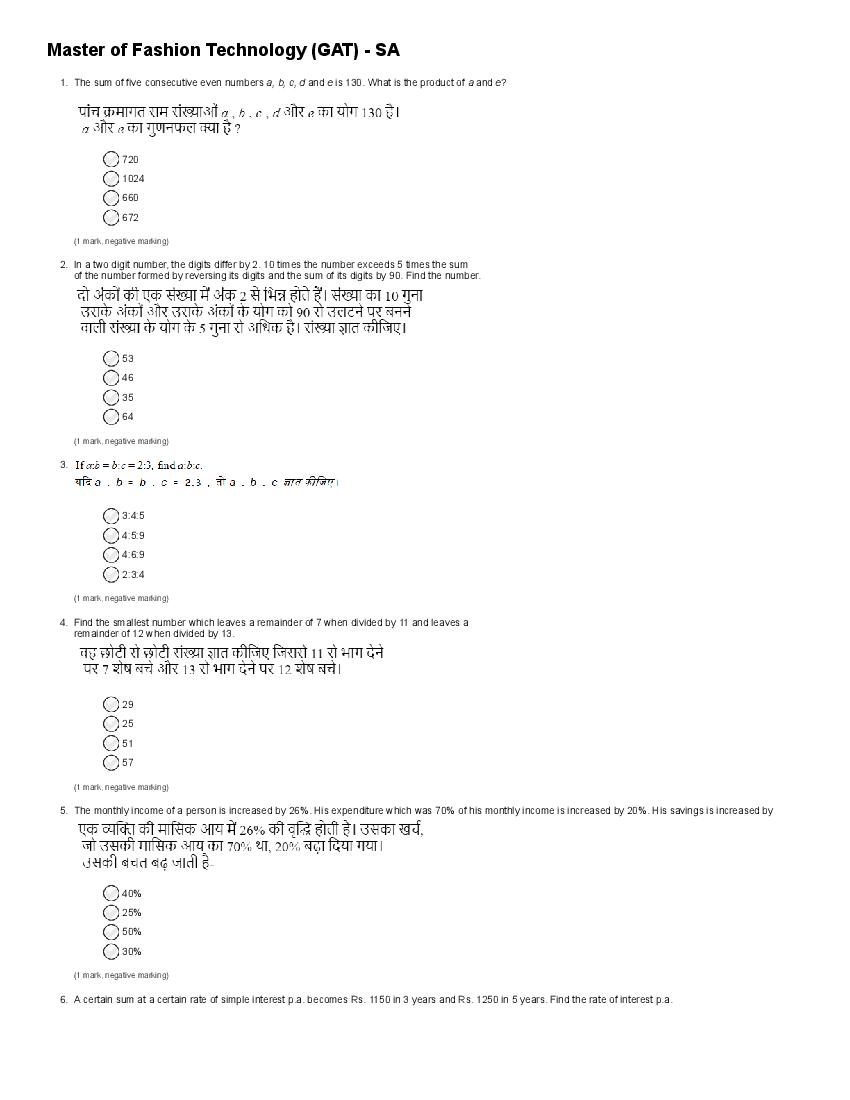
1. The sum of five consecutive even numbers a, b, c, d and e is 130. What is the product of a and e?
720
1024
660
672
2. In a two digit number, the digits differ by 2. 10 times the number exceeds 5 times the sum
of the number formed by reversing its digits and the sum of its digits by 90. Find the number.
53
46
35
64
3.
3:4:5
4:5:9
4:6:9
2:3:4
4. Find the smallest number which leaves a remainder of 7 when divided by 11 and leaves a
remainder of 12 when divided by 13.
29
25
51
57
5. The monthly income of a person is increased by 26%. His expenditure which was 70% of his monthly income is increased by 20%. His savings is increased by
40%
25%
50%
30%
6. A certain sum at a certain rate of simple interest p.a. becomes Rs. 1150 in 3 years and Rs. 1250 in 5 years. Find the rate of interest p.a.
Page 2
6.3%
6%
5%
7. The ratio of the number of boys to that of girls in a school is 9:7. If the number of boys increases by 40%, and that of girls by 20%, what will be the new ratio of boys to
girls?
3:4
3:2
2:3
4:3
8. In what time will the simple interest on a certain sum become 0.125 times the principal at 10% p.a.?
9. A person reaches to his destination by his bicycle with a speed of 15 km/hr and returns back with a speed of 10 km/hr. His average speed is
12 km/hr
11 km/hr
10km/hr
13 km/hr
10. The average weight of 17 boxes is 92 kg. If 18 new boxes are added, the new average increases by 3 kg. What will be the average weight of the 18 new boxes?
97.8 kg
91.8 kg
92.8 kg
Page 3
11. The cost of 3 tables and 4 chairs is Rs. 2500. The cost of 4 tables and 3 chairs is Rs. 2400. Find the costs of each table and each chair.
(Rs. 325, Rs. 425)
(Rs. 350, Rs. 350)
(Rs. 375, Rs. 415)
(Rs. 300, Rs. 400)
12. A person bought a certain number of chocolates at the rate of 16 chocolates for Rs. 12 and the same number of chocolates at the rate of 24 chocolates for Rs. 20. He
sold all of them at the rate of 30 chocolates for Rs. 30. Find his gain/loss percentage.
13.
(Rs. 5600, Rs. 3900)
(Rs. 5500, Rs. 4000)
(Rs. 5700, Rs. 3800)
(Rs. 5000, Rs. 4500)
14.
Page 4
Rs. 80,000
Rs. 83,500
Rs. 82,000
15. A person invests an amount of Rs. 24,200 at the rate of 4% p.a. for 6 years to obtain a simple interest. Later he invests the principal amount as well as the amount
obtained as simple interest for another 4 years at the same rate of interest. What amount of simple interest will he obtain at the end of the last 4 years?
Rs. 4850.32
Rs. 4801.28
Rs. 4800
Rs. 4700
16.
60 days
36 days
48 days
24 days
17. Find the time taken by a train 175 meters long running at a speed of 54 km/hr to overtake another train 75 meters long running at a speed of 36 km/hr.
55 seconds
45 seconds
50 seconds
Page 5
18.
19. X sold a chair to Y at 10% profit. Y sold it to Z at 20% profit. If Z bought it for Rs. 660, find the price at which X bought the chair.
Rs. 520
Rs. 500
Rs. 530
Rs. 450
20. X started a business with Rs. 20,000. After 3 months, Y joined him with Rs. 40,000. After some more months, Z joined them with Rs. 1,00,000. Y received Rs. 18,000
out of the total annual profit of Rs. 55,000. How many months after X started the business did Z join?
7.5
5.5
8
7
21. A person borrowed some money at the rate 6% p.a. for the first three years, 9% p.a. for the next five years and 13% p.a. for the period beyond eight years. If the total
interest paid by him at the end of eleven years is Rs. 8160, how much money did he borrow?
Rs. 12,000
Rs. 13,000
Rs. 10,000
Rs. 8000
22. Two vessels contain mixtures of milk and water. The ratios of milk and water are 3:10 and 4:5 in the first and second vessels respectively. In what ratio should they be
mixed so that the resulting mixture contains milk and water in the ratio 79:155?
Page 6
1:1
2:5
1:2
23. A vessel contains 400 litres of pure milk. 40 litres of milk is removed from the vessel and replaced by water. 40 litres of the mixture thus formed is again withdrawn
and replaced by water. This procedure is repeated once again. Find the percentage of milk in the resultant solution.
24. Pipes P, Q and R together can empty a full tank in 6 hours. All the three pipes are opened simultaneously and after 2 hours, P is closed. The tank is emptied in
another 6 hours. Find the time in which P can empty the tank.
9 hours
18 hours
12 hours
20 hours
25. The average monthly consumption of petrol for a car for 12 months is 160 litre. If the average monthly consumption for first 8 months is 145 litre, then the average mont
165 litre
175 litre
190 litre
180 litre
26.
If the price of tea goes up by , what should be the percentage by which its consumption must be reduced so that the expenditure on it remains unchanged?
Page 7
60%
59%
51%
55%
28. A vessel contains 60 litres of solution of milk and water having 80% milk. How much water should be added to it to make a solution in which milk forms 60%?
20 litres
30 litres
25 litres
27 litres
29. P can complete a job in 6 days working 8 hours a day. Q can complete it in 3 days working 12 hours a day. In how many days can they together complete it working 4
hours a day?
7 days
5 days
30. A contractor decided to complete a job in 30 days for which he employed 20 men in the beginning. After 10 days he realized that the job could not be completed on
time. Hence, he employed 15 more men and thus completed the job on time. Find the number of extra days it would have taken to complete the job if the additional
men were not employed.
18
8
10
Page 8
31. If RICH : 18, 9, 3, 8 :: TIME : ?
20, 13, 9, 5
21, 9, 13, 5
20, 9, 13, 5
21, 13, 9, 5
32. If all cats are dogs, some dogs are cows and some cows are
horses then which statement must be TRUE?
All dogs are horses
Some cats are horses
Some dogs may be horses
All cats are also cows
33. How many times in a day are the hands of a clock pointing opposite to each other?
24
20
22
44
34.
35. Find the odd one out.
PAGRE
Page 9
MUPL
SNUG
36. If A’s father is B, C is the father of B and D is A’s mother, then how is C related to D?
Father
Uncle
Father-in-law
Grandfather
37.
How many paths from top to bottom spell HARMONY?
18
20
24
26
38. Find the missing number: 1, 4, 27, 16, 125, 36, ?, 64
1, 4, 27, 16, 125, 36, ?, 64
49
343
334
243
39. Find the missing number: 52, 63, 94, ? 18
Page 10
21
36
25
46
40.
Tuesday
Wednesday
Friday
Thursday
41. If the code of MALE is *1%5 and that of FATE is 6185 then the code of FEMALE is
65%1*5
651*%5
65*1%5
651%*5
42. There are six persons A, B, C, D, E and F in a row. B and F are in the centre and C and D are at the ends. E is sitting on the left of C. Then who is on the left of D?
F
A
C
B
43. What is the angle between hour hand and minute hand of a clock at 9-15 p.m.?
44. Eight persons B, D, F, H, J, L, N and P are sitting around a circular table facing the centre, but not necessarily in the same order. D and H are immediate neighbours
of F. L sits third to the left of B. B is an immediate neighbour of D. J sits third to the right of P.
Page 11
Third to the left
Second to the left
Third to the right
Immediate right
45. Eight persons B, D, F, H, J, L, N and P are sitting around a circular table facing the centre, but not necessarily in the same order. D and H are immediate neighbours
of F. L sits third to the left of B. B is an immediate neighbour of D. J sits third to the right of P.
Who among the followings sits third to the left of F?
J
B
D
H
46. Eight persons B, D, F, H, J, L, N and P are sitting around a circular table facing the centre, but not necessarily in the same order. D and H are immediate neighbours
of F. L sits third to the left of B. B is an immediate neighbour of D. J sits third to the right of P.
Who among the following sits exactly between P and N?
L
F
H
J
47. Eight persons B, D, F, H, J, L, N and P are sitting around a circular table facing the centre, but not necessarily in the same order. D and H are immediate neighbours of
Which of the following pairs represents the immediate neighbours of L?
NP
BJ
PH
FP
48. Eight persons B, D, F, H, J, L, N and P are sitting around a circular table facing the centre, but not necessarily in the same order. D and H are immediate neighbours
of F. L sits third to the left of B. B is an immediate neighbour of D. J sits third to the right of P.
Page 12
Two
None
One
Three
49. Mr. V drives a car 30 km in the west and then 25 km to the left. Now every time turning to his right, he drives 15, 35 and 45 km respectively. How far is he now from
his starting point?
10 km
15 km
20 km
35 km
50. Heights of six girls A, B, C, D, E and F are different. A is taller than three girls. D is taller than E but shorter than F. F is shorter than A. B is not the tallest. The second
shortest height is 152 cm and the third tallest is 155 cm. What is the possible height of F?
160 cm
155 cm
153 cm
152 cm
51. What will be the angle between the hands of a clock at 8.10 a.m.?
52. In a class of 50 students, 15 read Physics, 20 read Chemistry and 20 read Mathematics, 3 read Physics and Chemistry, 6 read Chemistry and Mathematics and 5
read Physics and Mathematics, 7 read none of the subjects. How many students read all the three subjects?
Page 13
10
2
5
53.
350
300
200
250
54.
4
6
5
8
55. Find the missing letter in the given figure:
K
G
L
H
Page 14
The Oval
Edgbaston
Ageas Bowl
Lord’s Cricket Ground
57. Who was the first non-Congress Prime Minister in independent India?
Morarji Desai
Sankar Dayal Sharma
Charan Singh
Dr. Rajendra Prasad
58. BIMSTEC stands for
Bangladesh, India, Myanmar Scientific and Technological Economic Cooperation
Bay of Bengal Initiative for Multi-Sectoral Technical and Economic Cooperation
Bilateral and Multi-Sectoral Economic Corridor
Bangladesh, India, Myanmar, Sri Lanka, Thailand Economic Cooperation
59. Zloty is the currency of the country
Poland
Portugal
Zimbabwe
Ukraine
60. Gross Domestic Product, Gross National Product, Earned Income in foreign by citizen and
Earned Income by foreigners in a country are denoted by G, P, X and M respectively. Then
which one of the following is TRUE?
P = G + (M - X)
G = P + (X - M)
Page 15
P = G + (X - M)
61. FILL IN THE BLANKS
For a micro enterprise investment in Plant and Machinery or Equipment does not exceed ____ crore rupees and turnover does not exceed ____ crore rupees.
(1, 10)
(1, 5)
(2, 10)
(2, 5)
62. Who wrote the book ‘Rajtarangini’?
Kalhana
Vakpati
Bilhana
Banabhatta
63. How many hymns are there in RigVeda?
1028
1208
1802
1082
64. The cold and dry wind which originates over the snow-covered mountains of Alps and blows towards the Mediterranean Sea is known as
Sirrocco
Harmattan
Mistral
Chinook
65. Which of the following Biosphere Reserves is not included in UNESCO’s Man and Biosphere Reserves list?
Nilgiri
Sunderban
Simlipal
Dehang-Dibang
Page 16
12
11
9
10
67. Who is the Chairman of Indian Space Research Organisation?
Dr. K.Radhakrishnan
Dr. K.Sivan
Dr. S.Somnath
Dr. K.Kasturirangan
68. Darvaza gas crater, also known as Gateway to Hell, is located in
USA
Indonesia
Russia
Turkmenistan
69. The study of snakes, their types and distributions is known as
Phycology
Ophiology
Hematology
Odontology
70. “Cordelia” is a natural satellite of the planet
Neptune
Uranus
Jupiter
Saturn
71. The line that connects points of equal depth of water with equal temperature is known as
Isobathytherm
Isocheim
Page 17
Isober
72. The currency of Malaysia is known as
Kyat
Won
Ringgit
Peso
73. Who is Miss World at present?
Vanessa Ponce of Mexico
Toni-Ann Singh of Jamaica
Stepharie Del Valle of Puerto Rico
Manushi Chillaar of India
74. The ‘hero rat’ who detected over 100 land mines, explosives died recently is
None of these
Wagawa
Nagawa
Magawa
75. Who wrote the book “Godan”?
Shashi Tharoor
Sarojini Naidu
Premchand
Muluk Raj Anand
76. Which port is renamed as Shyama Prasad Mukherjee port?
Visakhapatnam Port
Page 18
Chennai Port
Paradip Port
77. India’s First Digital University is located in
Karnataka
Maharastra
Uttar Pradesh
Kerala
78. Abuja is the capital of the country
Nigeria
Kazakhstan
Belarus
Angola
79. The abbreviation NITI Aayog stands for
National Institution of Transforming India
National Institute of Transforming India
National Institution for Transforming India
National Institute for Transforming India
80. The Headquarter of International Labour Organisation is located at
Rome
Geneva
Moscow
Paris
81. Instruction : Read the following passage and answer the questions that follow:
Page 19
, it must be ‘ durable , distinct , divisible and portable’. When we think of money today , we picture it either as round, flat pieces of metal which we call coin or as
printed paper notes .But there are still parts of the world today where coins and notes are of no use .They will buy nothing , and a traveler might starve if he had none
of the particular local ‘money’ to exchange for food.
Aristotle said money should be :
Made of high quality material
Durable , distinct, divisible and portable
Made of metal
Paper currency
82. Instruction :Read the following passage and answer the questions that follow:
Aristotle , the Greek philosopher , summed up the four chief qualities of money .It must be lasting and easy to recognize , to divide , and to carry about. In other words
, it must be ‘ durable , distinct , divisible and portable’. When we think of money today , we picture it either as round, flat pieces of metal which we call coin or as
printed paper notes .But there are still parts of the world today where coins and notes are of no use .They will buy nothing , and a traveler might starve if he had none
of the particular local ‘money’ to exchange for food.
Now a days , we think of money as-
useful for starving travelers
Made of either metal or paper
Printed note paper only
Pieces of metal only
83. Instruction :Read the following passage and answer the questions that follow:
Aristotle , the Greek philosopher , summed up the four chief qualities of money .It must be lasting and easy to recognize , to divide , and to carry about. In other words
, it must be ‘ durable , distinct , divisible and portable’. When we think of money today , we picture it either as round, flat pieces of metal which we call coin or as
printed paper notes .But there are still parts of the world today where coins and notes are of no use .They will buy nothing , and a traveler might starve if he had none
of the particular local ‘money’ to exchange for food.
In some parts of the world a traveler might starve –
Even if he did not know the rate of exchange
Even if he had no coins or notes
Even if he had local currency
Even if he had plenty of coins and notes
84. Instruction :Read the following passage and answer the questions that follow:
Aristotle , the Greek philosopher , summed up the four chief qualities of money .It must be lasting and easy to recognize , to divide , and to carry about. In other words
, it must be ‘ durable , distinct , divisible and portable’. When we think of money today , we picture it either as round, flat pieces of metal which we call coin or as
printed paper notes .But there are still parts of the world today where coins and notes are of no use .They will buy nothing , and a traveler might starve if he had none
of the particular local ‘money’ to exchange for food.
Coins and notes are of no use in some places because –
They are not recognised
They are not as good as the local ‘money’
They are not needed
They are not easy to carry about
85. To ensure precise and forceful communication , the following expression may be replaced with the alternative given below:
“In the event of”
Although
Whatsoever
Page 20
In lieu of
86. “Superannuation” refers to-
Suspension
Appointment
Promotion
Retirement
87. “ Red-tapism” stands for –
Administrative responsibility
Organization of public personnel
unfair deal
The policy of delays in functioning
88. Instruction : Fill in up the blanks with appropriate usages -
Would you like some more.....
Cheese
Cheeses
Chesses
Choose
89. Instruction: Fill in up the blanks with appropriate usages -
Some movies like to show super....
Heroe
Heroes
Heros
Heross
90. Instruction: Fill in up the blanks with appropriate usages -
Many ...... were necessary to put out the fire.
Fireman
Firemens
Firemen
Firemans
91. Instruction : Fill in up the blanks with appropriate usages -
Come here,....., I am going to read you a story.
Childs
Children
Page 21
Childrens
92. Instruction : Fill in up the blanks with appropriate usages -
It’s winter. All the....have fallen from the trees.
Leaf
Leafes
Leaves
Leafs
93. Instruction : Fill in up the blanks with appropriate usages -
The wild..... travel in autumn.
Geese
Gooses
Geeses
Goose
94. Instruction : Fill in up the blanks with appropriate usages -
Brush your.....before you go to bed.
Teeths
Teeth
Tooths
Tooth
95. Instruction : Fill in up the blanks with appropriate usages -
I’ll buy a cat to kill the....
Mices
Mice
Mouse
Mouses
96. What is the plural form of ATROCITY:
Atroceetis
Atrocitys
Atroctes
Atrocities
97. What is the plural of SPY:
Spys
Spyes
Spies
Spy
Page 22
Assassinate
Slaughter
Murder
Stab
99. The following are the synonym of the word WHET but one word is not its synonym. Find it out.
Sharpen
Hone
Wheat
Stimulate
100. Choose the most appropriate one-word substitute for the expression given below.
‘a supporter of the cause of women’
Feminist
Feminine
Effeminate
Sophist
101. Which is the suitable expression for the voice of Puppies?
Hiss
Yelp
Warble
Grunt
102. Which of the following is spelt correctly?
convelesence
convilescence
convaelescence
convalescence
103. Which of the following is spelt correctly?
asassination
asaessination
assassination
asasination
104. Which of the following is spelt correctly?
Navsea
Nausea
Naucea
Nausia
Page 23
flageilation
flagellation
flaigelation
flageletion
106. Which of the following is spelt correctly?
Gobbledegook
Gobledegok
Gobbledeguk
Gobbledegok
107. Which of the following is spelt correctly?
Chiaroscurist
Chiarocurist
Chiaracurist
Chiarascurist
108. Instruction : Find out the correct option which gives the appropriate meaning of the given idiom/ phrase-
Cloak and dagger-
major and minor works
involving secrecy and plotting
the thought process
immediately
109. Instruction : Find out the correct option which gives the appropriate meaning of the given idiom/ phrase-
Bag of bones-
A colloquial name for fertilizers
An old fashioned workshop
Dirty place
an extremely skinny person or animal with bones showing
110. Instruction : Find out the correct option which gives the appropriate meaning of the given idiom/ phrase-
A penny for your thought -
the records of ancestors
the good wishes
to hold more meaning than one says
this is used to ask someone what the person is thinking about
Page 24
To have a whale of a time-
to feel adversity
to live in penury
to have an exciting or fun time
to give up something
112. Instruction : Find out the correct option which gives the appropriate meaning of the given idiom/ phrase-
with bated breath -
to speak like a pessimist
in a sweet tone
very anxiously or excitedly
slowly
113. Lenders to Future Retail met yesterday and took important decisions. The decided to classify the loans to the firm as a ‘non-performing asset’ after the retailer missed
payments to the banks. They also told the Supreme Court in a filing about the same since they were asked to file their replies latest by today. The lenders also said
they would be required to provision ₹80-90 billion in their books on account of the default by the retailer.
Being classified as an NPA will raise financial troubles for FRL, which has for months tried to sell its retail assets to rival Reliance Industries, but failed to do so
because of legal challenges from its partner Amazon.
Citing its dispute with Amazon, FRL last month challenged its lenders in the top court to avoid facing insolvency proceedings or being classified as a defaulter, after it
missed making certain payments on its loans.
Future has failed to complete its $3.4 billion retail asset sale as Amazon has successfully argued before legal forums that the Indian retail giant violated certain non-
compete contractual terms the two sides had. Future denies any wrongdoing.
Future has told Indian stock exchanges it was unable to pay 35 billion rupees ($470 million) it owed to its lenders on Dec.31 as it could not sell certain small stores
amid the row with Amazon. It had hoped to use a 30-day grace period to resolve the situation, but was not able to do so
FRL missed payments to the Bank
Page 25
The statement is a Minor factor for making the decisions
The statement is a Major assumption in making the decisions
The statement is a Major objective in making the decisions
114. Lenders to Future Retail met yesterday and took important decisions. The decided to classify the loans to the firm as a ‘non-performing asset’ after the retailer missed
payments to the banks. They also told the Supreme Court in a filing about the same since they were asked to file their replies latest by today. The lenders also said
they would be required to provision ₹80-90 billion in their books on account of the default by the retailer.
Being classified as an NPA will raise financial troubles for FRL, which has for months tried to sell its retail assets to rival Reliance Industries, but failed to do so
because of legal challenges from its partner Amazon.
Citing its dispute with Amazon, FRL last month challenged its lenders in the top court to avoid facing insolvency proceedings or being classified as a defaulter, after it
missed making certain payments on its loans.
Future has failed to complete its $3.4 billion retail asset sale as Amazon has successfully argued before legal forums that the Indian retail giant violated certain non-
compete contractual terms the two sides had. Future denies any wrongdoing.
Future has told Indian stock exchanges it was unable to pay 35 billion rupees ($470 million) it owed to its lenders on Dec.31 as it could not sell certain small stores
amid the row with Amazon. It had hoped to use a 30-day grace period to resolve the situation, but was not able to do so
The legal challenge created by Amazon to the FRL asset sale will take a long time to get resolved
The statement is a Major assumption in making the decisions
The statement is a Major objective in making the decisions
The statement is a Major factor for making the decisions
The statement is a Minor factor for making the decisions
115. Lenders to Future Retail met yesterday and took important decisions. The decided to classify the loans to the firm as a ‘non-performing asset’ after the retailer missed
payments to the banks. They also told the Supreme Court in a filing about the same since they were asked to file their replies latest by today. The lenders also said
they would be required to provision ₹80-90 billion in their books on account of the default by the retailer.
Page 26
because of legal challenges from its partner Amazon.
Citing its dispute with Amazon, FRL last month challenged its lenders in the top court to avoid facing insolvency proceedings or being classified as a defaulter, after it
missed making certain payments on its loans.
Future has failed to complete its $3.4 billion retail asset sale as Amazon has successfully argued before legal forums that the Indian retail giant violated certain non-
compete contractual terms the two sides had. Future denies any wrongdoing.
Future has told Indian stock exchanges it was unable to pay 35 billion rupees ($470 million) it owed to its lenders on Dec.31 as it could not sell certain small stores
amid the row with Amazon. It had hoped to use a 30-day grace period to resolve the situation, but was not able to do so
Reliance Industries will not be able to buy the assets in a short time
The statement is a Major factor for making the decisions
The statement is a Minor factor for making the decisions
The statement is a Major assumption in making the decisions
The statement is a Major objective in making the decisions
116. Lenders to Future Retail met yesterday and took important decisions. The decided to classify the loans to the firm as a ‘non-performing asset’ after the retailer missed
payments to the banks. They also told the Supreme Court in a filing about the same since they were asked to file their replies latest by today. The lenders also said
they would be required to provision ₹80-90 billion in their books on account of the default by the retailer.
Being classified as an NPA will raise financial troubles for FRL, which has for months tried to sell its retail assets to rival Reliance Industries, but failed to do so
because of legal challenges from its partner Amazon.
Citing its dispute with Amazon, FRL last month challenged its lenders in the top court to avoid facing insolvency proceedings or being classified as a defaulter, after it
missed making certain payments on its loans.
Future has failed to complete its $3.4 billion retail asset sale as Amazon has successfully argued before legal forums that the Indian retail giant violated certain non-
compete contractual terms the two sides had. Future denies any wrongdoing.
Future has told Indian stock exchanges it was unable to pay 35 billion rupees ($470 million) it owed to its lenders on Dec.31 as it could not sell certain small stores
amid the row with Amazon. It had hoped to use a 30-day grace period to resolve the situation, but was not able to do so
Page 27
The statement is a Major factor for making the decisions
The statement is a Major objective in making the decisions
The statement is a Minor factor for making the decisions
The statement is a Major assumption in making the decisions
117. Lenders to Future Retail met yesterday and took important decisions. The decided to classify the loans to the firm as a ‘non-performing asset’ after the retailer missed
payments to the banks. They also told the Supreme Court in a filing about the same since they were asked to file their replies latest by today. The lenders also said
they would be required to provision ₹80-90 billion in their books on account of the default by the retailer.
Being classified as an NPA will raise financial troubles for FRL, which has for months tried to sell its retail assets to rival Reliance Industries, but failed to do so
because of legal challenges from its partner Amazon.
Citing its dispute with Amazon, FRL last month challenged its lenders in the top court to avoid facing insolvency proceedings or being classified as a defaulter, after it
missed making certain payments on its loans.
Future has failed to complete its $3.4 billion retail asset sale as Amazon has successfully argued before legal forums that the Indian retail giant violated certain non-
compete contractual terms the two sides had. Future denies any wrongdoing.
Future has told Indian stock exchanges it was unable to pay 35 billion rupees ($470 million) it owed to its lenders on Dec.31 as it could not sell certain small stores
amid the row with Amazon. It had hoped to use a 30-day grace period to resolve the situation, but was not able to do so
Page 28
The statement is a Minor factor for making the decisions
The statement is a Major factor for making the decisions
The statement is a Major objective in making the decisions
The statement is a Major assumption in making the decisions
118. Aditya Birla Fashion and Retail Ltd (ABFRL), has announced plans to set up a platform for foraying into the Direct to Consumer (D2C) business. This is to support the
lack lustre growth in the existing business lines it is facing.
The Board has approved a proposal to set up a new subsidiary for building a portfolio of “distinct, new-age, digital brands across categories in fashion, beauty and
other allied lifestyle segments.”
“The D2C portfolio will be built through organic and inorganic means. This venture will initially be funded through ABFRL’s internal accruals. At an appropriate time,
the company will look to bring in external capital to accelerate the growth journey,” the company said in a statement. The newly incorporated entity will organically
incubate and also acquire promising and scalable D2C brands.
Other than providing growth capital, ABFRL will utilise its experience and capabilities to scale up this portfolio. Ashish Dikshit, Managing Director, ABFRL said, “We
want to build the next set of iconic brands in the digital space as we evolve with our changing consumers. Leveraging our core capabilities around design, product
creation, sourcing and brand building that have enabled us to create some of India’s most loved fashion brands in the offline space, we now wish to craft a blockbuster
portfolio in the digital space as well.” “We are confident that this foray will successfully meet the aspirations of digitally native customers [who are increasingly buying
online] and also create long-term value for investors and other stakeholders,” he added.
The company will now accelerate the process of building the D2C framework and identifying key talent for this play.
Page 29
The statement is a Major objective in making the decisions
The statement is a Major factor for making the decisions
The statement is a Minor factor for making the decisions
The statement is a Major assumption in making the decisions
119. Aditya Birla Fashion and Retail Ltd (ABFRL), has announced plans to set up a platform for foraying into the Direct to Consumer (D2C) business. This is to support the
lack lustre growth in the existing business lines it is facing.
The Board has approved a proposal to set up a new subsidiary for building a portfolio of “distinct, new-age, digital brands across categories in fashion, beauty and
other allied lifestyle segments.”
“The D2C portfolio will be built through organic and inorganic means. This venture will initially be funded through ABFRL’s internal accruals. At an appropriate time,
the company will look to bring in external capital to accelerate the growth journey,” the company said in a statement. The newly incorporated entity will organically
incubate and also acquire promising and scalable D2C brands.
Other than providing growth capital, ABFRL will utilise its experience and capabilities to scale up this portfolio. Ashish Dikshit, Managing Director, ABFRL said, “We
want to build the next set of iconic brands in the digital space as we evolve with our changing consumers. Leveraging our core capabilities around design, product
creation, sourcing and brand building that have enabled us to create some of India’s most loved fashion brands in the offline space, we now wish to craft a blockbuster
portfolio in the digital space as well.” “We are confident that this foray will successfully meet the aspirations of digitally native customers [who are increasingly buying
online] and also create long-term value for investors and other stakeholders,” he added.
The company will now accelerate the process of building the D2C framework and identifying key talent for this play.
Page 30
The statement is a Major factor in making the decisions
The statement is a Major objective in making the decisions
The statement is a Major assumption in making the decisions
The statement is a Minor factor in making the decisions
120. Aditya Birla Fashion and Retail Ltd (ABFRL), has announced plans to set up a platform for foraying into the Direct to Consumer (D2C) business. This is to support the
lack lustre growth in the existing business lines it is facing.
The Board has approved a proposal to set up a new subsidiary for building a portfolio of “distinct, new-age, digital brands across categories in fashion, beauty and
other allied lifestyle segments.”
“The D2C portfolio will be built through organic and inorganic means. This venture will initially be funded through ABFRL’s internal accruals. At an appropriate time,
the company will look to bring in external capital to accelerate the growth journey,” the company said in a statement. The newly incorporated entity will organically
incubate and also acquire promising and scalable D2C brands.
Other than providing growth capital, ABFRL will utilise its experience and capabilities to scale up this portfolio. Ashish Dikshit, Managing Director, ABFRL said, “We
want to build the next set of iconic brands in the digital space as we evolve with our changing consumers. Leveraging our core capabilities around design, product
creation, sourcing and brand building that have enabled us to create some of India’s most loved fashion brands in the offline space, we now wish to craft a blockbuster
portfolio in the digital space as well.” “We are confident that this foray will successfully meet the aspirations of digitally native customers [who are increasingly buying
online] and also create long-term value for investors and other stakeholders,” he added.
The company will now accelerate the process of building the D2C framework and identifying key talent for this play.
Page 31
The statement is a Minor factor in making the decisions
The statement is a Major assumption in making the decisions
The statement is a Major objective in making the decisions
The statement is a Major factor in making the decisions
121. Aditya Birla Fashion and Retail Ltd (ABFRL), has announced plans to set up a platform for foraying into the Direct to Consumer (D2C) business. This is to support the
lack lustre growth in the existing business lines it is facing.
The Board has approved a proposal to set up a new subsidiary for building a portfolio of “distinct, new-age, digital brands across categories in fashion, beauty and
other allied lifestyle segments.”
“The D2C portfolio will be built through organic and inorganic means. This venture will initially be funded through ABFRL’s internal accruals. At an appropriate time,
the company will look to bring in external capital to accelerate the growth journey,” the company said in a statement. The newly incorporated entity will organically
incubate and also acquire promising and scalable D2C brands.
Other than providing growth capital, ABFRL will utilise its experience and capabilities to scale up this portfolio. Ashish Dikshit, Managing Director, ABFRL said, “We
want to build the next set of iconic brands in the digital space as we evolve with our changing consumers. Leveraging our core capabilities around design, product
creation, sourcing and brand building that have enabled us to create some of India’s most loved fashion brands in the offline space, we now wish to craft a blockbuster
portfolio in the digital space as well.” “We are confident that this foray will successfully meet the aspirations of digitally native customers [who are increasingly buying
online] and also create long-term value for investors and other stakeholders,” he added.
The company will now accelerate the process of building the D2C framework and identifying key talent for this play.
Page 32
The statement is a Major objective in making the decisions
The statement is a Major assumption in making the decisions
The statement is a Major factor in making the decisions
The statement is a Minor factor in making the decisions
122. Aditya Birla Fashion and Retail Ltd (ABFRL), has announced plans to set up a platform for foraying into the Direct to Consumer (D2C) business. This is to support the
lack lustre growth in the existing business lines it is facing.
The Board has approved a proposal to set up a new subsidiary for building a portfolio of “distinct, new-age, digital brands across categories in fashion, beauty and
other allied lifestyle segments.”
“The D2C portfolio will be built through organic and inorganic means. This venture will initially be funded through ABFRL’s internal accruals. At an appropriate time,
the company will look to bring in external capital to accelerate the growth journey,” the company said in a statement. The newly incorporated entity will organically
incubate and also acquire promising and scalable D2C brands.
Other than providing growth capital, ABFRL will utilise its experience and capabilities to scale up this portfolio. Ashish Dikshit, Managing Director, ABFRL said, “We
want to build the next set of iconic brands in the digital space as we evolve with our changing consumers. Leveraging our core capabilities around design, product
creation, sourcing and brand building that have enabled us to create some of India’s most loved fashion brands in the offline space, we now wish to craft a blockbuster
portfolio in the digital space as well.” “We are confident that this foray will successfully meet the aspirations of digitally native customers [who are increasingly buying
online] and also create long-term value for investors and other stakeholders,” he added.
The company will now accelerate the process of building the D2C framework and identifying key talent for this play.
Page 33
The statement is a Major objective in making the decisions
The statement is a Major assumption in making the decisions
The statement is a Major factor in making the decisions
The statement is a Minor factor in making the decisions
123. Few companies have attracted as much praise, derision, scepticism and enthusiasm as Telsa Motors and its founder Elon Musk. How can you make sense of Tesla’s
wild strategies? The latest example is the move to create a “Gigafactory” for car batteries just outside Berlin.
Many ask the wrong questions, such as why Tesla isn’t making any money – a question appropriate for a mature business, but not a growth one. They ignore that
Tesla is like most rapid growth companies that eat up more cash flow than they produce while in the growth phase.
The big challenge to understanding Tesla’s strategy is that most of us only look at it from one level of analysis. At the level of the product, although a Tesla looks the
same as other vehicles, underneath the hood the vehicle has a fundamentally different architecture – both in terms of hardware and software. This matters because a
when incumbents face a new technology architecture, they struggle to understand and adapt.
If we lower our level of analysis to the level of components, rather than products, we see the Tesla strategy in a different light again. The bottleneck for electric
vehicles now and in the future is the batteries. If Tesla can dramatically lower the prices of batteries by manufacturing at scale, they lower the barriers to adoption for
electric vehicles. Also if they succeed, Tesla controls the biggest profit pool in the future of auto manufacturing.
Lastly, if we raise our level of analysis to the level of systems, we see Tesla in yet another light. The truth is that consumers don’t want products, they want solutions.
Most other car makers deliver products.
Page 34
Elon Musk makes wild statements
It is designed keeping in mind all levels of the business & technology
It is making losses
It is a large company
124. Few companies have attracted as much praise, derision, scepticism and enthusiasm as Telsa Motors and its founder Elon Musk. How can you make sense of Tesla’s
wild strategies? The latest example is the move to create a “Gigafactory” for car batteries just outside Berlin.
Many ask the wrong questions, such as why Tesla isn’t making any money – a question appropriate for a mature business, but not a growth one. They ignore that
Tesla is like most rapid growth companies that eat up more cash flow than they produce while in the growth phase.
The big challenge to understanding Tesla’s strategy is that most of us only look at it from one level of analysis. At the level of the product, although a Tesla looks the
same as other vehicles, underneath the hood the vehicle has a fundamentally different architecture – both in terms of hardware and software. This matters because a
when incumbents face a new technology architecture, they struggle to understand and adapt.
If we lower our level of analysis to the level of components, rather than products, we see the Tesla strategy in a different light again. The bottleneck for electric
vehicles now and in the future is the batteries. If Tesla can dramatically lower the prices of batteries by manufacturing at scale, they lower the barriers to adoption for
electric vehicles. Also if they succeed, Tesla controls the biggest profit pool in the future of auto manufacturing.
Lastly, if we raise our level of analysis to the level of systems, we see Tesla in yet another light. The truth is that consumers don’t want products, they want solutions.
Most other car makers deliver products.
Page 35
Making batteries is a great business
It feels batteries can be made cheaper in large factories
Its CEO is known for wild strategies
It is facing problem sourcing batteries
125. Few companies have attracted as much praise, derision, scepticism and enthusiasm as Telsa Motors and its founder Elon Musk. How can you make sense of Tesla’s
wild strategies? The latest example is the move to create a “Gigafactory” for car batteries just outside Berlin.
Many ask the wrong questions, such as why Tesla isn’t making any money – a question appropriate for a mature business, but not a growth one. They ignore that
Tesla is like most rapid growth companies that eat up more cash flow than they produce while in the growth phase.
The big challenge to understanding Tesla’s strategy is that most of us only look at it from one level of analysis. At the level of the product, although a Tesla looks the
same as other vehicles, underneath the hood the vehicle has a fundamentally different architecture – both in terms of hardware and software. This matters because a
when incumbents face a new technology architecture, they struggle to understand and adapt.
If we lower our level of analysis to the level of components, rather than products, we see the Tesla strategy in a different light again. The bottleneck for electric
vehicles now and in the future is the batteries. If Tesla can dramatically lower the prices of batteries by manufacturing at scale, they lower the barriers to adoption for
electric vehicles. Also if they succeed, Tesla controls the biggest profit pool in the future of auto manufacturing.
Lastly, if we raise our level of analysis to the level of systems, we see Tesla in yet another light. The truth is that consumers don’t want products, they want solutions.
Most other car makers deliver products.
Page 36
All of these
A technologically advanced car
An experience and sense of pride
A solution to solve their mobility requirement
126. Few companies have attracted as much praise, derision, scepticism and enthusiasm as Telsa Motors and its founder Elon Musk. How can you make sense of Tesla’s
wild strategies? The latest example is the move to create a “Gigafactory” for car batteries just outside Berlin.
Many ask the wrong questions, such as why Tesla isn’t making any money – a question appropriate for a mature business, but not a growth one. They ignore that
Tesla is like most rapid growth companies that eat up more cash flow than they produce while in the growth phase.
The big challenge to understanding Tesla’s strategy is that most of us only look at it from one level of analysis. At the level of the product, although a Tesla looks the
same as other vehicles, underneath the hood the vehicle has a fundamentally different architecture – both in terms of hardware and software. This matters because a
when incumbents face a new technology architecture, they struggle to understand and adapt.
If we lower our level of analysis to the level of components, rather than products, we see the Tesla strategy in a different light again. The bottleneck for electric
vehicles now and in the future is the batteries. If Tesla can dramatically lower the prices of batteries by manufacturing at scale, they lower the barriers to adoption for
electric vehicles. Also if they succeed, Tesla controls the biggest profit pool in the future of auto manufacturing.
Lastly, if we raise our level of analysis to the level of systems, we see Tesla in yet another light. The truth is that consumers don’t want products, they want solutions.
Most other car makers deliver products.
Page 37
None of the options are correct
Its sales are growing
It buys cheap raw material
Its cars are very expensive
127. Few companies have attracted as much praise, derision, scepticism and enthusiasm as Telsa Motors and its founder Elon Musk. How can you make sense of Tesla’s
wild strategies? The latest example is the move to create a “Gigafactory” for car batteries just outside Berlin.
Many ask the wrong questions, such as why Tesla isn’t making any money – a question appropriate for a mature business, but not a growth one. They ignore that
Tesla is like most rapid growth companies that eat up more cash flow than they produce while in the growth phase.
The big challenge to understanding Tesla’s strategy is that most of us only look at it from one level of analysis. At the level of the product, although a Tesla looks the
same as other vehicles, underneath the hood the vehicle has a fundamentally different architecture – both in terms of hardware and software. This matters because a
when incumbents face a new technology architecture, they struggle to understand and adapt.
If we lower our level of analysis to the level of components, rather than products, we see the Tesla strategy in a different light again. The bottleneck for electric
vehicles now and in the future is the batteries. If Tesla can dramatically lower the prices of batteries by manufacturing at scale, they lower the barriers to adoption for
electric vehicles. Also if they succeed, Tesla controls the biggest profit pool in the future of auto manufacturing.
Lastly, if we raise our level of analysis to the level of systems, we see Tesla in yet another light. The truth is that consumers don’t want products, they want solutions.
Most other car makers deliver products.
Page 38
All of these
They are not able to understand the change at all levels
They are reluctant to abandon their existing way of doing things
They are reluctant to change
128. American chip-making giant Intel is a shadow of its former self. Despite the global semiconductor shortage, which has boosted rival chipmakers, Intel is making less
money than a year ago with net income down 21% year over year to US$4.6 billion (£3.4 billion). Unfortunately, this is an ongoing trend.
Intel was the world’s largest chipmaker until 2021, when it was dethroned by Samsung. Though Samsung’s main business is memory chips, which is a different
segment of the market to Intel’s microprocessors, it is sign of Intel’s decline.
During the most recent earnings call with analysts, CEO Pat Gelsinger had to concede that the technology in Intel’s data-centre processors hadn’t been improved in
five years. “[Intel] fell behind AMD in chip design and Taiwan Semiconductor (TSMC) in manufacturing.”
Intel’s engineers – from research to design to manufacturing – have always worked as a close in-house team. In contrast, fellow US rivals like Qualcomm, Nvidia and
AMD, have either shed their manufacturing capacity or never had it in the first place. They outsource to suppliers such as TSMC and other third-party foundries in
Taiwan for the same reason that most of the stuff sold in Walmart is made in China: it’s cheaper.
When mobile took off, the chipset didn’t require as much computing power as those in a laptop or PC, since the priority was energy-saving to extend battery life on a
single charge. As Intel was in the business of selling top-quality chips for high margins, it left its rivals to supply chipsets for this new market.
Companies like TSMC doesn’t have to shoulder the risks of launching a new product. It just needs to excel in manufacturing, because if a Qualcomm product fails,
AMD’s may take off. For chip designers, on the other hand outsourcing to TSMC has gradually meant they can afford to be fast-moving and bold in product design. If
a new chip doesn’t sell, they can pull the plug without having to worry about the factory: that’s TSMC’s problem.
Unlike the above Intel needs to ensure that every product wins with enough volume to feed its network of factories, each costing billions of dollars. This has made the
company more and more conservative. And having stuck to supplying chips to PCs, servers and data centres, it is struggling to innovate. Tellingly, the company’s
gross margin – total revenue minus the cost of production – has been sliding for nearly a decade. The biggest danger for a technology company is that it’s not
developing leading-edge products fast enough, backsliding into selling commodities.
Page 39
It is not able to keep good Research scientists
It is falling behind in both design and manufacturing ability
None of the options given are correct
Its products are more expensive
129. American chip-making giant Intel is a shadow of its former self. Despite the global semiconductor shortage, which has boosted rival chipmakers, Intel is making less
money than a year ago with net income down 21% year over year to US$4.6 billion (£3.4 billion). Unfortunately, this is an ongoing trend.
Intel was the world’s largest chipmaker until 2021, when it was dethroned by Samsung. Though Samsung’s main business is memory chips, which is a different
segment of the market to Intel’s microprocessors, it is sign of Intel’s decline.
During the most recent earnings call with analysts, CEO Pat Gelsinger had to concede that the technology in Intel’s data-centre processors hadn’t been improved in
five years. “[Intel] fell behind AMD in chip design and Taiwan Semiconductor (TSMC) in manufacturing.”
Intel’s engineers – from research to design to manufacturing – have always worked as a close in-house team. In contrast, fellow US rivals like Qualcomm, Nvidia and
AMD, have either shed their manufacturing capacity or never had it in the first place. They outsource to suppliers such as TSMC and other third-party foundries in
Taiwan for the same reason that most of the stuff sold in Walmart is made in China: it’s cheaper.
When mobile took off, the chipset didn’t require as much computing power as those in a laptop or PC, since the priority was energy-saving to extend battery life on a
single charge. As Intel was in the business of selling top-quality chips for high margins, it left its rivals to supply chipsets for this new market.
Companies like TSMC doesn’t have to shoulder the risks of launching a new product. It just needs to excel in manufacturing, because if a Qualcomm product fails,
AMD’s may take off. For chip designers, on the other hand outsourcing to TSMC has gradually meant they can afford to be fast-moving and bold in product design. If
a new chip doesn’t sell, they can pull the plug without having to worry about the factory: that’s TSMC’s problem.
Unlike the above Intel needs to ensure that every product wins with enough volume to feed its network of factories, each costing billions of dollars. This has made the
company more and more conservative. And having stuck to supplying chips to PCs, servers and data centres, it is struggling to innovate. Tellingly, the company’s
gross margin – total revenue minus the cost of production – has been sliding for nearly a decade. The biggest danger for a technology company is that it’s not
developing leading-edge products fast enough, backsliding into selling commodities.
Page 40
It has become conservative and risk averse
It is making losses
It does not have factories to make new products
It is more concerned about running its existing factories which it owns
130. American chip-making giant Intel is a shadow of its former self. Despite the global semiconductor shortage, which has boosted rival chipmakers, Intel is making less
money than a year ago with net income down 21% year over year to US$4.6 billion (£3.4 billion). Unfortunately, this is an ongoing trend.
Intel was the world’s largest chipmaker until 2021, when it was dethroned by Samsung. Though Samsung’s main business is memory chips, which is a different
segment of the market to Intel’s microprocessors, it is sign of Intel’s decline.
During the most recent earnings call with analysts, CEO Pat Gelsinger had to concede that the technology in Intel’s data-centre processors hadn’t been improved in
five years. “[Intel] fell behind AMD in chip design and Taiwan Semiconductor (TSMC) in manufacturing.”
Intel’s engineers – from research to design to manufacturing – have always worked as a close in-house team. In contrast, fellow US rivals like Qualcomm, Nvidia and
AMD, have either shed their manufacturing capacity or never had it in the first place. They outsource to suppliers such as TSMC and other third-party foundries in
Taiwan for the same reason that most of the stuff sold in Walmart is made in China: it’s cheaper.
When mobile took off, the chipset didn’t require as much computing power as those in a laptop or PC, since the priority was energy-saving to extend battery life on a
single charge. As Intel was in the business of selling top-quality chips for high margins, it left its rivals to supply chipsets for this new market.
Companies like TSMC doesn’t have to shoulder the risks of launching a new product. It just needs to excel in manufacturing, because if a Qualcomm product fails,
AMD’s may take off. For chip designers, on the other hand outsourcing to TSMC has gradually meant they can afford to be fast-moving and bold in product design. If
a new chip doesn’t sell, they can pull the plug without having to worry about the factory: that’s TSMC’s problem.
Page 41
company more and more conservative. And having stuck to supplying chips to PCs, servers and data centres, it is struggling to innovate. Tellingly, the company’s
gross margin – total revenue minus the cost of production – has been sliding for nearly a decade. The biggest danger for a technology company is that it’s not
developing leading-edge products fast enough, backsliding into selling commodities.
Intel does not operate in the following segments which are growing. Which are these segments? Choose the most correct answer.
Mobile Chipsets
Chips used in Servers
Mobile chipsets & Memory chips
Memory Chips
131. American chip-making giant Intel is a shadow of its former self. Despite the global semiconductor shortage, which has boosted rival chipmakers, Intel is making less
money than a year ago with net income down 21% year over year to US$4.6 billion (£3.4 billion). Unfortunately, this is an ongoing trend.
Intel was the world’s largest chipmaker until 2021, when it was dethroned by Samsung. Though Samsung’s main business is memory chips, which is a different
segment of the market to Intel’s microprocessors, it is sign of Intel’s decline.
During the most recent earnings call with analysts, CEO Pat Gelsinger had to concede that the technology in Intel’s data-centre processors hadn’t been improved in
five years. “[Intel] fell behind AMD in chip design and Taiwan Semiconductor (TSMC) in manufacturing.”
Intel’s engineers – from research to design to manufacturing – have always worked as a close in-house team. In contrast, fellow US rivals like Qualcomm, Nvidia and
AMD, have either shed their manufacturing capacity or never had it in the first place. They outsource to suppliers such as TSMC and other third-party foundries in
Taiwan for the same reason that most of the stuff sold in Walmart is made in China: it’s cheaper.
When mobile took off, the chipset didn’t require as much computing power as those in a laptop or PC, since the priority was energy-saving to extend battery life on a
single charge. As Intel was in the business of selling top-quality chips for high margins, it left its rivals to supply chipsets for this new market.
Page 42
AMD’s may take off. For chip designers, on the other hand outsourcing to TSMC has gradually meant they can afford to be fast-moving and bold in product design. If
a new chip doesn’t sell, they can pull the plug without having to worry about the factory: that’s TSMC’s problem.
Unlike the above Intel needs to ensure that every product wins with enough volume to feed its network of factories, each costing billions of dollars. This has made the
company more and more conservative. And having stuck to supplying chips to PCs, servers and data centres, it is struggling to innovate. Tellingly, the company’s
gross margin – total revenue minus the cost of production – has been sliding for nearly a decade. The biggest danger for a technology company is that it’s not
developing leading-edge products fast enough, backsliding into selling commodities.
Intel has a high cost of manufacturing as compared to some of its competitors. Which of the following is the most correct answer ?
None of these
It owns its own factories and they are more expensive to run than other factories located in the USA
It owns its own factories & they have high cost of production as compared to vendors like TSMC
Its factories are more expensive to operate than those located in China
132. American chip-making giant Intel is a shadow of its former self. Despite the global semiconductor shortage, which has boosted rival chipmakers, Intel is making less
money than a year ago with net income down 21% year over year to US$4.6 billion (£3.4 billion). Unfortunately, this is an ongoing trend.
Intel was the world’s largest chipmaker until 2021, when it was dethroned by Samsung. Though Samsung’s main business is memory chips, which is a different
segment of the market to Intel’s microprocessors, it is sign of Intel’s decline.
Page 43
five years. “[Intel] fell behind AMD in chip design and Taiwan Semiconductor (TSMC) in manufacturing.”
Intel’s engineers – from research to design to manufacturing – have always worked as a close in-house team. In contrast, fellow US rivals like Qualcomm, Nvidia and
AMD, have either shed their manufacturing capacity or never had it in the first place. They outsource to suppliers such as TSMC and other third-party foundries in
Taiwan for the same reason that most of the stuff sold in Walmart is made in China: it’s cheaper.
When mobile took off, the chipset didn’t require as much computing power as those in a laptop or PC, since the priority was energy-saving to extend battery life on a
single charge. As Intel was in the business of selling top-quality chips for high margins, it left its rivals to supply chipsets for this new market.
Companies like TSMC doesn’t have to shoulder the risks of launching a new product. It just needs to excel in manufacturing, because if a Qualcomm product fails,
AMD’s may take off. For chip designers, on the other hand outsourcing to TSMC has gradually meant they can afford to be fast-moving and bold in product design. If
a new chip doesn’t sell, they can pull the plug without having to worry about the factory: that’s TSMC’s problem.
Unlike the above Intel needs to ensure that every product wins with enough volume to feed its network of factories, each costing billions of dollars. This has made the
company more and more conservative. And having stuck to supplying chips to PCs, servers and data centres, it is struggling to innovate. Tellingly, the company’s
gross margin – total revenue minus the cost of production – has been sliding for nearly a decade. The biggest danger for a technology company is that it’s not
developing leading-edge products fast enough, backsliding into selling commodities.
What is the biggest risk for a technology company ?
Inability to innovate
Inability to outsource
Inability to make products in cost effective manner
Inability to hire a good CEO
133. American chip-making giant Intel is a shadow of its former self. Despite the global semiconductor shortage, which has boosted rival chipmakers, Intel is making less
money than a year ago with net income down 21% year over year to US$4.6 billion (£3.4 billion). Unfortunately, this is an ongoing trend.
Page 44
segment of the market to Intel’s microprocessors, it is sign of Intel’s decline.
During the most recent earnings call with analysts, CEO Pat Gelsinger had to concede that the technology in Intel’s data-centre processors hadn’t been improved in
five years. “[Intel] fell behind AMD in chip design and Taiwan Semiconductor (TSMC) in manufacturing.”
Intel’s engineers – from research to design to manufacturing – have always worked as a close in-house team. In contrast, fellow US rivals like Qualcomm, Nvidia and
AMD, have either shed their manufacturing capacity or never had it in the first place. They outsource to suppliers such as TSMC and other third-party foundries in
Taiwan for the same reason that most of the stuff sold in Walmart is made in China: it’s cheaper.
When mobile took off, the chipset didn’t require as much computing power as those in a laptop or PC, since the priority was energy-saving to extend battery life on a
single charge. As Intel was in the business of selling top-quality chips for high margins, it left its rivals to supply chipsets for this new market.
Companies like TSMC doesn’t have to shoulder the risks of launching a new product. It just needs to excel in manufacturing, because if a Qualcomm product fails,
AMD’s may take off. For chip designers, on the other hand outsourcing to TSMC has gradually meant they can afford to be fast-moving and bold in product design. If
a new chip doesn’t sell, they can pull the plug without having to worry about the factory: that’s TSMC’s problem.
Unlike the above Intel needs to ensure that every product wins with enough volume to feed its network of factories, each costing billions of dollars. This has made the
company more and more conservative. And having stuck to supplying chips to PCs, servers and data centres, it is struggling to innovate. Tellingly, the company’s
gross margin – total revenue minus the cost of production – has been sliding for nearly a decade. The biggest danger for a technology company is that it’s not
developing leading-edge products fast enough, backsliding into selling commodities.
How are Chip manufacturing vendors like TSMC able to handle the risk of failed products of their customers ?
By having alternate customers to utilise their production capacity
By not being involved in designing them
By not entering into contracts until very sure
None of the options given
Page 45
26.4% after quarterly figures disappointed investors. Meta also said that Facebook's daily active users (DAUs) had dropped for the first time in its 18-year history. That
came after Meta revealed that Facebook's DAUs fell to 1.929bn in the three months to the end of December, compared to 1.930bn in the previous quarter.
It was the first time ever that this measure of activity on the world's biggest social network had gone into reverse. Meta also warned of slowing revenue growth in the
face of competition from rival platforms including TikTok and YouTube, while advertisers were also cutting spending.
Meta, which owns the world's second largest digital advertising platform after Google, also said it had been hit by privacy changes on Apple's operating system. The
changes, which make it harder for brands to target and measure their advertising on Facebook and Instagram, could have an impact "in the order of $10bn" for this
year, the firm said.
Meta's rivals, like TikTok, are also attracting younger audiences. And user growth has stagnated around the world.
There are bigger longer term issues too.
Meta makes money from advertising. Yet the company's name has been changed to mark a concept - the Metaverse - a thing that doesn't exist yet and won't do for
years. Mark Zuckerberg, it's CEO is committed to spending tens of billions of dollars on the project, even though evidence that people actually want to live their lives in
virtual reality is scant.
Meta Platforms share price fell because .... Choose the best possible answer.
All of the options given
Its usage is decreasing
Its investors have less faith in its long term vision
Poor outlook in revenue growth
135. Facebook's owner Meta Platforms saw its stock market value slump by more than $230bn (£169bn) on Thursday, in a record daily loss for a US firm. Its shares fell
26.4% after quarterly figures disappointed investors. Meta also said that Facebook's daily active users (DAUs) had dropped for the first time in its 18-year history. That
came after Meta revealed that Facebook's DAUs fell to 1.929bn in the three months to the end of December, compared to 1.930bn in the previous quarter.
It was the first time ever that this measure of activity on the world's biggest social network had gone into reverse. Meta also warned of slowing revenue growth in the
face of competition from rival platforms including TikTok and YouTube, while advertisers were also cutting spending.
Meta, which owns the world's second largest digital advertising platform after Google, also said it had been hit by privacy changes on Apple's operating system. The
changes, which make it harder for brands to target and measure their advertising on Facebook and Instagram, could have an impact "in the order of $10bn" for this
year, the firm said.
Meta's rivals, like TikTok, are also attracting younger audiences. And user growth has stagnated around the world.
There are bigger longer term issues too.
Meta makes money from advertising. Yet the company's name has been changed to mark a concept - the Metaverse - a thing that doesn't exist yet and won't do for
years. Mark Zuckerberg, it's CEO is committed to spending tens of billions of dollars on the project, even though evidence that people actually want to live their lives in
Page 46
What is the long term issue faced by Meta ?
Its new plans are virtual
Its revenues are lower than previous year
Its new name is not popular
None of the options given are correct
136. Facebook's owner Meta Platforms saw its stock market value slump by more than $230bn (£169bn) on Thursday, in a record daily loss for a US firm. Its shares fell
26.4% after quarterly figures disappointed investors. Meta also said that Facebook's daily active users (DAUs) had dropped for the first time in its 18-year history. That
came after Meta revealed that Facebook's DAUs fell to 1.929bn in the three months to the end of December, compared to 1.930bn in the previous quarter.
It was the first time ever that this measure of activity on the world's biggest social network had gone into reverse. Meta also warned of slowing revenue growth in the
face of competition from rival platforms including TikTok and YouTube, while advertisers were also cutting spending.
Meta, which owns the world's second largest digital advertising platform after Google, also said it had been hit by privacy changes on Apple's operating system. The
changes, which make it harder for brands to target and measure their advertising on Facebook and Instagram, could have an impact "in the order of $10bn" for this
year, the firm said.
Meta's rivals, like TikTok, are also attracting younger audiences. And user growth has stagnated around the world.
There are bigger longer term issues too.
Meta makes money from advertising. Yet the company's name has been changed to mark a concept - the Metaverse - a thing that doesn't exist yet and won't do for
years. Mark Zuckerberg, it's CEO is committed to spending tens of billions of dollars on the project, even though evidence that people actually want to live their lives in
virtual reality is scant.
Page 47
Its policies affect the advertising ability of Meta
It is a competitor
It is just an alibi
Meta's CEO does not like Apple
137. Facebook's owner Meta Platforms saw its stock market value slump by more than $230bn (£169bn) on Thursday, in a record daily loss for a US firm. Its shares fell
26.4% after quarterly figures disappointed investors. Meta also said that Facebook's daily active users (DAUs) had dropped for the first time in its 18-year history. That
came after Meta revealed that Facebook's DAUs fell to 1.929bn in the three months to the end of December, compared to 1.930bn in the previous quarter.
It was the first time ever that this measure of activity on the world's biggest social network had gone into reverse. Meta also warned of slowing revenue growth in the
face of competition from rival platforms including TikTok and YouTube, while advertisers were also cutting spending.
Meta, which owns the world's second largest digital advertising platform after Google, also said it had been hit by privacy changes on Apple's operating system. The
changes, which make it harder for brands to target and measure their advertising on Facebook and Instagram, could have an impact "in the order of $10bn" for this
year, the firm said.
Meta's rivals, like TikTok, are also attracting younger audiences. And user growth has stagnated around the world.
There are bigger longer term issues too.
Meta makes money from advertising. Yet the company's name has been changed to mark a concept - the Metaverse - a thing that doesn't exist yet and won't do for
years. Mark Zuckerberg, it's CEO is committed to spending tens of billions of dollars on the project, even though evidence that people actually want to live their lives in
virtual reality is scant.
Page 48
It does not exist today
We can say nothing about it
It is related to Virtual reality
It does not exist and is related to Virtual reality
138. For many people who live in cities, parks are an important part of the landscape. They provide a place for people to relax and play sports, as well as a refuge from the
often harsh environment of a city. What people often overlook is that parks also provide considerable environmental benefits.
One benefit of parks is that plants absorb carbon dioxide—a key pollutant—and emit oxygen, which humans need to breathe. According to one study, an acre of trees
can absorb the same amount
of carbon dioxide that a typical car emits in 11,000 miles of driving. Parks also make cities cooler. Scientists have long noted what is called the Urban Heat Island
Effect: building materials such as metal, concrete, and asphalt absorb much more of the sun’s heat and release it much more quickly than organic surfaces like trees
and grass. Because city landscapes contain so much of these building materials, cities are usually warmer than surrounding rural areas. Parks and other green
spaces help to mitigate the Urban Heat Island Effect.
Unfortunately, many cities cannot easily create more parks because most land is already being
used for buildings, roads, parking lots, and other essential parts of the urban environment. However, cities could benefit from many of the positive effects of parks by
encouraging citizens to create another type of green space: rooftop gardens. While most people would not think of starting a garden on their roof, human beings have
been planting gardens on rooftops for thousands of years. Some rooftop gardens are very complex and require complicated engineering, but others are simple
container gardens that anyone can create with the investment of a few hundred dollars and a few hours of work. Rooftop gardens provide many of the same benefits
as other urban park and garden spaces, but without taking up the much-needed land. Like parks, rooftop gardens help to replace carbon dioxide in the air with
nourishing oxygen. They also help to lessen the Urban Heat Island Effect, which can save people
money. In the summer, rooftop gardens prevent buildings from absorbing heat from the sun, which can
significantly reduce cooling bills. In the winter, gardens help hold in the heat that materials like brick and concrete radiate so quickly, leading to savings on heating
bills. Rooftop vegetable and herb gardens can also provide fresh food for city dwellers, saving them money and making their diets healthier. Rooftop gardens are not
only something everyone can enjoy, they are also a smart environmental investment.
Based on its use in paragraph 2, it can be inferred that the word mitigate belongs to which of the following word groups?
allay, alleviate, reduce
exacerbate, aggravate, intensify
obliterate, destroy, annihilate
absorb, intake, consume
139. For many people who live in cities, parks are an important part of the landscape. They provide a place for people to relax and play sports, as well as a refuge from the
often harsh environment of a city. What people often overlook is that parks also provide considerable environmental benefits.
Page 49
can absorb the same amount
of carbon dioxide that a typical car emits in 11,000 miles of driving. Parks also make cities cooler. Scientists have long noted what is called the Urban Heat Island
Effect: building materials such as metal, concrete, and asphalt absorb much more of the sun’s heat and release it much more quickly than organic surfaces like trees
and grass. Because city landscapes contain so much of these building materials, cities are usually warmer than surrounding rural areas. Parks and other green
spaces help to mitigate the Urban Heat Island Effect.
Unfortunately, many cities cannot easily create more parks because most land is already being
used for buildings, roads, parking lots, and other essential parts of the urban environment. However, cities could benefit from many of the positive effects of parks by
encouraging citizens to create another type of green space: rooftop gardens. While most people would not think of starting a garden on their roof, human beings have
been planting gardens on rooftops for thousands of years. Some rooftop gardens are very complex and require complicated engineering, but others are simple
container gardens that anyone can create with the investment of a few hundred dollars and a few hours of work. Rooftop gardens provide many of the same benefits
as other urban park and garden spaces, but without taking up the much-needed land. Like parks, rooftop gardens help to replace carbon dioxide in the air with
nourishing oxygen. They also help to lessen the Urban Heat Island Effect, which can save people
money. In the summer, rooftop gardens prevent buildings from absorbing heat from the sun, which can
significantly reduce cooling bills. In the winter, gardens help hold in the heat that materials like brick and concrete radiate so quickly, leading to savings on heating
bills. Rooftop vegetable and herb gardens can also provide fresh food for city dwellers, saving them money and making their diets healthier. Rooftop gardens are not
only something everyone can enjoy, they are also a smart environmental investment.
Using information in paragraph 2 as a guide, it can be inferred that
some plants are not suitable for growth in rooftop gardens
most people prefer life in the country over life in the city
cities with rooftop gardens are cooler than those without
most people prefer parks to rooftop gardens
140. For many people who live in cities, parks are an important part of the landscape. They provide a place for people to relax and play sports, as well as a refuge from the
often harsh environment of a city. What people often overlook is that parks also provide considerable environmental benefits.
One benefit of parks is that plants absorb carbon dioxide—a key pollutant—and emit oxygen, which humans need to breathe. According to one study, an acre of trees
can absorb the same amount
of carbon dioxide that a typical car emits in 11,000 miles of driving. Parks also make cities cooler. Scientists have long noted what is called the Urban Heat Island
Effect: building materials such as metal, concrete, and asphalt absorb much more of the sun’s heat and release it much more quickly than organic surfaces like trees
and grass. Because city landscapes contain so much of these building materials, cities are usually warmer than surrounding rural areas. Parks and other green
spaces help to mitigate the Urban Heat Island Effect.
Unfortunately, many cities cannot easily create more parks because most land is already being
used for buildings, roads, parking lots, and other essential parts of the urban environment. However, cities could benefit from many of the positive effects of parks by
encouraging citizens to create another type of green space: rooftop gardens. While most people would not think of starting a garden on their roof, human beings have
been planting gardens on rooftops for thousands of years. Some rooftop gardens are very complex and require complicated engineering, but others are simple
container gardens that anyone can create with the investment of a few hundred dollars and a few hours of work. Rooftop gardens provide many of the same benefits
as other urban park and garden spaces, but without taking up the much-needed land. Like parks, rooftop gardens help to replace carbon dioxide in the air with
nourishing oxygen. They also help to lessen the Urban Heat Island Effect, which can save people
money. In the summer, rooftop gardens prevent buildings from absorbing heat from the sun, which can
significantly reduce cooling bills. In the winter, gardens help hold in the heat that materials like brick and concrete radiate so quickly, leading to savings on heating
bills. Rooftop vegetable and herb gardens can also provide fresh food for city dwellers, saving them money and making their diets healthier. Rooftop gardens are not
only something everyone can enjoy, they are also a smart environmental investment.
According to the passage, the Urban Heat Island Effect is caused by the fact(s) that
I. cities are warmer than nearby rural areas
II. building materials absorb more of the sun’s heat than organic surfaces
III. building materials release the sun’s heat more quickly than organic surfaces
I only
I, II, and III
I and II only
II and III only
141. For many people who live in cities, parks are an important part of the landscape. They provide a place for people to relax and play sports, as well as a refuge from the
often harsh environment of a city. What people often overlook is that parks also provide considerable environmental benefits.
One benefit of parks is that plants absorb carbon dioxide—a key pollutant—and emit oxygen, which humans need to breathe. According to one study, an acre of trees
can absorb the same amount
of carbon dioxide that a typical car emits in 11,000 miles of driving. Parks also make cities cooler. Scientists have long noted what is called the Urban Heat Island
Effect: building materials such as metal, concrete, and asphalt absorb much more of the sun’s heat and release it much more quickly than organic surfaces like trees
and grass. Because city landscapes contain so much of these building materials, cities are usually warmer than surrounding rural areas. Parks and other green
spaces help to mitigate the Urban Heat Island Effect.
Unfortunately, many cities cannot easily create more parks because most land is already being
used for buildings, roads, parking lots, and other essential parts of the urban environment. However, cities could benefit from many of the positive effects of parks by
encouraging citizens to create another type of green space: rooftop gardens. While most people would not think of starting a garden on their roof, human beings have
been planting gardens on rooftops for thousands of years. Some rooftop gardens are very complex and require complicated engineering, but others are simple
container gardens that anyone can create with the investment of a few hundred dollars and a few hours of work. Rooftop gardens provide many of the same benefits
as other urban park and garden spaces, but without taking up the much-needed land. Like parks, rooftop gardens help to replace carbon dioxide in the air with
nourishing oxygen. They also help to lessen the Urban Heat Island Effect, which can save people
money. In the summer, rooftop gardens prevent buildings from absorbing heat from the sun, which can
significantly reduce cooling bills. In the winter, gardens help hold in the heat that materials like brick and concrete radiate so quickly, leading to savings on heating
bills. Rooftop vegetable and herb gardens can also provide fresh food for city dwellers, saving them money and making their diets healthier. Rooftop gardens are not
only something everyone can enjoy, they are also a smart environmental investment.
Which of the following accurately describes the main difference between parks and rooftop gardens
as outlined in the passage?
Page 50
Parks absorb heat while rooftop gardens do not.
Parks are public while rooftop gardens are private.
Parks are expensive to create while rooftop gardens are not.
142. For many people who live in cities, parks are an important part of the landscape. They provide a place for people to relax and play sports, as well as a refuge from the
often harsh environment of a city. What people often overlook is that parks also provide considerable environmental benefits.
One benefit of parks is that plants absorb carbon dioxide—a key pollutant—and emit oxygen, which humans need to breathe. According to one study, an acre of trees
can absorb the same amount
of carbon dioxide that a typical car emits in 11,000 miles of driving. Parks also make cities cooler. Scientists have long noted what is called the Urban Heat Island
Effect: building materials such as metal, concrete, and asphalt absorb much more of the sun’s heat and release it much more quickly than organic surfaces like trees
and grass. Because city landscapes contain so much of these building materials, cities are usually warmer than surrounding rural areas. Parks and other green
spaces help to mitigate the Urban Heat Island Effect.
Unfortunately, many cities cannot easily create more parks because most land is already being
used for buildings, roads, parking lots, and other essential parts of the urban environment. However, cities could benefit from many of the positive effects of parks by
encouraging citizens to create another type of green space: rooftop gardens. While most people would not think of starting a garden on their roof, human beings have
been planting gardens on rooftops for thousands of years. Some rooftop gardens are very complex and require complicated engineering, but others are simple
container gardens that anyone can create with the investment of a few hundred dollars and a few hours of work. Rooftop gardens provide many of the same benefits
as other urban park and garden spaces, but without taking up the much-needed land. Like parks, rooftop gardens help to replace carbon dioxide in the air with
nourishing oxygen. They also help to lessen the Urban Heat Island Effect, which can save people
money. In the summer, rooftop gardens prevent buildings from absorbing heat from the sun, which can
significantly reduce cooling bills. In the winter, gardens help hold in the heat that materials like brick and concrete radiate so quickly, leading to savings on heating
bills. Rooftop vegetable and herb gardens can also provide fresh food for city dwellers, saving them money and making their diets healthier. Rooftop gardens are not
only something everyone can enjoy, they are also a smart environmental investment.
The author claims all of the following to be benefits of rooftop gardens EXCEPT
better food for city dwellers
increased space for private relaxation
improved air quality
savings on heating and cooling costs
143. For many people who live in cities, parks are an important part of the landscape. They provide a place for people to relax and play sports, as well as a refuge from the
often harsh environment of a city. What people often overlook is that parks also provide considerable environmental benefits.
One benefit of parks is that plants absorb carbon dioxide—a key pollutant—and emit oxygen, which humans need to breathe. According to one study, an acre of trees
can absorb the same amount
of carbon dioxide that a typical car emits in 11,000 miles of driving. Parks also make cities cooler. Scientists have long noted what is called the Urban Heat Island
Effect: building materials such as metal, concrete, and asphalt absorb much more of the sun’s heat and release it much more quickly than organic surfaces like trees
and grass. Because city landscapes contain so much of these building materials, cities are usually warmer than surrounding rural areas. Parks and other green
spaces help to mitigate the Urban Heat Island Effect.
Unfortunately, many cities cannot easily create more parks because most land is already being
used for buildings, roads, parking lots, and other essential parts of the urban environment. However, cities could benefit from many of the positive effects of parks by
encouraging citizens to create another type of green space: rooftop gardens. While most people would not think of starting a garden on their roof, human beings have
been planting gardens on rooftops for thousands of years. Some rooftop gardens are very complex and require complicated engineering, but others are simple
container gardens that anyone can create with the investment of a few hundred dollars and a few hours of work. Rooftop gardens provide many of the same benefits
as other urban park and garden spaces, but without taking up the much-needed land. Like parks, rooftop gardens help to replace carbon dioxide in the air with
nourishing oxygen. They also help to lessen the Urban Heat Island Effect, which can save people
money. In the summer, rooftop gardens prevent buildings from absorbing heat from the sun, which can
significantly reduce cooling bills. In the winter, gardens help hold in the heat that materials like brick and concrete radiate so quickly, leading to savings on heating
bills. Rooftop vegetable and herb gardens can also provide fresh food for city dwellers, saving them money and making their diets healthier. Rooftop gardens are not
only something everyone can enjoy, they are also a smart environmental investment.
According to the author, one advantage that rooftop gardens have over parks is that they
decrease the Urban Heat Island Effect
are less expensive than traditional park spaces
do not require the use of valuable urban land
replenish the air with nourishing oxygen
144. For many people who live in cities, parks are an important part of the landscape. They provide a place for people to relax and play sports, as well as a refuge from the
often harsh environment of a city. What people often overlook is that parks also provide considerable environmental benefits.
One benefit of parks is that plants absorb carbon dioxide—a key pollutant—and emit oxygen, which humans need to breathe. According to one study, an acre of trees
can absorb the same amount
of carbon dioxide that a typical car emits in 11,000 miles of driving. Parks also make cities cooler. Scientists have long noted what is called the Urban Heat Island
Effect: building materials such as metal, concrete, and asphalt absorb much more of the sun’s heat and release it much more quickly than organic surfaces like trees
and grass. Because city landscapes contain so much of these building materials, cities are usually warmer than surrounding rural areas. Parks and other green
spaces help to mitigate the Urban Heat Island Effect.
Unfortunately, many cities cannot easily create more parks because most land is already being
used for buildings, roads, parking lots, and other essential parts of the urban environment. However, cities could benefit from many of the positive effects of parks by
encouraging citizens to create another type of green space: rooftop gardens. While most people would not think of starting a garden on their roof, human beings have
been planting gardens on rooftops for thousands of years. Some rooftop gardens are very complex and require complicated engineering, but others are simple
container gardens that anyone can create with the investment of a few hundred dollars and a few hours of work. Rooftop gardens provide many of the same benefits
as other urban park and garden spaces, but without taking up the much-needed land. Like parks, rooftop gardens help to replace carbon dioxide in the air with
nourishing oxygen. They also help to lessen the Urban Heat Island Effect, which can save people
money. In the summer, rooftop gardens prevent buildings from absorbing heat from the sun, which can
Page 51
bills. Rooftop vegetable and herb gardens can also provide fresh food for city dwellers, saving them money and making their diets healthier. Rooftop gardens are not
only something everyone can enjoy, they are also a smart environmental investment.
Which of the following pieces of information would, if true, most weaken the author's claim that
rooftop gardens are good for the environment?
Extremely high winds atop tall city buildings can severely damage some plants.
More pollution is produced during rooftop garden construction than rooftop plants can remove
from the air.
Parks have many benefits that rooftop gardens do not share.
The overall environmental benefits that result from driving less exceed those of planting a rooftop
garden.
145. For many people who live in cities, parks are an important part of the landscape. They provide a place for people to relax and play sports, as well as a refuge from the
often harsh environment of a city. What people often overlook is that parks also provide considerable environmental benefits.
One benefit of parks is that plants absorb carbon dioxide—a key pollutant—and emit oxygen, which humans need to breathe. According to one study, an acre of trees
can absorb the same amount
of carbon dioxide that a typical car emits in 11,000 miles of driving. Parks also make cities cooler. Scientists have long noted what is called the Urban Heat Island
Effect: building materials such as metal, concrete, and asphalt absorb much more of the sun’s heat and release it much more quickly than organic surfaces like trees
and grass. Because city landscapes contain so much of these building materials, cities are usually warmer than surrounding rural areas. Parks and other green
spaces help to mitigate the Urban Heat Island Effect.
Unfortunately, many cities cannot easily create more parks because most land is already being
used for buildings, roads, parking lots, and other essential parts of the urban environment. However, cities could benefit from many of the positive effects of parks by
encouraging citizens to create another type of green space: rooftop gardens. While most people would not think of starting a garden on their roof, human beings have
been planting gardens on rooftops for thousands of years. Some rooftop gardens are very complex and require complicated engineering, but others are simple
container gardens that anyone can create with the investment of a few hundred dollars and a few hours of work. Rooftop gardens provide many of the same benefits
as other urban park and garden spaces, but without taking up the much-needed land. Like parks, rooftop gardens help to replace carbon dioxide in the air with
nourishing oxygen. They also help to lessen the Urban Heat Island Effect, which can save people
money. In the summer, rooftop gardens prevent buildings from absorbing heat from the sun, which can
significantly reduce cooling bills. In the winter, gardens help hold in the heat that materials like brick and concrete radiate so quickly, leading to savings on heating
bills. Rooftop vegetable and herb gardens can also provide fresh food for city dwellers, saving them money and making their diets healthier. Rooftop gardens are not
only something everyone can enjoy, they are also a smart environmental investment.
Which of the following best describes the organization of the passage?
A viewpoint is established and then defended.
A hypothesis is stated and then analyzed.
A thesis is presented and then supported.
A proposal is evaluated and alternatives are explored.
146. For many people who live in cities, parks are an important part of the landscape. They provide a place for people to relax and play sports, as well as a refuge from the
often harsh environment of a city. What people often overlook is that parks also provide considerable environmental benefits.
One benefit of parks is that plants absorb carbon dioxide—a key pollutant—and emit oxygen, which humans need to breathe. According to one study, an acre of trees
can absorb the same amount
of carbon dioxide that a typical car emits in 11,000 miles of driving. Parks also make cities cooler. Scientists have long noted what is called the Urban Heat Island
Effect: building materials such as metal, concrete, and asphalt absorb much more of the sun’s heat and release it much more quickly than organic surfaces like trees
and grass. Because city landscapes contain so much of these building materials, cities are usually warmer than surrounding rural areas. Parks and other green
spaces help to mitigate the Urban Heat Island Effect.
Unfortunately, many cities cannot easily create more parks because most land is already being
used for buildings, roads, parking lots, and other essential parts of the urban environment. However, cities could benefit from many of the positive effects of parks by
encouraging citizens to create another type of green space: rooftop gardens. While most people would not think of starting a garden on their roof, human beings have
been planting gardens on rooftops for thousands of years. Some rooftop gardens are very complex and require complicated engineering, but others are simple
container gardens that anyone can create with the investment of a few hundred dollars and a few hours of work. Rooftop gardens provide many of the same benefits
as other urban park and garden spaces, but without taking up the much-needed land. Like parks, rooftop gardens help to replace carbon dioxide in the air with
nourishing oxygen. They also help to lessen the Urban Heat Island Effect, which can save people
money. In the summer, rooftop gardens prevent buildings from absorbing heat from the sun, which can
significantly reduce cooling bills. In the winter, gardens help hold in the heat that materials like brick and concrete radiate so quickly, leading to savings on heating
bills. Rooftop vegetable and herb gardens can also provide fresh food for city dwellers, saving them money and making their diets healthier. Rooftop gardens are not
only something everyone can enjoy, they are also a smart environmental investment.
Based on information in the passage, it can be inferred that the author would most likely endorse a
program that
offered free admission to schools willing to take their students on field trips to the city park
promised vacation getaways to cooler destinations for those trapped in the city at the peak of
summer
extended discounts on plants to customers who use them to create rooftop gardens
permitted the construction of buildings in city park land provided they have rooftop gardens
147. Architecture, like design or fashion, is often hard for people to perceive as an art form, for so much of it is wrapped up not only in purely aesthetic terms—
appearances, colors, beauty—but also in feats of engineering. That is, form in architecture, by definition, has to follow function. Take the skyscraper. It is necessarily
tall because of the limited amount of space on Earth. Its form—that is its impressive height—follows its function: to fit as much building as possible into a small lot. But
the architect takes it further. Instead of merely building a lifeless, monolithic structure, she inserts art into the design, so that each skyscraper has its own character, its
own ambience, its own
Page 52
structures stretch into the sky a mere ten blocks from each other in Midtown Manhattan. Their functions are the same, but both solve the problems of function
differently and using radically contrasting forms.
As used in the middle of the passage, the word monolithic most nearly means
huge and drab
cheery and opulent
giant and inventive
characterless and unimpressive
148. Architecture, like design or fashion, is often hard for people to perceive as an art form, for so much of it is wrapped up not only in purely aesthetic terms—
appearances, colors, beauty—but also in feats of engineering. That is, form in architecture, by definition, has to follow function. Take the skyscraper. It is necessarily
tall because of the limited amount of space on Earth. Its form—that is its impressive height—follows its function: to fit as much building as possible into a small lot. But
the architect takes it further. Instead of merely building a lifeless, monolithic structure, she inserts art into the design, so that each skyscraper has its own character, its
own ambience, its own
essence. Thus, the Chrysler Building, with its art deco façade, presents a stark contrast to the functional modernism of the Seagram Building, even though both
structures stretch into the sky a mere ten blocks from each other in Midtown Manhattan. Their functions are the same, but both solve the problems of function
differently and using radically contrasting forms.
It can be inferred from the passage that the author considers design and fashion to
be something not worth studying
involve no engineering skills or insight
be art forms that also involve functionality
not be forms of art or aesthetics
149. Architecture, like design or fashion, is often hard for people to perceive as an art form, for so much of it is wrapped up not only in purely aesthetic terms—
appearances, colors, beauty—but also in feats of engineering. That is, form in architecture, by definition, has to follow function. Take the skyscraper. It is necessarily
tall because of the limited amount of space on Earth. Its form—that is its impressive height—follows its function: to fit as much building as possible into a small lot. But
the architect takes it further. Instead of merely building a lifeless, monolithic structure, she inserts art into the design, so that each skyscraper has its own character, its
own ambience, its own
essence. Thus, the Chrysler Building, with its art deco façade, presents a stark contrast to the functional modernism of the Seagram Building, even though both
structures stretch into the sky a mere ten blocks from each other in Midtown Manhattan. Their functions are the same, but both solve the problems of function
differently and using radically contrasting forms.
The author primarily sees an architect’s task as
a race against the clock
a balancing act
an impressive feat
a purely artistic job
150. Architecture, like design or fashion, is often hard for people to perceive as an art form, for so much of it is wrapped up not only in purely aesthetic terms—
appearances, colors, beauty—but also in feats of engineering. That is, form in architecture, by definition, has to follow function. Take the skyscraper. It is necessarily
tall because of the limited amount of space on Earth. Its form—that is its impressive height—follows its function: to fit as much building as possible into a small lot. But
the architect takes it further. Instead of merely building a lifeless, monolithic structure, she inserts art into the design, so that each skyscraper has its own character, its
own ambience, its own
essence. Thus, the Chrysler Building, with its art deco façade, presents a stark contrast to the functional modernism of the Seagram Building, even though both
structures stretch into the sky a mere ten blocks from each other in Midtown Manhattan. Their functions are the same, but both solve the problems of function
differently and using radically contrasting forms.
Based on their description in the passage, which of the following is a true statement concerning the
Chrysler Building and the Seagram Building?
While the Chrysler Building is purely impractical, the Seagram Building is more functional.
One building solves the problem of a lack of space in a more innovative way than the other, but
both buildings are similar in style and form.
While the Seagram Building makes use of an art deco design scheme, the Chrysler Building is
more purely functional and modern.
Though similar in function and location, the two buildings are dissimilar in appearance and style.
Document Details
| Board / Org | NIFT |
| Exam | National Institute of Fashion Technology Entrance Examination |
| Type | Sample Paper |
| Pages | 52 |
| Updated | 30 Apr 2026 |