NIFT Sample Paper 2022 for MFM
Finished viewing? Save it for later —
Download NIFT Sample Paper 2022 for MFM (PDF · 81 pages)About NIFT Sample Paper 2022 for MFM
NIFT Sample Paper 2022 for MFM is available here for free download. Published by NIFT for National Institute of Fashion Technology Entrance Examination, this sample paper can be viewed online or downloaded as a PDF (81 pages). Candidates preparing for National Institute of Fashion Technology Entrance Examination can use NIFT Sample Paper 2022 for MFM to understand the exam pattern, the type of questions asked, and the overall difficulty level.
Frequently Asked Questions
How can I download NIFT Sample Paper 2022 for MFM?
Open this page and click the Download button to save NIFT Sample Paper 2022 for MFM as a PDF. It is completely free on AglaSem Docs.
Is NIFT Sample Paper 2022 for MFM free to download?
Yes. NIFT Sample Paper 2022 for MFM can be viewed online and downloaded as a PDF free of cost on AglaSem Docs.
How many pages does NIFT Sample Paper 2022 for MFM have?
NIFT Sample Paper 2022 for MFM contains 81 pages, which you can read online or download together as a single PDF.
Where can I find more National Institute of Fashion Technology Entrance Examination study material?
You can find more National Institute of Fashion Technology Entrance Examination question papers, sample papers, syllabus, and answer keys on AglaSem Docs.
NIFT Sample Paper 2022 for MFM – Text
Read the full text of this sample paper below — useful to quickly search, copy and reference the content online without downloading the PDF.
📄 View text version (81 pages)
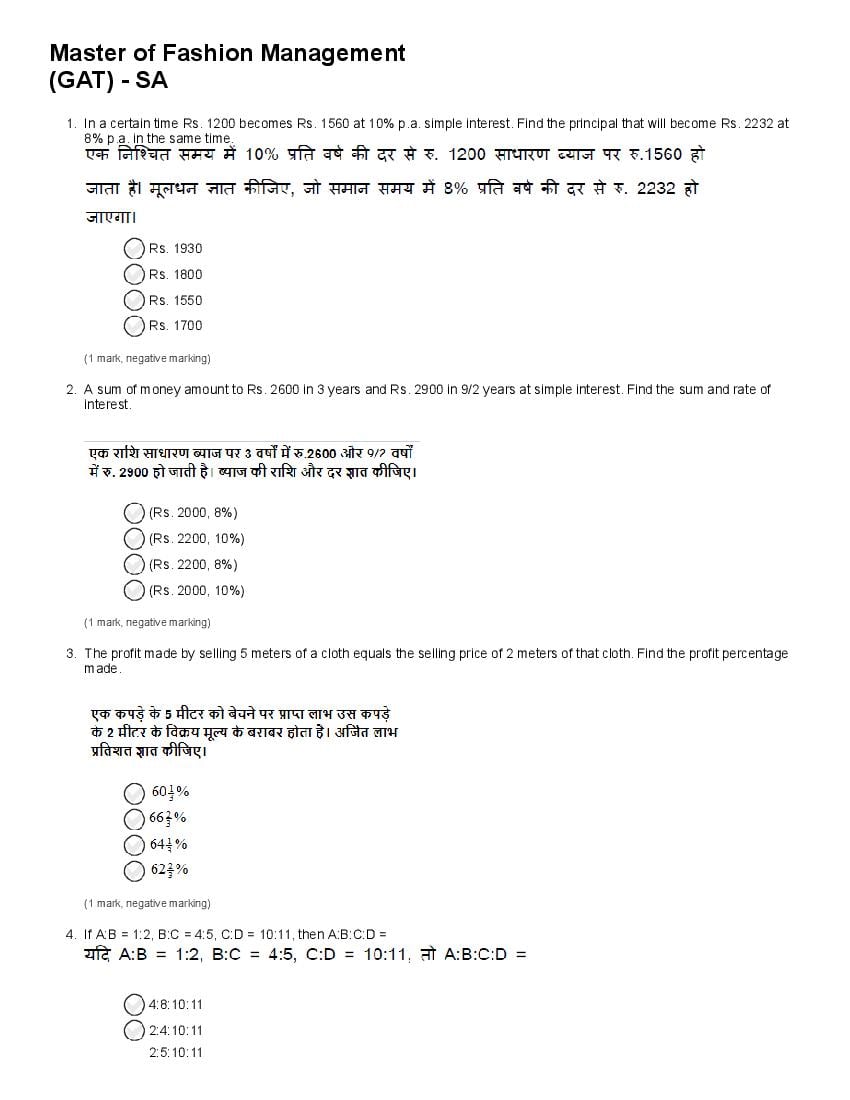
Page 1
(GAT) - SA
1. In a certain time Rs. 1200 becomes Rs. 1560 at 10% p.a. simple interest. Find the principal that will become Rs. 2232 at
8% p.a. in the same time.
Rs. 1930
Rs. 1800
Rs. 1550
Rs. 1700
2. A sum of money amount to Rs. 2600 in 3 years and Rs. 2900 in 9/2 years at simple interest. Find the sum and rate of
interest.
(Rs. 2000, 8%)
(Rs. 2200, 10%)
(Rs. 2200, 8%)
(Rs. 2000, 10%)
3. The profit made by selling 5 meters of a cloth equals the selling price of 2 meters of that cloth. Find the profit percentage
made.
4. If A:B = 1:2, B:C = 4:5, C:D = 10:11, then A:B:C:D =
4:8:10:11
2:4:10:11
2:5:10:11
Page 2
5. The average height of 30 students in a class is found to be 130 cm. Later, a student of height 140 cm left the class whereas
a new student joined and the average height has been changed to 129.5 cm. The height of the new student is
128.2 cm
125 cm
127.5 cm
126 cm
6.
A person lent some amount at 12% p.a. for years and some amount at 12.5% p.a. for 2 years. If he had amount of Rs.
10,000 in hand and on such investment earned Rs. 2700 in all, find the amount he invested in each case.
(Rs. 5000, Rs. 5000)
(Rs. 4500, Rs. 5500)
(Rs. 4000, Rs. 6000)
(Rs. 3500, Rs. 6500)
7. Divide Rs. 2760 in two parts such that simple interest on one part at 12.5% p.a. for 2 years is equal to the simple interest
on the other part at 12.5% p.a. for 3 years.
(Rs. 1700, Rs. 1060)
(Rs. 1900, Rs. 860)
(Rs. 2000, Rs. 760)
(Rs. 1800, Rs. 960)
8. X started a business with Rs. 20,000. After 4 months, Y joined him with Rs. 30,000. At the beginning of the fifth month, X
Page 3
3:2
4:3
1:1
1:2
9. In what ratio must two kinds of coffee which cost Rs. 80 per kg and Rs. 108 per kg be mixed such that the resultant mixture
costs Rs. 96 per kg?
2:1
3:4
1:2
2:3
10. Pipes X and Y take 10 minutes and 20 minutes respectively to fill an empty tank. Pipe Z takes 40 minutes to empty a full
tank. Find the time taken to fill the empty tank if all the three pipes are opened simultaneously.
8 minutes
6.5 minutes
7.5 minutes
7 minutes
11. A, B, C and D live in a building having 14th floors. A lives two floors above B. C lives on the 14th floor immediately above A.
D neither lives immediately above nor immediately below B. The first 7 floors of the building are vacant. On which of the
following floors does D live?
Page 4
10th
8th
Cannot be determined
12. If each of the vowels in the word HONESTLY is changed to the next letter in the English alphabetical series and each
consonant is changed to the previous letter in the English alphabetical series, and then the alphabets so formed are
arranged in alphabetical order from left to right, the positions of how many of the following alphabets will remain
unchanged? (from that of before arranging in alphabetical order)
Two
None
One
Three
13.
If all the numbers are arranged in ascending order from left to right, which of the following will be the sum of all the three-
digits of the number which is second from the left of the new arrangement thus formed?
11
19
14
20
Page 5
What will be the resultant of the third digit of the second lowest number is divided by the third digit of the highest number?
2
4
5
3
15.
If 2 is subtracted from the last digit of every odd number and 1 is added to the last digit of every even number, what will be
the difference between the highest and the lowest numbers thus formed?
548
456
318
380
16.
If all the digits in each of the numbers are arranged in descending order within the number, which of the following will form
the second highest number in the new arrangement of numbers?
812
739
356
497
17.
If the positions of the first and the second digits of each of the numbers are interchanged, in how many numbers thus
formed will the first digit be a perfect square? (Consider 1 as perfect square number)
Page 6
Two
Three
One
18. A, B, C, D, E and F are six members of a family. A is the mother of B, who is the husband of D. F is the brother of one of
the parents of C. D is the daughter-in-law of E and has no siblings. C is the son of D.
How is C related to A?
Nephew
Father
Grandson
Son-in-law
19. A, B, C, D, E and F are six members of a family. A is the mother of B, who is the husband of D. F is the brother of one of
the parents of C. D is the daughter-in-law of E and has no siblings. C is the son of D.
How is F related to D?
Cousin
Father
Brother
Brother-in-law
Page 7
the parents of C. D is the daughter-in-law of E and has no siblings. C is the son of D.
How is E related to F?
Father
Father-in-law
Mother
Son
21. A, B, C, D, E and F are six members of a family. A is the mother of B, who is the husband of D. F is the brother of one of
the parents of C. D is the daughter-in-law of E and has no siblings. C is the son of D.
If F is married to G, then how is G related to B?
Sister-in-law
Cousin
Mother
Sister
22. A, B, C, D, E and F are six members of a family. A is the mother of B, who is the husband of D. F is the brother of one of
the parents of C. D is the daughter-in-law of E and has no siblings. C is the son of D.
How many male members are there in the family?
Four
Page 8
Three
Cannot be determined
23.
21
94
97
84
24. The first 9 positive integers are placed in square so that the sum of the numbers in each row, column and diagonal are
equal. Find B + F.
28
26
32
30
25.
Page 9
googol3
googol googol
3 googol
100 googol
27. Two candles of the same height are lit at the same time. The first candle is completely burnt in 3 hours while the second
candle is completely burnt up in 4 hours. At what point of time is the height of the second candle equals to twice that of the
first candle?
196 minutes
72 minutes
105 minutes
144 minutes
28. The position of how many digits will remain the same if the digits in the number 2567394 are rearranged in ascending order
from left to right?
Two
One
Three
None
29. A, B, C, D, P, Q, R and S are sitting around a circle facing the centre. P is the third to the left of A and R is the second to
the right of A. Q is not an immediate neighbour of either P or R. C sits third to the right of B and S sits exactly between C
and R.
Page 10
D
R
B
Q
30. A, B, C, D, P, Q, R and S are sitting around a circle facing the centre. P is the third to the left of A and R is the second to
the right of A. Q is not an immediate neighbour of either P or R. C sits third to the right of B and S sits exactly between C
and R.
What is S’s position with respect to D?
Third to the right
Immediate right
Third to the left
Second to the left
31. A, B, C, D, P, Q, R and S are sitting around a circle facing the centre. P is the third to the left of A and R is the second to
the right of A. Q is not an immediate neighbour of either P or R. C sits third to the right of B and S sits exactly between C
and R.
Three of the following four options are similar in a certain way based on their positions in the seating arrangement and so
form a group. Which of the following does not belong to that group?
Page 11
SR
CS
AB
QD
32. A, B, C, D, P, Q, R and S are sitting around a circle facing the centre. P is the third to the left of A and R is the second to
the right of A. Q is not an immediate neighbour of either P or R. C sits third to the right of B and S sits exactly between C
and R.
Who sits between P and S?
R
D
C
Q
33. In a class of 95 students, 40 play cricket, 50 play football and 10 play both cricket and football.
How many students play neither cricket nor football?
15
12
20
18
34. A, B, C, D, E, F and G are seven players. They form two teams of two players each and one team of three players. A and B
cannot be in the same team. B and C cannot be in the same team whereas E and F must be in the same team. G and D
cannot be in the same team.
Page 12
G and B
A and E
E and F
Both B and C
35. A, B, C, D, E, F and G are seven players. They form two teams of two players each and one team of three players. A and B
cannot be in the same team. B and C cannot be in the same team whereas E and F must be in the same team. G and D
cannot be in the same team.
If E, F and G form a team of three players, then in how many ways can the remaining two teams of two players each can
be formed?
1
3
2
4
36. Capital of Chattisgarh is
Patna
Aizawl
Uttarakhand
Raipur
Page 13
Nicobar Island
Tamil Nadu
Andaman Island
Tripura
38. The objective of the Project Sunrise is
to enable better living
for prevention of AIDS in North Eastern States
to provide skill training to youths
to improve employability skill development and other convenience for labour
39. Claudius Ptolemy was
Emperor of the Holy Roman Empire
Italian Explorer
Astronomer and Geographer
Italian Explorer
40. Writer of the Sanskrit drama “Malti Madhav” is
Bhavabhuti
Kalidas
Varahmihira
Banbhatta
Page 14
December 8
December 10
December 9
December 11
42. Kiran Desai won the Booker Prize in 2006 for the book
The Inheritance of Loss
Bring up the Bodies
The Winter Tiger
The Sellout
43. Nobel Prize winner in Literature in 2019 is
Peter Handke
John B Goodenough
James Peebless
Akira Yoshino
44. First recipient of Dada Saheb Phalke Award was
Prithviraj Kapoor
Pankaj Mallick
B.N.Sirkar
Mrs. Devika Rani
Page 15
Gas Authority of India Limited
Power Grid Corporation of India
Hindustan Aeronautics Limited
Bharat Heavy Electrical Limited
46. First country to win the World Cup Football is
Brazil
Germany
Uruguay
Argentina
47. Atal Pension Yojana was introduced on
1 June 2016
9 May 2015
1 June 2015
9 May 2016
48. Who is the author of the book “ A Promised Land”?
Donald Trump
Barack Obama
Man Mohan Singh
Angela Merkel
Page 16
R.K.Narayan
Edward Luce
Gunter Grass
Ruskin Bond
50. The abbreviation RAF stands for
Regimental Action Force
Rapid Action Force
Regular Action Force
Rapid Active Force
51. Swarn Jayanti Gram Swarozgar Yojna was introduced on
1 April 1998
1 April 1999
15 August 1999
25 December 1999
52. The first Indian woman to go to Antarctica was
Meher Moos
Anandi Bai Joshi
Preet Chandi
Sudipta Sengupta
Page 17
DGI
Mosad
Naicho
SAVAK
54. “The Age” is a news paper of
USA
Australia
Canada
UK
55. “Likud Party” is a political party of
Australia
Iraq
Israel
Sri Lanka
56. World Wildlife Day is observed on
October 4
October 6
October 3
October 5
Page 18
Arvind Adiga
George Saundars
Anna Bums
Douglas Stuart
58. Recipient of Bharatiya Jnanpith Award in 2019 was
Shankh Ghosh
Krishna Sobhi
Akkithem Achuthan Namboothiri
Amitav Ghosh
59. National Consumer Right Day is observed in India on
December 24
December 23
December 16
December 20
60. What will be the colour of a dark blue suit when viewed in candle light?
Navy blue
Black
Dark blue
Green
Page 19
Enterpreneur
Entrepreneur
Entreprenure
Enterprenure
62. Groups of four words are given. In each group one word is correctly spelt. Find out the correctly spelt word.
Marquei
Markue
Marquee
Marquie
63. Groups of four words are given. In each group one word is correctly spelt. Find out the correctly spelt word.
Acquaintance
Acquentance
Acquaintence
Acqueintence
64. Groups of four words are given. In each group one word is correctly spelt. Find out the correctly spelt word.
Vacilation
Vacilation
Vacillation
Vacilliation
65. Groups of four words are given. In each group one word is correctly spelt. Find out the correctly spelt word.
Circuitous
Circutious
Circutitus
Circutous
66. choose the one which can be substituted for the given words / sentence.
A small raised platform that a person stands on to make a speech or receive a prize-
Rostrum
Palace
Dais
Page 20
67. Choose the one which can be substituted for the given words / sentence.
A quick short sudden movement of the features, muscles, limbs of the human body usually without conscious control
Tweet
Tweed
Twit
Twitch
68. Choose the one which can be substituted for the given words / sentence.
A picture of a person or a thing drawn in such a manner such as to instigate laughter
Cacography
Cartography
Caricature
Cartoon
69. Choose the one which can be substituted for the given words / sentence.
A system of government in which the power is distributed between the Central Government and its constituent units
Federalism
Secularism
Socialism
Communism
70. Choose the one which can be substituted for the given words / sentence.
Special words that are spoken or sung to have a magical effect
Invoice
Incantation
Verbiage
Mendicant
71. Choose the word opposite in meaning to the given word.
VIRGINAL
Page 21
Vestal
Corrupted
Sophomoric
72. Choose the word / phrase which is similar in meaning to the given word.
ENDURING
painful
Fleeting
Long lasting
Permanent
73. choose the word opposite in meaning to the given word.
PROGRESSIVE
Regressive
Retrogressive
Repulsive
Aggressive
74. Choose the word opposite in meaning to the given word.
ASCETICISM
Comfort
Anti- Semitism
Luxury
Humility
75. Choose the word opposite in meaning to the given word.
UNNERVED
Nervous
Confident
Anxious
Hopeful
Page 22
SQUANDER
Expensive
Litter
Waste
Save
77. choose the one which best expresses the meaning of the given word.
LICENTIOUS
Without licence
Immoral
Moral
Intellectual
78. choose the one which best expresses the meaning of the given word.
DELIRIOUS
Pleasing
Desperate
Hysterical
Composed
79. Choose the one which best expresses the meaning of the given word.
CORROBORATE
Validate
Collaborate
Substantiate
Co-operate
80. choose the one which best expresses the meaning of the given word.
SOLECISM
Clever argument
Wise saying
Page 23
Grammatical error
81. The various parts of the sentence are segregated with the symbol " / "
Find out which part of the sentence has an error.
If there is no error, mark "No error" as your answer.
Don’t think / you can deceive me / like you did my brother. /
like you did my brother.
you can deceive me
No error
Don’t think
82. The various parts of the sentence are segregated with the symbol " / "
Find out which part of the sentence has an error.
If there is no error, mark "No error" as your answer.
I shall avail / of this opportunity / to meet you there. /
I shall avail
to meet you there.
No error
of this opportunity
83. The various parts of the sentence are segregated with the symbol " / "
Find out which part of the sentence has an error.
If there is no error, mark "No error" as your answer.
Shreenet is telling / that I have stolen / his notebook./
that I have stolen
his notebook.
No error
Shreenet is telling
84. The various parts of the sentence are segregated with the symbol " / "
Find out which part of the sentence has an error.
If there is no error, mark "No error" as your answer.
A rise in rents and wages / have been found / to go together. /
No error
to go together.
have been found
Page 24
85. The various parts of the sentence are segregated with the symbol " / "
Find out which part of the sentence has an error.
If there is no error, mark "No error" as your answer.
If only it were possible to get near / one of the volcanic eruptions take place / without getting burnt. /
No error
If only it were possible to get near
without getting burnt
one of the volcanic eruptions take place
86. The various parts of the sentence are segregated with the symbol " / "
Find out which part of the sentence has an error.
If there is no error, mark "No error" as your answer.
The manager of this bank / gave rupees two hundred / to the door keeper. /
gave rupees two hundred
to the door keeper.
The manager of this bank
No error
87. The various parts of the sentence are segregated with the symbol " / "
Find out which part of the sentence has an error.
If there is no error, mark "No error" as your answer.
No other student / in my class / is as tall as Rishabh. /
is as tall as Rishabh.
No error
in my class
No other student
88. The various parts of the sentence are segregated with the symbol " / "
Find out which part of the sentence has an error.
If there is no error, mark "No error" as your answer.
He must give that / answer of the question / asked by his teacher. /
No error
answer of the question
He must give that
asked by his teacher.
Page 25
Find out which part of the sentence has an error.
If there is no error, mark "No error" as your answer.
They had hardly / gone few steps that / they saw a lion. /
No error
they saw a lion.
gone few steps that
They had hardly
90. The various parts of the sentence are segregated with the symbol " / "
Find out which part of the sentence has an error.
If there is no error, mark "No error" as your answer.
I have met one of / the most beautiful / mind in the seminar. /
I have met one of
No error
the most beautiful
mind in the seminar.
91. Choose the alternative which best expresses the meaning of the idiom/ phrase.
As the bomb exploded people ran helter-skelter.
in disorderly haste
in great fear
in great sorrow
in haste
92. Choose the alternative which best expresses the meaning of the idiom/ phrase.
My close friend got the sack from his first job recently.
resigned
got rid of
was dismissed from
was demoted from
93. Choose the alternative which best expresses the meaning of the idiom/ phrase.
She is a fair weather friend.
Page 26
a favourable friend
a friend who meets difficulties calmly
A good friend
94. Choose the alternative which best expresses the meaning of the idiom/ phrase.
His failure at the election has been a sore point with him for a long time.
something memorable for
something pleasurable to
something which hurts
something that brings fear to
95. Choose the alternative which best expresses the meaning of the idiom/ phrase.
He went on sowing wild oats; he reaped suffering in his later life.
inviting troubles as a boy
sowing grains called oats when young
irresponsible pleasure seeking in young age
warning others as a young man
96. When critics discuss the oeuvre of Richard Wright, they usually dwell on his famed memoir Black Boy or the highly
successful and groundbreaking Native Son. They seem to allege he was an important
early black author whose principal innovation was in bringing to the masses the rage that seethed in the African-American
communities in the early 20th century. In making that case alone, these pedagogues do a great disservice to Wright
scholarship, for they avoid the nuanced look at Wright’s skill as an artist, a writer, and a maturing literary voice. One of the
novels that is especially overlooked is The Outsider, a novel he completed while living in Europe. The Existentialist circle
Wright found himself amidst in France heavily influenced the book. Note, for instance, the similarities in title between it and
Albert Camus’s classic The Stranger. In both novels, the titular character is an Other, someone whom society has made
abject and for whom a great deal of vituperative ignominy is unleashed. The story of Wright’s work centers around Cross
Damon, an indebted black postal worker who finds out he has been assumed dead in a train accident. He flees to New
York where he starts a new life working for the Communist Party (note the similarities to Invisible Man), a group he
eventually learns to despise. Throughout the book, Cross matures while also articulating the fact of the black male
experience: living in dread in the liminal spaces of American life. But the real power of the book comes in giving Cross
agency. Unlike Bigger Thomas in Native Son, Cross is allowed to speak for himself, lending him the power to communicate
directly with the reader, without the filter of Bigger’s (white) attorney. Additionally, the voice Cross finds is articulate without
being edifying or pedagogic, meaning that Wright trusts his reader to grasp subtlety, rather than
being hit over the head with the message the intelligent reader deduced halfway through the book.
Sadly, though, The Outsider tends to be dismissed as a failed attempt at Existentialism from an
author who had been away from America too long to know what the nation was really like. This is how the book was seen
in the 1950s and how it, largely, continues to be seen today.
The author’s main criticism of Native Son seems to be that it
shows a still nascent author
is too didactic
does not articulate the black experience
Page 27
97. When critics discuss the oeuvre of Richard Wright, they usually dwell on his famed memoir Black Boy or the highly
successful and groundbreaking Native Son. They seem to allege he was an important
early black author whose principal innovation was in bringing to the masses the rage that seethed in the African-American
communities in the early 20th century. In making that case alone, these pedagogues do a great disservice to Wright
scholarship, for they avoid the nuanced look at Wright’s skill as an artist, a writer, and a maturing literary voice. One of the
novels that is especially overlooked is The Outsider, a novel he completed while living in Europe. The Existentialist circle
Wright found himself amidst in France heavily influenced the book. Note, for instance, the similarities in title between it and
Albert Camus’s classic The Stranger. In both novels, the titular character is an Other, someone whom society has made
abject and for whom a great deal of vituperative ignominy is unleashed. The story of Wright’s work centers around Cross
Damon, an indebted black postal worker who finds out he has been assumed dead in a train accident. He flees to New
York where he starts a new life working for the Communist Party (note the similarities to Invisible Man), a group he
eventually learns to despise. Throughout the book, Cross matures while also articulating the fact of the black male
experience: living in dread in the liminal spaces of American life. But the real power of the book comes in giving Cross
agency. Unlike Bigger Thomas in Native Son, Cross is allowed to speak for himself, lending him the power to communicate
directly with the reader, without the filter of Bigger’s (white) attorney. Additionally, the voice Cross finds is articulate without
being edifying or pedagogic, meaning that Wright trusts his reader to grasp subtlety, rather than
being hit over the head with the message the intelligent reader deduced halfway through the book.
Sadly, though, The Outsider tends to be dismissed as a failed attempt at Existentialism from an
author who had been away from America too long to know what the nation was really like. This is how the book was seen
in the 1950s and how it, largely, continues to be seen today.
As used in paragraph 2, the word abject most nearly means
wretched
abusive
impoverished
dishonest
98. When critics discuss the oeuvre of Richard Wright, they usually dwell on his famed memoir Black Boy or the highly
successful and groundbreaking Native Son. They seem to allege he was an important
early black author whose principal innovation was in bringing to the masses the rage that seethed in the African-American
communities in the early 20th century. In making that case alone, these pedagogues do a great disservice to Wright
scholarship, for they avoid the nuanced look at Wright’s skill as an artist, a writer, and a maturing literary voice. One of the
novels that is especially overlooked is The Outsider, a novel he completed while living in Europe. The Existentialist circle
Wright found himself amidst in France heavily influenced the book. Note, for instance, the similarities in title between it and
Albert Camus’s classic The Stranger. In both novels, the titular character is an Other, someone whom society has made
abject and for whom a great deal of vituperative ignominy is unleashed. The story of Wright’s work centers around Cross
Damon, an indebted black postal worker who finds out he has been assumed dead in a train accident. He flees to New
York where he starts a new life working for the Communist Party (note the similarities to Invisible Man), a group he
eventually learns to despise. Throughout the book, Cross matures while also articulating the fact of the black male
experience: living in dread in the liminal spaces of American life. But the real power of the book comes in giving Cross
agency. Unlike Bigger Thomas in Native Son, Cross is allowed to speak for himself, lending him the power to communicate
directly with the reader, without the filter of Bigger’s (white) attorney. Additionally, the voice Cross finds is articulate without
being edifying or pedagogic, meaning that Wright trusts his reader to grasp subtlety, rather than
being hit over the head with the message the intelligent reader deduced halfway through the book.
Sadly, though, The Outsider tends to be dismissed as a failed attempt at Existentialism from an
author who had been away from America too long to know what the nation was really like. This is how the book was seen
in the 1950s and how it, largely, continues to be seen today.
The author’s main purpose in writing this passage is to
defend the remarks of literary critics throughout the past century
argue that a book by a famous author should not be overlooked
suggest that The Outsider is a better book than is Native Son or Black Boy
Page 28
99. When critics discuss the oeuvre of Richard Wright, they usually dwell on his famed memoir Black Boy or the highly
successful and groundbreaking Native Son. They seem to allege he was an important
early black author whose principal innovation was in bringing to the masses the rage that seethed in the African-American
communities in the early 20th century. In making that case alone, these pedagogues do a great disservice to Wright
scholarship, for they avoid the nuanced look at Wright’s skill as an artist, a writer, and a maturing literary voice. One of the
novels that is especially overlooked is The Outsider, a novel he completed while living in Europe. The Existentialist circle
Wright found himself amidst in France heavily influenced the book. Note, for instance, the similarities in title between it and
Albert Camus’s classic The Stranger. In both novels, the titular character is an Other, someone whom society has made
abject and for whom a great deal of vituperative ignominy is unleashed. The story of Wright’s work centers around Cross
Damon, an indebted black postal worker who finds out he has been assumed dead in a train accident. He flees to New
York where he starts a new life working for the Communist Party (note the similarities to Invisible Man), a group he
eventually learns to despise. Throughout the book, Cross matures while also articulating the fact of the black male
experience: living in dread in the liminal spaces of American life. But the real power of the book comes in giving Cross
agency. Unlike Bigger Thomas in Native Son, Cross is allowed to speak for himself, lending him the power to communicate
directly with the reader, without the filter of Bigger’s (white) attorney. Additionally, the voice Cross finds is articulate without
being edifying or pedagogic, meaning that Wright trusts his reader to grasp subtlety, rather than
being hit over the head with the message the intelligent reader deduced halfway through the book.
Sadly, though, The Outsider tends to be dismissed as a failed attempt at Existentialism from an
author who had been away from America too long to know what the nation was really like. This is how the book was seen
in the 1950s and how it, largely, continues to be seen today.
According to the passage, The Outsider is similar to which of the following works?
I. Native Son
II. The Stranger
III. Invisible Man
I only
II and III only
II only
I and II only
100. When critics discuss the oeuvre of Richard Wright, they usually dwell on his famed memoir Black Boy or the highly
successful and groundbreaking Native Son. They seem to allege he was an important
early black author whose principal innovation was in bringing to the masses the rage that seethed in the African-American
communities in the early 20th century. In making that case alone, these pedagogues do a great disservice to Wright
scholarship, for they avoid the nuanced look at Wright’s skill as an artist, a writer, and a maturing literary voice. One of the
novels that is especially overlooked is The Outsider, a novel he completed while living in Europe. The Existentialist circle
Wright found himself amidst in France heavily influenced the book. Note, for instance, the similarities in title between it and
Albert Camus’s classic The Stranger. In both novels, the titular character is an Other, someone whom society has made
abject and for whom a great deal of vituperative ignominy is unleashed. The story of Wright’s work centers around Cross
Damon, an indebted black postal worker who finds out he has been assumed dead in a train accident. He flees to New
York where he starts a new life working for the Communist Party (note the similarities to Invisible Man), a group he
eventually learns to despise. Throughout the book, Cross matures while also articulating the fact of the black male
experience: living in dread in the liminal spaces of American life. But the real power of the book comes in giving Cross
agency. Unlike Bigger Thomas in Native Son, Cross is allowed to speak for himself, lending him the power to communicate
directly with the reader, without the filter of Bigger’s (white) attorney. Additionally, the voice Cross finds is articulate without
being edifying or pedagogic, meaning that Wright trusts his reader to grasp subtlety, rather than
being hit over the head with the message the intelligent reader deduced halfway through the book.
Sadly, though, The Outsider tends to be dismissed as a failed attempt at Existentialism from an
author who had been away from America too long to know what the nation was really like. This is how the book was seen
in the 1950s and how it, largely, continues to be seen today.
What does the word "oeuvre" mean in the passage above ?
body of work
Page 29
demon
an omen
101. When critics discuss the oeuvre of Richard Wright, they usually dwell on his famed memoir Black Boy or the highly
successful and groundbreaking Native Son. They seem to allege he was an important
early black author whose principal innovation was in bringing to the masses the rage that seethed in the African-American
communities in the early 20th century. In making that case alone, these pedagogues do a great disservice to Wright
scholarship, for they avoid the nuanced look at Wright’s skill as an artist, a writer, and a maturing literary voice. One of the
novels that is especially overlooked is The Outsider, a novel he completed while living in Europe. The Existentialist circle
Wright found himself amidst in France heavily influenced the book. Note, for instance, the similarities in title between it and
Albert Camus’s classic The Stranger. In both novels, the titular character is an Other, someone whom society has made
abject and for whom a great deal of vituperative ignominy is unleashed. The story of Wright’s work centers around Cross
Damon, an indebted black postal worker who finds out he has been assumed dead in a train accident. He flees to New
York where he starts a new life working for the Communist Party (note the similarities to Invisible Man), a group he
eventually learns to despise. Throughout the book, Cross matures while also articulating the fact of the black male
experience: living in dread in the liminal spaces of American life. But the real power of the book comes in giving Cross
agency. Unlike Bigger Thomas in Native Son, Cross is allowed to speak for himself, lending him the power to communicate
directly with the reader, without the filter of Bigger’s (white) attorney. Additionally, the voice Cross finds is articulate without
being edifying or pedagogic, meaning that Wright trusts his reader to grasp subtlety, rather than
being hit over the head with the message the intelligent reader deduced halfway through the book.
Sadly, though, The Outsider tends to be dismissed as a failed attempt at Existentialism from an
author who had been away from America too long to know what the nation was really like. This is how the book was seen
in the 1950s and how it, largely, continues to be seen today.
The term "pedagogues" refers to :
a disobedient student
a strict teacher
a lazy teacher
a strict student
102. When critics discuss the oeuvre of Richard Wright, they usually dwell on his famed memoir Black Boy or the highly
successful and groundbreaking Native Son. They seem to allege he was an important
early black author whose principal innovation was in bringing to the masses the rage that seethed in the African-American
communities in the early 20th century. In making that case alone, these pedagogues do a great disservice to Wright
scholarship, for they avoid the nuanced look at Wright’s skill as an artist, a writer, and a maturing literary voice. One of the
novels that is especially overlooked is The Outsider, a novel he completed while living in Europe. The Existentialist circle
Wright found himself amidst in France heavily influenced the book. Note, for instance, the similarities in title between it and
Albert Camus’s classic The Stranger. In both novels, the titular character is an Other, someone whom society has made
abject and for whom a great deal of vituperative ignominy is unleashed. The story of Wright’s work centers around Cross
Damon, an indebted black postal worker who finds out he has been assumed dead in a train accident. He flees to New
York where he starts a new life working for the Communist Party (note the similarities to Invisible Man), a group he
eventually learns to despise. Throughout the book, Cross matures while also articulating the fact of the black male
experience: living in dread in the liminal spaces of American life. But the real power of the book comes in giving Cross
agency. Unlike Bigger Thomas in Native Son, Cross is allowed to speak for himself, lending him the power to communicate
directly with the reader, without the filter of Bigger’s (white) attorney. Additionally, the voice Cross finds is articulate without
being edifying or pedagogic, meaning that Wright trusts his reader to grasp subtlety, rather than
being hit over the head with the message the intelligent reader deduced halfway through the book.
Sadly, though, The Outsider tends to be dismissed as a failed attempt at Existentialism from an
author who had been away from America too long to know what the nation was really like. This is how the book was seen
in the 1950s and how it, largely, continues to be seen today.
The term "early black author" is a reference to
the author's origin
Page 30
the colour of the novel
to make fun of the author
103. Over the past half a century, many have erroneously agreed that there is a chasm in Frank Lloyd Wright’s work, an
unbridgeable gap between his residential and commercial buildings. In fact, all of his architectural designs show off his
belief in a world governed by technology but indebted to nature, and all his buildings are really monuments to man’s place
in the natural world.
In his domestic homes, Wright seems to emphasize a blending of the artificial and the natural, with an emphasis on low-
pitched roofs, asymmetry, natural light, and hidden entrances that would require a visitor to search for a way in. These
obscured entrances also make the visitor confront the landscape in a way he or she would not have to if he or she entered
merely from the urban street the house would be located on (in the case of houses such as the Winslow House in Illinois
and other suburban houses). In his own house at Taliesien, in Wisconsin, the visitor must travel a winding driveway uphill to
the back of the house and literally confront a panoramic vista of green hills and woods, rather than merely entering the
house. In this way, then, one is forced to acknowledge both the artificial and the natural at once and cannot merely observe
the home
as one thing alone.
In his commercial buildings, too, there exists a great deal of nature’s influence. Though the
spaces are more straightforward than the domestic spaces (entrances are not hidden, for instance), as their functions
necessitated, Wright’s commercial buildings still showcase the marriage of nature and technology. The Larkin Building, for
instance, lets in an unprecedented amount of natural light for an office building. Wright intentionally eliminated darkness
wherever possible, even encapsulating the central space with a giant skylight, creating the effect of working outdoors.
As used in paragraph 1, the word chasm most nearly means
a divide
an abyss
an analysis
an opinion
104. Over the past half a century, many have erroneously agreed that there is a chasm in Frank Lloyd Wright’s work, an
unbridgeable gap between his residential and commercial buildings. In fact, all of his architectural designs show off his
belief in a world governed by technology but indebted to nature, and all his buildings are really monuments to man’s place
in the natural world.
In his domestic homes, Wright seems to emphasize a blending of the artificial and the natural, with an emphasis on low-
pitched roofs, asymmetry, natural light, and hidden entrances that would require a visitor to search for a way in. These
obscured entrances also make the visitor confront the landscape in a way he or she would not have to if he or she entered
merely from the urban street the house would be located on (in the case of houses such as the Winslow House in Illinois
and other suburban houses). In his own house at Taliesien, in Wisconsin, the visitor must travel a winding driveway uphill to
the back of the house and literally confront a panoramic vista of green hills and woods, rather than merely entering the
house. In this way, then, one is forced to acknowledge both the artificial and the natural at once and cannot merely observe
the home
as one thing alone.
In his commercial buildings, too, there exists a great deal of nature’s influence. Though the
spaces are more straightforward than the domestic spaces (entrances are not hidden, for instance), as their functions
necessitated, Wright’s commercial buildings still showcase the marriage of nature and technology. The Larkin Building, for
instance, lets in an unprecedented amount of natural light for an office building. Wright intentionally eliminated darkness
wherever possible, even encapsulating the central space with a giant skylight, creating the effect of working outdoors.
According to the passage, the central difference between Frank Lloyd Wright’s residential and
commercial buildings is that
the residential buildings were not usually on city streets
the commercial buildings had hidden entrances
the residential buildings are less straightforward
Page 31
105. Over the past half a century, many have erroneously agreed that there is a chasm in Frank Lloyd Wright’s work, an
unbridgeable gap between his residential and commercial buildings. In fact, all of his architectural designs show off his
belief in a world governed by technology but indebted to nature, and all his buildings are really monuments to man’s place
in the natural world.
In his domestic homes, Wright seems to emphasize a blending of the artificial and the natural, with an emphasis on low-
pitched roofs, asymmetry, natural light, and hidden entrances that would require a visitor to search for a way in. These
obscured entrances also make the visitor confront the landscape in a way he or she would not have to if he or she entered
merely from the urban street the house would be located on (in the case of houses such as the Winslow House in Illinois
and other suburban houses). In his own house at Taliesien, in Wisconsin, the visitor must travel a winding driveway uphill to
the back of the house and literally confront a panoramic vista of green hills and woods, rather than merely entering the
house. In this way, then, one is forced to acknowledge both the artificial and the natural at once and cannot merely observe
the home
as one thing alone.
In his commercial buildings, too, there exists a great deal of nature’s influence. Though the
spaces are more straightforward than the domestic spaces (entrances are not hidden, for instance), as their functions
necessitated, Wright’s commercial buildings still showcase the marriage of nature and technology. The Larkin Building, for
instance, lets in an unprecedented amount of natural light for an office building. Wright intentionally eliminated darkness
wherever possible, even encapsulating the central space with a giant skylight, creating the effect of working outdoors.
It can be inferred from paragraph 3 that Frank Lloyd Wright believed
technology would never be able to stand out from nature
a commercial space should look as professional as possible
a building’s function should influence its form
all domestic homes should be monuments to nature
106. Read the passage carefully and choose the best answer to each question out of the four alternatives:
Power and possession have been central pursuits of modern civilisation for a long time. They blocked out or distorted other
features of the western renaissance (revival) which promised so much for humanity. What people have been and are still
being taught to praise is money, success, control over the lives of others and acquisition of more objects. Modern social,
political, and economic system, whether capitalist, fascist or communist, reject in their working the basic principles that the
free and creative infoldment of every man, woman and child is the true measure of the worth of any society. Such
infoldment requires understanding and imagination, integrity and compassion, co-operation among people and harmony
between the human species and the rest of nature. Acquisitiveness and the pursuit of power have made the modern man
an aggressor against everything that is non-human, an exploiter and oppressor of those who are poor, meek and
unorganised, a pathological type which hates and distrusts the world and suffers from both acute loneliness and false pride.
The author appears to be advocating which of the following approaches to be adopted by society?
communist
humanistic
capitalistic
authoritarian
107. Read the passage carefully and choose the best answer to each question out of the four alternatives:
Power and possession have been central pursuits of modern civilisation for a long time. They blocked out or distorted other
features of the western renaissance (revival) which promised so much for humanity. What people have been and are still
being taught to praise is money, success, control over the lives of others and acquisition of more objects. Modern social,
political, and economic system, whether capitalist, fascist or communist, reject in their working the basic principles that the
free and creative infoldment of every man, woman and child is the true measure of the worth of any society. Such
infoldment requires understanding and imagination, integrity and compassion, co-operation among people and harmony
between the human species and the rest of nature. Acquisitiveness and the pursuit of power have made the modern man
Page 32
unorganised, a pathological type which hates and distrusts the world and suffers from both acute loneliness and false pride.
Which of the following best describes the behaviour of modern man?
cruel and greedy
perceptive and creative
imaginative and sympathetic
conscientious and cooperative
108. Read the passage carefully and choose the best answer to each question out of the four alternatives:
Power and possession have been central pursuits of modern civilisation for a long time. They blocked out or distorted other
features of the western renaissance (revival) which promised so much for humanity. What people have been and are still
being taught to praise is money, success, control over the lives of others and acquisition of more objects. Modern social,
political, and economic system, whether capitalist, fascist or communist, reject in their working the basic principles that the
free and creative infoldment of every man, woman and child is the true measure of the worth of any society. Such
infoldment requires understanding and imagination, integrity and compassion, co-operation among people and harmony
between the human species and the rest of nature. Acquisitiveness and the pursuit of power have made the modern man
an aggressor against everything that is non-human, an exploiter and oppressor of those who are poor, meek and
unorganised, a pathological type which hates and distrusts the world and suffers from both acute loneliness and false pride.
According to the passage, why has modern man turned out as an enemy of everything that is non- human?
Non- humans have refused cooperation to human beings
He has been dominated by drives of acquisitiveness and power
He hates and distrusts other human beings.
He consciously practices spirit of cooperation
109. Read the passage carefully and choose the best answer to each question out of the four alternatives:
Power and possession have been central pursuits of modern civilisation for a long time. They blocked out or distorted other
features of the western renaissance (revival) which promised so much for humanity. What people have been and are still
being taught to praise is money, success, control over the lives of others and acquisition of more objects. Modern social,
political, and economic system, whether capitalist, fascist or communist, reject in their working the basic principles that the
free and creative infoldment of every man, woman and child is the true measure of the worth of any society. Such
infoldment requires understanding and imagination, integrity and compassion, co-operation among people and harmony
between the human species and the rest of nature. Acquisitiveness and the pursuit of power have made the modern man
an aggressor against everything that is non-human, an exploiter and oppressor of those who are poor, meek and
unorganised, a pathological type which hates and distrusts the world and suffers from both acute loneliness and false pride.
Which of the following statements is not true in context of the given passage?
There is a need for a new renaissance
The modern man is not individualist
Power and possession go hand in hand
Poor and week people are oppressed by the modern man
110. Read the passage carefully and choose the best answer to each question out of the four alternatives:
Power and possession have been central pursuits of modern civilisation for a long time. They blocked out or distorted other
features of the western renaissance (revival) which promised so much for humanity. What people have been and are still
Page 33
political, and economic system, whether capitalist, fascist or communist, reject in their working the basic principles that the
free and creative infoldment of every man, woman and child is the true measure of the worth of any society. Such
infoldment requires understanding and imagination, integrity and compassion, co-operation among people and harmony
between the human species and the rest of nature. Acquisitiveness and the pursuit of power have made the modern man
an aggressor against everything that is non-human, an exploiter and oppressor of those who are poor, meek and
unorganised, a pathological type which hates and distrusts the world and suffers from both acute loneliness and false pride.
Which of the following is one of the requirements bringing out the best in man?
money
success
understanding
power
111. American chip-making giant Intel is a shadow of its former self. Despite the global semiconductor shortage, which has
boosted rival chipmakers, Intel is making less money than a year ago with net income down 21% year over year to US$4.6
billion (£3.4 billion). Unfortunately, this is an ongoing trend.
Intel was the world’s largest chipmaker until 2021, when it was dethroned by Samsung. Though Samsung’s main business
is memory chips, which is a different segment of the market to Intel’s microprocessors, it is sign of Intel’s decline.
During the most recent earnings call with analysts, CEO Pat Gelsinger had to concede that the technology in Intel’s data-
centre processors hadn’t been improved in five years. “[Intel] fell behind AMD in chip design and Taiwan Semiconductor
(TSMC) in manufacturing.”
Intel’s engineers – from research to design to manufacturing – have always worked as a close in-house team. In contrast,
fellow US rivals like Qualcomm, Nvidia and AMD, have either shed their manufacturing capacity or never had it in the first
place. They outsource to suppliers such as TSMC and other third-party foundries in Taiwan for the same reason that most
of the stuff sold in Walmart is made in China: it’s cheaper.
When mobile took off, the chipset didn’t require as much computing power as those in a laptop or PC, since the priority was
energy-saving to extend battery life on a single charge. As Intel was in the business of selling top-quality chips for high
margins, it left its rivals to supply chipsets for this new market.
Companies like TSMC doesn’t have to shoulder the risks of launching a new product. It just needs to excel in
manufacturing, because if a Qualcomm product fails, AMD’s may take off. For chip designers, on the other hand
outsourcing to TSMC has gradually meant they can afford to be fast-moving and bold in product design. If a new chip
doesn’t sell, they can pull the plug without having to worry about the factory: that’s TSMC’s problem.
Unlike the above Intel needs to ensure that every product wins with enough volume to feed its network of factories, each
costing billions of dollars. This has made the company more and more conservative. And having stuck to supplying chips to
PCs, servers and data centres, it is struggling to innovate. Tellingly, the company’s gross margin – total revenue minus the
cost of production – has been sliding for nearly a decade. The biggest danger for a technology company is that it’s not
developing leading-edge products fast enough, backsliding into selling commodities.
Page 34
Making you more risk averse
Making you more conservative
Improving your product quality
Making you more flexible
112. American chip-making giant Intel is a shadow of its former self. Despite the global semiconductor shortage, which has
boosted rival chipmakers, Intel is making less money than a year ago with net income down 21% year over year to US$4.6
billion (£3.4 billion). Unfortunately, this is an ongoing trend.
Intel was the world’s largest chipmaker until 2021, when it was dethroned by Samsung. Though Samsung’s main business
is memory chips, which is a different segment of the market to Intel’s microprocessors, it is sign of Intel’s decline.
During the most recent earnings call with analysts, CEO Pat Gelsinger had to concede that the technology in Intel’s data-
centre processors hadn’t been improved in five years. “[Intel] fell behind AMD in chip design and Taiwan Semiconductor
Page 35
Intel’s engineers – from research to design to manufacturing – have always worked as a close in-house team. In contrast,
fellow US rivals like Qualcomm, Nvidia and AMD, have either shed their manufacturing capacity or never had it in the first
place. They outsource to suppliers such as TSMC and other third-party foundries in Taiwan for the same reason that most
of the stuff sold in Walmart is made in China: it’s cheaper.
When mobile took off, the chipset didn’t require as much computing power as those in a laptop or PC, since the priority was
energy-saving to extend battery life on a single charge. As Intel was in the business of selling top-quality chips for high
margins, it left its rivals to supply chipsets for this new market.
Companies like TSMC doesn’t have to shoulder the risks of launching a new product. It just needs to excel in
manufacturing, because if a Qualcomm product fails, AMD’s may take off. For chip designers, on the other hand
outsourcing to TSMC has gradually meant they can afford to be fast-moving and bold in product design. If a new chip
doesn’t sell, they can pull the plug without having to worry about the factory: that’s TSMC’s problem.
Unlike the above Intel needs to ensure that every product wins with enough volume to feed its network of factories, each
costing billions of dollars. This has made the company more and more conservative. And having stuck to supplying chips to
PCs, servers and data centres, it is struggling to innovate. Tellingly, the company’s gross margin – total revenue minus the
cost of production – has been sliding for nearly a decade. The biggest danger for a technology company is that it’s not
developing leading-edge products fast enough, backsliding into selling commodities.
Page 36
AMD
TSMC
Intel
All of the options given
113. The e-commerce giant Amazon said it was hiking the price by 17% to $139 for annual membership to it's membership plan
"PRIME" in the US.
It is the first increase since 2018 for Prime, which gives subscribers access to benefits like faster shipping.
More than 200 million people globally pay for the service, many of them in the US.
The firm, which cited increased wage and shipping costs, said it had no announcements to make about other countries "at
this time". More than 200 million people globally pay for the service, many of them in the US. Sales for the last three
months of 2021 expanded by 10% year-on-year to $137.4bn. But those gains were driven by growth in areas like its cloud
computing division, Amazon Web Services, and advertising, while its e-commerce sales dipped from 2020, when the
pandemic propelled blockbuster gains. The firm's profits in the quarter also jumped, to $14.3bn - almost double the prior
year. Its investment in electric vehicle maker Rivian, which floated on the stock market in November, drove those
increases.
"As expected over the holidays, we saw higher costs driven by labour supply shortages and inflationary pressures, and
these issues persisted into the first quarter due to Omicron," chief executive Andy Jassy said.
"Despite these short-term challenges, we continue to feel optimistic and excited about the business as we emerge from the
pandemic."
Page 37
suitable reason from those given below :
Costs of both labour and logistics has increased
It is facing higher logistics costs
Its cost of manufacturing is high
It is facing increased manpower costs
114. The e-commerce giant Amazon said it was hiking the price by 17% to $139 for annual membership to it's membership plan
"PRIME" in the US.
It is the first increase since 2018 for Prime, which gives subscribers access to benefits like faster shipping.
More than 200 million people globally pay for the service, many of them in the US.
The firm, which cited increased wage and shipping costs, said it had no announcements to make about other countries "at
this time". More than 200 million people globally pay for the service, many of them in the US. Sales for the last three
months of 2021 expanded by 10% year-on-year to $137.4bn. But those gains were driven by growth in areas like its cloud
computing division, Amazon Web Services, and advertising, while its e-commerce sales dipped from 2020, when the
pandemic propelled blockbuster gains. The firm's profits in the quarter also jumped, to $14.3bn - almost double the prior
year. Its investment in electric vehicle maker Rivian, which floated on the stock market in November, drove those
increases.
"As expected over the holidays, we saw higher costs driven by labour supply shortages and inflationary pressures, and
these issues persisted into the first quarter due to Omicron," chief executive Andy Jassy said.
Page 38
pandemic."
Amazon's quarterly profits are due to blockbuster gains. The gains are there because of :
Increased adoption of its Cloud computing services
Stock marketing gains on investment made in another company
Increased growth in advertisements
All of the options
115. The e-commerce giant Amazon said it was hiking the price by 17% to $139 for annual membership to it's membership plan
"PRIME" in the US.
It is the first increase since 2018 for Prime, which gives subscribers access to benefits like faster shipping.
More than 200 million people globally pay for the service, many of them in the US.
The firm, which cited increased wage and shipping costs, said it had no announcements to make about other countries "at
this time". More than 200 million people globally pay for the service, many of them in the US. Sales for the last three
months of 2021 expanded by 10% year-on-year to $137.4bn. But those gains were driven by growth in areas like its cloud
computing division, Amazon Web Services, and advertising, while its e-commerce sales dipped from 2020, when the
pandemic propelled blockbuster gains. The firm's profits in the quarter also jumped, to $14.3bn - almost double the prior
year. Its investment in electric vehicle maker Rivian, which floated on the stock market in November, drove those
increases.
Page 39
these issues persisted into the first quarter due to Omicron," chief executive Andy Jassy said.
"Despite these short-term challenges, we continue to feel optimistic and excited about the business as we emerge from the
pandemic."
Amazon is not hiking its prices in other countries because
It is not clear from the details given
It does not want to grow profits in other countries
It is waiting and evaluating the scenario in other countries
It will lead to loss in market share
116. The e-commerce giant Amazon said it was hiking the price by 17% to $139 for annual membership to it's membership plan
"PRIME" in the US.
It is the first increase since 2018 for Prime, which gives subscribers access to benefits like faster shipping.
More than 200 million people globally pay for the service, many of them in the US.
The firm, which cited increased wage and shipping costs, said it had no announcements to make about other countries "at
this time". More than 200 million people globally pay for the service, many of them in the US. Sales for the last three
months of 2021 expanded by 10% year-on-year to $137.4bn. But those gains were driven by growth in areas like its cloud
computing division, Amazon Web Services, and advertising, while its e-commerce sales dipped from 2020, when the
pandemic propelled blockbuster gains. The firm's profits in the quarter also jumped, to $14.3bn - almost double the prior
Page 40
increases.
"As expected over the holidays, we saw higher costs driven by labour supply shortages and inflationary pressures, and
these issues persisted into the first quarter due to Omicron," chief executive Andy Jassy said.
"Despite these short-term challenges, we continue to feel optimistic and excited about the business as we emerge from the
pandemic."
Amazon's expected gain in revenue due to the increase in prices of PRIME membership is to the tune of ..... Choose the
best possible estimate.
More than 6000 million USD
More than 4000 million USD
Cannot be calculated from the data given
More than 5000 million USD
117. German luxury carmaker Audi is eyeing a ‘good double digit’ sales growth in 2022 in India, after doubling sales during the
last year, on the back of new product launches, a senior company official said.
“The last two years needless to say were difficult for everybody, but we grew by 100% last year while the industry grew by
about 40%. So, we are already seeing a positive momentum for the Audi brand in India…” Balbir Singh Dhillon, Head of
Audi India, told The Hindu.
Page 41
‘suppressing’ the industry. “The luxury industry has been hovering around 1-1.5% of the overall car market. If you compare
this with Southeast Asian countries, even in small countries this ratio is 5-6%. So to that extent there is a lot of road to
cover for the country.”… So I only hope going forward things should change.
Pointing out that the company launched nine new models in the last year, Mr. Dhillon added that the year 2022 will see the
launch of high volume models, in addition to some top-end products.
He added that the new Audi Q7, launched on Wednesday, February 2, 2022, with an introductory price of ₹79.99 lakh
onwards, will play a major role in boosting sales as it a a ‘volume model’.
The new car will be locally manufactured in India, he said, adding that about 80% of the cars sold in the country are locally
produced. Other models currently manufactured in India include the Audi A4, Audi A6, Audi Q5 and Audi A7.
Read the paragraph above and then Analyse the statements given below and mark the most correct option:
Audi is planning for good double digit growth
Minor reason for making the decisions
Major assumption in making the decisions
Major Reason for making the decisions
Major objective in making the decisions
118. German luxury carmaker Audi is eyeing a ‘good double digit’ sales growth in 2022 in India, after doubling sales during the
Page 42
“The last two years needless to say were difficult for everybody, but we grew by 100% last year while the industry grew by
about 40%. So, we are already seeing a positive momentum for the Audi brand in India…” Balbir Singh Dhillon, Head of
Audi India, told The Hindu.
Talking about the luxury car market in India, Mr. Dhillion said that multiple layering of taxation on luxury cars is
‘suppressing’ the industry. “The luxury industry has been hovering around 1-1.5% of the overall car market. If you compare
this with Southeast Asian countries, even in small countries this ratio is 5-6%. So to that extent there is a lot of road to
cover for the country.”… So I only hope going forward things should change.
Pointing out that the company launched nine new models in the last year, Mr. Dhillon added that the year 2022 will see the
launch of high volume models, in addition to some top-end products.
He added that the new Audi Q7, launched on Wednesday, February 2, 2022, with an introductory price of ₹79.99 lakh
onwards, will play a major role in boosting sales as it a a ‘volume model’.
The new car will be locally manufactured in India, he said, adding that about 80% of the cars sold in the country are locally
produced. Other models currently manufactured in India include the Audi A4, Audi A6, Audi Q5 and Audi A7.
Read the paragraph above and then Analyse the statements given below and mark the most correct option:
Multiple layers of taxation is there in the Luxury car segment
Minor reason for making the decisions
Major Reason for making the decisions
Major assumption in making the decisions
Major objective in making the decisions
Page 43
last year, on the back of new product launches, a senior company official said.
“The last two years needless to say were difficult for everybody, but we grew by 100% last year while the industry grew by
about 40%. So, we are already seeing a positive momentum for the Audi brand in India…” Balbir Singh Dhillon, Head of
Audi India, told The Hindu.
Talking about the luxury car market in India, Mr. Dhillion said that multiple layering of taxation on luxury cars is
‘suppressing’ the industry. “The luxury industry has been hovering around 1-1.5% of the overall car market. If you compare
this with Southeast Asian countries, even in small countries this ratio is 5-6%. So to that extent there is a lot of road to
cover for the country.”… So I only hope going forward things should change.
Pointing out that the company launched nine new models in the last year, Mr. Dhillon added that the year 2022 will see the
launch of high volume models, in addition to some top-end products.
He added that the new Audi Q7, launched on Wednesday, February 2, 2022, with an introductory price of ₹79.99 lakh
onwards, will play a major role in boosting sales as it a a ‘volume model’.
The new car will be locally manufactured in India, he said, adding that about 80% of the cars sold in the country are locally
produced. Other models currently manufactured in India include the Audi A4, Audi A6, Audi Q5 and Audi A7.
Read the paragraph above and then Analyse the statements given below and mark the most correct option:
Rs 79.99 Lakhs is not a very high price for an Audi car
Page 44
Major Reason for making the decisions
Minor reason for making the decisions
Major objective in making the decisions
120. German luxury carmaker Audi is eyeing a ‘good double digit’ sales growth in 2022 in India, after doubling sales during the
last year, on the back of new product launches, a senior company official said.
“The last two years needless to say were difficult for everybody, but we grew by 100% last year while the industry grew by
about 40%. So, we are already seeing a positive momentum for the Audi brand in India…” Balbir Singh Dhillon, Head of
Audi India, told The Hindu.
Talking about the luxury car market in India, Mr. Dhillion said that multiple layering of taxation on luxury cars is
‘suppressing’ the industry. “The luxury industry has been hovering around 1-1.5% of the overall car market. If you compare
this with Southeast Asian countries, even in small countries this ratio is 5-6%. So to that extent there is a lot of road to
cover for the country.”… So I only hope going forward things should change.
Pointing out that the company launched nine new models in the last year, Mr. Dhillon added that the year 2022 will see the
launch of high volume models, in addition to some top-end products.
He added that the new Audi Q7, launched on Wednesday, February 2, 2022, with an introductory price of ₹79.99 lakh
onwards, will play a major role in boosting sales as it a a ‘volume model’.
The new car will be locally manufactured in India, he said, adding that about 80% of the cars sold in the country are locally
produced. Other models currently manufactured in India include the Audi A4, Audi A6, Audi Q5 and Audi A7.
Read the paragraph above and then Analyse the statements given below and mark the most correct option:
Page 45
Major assumption in making the decisions
Major Reason for making the decisions
Minor reason for making the decisions
Major objective in making the decisions
121. Buoyed by the demand for bicycles in India, Firefox Bikes, a Hero Cycles group company, is aiming to double sales this
year to two lakh cycles, a senior company official said.
“It’s been a great time for biking in India as well as across the world,” said CEO Sukanta Das. “The last two years have
been phenomenal and we have been among the few businesses that have ended up on the right side of COVID,” he said.
“We’ve seen a tremendous growth and adoption of biking as a choice to remain healthy, for enjoyment as well as for
transportation,” Mr. Das added. He said last year, the premium bicycle maker sold more than one lakh bikes and was
targeting sales of more than two lakh this year. “We have already achieved what we did last year in H1. So, we will surely
double,” Mr. Das said, adding that the company was looking at doubling the turnover in 2022 as the strong demand for
bikes that started during the lockdown last year was set to continue for the next two years.
Overall, the bicycle market in India is estimated at 27 lakh annually. Of this, premium bicycles or bikes that cost above
₹10,000 constituted about 7 lakh.
Mr. Das said the company had received a large number of export enquiries from across the globe and had recently begun
exports to Canada. While last year the company focused on the domestic market owing to strong demand, it now plans to
start exports to Africa and West Asia.
Page 46
It did not make good quality products
It did not have permission
It was making losses
It was able to produce only enough to meet the increasing domestic demand
122. Buoyed by the demand for bicycles in India, Firefox Bikes, a Hero Cycles group company, is aiming to double sales this
year to two lakh cycles, a senior company official said.
“It’s been a great time for biking in India as well as across the world,” said CEO Sukanta Das. “The last two years have
been phenomenal and we have been among the few businesses that have ended up on the right side of COVID,” he said.
“We’ve seen a tremendous growth and adoption of biking as a choice to remain healthy, for enjoyment as well as for
transportation,” Mr. Das added. He said last year, the premium bicycle maker sold more than one lakh bikes and was
targeting sales of more than two lakh this year. “We have already achieved what we did last year in H1. So, we will surely
double,” Mr. Das said, adding that the company was looking at doubling the turnover in 2022 as the strong demand for
bikes that started during the lockdown last year was set to continue for the next two years.
Overall, the bicycle market in India is estimated at 27 lakh annually. Of this, premium bicycles or bikes that cost above
₹10,000 constituted about 7 lakh.
Page 47
exports to Canada. While last year the company focused on the domestic market owing to strong demand, it now plans to
start exports to Africa and West Asia.
What is the approximate market share of Firefox in the Premium bicycle segment in India ?
Approx 50%
Approx 4%
Cannot be guessed
Approx 14%
123. Buoyed by the demand for bicycles in India, Firefox Bikes, a Hero Cycles group company, is aiming to double sales this
year to two lakh cycles, a senior company official said.
“It’s been a great time for biking in India as well as across the world,” said CEO Sukanta Das. “The last two years have
been phenomenal and we have been among the few businesses that have ended up on the right side of COVID,” he said.
“We’ve seen a tremendous growth and adoption of biking as a choice to remain healthy, for enjoyment as well as for
transportation,” Mr. Das added. He said last year, the premium bicycle maker sold more than one lakh bikes and was
targeting sales of more than two lakh this year. “We have already achieved what we did last year in H1. So, we will surely
double,” Mr. Das said, adding that the company was looking at doubling the turnover in 2022 as the strong demand for
bikes that started during the lockdown last year was set to continue for the next two years.
Page 48
₹10,000 constituted about 7 lakh.
Mr. Das said the company had received a large number of export enquiries from across the globe and had recently begun
exports to Canada. While last year the company focused on the domestic market owing to strong demand, it now plans to
start exports to Africa and West Asia.
Which are the countries / regions Firefox exported to in the last year ?
Canada
All of the options given
West Asia
Africa
124. Buoyed by the demand for bicycles in India, Firefox Bikes, a Hero Cycles group company, is aiming to double sales this
year to two lakh cycles, a senior company official said.
“It’s been a great time for biking in India as well as across the world,” said CEO Sukanta Das. “The last two years have
been phenomenal and we have been among the few businesses that have ended up on the right side of COVID,” he said.
“We’ve seen a tremendous growth and adoption of biking as a choice to remain healthy, for enjoyment as well as for
transportation,” Mr. Das added. He said last year, the premium bicycle maker sold more than one lakh bikes and was
targeting sales of more than two lakh this year. “We have already achieved what we did last year in H1. So, we will surely
double,” Mr. Das said, adding that the company was looking at doubling the turnover in 2022 as the strong demand for
bikes that started during the lockdown last year was set to continue for the next two years.
Page 49
₹10,000 constituted about 7 lakh.
Mr. Das said the company had received a large number of export enquiries from across the globe and had recently begun
exports to Canada. While last year the company focused on the domestic market owing to strong demand, it now plans to
start exports to Africa and West Asia.
Analyse the statement given. Now choose the best possible option from those provided which is TRUE.
"Firefox was impacted by the Pandemic."
No. There was no impact.
Yes. There was an impact. It suffered huge losses.
Yes. There was an impact. It made higher sales
None of the above options are true
125. Buoyed by the demand for bicycles in India, Firefox Bikes, a Hero Cycles group company, is aiming to double sales this
year to two lakh cycles, a senior company official said.
“It’s been a great time for biking in India as well as across the world,” said CEO Sukanta Das. “The last two years have
been phenomenal and we have been among the few businesses that have ended up on the right side of COVID,” he said.
Page 50
transportation,” Mr. Das added. He said last year, the premium bicycle maker sold more than one lakh bikes and was
targeting sales of more than two lakh this year. “We have already achieved what we did last year in H1. So, we will surely
double,” Mr. Das said, adding that the company was looking at doubling the turnover in 2022 as the strong demand for
bikes that started during the lockdown last year was set to continue for the next two years.
Overall, the bicycle market in India is estimated at 27 lakh annually. Of this, premium bicycles or bikes that cost above
₹10,000 constituted about 7 lakh.
Mr. Das said the company had received a large number of export enquiries from across the globe and had recently begun
exports to Canada. While last year the company focused on the domestic market owing to strong demand, it now plans to
start exports to Africa and West Asia.
What is the expected growth in sales of Firefox ?
Expected growth is 100%
Expected growth is NIL
Expected growth cannot be guessed
Expected growth is 50%
126. Leading film exhibitor PVR has plans to add more screens under luxury formats and aims to have 20 per cent of its total
screens under this category in the near future, said a top company official. Terming luxury formats as more experiential in
Page 51
homes to watch movies in cinemas after the pandemic.
"PVR currently has 12 per cent of its total screen portfolio allocated to the luxury screen formats. We are keen to grow this
share of screen portfolio to 20 per cent as we open new cinemas in the near future," said Bijli.
PVR, as per its strategy to grow the luxury screen format, on Friday announced to sign agreement with the realty firm M3M
India to set up an eight-screen multiplex at 65th Avenue, a luxurious retail project in south Gurugram.
"Our eight screen multiplex in M3M India's 65th Avenue will also host luxury formats such as LUXE, 4DX and a premium
P[XL] auditorium with an extra-large screen," Bijli added.
Pankaj Bansal, Director-M3M India, said: "PVR has defined luxurious multiplex experience to movie lovers in India. It has
become a synonym for movie lovers. We are delighted to partner with PVR and welcome them to M3M India's 65th
Avenue. The 65th Avenue has been conceptualised as a high-end experience and association with best of the brands has
given 65th Avenue its niche position."
PVR currently operates a cinema circuit comprising of 860 screens at 179 properties in 73 cities in India and Sri Lanka.
It offers several formats in the premium screen category, which includes Director's Cut, LUXE, Sapphire, IMAX, 4DX, P[XL],
Playhouse and PVR Onyx across the country.
PVR feels that the Luxury formats are
a key growth segment
all of the options
more experential
more effective in drawing people to multiplexes
Page 52
screens under this category in the near future, said a top company official. Terming luxury formats as more experiential in
nature, PVR Joint Managing Director Sanjeev Kumar Bijli said it is the need of the times so that people come out of their
homes to watch movies in cinemas after the pandemic.
"PVR currently has 12 per cent of its total screen portfolio allocated to the luxury screen formats. We are keen to grow this
share of screen portfolio to 20 per cent as we open new cinemas in the near future," said Bijli.
PVR, as per its strategy to grow the luxury screen format, on Friday announced to sign agreement with the realty firm M3M
India to set up an eight-screen multiplex at 65th Avenue, a luxurious retail project in south Gurugram.
"Our eight screen multiplex in M3M India's 65th Avenue will also host luxury formats such as LUXE, 4DX and a premium
P[XL] auditorium with an extra-large screen," Bijli added.
Pankaj Bansal, Director-M3M India, said: "PVR has defined luxurious multiplex experience to movie lovers in India. It has
become a synonym for movie lovers. We are delighted to partner with PVR and welcome them to M3M India's 65th
Avenue. The 65th Avenue has been conceptualised as a high-end experience and association with best of the brands has
given 65th Avenue its niche position."
PVR currently operates a cinema circuit comprising of 860 screens at 179 properties in 73 cities in India and Sri Lanka.
It offers several formats in the premium screen category, which includes Director's Cut, LUXE, Sapphire, IMAX, 4DX, P[XL],
Playhouse and PVR Onyx across the country.
How many screens in Luxury format are most likely to be currently being operated by PVR ?
Cannot be ascertained from the facts given
Around 150
Page 53
Around 50
128. Leading film exhibitor PVR has plans to add more screens under luxury formats and aims to have 20 per cent of its total
screens under this category in the near future, said a top company official. Terming luxury formats as more experiential in
nature, PVR Joint Managing Director Sanjeev Kumar Bijli said it is the need of the times so that people come out of their
homes to watch movies in cinemas after the pandemic.
"PVR currently has 12 per cent of its total screen portfolio allocated to the luxury screen formats. We are keen to grow this
share of screen portfolio to 20 per cent as we open new cinemas in the near future," said Bijli.
PVR, as per its strategy to grow the luxury screen format, on Friday announced to sign agreement with the realty firm M3M
India to set up an eight-screen multiplex at 65th Avenue, a luxurious retail project in south Gurugram.
"Our eight screen multiplex in M3M India's 65th Avenue will also host luxury formats such as LUXE, 4DX and a premium
P[XL] auditorium with an extra-large screen," Bijli added.
Pankaj Bansal, Director-M3M India, said: "PVR has defined luxurious multiplex experience to movie lovers in India. It has
become a synonym for movie lovers. We are delighted to partner with PVR and welcome them to M3M India's 65th
Avenue. The 65th Avenue has been conceptualised as a high-end experience and association with best of the brands has
given 65th Avenue its niche position."
PVR currently operates a cinema circuit comprising of 860 screens at 179 properties in 73 cities in India and Sri Lanka.
It offers several formats in the premium screen category, which includes Director's Cut, LUXE, Sapphire, IMAX, 4DX, P[XL],
Playhouse and PVR Onyx across the country.
How many formats does PVR operate in the premium screen category ?
Page 54
8
7
6
129. Leading film exhibitor PVR has plans to add more screens under luxury formats and aims to have 20 per cent of its total
screens under this category in the near future, said a top company official. Terming luxury formats as more experiential in
nature, PVR Joint Managing Director Sanjeev Kumar Bijli said it is the need of the times so that people come out of their
homes to watch movies in cinemas after the pandemic.
"PVR currently has 12 per cent of its total screen portfolio allocated to the luxury screen formats. We are keen to grow this
share of screen portfolio to 20 per cent as we open new cinemas in the near future," said Bijli.
PVR, as per its strategy to grow the luxury screen format, on Friday announced to sign agreement with the realty firm M3M
India to set up an eight-screen multiplex at 65th Avenue, a luxurious retail project in south Gurugram.
"Our eight screen multiplex in M3M India's 65th Avenue will also host luxury formats such as LUXE, 4DX and a premium
P[XL] auditorium with an extra-large screen," Bijli added.
Pankaj Bansal, Director-M3M India, said: "PVR has defined luxurious multiplex experience to movie lovers in India. It has
become a synonym for movie lovers. We are delighted to partner with PVR and welcome them to M3M India's 65th
Avenue. The 65th Avenue has been conceptualised as a high-end experience and association with best of the brands has
given 65th Avenue its niche position."
PVR currently operates a cinema circuit comprising of 860 screens at 179 properties in 73 cities in India and Sri Lanka.
It offers several formats in the premium screen category, which includes Director's Cut, LUXE, Sapphire, IMAX, 4DX, P[XL],
Playhouse and PVR Onyx across the country.
Page 55
Their plans to construct a 6 Screen Multiplex
Their launch of a new PVR screen
Their tie up with a Real Estate company in Bangalore
None of these
130. Leading film exhibitor PVR has plans to add more screens under luxury formats and aims to have 20 per cent of its total
screens under this category in the near future, said a top company official. Terming luxury formats as more experiential in
nature, PVR Joint Managing Director Sanjeev Kumar Bijli said it is the need of the times so that people come out of their
homes to watch movies in cinemas after the pandemic.
"PVR currently has 12 per cent of its total screen portfolio allocated to the luxury screen formats. We are keen to grow this
share of screen portfolio to 20 per cent as we open new cinemas in the near future," said Bijli.
PVR, as per its strategy to grow the luxury screen format, on Friday announced to sign agreement with the realty firm M3M
India to set up an eight-screen multiplex at 65th Avenue, a luxurious retail project in south Gurugram.
"Our eight screen multiplex in M3M India's 65th Avenue will also host luxury formats such as LUXE, 4DX and a premium
P[XL] auditorium with an extra-large screen," Bijli added.
Pankaj Bansal, Director-M3M India, said: "PVR has defined luxurious multiplex experience to movie lovers in India. It has
become a synonym for movie lovers. We are delighted to partner with PVR and welcome them to M3M India's 65th
Avenue. The 65th Avenue has been conceptualised as a high-end experience and association with best of the brands has
given 65th Avenue its niche position."
PVR currently operates a cinema circuit comprising of 860 screens at 179 properties in 73 cities in India and Sri Lanka.
It offers several formats in the premium screen category, which includes Director's Cut, LUXE, Sapphire, IMAX, 4DX, P[XL],
Playhouse and PVR Onyx across the country.
Page 56
Running Multiplexes
Running Entertainment places
Construction and Real Estate
None of these
131. Core values are the organization’s essential and enduring tenets – a small set of timeless guiding principles that require no
external justification; they have intrinsic value and importance to those inside the organization. Disney’s core values of
imagination and wholesomeness stem not from the market requirement, but from an inner belief that imagination and
wholesomeness should be nurtured for their own sake. William Procter and James Gamble did not instill product
excellence as a mere “strategy” for success, as an almost religious tenet held for over fifteen decades by P&G people.
Being subordinate to the customer as a way of life Nordstrom traces its roots back to 1901 – eight decades before
customer service programs became stylish in business. Bill Hewlett and David Packard held respect for the individual first
and foremost as a deep personal belief; they did not read it in a book somewhere or hear it from a management guru. Ralf
Larson, CEO of Johnson and Johnson, put it this way: “The Core values embodied in our philosophy might be a
competitive advantage, but that is not why we have them. We have them because they define for us what we stand for, and
we would hold them even if they became a competitive disadvantage in certain situations.” The key point is that an
enduring great company decides for itself what values it holds to be core, largely independent of the current environment,
competitive requirements, or management fads. Clearly, then there is no universally “right” set of core values. A company
need not have customer service as a core value (Sony does not), or respect for the individual (Disney does not), or quality
(Wal-Mart does not), or market responsiveness (HP does not), or teamwork (Nordstrom does not). (Of course, these
companies might have practices or strategies based around these dimensions.) Again, to emphasize a fundamental finding
of our research, the key is not what core values an organization has, but that it has core values.
In identifying the core values of your organization, push with relentless self-honesty for truly core values. If you articulate
more than five or six, there is a good chance you are not getting down to the essentials, and probably confusing core
values (which do not change) with operating practices, business strategies and cultural norms (which should be open for
change).
Page 57
Required for smooth functioning of the organization.
Define the company for which it stands for.
For better marketing.
Competitive Advantage.
132. Core values are the organization’s essential and enduring tenets – a small set of timeless guiding principles that require no
external justification; they have intrinsic value and importance to those inside the organization. Disney’s core values of
imagination and wholesomeness stem not from the market requirement, but from an inner belief that imagination and
wholesomeness should be nurtured for their own sake. William Procter and James Gamble did not instill product
excellence as a mere “strategy” for success, as an almost religious tenet held for over fifteen decades by P&G people.
Being subordinate to the customer as a way of life Nordstrom traces its roots back to 1901 – eight decades before
Page 58
and foremost as a deep personal belief; they did not read it in a book somewhere or hear it from a management guru. Ralf
Larson, CEO of Johnson and Johnson, put it this way: “The Core values embodied in our philosophy might be a
competitive advantage, but that is not why we have them. We have them because they define for us what we stand for, and
we would hold them even if they became a competitive disadvantage in certain situations.” The key point is that an
enduring great company decides for itself what values it holds to be core, largely independent of the current environment,
competitive requirements, or management fads. Clearly, then there is no universally “right” set of core values. A company
need not have customer service as a core value (Sony does not), or respect for the individual (Disney does not), or quality
(Wal-Mart does not), or market responsiveness (HP does not), or teamwork (Nordstrom does not). (Of course, these
companies might have practices or strategies based around these dimensions.) Again, to emphasize a fundamental finding
of our research, the key is not what core values an organization has, but that it has core values.
In identifying the core values of your organization, push with relentless self-honesty for truly core values. If you articulate
more than five or six, there is a good chance you are not getting down to the essentials, and probably confusing core
values (which do not change) with operating practices, business strategies and cultural norms (which should be open for
change).
Product excellence is a strategy of :
William Procter and James Gamble
Nordstorm
Page 59
Johnson and Johnson
133. Core values are the organization’s essential and enduring tenets – a small set of timeless guiding principles that require no
external justification; they have intrinsic value and importance to those inside the organization. Disney’s core values of
imagination and wholesomeness stem not from the market requirement, but from an inner belief that imagination and
wholesomeness should be nurtured for their own sake. William Procter and James Gamble did not instill product
excellence as a mere “strategy” for success, as an almost religious tenet held for over fifteen decades by P&G people.
Being subordinate to the customer as a way of life Nordstrom traces its roots back to 1901 – eight decades before
customer service programs became stylish in business. Bill Hewlett and David Packard held respect for the individual first
and foremost as a deep personal belief; they did not read it in a book somewhere or hear it from a management guru. Ralf
Larson, CEO of Johnson and Johnson, put it this way: “The Core values embodied in our philosophy might be a
competitive advantage, but that is not why we have them. We have them because they define for us what we stand for, and
we would hold them even if they became a competitive disadvantage in certain situations.” The key point is that an
enduring great company decides for itself what values it holds to be core, largely independent of the current environment,
competitive requirements, or management fads. Clearly, then there is no universally “right” set of core values. A company
need not have customer service as a core value (Sony does not), or respect for the individual (Disney does not), or quality
(Wal-Mart does not), or market responsiveness (HP does not), or teamwork (Nordstrom does not). (Of course, these
companies might have practices or strategies based around these dimensions.) Again, to emphasize a fundamental finding
of our research, the key is not what core values an organization has, but that it has core values.
In identifying the core values of your organization, push with relentless self-honesty for truly core values. If you articulate
more than five or six, there is a good chance you are not getting down to the essentials, and probably confusing core
values (which do not change) with operating practices, business strategies and cultural norms (which should be open for
change).
Page 60
Johnson and Johnson
Nordstorm
William Procter and James Gamble
Disney
134. Core values are the organization’s essential and enduring tenets – a small set of timeless guiding principles that require no
external justification; they have intrinsic value and importance to those inside the organization. Disney’s core values of
imagination and wholesomeness stem not from the market requirement, but from an inner belief that imagination and
wholesomeness should be nurtured for their own sake. William Procter and James Gamble did not instill product
excellence as a mere “strategy” for success, as an almost religious tenet held for over fifteen decades by P&G people.
Being subordinate to the customer as a way of life Nordstrom traces its roots back to 1901 – eight decades before
customer service programs became stylish in business. Bill Hewlett and David Packard held respect for the individual first
Page 61
Larson, CEO of Johnson and Johnson, put it this way: “The Core values embodied in our philosophy might be a
competitive advantage, but that is not why we have them. We have them because they define for us what we stand for, and
we would hold them even if they became a competitive disadvantage in certain situations.” The key point is that an
enduring great company decides for itself what values it holds to be core, largely independent of the current environment,
competitive requirements, or management fads. Clearly, then there is no universally “right” set of core values. A company
need not have customer service as a core value (Sony does not), or respect for the individual (Disney does not), or quality
(Wal-Mart does not), or market responsiveness (HP does not), or teamwork (Nordstrom does not). (Of course, these
companies might have practices or strategies based around these dimensions.) Again, to emphasize a fundamental finding
of our research, the key is not what core values an organization has, but that it has core values.
In identifying the core values of your organization, push with relentless self-honesty for truly core values. If you articulate
more than five or six, there is a good chance you are not getting down to the essentials, and probably confusing core
values (which do not change) with operating practices, business strategies and cultural norms (which should be open for
change).
Which is incorrect pair:
Disney - Imagination and Wholesomeness
Sony - Customer service
P&G – Product Excellence
Page 62
135. Core values are the organization’s essential and enduring tenets – a small set of timeless guiding principles that require no
external justification; they have intrinsic value and importance to those inside the organization. Disney’s core values of
imagination and wholesomeness stem not from the market requirement, but from an inner belief that imagination and
wholesomeness should be nurtured for their own sake. William Procter and James Gamble did not instill product
excellence as a mere “strategy” for success, as an almost religious tenet held for over fifteen decades by P&G people.
Being subordinate to the customer as a way of life Nordstrom traces its roots back to 1901 – eight decades before
customer service programs became stylish in business. Bill Hewlett and David Packard held respect for the individual first
and foremost as a deep personal belief; they did not read it in a book somewhere or hear it from a management guru. Ralf
Larson, CEO of Johnson and Johnson, put it this way: “The Core values embodied in our philosophy might be a
competitive advantage, but that is not why we have them. We have them because they define for us what we stand for, and
we would hold them even if they became a competitive disadvantage in certain situations.” The key point is that an
enduring great company decides for itself what values it holds to be core, largely independent of the current environment,
competitive requirements, or management fads. Clearly, then there is no universally “right” set of core values. A company
need not have customer service as a core value (Sony does not), or respect for the individual (Disney does not), or quality
(Wal-Mart does not), or market responsiveness (HP does not), or teamwork (Nordstrom does not). (Of course, these
companies might have practices or strategies based around these dimensions.) Again, to emphasize a fundamental finding
of our research, the key is not what core values an organization has, but that it has core values.
In identifying the core values of your organization, push with relentless self-honesty for truly core values. If you articulate
more than five or six, there is a good chance you are not getting down to the essentials, and probably confusing core
values (which do not change) with operating practices, business strategies and cultural norms (which should be open for
change).
Page 63
Interest of Management
All of these
Current environment
competitive requirement
136. Leadership communication is defined as inspiring and encouraging an individual or a group by systematic and meaningful
sharing of information by using excellent communication skills. Leadership communication has three major aspects: Core,
Managerial, and Corporate. With an increase in leader’s portfolio there is a need to improvise communication skills to
manage large horizon and to become much more effective all possible situations. So, complexity increases with an
increase in the level of leadership. The Core Aspects Approach includes writing and speaking: these are the individualized
skills and are required to be expanded, to lead and manage bigger groups or teams. Expressive cultural understandings,
Page 64
to manage huge groups and are Managerial Aspect Approach of leadership communication.
The Corporate Aspects Approach is the skills required at much higher levels of leadership, and there is a need to interact
with an external sphere, skills which are most needed: maintain employee relations, communication during change and
crises, media associations and image building. For an organization the biggest challenge these days is to win the trust of
its employees, business partners and customers. An organization with leaders who are skillful enough to communicate
responsively and frequently with perfectly planned and dedicated communication policies, is able to encourage not only
employees, but business partner and customers as well to trust on the organization. Now the question comes, why a leader
is required to gain trust among stakeholders? The answer to this question is; Leaders are the individuals who are followed
by many people because they trust him. They don’t follow the leader they cannot trust on (Diane Bean).
Complexities _________________ with increase in level of leadership :
Remain the same
decreases
cannot say
Increase
137. Leadership communication is defined as inspiring and encouraging an individual or a group by systematic and meaningful
sharing of information by using excellent communication skills. Leadership communication has three major aspects: Core,
Managerial, and Corporate. With an increase in leader’s portfolio there is a need to improvise communication skills to
manage large horizon and to become much more effective all possible situations. So, complexity increases with an
increase in the level of leadership. The Core Aspects Approach includes writing and speaking: these are the individualized
skills and are required to be expanded, to lead and manage bigger groups or teams. Expressive cultural understandings,
Page 65
to manage huge groups and are Managerial Aspect Approach of leadership communication.
The Corporate Aspects Approach is the skills required at much higher levels of leadership, and there is a need to interact
with an external sphere, skills which are most needed: maintain employee relations, communication during change and
crises, media associations and image building. For an organization the biggest challenge these days is to win the trust of
its employees, business partners and customers. An organization with leaders who are skillful enough to communicate
responsively and frequently with perfectly planned and dedicated communication policies, is able to encourage not only
employees, but business partner and customers as well to trust on the organization. Now the question comes, why a leader
is required to gain trust among stakeholders? The answer to this question is; Leaders are the individuals who are followed
by many people because they trust him. They don’t follow the leader they cannot trust on (Diane Bean).
Which of the following is not a major aspect of Leadership communication?
Emotional
Corporate
Managerial
Core
138. Leadership communication is defined as inspiring and encouraging an individual or a group by systematic and meaningful
sharing of information by using excellent communication skills. Leadership communication has three major aspects: Core,
Managerial, and Corporate. With an increase in leader’s portfolio there is a need to improvise communication skills to
manage large horizon and to become much more effective all possible situations. So, complexity increases with an
increase in the level of leadership. The Core Aspects Approach includes writing and speaking: these are the individualized
skills and are required to be expanded, to lead and manage bigger groups or teams. Expressive cultural understandings,
Page 66
to manage huge groups and are Managerial Aspect Approach of leadership communication.
The Corporate Aspects Approach is the skills required at much higher levels of leadership, and there is a need to interact
with an external sphere, skills which are most needed: maintain employee relations, communication during change and
crises, media associations and image building. For an organization the biggest challenge these days is to win the trust of
its employees, business partners and customers. An organization with leaders who are skillful enough to communicate
responsively and frequently with perfectly planned and dedicated communication policies, is able to encourage not only
employees, but business partner and customers as well to trust on the organization. Now the question comes, why a leader
is required to gain trust among stakeholders? The answer to this question is; Leaders are the individuals who are followed
by many people because they trust him. They don’t follow the leader they cannot trust on (Diane Bean).
Biggest challenge for an organization in these days is:
Win the trust of its Suppliers, business partners and customers.
Win the trust of its employees, business partners and Political parties.
Win the trust of its employees, business partners and customers.
Win the trust of its employees, business partners and Political parties.
Page 67
sharing of information by using excellent communication skills. Leadership communication has three major aspects: Core,
Managerial, and Corporate. With an increase in leader’s portfolio there is a need to improvise communication skills to
manage large horizon and to become much more effective all possible situations. So, complexity increases with an
increase in the level of leadership. The Core Aspects Approach includes writing and speaking: these are the individualized
skills and are required to be expanded, to lead and manage bigger groups or teams. Expressive cultural understandings,
listening patiently, team management and team meetings, providing training facilities and mentoring are the skills which aid
to manage huge groups and are Managerial Aspect Approach of leadership communication.
The Corporate Aspects Approach is the skills required at much higher levels of leadership, and there is a need to interact
with an external sphere, skills which are most needed: maintain employee relations, communication during change and
crises, media associations and image building. For an organization the biggest challenge these days is to win the trust of
its employees, business partners and customers. An organization with leaders who are skillful enough to communicate
responsively and frequently with perfectly planned and dedicated communication policies, is able to encourage not only
employees, but business partner and customers as well to trust on the organization. Now the question comes, why a leader
is required to gain trust among stakeholders? The answer to this question is; Leaders are the individuals who are followed
by many people because they trust him. They don’t follow the leader they cannot trust on (Diane Bean).
Skills required for Corporate Aspect of Leadership does not include:
Maintain employee relations
communication during change and crises
Listening patiently.
Media associations and image building.
Page 68
sharing of information by using excellent communication skills. Leadership communication has three major aspects: Core,
Managerial, and Corporate. With an increase in leader’s portfolio there is a need to improvise communication skills to
manage large horizon and to become much more effective all possible situations. So, complexity increases with an
increase in the level of leadership. The Core Aspects Approach includes writing and speaking: these are the individualized
skills and are required to be expanded, to lead and manage bigger groups or teams. Expressive cultural understandings,
listening patiently, team management and team meetings, providing training facilities and mentoring are the skills which aid
to manage huge groups and are Managerial Aspect Approach of leadership communication.
The Corporate Aspects Approach is the skills required at much higher levels of leadership, and there is a need to interact
with an external sphere, skills which are most needed: maintain employee relations, communication during change and
crises, media associations and image building. For an organization the biggest challenge these days is to win the trust of
its employees, business partners and customers. An organization with leaders who are skillful enough to communicate
responsively and frequently with perfectly planned and dedicated communication policies, is able to encourage not only
employees, but business partner and customers as well to trust on the organization. Now the question comes, why a leader
is required to gain trust among stakeholders? The answer to this question is; Leaders are the individuals who are followed
by many people because they trust him. They don’t follow the leader they cannot trust on (Diane Bean).
Managerial Aspect of leadership addresses:
i) Expressive cultural understandings,
ii) Team management and team meetings,
iii) Providing training facilities and mentoring
iv) writing and speaking Skills
All of these
Page 69
(i) & (iii) only
(i) & (iv) only
141. In spite of having the right people, if the right methodologies for execution are not put in place an organization cannot
succeed. The Thirukural, the Treatise on the ‘Art of living’ born out of Tamil Culture, authored by Thiru Valluvar, beautifully
summarizes how to conduct the affairs of an enterprise. Though there is a huge body of literature on how to handle various
aspects of an organization, no such literature summarizes this complex subject in just seventy words and yet covers more
than all of those several volumes of literature. It says, “The end of all deliberation is to arrive at a decision; and when a
decision is reached, it is wrong to delay it execution”. In this connection, the concept of ‘completed staff work’ by Stephen
Covey is worth noting. Under this concept the people who are responsible for certain functions should think through the
whole problem areas, identify and analyze the problems, identify the various possible solutions, analyze them for their
effectiveness and efficiency and recommend the final solution. As considerable work has already been done, it makes the
job of the decision makers quite simple. With the analysis available, the deliberations can be quite focused and decisions
can be reached very quickly. As opposed to this, organizations that are mired in meetings and committee work take a long
time in coming to conclusions and a longer time for implementation. The Thirukural advocates quickness in decision and
implementation. It says “Unfinished work and un-subdued enemies are like un-extinguished sparks of fire. They will grow
over time and overwhelm you”. Hence work should not be left unfinished and every effort should be made to finish it off in
time. “Do with deliberation those things that require detailed consideration and for which enough time is available. For
those things that require prompt action, don’t waste a lot of time in deliberation”. In normal course most actions do not need
detailed deliberation. And often the luxury of time is not available. As another kural advocates: “Go straight for the goal
whenever circumstances permit. When circumstances are against, choose the path of least resistance”.
The Concept of Staff Work deals with:
Page 70
Responsibility of people involved in a function.
None of these
Assigning work among the staff.
142. In spite of having the right people, if the right methodologies for execution are not put in place an organization cannot
succeed. The Thirukural, the Treatise on the ‘Art of living’ born out of Tamil Culture, authored by Thiru Valluvar, beautifully
summarizes how to conduct the affairs of an enterprise. Though there is a huge body of literature on how to handle various
aspects of an organization, no such literature summarizes this complex subject in just seventy words and yet covers more
than all of those several volumes of literature. It says, “The end of all deliberation is to arrive at a decision; and when a
decision is reached, it is wrong to delay it execution”. In this connection, the concept of ‘completed staff work’ by Stephen
Covey is worth noting. Under this concept the people who are responsible for certain functions should think through the
whole problem areas, identify and analyze the problems, identify the various possible solutions, analyze them for their
effectiveness and efficiency and recommend the final solution. As considerable work has already been done, it makes the
job of the decision makers quite simple. With the analysis available, the deliberations can be quite focused and decisions
can be reached very quickly. As opposed to this, organizations that are mired in meetings and committee work take a long
time in coming to conclusions and a longer time for implementation. The Thirukural advocates quickness in decision and
implementation. It says “Unfinished work and un-subdued enemies are like un-extinguished sparks of fire. They will grow
over time and overwhelm you”. Hence work should not be left unfinished and every effort should be made to finish it off in
time. “Do with deliberation those things that require detailed consideration and for which enough time is available. For
those things that require prompt action, don’t waste a lot of time in deliberation”. In normal course most actions do not need
detailed deliberation. And often the luxury of time is not available. As another kural advocates: “Go straight for the goal
whenever circumstances permit. When circumstances are against, choose the path of least resistance”.
Page 71
Eases with meetings and committee work.
Get complicated with the work already done.
None of these
Not affected with the analysis made earlier.
143. In spite of having the right people, if the right methodologies for execution are not put in place an organization cannot
succeed. The Thirukural, the Treatise on the ‘Art of living’ born out of Tamil Culture, authored by Thiru Valluvar, beautifully
summarizes how to conduct the affairs of an enterprise. Though there is a huge body of literature on how to handle various
aspects of an organization, no such literature summarizes this complex subject in just seventy words and yet covers more
than all of those several volumes of literature. It says, “The end of all deliberation is to arrive at a decision; and when a
decision is reached, it is wrong to delay it execution”. In this connection, the concept of ‘completed staff work’ by Stephen
Covey is worth noting. Under this concept the people who are responsible for certain functions should think through the
whole problem areas, identify and analyze the problems, identify the various possible solutions, analyze them for their
effectiveness and efficiency and recommend the final solution. As considerable work has already been done, it makes the
job of the decision makers quite simple. With the analysis available, the deliberations can be quite focused and decisions
can be reached very quickly. As opposed to this, organizations that are mired in meetings and committee work take a long
time in coming to conclusions and a longer time for implementation. The Thirukural advocates quickness in decision and
implementation. It says “Unfinished work and un-subdued enemies are like un-extinguished sparks of fire. They will grow
over time and overwhelm you”. Hence work should not be left unfinished and every effort should be made to finish it off in
time. “Do with deliberation those things that require detailed consideration and for which enough time is available. For
those things that require prompt action, don’t waste a lot of time in deliberation”. In normal course most actions do not need
detailed deliberation. And often the luxury of time is not available. As another kural advocates: “Go straight for the goal
whenever circumstances permit. When circumstances are against, choose the path of least resistance”.
Page 72
Long deliberations are waste of time for any decision making.
Act whatever the resistance, when things are not in favour.
Do not waste time for deliberation where prompt action is required.
All decision must be taken after detailed deliberation.
144. In spite of having the right people, if the right methodologies for execution are not put in place an organization cannot
succeed. The Thirukural, the Treatise on the ‘Art of living’ born out of Tamil Culture, authored by Thiru Valluvar, beautifully
summarizes how to conduct the affairs of an enterprise. Though there is a huge body of literature on how to handle various
aspects of an organization, no such literature summarizes this complex subject in just seventy words and yet covers more
than all of those several volumes of literature. It says, “The end of all deliberation is to arrive at a decision; and when a
decision is reached, it is wrong to delay it execution”. In this connection, the concept of ‘completed staff work’ by Stephen
Covey is worth noting. Under this concept the people who are responsible for certain functions should think through the
whole problem areas, identify and analyze the problems, identify the various possible solutions, analyze them for their
effectiveness and efficiency and recommend the final solution. As considerable work has already been done, it makes the
job of the decision makers quite simple. With the analysis available, the deliberations can be quite focused and decisions
Page 73
time in coming to conclusions and a longer time for implementation. The Thirukural advocates quickness in decision and
implementation. It says “Unfinished work and un-subdued enemies are like un-extinguished sparks of fire. They will grow
over time and overwhelm you”. Hence work should not be left unfinished and every effort should be made to finish it off in
time. “Do with deliberation those things that require detailed consideration and for which enough time is available. For
those things that require prompt action, don’t waste a lot of time in deliberation”. In normal course most actions do not need
detailed deliberation. And often the luxury of time is not available. As another kural advocates: “Go straight for the goal
whenever circumstances permit. When circumstances are against, choose the path of least resistance”.
Gravity and enormity of unfinished work is portrayed to:
To be ignored forever.
Extinguished fire
Thunder storm
Unsubdued Enemy
145. In spite of having the right people, if the right methodologies for execution are not put in place an organization cannot
succeed. The Thirukural, the Treatise on the ‘Art of living’ born out of Tamil Culture, authored by Thiru Valluvar, beautifully
summarizes how to conduct the affairs of an enterprise. Though there is a huge body of literature on how to handle various
Page 74
than all of those several volumes of literature. It says, “The end of all deliberation is to arrive at a decision; and when a
decision is reached, it is wrong to delay it execution”. In this connection, the concept of ‘completed staff work’ by Stephen
Covey is worth noting. Under this concept the people who are responsible for certain functions should think through the
whole problem areas, identify and analyze the problems, identify the various possible solutions, analyze them for their
effectiveness and efficiency and recommend the final solution. As considerable work has already been done, it makes the
job of the decision makers quite simple. With the analysis available, the deliberations can be quite focused and decisions
can be reached very quickly. As opposed to this, organizations that are mired in meetings and committee work take a long
time in coming to conclusions and a longer time for implementation. The Thirukural advocates quickness in decision and
implementation. It says “Unfinished work and un-subdued enemies are like un-extinguished sparks of fire. They will grow
over time and overwhelm you”. Hence work should not be left unfinished and every effort should be made to finish it off in
time. “Do with deliberation those things that require detailed consideration and for which enough time is available. For
those things that require prompt action, don’t waste a lot of time in deliberation”. In normal course most actions do not need
detailed deliberation. And often the luxury of time is not available. As another kural advocates: “Go straight for the goal
whenever circumstances permit. When circumstances are against, choose the path of least resistance”.
Which of the following statement is not true about Thirukural:
It teaches how to conduct an enterprise.
It contains elaborate description on managing organizations.
Its Verses summarize volumes of literature.
Page 75
146. These days every business school dean worth his baggy tweeds is agonizing over what exactly it is that an MBA – or
anybody else – will need to know or do, to be effective in business a decade from now. And is it teachable? Business
education’s current plunge into self analysis is the deepest in 30 years, prompted by among other things an end to the
expanding demand for the MBA degree by college grads increasing complaints from companies about the usefulness of
MBAs, and new rankings of schools that appear every few year.
The current round of B-school soul-searching has its roots in the last great reformation of business education, which
occurred in the 1960s. Then, in response to criticism that they were unchallenging ‘schools of commerce’ for the cerebrally
limited, business schools set out to become more rigorous and intellectual. Professor Harry Davis, who teaches marketing
at the University of Chicago, says schools and businesses came to believe that the ‘critical ingredient in management was
knowledge – the broader and more abstract, the better’. It was thought that manager’s decisions would be better if he
understood, say, the economist’s definition and theory of self-interest.
Enough of this worked to convince the academics they were on the right track. The capital asset pricing model, developed
by the University of Chicago and no child’s toy to understand, has had a profound and lasting effect on financial markets.
But, says Davis, even the best schools fell into a trap. ‘We became enamored of the notion that being an expert was
enough to run things. Nobody paid much attention to effectiveness. But being smart is enough’.
Now the search for the model MBA has begun to veer off in other direction, often emphasizing hard to measure attributes
such as interpersonal skills, initiative and the ability to see patterns and opportunities in apparent chaos. A crop of
airheaded smoothies on the way? No, insist the deans. Traditional so called hard skills like accounting, marketing and
finance are still essential, they aver.
It can be inferred from the passage that the business schools pre-1960s, were
on the right track
Page 76
providing no-rigorous, non-intellectual program
emphasizing knowledge and hard skills
147. These days every business school dean worth his baggy tweeds is agonizing over what exactly it is that an MBA – or
anybody else – will need to know or do, to be effective in business a decade from now. And is it teachable? Business
education’s current plunge into self analysis is the deepest in 30 years, prompted by among other things an end to the
expanding demand for the MBA degree by college grads increasing complaints from companies about the usefulness of
MBAs, and new rankings of schools that appear every few year.
The current round of B-school soul-searching has its roots in the last great reformation of business education, which
occurred in the 1960s. Then, in response to criticism that they were unchallenging ‘schools of commerce’ for the cerebrally
limited, business schools set out to become more rigorous and intellectual. Professor Harry Davis, who teaches marketing
at the University of Chicago, says schools and businesses came to believe that the ‘critical ingredient in management was
knowledge – the broader and more abstract, the better’. It was thought that manager’s decisions would be better if he
understood, say, the economist’s definition and theory of self-interest.
Enough of this worked to convince the academics they were on the right track. The capital asset pricing model, developed
by the University of Chicago and no child’s toy to understand, has had a profound and lasting effect on financial markets.
But, says Davis, even the best schools fell into a trap. ‘We became enamored of the notion that being an expert was
enough to run things. Nobody paid much attention to effectiveness. But being smart is enough’.
Now the search for the model MBA has begun to veer off in other direction, often emphasizing hard to measure attributes
such as interpersonal skills, initiative and the ability to see patterns and opportunities in apparent chaos. A crop of
airheaded smoothies on the way? No, insist the deans. Traditional so called hard skills like accounting, marketing and
finance are still essential, they aver.
Page 77
MBAs with strong interpersonal skills
MBAs in 1960s
MBAs with so called hard skills
current MBAs
148. These days every business school dean worth his baggy tweeds is agonizing over what exactly it is that an MBA – or
anybody else – will need to know or do, to be effective in business a decade from now. And is it teachable? Business
education’s current plunge into self analysis is the deepest in 30 years, prompted by among other things an end to the
expanding demand for the MBA degree by college grads increasing complaints from companies about the usefulness of
MBAs, and new rankings of schools that appear every few year.
The current round of B-school soul-searching has its roots in the last great reformation of business education, which
occurred in the 1960s. Then, in response to criticism that they were unchallenging ‘schools of commerce’ for the cerebrally
limited, business schools set out to become more rigorous and intellectual. Professor Harry Davis, who teaches marketing
at the University of Chicago, says schools and businesses came to believe that the ‘critical ingredient in management was
knowledge – the broader and more abstract, the better’. It was thought that manager’s decisions would be better if he
understood, say, the economist’s definition and theory of self-interest.
Enough of this worked to convince the academics they were on the right track. The capital asset pricing model, developed
by the University of Chicago and no child’s toy to understand, has had a profound and lasting effect on financial markets.
But, says Davis, even the best schools fell into a trap. ‘We became enamored of the notion that being an expert was
enough to run things. Nobody paid much attention to effectiveness. But being smart is enough’.
Now the search for the model MBA has begun to veer off in other direction, often emphasizing hard to measure attributes
such as interpersonal skills, initiative and the ability to see patterns and opportunities in apparent chaos. A crop of
airheaded smoothies on the way? No, insist the deans. Traditional so called hard skills like accounting, marketing and
finance are still essential, they aver.
Page 78
i. Plateauing demand for MBAs
ii. Employer companies’ disillusionment with MBAs
iii. Need for increased specialization in dynamic business scenario
iv. Ability to see patterns and opportunities in apparent chaos
ii and iii
i, ii and iv
iii and iv
i and ii
149. These days every business school dean worth his baggy tweeds is agonizing over what exactly it is that an MBA – or
anybody else – will need to know or do, to be effective in business a decade from now. And is it teachable? Business
education’s current plunge into self analysis is the deepest in 30 years, prompted by among other things an end to the
Page 79
MBAs, and new rankings of schools that appear every few year.
The current round of B-school soul-searching has its roots in the last great reformation of business education, which
occurred in the 1960s. Then, in response to criticism that they were unchallenging ‘schools of commerce’ for the cerebrally
limited, business schools set out to become more rigorous and intellectual. Professor Harry Davis, who teaches marketing
at the University of Chicago, says schools and businesses came to believe that the ‘critical ingredient in management was
knowledge – the broader and more abstract, the better’. It was thought that manager’s decisions would be better if he
understood, say, the economist’s definition and theory of self-interest.
Enough of this worked to convince the academics they were on the right track. The capital asset pricing model, developed
by the University of Chicago and no child’s toy to understand, has had a profound and lasting effect on financial markets.
But, says Davis, even the best schools fell into a trap. ‘We became enamored of the notion that being an expert was
enough to run things. Nobody paid much attention to effectiveness. But being smart is enough’.
Now the search for the model MBA has begun to veer off in other direction, often emphasizing hard to measure attributes
such as interpersonal skills, initiative and the ability to see patterns and opportunities in apparent chaos. A crop of
airheaded smoothies on the way? No, insist the deans. Traditional so called hard skills like accounting, marketing and
finance are still essential, they aver.
The basic premise of business educationists in the recent past can be best described as
broad and abstract knowledge makes better decision – makers
smartness is the key ingredient in management
interpersonal skills, initiative and leadership is critical to management
Page 80
150. These days every business school dean worth his baggy tweeds is agonizing over what exactly it is that an MBA – or
anybody else – will need to know or do, to be effective in business a decade from now. And is it teachable? Business
education’s current plunge into self analysis is the deepest in 30 years, prompted by among other things an end to the
expanding demand for the MBA degree by college grads increasing complaints from companies about the usefulness of
MBAs, and new rankings of schools that appear every few year.
The current round of B-school soul-searching has its roots in the last great reformation of business education, which
occurred in the 1960s. Then, in response to criticism that they were unchallenging ‘schools of commerce’ for the cerebrally
limited, business schools set out to become more rigorous and intellectual. Professor Harry Davis, who teaches marketing
at the University of Chicago, says schools and businesses came to believe that the ‘critical ingredient in management was
knowledge – the broader and more abstract, the better’. It was thought that manager’s decisions would be better if he
understood, say, the economist’s definition and theory of self-interest.
Enough of this worked to convince the academics they were on the right track. The capital asset pricing model, developed
by the University of Chicago and no child’s toy to understand, has had a profound and lasting effect on financial markets.
But, says Davis, even the best schools fell into a trap. ‘We became enamored of the notion that being an expert was
enough to run things. Nobody paid much attention to effectiveness. But being smart is enough’.
Now the search for the model MBA has begun to veer off in other direction, often emphasizing hard to measure attributes
such as interpersonal skills, initiative and the ability to see patterns and opportunities in apparent chaos. A crop of
airheaded smoothies on the way? No, insist the deans. Traditional so called hard skills like accounting, marketing and
finance are still essential, they aver.
What would the focus of good B-Schools be if they believed this article ?
Total focus on inter personal skills
Page 81
A mix of the traditional subjects and strong inter personal skills
Not clear what needs to be done
Document Details
| Board / Org | NIFT |
| Exam | National Institute of Fashion Technology Entrance Examination |
| Type | Sample Paper |
| Pages | 81 |
| Updated | 30 Apr 2026 |