NIFT Sample Paper 2022 for BFT
Finished viewing? Save it for later —
Download NIFT Sample Paper 2022 for BFT (PDF · 76 pages)About NIFT Sample Paper 2022 for BFT
NIFT Sample Paper 2022 for BFT is available here for free download. Published by NIFT for NIFT, this sample paper can be viewed online or downloaded as a PDF (76 pages). Candidates preparing for NIFT can use NIFT Sample Paper 2022 for BFT to understand the exam pattern, the type of questions asked, and the overall difficulty level.
Frequently Asked Questions
How can I download NIFT Sample Paper 2022 for BFT?
Open this page and click the Download button to save NIFT Sample Paper 2022 for BFT as a PDF. It is completely free on AglaSem Docs.
Is NIFT Sample Paper 2022 for BFT free to download?
Yes. NIFT Sample Paper 2022 for BFT can be viewed online and downloaded as a PDF free of cost on AglaSem Docs.
How many pages does NIFT Sample Paper 2022 for BFT have?
NIFT Sample Paper 2022 for BFT contains 76 pages, which you can read online or download together as a single PDF.
Where can I find more NIFT study material?
You can find more NIFT question papers, sample papers, syllabus, and answer keys on AglaSem Docs.
NIFT Sample Paper 2022 for BFT – Text
Read the full text of this sample paper below — useful to quickly search, copy and reference the content online without downloading the PDF.
📄 View text version (76 pages)
Page 1
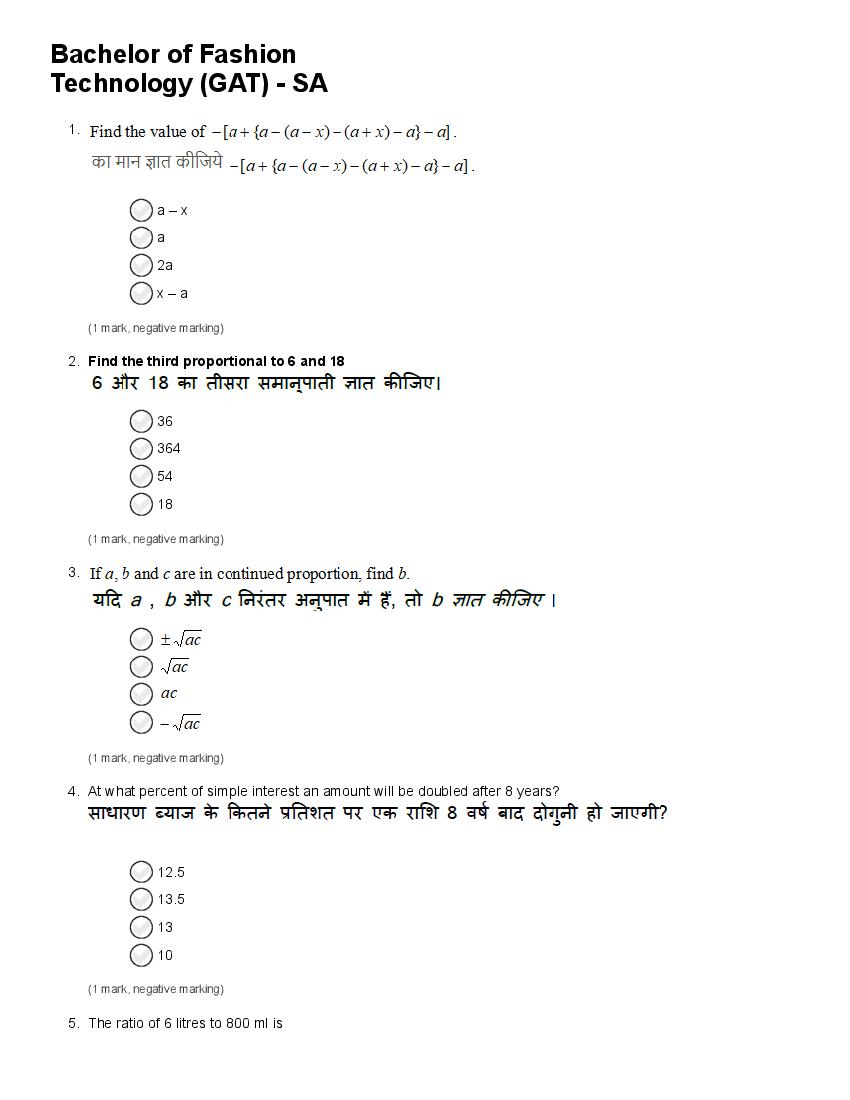
Technology (GAT) - SA
1.
a–x
a
2a
x–a
2. Find the third proportional to 6 and 18
36
364
54
18
3.
4. At what percent of simple interest an amount will be doubled after 8 years?
12.5
13.5
13
10
5. The ratio of 6 litres to 800 ml is
Page 2
11:6
16:3
15:2
6. The sub-duplicate ratio of 49:81 is
7:9
6:7
9:7
7:6
7. X has Rs. 90 and Y has Rs. 40; after Y has won from X a certain sum, X has then six-sevenths of what Y has;
how much did Y win?
Rs. 20
Rs. 30
Rs. 35
Rs. 25
8. If 15% of x = 25% of y then x : y is
8:5
3:5
5:8
5:3
9. Oil refining yields 28% kerosene. How much kerosene is obtained when refining 4000 tons of oil?
Page 3
109 tons
112 tons
110 tons
10.
11. How should salt at Rs. 25 and Rs. 33 per kg be mixed to produce a mixture worth Rs. 30 per kg?
3:5
2:5
5:3
4:5
12. The ratio of present age of two brothers is 5:3. Ten years before the ratio was 2:1. Find the present ages.
(40, 24)
(30, 18)
(25, 15)
(50, 30)
13. If 1 + 2 + 3 +…….+ n = 820 then n = ?
Page 4
42
44
40
14. What sum of money will amount to Rs. 52,000 in 6 years at the same simple interest at which Rs. 1706 amount to
Rs. 3412 in 20 years?
Rs. 48,000
Rs. 42,000
Rs. 45,000
Rs. 40,000
15. 8 men working 5 hours a day can finish a work in 6 days. Then how many men are required to finish the same job
in 3 days working 4 hours a day?
10
20
18
15
16. If x: y = 2:5 and y:z = 8:11 then x:y:z is equal to
16:40:55
8:20:33
2:8:11
Page 5
17. Mr. X deposited a sum of Rs. 1,00,000 in a bank. After 2 years he withdrew Rs. 40,000 and at the end of 5 years,
he received an amount of Rs. 75,200. Find the rate of simple interest.
4%
4.5%
5%
5.5%
18. A sum of money becomes double in 10 years at simple interest. In how many years will it be triple?
20
30
15
25
19.
A person took some loan from a bank and after 5 years he found that the interest has become th of the
principal. The rate of interest per annum is
5%
4%
6%
7%
20. In mixing two grades of material 1% is wasted. In what proportion must a dealer mix two grades of material which
cost him Rs. 4.50 and Rs. 7.00 per kg respectively, so that to gain 8.9% by selling the mixture at Rs. 5.50 per kg?
Page 6
4:3
2:1
4:1
21. The price of an item was cut by 20%, then new price was reduced by another 15% and finally, during fest season,
it was decreased once again by 10%. By how many percent was the initial price cut in all?
40
40.8
45
38.8
22. A dealer mixes two varieties of grains costing Rs. 6 per kg and Rs. 15 per kg in such a way that he can gain 10%
by selling the resultant mixture at Rs. 8.25 per kg. What is the proportion in which the grains are mixed?
5:2
5:1
1:5
2:5
23.
Mr. X deposited a total of Rs. 95,000 in two different banks which gives 5% and interest. If the amounts
repayable by the two banks at the end of 5 years are to be equal; find the individual amount of deposit.
Rs. 50,000, Rs. 45,000
Page 7
Rs. 55,000, Rs. 40,000
Rs. 60,000, Rs. 35,000
24. A shopkeeper allows his customer 10% discount on a marked price of the goods and still gets a profit 25%. What
is the cost price of a shirt if the marked price is Rs. 1250?
Rs. 875
Rs. 900
Rs. 850
Rs. 925
25.
The simple interest on a sum of money is th of the principal and the number of years is equal to rate percent
per annum. What is the rate percent?
2.5
3
26. A trader promised his customers to sell rice at cost price but he cheats his customers by giving 100 gram less for
every kg that he sells. His profit percentage is
Page 8
27. How many kilograms of rice costing Rs.60 per kg must be mixed with 6 kg of rice costing Rs.80 per kg so that the
resulting mixture costs Rs.72 per kg?
6
4
5
3
28. The ratio of milk and water in two containers are 3:1 and 5:2 respectively. The liquids of the containers are poured
in a third container in the ratio 2:1. The ratio of milk and water in the third container is
7:4
15:2
35:16
31:11
29. P can complete a job in 16 days. He started the work and after 4 days, Q joined him. They completed the job in 4
more days. Find the number of days in which Q alone can complete it.
6
10
12
Page 9
30. If the selling price of 100 articles is equal to the cost price of 80 articles, then the loss or gain percent is
20% gain
25% gain
25% loss
20% loss
31. Choose the number which will replace the question mark.
ACEG : 16 :: NPRT : ?
70
72
69
68
32. Choose the word which will replace the question mark.
LAME : OZNV :: MALE : ?
NZOV
MZOV
MZVO
NZVO
33. Choose the word which will replace the question mark.
KING : JHMF :: HERO : ?
Page 10
GDQN
GNDQ
GQDN
34. If BEHK : FILO :: JMRU : ?
NVQY
NRVY
MQVY
NQVY
35. ‘Atom’ is related to ‘Molecule’, in the same way ‘Cell’ is related to
Battery
Nucleus
Matter
Organism
36. If GATE : 22, 26, 7, 22 :: DOWN : ?
4, 13, 15, 14
4, 15, 23, 14
23, 13, 3, 13
23, 12, 4, 13
37. If ROME : 9, 12, 14, 22 :: STOP : ?
8, 7, 12, 11
19, 20, 15, 16
8, 12, 11, 16
8, 7, 11, 12
Page 11
8*%5
6*%5
8%*5
8%5*
39. Find the missing number 5, 11, 23, 47, 95, 191, ?
382
383
381
385
40. Find the odd one among the following:
49
147
343
2401
41. Find the odd one among the following:
Win – Lose
Spend – Earn
Success – Failure
Gain – Profit
42. In a class of 52 students, 20 students play football, 16 play hockey and 10 students play both the games. How
many students play neither football nor hockey?
Page 12
22
26
20
43. Find the odd one out.
REPLUP
LOITEV
RAEZU
KOYNED
44. Find the odd one out.
LEEST
PORPEC
NOBREZ
NIROY
45. Insert the missing letter.
ADG
DIN
IP?
W
Y
X
Z
46.
P
K
Page 13
M
47. Find the missing number 1, 4, 16, 64, 256, ?
1, 4, 16, 64, 256, ?
1034
1044
1042
1024
48. Find the missing number 1, 2, 10, 30, 260, ?
300
2350
4210
3130
49.
50. Six persons A, B, C, D, E and F reside on two sides of a road facing east and west. B resides in an east facing
house and is not next to D; D and F reside diagonally opposite houses; C next to F resides in a west facing house
and E resides in an east facing house. Who resides between B and D?
Page 14
E
B
C
51. Eight persons A, B, C, D, E, F, G, H and J are setting around a circle facing to the centre. D is third to the left of B;
F is fourth to the right of B; E is fourth to the left of A who is second to the right of B; G is third to the right of C; H
is not an immediate neighbour of B. Who is third to the right of H?
B
G
D
F
52. How many times in a day, do the hands of a clock coincide with each other?
12
22
24
44
53. At what point of time between 3 p.m. and 4 p.m. both the hands of a clock will coincide with each other?
3.16 4/11 PM
3.05 1/11 PM
3.12 3/11 PM
Page 15
54.
Which of the following means S is son-in-law of P?
55. P is the father of Q, R is the son of S, T is the brother of R while S is the sister of Q. How is Q related to T?
Either Uncle OR Aunt
OR
Uncle
Mother
Aunt
56. Which country won Copa America in 2021?
Argentina
Page 16
Chile
Brazil
57. On whose name is the highest award of services to the development of cinema given?
Raj Kapur
Meena Kumar
Dlieep Kumar
Dadasaheb Phalke
58. The speed of central processing unit (CPU) of a computer is measured by
Gigahertz
Hertz
Megahertz
Kilohertz
59. Which is the highest national highway in India?
NH 44
NH 5
NH 4
NH 10
Page 17
Homi J Bhava
Rakesh Sharma
Kalpana Chawla
Satish Dhawan
61. For excellence in which field is Grammy Award given?
Painting
Music
Literature
Sculpture
62. How many bits are equal to one byte?
8
4
6
2
63. Which is the International Mother Language Day?
February 19
February 21
February 22
February 20
Page 18
Automated Teller Money
All Time Money
Automatic Teller Machine
Automated Teller Machine
65. The longest sea beach of India is
Marina Beach
Juhu Beach
Palolem Beach
Calangute Beach
66. World’s Ocean’s Day is celebrated on
5th May
4th June
8th June
2nd June
67. India’s first National Sports University has been launched in
Page 19
Kerala
Gujarat
Manipur
68. How many gold medals won by athlete Milkha Singh in Asian Games?
4
6
5
3
69. India’s first private Liquefied Natural Gas (LNG) facility plant is situated at
Bengaluru
Hyderabad
Nagpur
Chennai
70. Who wrote the book “My Truth”?
Pranab Kumar Mukherjee
Jai Sankar Prasad
Jawaharlal Nehru
Page 20
71. The recipient of Polly Umrigar Award 2018-19 is
Jasprit Bumrah
Rohit Sharma
Virat Kohli
Mohammaed Shami
72. Which team won the ICC Under 19 World Cup 2020?
Pakistan
India
New Zealand
Bangladesh
73. Which of the following is an operating system?
Google Chrome
Mozilla
Debugger
Linux
74. The world’s largest cricket stadium is
Page 21
Melbourne
Lords
Motera
75. Who invented the television?
Marconi
Newton
Galileo
J.L.Baird
76. Who wrote “Dragons Seed”?
William Wordsworth
Pearl S Buck
Shelly
Keats
77. Who is the winner of Nobel Prize 2020 in literature?
Paul R. Milgrom
Abhijit Banerjee
Louise Gluck
Page 22
78. Number of recipients of Praadhan Mantri Rashtriyaa Bal Puraskar 2021 is
28
34
32
30
79. What is the position of India in Democracy Index 2020?
55th
53rd
54th
50th
80. The motif of “Ellora Caves” is printed on the reverse side of which currency note?
Rs. 50
Rs. 500
Rs. 100
Rs. 20
81. Antonym of Unravel is
Complicate
Edible
Demon
Enlarge
Page 23
Fault
Heat
Implausible
Grow
83. Antonym of Perspicacious is
Grand
Halt
Ignorant
Famous
84. Antonym of Pillage is
Known
Protect
Lavish
Induce
85. Choose the alternative that best expresses the meaning of the expression in bold:
Hang Together
Live together
Go together
Hand with each other
Be united
86. Choose the alternative that best expresses the meaning of the expression in bold:
He was in doldrums after the quarrel with his brother.
Left the house
Jubilant
In low spirits
Angry
Page 24
Carry weight
Carry the day
To carry burden
Carry through
Be important
88. Choose the alternative that best expresses the meaning of the expression in bold:
Turn down
Twist
Reject
Weave
To accept
89. Choose the alternative that best expresses the meaning of the expression in bold:
Die hard
Arrogant
Ready to change
Egoist
Unwilling to change
90. Below each of the following words (in capital letters ) four words are given. Pick out the word that is
nearest in meaning to the words given in the capital letters.
VEHEMENCE
Axterous
Ardour
Aggrandize
Alpathy
91. Below each of the following words (in capital letters ) four words are given. Pick out the word that is
nearest in meaning to the words given in the capital letters.
DEMAGOGUE
Egregious
Page 25
Bailure
Phlegmatic
92. Below each of the following words (in capital letters ) four words are given. Pick out the word that is
nearest in meaning to the words given in the capital letters.
QUID PRO QUO
Trade-off
Travesty
Convivial
Lambster
93. Fill up the blanks with appropriate Preposition .
That book deals …life in the United States.
with
on
to
in
94. Out of the options given ,find out the most similar in meaning for the given word.
Lore
Folklore
Deprivation
Denial
Forfeiture
95. Out of the options given ,find out the most similar in meaning for the given word.
Infringement
Efficacious
Weasel
Non compliance
Sporadically
Page 26
Modicum
Morose
Bit
Simian
Monastic
97. Out of the options given ,find out the most similar in meaning for the given word.
Rhapsodic
Enthusiastic
Versification
Derision
Recompense
98. Out of the options given ,find out the most similar in meaning for the given word.
Domicile
Residence
Somnolent
Hegemony
Slumbering
99. Out of the options given ,find out the most similar in meaning for the given word.
Appall
Penitent
Dismay
Regretful
Contrite
100. Out of the options given ,find out the most similar in meaning for the given word.
Din
Noise
Dreary
Page 27
Miniature
101. Out of the options given ,find out the most similar in meaning for the given word.
Whisk
Shave
Devoted
Rush
Carve
102. Pick out the most suitable prepositions from the given options to complete the sentence.
Maalti is fed up _____ the weather
over
with
from
about
103. Pick out the most suitable prepositions from the given options to complete the sentence.
These boxes are very heavy. They are full ____ books
from
with
in
of
104. Pick out the most suitable prepositions from the given options to complete the sentence.
Raman is very good ___ telling stories.
to
at
in
on
Page 28
Samir is thinking _____ going to London next week.
None of these
about
to
for
106. Pick out the most suitable prepositions from the given options to complete the sentence.
Have you read any book ___ Salman Rushdie
on
about
All of these
by
107. Jio Platforms Ltd. has announced an investment of US$ 15 million in Two Platforms Inc., a Silicon Valley based
deep tech startup founded by Pranav Mistry, for a 25% equity stake on a fully diluted basis.
Two is an Artificial Reality company with focus on building interactive and immersional AI experiences. After text
and voice, it believes the next chapter of AI is visual and interactive.
Its Artificial Reality platform enables real-time AI voice and video calls, digital humans, immersive spaces and
lifelike gaming.Two plans to bring its interactive AI technologies first to consumer applications, followed by
entertainment and gaming, as well as enterprise solutions including retail, services, education, health and
wellness.
Akash Ambani, Director, Jio, said, “We are impressed with the strong experience and capabilities of the founding
team at TWO in the areas of AI/ ML, AR, metaverse and Web 3.0.”“We look forward to working together with
TWO to help expedite development of new products in the areas of interactive AI, immersive gaming and
metaverse. This acquisition will also help strengthen our internal team to move on these fronts at a faster pace
than what they were able to do uptil now. It will also help is improving our top line as it showed lack lustre growth
in the previous year, he said.
“ We feel Jio will be the right strategic partner that we needed” added Pranav.
Page 29
The statement is a Major factor in making the decisions
The statement is a Major assumption in making the decisions
The statement is a Minor factor in making the decisions
The statement is a Major objective in making the decisions
108. Jio Platforms Ltd. has announced an investment of US$ 15 million in Two Platforms Inc., a Silicon Valley based
deep tech startup founded by Pranav Mistry, for a 25% equity stake on a fully diluted basis.
Two is an Artificial Reality company with focus on building interactive and immersional AI experiences. After text
and voice, it believes the next chapter of AI is visual and interactive.
Its Artificial Reality platform enables real-time AI voice and video calls, digital humans, immersive spaces and
lifelike gaming.Two plans to bring its interactive AI technologies first to consumer applications, followed by
entertainment and gaming, as well as enterprise solutions including retail, services, education, health and
wellness.
Akash Ambani, Director, Jio, said, “We are impressed with the strong experience and capabilities of the founding
team at TWO in the areas of AI/ ML, AR, metaverse and Web 3.0.”“We look forward to working together with
TWO to help expedite development of new products in the areas of interactive AI, immersive gaming and
metaverse. This acquisition will also help strengthen our internal team to move on these fronts at a faster pace
Page 30
in the previous year, he said.
“ We feel Jio will be the right strategic partner that we needed” added Pranav.
Use of AI in Virtual reality platforms can be the next big disruption
The statement is a Major factor in making the decisions
The statement is a Minor factor in making the decisions'
The statement is a Major objective in making the decisions
The statement is a Major assumption in making the decisions
109. Jio Platforms Ltd. has announced an investment of US$ 15 million in Two Platforms Inc., a Silicon Valley based
deep tech startup founded by Pranav Mistry, for a 25% equity stake on a fully diluted basis.
Two is an Artificial Reality company with focus on building interactive and immersional AI experiences. After text
and voice, it believes the next chapter of AI is visual and interactive.
Its Artificial Reality platform enables real-time AI voice and video calls, digital humans, immersive spaces and
lifelike gaming.Two plans to bring its interactive AI technologies first to consumer applications, followed by
entertainment and gaming, as well as enterprise solutions including retail, services, education, health and
wellness.
Page 31
team at TWO in the areas of AI/ ML, AR, metaverse and Web 3.0.”“We look forward to working together with
TWO to help expedite development of new products in the areas of interactive AI, immersive gaming and
metaverse. This acquisition will also help strengthen our internal team to move on these fronts at a faster pace
than what they were able to do uptil now. It will also help is improving our top line as it showed lack lustre growth
in the previous year, he said.
“ We feel Jio will be the right strategic partner that we needed” added Pranav.
Jio Platforms Ltd. wants to work fast in the fields of immersive gaming, interactive AI & metaverse
The statement is a Major factor in making the decisions
The statement is a Major assumption in making the decisions
The statement is a Minor factor in making the decisions
The statement is a Major objective in making the decisions
110. Jio Platforms Ltd. has announced an investment of US$ 15 million in Two Platforms Inc., a Silicon Valley based
Page 32
Two is an Artificial Reality company with focus on building interactive and immersional AI experiences. After text
and voice, it believes the next chapter of AI is visual and interactive.
Its Artificial Reality platform enables real-time AI voice and video calls, digital humans, immersive spaces and
lifelike gaming.Two plans to bring its interactive AI technologies first to consumer applications, followed by
entertainment and gaming, as well as enterprise solutions including retail, services, education, health and
wellness.
Akash Ambani, Director, Jio, said, “We are impressed with the strong experience and capabilities of the founding
team at TWO in the areas of AI/ ML, AR, metaverse and Web 3.0.”“We look forward to working together with
TWO to help expedite development of new products in the areas of interactive AI, immersive gaming and
metaverse. This acquisition will also help strengthen our internal team to move on these fronts at a faster pace
than what they were able to do uptil now. It will also help is improving our top line as it showed lack lustre growth
in the previous year, he said.
“ We feel Jio will be the right strategic partner that we needed” added Pranav.
Jio Platforms’s own team was struggling to move fast on these new technologies
Minor factor in making the decisions
Major objective in making the decisions
Major assumption in making the decisions
Major factor in making the decisions
Page 33
deep tech startup founded by Pranav Mistry, for a 25% equity stake on a fully diluted basis.
Two is an Artificial Reality company with focus on building interactive and immersional AI experiences. After text
and voice, it believes the next chapter of AI is visual and interactive.
Its Artificial Reality platform enables real-time AI voice and video calls, digital humans, immersive spaces and
lifelike gaming.Two plans to bring its interactive AI technologies first to consumer applications, followed by
entertainment and gaming, as well as enterprise solutions including retail, services, education, health and
wellness.
Akash Ambani, Director, Jio, said, “We are impressed with the strong experience and capabilities of the founding
team at TWO in the areas of AI/ ML, AR, metaverse and Web 3.0.”“We look forward to working together with
TWO to help expedite development of new products in the areas of interactive AI, immersive gaming and
metaverse. This acquisition will also help strengthen our internal team to move on these fronts at a faster pace
than what they were able to do uptil now. It will also help is improving our top line as it showed lack lustre growth
in the previous year, he said.
“ We feel Jio will be the right strategic partner that we needed” added Pranav.
Jio Platforms were seeing lacklustre growth in the previous year
The statement is a Major assumption in making the decisions
The statement is a Minor factor in making the decisions
Page 34
The statement is a Major objective in making the decisions
112. FedEx Express, a subsidiary of FedEx Corp., has announced the start of electric vehicle (EV) trials in India as part
of its global goal to achieve carbon neutral operations by 2040.
The trial, which is expected to conclude in a month in Bengaluru, will test the vehicle technology within the
company’s operations, assessing the vehicles’ operational effectiveness on a standard route fully loaded with
packages, FedEx Express said. Upon positive results, the company said it would extend the trials to Delhi. The
trials are also being done as it was suggested as an idea by the Chief Minister of Karnataka in a meeting with
FedEx CEO.
Mohamad Sayegh, V-P, India Operations for FedEx Express said, “With the growth of e-commerce in India, we
are constantly looking for ways to support this momentum while reducing environmental impact. The
commencement of EV trials brings us one step closer to this vision especially since a lot of people feel that this
technology can be most useful for last mile deliveries of E-Commerce companies.”
The company is approaching vehicle electrification goal through a phased manner to replace the existing carbon
emitting vehicles. The aim is for 50% of the company’s global pickup and delivery vehicle purchases to be EVs by
2025, rising to 100% by 2030. “The trial is a critical part of the integration of EV technology across our operations.
Finding the right technology to serve our business, our customers, and our team members will play a key role in
the successful integration of EV into the fleet,” Mr. Sayegh said.
Page 35
The statement is a Minor factor in making the decisions
The statement is a Major objective in making the decisions
The statement is a Major assumption in making the decisions
The statement is a Major factor in making the decisions
113. FedEx Express, a subsidiary of FedEx Corp., has announced the start of electric vehicle (EV) trials in India as part
of its global goal to achieve carbon neutral operations by 2040.
The trial, which is expected to conclude in a month in Bengaluru, will test the vehicle technology within the
company’s operations, assessing the vehicles’ operational effectiveness on a standard route fully loaded with
packages, FedEx Express said. Upon positive results, the company said it would extend the trials to Delhi. The
trials are also being done as it was suggested as an idea by the Chief Minister of Karnataka in a meeting with
FedEx CEO.
Mohamad Sayegh, V-P, India Operations for FedEx Express said, “With the growth of e-commerce in India, we
are constantly looking for ways to support this momentum while reducing environmental impact. The
commencement of EV trials brings us one step closer to this vision especially since a lot of people feel that this
technology can be most useful for last mile deliveries of E-Commerce companies.”
The company is approaching vehicle electrification goal through a phased manner to replace the existing carbon
emitting vehicles. The aim is for 50% of the company’s global pickup and delivery vehicle purchases to be EVs by
2025, rising to 100% by 2030. “The trial is a critical part of the integration of EV technology across our operations.
Finding the right technology to serve our business, our customers, and our team members will play a key role in
the successful integration of EV into the fleet,” Mr. Sayegh said.
Page 36
The statement is a Major factor in making the decisions
The statement is a Minor factor in making the decisions
The statement is a Major assumption in making the decisions
The statement is a Major objective in making the decisions
114. FedEx Express, a subsidiary of FedEx Corp., has announced the start of electric vehicle (EV) trials in India as part
of its global goal to achieve carbon neutral operations by 2040.
The trial, which is expected to conclude in a month in Bengaluru, will test the vehicle technology within the
company’s operations, assessing the vehicles’ operational effectiveness on a standard route fully loaded with
packages, FedEx Express said. Upon positive results, the company said it would extend the trials to Delhi. The
trials are also being done as it was suggested as an idea by the Chief Minister of Karnataka in a meeting with
FedEx CEO.
Mohamad Sayegh, V-P, India Operations for FedEx Express said, “With the growth of e-commerce in India, we
Page 37
commencement of EV trials brings us one step closer to this vision especially since a lot of people feel that this
technology can be most useful for last mile deliveries of E-Commerce companies.”
The company is approaching vehicle electrification goal through a phased manner to replace the existing carbon
emitting vehicles. The aim is for 50% of the company’s global pickup and delivery vehicle purchases to be EVs by
2025, rising to 100% by 2030. “The trial is a critical part of the integration of EV technology across our operations.
Finding the right technology to serve our business, our customers, and our team members will play a key role in
the successful integration of EV into the fleet,” Mr. Sayegh said.
E-commerce growth requires purchase of new vehicles by FedEx
The statement is a Major assumption in making the decisions
The statement is a Major objective in making the decisions
The statement is a Major factor in making the decisions
The statement is a Minor factor in making the decisions
Page 38
of its global goal to achieve carbon neutral operations by 2040.
The trial, which is expected to conclude in a month in Bengaluru, will test the vehicle technology within the
company’s operations, assessing the vehicles’ operational effectiveness on a standard route fully loaded with
packages, FedEx Express said. Upon positive results, the company said it would extend the trials to Delhi. The
trials are also being done as it was suggested as an idea by the Chief Minister of Karnataka in a meeting with
FedEx CEO.
Mohamad Sayegh, V-P, India Operations for FedEx Express said, “With the growth of e-commerce in India, we
are constantly looking for ways to support this momentum while reducing environmental impact. The
commencement of EV trials brings us one step closer to this vision especially since a lot of people feel that this
technology can be most useful for last mile deliveries of E-Commerce companies.”
The company is approaching vehicle electrification goal through a phased manner to replace the existing carbon
emitting vehicles. The aim is for 50% of the company’s global pickup and delivery vehicle purchases to be EVs by
2025, rising to 100% by 2030. “The trial is a critical part of the integration of EV technology across our operations.
Finding the right technology to serve our business, our customers, and our team members will play a key role in
the successful integration of EV into the fleet,” Mr. Sayegh said.
EVs can help service E-commerce company needs
The statement is a Major factor in making the decisions
The statement is a Major assumption in making the decisions
The statement is a Major objective in making the decisions
Page 39
116. FedEx Express, a subsidiary of FedEx Corp., has announced the start of electric vehicle (EV) trials in India as part
of its global goal to achieve carbon neutral operations by 2040.
The trial, which is expected to conclude in a month in Bengaluru, will test the vehicle technology within the
company’s operations, assessing the vehicles’ operational effectiveness on a standard route fully loaded with
packages, FedEx Express said. Upon positive results, the company said it would extend the trials to Delhi. The
trials are also being done as it was suggested as an idea by the Chief Minister of Karnataka in a meeting with
FedEx CEO.
Mohamad Sayegh, V-P, India Operations for FedEx Express said, “With the growth of e-commerce in India, we
are constantly looking for ways to support this momentum while reducing environmental impact. The
commencement of EV trials brings us one step closer to this vision especially since a lot of people feel that this
technology can be most useful for last mile deliveries of E-Commerce companies.”
The company is approaching vehicle electrification goal through a phased manner to replace the existing carbon
emitting vehicles. The aim is for 50% of the company’s global pickup and delivery vehicle purchases to be EVs by
2025, rising to 100% by 2030. “The trial is a critical part of the integration of EV technology across our operations.
Finding the right technology to serve our business, our customers, and our team members will play a key role in
the successful integration of EV into the fleet,” Mr. Sayegh said.
The CM of Karnataka had suggested choosing Delhi as the first place for trials
The statement is a Major assumption in making the decisions
Page 40
The statement is a Minor factor in making the decisions
The statement is a Major factor in making the decisions
117. Corrugated packaging industry has landed in deep trouble as prices of its principal raw material - kraft paper have
started shooting up over the past few days. This is along with increase in other raw material and logistics cost.
There has been a sharp price increase of Rs 5000 per tonne of kraft paper within a span of 10 days. The mills say
that this is not the end and expect further increase in the coming days, said Federation of Corrugated Box
Manufacturers of India (FCBM) in a release issued on Monday.
With China facing a severe electricity shortage the demand for finished paper from India and other parts of the
world has started to become stronger. This has created a sense of optimism in the Indian markets as it can fulfill
the capacity available. Imported waste paper is touching all-time highs every day due to sustained self-
consumption. There has been an almost seven-fold increase in global container freight charges and has only
added fuel to the raging spike in imported waste paper prices.
The recent move of the Centre to increase the GST levied on corrugated boxes from 12% to 18% has irreversibly
halted the gradual switchover from plastic to paper in the above-mentioned sectors. Governments need to
incentivize the adoption of eco-friendly packaging and replacement of plastic by lowering the GST for these
sectors, thereby providing an incentive for shifting mindsets towards paper-based packaging. The resultant impact
on working capital requirements for our members predominantly in the MSME sector has been crippling.
In line with the global trend, India has also been witnessing widespread awareness of the effects of climate
change and harmful aftereffects of single-use plastic products. The majority consumption of single-use plastic is in
the unorganized retail sector, hotel & hospitality sector, and in agriculture/ horticulture sectors where the end-user/
farmer is not able to take credit of GST charged on eco-friendly corrugated packaging.
Page 41
Shortage of Kraft Paper in India
Shortage of supply in Finished paper in the World Markets
Increase in demand of Packaging material in India
Shortage of Supply in Packaging Material in World Markets
118. Corrugated packaging industry has landed in deep trouble as prices of its principal raw material - kraft paper have
started shooting up over the past few days. This is along with increase in other raw material and logistics cost.
There has been a sharp price increase of Rs 5000 per tonne of kraft paper within a span of 10 days. The mills say
that this is not the end and expect further increase in the coming days, said Federation of Corrugated Box
Manufacturers of India (FCBM) in a release issued on Monday.
With China facing a severe electricity shortage the demand for finished paper from India and other parts of the
world has started to become stronger. This has created a sense of optimism in the Indian markets as it can fulfill
the capacity available. Imported waste paper is touching all-time highs every day due to sustained self-
consumption. There has been an almost seven-fold increase in global container freight charges and has only
added fuel to the raging spike in imported waste paper prices.
The recent move of the Centre to increase the GST levied on corrugated boxes from 12% to 18% has irreversibly
halted the gradual switchover from plastic to paper in the above-mentioned sectors. Governments need to
incentivize the adoption of eco-friendly packaging and replacement of plastic by lowering the GST for these
sectors, thereby providing an incentive for shifting mindsets towards paper-based packaging. The resultant impact
on working capital requirements for our members predominantly in the MSME sector has been crippling.
In line with the global trend, India has also been witnessing widespread awareness of the effects of climate
change and harmful aftereffects of single-use plastic products. The majority consumption of single-use plastic is in
Page 42
farmer is not able to take credit of GST charged on eco-friendly corrugated packaging.
GST has been increased on Corrugated Boxes. This has led to
None of these
Increase in supply of paper
Increase in prices of corrugated packaging material
Page 43
119. Corrugated packaging industry has landed in deep trouble as prices of its principal raw material - kraft paper have
started shooting up over the past few days. This is along with increase in other raw material and logistics cost.
There has been a sharp price increase of Rs 5000 per tonne of kraft paper within a span of 10 days. The mills say
that this is not the end and expect further increase in the coming days, said Federation of Corrugated Box
Manufacturers of India (FCBM) in a release issued on Monday.
With China facing a severe electricity shortage the demand for finished paper from India and other parts of the
world has started to become stronger. This has created a sense of optimism in the Indian markets as it can fulfill
the capacity available. Imported waste paper is touching all-time highs every day due to sustained self-
consumption. There has been an almost seven-fold increase in global container freight charges and has only
added fuel to the raging spike in imported waste paper prices.
The recent move of the Centre to increase the GST levied on corrugated boxes from 12% to 18% has irreversibly
halted the gradual switchover from plastic to paper in the above-mentioned sectors. Governments need to
incentivize the adoption of eco-friendly packaging and replacement of plastic by lowering the GST for these
sectors, thereby providing an incentive for shifting mindsets towards paper-based packaging. The resultant impact
on working capital requirements for our members predominantly in the MSME sector has been crippling.
In line with the global trend, India has also been witnessing widespread awareness of the effects of climate
change and harmful aftereffects of single-use plastic products. The majority consumption of single-use plastic is in
the unorganized retail sector, hotel & hospitality sector, and in agriculture/ horticulture sectors where the end-user/
farmer is not able to take credit of GST charged on eco-friendly corrugated packaging.
Page 44
Made from Kraft Paper
All of these
Good for the Environment
More expensive than Single use plastic
120. Corrugated packaging industry has landed in deep trouble as prices of its principal raw material - kraft paper have
started shooting up over the past few days. This is along with increase in other raw material and logistics cost.
There has been a sharp price increase of Rs 5000 per tonne of kraft paper within a span of 10 days. The mills say
that this is not the end and expect further increase in the coming days, said Federation of Corrugated Box
Manufacturers of India (FCBM) in a release issued on Monday.
With China facing a severe electricity shortage the demand for finished paper from India and other parts of the
world has started to become stronger. This has created a sense of optimism in the Indian markets as it can fulfill
the capacity available. Imported waste paper is touching all-time highs every day due to sustained self-
consumption. There has been an almost seven-fold increase in global container freight charges and has only
added fuel to the raging spike in imported waste paper prices.
The recent move of the Centre to increase the GST levied on corrugated boxes from 12% to 18% has irreversibly
halted the gradual switchover from plastic to paper in the above-mentioned sectors. Governments need to
incentivize the adoption of eco-friendly packaging and replacement of plastic by lowering the GST for these
sectors, thereby providing an incentive for shifting mindsets towards paper-based packaging. The resultant impact
on working capital requirements for our members predominantly in the MSME sector has been crippling.
In line with the global trend, India has also been witnessing widespread awareness of the effects of climate
change and harmful aftereffects of single-use plastic products. The majority consumption of single-use plastic is in
Page 45
farmer is not able to take credit of GST charged on eco-friendly corrugated packaging.
Why has the working capital requirement increased for Corrugated Box manufacturers ?
The price of other Raw material has increased
The price of Paper has increased
All of these
The logistics cost has increased
Page 46
started shooting up over the past few days. This is along with increase in other raw material and logistics cost.
There has been a sharp price increase of Rs 5000 per tonne of kraft paper within a span of 10 days. The mills say
that this is not the end and expect further increase in the coming days, said Federation of Corrugated Box
Manufacturers of India (FCBM) in a release issued on Monday.
With China facing a severe electricity shortage the demand for finished paper from India and other parts of the
world has started to become stronger. This has created a sense of optimism in the Indian markets as it can fulfill
the capacity available. Imported waste paper is touching all-time highs every day due to sustained self-
consumption. There has been an almost seven-fold increase in global container freight charges and has only
added fuel to the raging spike in imported waste paper prices.
The recent move of the Centre to increase the GST levied on corrugated boxes from 12% to 18% has irreversibly
halted the gradual switchover from plastic to paper in the above-mentioned sectors. Governments need to
incentivize the adoption of eco-friendly packaging and replacement of plastic by lowering the GST for these
sectors, thereby providing an incentive for shifting mindsets towards paper-based packaging. The resultant impact
on working capital requirements for our members predominantly in the MSME sector has been crippling.
In line with the global trend, India has also been witnessing widespread awareness of the effects of climate
change and harmful aftereffects of single-use plastic products. The majority consumption of single-use plastic is in
the unorganized retail sector, hotel & hospitality sector, and in agriculture/ horticulture sectors where the end-user/
farmer is not able to take credit of GST charged on eco-friendly corrugated packaging.
Page 47
6%
7%
5%
Not clear from the facts
122. Mahindra South Africa has set a new record for monthly sales since it first started selling its range of automotive
vehicles in the country 18 years ago.
Figures released by the National Association of Automobile Manufacturers of South Africa (NAAMSA) showed
that Mahindra hit a new all-time best sales figure of 1,010 in January 2022. This is a massive 77% improvement
over the same month in 2021 and comes despite severe stock shortages and other COVID-19-related disruptions.
The locally-manufactured Mahindra Pik Up range remained the company's best-seller, with 618 units sold in
January, continuing a trend of being one of South Africa's three fastest-growing models in what is known locally
as the 'bakkie'.
In its range of SUVs, the KUV100 NXT and Scorpio both outperformed expectations. The former found favour with
budget-conscious buyers looking for a frugal and highly capable compact SUV and the latter's Adventure model
proved very popular among South African families.
"The new sales record is testament to the hard work of our team at Mahindra SA and each of our 72 dealers,"
said Rajesh Gupta, CEO of Mahindra South Africa.
In the past four years, this growth was accelerated with several large investments, including an assembly facility
in Durban.
In Gauteng province, the economic hub of South Africa, Mahindra opened a new, larger and more modern training
facility for technical and sales staff and a specialised vehicle fitment centre.
"We have a very ambitious target for the new year and set very high standards for our customer service team and
our dealers. Like before, we will make sure our customer service and dealer capacity grow in step with our sales,
Page 48
Mahindra South Africa owes its success to which of the factors given :
Page 49
Dealer network
Investments in training & local assembly
Mahindra SA team
123. Mahindra South Africa has set a new record for monthly sales since it first started selling its range of automotive
vehicles in the country 18 years ago.
Figures released by the National Association of Automobile Manufacturers of South Africa (NAAMSA) showed
that Mahindra hit a new all-time best sales figure of 1,010 in January 2022. This is a massive 77% improvement
over the same month in 2021 and comes despite severe stock shortages and other COVID-19-related disruptions.
The locally-manufactured Mahindra Pik Up range remained the company's best-seller, with 618 units sold in
January, continuing a trend of being one of South Africa's three fastest-growing models in what is known locally
as the 'bakkie'.
In its range of SUVs, the KUV100 NXT and Scorpio both outperformed expectations. The former found favour with
budget-conscious buyers looking for a frugal and highly capable compact SUV and the latter's Adventure model
proved very popular among South African families.
"The new sales record is testament to the hard work of our team at Mahindra SA and each of our 72 dealers,"
said Rajesh Gupta, CEO of Mahindra South Africa.
In the past four years, this growth was accelerated with several large investments, including an assembly facility
in Durban.
In Gauteng province, the economic hub of South Africa, Mahindra opened a new, larger and more modern training
facility for technical and sales staff and a specialised vehicle fitment centre.
"We have a very ambitious target for the new year and set very high standards for our customer service team and
our dealers. Like before, we will make sure our customer service and dealer capacity grow in step with our sales,
and we trust that this will continue to win us many more fans," Gupta concluded.
Page 50
Scorpio
Page 51
KUV 100 NXT
XUV 500
124. Mahindra South Africa has set a new record for monthly sales since it first started selling its range of automotive
vehicles in the country 18 years ago.
Figures released by the National Association of Automobile Manufacturers of South Africa (NAAMSA) showed
that Mahindra hit a new all-time best sales figure of 1,010 in January 2022. This is a massive 77% improvement
over the same month in 2021 and comes despite severe stock shortages and other COVID-19-related disruptions.
The locally-manufactured Mahindra Pik Up range remained the company's best-seller, with 618 units sold in
January, continuing a trend of being one of South Africa's three fastest-growing models in what is known locally
as the 'bakkie'.
In its range of SUVs, the KUV100 NXT and Scorpio both outperformed expectations. The former found favour with
budget-conscious buyers looking for a frugal and highly capable compact SUV and the latter's Adventure model
proved very popular among South African families.
"The new sales record is testament to the hard work of our team at Mahindra SA and each of our 72 dealers,"
said Rajesh Gupta, CEO of Mahindra South Africa.
In the past four years, this growth was accelerated with several large investments, including an assembly facility
in Durban.
In Gauteng province, the economic hub of South Africa, Mahindra opened a new, larger and more modern training
facility for technical and sales staff and a specialised vehicle fitment centre.
"We have a very ambitious target for the new year and set very high standards for our customer service team and
our dealers. Like before, we will make sure our customer service and dealer capacity grow in step with our sales,
and we trust that this will continue to win us many more fans," Gupta concluded.
Page 52
Bakkie
KUV 100 NXT
None of these
XUV 500
125. Mahindra South Africa has set a new record for monthly sales since it first started selling its range of automotive
vehicles in the country 18 years ago.
Figures released by the National Association of Automobile Manufacturers of South Africa (NAAMSA) showed
that Mahindra hit a new all-time best sales figure of 1,010 in January 2022. This is a massive 77% improvement
over the same month in 2021 and comes despite severe stock shortages and other COVID-19-related disruptions.
The locally-manufactured Mahindra Pik Up range remained the company's best-seller, with 618 units sold in
January, continuing a trend of being one of South Africa's three fastest-growing models in what is known locally
as the 'bakkie'.
In its range of SUVs, the KUV100 NXT and Scorpio both outperformed expectations. The former found favour with
budget-conscious buyers looking for a frugal and highly capable compact SUV and the latter's Adventure model
proved very popular among South African families.
"The new sales record is testament to the hard work of our team at Mahindra SA and each of our 72 dealers,"
said Rajesh Gupta, CEO of Mahindra South Africa.
Page 53
in Durban.
In Gauteng province, the economic hub of South Africa, Mahindra opened a new, larger and more modern training
facility for technical and sales staff and a specialised vehicle fitment centre.
"We have a very ambitious target for the new year and set very high standards for our customer service team and
our dealers. Like before, we will make sure our customer service and dealer capacity grow in step with our sales,
and we trust that this will continue to win us many more fans," Gupta concluded.
Page 54
None of these
Much higher than the same month last year
75% higher than last year annual numbers
77% higher than last year annual numbers
126. Mahindra South Africa has set a new record for monthly sales since it first started selling its range of automotive
vehicles in the country 18 years ago.
Figures released by the National Association of Automobile Manufacturers of South Africa (NAAMSA) showed
that Mahindra hit a new all-time best sales figure of 1,010 in January 2022. This is a massive 77% improvement
over the same month in 2021 and comes despite severe stock shortages and other COVID-19-related disruptions.
The locally-manufactured Mahindra Pik Up range remained the company's best-seller, with 618 units sold in
January, continuing a trend of being one of South Africa's three fastest-growing models in what is known locally
as the 'bakkie'.
Page 55
budget-conscious buyers looking for a frugal and highly capable compact SUV and the latter's Adventure model
proved very popular among South African families.
"The new sales record is testament to the hard work of our team at Mahindra SA and each of our 72 dealers,"
said Rajesh Gupta, CEO of Mahindra South Africa.
In the past four years, this growth was accelerated with several large investments, including an assembly facility
in Durban.
In Gauteng province, the economic hub of South Africa, Mahindra opened a new, larger and more modern training
facility for technical and sales staff and a specialised vehicle fitment centre.
"We have a very ambitious target for the new year and set very high standards for our customer service team and
our dealers. Like before, we will make sure our customer service and dealer capacity grow in step with our sales,
and we trust that this will continue to win us many more fans," Gupta concluded.
Page 56
None of these
Budget conscious
Luxury good lovers
Adventure lovers
127. Seeking the government's intervention, the Aluminium Association of India (AAI) has said the sector's captive
power plants are facing "alarmingly" depleted coal stock of only three-four days as against the prescribed level of
15 days. The aluminium industry has also made a plea to earmark at least 25-30 coal rakes per day for
economically viable and sustainable industry operations.
Even though there is improved availability of coal, the non-availability of rakes for non-regulated sectors is a major
concern, the letter said.
It added that since August 2021, the non-regulated sector is struggling to get uninterrupted coal supplies for
continued operations, with supplies limited to just 40-50 per cent of the required coal.
Page 57
power sector as "priority coal supplies", the AAI stated.
It also said the power sector coal inventory situation has drastically improved to around 10 days from two-three
days in September-October 2021.
"So, to avoid closure of the aluminium industry, we earnestly request your kind intervention to normalise the
precarious situation with the immediate resumption of coal and rakes supply for highly power-intensive aluminium
industry CPPs," the AAI said in the letter to the Union coal secretary.
It urged the government to earmark at least 25-30 coal rakes per day for economically viable and sustainable
industry operations.
Aluminium is part of which category of consumers ? What can you infer from the passage ?
Page 58
None of these
Non-regulated
Govt owned
128. Seeking the government's intervention, the Aluminium Association of India (AAI) has said the sector's captive
power plants are facing "alarmingly" depleted coal stock of only three-four days as against the prescribed level of
15 days. The aluminium industry has also made a plea to earmark at least 25-30 coal rakes per day for
economically viable and sustainable industry operations.
Even though there is improved availability of coal, the non-availability of rakes for non-regulated sectors is a major
concern, the letter said.
It added that since August 2021, the non-regulated sector is struggling to get uninterrupted coal supplies for
continued operations, with supplies limited to just 40-50 per cent of the required coal.
There is a backlog of over 6,000 coal rakes as most of the available coal and rakes are being diverted to the
power sector as "priority coal supplies", the AAI stated.
It also said the power sector coal inventory situation has drastically improved to around 10 days from two-three
days in September-October 2021.
"So, to avoid closure of the aluminium industry, we earnestly request your kind intervention to normalise the
precarious situation with the immediate resumption of coal and rakes supply for highly power-intensive aluminium
industry CPPs," the AAI said in the letter to the Union coal secretary.
It urged the government to earmark at least 25-30 coal rakes per day for economically viable and sustainable
industry operations.
Page 59
Both Coal and Rakes are not adequate for Aluminium Industries
Coal is available but Rakes are not available for Aluminium Industries
Power is not available in the country
Aluminium is not in demand
Page 60
power plants are facing "alarmingly" depleted coal stock of only three-four days as against the prescribed level of
15 days. The aluminium industry has also made a plea to earmark at least 25-30 coal rakes per day for
economically viable and sustainable industry operations.
Even though there is improved availability of coal, the non-availability of rakes for non-regulated sectors is a major
concern, the letter said.
It added that since August 2021, the non-regulated sector is struggling to get uninterrupted coal supplies for
continued operations, with supplies limited to just 40-50 per cent of the required coal.
There is a backlog of over 6,000 coal rakes as most of the available coal and rakes are being diverted to the
power sector as "priority coal supplies", the AAI stated.
It also said the power sector coal inventory situation has drastically improved to around 10 days from two-three
days in September-October 2021.
"So, to avoid closure of the aluminium industry, we earnestly request your kind intervention to normalise the
precarious situation with the immediate resumption of coal and rakes supply for highly power-intensive aluminium
industry CPPs," the AAI said in the letter to the Union coal secretary.
It urged the government to earmark at least 25-30 coal rakes per day for economically viable and sustainable
industry operations.
Page 61
Around 25%
Cannot be ascertained from the facts given
Around 10%
Around 40-50%
130. Seeking the government's intervention, the Aluminium Association of India (AAI) has said the sector's captive
power plants are facing "alarmingly" depleted coal stock of only three-four days as against the prescribed level of
15 days. The aluminium industry has also made a plea to earmark at least 25-30 coal rakes per day for
economically viable and sustainable industry operations.
Even though there is improved availability of coal, the non-availability of rakes for non-regulated sectors is a major
concern, the letter said.
It added that since August 2021, the non-regulated sector is struggling to get uninterrupted coal supplies for
continued operations, with supplies limited to just 40-50 per cent of the required coal.
There is a backlog of over 6,000 coal rakes as most of the available coal and rakes are being diverted to the
power sector as "priority coal supplies", the AAI stated.
It also said the power sector coal inventory situation has drastically improved to around 10 days from two-three
days in September-October 2021.
"So, to avoid closure of the aluminium industry, we earnestly request your kind intervention to normalise the
precarious situation with the immediate resumption of coal and rakes supply for highly power-intensive aluminium
industry CPPs," the AAI said in the letter to the Union coal secretary.
It urged the government to earmark at least 25-30 coal rakes per day for economically viable and sustainable
industry operations.
Page 62
The Goverment is not reviewing the Coal supply situation
None of these
The Government is favoring the Power Sector
The Aluminium industry is making lower profits
Page 63
power plants are facing "alarmingly" depleted coal stock of only three-four days as against the prescribed level of
15 days. The aluminium industry has also made a plea to earmark at least 25-30 coal rakes per day for
economically viable and sustainable industry operations.
Even though there is improved availability of coal, the non-availability of rakes for non-regulated sectors is a major
concern, the letter said.
It added that since August 2021, the non-regulated sector is struggling to get uninterrupted coal supplies for
continued operations, with supplies limited to just 40-50 per cent of the required coal.
There is a backlog of over 6,000 coal rakes as most of the available coal and rakes are being diverted to the
power sector as "priority coal supplies", the AAI stated.
It also said the power sector coal inventory situation has drastically improved to around 10 days from two-three
days in September-October 2021.
"So, to avoid closure of the aluminium industry, we earnestly request your kind intervention to normalise the
precarious situation with the immediate resumption of coal and rakes supply for highly power-intensive aluminium
industry CPPs," the AAI said in the letter to the Union coal secretary.
It urged the government to earmark at least 25-30 coal rakes per day for economically viable and sustainable
industry operations.
Page 64
3-4
10
15
Not clear from the facts mentioned
132. Retreads seem to be the dominant "creative" (if we can even call it that) form of late. When I went to see a movie
last weekend, I was astonished to find three sequels, two remakes, and a half dozen formulaic romantic comedies
or superhero movies that feel even less original than the remakes. However, unlike many critics, I’m not so quick
to dismiss remakes altogether. While none of the movies at my local theater are great artistic efforts (nor are most
of them intended to be), re-imaginings can actually be quite brilliant. After all, in a way, isn’t all art just a rehashing
of past events or stories? The tales from the Bible, for instance, inspired most of the great paintings of the
Renaissance, not to mention one of the greatest poetic works of all time, John Milton’s Paradise Lost. We
shouldn’t take anything away from Michelangelo or Milton simply because neither created an original story in his
work. Rather, they should be celebrated for using existing stories to make unique statements about the human
spirit—or what is commonly known as "art." Today’s filmmakers keep reusing the same stories for entirely the
opposite reason: they have found an easy-touse formula that has proven commercially successful in the past. But
let’s not get carried away and outright dismiss retreads because Hollywood executives are greedy. A filmmaker
could someday create a film remake that is as superb as Milton’s great retread. And while I have to admit that I
have yet to see a film remake on par with Paradise Lost, I don’t think we should close our minds to the possibility
Which of the following best describes the organization of the passage?
The author makes an appeal to reason based on a mixture of scientific data and anecdotal
evidence.
The author introduces a point, refutes it using anecdotal evidence, and then makes a different
point backed by scientific data.
The author uses an anecdote to introduce a paradox the passage later resolves through a
specific example.
The author uses an anecdote to introduce a viewpoint that is then refuted and supported by a
specific example.
Page 65
last weekend, I was astonished to find three sequels, two remakes, and a half dozen formulaic romantic comedies
or superhero movies that feel even less original than the remakes. However, unlike many critics, I’m not so quick
to dismiss remakes altogether. While none of the movies at my local theater are great artistic efforts (nor are most
of them intended to be), re-imaginings can actually be quite brilliant. After all, in a way, isn’t all art just a rehashing
of past events or stories? The tales from the Bible, for instance, inspired most of the great paintings of the
Renaissance, not to mention one of the greatest poetic works of all time, John Milton’s Paradise Lost. We
shouldn’t take anything away from Michelangelo or Milton simply because neither created an original story in his
work. Rather, they should be celebrated for using existing stories to make unique statements about the human
spirit—or what is commonly known as "art." Today’s filmmakers keep reusing the same stories for entirely the
opposite reason: they have found an easy-touse formula that has proven commercially successful in the past. But
let’s not get carried away and outright dismiss retreads because Hollywood executives are greedy. A filmmaker
could someday create a film remake that is as superb as Milton’s great retread. And while I have to admit that I
have yet to see a film remake on par with Paradise Lost, I don’t think we should close our minds to the possibility.
The author uses all of the following terms to reference updated versions of past works EXCEPT for which one?
a rehashing
remake
rework
re-imagining
134. Retreads seem to be the dominant "creative" (if we can even call it that) form of late. When I went to see a movie
last weekend, I was astonished to find three sequels, two remakes, and a half dozen formulaic romantic comedies
or superhero movies that feel even less original than the remakes. However, unlike many critics, I’m not so quick
to dismiss remakes altogether. While none of the movies at my local theater are great artistic efforts (nor are most
of them intended to be), re-imaginings can actually be quite brilliant. After all, in a way, isn’t all art just a rehashing
of past events or stories? The tales from the Bible, for instance, inspired most of the great paintings of the
Renaissance, not to mention one of the greatest poetic works of all time, John Milton’s Paradise Lost. We
shouldn’t take anything away from Michelangelo or Milton simply because neither created an original story in his
work. Rather, they should be celebrated for using existing stories to make unique statements about the human
spirit—or what is commonly known as "art." Today’s filmmakers keep reusing the same stories for entirely the
opposite reason: they have found an easy-touse formula that has proven commercially successful in the past. But
let’s not get carried away and outright dismiss retreads because Hollywood executives are greedy. A filmmaker
could someday create a film remake that is as superb as Milton’s great retread. And while I have to admit that I
have yet to see a film remake on par with Paradise Lost, I don’t think we should close our minds to the possibility.
The author apparently believes that in order for work to be considered “great art” it must be
I. a rehashing of a past event and stand up over time.
II. based on an original concept, never before seen.
III. commercially successful and marketable in galleries.
II and III only
II only
I only
I and II only
135. Retreads seem to be the dominant "creative" (if we can even call it that) form of late. When I went to see a movie
last weekend, I was astonished to find three sequels, two remakes, and a half dozen formulaic romantic comedies
Page 66
to dismiss remakes altogether. While none of the movies at my local theater are great artistic efforts (nor are most
of them intended to be), re-imaginings can actually be quite brilliant. After all, in a way, isn’t all art just a rehashing
of past events or stories? The tales from the Bible, for instance, inspired most of the great paintings of the
Renaissance, not to mention one of the greatest poetic works of all time, John Milton’s Paradise Lost. We
shouldn’t take anything away from Michelangelo or Milton simply because neither created an original story in his
work. Rather, they should be celebrated for using existing stories to make unique statements about the human
spirit—or what is commonly known as "art." Today’s filmmakers keep reusing the same stories for entirely the
opposite reason: they have found an easy-touse formula that has proven commercially successful in the past. But
let’s not get carried away and outright dismiss retreads because Hollywood executives are greedy. A filmmaker
could someday create a film remake that is as superb as Milton’s great retread. And while I have to admit that I
have yet to see a film remake on par with Paradise Lost, I don’t think we should close our minds to the possibility.
Which of the following sentences from the passage best summarizes the author’s main idea?
Retreads seem to be the dominant “creative” (if we can even call it that) form of late.
The tales from the Bible, for instance, inspired most of the great paintings of the Renaissance,
not to mention one of the greatest poetic works of all time, John Milton’s Paradise Lost.
While all of the movies at my local theater are not great artistic efforts (nor are most of them
intended to be), re-imaginings can actually be quite brilliant.
Today’s filmmakers keep reusing the same stories for entirely the opposite reason: they have
found an easy-to-use formula that has proven commercially successful in the past.
136. Retreads seem to be the dominant "creative" (if we can even call it that) form of late. When I went to see a movie
last weekend, I was astonished to find three sequels, two remakes, and a half dozen formulaic romantic comedies
or superhero movies that feel even less original than the remakes. However, unlike many critics, I’m not so quick
to dismiss remakes altogether. While none of the movies at my local theater are great artistic efforts (nor are most
of them intended to be), re-imaginings can actually be quite brilliant. After all, in a way, isn’t all art just a rehashing
of past events or stories? The tales from the Bible, for instance, inspired most of the great paintings of the
Renaissance, not to mention one of the greatest poetic works of all time, John Milton’s Paradise Lost. We
shouldn’t take anything away from Michelangelo or Milton simply because neither created an original story in his
work. Rather, they should be celebrated for using existing stories to make unique statements about the human
spirit—or what is commonly known as "art." Today’s filmmakers keep reusing the same stories for entirely the
opposite reason: they have found an easy-touse formula that has proven commercially successful in the past. But
let’s not get carried away and outright dismiss retreads because Hollywood executives are greedy. A filmmaker
could someday create a film remake that is as superb as Milton’s great retread. And while I have to admit that I
have yet to see a film remake on par with Paradise Lost, I don’t think we should close our minds to the possibility.
As used in the passage, the word brilliant most nearly means
glowing
shining brightly
ingenious
high quality
137. Retreads seem to be the dominant "creative" (if we can even call it that) form of late. When I went to see a movie
last weekend, I was astonished to find three sequels, two remakes, and a half dozen formulaic romantic comedies
or superhero movies that feel even less original than the remakes. However, unlike many critics, I’m not so quick
to dismiss remakes altogether. While none of the movies at my local theater are great artistic efforts (nor are most
of them intended to be), re-imaginings can actually be quite brilliant. After all, in a way, isn’t all art just a rehashing
of past events or stories? The tales from the Bible, for instance, inspired most of the great paintings of the
Renaissance, not to mention one of the greatest poetic works of all time, John Milton’s Paradise Lost. We
shouldn’t take anything away from Michelangelo or Milton simply because neither created an original story in his
work. Rather, they should be celebrated for using existing stories to make unique statements about the human
Page 67
opposite reason: they have found an easy-touse formula that has proven commercially successful in the past. But
let’s not get carried away and outright dismiss retreads because Hollywood executives are greedy. A filmmaker
could someday create a film remake that is as superb as Milton’s great retread. And while I have to admit that I
have yet to see a film remake on par with Paradise Lost, I don’t think we should close our minds to the possibility.
The author’s tone in discussing “Hollywood executives” in the third-to-last sentence can best be described as
critical
saccharine
creative
condescending
138. It is commonplace amongst cultural theorists to argue that modern society is a Big Brother state, with certain
powerful individuals eyeing our every move and decision, not unlike Big Brother in George Orwell’s classic tale of
a totalitarian dystopia, 1984. But such arguments miss a larger point: For there to be a Big Brother state, there
has to be someone watching us. What we actually live in is a voluntary, self-policing panopticon. That is, we all
submit every aspect of our lives to be monitored, but someone is not necessarily watching.
As conceived by English philosopher Jeremy Bentham, the panopticon would be a way of making a cheaper,
more efficient prison. In his design, a central tower would house all the prison guards, and, through holes in each
cell, they would be able to monitor the prisoners’ every movement from within. Bentham believed that the mere
act of potentially being monitored would prevent the prisoners from misbehaving, allowing the prison to not even
have a guard on duty at all times. Thus, the watched would effectively do the watching.
Does this not describe our self-obsessed realities? We create online identities for ourselves to broadcast to the
world, constantly thinking about how any potential action would be viewed by others online. In doing so, we police
ourselves and prevent originality or deviant behaviors, not wanting to rock the proverbial boat. Social media thus
becomes the panopticon, and we its prisoners. And, just like in the panopticon, we cannot be certain that anyone
is actually watching what we do, but we let the mere fact that someone might be watching dictate our behavior.
Which of the following statements best summarizes the author’s principal objection to the argument put forth by
“cultural theorists” in paragraph 1?
Big Brother is not a group of powerful individuals but, rather, the Internet.
Nobody would voluntarily subject oneself to constant surveillance.
There only might be someone surveilling us, not that there actually is a monitor.
Jeremy Bentham better described our world than did George Orwell.
139. It is commonplace amongst cultural theorists to argue that modern society is a Big Brother state, with certain
powerful individuals eyeing our every move and decision, not unlike Big Brother in George Orwell’s classic tale of
a totalitarian dystopia, 1984. But such arguments miss a larger point: For there to be a Big Brother state, there
has to be someone watching us. What we actually live in is a voluntary, self-policing panopticon. That is, we all
submit every aspect of our lives to be monitored, but someone is not necessarily watching.
As conceived by English philosopher Jeremy Bentham, the panopticon would be a way of making a cheaper,
more efficient prison. In his design, a central tower would house all the prison guards, and, through holes in each
cell, they would be able to monitor the prisoners’ every movement from within. Bentham believed that the mere
act of potentially being monitored would prevent the prisoners from misbehaving, allowing the prison to not even
have a guard on duty at all times. Thus, the watched would effectively do the watching.
Does this not describe our self-obsessed realities? We create online identities for ourselves to broadcast to the
world, constantly thinking about how any potential action would be viewed by others online. In doing so, we police
ourselves and prevent originality or deviant behaviors, not wanting to rock the proverbial boat. Social media thus
Page 68
is actually watching what we do, but we let the mere fact that someone might be watching dictate our behavior.
Which of the following best describes the function of paragraph 2?
It elaborates on a theory put forth earlier in the passage.
It challenges a commonly held misconception about a historical term.
It defines a metaphor the author elaborates on in the passage.
It changes the focus of the passage to a historical perspective.
140. It is commonplace amongst cultural theorists to argue that modern society is a Big Brother state, with certain
powerful individuals eyeing our every move and decision, not unlike Big Brother in George Orwell’s classic tale of
a totalitarian dystopia, 1984. But such arguments miss a larger point: For there to be a Big Brother state, there
has to be someone watching us. What we actually live in is a voluntary, self-policing panopticon. That is, we all
submit every aspect of our lives to be monitored, but someone is not necessarily watching.
As conceived by English philosopher Jeremy Bentham, the panopticon would be a way of making a cheaper,
more efficient prison. In his design, a central tower would house all the prison guards, and, through holes in each
cell, they would be able to monitor the prisoners’ every movement from within. Bentham believed that the mere
act of potentially being monitored would prevent the prisoners from misbehaving, allowing the prison to not even
have a guard on duty at all times. Thus, the watched would effectively do the watching.
Does this not describe our self-obsessed realities? We create online identities for ourselves to broadcast to the
world, constantly thinking about how any potential action would be viewed by others online. In doing so, we police
ourselves and prevent originality or deviant behaviors, not wanting to rock the proverbial boat. Social media thus
becomes the panopticon, and we its prisoners. And, just like in the panopticon, we cannot be certain that anyone
is actually watching what we do, but we let the mere fact that someone might be watching dictate our behavior.
It can be inferred from the passage that the panopticon
existed in theory only
required more guards than did other prisons
was a precursor to the Internet
was not understood by George Orwell
141. It is commonplace amongst cultural theorists to argue that modern society is a Big Brother state, with certain
powerful individuals eyeing our every move and decision, not unlike Big Brother in George Orwell’s classic tale of
a totalitarian dystopia, 1984. But such arguments miss a larger point: For there to be a Big Brother state, there
has to be someone watching us. What we actually live in is a voluntary, self-policing panopticon. That is, we all
submit every aspect of our lives to be monitored, but someone is not necessarily watching.
As conceived by English philosopher Jeremy Bentham, the panopticon would be a way of making a cheaper,
more efficient prison. In his design, a central tower would house all the prison guards, and, through holes in each
cell, they would be able to monitor the prisoners’ every movement from within. Bentham believed that the mere
act of potentially being monitored would prevent the prisoners from misbehaving, allowing the prison to not even
have a guard on duty at all times. Thus, the watched would effectively do the watching.
Does this not describe our self-obsessed realities? We create online identities for ourselves to broadcast to the
world, constantly thinking about how any potential action would be viewed by others online. In doing so, we police
ourselves and prevent originality or deviant behaviors, not wanting to rock the proverbial boat. Social media thus
Page 69
is actually watching what we do, but we let the mere fact that someone might be watching dictate our behavior.
As used in paragraph 3, the word deviant most nearly means
abhorrent
abnormal
abusing
abashed
142. It is commonplace amongst cultural theorists to argue that modern society is a Big Brother state, with certain
powerful individuals eyeing our every move and decision, not unlike Big Brother in George Orwell’s classic tale of
a totalitarian dystopia, 1984. But such arguments miss a larger point: For there to be a Big Brother state, there
has to be someone watching us. What we actually live in is a voluntary, self-policing panopticon. That is, we all
submit every aspect of our lives to be monitored, but someone is not necessarily watching.
As conceived by English philosopher Jeremy Bentham, the panopticon would be a way of making a cheaper,
more efficient prison. In his design, a central tower would house all the prison guards, and, through holes in each
cell, they would be able to monitor the prisoners’ every movement from within. Bentham believed that the mere
act of potentially being monitored would prevent the prisoners from misbehaving, allowing the prison to not even
have a guard on duty at all times. Thus, the watched would effectively do the watching.
Does this not describe our self-obsessed realities? We create online identities for ourselves to broadcast to the
world, constantly thinking about how any potential action would be viewed by others online. In doing so, we police
ourselves and prevent originality or deviant behaviors, not wanting to rock the proverbial boat. Social media thus
becomes the panopticon, and we its prisoners. And, just like in the panopticon, we cannot be certain that anyone
is actually watching what we do, but we let the mere fact that someone might be watching dictate our behavior.
The author of this passage is most interested in discussing
rival historic perspectives through a philosophical lens
literary theory through the lens of modern culture
modern culture through a literary perspective
modern culture through a historical philosophical lens
143. There was no reason for us to have been actually scared before the weekend, and, at the time, we certainly
weren’t scared, at least not until the tragedy struck. Yet, when each of us recalls the event in the present, it seems
we all recall feeling trepidations about the camping trip, as though there was something portentous about the trip
that, in retrospect, we all should’ve been able to correctly interpret as an omen. Yes, we all should’ve known that
the trip was cursed. Remember the eerie cloud formation, the crazy old man who told us not to go into the hills,
the bloody footprints we saw on the path through the woods? None of us did of course, but we might embellish
the truth with such atmospheric details so that we, like a movie audience, could retroactively shout, “Don’t go in
there!” But, just like the teenage girl running from the serial killer on the screen, we could not heed the warnings.
Unlike her, though, it was because there simply were no warnings.
When you think about it, it seems stupid to try to pretend that the warnings did exist. How did it make us look
better to have ignored obvious omens and signals of danger? Maybe it didn’t, but it certainly did make the story
more interesting. Thus, when we recalled it to others—even decades later—the story would always start the
same. “We had been planning the camping trip for months, and we knew it was the last possible weekend we
could go out to Shady Rock, for the next weekend, we all had to return to school. And yet there was something
telling us not to go. I had this feeling in my stomach that the trip could not end well. But the others assured me
that I was just overreacting.”
Page 70
alone knew better, but peer pressure convinced us otherwise. I suppose that is human nature, blaming others for
our own mistakes, or, in this case, freak events that were beyond basic levels of prediction. But passing blame on
others allows us to pretend that events like what we experienced are controllable. And, if the warnings come like
they do in stories and movies we all know, the events become less chaotic, more planned, more intentional. Such
intentionality allows us to pretend that things happen for a reason, when, really, such events should convince us
that there are things that just happen, free of any plan.
If I sound bitter and overly reflective about this event, that should be expected. However, I think I’ve come to terms
with what actually happened and the random forces of nature that conspired to destroy us that weekend. What I
find harder to accept is the fact that none of the rest of us has come to terms with the event. It appalls me that
each of us continues to propagate a distorted reality of events, a vision of what we would like to say happened
rather than what actually happened. What disturbs me the most is that, even in the face of insurmountable
evidence that shows that life is not like it is in fictions, we still cling to the fictions we know and pass them as
though they are the truth.
I would be remiss if I told you that I was no different. See, I still do it too. Whenever someone asks me, I resort to
the same clichés. That’s why I had to write this. It is my confession to what really happened and also my
admission that even those of us who are the most certain and dogmatic often contradict ourselves. What I want to
do and what I actually do are, sadly, not usually the same. I hope that in writing this, I can at least finally get the
truth—not the embellished truth but the actual verity of the event—out to the rest of the world.
Based on its use in paragraph 1, it can be inferred that the word portentous belongs to which of the following word
groups?
imaginary, fictitious, pretend
premonitory, ominous, threatening
tragic, disastrous, terrible
terrifying, nefarious, evil
144. There was no reason for us to have been actually scared before the weekend, and, at the time, we certainly
weren’t scared, at least not until the tragedy struck. Yet, when each of us recalls the event in the present, it seems
we all recall feeling trepidations about the camping trip, as though there was something portentous about the trip
that, in retrospect, we all should’ve been able to correctly interpret as an omen. Yes, we all should’ve known that
the trip was cursed. Remember the eerie cloud formation, the crazy old man who told us not to go into the hills,
the bloody footprints we saw on the path through the woods? None of us did of course, but we might embellish
the truth with such atmospheric details so that we, like a movie audience, could retroactively shout, “Don’t go in
there!” But, just like the teenage girl running from the serial killer on the screen, we could not heed the warnings.
Unlike her, though, it was because there simply were no warnings.
When you think about it, it seems stupid to try to pretend that the warnings did exist. How did it make us look
better to have ignored obvious omens and signals of danger? Maybe it didn’t, but it certainly did make the story
more interesting. Thus, when we recalled it to others—even decades later—the story would always start the
same. “We had been planning the camping trip for months, and we knew it was the last possible weekend we
could go out to Shady Rock, for the next weekend, we all had to return to school. And yet there was something
telling us not to go. I had this feeling in my stomach that the trip could not end well. But the others assured me
that I was just overreacting.”
That’s the other part of it that is seemingly invariable. We all want to blame the others for what happened. We
alone knew better, but peer pressure convinced us otherwise. I suppose that is human nature, blaming others for
our own mistakes, or, in this case, freak events that were beyond basic levels of prediction. But passing blame on
others allows us to pretend that events like what we experienced are controllable. And, if the warnings come like
they do in stories and movies we all know, the events become less chaotic, more planned, more intentional. Such
intentionality allows us to pretend that things happen for a reason, when, really, such events should convince us
that there are things that just happen, free of any plan.
If I sound bitter and overly reflective about this event, that should be expected. However, I think I’ve come to terms
with what actually happened and the random forces of nature that conspired to destroy us that weekend. What I
find harder to accept is the fact that none of the rest of us has come to terms with the event. It appalls me that
each of us continues to propagate a distorted reality of events, a vision of what we would like to say happened
Page 71
evidence that shows that life is not like it is in fictions, we still cling to the fictions we know and pass them as
though they are the truth.
I would be remiss if I told you that I was no different. See, I still do it too. Whenever someone asks me, I resort to
the same clichés. That’s why I had to write this. It is my confession to what really happened and also my
admission that even those of us who are the most certain and dogmatic often contradict ourselves. What I want to
do and what I actually do are, sadly, not usually the same. I hope that in writing this, I can at least finally get the
truth—not the embellished truth but the actual verity of the event—out to the rest of the world.
The first paragraph makes an allusion to
a childhood memory
a biblical sermon
a period drama
a horror movie
145. There was no reason for us to have been actually scared before the weekend, and, at the time, we certainly
weren’t scared, at least not until the tragedy struck. Yet, when each of us recalls the event in the present, it seems
we all recall feeling trepidations about the camping trip, as though there was something portentous about the trip
that, in retrospect, we all should’ve been able to correctly interpret as an omen. Yes, we all should’ve known that
the trip was cursed. Remember the eerie cloud formation, the crazy old man who told us not to go into the hills,
the bloody footprints we saw on the path through the woods? None of us did of course, but we might embellish
the truth with such atmospheric details so that we, like a movie audience, could retroactively shout, “Don’t go in
there!” But, just like the teenage girl running from the serial killer on the screen, we could not heed the warnings.
Unlike her, though, it was because there simply were no warnings.
When you think about it, it seems stupid to try to pretend that the warnings did exist. How did it make us look
better to have ignored obvious omens and signals of danger? Maybe it didn’t, but it certainly did make the story
more interesting. Thus, when we recalled it to others—even decades later—the story would always start the
same. “We had been planning the camping trip for months, and we knew it was the last possible weekend we
could go out to Shady Rock, for the next weekend, we all had to return to school. And yet there was something
telling us not to go. I had this feeling in my stomach that the trip could not end well. But the others assured me
that I was just overreacting.”
That’s the other part of it that is seemingly invariable. We all want to blame the others for what happened. We
alone knew better, but peer pressure convinced us otherwise. I suppose that is human nature, blaming others for
our own mistakes, or, in this case, freak events that were beyond basic levels of prediction. But passing blame on
others allows us to pretend that events like what we experienced are controllable. And, if the warnings come like
they do in stories and movies we all know, the events become less chaotic, more planned, more intentional. Such
intentionality allows us to pretend that things happen for a reason, when, really, such events should convince us
that there are things that just happen, free of any plan.
If I sound bitter and overly reflective about this event, that should be expected. However, I think I’ve come to terms
with what actually happened and the random forces of nature that conspired to destroy us that weekend. What I
find harder to accept is the fact that none of the rest of us has come to terms with the event. It appalls me that
each of us continues to propagate a distorted reality of events, a vision of what we would like to say happened
rather than what actually happened. What disturbs me the most is that, even in the face of insurmountable
evidence that shows that life is not like it is in fictions, we still cling to the fictions we know and pass them as
though they are the truth.
I would be remiss if I told you that I was no different. See, I still do it too. Whenever someone asks me, I resort to
the same clichés. That’s why I had to write this. It is my confession to what really happened and also my
admission that even those of us who are the most certain and dogmatic often contradict ourselves. What I want to
do and what I actually do are, sadly, not usually the same. I hope that in writing this, I can at least finally get the
truth—not the embellished truth but the actual verity of the event—out to the rest of the world.
Page 72
happened the weekend before the start of school III. could not have been foreseen
II and III only
I only
III only
I and II only
146. There was no reason for us to have been actually scared before the weekend, and, at the time, we certainly
weren’t scared, at least not until the tragedy struck. Yet, when each of us recalls the event in the present, it seems
we all recall feeling trepidations about the camping trip, as though there was something portentous about the trip
that, in retrospect, we all should’ve been able to correctly interpret as an omen. Yes, we all should’ve known that
the trip was cursed. Remember the eerie cloud formation, the crazy old man who told us not to go into the hills,
the bloody footprints we saw on the path through the woods? None of us did of course, but we might embellish
the truth with such atmospheric details so that we, like a movie audience, could retroactively shout, “Don’t go in
there!” But, just like the teenage girl running from the serial killer on the screen, we could not heed the warnings.
Unlike her, though, it was because there simply were no warnings.
When you think about it, it seems stupid to try to pretend that the warnings did exist. How did it make us look
better to have ignored obvious omens and signals of danger? Maybe it didn’t, but it certainly did make the story
more interesting. Thus, when we recalled it to others—even decades later—the story would always start the
same. “We had been planning the camping trip for months, and we knew it was the last possible weekend we
could go out to Shady Rock, for the next weekend, we all had to return to school. And yet there was something
telling us not to go. I had this feeling in my stomach that the trip could not end well. But the others assured me
that I was just overreacting.”
That’s the other part of it that is seemingly invariable. We all want to blame the others for what happened. We
alone knew better, but peer pressure convinced us otherwise. I suppose that is human nature, blaming others for
our own mistakes, or, in this case, freak events that were beyond basic levels of prediction. But passing blame on
others allows us to pretend that events like what we experienced are controllable. And, if the warnings come like
they do in stories and movies we all know, the events become less chaotic, more planned, more intentional. Such
intentionality allows us to pretend that things happen for a reason, when, really, such events should convince us
that there are things that just happen, free of any plan.
If I sound bitter and overly reflective about this event, that should be expected. However, I think I’ve come to terms
with what actually happened and the random forces of nature that conspired to destroy us that weekend. What I
find harder to accept is the fact that none of the rest of us has come to terms with the event. It appalls me that
each of us continues to propagate a distorted reality of events, a vision of what we would like to say happened
rather than what actually happened. What disturbs me the most is that, even in the face of insurmountable
evidence that shows that life is not like it is in fictions, we still cling to the fictions we know and pass them as
though they are the truth.
I would be remiss if I told you that I was no different. See, I still do it too. Whenever someone asks me, I resort to
the same clichés. That’s why I had to write this. It is my confession to what really happened and also my
admission that even those of us who are the most certain and dogmatic often contradict ourselves. What I want to
do and what I actually do are, sadly, not usually the same. I hope that in writing this, I can at least finally get the
truth—not the embellished truth but the actual verity of the event—out to the rest of the world.
Paragraph 4 makes use of which of the following literary devices?
Aphorism, characterized by the use of a concise statement that is made in a matter of fact tone
to state a principle or an opinion that is generally understood to be a universal truth
Irony, characterized by the use of words to convey a meaning that is the opposite of its literal
meaning
Hyperbole, characterized by the use of specific words and phrases that exaggerate and
overemphasize the core of the statement in order to produce a grander, more noticeable effect
Allegory, characterized by the use of symbolic representation to convey the meaning of an often
abstract concept
Page 73
weren’t scared, at least not until the tragedy struck. Yet, when each of us recalls the event in the present, it seems
we all recall feeling trepidations about the camping trip, as though there was something portentous about the trip
that, in retrospect, we all should’ve been able to correctly interpret as an omen. Yes, we all should’ve known that
the trip was cursed. Remember the eerie cloud formation, the crazy old man who told us not to go into the hills,
the bloody footprints we saw on the path through the woods? None of us did of course, but we might embellish
the truth with such atmospheric details so that we, like a movie audience, could retroactively shout, “Don’t go in
there!” But, just like the teenage girl running from the serial killer on the screen, we could not heed the warnings.
Unlike her, though, it was because there simply were no warnings.
When you think about it, it seems stupid to try to pretend that the warnings did exist. How did it make us look
better to have ignored obvious omens and signals of danger? Maybe it didn’t, but it certainly did make the story
more interesting. Thus, when we recalled it to others—even decades later—the story would always start the
same. “We had been planning the camping trip for months, and we knew it was the last possible weekend we
could go out to Shady Rock, for the next weekend, we all had to return to school. And yet there was something
telling us not to go. I had this feeling in my stomach that the trip could not end well. But the others assured me
that I was just overreacting.”
That’s the other part of it that is seemingly invariable. We all want to blame the others for what happened. We
alone knew better, but peer pressure convinced us otherwise. I suppose that is human nature, blaming others for
our own mistakes, or, in this case, freak events that were beyond basic levels of prediction. But passing blame on
others allows us to pretend that events like what we experienced are controllable. And, if the warnings come like
they do in stories and movies we all know, the events become less chaotic, more planned, more intentional. Such
intentionality allows us to pretend that things happen for a reason, when, really, such events should convince us
that there are things that just happen, free of any plan.
If I sound bitter and overly reflective about this event, that should be expected. However, I think I’ve come to terms
with what actually happened and the random forces of nature that conspired to destroy us that weekend. What I
find harder to accept is the fact that none of the rest of us has come to terms with the event. It appalls me that
each of us continues to propagate a distorted reality of events, a vision of what we would like to say happened
rather than what actually happened. What disturbs me the most is that, even in the face of insurmountable
evidence that shows that life is not like it is in fictions, we still cling to the fictions we know and pass them as
though they are the truth.
I would be remiss if I told you that I was no different. See, I still do it too. Whenever someone asks me, I resort to
the same clichés. That’s why I had to write this. It is my confession to what really happened and also my
admission that even those of us who are the most certain and dogmatic often contradict ourselves. What I want to
do and what I actually do are, sadly, not usually the same. I hope that in writing this, I can at least finally get the
truth—not the embellished truth but the actual verity of the event—out to the rest of the world.
As used in paragraph 4, the word propagate most nearly means to
bother
spread
confuse
invent
148. There was no reason for us to have been actually scared before the weekend, and, at the time, we certainly
weren’t scared, at least not until the tragedy struck. Yet, when each of us recalls the event in the present, it seems
we all recall feeling trepidations about the camping trip, as though there was something portentous about the trip
that, in retrospect, we all should’ve been able to correctly interpret as an omen. Yes, we all should’ve known that
the trip was cursed. Remember the eerie cloud formation, the crazy old man who told us not to go into the hills,
the bloody footprints we saw on the path through the woods? None of us did of course, but we might embellish
the truth with such atmospheric details so that we, like a movie audience, could retroactively shout, “Don’t go in
there!” But, just like the teenage girl running from the serial killer on the screen, we could not heed the warnings.
Unlike her, though, it was because there simply were no warnings.
When you think about it, it seems stupid to try to pretend that the warnings did exist. How did it make us look
better to have ignored obvious omens and signals of danger? Maybe it didn’t, but it certainly did make the story
Page 74
same. “We had been planning the camping trip for months, and we knew it was the last possible weekend we
could go out to Shady Rock, for the next weekend, we all had to return to school. And yet there was something
telling us not to go. I had this feeling in my stomach that the trip could not end well. But the others assured me
that I was just overreacting.”
That’s the other part of it that is seemingly invariable. We all want to blame the others for what happened. We
alone knew better, but peer pressure convinced us otherwise. I suppose that is human nature, blaming others for
our own mistakes, or, in this case, freak events that were beyond basic levels of prediction. But passing blame on
others allows us to pretend that events like what we experienced are controllable. And, if the warnings come like
they do in stories and movies we all know, the events become less chaotic, more planned, more intentional. Such
intentionality allows us to pretend that things happen for a reason, when, really, such events should convince us
that there are things that just happen, free of any plan.
If I sound bitter and overly reflective about this event, that should be expected. However, I think I’ve come to terms
with what actually happened and the random forces of nature that conspired to destroy us that weekend. What I
find harder to accept is the fact that none of the rest of us has come to terms with the event. It appalls me that
each of us continues to propagate a distorted reality of events, a vision of what we would like to say happened
rather than what actually happened. What disturbs me the most is that, even in the face of insurmountable
evidence that shows that life is not like it is in fictions, we still cling to the fictions we know and pass them as
though they are the truth.
I would be remiss if I told you that I was no different. See, I still do it too. Whenever someone asks me, I resort to
the same clichés. That’s why I had to write this. It is my confession to what really happened and also my
admission that even those of us who are the most certain and dogmatic often contradict ourselves. What I want to
do and what I actually do are, sadly, not usually the same. I hope that in writing this, I can at least finally get the
truth—not the embellished truth but the actual verity of the event—out to the rest of the world.
Today, the narrator is principally upset that people
often ignore signs and signals
embrace falsehoods instead of realities
never believe the truth in tragedies
are overly concerned with providing knowledge
149. There was no reason for us to have been actually scared before the weekend, and, at the time, we certainly
weren’t scared, at least not until the tragedy struck. Yet, when each of us recalls the event in the present, it seems
we all recall feeling trepidations about the camping trip, as though there was something portentous about the trip
that, in retrospect, we all should’ve been able to correctly interpret as an omen. Yes, we all should’ve known that
the trip was cursed. Remember the eerie cloud formation, the crazy old man who told us not to go into the hills,
the bloody footprints we saw on the path through the woods? None of us did of course, but we might embellish
the truth with such atmospheric details so that we, like a movie audience, could retroactively shout, “Don’t go in
there!” But, just like the teenage girl running from the serial killer on the screen, we could not heed the warnings.
Unlike her, though, it was because there simply were no warnings.
When you think about it, it seems stupid to try to pretend that the warnings did exist. How did it make us look
better to have ignored obvious omens and signals of danger? Maybe it didn’t, but it certainly did make the story
more interesting. Thus, when we recalled it to others—even decades later—the story would always start the
same. “We had been planning the camping trip for months, and we knew it was the last possible weekend we
could go out to Shady Rock, for the next weekend, we all had to return to school. And yet there was something
telling us not to go. I had this feeling in my stomach that the trip could not end well. But the others assured me
that I was just overreacting.”
That’s the other part of it that is seemingly invariable. We all want to blame the others for what happened. We
alone knew better, but peer pressure convinced us otherwise. I suppose that is human nature, blaming others for
our own mistakes, or, in this case, freak events that were beyond basic levels of prediction. But passing blame on
others allows us to pretend that events like what we experienced are controllable. And, if the warnings come like
they do in stories and movies we all know, the events become less chaotic, more planned, more intentional. Such
intentionality allows us to pretend that things happen for a reason, when, really, such events should convince us
that there are things that just happen, free of any plan.
Page 75
with what actually happened and the random forces of nature that conspired to destroy us that weekend. What I
find harder to accept is the fact that none of the rest of us has come to terms with the event. It appalls me that
each of us continues to propagate a distorted reality of events, a vision of what we would like to say happened
rather than what actually happened. What disturbs me the most is that, even in the face of insurmountable
evidence that shows that life is not like it is in fictions, we still cling to the fictions we know and pass them as
though they are the truth.
I would be remiss if I told you that I was no different. See, I still do it too. Whenever someone asks me, I resort to
the same clichés. That’s why I had to write this. It is my confession to what really happened and also my
admission that even those of us who are the most certain and dogmatic often contradict ourselves. What I want to
do and what I actually do are, sadly, not usually the same. I hope that in writing this, I can at least finally get the
truth—not the embellished truth but the actual verity of the event—out to the rest of the world.
In this passage, the narrator does each of the following EXCEPT
describes a tragic event in detail
suggests that people often prefer fiction to reality
considers an event that happened in his or her past
criticizes human behavior years after a tragedy
150. There was no reason for us to have been actually scared before the weekend, and, at the time, we certainly
weren’t scared, at least not until the tragedy struck. Yet, when each of us recalls the event in the present, it seems
we all recall feeling trepidations about the camping trip, as though there was something portentous about the trip
that, in retrospect, we all should’ve been able to correctly interpret as an omen. Yes, we all should’ve known that
the trip was cursed. Remember the eerie cloud formation, the crazy old man who told us not to go into the hills,
the bloody footprints we saw on the path through the woods? None of us did of course, but we might embellish
the truth with such atmospheric details so that we, like a movie audience, could retroactively shout, “Don’t go in
there!” But, just like the teenage girl running from the serial killer on the screen, we could not heed the warnings.
Unlike her, though, it was because there simply were no warnings.
When you think about it, it seems stupid to try to pretend that the warnings did exist. How did it make us look
better to have ignored obvious omens and signals of danger? Maybe it didn’t, but it certainly did make the story
more interesting. Thus, when we recalled it to others—even decades later—the story would always start the
same. “We had been planning the camping trip for months, and we knew it was the last possible weekend we
could go out to Shady Rock, for the next weekend, we all had to return to school. And yet there was something
telling us not to go. I had this feeling in my stomach that the trip could not end well. But the others assured me
that I was just overreacting.”
That’s the other part of it that is seemingly invariable. We all want to blame the others for what happened. We
alone knew better, but peer pressure convinced us otherwise. I suppose that is human nature, blaming others for
our own mistakes, or, in this case, freak events that were beyond basic levels of prediction. But passing blame on
others allows us to pretend that events like what we experienced are controllable. And, if the warnings come like
they do in stories and movies we all know, the events become less chaotic, more planned, more intentional. Such
intentionality allows us to pretend that things happen for a reason, when, really, such events should convince us
that there are things that just happen, free of any plan.
If I sound bitter and overly reflective about this event, that should be expected. However, I think I’ve come to terms
with what actually happened and the random forces of nature that conspired to destroy us that weekend. What I
find harder to accept is the fact that none of the rest of us has come to terms with the event. It appalls me that
each of us continues to propagate a distorted reality of events, a vision of what we would like to say happened
rather than what actually happened. What disturbs me the most is that, even in the face of insurmountable
evidence that shows that life is not like it is in fictions, we still cling to the fictions we know and pass them as
though they are the truth.
I would be remiss if I told you that I was no different. See, I still do it too. Whenever someone asks me, I resort to
the same clichés. That’s why I had to write this. It is my confession to what really happened and also my
admission that even those of us who are the most certain and dogmatic often contradict ourselves. What I want to
Page 76
truth—not the embellished truth but the actual verity of the event—out to the rest of the world.
The last paragraph implies that this passage is
an impartial recollection of events
an introduction to a larger work
being used as evidence in a trial
the end of a collection of fiction stories
Document Details
| Board / Org | NIFT |
| Exam | NIFT |
| Type | Sample Paper |
| Pages | 76 |
| Updated | 30 Apr 2026 |