NIFT Sample Paper 2022 for M.Des
Finished viewing? Save it for later —
Download NIFT Sample Paper 2022 for M.Des (PDF · 47 pages)About NIFT Sample Paper 2022 for M.Des
NIFT Sample Paper 2022 for M.Des is available here for free download. Published by NIFT for National Institute of Fashion Technology Entrance Examination, this sample paper can be viewed online or downloaded as a PDF (47 pages). Candidates preparing for National Institute of Fashion Technology Entrance Examination can use NIFT Sample Paper 2022 for M.Des to understand the exam pattern, the type of questions asked, and the overall difficulty level.
Frequently Asked Questions
How can I download NIFT Sample Paper 2022 for M.Des?
Open this page and click the Download button to save NIFT Sample Paper 2022 for M.Des as a PDF. It is completely free on AglaSem Docs.
Is NIFT Sample Paper 2022 for M.Des free to download?
Yes. NIFT Sample Paper 2022 for M.Des can be viewed online and downloaded as a PDF free of cost on AglaSem Docs.
How many pages does NIFT Sample Paper 2022 for M.Des have?
NIFT Sample Paper 2022 for M.Des contains 47 pages, which you can read online or download together as a single PDF.
Where can I find more National Institute of Fashion Technology Entrance Examination study material?
You can find more National Institute of Fashion Technology Entrance Examination question papers, sample papers, syllabus, and answer keys on AglaSem Docs.
NIFT Sample Paper 2022 for M.Des – Text
Read the full text of this sample paper below — useful to quickly search, copy and reference the content online without downloading the PDF.
📄 View text version (47 pages)
Page 1
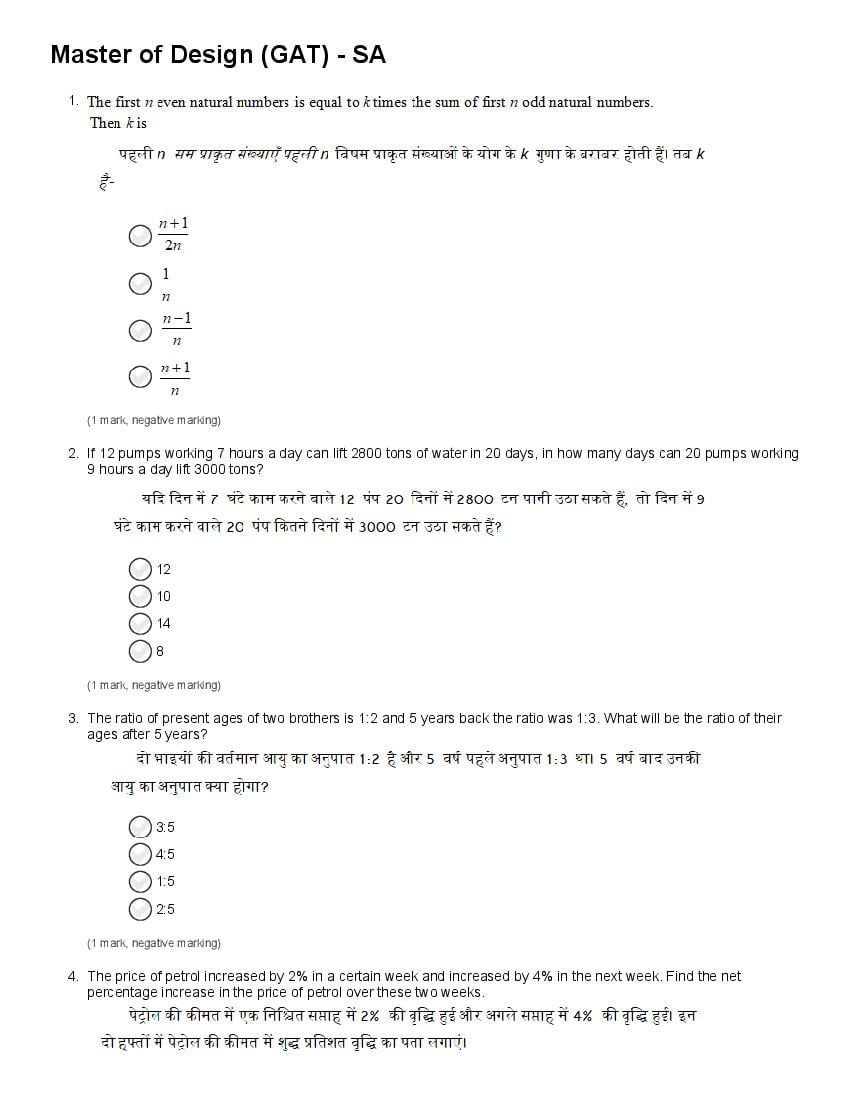
1.
2. If 12 pumps working 7 hours a day can lift 2800 tons of water in 20 days, in how many days can 20 pumps working
9 hours a day lift 3000 tons?
12
10
14
8
3. The ratio of present ages of two brothers is 1:2 and 5 years back the ratio was 1:3. What will be the ratio of their
ages after 5 years?
3:5
4:5
1:5
2:5
4. The price of petrol increased by 2% in a certain week and increased by 4% in the next week. Find the net
percentage increase in the price of petrol over these two weeks.
Page 2
6.20%
6.08%
6.16%
5.
4%
3%
4.5%
5%
6. In how many years interest of a sum will be (3/5)th of the total amount at 10% simple interest?
12 years
13 years
15 years
10 years
7. What annual installment will discharge a debt of Rs. 3094 due in 4 years at 7% simple interest?
Rs. 650
Rs. 1200
Rs. 700
Rs. 900
8. P and Q working together can complete a job in 16 days. P alone can complete it in 18 days. Both work together for
4 days and then Q leaves. Find the time taken by P to complete the remaining work.
Page 3
14.5 days
12.5 days
13.5 days
9. A tank has a leak at its bottom which empties it at 6 litres/minute. It also has a filling tap which can fill the tank in 6
hours. The tank takes 18 hours to become full. Find the capacity of the tank.
3240 litres
3402 litres
3403 litres
4023 litres
10. A person covered a certain distance at a certain speed. If his speed was 20% more, he would take 10 minutes less
to cover the same distance. Find the time he takes to cover the distance.
42 minutes
45 minutes
60 minutes
50 minutes
11.
Page 4
13:12:11
13:11:12
12:13:11
12. The cost price of 80 articles is Rs. 12.50 per article. 20 of them were sold for Rs. 18 each. At what price should
each of the remaining articles be sold so as to get an overall profit of Rs. 4.50 per article?
Rs. 15
Rs. 18
13. Divide Rs. 6600 into two parts so that the simple interest on the first part for 5 years at 6% per annum is equal to
the simple interest on the second part for 3 years at 12% per annum.
(Rs. 4000, Rs. 2600)
(Rs. 3500, Rs. 3100)
(Rs. 3600, Rs. 3000)
(Rs. 3800, Rs. 2800)
14. A vessel is full of a mixture of milk and water with 9% milk. 9 litres are withdrawn and then replaced with pure water.
If the milk is now 6%, how much does the vessel hold?
Page 5
40 litres
27 litres
18 litres
15. There are two containers having mixtures of hydrochloric acid and water. In container 1, the ratio of hydrochloric
acid and water is 1:2 and in container 2 the ratio of hydrochloric acid and water is 4:1. Find the amount of mixture
that should be taken from container 1 in order to make 28 litres of a mixture containing equal amount of water and
hydrochloric acid.
20 litres
14 litres
15 litres
18 litres
16. P, Q and R can together earn Rs. 3100 in 10 days. Q and R together can earn Rs. 1320 in 6 days. P and R together
can earn Rs. 1050 in 5 days. Find R’s daily earning.
Rs. 90
Rs. 100
Rs. 110
Rs. 120
17. A train overtakes two persons, cycling at 9 km/hr and 18 km/hr in 40 seconds and 48 seconds respectively. Find the
Page 6
600 meters
550 meters
580 meters
625 meters
18. A, B, C and D play four different games among Baseball, Cricket, Kabaddi and Volley ball. A does not play Baseball
or Cricket. B does not play Kabaddi or Volleyball. C plays Volleyball and D plays either Baseball or Volleyball. Who
plays Cricket?
B
C
D
A
19. What is the angle between the minute hand and the hour hand of a clock at 3 hours 40 minutes?
20. If 1st January 1992 is a Tuesday then on which day of the week will 1st January 1993 fall?
Saturday
Thursday
Page 7
Friday
21. P, Q, R, S, T, U, V and W are eight employees of a concern. Each is allotted a different locker out of eight lockers
numbered 1 to 8 in a cupboard. The lockers are arranged in four rows with two lockers in each row.
Lockers 1 and 2 are in the top row from left to right respectively while lockers 7 and 8 are in the bottom row –
arranged from left to right respectively. Lockers 3 and 4 are in the second row from the top – arranged from right to
left respectively. So are lockers 5 and 6 – arranged from right to left respectively – in the second row from the
bottom. P has been allotted locker 1 while V has been allotted locker 8. T’s locker is just above that of Q which is
just above that of R, whereas W’s locker is in the bottom row.
Which of the following cannot be the correct locker number-occupant pair?
6-R
3-Q
4-U
7-W
22. P, Q, R, S, T, U, V and W are eight employees of a concern. Each is allotted a different locker out of eight lockers
numbered 1 to 8 in a cupboard. The lockers are arranged in four rows with two lockers in each row.
Lockers 1 and 2 are in the top row from left to right respectively while lockers 7 and 8 are in the bottom row –
arranged from left to right respectively. Lockers 3 and 4 are in the second row from the top – arranged from right to
left respectively. So are lockers 5 and 6 – arranged from right to left respectively – in the second row from the
bottom. P has been allotted locker 1 while V has been allotted locker 8. T’s locker is just above that of Q which is
just above that of R, whereas W’s locker is in the bottom row.
Page 8
R
Q
S
U
23. P, Q, R, S, T, U, V and W are eight employees of a concern. Each is allotted a different locker out of eight lockers
numbered 1 to 8 in a cupboard. The lockers are arranged in four rows with two lockers in each row.
Lockers 1 and 2 are in the top row from left to right respectively while lockers 7 and 8 are in the bottom row –
arranged from left to right respectively. Lockers 3 and 4 are in the second row from the top – arranged from right to
left respectively. So are lockers 5 and 6 – arranged from right to left respectively – in the second row from the
bottom. P has been allotted locker 1 while V has been allotted locker 8. T’s locker is just above that of Q which is
just above that of R, whereas W’s locker is in the bottom row.
Which of these pairs cannot have lockers that are diagonally placed?
a) P-Q
b) S-R
Page 9
c) U-R
24. P, Q, R, S, T, U, V and W are eight employees of a concern. Each is allotted a different locker out of eight lockers
numbered 1 to 8 in a cupboard. The lockers are arranged in four rows with two lockers in each row.
Lockers 1 and 2 are in the top row from left to right respectively while lockers 7 and 8 are in the bottom row –
arranged from left to right respectively. Lockers 3 and 4 are in the second row from the top – arranged from right to
left respectively. So are lockers 5 and 6 – arranged from right to left respectively – in the second row from the
bottom. P has been allotted locker 1 while V has been allotted locker 8. T’s locker is just above that of Q which is
just above that of R, whereas W’s locker is in the bottom row.
Which of the following groups consists only occupants of odd numbered lockers?
R, V, W
Q, R, W
P, T, Q
T, R, Q
25. P, Q, R, S, T, U, V and W are eight employees of a concern. Each is allotted a different locker out of eight lockers
numbered 1 to 8 in a cupboard. The lockers are arranged in four rows with two lockers in each row.
Lockers 1 and 2 are in the top row from left to right respectively while lockers 7 and 8 are in the bottom row –
arranged from left to right respectively. Lockers 3 and 4 are in the second row from the top – arranged from right to
left respectively. So are lockers 5 and 6 – arranged from right to left respectively – in the second row from the
bottom. P has been allotted locker 1 while V has been allotted locker 8. T’s locker is just above that of Q which is
just above that of R, whereas W’s locker is in the bottom row.
Page 10
in the same row? (Assume that nothing else is distributed from the original arrangement)
P
Q
R
U
26. P, Q, R, S and T sit around a table. P sits two seats to the left of R and Q sits two seats to the right of R.
If S sits in between Q and R, who sits to the immediate right of P?
Q
R
S
T
27. P, Q, R, S and T sit around a table. P sits two seats to the left of R and Q sits two seats to the right of R.
Which of the following cannot be the correct seating arrangement of the five persons in either the clockwise
direction or the anti-clockwise direction?
Page 11
P, T, R, S, Q
P, Q, S, R, T
P, Q, R, S, T
28. P, Q, R, S and T sit around a table. P sits two seats to the left of R and Q sits two seats to the right of R.
If S is not sitting next to Q, who is sitting between Q and S?
Both R and P
P
R
T
29. P, Q, R, S and T sit around a table. P sits two seats to the left of R and Q sits two seats to the right of R.
If a new person U joins the group such that the initial conditions for the seating arrangement should be observed
and also a new condition that U does not sit next to R be satisfied, then which of the following statements is TRUE?
d)Either A or B above
c) U sits to the immediate left of P
a) U sits to the immediate right of S
b) U sits to the immediate left of T
30. P, Q, R, S and T sit around a table. P sits two seats to the left of R and Q sits two seats to the right of R.
Page 12
and also a new condition that U does not sit next to P, S or T be satisfied, then who will be the neighbours of P (one
on either side)?
S and T
T and R
S and Q
R and Q
31. Five villages P, Q, R, S and T situated close to each other. P is to the west of Q, R is to the south of P, T is to the
north of Q and S is to the east of T. Then in which direction R is with respect to S?
South-East
North-West
South-West
Data inadequate
32. A, B, C, D, E, F and G are seven members of a club. Each of them likes one day of the week, viz. Monday,
Tuesday, Wednesday, Thursday, Friday, Saturday and Sunday, not necessarily in the same order. Each of them
owns a different car, viz. Swift, Alto, Figo, Beat, SX4, Estillo and Optra, not necessarily in the same order.
C likes Wednesday and his favourite car is neither SX4 nor Optra. E does not like Monday and his favourite car is
Beat. The favourite car of one who likes Friday is Figo. The one whose favourie car is Estillo likes Tuesday. D likes
Saturday and D’s favourite car is not SX4. G’s favourite car is Alto. F likes Thursday. B does not like Estillo.
Page 13
B
A
D
Data inadequate
33. A, B, C, D, E, F and G are seven members of a club. Each of them likes one day of the week, viz. Monday,
Tuesday, Wednesday, Thursday, Friday, Saturday and Sunday, not necessarily in the same order. Each of them
owns a different car, viz. Swift, Alto, Figo, Beat, SX4, Estillo and Optra, not necessarily in the same order.
C likes Wednesday and his favourite car is neither SX4 nor Optra. E does not like Monday and his favourite car is
Beat. The favourite car of one who likes Friday is Figo. The one whose favourie car is Estillo likes Tuesday. D likes
Saturday and D’s favourite car is not SX4. G’s favourite car is Alto. F likes Thursday. B does not like Estillo.
Whose favourite car is Figo?
B
Page 14
F
C
34. A, B, C, D, E, F and G are seven members of a club. Each of them likes one day of the week, viz. Monday,
Tuesday, Wednesday, Thursday, Friday, Saturday and Sunday, not necessarily in the same order. Each of them
owns a different car, viz. Swift, Alto, Figo, Beat, SX4, Estillo and Optra, not necessarily in the same order.
C likes Wednesday and his favourite car is neither SX4 nor Optra. E does not like Monday and his favourite car is
Beat. The favourite car of one who likes Friday is Figo. The one whose favourie car is Estillo likes Tuesday. D likes
Saturday and D’s favourite car is not SX4. G’s favourite car is Alto. F likes Thursday. B does not like Estillo.
Who among the following likes Sunday?
A
C
E
F
35. A, B, C, D, E, F and G are seven members of a club. Each of them likes one day of the week, viz. Monday,
Tuesday, Wednesday, Thursday, Friday, Saturday and Sunday, not necessarily in the same order. Each of them
owns a different car, viz. Swift, Alto, Figo, Beat, SX4, Estillo and Optra, not necessarily in the same order.
C likes Wednesday and his favourite car is neither SX4 nor Optra. E does not like Monday and his favourite car is
Beat. The favourite car of one who likes Friday is Figo. The one whose favourie car is Estillo likes Tuesday. D likes
Saturday and D’s favourite car is not SX4. G’s favourite car is Alto. F likes Thursday. B does not like Estillo.
Page 15
F
A
B
D
36. A, B, C, D, E, F and G are seven members of a club. Each of them likes one day of the week, viz. Monday,
Tuesday, Wednesday, Thursday, Friday, Saturday and Sunday, not necessarily in the same order. Each of them
owns a different car, viz. Swift, Alto, Figo, Beat, SX4, Estillo and Optra, not necessarily in the same order.
C likes Wednesday and his favourite car is neither SX4 nor Optra. E does not like Monday and his favourite car is
Beat. The favourite car of one who likes Friday is Figo. The one whose favourie car is Estillo likes Tuesday. D likes
Saturday and D’s favourite car is not SX4. G’s favourite car is Alto. F likes Thursday. B does not like Estillo.
Which of the following combinations is correct?
D-Saturday-Beat
Page 16
C-Wednesday-Alto
F-Thursday-Estillo
37. A, B, C, D, E, F and G are standing in a straight line facing north with equal distances between them, not
necessarily in the same order.
Each one is pursuing a different profession – actor, reporter, doctor, engineer, lawyer, teacher and painter not
necessarily in the same order.
G is fifth to the left of C. The reporter is third to the right of G. F is fifth to the right of A. E is second to the left of B.
The engineer is second to the left of D. There are only three people between the engineer and the painter. The
doctor is to the immediate left of the engineer. The lawyer is to the immediate right of the teacher.
What is A’s profession?
Doctor
Teacher
Actor
Painter
38. A, B, C, D, E, F and G are standing in a straight line facing north with equal distances between them, not
necessarily in the same order.
Each one is pursuing a different profession – actor, reporter, doctor, engineer, lawyer, teacher and painter not
necessarily in the same order.
G is fifth to the left of C. The reporter is third to the right of G. F is fifth to the right of A. E is second to the left of B.
The engineer is second to the left of D. There are only three people between the engineer and the painter. The
doctor is to the immediate left of the engineer. The lawyer is to the immediate right of the teacher.
Page 17
F is third to the left of E
F is the teacher
The painter is to the immediate left of B
The lawyer is standing in the exact middle of the arrangement
39. A, B, C, D, E, F and G are standing in a straight line facing north with equal distances between them, not
necessarily in the same order.
Each one is pursuing a different profession – actor, reporter, doctor, engineer, lawyer, teacher and painter not
necessarily in the same order.
G is fifth to the left of C. The reporter is third to the right of G. F is fifth to the right of A. E is second to the left of B.
The engineer is second to the left of D. There are only three people between the engineer and the painter. The
doctor is to the immediate left of the engineer. The lawyer is to the immediate right of the teacher.
Who among the following is an actor?
Page 18
C
B
F
40. A, B, C, D, E, F and G are standing in a straight line facing north with equal distances between them, not
necessarily in the same order.
Each one is pursuing a different profession – actor, reporter, doctor, engineer, lawyer, teacher and painter not
necessarily in the same order.
G is fifth to the left of C. The reporter is third to the right of G. F is fifth to the right of A. E is second to the left of B.
The engineer is second to the left of D. There are only three people between the engineer and the painter. The
doctor is to the immediate left of the engineer. The lawyer is to the immediate right of the teacher.
What is D’s position with respect to the painter?
Third to the right
Third to the left
Second to the right
Second to the left
41. A, B, C, D, E, F and G are standing in a straight line facing north with equal distances between them, not
necessarily in the same order.
Each one is pursuing a different profession – actor, reporter, doctor, engineer, lawyer, teacher and painter not
necessarily in the same order.
G is fifth to the left of C. The reporter is third to the right of G. F is fifth to the right of A. E is second to the left of B.
The engineer is second to the left of D. There are only three people between the engineer and the painter. The
doctor is to the immediate left of the engineer. The lawyer is to the immediate right of the teacher.
Page 19
Which of the following does not belong to the group?
BFC
EBF
GDB
DFC
42. What number will replace the question mark?
5
6
7
12
43. Which of the following countries is known as the Clove Bowl of the world?
Page 20
Gibralter
Brazil
Zanzibar
44. The land of Thousand Islands is
Finland
Indonesia
Ireland
Malayasia
45. Which of the following countries is known as Cockpit of Europe?
Netherlands
Germany
Belgium
Sweden
46. National Start Up day is
January 13
January 15
January 16
January 14
Page 21
Peru
Namibia
Iran
Chile
48. Who is the Managing Director of International Monetary Fund?
Gita Gopinath
Geoffery W.S. Okamoto
Kristalina Georgieva
Rodrigo Rato
49. The singer of SamaVeda is known as
Ardhavayu
Hotra
Udgatr
None of these
50. The river Parushni is known as
Swati
Ghaggar
Ravi
Page 22
51. Who wrote the book “Hasanat-ul-Arifin”?
Dara Shikoh
Nizamuddin Ahmed
Abbas Khan Sherwani
Abul Fazl
52. What is the capital of Macedonia?
Skopje
Vilnius
Valletta
Riga
53. The imaginary line in southern hemisphere that can be drawn at S of equator is known as
Antarctic Circle
Tropic of Cancer
Tropic of Capricorn
Arctic Circle
54. Damon Galgut won the Booker Prize, 2021 for the book
Page 23
Arctic Summer
The Good Doctor
In a Strange Room
55. The study of spiders and related animals is known as
Arachnology
Myology
Ethology
Ophiology
56. The capital of the country Mozambique is
Accra
Rabat
Lilongwe
Maputo
57. The Asiatic Society in Kolkata was established on
15 January 1884
15 January 1784
25 January 1784
15 January 1874
Page 24
the entire journey.
72
75
80
70
59. Find the time taken by a 200 meters long train running at 36 km/hr to cross a boy standing on a platform.
25 seconds
23 seconds
15 seconds
20 seconds
60. In a 600 meters race, P gives Q a start of 200 meters. Ratio of speeds of P and Q is 5:4. By what distance Q wins
the race?
125 meters
175 meters
150 meters
100 meters
61. choose the one which best expresses the meaning of the given word.
INADVERTENT
Thoughtless
Page 25
Unintelligent
Insane
62. choose the one which best expresses the meaning of the given word.
INFURIATE
Enrage
Disgrace
Threaten
Burn
63. choose the one which best expresses the meaning of the given word.
PROSPECTIVE
Prosperous
Potential
Possible
Perplexed
64. choose the one which best expresses the meaning of the given word.
LOUSY
Stinking
Awful
Unbearable
Unpleasant
65. choose the one which best expresses the meaning of the given word.
ACCENTUATED
Devalued
Sharpened
Mitigated
Page 26
66. choose the word opposite in meaning to the given word.
LACERATION
Convalescence
Healing
Recuperation
Palpitation
67. choose the word opposite in meaning to the given word.
IMPLICATE
Complicate
Impose
Impersonate
Disentangle
68. choose the word opposite in meaning to the given word.
INGEST
Dismiss
Display
Disrupt
Disgorge
69. choose the word opposite in meaning to the given word.
HERETICAL
Orthodox
Doubtful
Contradictory
Impious
Page 27
PHILISTINE
Libertine
Educated
Sober
Cultured
71. choose the one which can be substituted for the given words / sentence.
Commencement of adjacent words with the same letter-
Concubine
Alliteration
Consonance
Euphemism
72. choose the one which can be substituted for the given words / sentence.
A wall built to prevent the sea or a river from flooding an area-
Dyke
Surveillance
Reconnaissance
Nuance
73. choose the one which can be substituted for the given words / sentence.
An entertainer who performs difficult physical actions-
Gymnast
Acrobat
Nuance
Clown
74. choose the one which can be substituted for the given words / sentence.
A white skinned woman with dark brown hair-
Page 28
Anodyne
Brunette
Amazon
75. choose the one which can be substituted for the given words / sentence.
Bitter and violent attack in words-
Profanity
Pandemonium
Prototype
Diatribe
76. Groups of four words are given. In each group one word is wrongly spelt. Find out the wrongly spelt word.
Spendthrift
Jubillee
Connoisseur
Insolvent
77. Groups of four words are given. In each group one word is wrongly spelt. Find out the wrongly spelt word.
Renunciation
Efficient
Survivor
Quotiant
78. Groups of four words are given. In each group one word is wrongly spelt. Find out the wrongly spelt word.
Accommodation
Commemoration
Association
Asassination
79. Groups of four words are given. In each group one word is wrongly spelt. Find out the wrongly spelt word.
Barbarian
Abarrant
Page 29
Barouche
80. Groups of four words are given. In each group one word is wrongly spelt. Find out the wrongly spelt word.
Predater
Presumptuous
Prerogative
Replaceable
81. Choose the alternative which best expresses the meaning of the idiom/ phrase.
I don’t know why she has become stand –offish recently.
indifferent
hilarious
unmanageable
angry
82. Choose the alternative which best expresses the meaning of the idiom/ phrase.
The president of this club should be someone who is open and above board.
far better
honest
highly qualified
rich and hard working
83. Choose the alternative which best expresses the meaning of the idiom/ phrase.
The story of his survival in Tsunami beggars description.
is interesting
is beyond description
is described by a beggar
not described by anyone
Page 30
When it was the peak season of his business, he played ducks and drakes with money.
closed his season
distributed among the poor
played childish game
spent money carelessly
85. Choose the alternative which best expresses the meaning of the idiom/ phrase.
There is no love lost between any two neighbouring countries in the world.
not on good terms
have good understanding
stop loving
forming a group
86. In the following question a part of the sentence is bold. Below are given alternatives to the bold part as (a), (b), (c)
and (d) which may improve the sentence. Choose the correct alternative.
I am thinking to do an M.A. in English.
I am thinking doing an M.A. in English
I am thinking of doing an M.A. in English
no improvement
I am wondering to do an M.A. in English
87. In the following question a part of the sentence is bold. Below are given alternatives to the bold part as (a), (b), (c)
and (d) which may improve the sentence. Choose the correct alternative.
I will be with you in one quarter of an hour.
a quarter of one hour
a quarter of hour
a quarter of an hour
no improvement
88. In the following question a part of the sentence is bold. Below are given alternatives to the bold part as (a), (b), (c)
and (d) which may improve the sentence. Choose the correct alternative.
Page 31
addicted with smoking
used to smoke
addicted of smoking
addicted to smoking
89. In the following question a part of the sentence is bold. Below are given alternatives to the bold part as (a), (b), (c)
and (d) which may improve the sentence. Choose the correct alternative.
Write down the address lest you may forget.
you may not forget
you will forget
you should forget
you cannot forget
90. In the following question a part of the sentence is bold. Below are given alternatives to the bold part as (a), (b), (c)
and (d) which may improve the sentence. Choose the correct alternative.
The young boy was considered uncorrectable by his parents.
no improvement
incorrigible
impolite
unruly
91. In the height of the Enlightenment, men influenced by the new political theories of the era launched two of the
largest revolutions in history. These two conflicts, on two separate continents, were both initially successful in
forming new forms of government. And yet, the two conflicts, though merely a decade apart, had radically different
conclusions. How do two wars inspired by more or less the same ideals end up so completely different? Why was
the American Revolution largely a success and the French Revolution largely a failure?
Historians have pointed to myriad reasons—far too various to be listed here. However, the most frequently cited are
worth mentioning. For one, the American Revolution was far removed from the Old World; that is, since it was on a
different continent, other European nations did not attempt to interfere with it. However, in the French Revolution,
there were immediate cries for war from neighboring nations. Early on, for instance, the ousted king attempted to
flee to neighboring Austria and the army waiting there. The newly formed French Republic also warred with
Belgium, and a conflict with Britain loomed. Thus, the French had the burden not only of winning a revolution but
also defending it from outside. The Americans simply had to win a revolution.
Secondly, the American Revolution seemed to have a better chance for success from the get-go, due to the fact
that Americans already saw themselves as something other than British subjects. Thus, there was already a
uniquely American character, so, there was not as loud a cry to preserve the British way of life. In France, several
thousands of people still supported the king, largely because the king was seen as an essential part of French life.
Page 32
the Americans did not oust a king or kill him— they merely separated from him.
Finally, there is a general agreement that the French were not as unified as the Americans, who, for the most part,
put aside their political differences until after they had already formed a new nation. The French, despite their
Tennis Court Oath, could not do so. Infighting led to inner turmoil, civil war, and eventually the Reign of Terror, in
which political dissidents were executed in large numbers. Additionally, the French people themselves were not
unified. The nation had so much stratification that it was impossible to unite all of them—the workers, the peasants,
the middle-class, the nobles, the clergy—into one cause. And the attempts to do so under a new religion, the Divine
Cult of Reason, certainly did not help. The Americans, remember, never attempted to change the society at large;
rather, they merely attempted to change the government.
It can be inferred from paragraph 1 that the author most likely believes that
two events based on the same philosophy are generally not that common
the French Revolution could have been just as successful as the American Revolution was
historians have not come to a conclusion about what separates the French and American
Revolutions
two events that are similar in one way ought to be similar in other ways
92. In the height of the Enlightenment, men influenced by the new political theories of the era launched two of the
largest revolutions in history. These two conflicts, on two separate continents, were both initially successful in
forming new forms of government. And yet, the two conflicts, though merely a decade apart, had radically different
conclusions. How do two wars inspired by more or less the same ideals end up so completely different? Why was
the American Revolution largely a success and the French Revolution largely a failure?
Historians have pointed to myriad reasons—far too various to be listed here. However, the most frequently cited are
worth mentioning. For one, the American Revolution was far removed from the Old World; that is, since it was on a
different continent, other European nations did not attempt to interfere with it. However, in the French Revolution,
there were immediate cries for war from neighboring nations. Early on, for instance, the ousted king attempted to
flee to neighboring Austria and the army waiting there. The newly formed French Republic also warred with
Belgium, and a conflict with Britain loomed. Thus, the French had the burden not only of winning a revolution but
also defending it from outside. The Americans simply had to win a revolution.
Secondly, the American Revolution seemed to have a better chance for success from the get-go, due to the fact
that Americans already saw themselves as something other than British subjects. Thus, there was already a
uniquely American character, so, there was not as loud a cry to preserve the British way of life. In France, several
thousands of people still supported the king, largely because the king was seen as an essential part of French life.
And when the king was first ousted and then killed, some believed that character itself was corrupted. Remember,
the Americans did not oust a king or kill him— they merely separated from him.
Finally, there is a general agreement that the French were not as unified as the Americans, who, for the most part,
put aside their political differences until after they had already formed a new nation. The French, despite their
Tennis Court Oath, could not do so. Infighting led to inner turmoil, civil war, and eventually the Reign of Terror, in
which political dissidents were executed in large numbers. Additionally, the French people themselves were not
unified. The nation had so much stratification that it was impossible to unite all of them—the workers, the peasants,
the middle-class, the nobles, the clergy—into one cause. And the attempts to do so under a new religion, the Divine
Cult of Reason, certainly did not help. The Americans, remember, never attempted to change the society at large;
rather, they merely attempted to change the government.
What function do the questions that end paragraph 1 play in the passage?
They introduce the topic the author of the passage will explore, even though he or she will not
answer the questions.
They introduce the author’s opinions on the main topic and summarize his or her main argument.
They present rhetorical questions that are used only for the purposes of engaging the reader,
even though the questions will not be answered.
Page 33
93. In the height of the Enlightenment, men influenced by the new political theories of the era launched two of the
largest revolutions in history. These two conflicts, on two separate continents, were both initially successful in
forming new forms of government. And yet, the two conflicts, though merely a decade apart, had radically different
conclusions. How do two wars inspired by more or less the same ideals end up so completely different? Why was
the American Revolution largely a success and the French Revolution largely a failure?
Historians have pointed to myriad reasons—far too various to be listed here. However, the most frequently cited are
worth mentioning. For one, the American Revolution was far removed from the Old World; that is, since it was on a
different continent, other European nations did not attempt to interfere with it. However, in the French Revolution,
there were immediate cries for war from neighboring nations. Early on, for instance, the ousted king attempted to
flee to neighboring Austria and the army waiting there. The newly formed French Republic also warred with
Belgium, and a conflict with Britain loomed. Thus, the French had the burden not only of winning a revolution but
also defending it from outside. The Americans simply had to win a revolution.
Secondly, the American Revolution seemed to have a better chance for success from the get-go, due to the fact
that Americans already saw themselves as something other than British subjects. Thus, there was already a
uniquely American character, so, there was not as loud a cry to preserve the British way of life. In France, several
thousands of people still supported the king, largely because the king was seen as an essential part of French life.
And when the king was first ousted and then killed, some believed that character itself was corrupted. Remember,
the Americans did not oust a king or kill him— they merely separated from him.
Finally, there is a general agreement that the French were not as unified as the Americans, who, for the most part,
put aside their political differences until after they had already formed a new nation. The French, despite their
Tennis Court Oath, could not do so. Infighting led to inner turmoil, civil war, and eventually the Reign of Terror, in
which political dissidents were executed in large numbers. Additionally, the French people themselves were not
unified. The nation had so much stratification that it was impossible to unite all of them—the workers, the peasants,
the middle-class, the nobles, the clergy—into one cause. And the attempts to do so under a new religion, the Divine
Cult of Reason, certainly did not help. The Americans, remember, never attempted to change the society at large;
rather, they merely attempted to change the government.
As used in paragraph 2, the word myriad most nearly means
an unrealistic ideal
an unusually rare occurrence
an uncountable number
an unknowable secret
94. In the height of the Enlightenment, men influenced by the new political theories of the era launched two of the
largest revolutions in history. These two conflicts, on two separate continents, were both initially successful in
forming new forms of government. And yet, the two conflicts, though merely a decade apart, had radically different
conclusions. How do two wars inspired by more or less the same ideals end up so completely different? Why was
the American Revolution largely a success and the French Revolution largely a failure?
Historians have pointed to myriad reasons—far too various to be listed here. However, the most frequently cited are
worth mentioning. For one, the American Revolution was far removed from the Old World; that is, since it was on a
different continent, other European nations did not attempt to interfere with it. However, in the French Revolution,
there were immediate cries for war from neighboring nations. Early on, for instance, the ousted king attempted to
flee to neighboring Austria and the army waiting there. The newly formed French Republic also warred with
Belgium, and a conflict with Britain loomed. Thus, the French had the burden not only of winning a revolution but
also defending it from outside. The Americans simply had to win a revolution.
Secondly, the American Revolution seemed to have a better chance for success from the get-go, due to the fact
that Americans already saw themselves as something other than British subjects. Thus, there was already a
uniquely American character, so, there was not as loud a cry to preserve the British way of life. In France, several
thousands of people still supported the king, largely because the king was seen as an essential part of French life.
And when the king was first ousted and then killed, some believed that character itself was corrupted. Remember,
the Americans did not oust a king or kill him— they merely separated from him.
Page 34
put aside their political differences until after they had already formed a new nation. The French, despite their
Tennis Court Oath, could not do so. Infighting led to inner turmoil, civil war, and eventually the Reign of Terror, in
which political dissidents were executed in large numbers. Additionally, the French people themselves were not
unified. The nation had so much stratification that it was impossible to unite all of them—the workers, the peasants,
the middle-class, the nobles, the clergy—into one cause. And the attempts to do so under a new religion, the Divine
Cult of Reason, certainly did not help. The Americans, remember, never attempted to change the society at large;
rather, they merely attempted to change the government.
According to the passage, the Reign of Terror happened because of
the decision to kill the king in the French Revolution
social stratification in America
infighting in the French Revolution
infighting in the American Revolution
95. In the height of the Enlightenment, men influenced by the new political theories of the era launched two of the
largest revolutions in history. These two conflicts, on two separate continents, were both initially successful in
forming new forms of government. And yet, the two conflicts, though merely a decade apart, had radically different
conclusions. How do two wars inspired by more or less the same ideals end up so completely different? Why was
the American Revolution largely a success and the French Revolution largely a failure?
Historians have pointed to myriad reasons—far too various to be listed here. However, the most frequently cited are
worth mentioning. For one, the American Revolution was far removed from the Old World; that is, since it was on a
different continent, other European nations did not attempt to interfere with it. However, in the French Revolution,
there were immediate cries for war from neighboring nations. Early on, for instance, the ousted king attempted to
flee to neighboring Austria and the army waiting there. The newly formed French Republic also warred with
Belgium, and a conflict with Britain loomed. Thus, the French had the burden not only of winning a revolution but
also defending it from outside. The Americans simply had to win a revolution.
Secondly, the American Revolution seemed to have a better chance for success from the get-go, due to the fact
that Americans already saw themselves as something other than British subjects. Thus, there was already a
uniquely American character, so, there was not as loud a cry to preserve the British way of life. In France, several
thousands of people still supported the king, largely because the king was seen as an essential part of French life.
And when the king was first ousted and then killed, some believed that character itself was corrupted. Remember,
the Americans did not oust a king or kill him— they merely separated from him.
Finally, there is a general agreement that the French were not as unified as the Americans, who, for the most part,
put aside their political differences until after they had already formed a new nation. The French, despite their
Tennis Court Oath, could not do so. Infighting led to inner turmoil, civil war, and eventually the Reign of Terror, in
which political dissidents were executed in large numbers. Additionally, the French people themselves were not
unified. The nation had so much stratification that it was impossible to unite all of them—the workers, the peasants,
the middle-class, the nobles, the clergy—into one cause. And the attempts to do so under a new religion, the Divine
Cult of Reason, certainly did not help. The Americans, remember, never attempted to change the society at large;
rather, they merely attempted to change the government.
According to the author, which of the following best summarizes the most frequently cited explanations historians
give for why the French and American Revolutions did not turn out the same way?
locations relative to Europe, the decision to oust or not oust a king, and a lack of unity amongst all
the revolutionaries
social unity among the Americans, social stratification among the French, and the character of the
French and Americans in general
locations relative to Europe, social equality in America, and the lack of a unique French identity
locations relative to Europe, American and French characters, and political cohesion or lack
thereof
Page 35
four substances known as humors and that any ailment was simply the result of an imbalance of these humors. The
four substances—black bile, yellow bile, phlegm, and blood—were all found in the body, and each was associated
with a different element—air, fire, earth, and water, respectively; too much of one would cause disease. An excess
of black bile in your body, for instance, meant you were melancholic; too much blood made you amorous and
sanguine. While it is easy today to sneer at such beliefs, theories like this one, though ludicrous, matter historically.
The beauty of the ancient wisdom is not that it was actually wise but that the logic behind it opened the door for
future scientific inquiry. Thus, while my cough might not be caused by a lack of blood, I can thank Hippocrates and
his cohorts for encouraging later doctors to find the actual source of my cough.
According to the passage, which of the following correctly matches a humor to its element?
black bile : water
yellow bile : fire
phlegm : fire
blood : earth
97. Ancient Greek doctors relied heavily on the theory of humorism, a belief that the body was essentially balanced by
four substances known as humors and that any ailment was simply the result of an imbalance of these humors. The
four substances—black bile, yellow bile, phlegm, and blood—were all found in the body, and each was associated
with a different element—air, fire, earth, and water, respectively; too much of one would cause disease. An excess
of black bile in your body, for instance, meant you were melancholic; too much blood made you amorous and
sanguine. While it is easy today to sneer at such beliefs, theories like this one, though ludicrous, matter historically.
The beauty of the ancient wisdom is not that it was actually wise but that the logic behind it opened the door for
future scientific inquiry. Thus, while my cough might not be caused by a lack of blood, I can thank Hippocrates and
his cohorts for encouraging later doctors to find the actual source of my cough.
As used near the end of the passage, the phrase "sneer at" most nearly means
deride
deplore
decline
debunk
98. Ancient Greek doctors relied heavily on the theory of humorism, a belief that the body was essentially balanced by
four substances known as humors and that any ailment was simply the result of an imbalance of these humors. The
four substances—black bile, yellow bile, phlegm, and blood—were all found in the body, and each was associated
with a different element—air, fire, earth, and water, respectively; too much of one would cause disease. An excess
of black bile in your body, for instance, meant you were melancholic; too much blood made you amorous and
sanguine. While it is easy today to sneer at such beliefs, theories like this one, though ludicrous, matter historically.
The beauty of the ancient wisdom is not that it was actually wise but that the logic behind it opened the door for
future scientific inquiry. Thus, while my cough might not be caused by a lack of blood, I can thank Hippocrates and
his cohorts for encouraging later doctors to find the actual source of my cough.
It can be inferred from the passage that Hippocrates was
a Greek physician
a disease researcher
a modern humanist
Page 36
99. Ancient Greek doctors relied heavily on the theory of humorism, a belief that the body was essentially balanced by
four substances known as humors and that any ailment was simply the result of an imbalance of these humors. The
four substances—black bile, yellow bile, phlegm, and blood—were all found in the body, and each was associated
with a different element—air, fire, earth, and water, respectively; too much of one would cause disease. An excess
of black bile in your body, for instance, meant you were melancholic; too much blood made you amorous and
sanguine. While it is easy today to sneer at such beliefs, theories like this one, though ludicrous, matter historically.
The beauty of the ancient wisdom is not that it was actually wise but that the logic behind it opened the door for
future scientific inquiry. Thus, while my cough might not be caused by a lack of blood, I can thank Hippocrates and
his cohorts for encouraging later doctors to find the actual source of my cough.
Which of the following would be the most appropriate subtitle for this passage?
The Humorists and the Scientists
Greek Philosophy and the Origin of Science
The Humors and Why They Matter
Ancient Humor, Modern Applications
100. Ancient Greek doctors relied heavily on the theory of humorism, a belief that the body was essentially balanced by
four substances known as humors and that any ailment was simply the result of an imbalance of these humors. The
four substances—black bile, yellow bile, phlegm, and blood—were all found in the body, and each was associated
with a different element—air, fire, earth, and water, respectively; too much of one would cause disease. An excess
of black bile in your body, for instance, meant you were melancholic; too much blood made you amorous and
sanguine. While it is easy today to sneer at such beliefs, theories like this one, though ludicrous, matter historically.
The beauty of the ancient wisdom is not that it was actually wise but that the logic behind it opened the door for
future scientific inquiry. Thus, while my cough might not be caused by a lack of blood, I can thank Hippocrates and
his cohorts for encouraging later doctors to find the actual source of my cough.
It can be inferred from the penultimate (second-to-last) sentence of the passage that the author believes the
humors
deserve to be studied today for historical reasons
can offer alternative treatment for diseases
should continue to be taught in medical schools
are laughably inaccurate as explanations for ailments
101. By the mid-nineteenth century, mass production of paper patterns, the emergence of the home sewing machine,
and the convenience of mail order catalogs brought fashionable clothing into the American home. By the early
twentieth century, home economists working in extension and outreach programs taught women how to use paper
patterns to improve the fit and efficiency of new garments as well as how to update existing ones.
Teachers of home economics traditionally made home sewing a critical part of their curriculum, emphasizing self-
sufficiency and resourcefulness for young women. However, with the increasing availability of mass-produced
clothing in catalogs and department stores, more and more women preferred buying garments to making them. As
a result, home economists shifted their attention to consumer education. Through field study, analysis, and
research, they became experts on the purchase and preservation of ready-to-wear clothing for the family, offering
budgeting instruction targeted at adolescent girls. Modern home sewing made it possible for American women to
transcend their economic differences and geographic locations with clothing that was increasingly standardized.
Page 37
home sewing became more of a pastime than a necessity.
According to the passage, the advent of mail order catalogs altered the role of home economists because
their focus shifted to instruction on budgeting and buying and preserving clothing
mass-produced clothing rendered their jobs obsolete
women ceased sewing so home economists had to teach other subjects
home economists had to compete with the ready-to-wear marketplace
102. By the mid-nineteenth century, mass production of paper patterns, the emergence of the home sewing machine,
and the convenience of mail order catalogs brought fashionable clothing into the American home. By the early
twentieth century, home economists working in extension and outreach programs taught women how to use paper
patterns to improve the fit and efficiency of new garments as well as how to update existing ones.
Teachers of home economics traditionally made home sewing a critical part of their curriculum, emphasizing self-
sufficiency and resourcefulness for young women. However, with the increasing availability of mass-produced
clothing in catalogs and department stores, more and more women preferred buying garments to making them. As
a result, home economists shifted their attention to consumer education. Through field study, analysis, and
research, they became experts on the purchase and preservation of ready-to-wear clothing for the family, offering
budgeting instruction targeted at adolescent girls. Modern home sewing made it possible for American women to
transcend their economic differences and geographic locations with clothing that was increasingly standardized.
The democratization of fashion continued through the twentieth century as the ready-towear market expanded and
home sewing became more of a pastime than a necessity.
The passage focuses on the
historical shifts in home sewing from the mid-nineteenth century through the twentieth century
changing role of home economists as a result of changes in the world
modernization of home sewing
effects of home economists on home sewing
103. By the mid-nineteenth century, mass production of paper patterns, the emergence of the home sewing machine,
and the convenience of mail order catalogs brought fashionable clothing into the American home. By the early
twentieth century, home economists working in extension and outreach programs taught women how to use paper
patterns to improve the fit and efficiency of new garments as well as how to update existing ones.
Teachers of home economics traditionally made home sewing a critical part of their curriculum, emphasizing self-
sufficiency and resourcefulness for young women. However, with the increasing availability of mass-produced
clothing in catalogs and department stores, more and more women preferred buying garments to making them. As
a result, home economists shifted their attention to consumer education. Through field study, analysis, and
research, they became experts on the purchase and preservation of ready-to-wear clothing for the family, offering
budgeting instruction targeted at adolescent girls. Modern home sewing made it possible for American women to
transcend their economic differences and geographic locations with clothing that was increasingly standardized.
The democratization of fashion continued through the twentieth century as the ready-towear market expanded and
home sewing became more of a pastime than a necessity.
As used in paragraph 2, which is the best definition for democratization?
becoming widely available to a populace
becoming more affordable to the lower class
Page 38
altering or modifying in a beneficial way
104. By the mid-nineteenth century, mass production of paper patterns, the emergence of the home sewing machine,
and the convenience of mail order catalogs brought fashionable clothing into the American home. By the early
twentieth century, home economists working in extension and outreach programs taught women how to use paper
patterns to improve the fit and efficiency of new garments as well as how to update existing ones.
Teachers of home economics traditionally made home sewing a critical part of their curriculum, emphasizing self-
sufficiency and resourcefulness for young women. However, with the increasing availability of mass-produced
clothing in catalogs and department stores, more and more women preferred buying garments to making them. As
a result, home economists shifted their attention to consumer education. Through field study, analysis, and
research, they became experts on the purchase and preservation of ready-to-wear clothing for the family, offering
budgeting instruction targeted at adolescent girls. Modern home sewing made it possible for American women to
transcend their economic differences and geographic locations with clothing that was increasingly standardized.
The democratization of fashion continued through the twentieth century as the ready-towear market expanded and
home sewing became more of a pastime than a necessity.
Based on information in the passage, it can be inferred that home sewing allowed American women to do all of the
following EXCEPT
create less expensive versions of current styles
become experts on budgeting and consumerism
continue to wear clothing that had gone out of style in stores
copy fashions they had seen elsewhere
105. By the mid-nineteenth century, mass production of paper patterns, the emergence of the home sewing machine,
and the convenience of mail order catalogs brought fashionable clothing into the American home. By the early
twentieth century, home economists working in extension and outreach programs taught women how to use paper
patterns to improve the fit and efficiency of new garments as well as how to update existing ones.
Teachers of home economics traditionally made home sewing a critical part of their curriculum, emphasizing self-
sufficiency and resourcefulness for young women. However, with the increasing availability of mass-produced
clothing in catalogs and department stores, more and more women preferred buying garments to making them. As
a result, home economists shifted their attention to consumer education. Through field study, analysis, and
research, they became experts on the purchase and preservation of ready-to-wear clothing for the family, offering
budgeting instruction targeted at adolescent girls. Modern home sewing made it possible for American women to
transcend their economic differences and geographic locations with clothing that was increasingly standardized.
The democratization of fashion continued through the twentieth century as the ready-towear market expanded and
home sewing became more of a pastime than a necessity.
According to the passage, which of the following led to a decline in home sewing? I. mail order catalogs II. the
availability of apparel in retail outlets III. curriculum changes in home economics
I only
II only
I and II only
II and III only
106. Imagine a mythical beast rising before you on two legs that end in cloven hooves. Sharp, curled horns and pointed
Page 39
carries rusty chains and a pack upon its
back, and it waits until nightfall to enter homes and terrorize youngsters. For centuries, horrifying tales of this
creature induced nightmares in children during a certain holiday. But while this monster seems like it would be right
at home in a Halloween horror story, children across Europe know the creature as Krampus, a demonic creature
that punishesmisbehaving youth during Christmas.
The legend of Krampus has its roots in Germanic folklore and was popularized in Central European countries such
as Austria, Hungary, and Slovenia during the seventeenth century. The beast was said to be the uncharitable
counterpart to the magnanimous St. Nicholas. While St. Nicholas filled children’s wooden shoes and stockings with
treats, Krampus sought out the children who didn’t deserve gifts and delivered spankings and whippings. Children
who had been especially bad during the year were in danger of being kidnapped and taken back to the creature’s
lair for further punishment until they showed true remorse for their misbehavior.By the mid-twentieth century,
however, people were actively trying to bring an end to perpetuating the story of Krampus. Prominent newspapers
across Europe published editorials discouraging parents to share the legend with their children, and the Austrian
government distributed “Krampus Is an Evil Man,” a cautionary pamphlet written by psychologists. Thankfully, fewer
children grow up fearing Krampus in modern times. But fans of history, folk tales, and offbeat holiday traditions still
take time every December to reflect on one of the most frightening characters ever associated with a holiday.
Using the passage as a guide, it can be understood that
I. efforts taken in the mid-twentieth century to discourage sharing the tale of Krampus were
effective
II. the legend of Krampus was popularized when the Austrian government distributed pamphlets
III. children in Central European countries were afraid of getting eaten by Krampus every Christmas
II only
I only
II and III only
I and II only
107. Imagine a mythical beast rising before you on two legs that end in cloven hooves. Sharp, curled horns and pointed
ears sit atop its head, while a long tongue lolls out of a mouth that seems perpetually frozen in a sinister smile. It
carries rusty chains and a pack upon its
back, and it waits until nightfall to enter homes and terrorize youngsters. For centuries, horrifying tales of this
creature induced nightmares in children during a certain holiday. But while this monster seems like it would be right
at home in a Halloween horror story, children across Europe know the creature as Krampus, a demonic creature
that punishesmisbehaving youth during Christmas.
The legend of Krampus has its roots in Germanic folklore and was popularized in Central European countries such
as Austria, Hungary, and Slovenia during the seventeenth century. The beast was said to be the uncharitable
counterpart to the magnanimous St. Nicholas. While St. Nicholas filled children’s wooden shoes and stockings with
treats, Krampus sought out the children who didn’t deserve gifts and delivered spankings and whippings. Children
who had been especially bad during the year were in danger of being kidnapped and taken back to the creature’s
lair for further punishment until they showed true remorse for their misbehavior.By the mid-twentieth century,
however, people were actively trying to bring an end to perpetuating the story of Krampus. Prominent newspapers
across Europe published editorials discouraging parents to share the legend with their children, and the Austrian
government distributed “Krampus Is an Evil Man,” a cautionary pamphlet written by psychologists. Thankfully, fewer
children grow up fearing Krampus in modern times. But fans of history, folk tales, and offbeat holiday traditions still
take time every December to reflect on one of the most frightening characters ever associated with a holiday.
Based on its use in paragraph 2, it can be inferred that the word magnanimous belongs to which of
the following word groups?
dastardly, vile, detestable
generous, compassionate, benevolent
Page 40
refined, polish, genteel
108. Imagine a mythical beast rising before you on two legs that end in cloven hooves. Sharp, curled horns and pointed
ears sit atop its head, while a long tongue lolls out of a mouth that seems perpetually frozen in a sinister smile. It
carries rusty chains and a pack upon its
back, and it waits until nightfall to enter homes and terrorize youngsters. For centuries, horrifying tales of this
creature induced nightmares in children during a certain holiday. But while this monster seems like it would be right
at home in a Halloween horror story, children across Europe know the creature as Krampus, a demonic creature
that punishesmisbehaving youth during Christmas.
The legend of Krampus has its roots in Germanic folklore and was popularized in Central European countries such
as Austria, Hungary, and Slovenia during the seventeenth century. The beast was said to be the uncharitable
counterpart to the magnanimous St. Nicholas. While St. Nicholas filled children’s wooden shoes and stockings with
treats, Krampus sought out the children who didn’t deserve gifts and delivered spankings and whippings. Children
who had been especially bad during the year were in danger of being kidnapped and taken back to the creature’s
lair for further punishment until they showed true remorse for their misbehavior.By the mid-twentieth century,
however, people were actively trying to bring an end to perpetuating the story of Krampus. Prominent newspapers
across Europe published editorials discouraging parents to share the legend with their children, and the Austrian
government distributed “Krampus Is an Evil Man,” a cautionary pamphlet written by psychologists. Thankfully, fewer
children grow up fearing Krampus in modern times. But fans of history, folk tales, and offbeat holiday traditions still
take time every December to reflect on one of the most frightening characters ever associated with a holiday.
Which of the following statements would the author most likely agree with?
The legend of Krampus is too juvenile to be discussed in prominent newspapers.
Children should not expect gifts during the holidays unless they behave all year.
The image of Krampus was not very frightening and shouldn’t have bothered children.
It is for the best that fewer children grow up knowing the legend of Krampus.
109. Imagine a mythical beast rising before you on two legs that end in cloven hooves. Sharp, curled horns and pointed
ears sit atop its head, while a long tongue lolls out of a mouth that seems perpetually frozen in a sinister smile. It
carries rusty chains and a pack upon its
back, and it waits until nightfall to enter homes and terrorize youngsters. For centuries, horrifying tales of this
creature induced nightmares in children during a certain holiday. But while this monster seems like it would be right
at home in a Halloween horror story, children across Europe know the creature as Krampus, a demonic creature
that punishesmisbehaving youth during Christmas.
The legend of Krampus has its roots in Germanic folklore and was popularized in Central European countries such
as Austria, Hungary, and Slovenia during the seventeenth century. The beast was said to be the uncharitable
counterpart to the magnanimous St. Nicholas. While St. Nicholas filled children’s wooden shoes and stockings with
treats, Krampus sought out the children who didn’t deserve gifts and delivered spankings and whippings. Children
who had been especially bad during the year were in danger of being kidnapped and taken back to the creature’s
lair for further punishment until they showed true remorse for their misbehavior.By the mid-twentieth century,
however, people were actively trying to bring an end to perpetuating the story of Krampus. Prominent newspapers
across Europe published editorials discouraging parents to share the legend with their children, and the Austrian
government distributed “Krampus Is an Evil Man,” a cautionary pamphlet written by psychologists. Thankfully, fewer
children grow up fearing Krampus in modern times. But fans of history, folk tales, and offbeat holiday traditions still
take time every December to reflect on one of the most frightening characters ever associated with a holiday.
In the final sentence of the passage, we learn that, "fans of history, folk tales, and offbeat holiday
traditions still take time every December to reflect on one of the most frightening characters ever
associated with a holiday." Based on its use in this sentence, which of the following accurately
describes something that is offbeat?
Page 41
The toddler had a tantrum after his mother refused to buy him a new toy.
My cousin’s handmade clothing combines contrasting colors and patterns.
The new restaurant downtown offers simple, traditional American cuisine.
110. Imagine a mythical beast rising before you on two legs that end in cloven hooves. Sharp, curled horns and pointed
ears sit atop its head, while a long tongue lolls out of a mouth that seems perpetually frozen in a sinister smile. It
carries rusty chains and a pack upon its
back, and it waits until nightfall to enter homes and terrorize youngsters. For centuries, horrifying tales of this
creature induced nightmares in children during a certain holiday. But while this monster seems like it would be right
at home in a Halloween horror story, children across Europe know the creature as Krampus, a demonic creature
that punishesmisbehaving youth during Christmas.
The legend of Krampus has its roots in Germanic folklore and was popularized in Central European countries such
as Austria, Hungary, and Slovenia during the seventeenth century. The beast was said to be the uncharitable
counterpart to the magnanimous St. Nicholas. While St. Nicholas filled children’s wooden shoes and stockings with
treats, Krampus sought out the children who didn’t deserve gifts and delivered spankings and whippings. Children
who had been especially bad during the year were in danger of being kidnapped and taken back to the creature’s
lair for further punishment until they showed true remorse for their misbehavior.By the mid-twentieth century,
however, people were actively trying to bring an end to perpetuating the story of Krampus. Prominent newspapers
across Europe published editorials discouraging parents to share the legend with their children, and the Austrian
government distributed “Krampus Is an Evil Man,” a cautionary pamphlet written by psychologists. Thankfully, fewer
children grow up fearing Krampus in modern times. But fans of history, folk tales, and offbeat holiday traditions still
take time every December to reflect on one of the most frightening characters ever associated with a holiday.
Which of the following would be the most appropriate subtitle for this passage?
The Yuletide Legends of Central Europe
Austria’s Holiday Traditions and Rituals
Holiday Monsters from Halloween to Christmas
On the Dark Side of Christmas
111. By far, the most popular exhibit at the National Zoo in Washington, DC is the zoo’s pair of giant pandas, Mei Xiang
and Tian Tian. These are the second set of pandas the zoo has owned; the first two were a gift the Chinese
government made to the Nixons during then-president Nixon’s historic trip to China in 1972. Nixon was the first
sitting president to visit China since the nation became Communist. The popularity of the exhibit today is easy to
understand: The zoo’s giant pandas are two of only 300 captive pandas in the world, and two of only 1,900 total
pandas in either China or captivity! Yet, while literally thousands of people “bear” witness to the giant pandas each
day, few can “bear” to face a simple reality: the socalled “panda bears” may not be bears at all.
The debate began in 1869, when the first European witness of a giant panda likened the strange animal to a bear.
However, Alphonse Milne-Edwards, a French scientist, challenged that classification after reviewing the remains of
a giant panda and concluding that it was physiologically closer to the red panda, a member of the raccoon family. To
this day, scientists are not certain about how to classify the giant panda.
But the giant panda is plainly a bear on sight, so how can it be classified with raccoons? Well,
part of it is because taxonomy is hardly a perfect science, and classification occurs on many levels: appearance,
genetics, behavior, evolution, etc. In appearance, the red and giant pandas are as similar as they are dissimilar.
Likewise, DNA research has revealed similar links between giant pandas and both bears and raccoons.
Behaviorally, the only animal that is clearly similar to the giant panda is the red panda. So, even though the giant
Page 42
a trait that developed independently in both species, meaning that tracing evolution may likewise be an inconclusive
path.
Perhaps, in the end it is best to merely classify both red and giant pandas as, simply, “pandas.” Certainly, the
classification does not make the animals any less majestic.
Which sentence, if removed from the first paragraph, would strengthen the passage?
"Nixon was the first sitting president to visit China since the nation became Communist."
"The popularity of the exhibit today is easy to understand: The zoo’s giant pandas are two of only
300 captive pandas in the world, and two of only 1,900 total pandas in either China or captivity!"
"By far, the most popular exhibit at the National Zoo in Washington, DC is the zoo’s pair of giant
pandas, Mei Xiang and Tian Tian."
"These are the second set of pandas the zoo has owned; the first two were a gift the Chinese
government made to the Nixons during then-president Nixon’s historic trip to China in 1972."
112. By far, the most popular exhibit at the National Zoo in Washington, DC is the zoo’s pair of giant pandas, Mei Xiang
and Tian Tian. These are the second set of pandas the zoo has owned; the first two were a gift the Chinese
government made to the Nixons during then-president Nixon’s historic trip to China in 1972. Nixon was the first
sitting president to visit China since the nation became Communist. The popularity of the exhibit today is easy to
understand: The zoo’s giant pandas are two of only 300 captive pandas in the world, and two of only 1,900 total
pandas in either China or captivity! Yet, while literally thousands of people “bear” witness to the giant pandas each
day, few can “bear” to face a simple reality: the socalled “panda bears” may not be bears at all.
The debate began in 1869, when the first European witness of a giant panda likened the strange animal to a bear.
However, Alphonse Milne-Edwards, a French scientist, challenged that classification after reviewing the remains of
a giant panda and concluding that it was physiologically closer to the red panda, a member of the raccoon family. To
this day, scientists are not certain about how to classify the giant panda.
But the giant panda is plainly a bear on sight, so how can it be classified with raccoons? Well,
part of it is because taxonomy is hardly a perfect science, and classification occurs on many levels: appearance,
genetics, behavior, evolution, etc. In appearance, the red and giant pandas are as similar as they are dissimilar.
Likewise, DNA research has revealed similar links between giant pandas and both bears and raccoons.
Behaviorally, the only animal that is clearly similar to the giant panda is the red panda. So, even though the giant
panda moves like a bear, it eats bamboo in the same manner as the red panda. Eating bamboo could, however, be
a trait that developed independently in both species, meaning that tracing evolution may likewise be an inconclusive
path.
Perhaps, in the end it is best to merely classify both red and giant pandas as, simply, “pandas.” Certainly, the
classification does not make the animals any less majestic.
The author traces the popularity of the giant panda exhibit at the National Zoo to the
debate over classifying giant pandas
small number of giant pandas in the wild
scarcity of giant pandas in zoos
fact that the pandas were gifts to the United States
113. By far, the most popular exhibit at the National Zoo in Washington, DC is the zoo’s pair of giant pandas, Mei Xiang
and Tian Tian. These are the second set of pandas the zoo has owned; the first two were a gift the Chinese
Page 43
sitting president to visit China since the nation became Communist. The popularity of the exhibit today is easy to
understand: The zoo’s giant pandas are two of only 300 captive pandas in the world, and two of only 1,900 total
pandas in either China or captivity! Yet, while literally thousands of people “bear” witness to the giant pandas each
day, few can “bear” to face a simple reality: the socalled “panda bears” may not be bears at all.
The debate began in 1869, when the first European witness of a giant panda likened the strange animal to a bear.
However, Alphonse Milne-Edwards, a French scientist, challenged that classification after reviewing the remains of
a giant panda and concluding that it was physiologically closer to the red panda, a member of the raccoon family. To
this day, scientists are not certain about how to classify the giant panda.
But the giant panda is plainly a bear on sight, so how can it be classified with raccoons? Well,
part of it is because taxonomy is hardly a perfect science, and classification occurs on many levels: appearance,
genetics, behavior, evolution, etc. In appearance, the red and giant pandas are as similar as they are dissimilar.
Likewise, DNA research has revealed similar links between giant pandas and both bears and raccoons.
Behaviorally, the only animal that is clearly similar to the giant panda is the red panda. So, even though the giant
panda moves like a bear, it eats bamboo in the same manner as the red panda. Eating bamboo could, however, be
a trait that developed independently in both species, meaning that tracing evolution may likewise be an inconclusive
path.
Perhaps, in the end it is best to merely classify both red and giant pandas as, simply, “pandas.” Certainly, the
classification does not make the animals any less majestic.
Each of the following can be inferred from the passage EXCEPT that
giant pandas primarily live in China
the first giant panda was seen by a non-European
scientists are still not certain how to classify giant pandas
giant pandas are clearly members of the raccoon family
114. By far, the most popular exhibit at the National Zoo in Washington, DC is the zoo’s pair of giant pandas, Mei Xiang
and Tian Tian. These are the second set of pandas the zoo has owned; the first two were a gift the Chinese
government made to the Nixons during then-president Nixon’s historic trip to China in 1972. Nixon was the first
sitting president to visit China since the nation became Communist. The popularity of the exhibit today is easy to
understand: The zoo’s giant pandas are two of only 300 captive pandas in the world, and two of only 1,900 total
pandas in either China or captivity! Yet, while literally thousands of people “bear” witness to the giant pandas each
day, few can “bear” to face a simple reality: the socalled “panda bears” may not be bears at all.
The debate began in 1869, when the first European witness of a giant panda likened the strange animal to a bear.
However, Alphonse Milne-Edwards, a French scientist, challenged that classification after reviewing the remains of
a giant panda and concluding that it was physiologically closer to the red panda, a member of the raccoon family. To
this day, scientists are not certain about how to classify the giant panda.
But the giant panda is plainly a bear on sight, so how can it be classified with raccoons? Well,
part of it is because taxonomy is hardly a perfect science, and classification occurs on many levels: appearance,
genetics, behavior, evolution, etc. In appearance, the red and giant pandas are as similar as they are dissimilar.
Likewise, DNA research has revealed similar links between giant pandas and both bears and raccoons.
Behaviorally, the only animal that is clearly similar to the giant panda is the red panda. So, even though the giant
panda moves like a bear, it eats bamboo in the same manner as the red panda. Eating bamboo could, however, be
a trait that developed independently in both species, meaning that tracing evolution may likewise be an inconclusive
path.
Perhaps, in the end it is best to merely classify both red and giant pandas as, simply, “pandas.” Certainly, the
classification does not make the animals any less majestic.
Which of the following statements made in the passage least summarizes the author’s main point?
“it is best to merely classify both the red and giant pandas as, simply, ‘pandas’”
“the so-called ‘panda bears’ may not be bears at all”
Page 44
“to this day, scientists are not certain about how to classify the giant panda”
115. By far, the most popular exhibit at the National Zoo in Washington, DC is the zoo’s pair of giant pandas, Mei Xiang
and Tian Tian. These are the second set of pandas the zoo has owned; the first two were a gift the Chinese
government made to the Nixons during then-president Nixon’s historic trip to China in 1972. Nixon was the first
sitting president to visit China since the nation became Communist. The popularity of the exhibit today is easy to
understand: The zoo’s giant pandas are two of only 300 captive pandas in the world, and two of only 1,900 total
pandas in either China or captivity! Yet, while literally thousands of people “bear” witness to the giant pandas each
day, few can “bear” to face a simple reality: the socalled “panda bears” may not be bears at all.
The debate began in 1869, when the first European witness of a giant panda likened the strange animal to a bear.
However, Alphonse Milne-Edwards, a French scientist, challenged that classification after reviewing the remains of
a giant panda and concluding that it was physiologically closer to the red panda, a member of the raccoon family. To
this day, scientists are not certain about how to classify the giant panda.
But the giant panda is plainly a bear on sight, so how can it be classified with raccoons? Well,
part of it is because taxonomy is hardly a perfect science, and classification occurs on many levels: appearance,
genetics, behavior, evolution, etc. In appearance, the red and giant pandas are as similar as they are dissimilar.
Likewise, DNA research has revealed similar links between giant pandas and both bears and raccoons.
Behaviorally, the only animal that is clearly similar to the giant panda is the red panda. So, even though the giant
panda moves like a bear, it eats bamboo in the same manner as the red panda. Eating bamboo could, however, be
a trait that developed independently in both species, meaning that tracing evolution may likewise be an inconclusive
path.
Perhaps, in the end it is best to merely classify both red and giant pandas as, simply, “pandas.” Certainly, the
classification does not make the animals any less majestic.
The author’s purpose in writing this passage is most likely to
inform readers about an important scientific debate
suggest that a species has been misclassified
argue that a species is difficult to classify
refute an argument about two species
116. Many people are aware of the famous “witch trials” that occurred at the end of the seventeenth century in Salem,
Massachusetts. But fewer people know that men, women, and children had been persecuted in New England for
practicing witchcraft decades before the Salem trials ever took place. The events in Salem happened between
February 1692 and May 1693 and resulted in twenty deaths, but colonies in Connecticut, New Hampshire, and
Vermont accused women of practicing witchcraft as early as the 1640s. Colonies in Connecticut executed eleven
women on these charges between 1647 and 1663.
Colonists brought with them to North America the widespread European belief in dark magic and the supernatural.
Suspicious behavior, sudden illnesses or deaths in families, and rivalries among neighbors often led to accusations
of witchcraft. Witchcraft was a capital crime in colonial North America until 1750, and though the judicial procedure
varied from colony to colony, often the only evidence needed to start a trial was the testimony of a single witness.
The accused woman was ordered to appear before a judge to confess her wrongdoing. If she did not confess, she
was brought before a jury, where she endured questioning, torture, and tests that would supposedly reveal her
affiliation with the devil. If the woman was found guilty, she was sentenced to death.
The trials ceased in the mid-1690s after thirty-five people had been killed. The governor of Massachusetts put an
end to the process after receiving pleas from legal scholars—though it should be noted that the governor’s own wife
had been accused of witchcraft right before he called off the trials. Colonists began demanding public apologies
from the judges and jury members in 1695, and petitions were filed seeking to reverse the alleged witches’
convictions as early as 1700. The Massachusetts, New Hampshire, and Vermont governments have formally
acknowledged the harm done to the women, but the Connecticut government has yet to clear their names. To this
Page 45
ancestors’ names.
According to the passage, in which year did the Salem witch trials end?
1692
1647
1693
1663
117. Many people are aware of the famous “witch trials” that occurred at the end of the seventeenth century in Salem,
Massachusetts. But fewer people know that men, women, and children had been persecuted in New England for
practicing witchcraft decades before the Salem trials ever took place. The events in Salem happened between
February 1692 and May 1693 and resulted in twenty deaths, but colonies in Connecticut, New Hampshire, and
Vermont accused women of practicing witchcraft as early as the 1640s. Colonies in Connecticut executed eleven
women on these charges between 1647 and 1663.
Colonists brought with them to North America the widespread European belief in dark magic and the supernatural.
Suspicious behavior, sudden illnesses or deaths in families, and rivalries among neighbors often led to accusations
of witchcraft. Witchcraft was a capital crime in colonial North America until 1750, and though the judicial procedure
varied from colony to colony, often the only evidence needed to start a trial was the testimony of a single witness.
The accused woman was ordered to appear before a judge to confess her wrongdoing. If she did not confess, she
was brought before a jury, where she endured questioning, torture, and tests that would supposedly reveal her
affiliation with the devil. If the woman was found guilty, she was sentenced to death.
The trials ceased in the mid-1690s after thirty-five people had been killed. The governor of Massachusetts put an
end to the process after receiving pleas from legal scholars—though it should be noted that the governor’s own wife
had been accused of witchcraft right before he called off the trials. Colonists began demanding public apologies
from the judges and jury members in 1695, and petitions were filed seeking to reverse the alleged witches’
convictions as early as 1700. The Massachusetts, New Hampshire, and Vermont governments have formally
acknowledged the harm done to the women, but the Connecticut government has yet to clear their names. To this
day, descendants of the eleven women put to death in Connecticut hundreds of years ago are fighting to clear their
ancestors’ names.
Which of the following would be the most appropriate subtitle for this passage?
The Witch Trials of Colonial New England
Religion and Witchcraft in Early New England
Seeking Justice for Connecticut’s Convicted Witches
The Lost Souls of Salem
118. Many people are aware of the famous “witch trials” that occurred at the end of the seventeenth century in Salem,
Massachusetts. But fewer people know that men, women, and children had been persecuted in New England for
practicing witchcraft decades before the Salem trials ever took place. The events in Salem happened between
February 1692 and May 1693 and resulted in twenty deaths, but colonies in Connecticut, New Hampshire, and
Vermont accused women of practicing witchcraft as early as the 1640s. Colonies in Connecticut executed eleven
women on these charges between 1647 and 1663.
Colonists brought with them to North America the widespread European belief in dark magic and the supernatural.
Suspicious behavior, sudden illnesses or deaths in families, and rivalries among neighbors often led to accusations
of witchcraft. Witchcraft was a capital crime in colonial North America until 1750, and though the judicial procedure
varied from colony to colony, often the only evidence needed to start a trial was the testimony of a single witness.
The accused woman was ordered to appear before a judge to confess her wrongdoing. If she did not confess, she
Page 46
affiliation with the devil. If the woman was found guilty, she was sentenced to death.
The trials ceased in the mid-1690s after thirty-five people had been killed. The governor of Massachusetts put an
end to the process after receiving pleas from legal scholars—though it should be noted that the governor’s own wife
had been accused of witchcraft right before he called off the trials. Colonists began demanding public apologies
from the judges and jury members in 1695, and petitions were filed seeking to reverse the alleged witches’
convictions as early as 1700. The Massachusetts, New Hampshire, and Vermont governments have formally
acknowledged the harm done to the women, but the Connecticut government has yet to clear their names. To this
day, descendants of the eleven women put to death in Connecticut hundreds of years ago are fighting to clear their
ancestors’ names.
In paragraph 2, we learn that "Colonists brought with them to North America the widespread European belief in dark
magic and the supernatural." Based on its use in paragraph 2, which of the following examples accurately describes
a scenario involving the supernatural?
Ben can read books faster than anyone else in class.
Jamie told me she talks to her guardian angel every night.
Calvin expected the house to be full of people, but it was dark and silent
The mansion on the hill has been abandoned for over a century..
119. Many people are aware of the famous “witch trials” that occurred at the end of the seventeenth century in Salem,
Massachusetts. But fewer people know that men, women, and children had been persecuted in New England for
practicing witchcraft decades before the Salem trials ever took place. The events in Salem happened between
February 1692 and May 1693 and resulted in twenty deaths, but colonies in Connecticut, New Hampshire, and
Vermont accused women of practicing witchcraft as early as the 1640s. Colonies in Connecticut executed eleven
women on these charges between 1647 and 1663.
Colonists brought with them to North America the widespread European belief in dark magic and the supernatural.
Suspicious behavior, sudden illnesses or deaths in families, and rivalries among neighbors often led to accusations
of witchcraft. Witchcraft was a capital crime in colonial North America until 1750, and though the judicial procedure
varied from colony to colony, often the only evidence needed to start a trial was the testimony of a single witness.
The accused woman was ordered to appear before a judge to confess her wrongdoing. If she did not confess, she
was brought before a jury, where she endured questioning, torture, and tests that would supposedly reveal her
affiliation with the devil. If the woman was found guilty, she was sentenced to death.
The trials ceased in the mid-1690s after thirty-five people had been killed. The governor of Massachusetts put an
end to the process after receiving pleas from legal scholars—though it should be noted that the governor’s own wife
had been accused of witchcraft right before he called off the trials. Colonists began demanding public apologies
from the judges and jury members in 1695, and petitions were filed seeking to reverse the alleged witches’
convictions as early as 1700. The Massachusetts, New Hampshire, and Vermont governments have formally
acknowledged the harm done to the women, but the Connecticut government has yet to clear their names. To this
day, descendants of the eleven women put to death in Connecticut hundreds of years ago are fighting to clear their
ancestors’ names.
Which of the following words best describes the public apology given to victims of the colonial witch
trials?
delayed
appropriate
inclusive
partial
Page 47
Massachusetts. But fewer people know that men, women, and children had been persecuted in New England for
practicing witchcraft decades before the Salem trials ever took place. The events in Salem happened between
February 1692 and May 1693 and resulted in twenty deaths, but colonies in Connecticut, New Hampshire, and
Vermont accused women of practicing witchcraft as early as the 1640s. Colonies in Connecticut executed eleven
women on these charges between 1647 and 1663.
Colonists brought with them to North America the widespread European belief in dark magic and the supernatural.
Suspicious behavior, sudden illnesses or deaths in families, and rivalries among neighbors often led to accusations
of witchcraft. Witchcraft was a capital crime in colonial North America until 1750, and though the judicial procedure
varied from colony to colony, often the only evidence needed to start a trial was the testimony of a single witness.
The accused woman was ordered to appear before a judge to confess her wrongdoing. If she did not confess, she
was brought before a jury, where she endured questioning, torture, and tests that would supposedly reveal her
affiliation with the devil. If the woman was found guilty, she was sentenced to death.
The trials ceased in the mid-1690s after thirty-five people had been killed. The governor of Massachusetts put an
end to the process after receiving pleas from legal scholars—though it should be noted that the governor’s own wife
had been accused of witchcraft right before he called off the trials. Colonists began demanding public apologies
from the judges and jury members in 1695, and petitions were filed seeking to reverse the alleged witches’
convictions as early as 1700. The Massachusetts, New Hampshire, and Vermont governments have formally
acknowledged the harm done to the women, but the Connecticut government has yet to clear their names. To this
day, descendants of the eleven women put to death in Connecticut hundreds of years ago are fighting to clear their
ancestors’ names.
Based on the information in the final paragraph, it can be inferred that the author believes
the Massachusetts governor should have formed an improved legal system
the governor's decision to end the trials may have been unduly influenced
the descendants of the Connecticut witches are fighting a useless battle
the trials should have continued well into the 1700s
Document Details
| Board / Org | NIFT |
| Exam | National Institute of Fashion Technology Entrance Examination |
| Type | Sample Paper |
| Pages | 47 |
| Updated | 30 Apr 2026 |