Manipur Board Class 12 Syllabus 2027 Biology
Finished viewing? Save it for later —
Download Manipur Board Class 12 Syllabus 2027 Biology (PDF · 8 pages)About Manipur Board Class 12 Syllabus 2027 Biology
Manipur Board Class 12 Syllabus 2027 Biology is available here for free download. Published by Manipur Board for Class 12, this syllabus can be viewed online or downloaded as a PDF (8 pages). Candidates preparing for Class 12 can use Manipur Board Class 12 Syllabus 2027 Biology to understand the exam pattern, the type of questions asked, and the overall difficulty level.
Frequently Asked Questions
How can I download Manipur Board Class 12 Syllabus 2027 Biology?
Open this page and click the Download button to save Manipur Board Class 12 Syllabus 2027 Biology as a PDF. It is completely free on AglaSem Docs.
Is Manipur Board Class 12 Syllabus 2027 Biology free to download?
Yes. Manipur Board Class 12 Syllabus 2027 Biology can be viewed online and downloaded as a PDF free of cost on AglaSem Docs.
How many pages does Manipur Board Class 12 Syllabus 2027 Biology have?
Manipur Board Class 12 Syllabus 2027 Biology contains 8 pages, which you can read online or download together as a single PDF.
Where can I find more Class 12 study material?
You can find more Class 12 question papers, sample papers, syllabus, and answer keys on AglaSem Docs.
Manipur Board Class 12 Syllabus 2027 Biology – Text
Read the full text of this syllabus below — useful to quickly search, copy and reference the content online without downloading the PDF.
📄 View text version (9 pages)
Page 1
Manipur Board Class
12 Syllabus 2027
Biology
EXAM YEAR TYPE SUBJECT
Manipur Class 12 2027 Syllabus Biology
Notes · Sample Papers · Previous Year Papers · Mock Tests
Page 2
m .co
m .co s e m
se g l a
a
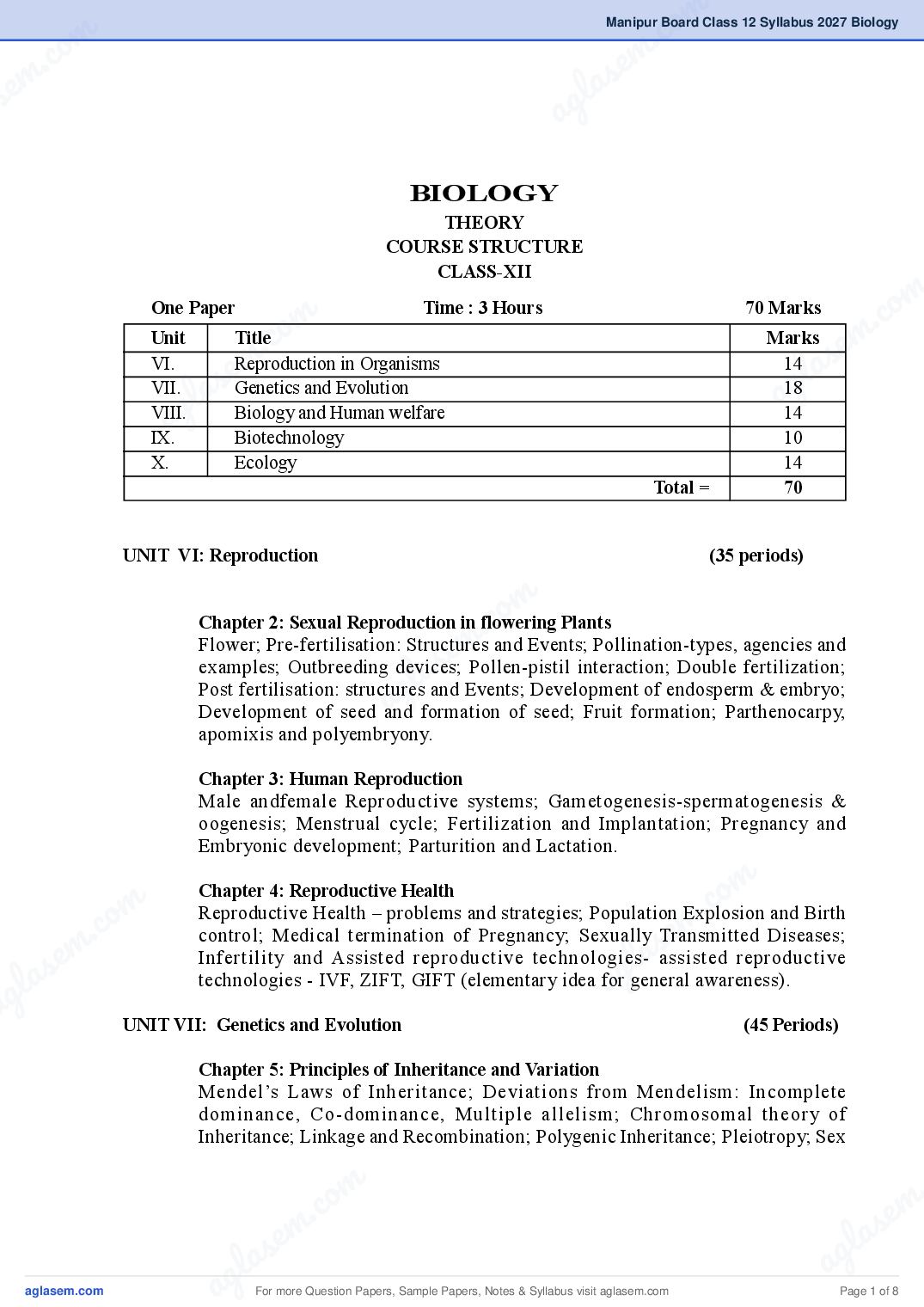
BIOLOGY
THEORY
COURSE STRUCTURE
CLASS-XII
m
One Paper
m Time : 3 Hours 70 Marks
.co
Unit
.co
Title
m
Marks
s e m
VI.
s e Reproduction in Organisms 14
l a
VII.
g l a Genetics and Evolution
ag
18
a
VIII.
IX.
Biology and Human welfare
Biotechnology
14
10
X. Ecology 14
Total = 70
UNIT VI: Reproduction (35 periods)
m
.co
Chapter 2: Sexual Reproduction in flowering Plants
m
e
Flower; Pre-fertilisation: Structures and Events; Pollination-types, agencies and
s
g la
examples; Outbreeding devices; Pollen-pistil interaction; Double fertilization;
Post fertilisation: structures and Events; Development of endosperm & embryo;
a
Development of seed and formation of seed; Fruit formation; Parthenocarpy,
apomixis and polyembryony.
Chapter 3: Human Reproduction
Male andfemale Reproductive systems; Gametogenesis-spermatogenesis &
oogenesis; Menstrual cycle; Fertilization and Implantation; Pregnancy and
Embryonic development; Parturition and Lactation.
m
.co
Chapter 4: Reproductive Health
m
.co
Reproductive Health – problems and strategies; Population Explosion and Birth
e m
e m control; Medical termination of Pregnancy; Sexually Transmitted Diseases;
l as
las Infertility and Assisted reproductive technologies- assisted reproductive
a
technologies - IVF, ZIFT, GIFT (elementary idea for general awareness).g
ag
UNIT VII: Genetics and Evolution (45 Periods)
Chapter 5: Principles of Inheritance and Variation
Mendel’s Laws of Inheritance; Deviations from Mendelism: Incomplete
dominance, Co-dominance, Multiple allelis m; Chromosomal t heory of
Inheritance; Linkage and Recombination; Polygenic Inheritance; Pleiotropy; Sex
m .
.co s e m
s em l a
g la ag
a For more Question Papers, Sample Papers, Notes & Syllabus visit Page 1 of 8
Page 3
Genetic Disorders: Mendelian disorders –Colour blindness,Haemophilia,sickle-cell
anaemia, phenylketonuria, Thalassemia; Chromosomal Disorders – Down’s syndrome,
klinefelter’s syndrome, Turner’s syndrome.
Chapter 6: Molecular Basis of Inheritance
Structure of DNA and RNA; Packaging of DNA; The search for genetic material;
RNA world; DNA Replication; Transcription; Genetic code; Translation;
Regulation of Gene Expression; Human genome Project; DNA fingerprinting.
Chapter 7: Evolution
Origin of Life; Evolution of Life Forms; Evidences for Evolution; Adaptive
radiation; Biological Evolution; Mechanism of Evolution; Hardy- Weinberg
Principle; A brief account of evolution; Origin and Evolution of Man.
UNIT VIII: Biology in Human Welfare (35 Periods)
Chapter 8: Human Health and Disease
Common Diseases in Humans (typhoid, pneumonia, commoncold, malaria, amoebiasis,
ascariasis, filariasis, ring worm);
Immunity (Innate, Acquired, Active and passive Immunity, Vaccination and Immunisation,
Allergy, Auto Immunity); Immune System in the body;
AIDS, Cancer, Drugs and Alcohol Abuse.
Chapter 10: Microbes in Human welfare
Microbes in Household Products, Industrial Products,Sewage Treatment, and
Production of biogas;
Microbes as Biocontrol agents and Biofertilisers.
UNIT IX: BIOTECHNOLOGY ( 30 Periods)
Chapter 11: Biotechnology: Principles and Processes
Principles of Biotechnology; Tools of Recombinant DNA Technology; Process
of Recombinant DNA Technology.
Chapter 12: Biotechnology and Its Application
Biotechnological Applications in agriculture (GMO and Bt cotton) and medicine
(genetically engineered insulin, gene therapy, molecular diagnosis);
Transgenic animals; Ethical Issues.
For more Question Papers, Sample Papers, Notes & Syllabus visit Page 2 of 8
Page 4
m .co
m .co s e m
se g l a
a
UNIT X: ECOLOGY (35 periods)
Chapter 13: Organisms and Populations
Populations: Population Attributes; Population Growth, Life history variation;
m
.co
Population Interactions – Predation, Competition, Parasitism, Commenselism and
m
.co
Mutualism.
e m
e m 14: Ecosystem
Chapter
l as
l a s ag
Structure and Function; Productivity; Decomposition; Energy Flow; Ecological Pyramids;
ag Chapter 15: Biodiversity and Conservation
Biodiversity: Patterns of Biodiversity; Importance of Species diversity to the
Ecosystem; Loss of Biodiversity; Biodiversity Conservation.
m
.co
e m
las
ag
m
m .co
m .co s e m
s e g l a
g la a
a
m .
.co s e m
s em l a
g la ag
a For more Question Papers, Sample Papers, Notes & Syllabus visit Page 3 of 8
Page 5
PRACTICAL
CLASS-XII
Time : 3 Hours Marks : 30 Periods : 60
1. Experiments and spotting 20 Marks
2. Record of one investigatory project and Viva based on the project 5 Marks
3. Class record and Viva based on experiment. 5 Marks
Total = 30 Marks
A. List of Experiments
1. Study of pollen germination on a slide.
2. Collect water from two different water bodies around you and study them for pH, clarity and
presence of any living organisms.
3. Study of plant population density by quadrat method.
4. Study of plant population frequency by quadrat method.
5. Prepare a temporary mount of onion root tip to study mitosis.
B. Study/observation of the following (Spotting)
1. Flowers adapted to pollination by different agencies (wind, insects).
2. Pollen germination on stigma through a permanent slide.
3. Identification of stages of gamete development i.e. T.S. testis and T.S. ovary through permanent
slide. (from any mammal)
4. Meiosis in onion bud cell or grasshopper testis through permanent slide.
5. T.S. of blastula through permanent slide.
6. Mendelian inheritance using seeds of different colour/size of any plant.
7. Prepared pediqree charts of genetic traits such as rolling of tongue, blood groups, widow’s
peak, colour blindness.
8. Exercise on controlled pollinationEmasculation, tagging and bagging.
9. Identification of common disease causing organism like Ascaris, Entamoeba, Plasmodium,
Ringworm through permanent slides or specimens. Comment on symptoms of diseases that
they cause.
10. Two plants and two animals found in xerophytic conditions. Comment upon their
morphological adaptations.
11. Plants and animals found in aquatic conditions. Comment upon their morphological
adaptations.
For more Question Papers, Sample Papers, Notes & Syllabus visit Page 4 of 8
Page 6
m .co
m .co s e m
se g l a
a
PRESCRIBED TEXTBOOKS : CLASS XII
1. Biology
Textbook for Class XII.
Published by : NCERT, New Delhi.
m
REFERENCE BOOKS :
c o m m .co
. Biology Vol. II
1. Elementary
m s e
sePublished Bhatia
By : K.N. and M.P. Tyagi l a
g la by : Trueman Book Company, Jalandhar - 144 008. ag
a 2. Companion Biology for Class XII
By : K. Bhatti.
Published by : S. Dinesh & Co. Jalandhar-144008.
3. Saraswati Lab Manual Biology for Class-XI I (NCF 2023 Aligned)
By: Rajesh Kumar Srivastav
Published by: New Saraswati House (India) Private Limited, New Delhi-110002
m
3.
.co
Comprehensive Laboratory Manual in Biology for Class XII (New Edition)
By : Dr. J.P. Sharma
s em
la
Published by : Laxmi Publications (P) Ltd., New Delhi - 110 002.
4.
g
A Textbook of PracticalaBiology for Class-XII
By : Dr. N. Mohendra Singh
Published by : Writers’ Book Store, Pologround, Imphal.
m
m .co
m .co s e m
s e g l a
g la a
a
m .
.co s e m
s em l a
g la ag
a For more Question Papers, Sample Papers, Notes & Syllabus visit Page 5 of 8
Page 7
QUESTION PAPER
Subject : BIOLOGY
Paper : Theory
Class : XII
Full Mark : 70
Time : 3 Hours
WEIGHTAGE TO OBJECTIVES:
Objectives Marks Percentage
Knowledge(K) 10 15
I Understanding (U) 35 50
Application (A) 21 30
Skill (S) 4 5
Total: 70 100
WEIGHTAGE TO FORMS OF QUESTIONS:
FORM OF QUESTIONS No. of questions Time(in minutes) Marks Percentage
Essay/Long Answer (E/LA) 3 60 15 21
II Short Answer (SA-I) 6 37 18 26
Short Answer (SA-II) 10 40 20 29
Very Short Answer(VSA) 7 21 7 10
MCQ 10 22 10 14
Total: 36 180 70 100
WEIGHTAGE TO CONTENT:
Unit CONTENTS Marks Percentage
I Reproduction in Organisms 14 20
II Genetics and Evolution 18 26
III III Biology and Human Welfare 14 20
IV Biotechnology 10 14
V Ecology 14 20
Total: 70 100
IV SCHEME OF SECTIONS: NIL
SCHEME OF OPTIONS: : i) Internal option will be given in Essay Type Question
V ii) Internal option will be given in three questions of SA-I including one case
study based question.
DIFFICULTY LEVEL :
VI Difficult : 35% of the total marks
Average : 50% of the total marks
Easy : 15% of the total marks
Abbreviation: K(Knowledge), U(Understanding), A(Application),S(Skill), E/LA(Essay Type/Long Answer Type),
SA(Short Answer Type), VSA(Very Short Answer Type), O(Objective Type).
MCQ (Multiple Choice Question).
N.B.: Assertion and reasoning: 2(two) Questions in MCQ.
Source Based Question: 1(one) Question in SA-I
For more Question Papers, Sample Papers, Notes & Syllabus visit Page 6 of 8
Page 8
m .co
m .co s e m
se g l a
a
DESIGN
QUESTION PAPER/UNIT TEST
Subject : BIOLOGY
Unit/Paper : Practical
m
.co
Class : XII
m
.co m
Time : 3 Hours
s e
em
Full Marks : 30
s l a
g la SCHEME :
MARKING ag
a Section - A 4 Marks
Q. 1
(a) Item 1 : Pollen germination.
(i) Slide Preparation 1
(ii) Observations 1
(iii) Diagram and labelling 1
(iv) Comments 1
o m Total = 4
c
. mitosis in Onion root tip cells.
(b) Item 5 : Preparation of temporary slide of
e m
(i) Preparation of slide
(ii) Labelled diagram la
s
2
1
(iii) Description a g 1
Total = 4
Section - B 4+4 = 8 Marks
Q.2
(a) Item 2 : Soil test, pH and water holding capacity, pH clarity and presence of
any living organisms and presence of suspended particulate matter in
air.
m
m (i) Experimentation/Setting of experiment 1
.co
m .co (ii) Observations
s em 1
la
(iii) Inference and Result 2
s e g
la
Total = 4
g a
a (b) Item 3 & 4 : Quadrate Method : Plant population density and plant population
frequency
(i) Setting of Field experiment 1
(ii) Identification of Species 1
(iii) Data and Comments 1+1
Total = 4
m .
.co s e m
s em l a
g la ag
a For more Question Papers, Sample Papers, Notes & Syllabus visit Page 7 of 8
Page 9
Q. 3
Item 1-11: Spotting
(i) Identification 1
(ii) Comment 1
Total = 2
Section - D
Q. 4 Investigatory Project 5 Marks
(i) Aim and object 1
(ii) Materials and Methods 1
(iii) Summary of the project 1
(iv) Viva Voce on project record 2
Total = 5
Q. 5 Laboratory Record Book 5 Marks
(i) Completeness of practical work 1
(ii) Regularity in Submitting record 1
(iii) Neatness and accuracy of record 1
(iv) Viva Voce on laboratory record 2
Total = 5
For more Question Papers, Sample Papers, Notes & Syllabus visit Page 8 of 8
Document Details
| Board / Org | Manipur Board |
| Exam | Class 12 |
| Type | Syllabus |
| Pages | 8 |
| Updated | 04 Nov 2026 |