Kerala SET 2019 Jul Question Paper _12_
Finished viewing? Save it for later —
Download Kerala SET 2019 Jul Question Paper _12_ (PDF · 11 pages)About Kerala SET 2019 Jul Question Paper _12_
Kerala SET 2019 Jul Question Paper _12_ is available here for free download. Published by Default for Govt Jobs Exams, this question paper can be viewed online or downloaded as a PDF (11 pages). Candidates preparing for Govt Jobs Exams can use Kerala SET 2019 Jul Question Paper _12_ to understand the exam pattern, the type of questions asked, and the overall difficulty level.
Frequently Asked Questions
How can I download Kerala SET 2019 Jul Question Paper _12_?
Open this page and click the Download button to save Kerala SET 2019 Jul Question Paper _12_ as a PDF. It is completely free on AglaSem Docs.
Is Kerala SET 2019 Jul Question Paper _12_ free to download?
Yes. Kerala SET 2019 Jul Question Paper _12_ can be viewed online and downloaded as a PDF free of cost on AglaSem Docs.
How many pages does Kerala SET 2019 Jul Question Paper _12_ have?
Kerala SET 2019 Jul Question Paper _12_ contains 11 pages, which you can read online or download together as a single PDF.
Where can I find more Govt Jobs Exams study material?
You can find more Govt Jobs Exams question papers, sample papers, syllabus, and answer keys on AglaSem Docs.
Kerala SET 2019 Jul Question Paper _12_ – Text
Read the full text of this question paper below — useful to quickly search, copy and reference the content online without downloading the PDF.
📄 View text version (11 pages)
Page 1
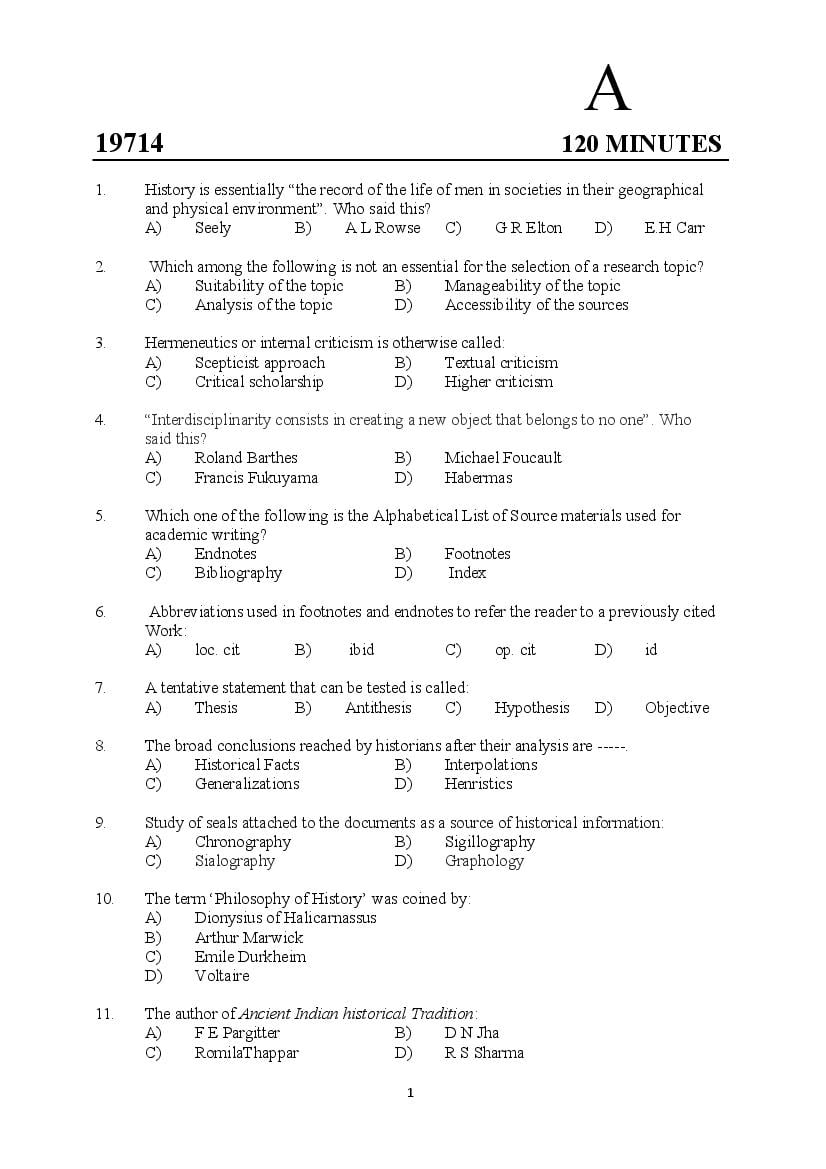
19714 120 MINUTES
1. History is essentially “the record of the life of men in societies in their geographical
and physical environment”. Who said this?
A) Seely B) A L Rowse C) G R Elton D) E.H Carr
2. Which among the following is not an essential for the selection of a research topic?
A) Suitability of the topic B) Manageability of the topic
C) Analysis of the topic D) Accessibility of the sources
3. Hermeneutics or internal criticism is otherwise called:
A) Scepticist approach B) Textual criticism
C) Critical scholarship D) Higher criticism
4. “Interdisciplinarity consists in creating a new object that belongs to no one”. Who
said this?
A) Roland Barthes B) Michael Foucault
C) Francis Fukuyama D) Habermas
5. Which one of the following is the Alphabetical List of Source materials used for
academic writing?
A) Endnotes B) Footnotes
C) Bibliography D) Index
6. Abbreviations used in footnotes and endnotes to refer the reader to a previously cited
Work:
A) loc. cit B) ibid C) op. cit D) id
7. A tentative statement that can be tested is called:
A) Thesis B) Antithesis C) Hypothesis D) Objective
8. The broad conclusions reached by historians after their analysis are -----.
A) Historical Facts B) Interpolations
C) Generalizations D) Henristics
9. Study of seals attached to the documents as a source of historical information:
A) Chronography B) Sigillography
C) Sialography D) Graphology
10. The term ‘Philosophy of History’ was coined by:
A) Dionysius of Halicarnassus
B) Arthur Marwick
C) Emile Durkheim
D) Voltaire
11. The author of Ancient Indian historical Tradition:
A) F E Pargitter B) D N Jha
C) RomilaThappar D) R S Sharma
1
Page 2
A) Robert Bruce foot B) William Johnes
C) Aurel Stein D) Max Muller
13. Method of source criticism in Arab historiography:
A) isnad B) ahadis C) asabiyah D) Tarikh
14. Which one of the following is a work by Khafi Khan?
A) Humayun Namah B) Alamgir Namah
C) Muntakhab-ul - Tawaikh D) Muntakhab-ul- Lubab
15. Which one of the following is a work of Romila Thapar?
A) Myth and Reality B) Indian Feudalism
C) Hindu Polity D) Ancient Indian Social History
16. Match the List I with List II and select the answer from the Codes given below.
List I List II
1. Sumit Sarkar A) A History of Modern India
2. Bipan Chandra B) From Plassey to Partition and After
3. Sekhar Bandhyopayay C) India’s Struggle for Independence
4. Ishita Banerjee Dube D) Modern Times
A) 1-a, 2-c, 3-b, 4-d B) 1-d, 2-b, 3-c, 4-a
C) 1-a, 2-c, 3-d, 4-b D) 1-d, 2-c, 3-b, 4-a
17. Who among the following coined concepts like ‘Feudalism from above’ and
‘Feudalism from below’?
A) Harbans Mukhia B) D D Kosambi
C) R S Sharma D) D N Jha
18. The first Survey of India, which is the Survey of Bengal was conducted by?
A) W.W.Hunter B) Reuben Burrow
C) Colin Mackenzie D) James Renell
19. From whom among the following did Hegel adopt the idea of universal history?
A) Immanuel Kant B) Fichte
C) Schiller D) Herder
20. Match the List I with List II and select the answer from the Codes given below.
List I List II
1. Deconstructing History A) Pierre Bourdieu
2. Orientalism B) Carlo Ginzburg
3. The Cheese and the Worms C) Edward Said
4. The Logic of Practice D) Alun Munslow
A) 1-d, 2-c, 3-b, 4-a B) 1-a, 2-c, 3-b, 4-d
C) 1-b, 2-c, 3-a, 4-d D) 1-b, 2-c, 3-d, 4-a
21. Which one of the following is not a common element present in Peasant Insurgency of
colonial India according to Ranajit Guha?
A) Negation B) Community C) Modality D) Ambiguity
2
Page 3
A) Dialogues on Orators B) Origines
C) Agricola D) de Germania
23. The author of the work “Discourses on the origin of Inequality”:
A) Voltaire B) Montesquieu
C) Rousseau D) Diderot
24. According to R G Collingwood major defect of Greeco Roman Historiography was-----.
A) Humanism B) Secularism
C) Substantialism D) None of these
25. The Paleolithic implements from Kanjirampuzha in Palakkad District were discovered by:
A) Padmanabhan Thampi B) P.Rajendran
C) Todd D) Robert Bruce Foote
26. The pass that connects Idukki with Madurai:
A) Aryankavu B) Bodinaikannur
C) Periya D) Cherambadi
27. The Edakkal Rock Shelter was discovered by:
A) Colonel Mackenzie B) J.Babyngton
C) Fawcett D) William Logan
28. The community or category of people known as Anthanar during the Sangham
Age:
A) The warrior class B) The Brahmins
C) The merchant class D) The Buddhists
29. Author of the Book ‘Reflections on Pre-modern Kerala’:
A) K N Ganesh B) Rajan Gurukkal
C) M G S Narayanan D) Raghava Varier
30. Arrange the following Nadus of Perumal period from north to south:
1. Kurumbranadu 2. Venadu
3. Kalkarainadu 4. Kolathunadu
A) 4, 1, 3, 2 B) 4, 2, 3, 1 C) 1, 4, 2, 3 D) 3, 1, 2, 4
31. The Sandesa Kavya written in imitation of Meghadut was:
A) Kokasandesam B) Mayurasandesam
C) Unnunilisandesam D) Mayukhasandesam
32. Who among the following wrote Tantrasamgraha ?
A) Parameswaran B) Nilakantha Somayaji
C) Jyestadeva D) Achyuta Pisharody
33. Venad ruler associated with the Mampalli Copper Plate of 974AD:
A) Ayyan Atikal Tiruvatikal B) Sthanu Ravi
C) Sri Vallabhan Kotha D) Vira Raghava
3
Page 4
A) Mr. Brennan B) Benjamin Baily
C) Dr. Herman Gundert D) None of these
35. The tomb of Dutch Captain De’Lannoy is situated at:
A) Kalkulam B) Kulachel C) Vizhinajm D) Udayagiri
36. The main brain behind the Kurichiya revolt of 1812 was:
A) Kumaran Nambi B) Raman Nambi
C) Pazhassi Raja D) Thalakkal Chanthu
37. The first Principal Collector of Malabar:
A) Charles Boddam B) William Logan
C) C A Innes D) Major Mac Leod
38. The Pandara Pattam Proclamation often hailed as the ‘Magnacarta of Travancore
ryots’ was enacted in the year:
A) 1865 B) 1867 C) 1896 D) 1932
39. Who among the following is related with Kayal Samaram?
A) Ayyankali B) Mannath Padmanabhan
C) Sri Narayana Guru D) Pandit Karuppan
40. During the Civil Disobedience in Kerala, the tali(marriage badge) incident captured
national attention. Who was the lady activist involved in that incident?
A) Parvathy Nenmenimangalam
B) Arya Pallam
C) Neeli Mangal
D) Lalitha Prabhu
41. The leader of the Quit India Movement in Kerala:
A) K.Madhavan Nair B) K.P.Raman Menon
C) Dr. K.B Menon D) Mannath Krishnan Nair
42. The Basel Evangelical Mission Society, which pioneered many educational activities
had its base at:
A) Britain B) Netherlands C) France D) Germany
43. How many Cabinet members were there in the first E.M.S Ministry of Kerala?
A) 9 B) 12 C) 11 D) 10
44. Which one of the following is not a poem by Pandit karuppan?
A) Jathikummi
B) Baalakalesam
C) Christhumatha Nirupanam
D) Aacharabhooshanam
45. Who among the following wrote Kongrassum Keralavum?
A) K Madhavan Nair B) G P Pillai
C) A K Pillai D) K Kelappan
4
Page 5
A) Kasturirangan B) Ramachandra Guha
C) M S Swaminathan D) Madhav Gadgil
47. The author of “Keralam Malayalikalude Mathrubhumi’:
A) A K Gopalan B) K P Kesava Menon
C) Vakkom Maulavi D) E M S Nampoothiripad
48. Tellicherry Consultations are the records relating to discussions held between:
A) Tippu Sultan and English
B) Pazhassi Raja and British
C) Zamorins and East India Company
D) English East India Company and French
49. Patu Marakkar is the nick name of:
A) Kunjali I B) Kunjali II C) Kunjali III D) Kunjali IV
50. Assertion (A): People of Indus Valley knew the art of navigation.
Reason (R): Seals from Indus Valley Civilization indicate prevalence of overseas trade
A) A is correct, R is wrong B) Both A and R are correct
C) Both A and R are wrong D) A is wrong, R is correct
51. The book Pre-History and Proto-History in India and Pakistan was written by:
A) Mortimer Wheeler B) John Marshall
C) R.S.Bisht D) H.D. Sanghalia
52. ‘The flood and earth quakes are responsible for the decline of Harappan civilization.’
This theory was proposed by:
A) Robert Raikes B) Stuart Piggot
C) Sherren Ratnagar D) M.R.Mughal
53. The teachings of Buddha give the idea that he was:
A) Theist B) Agnostic C) Atheist D) Materialist
54. The inscriptions which provide information on the rule of Darius in India:
A) Persepolis B) Behistan C) Caspatyrus D) Susa
55. The earliest evidence of Agriculture in Indian subcontinent was from:
A) Mehrgarh B) Amri C) Balakot D) Diamabad
56. Who among the following identified the King Piyadassi as Asoka, the Mauryan
emperor?
A) Robert Bruce Foote B) Alexander Cunningham
C) John Marshall D) James Princep
57. Which one of the following was the capital of Vatsa Mahajanapada?
A) Varanasi B) Avanti C) Kausambi D) Hastinapuri
5
Page 6
A) Nritya B) Gayatri C) Varna D) Gotea
59. The Second Budhist council was held at -----.
A) Vaishali B) Pataliputra C) Mandalay D) Rajagriha
60. The founder of the Satavahana dynasty:
A) Gautamaputra Satakarni B) Sri Satakarni
C) Pulamayi-I D) Simukha
61. The founder of Vikramasila University:
A) Mahipala B) Madnpala
C) Dharmapala D) Narayanapala
62. Chahalgani came into existence during the reign of ------ Sultan.
A) Iltumish B) Qutb-ud-din Aibak
C) Naziruddin Muhammed D) Balban
63. The work which provides information on the polity and political ideas of Vijayanagar
empire:
A) Manucharitam B) Saluvabhyudayam
C) Maduravijayam D) Amuktamalyada
64. The Chishti Order I India was established by:
A) Salim Chishti B) Shaikh Moinuddin Chishti
C) Abu Ishaq Shami D) Nizamuddin Auliya
65. The Alai Darwaza and Siri Fort was built by:
A) Alauddin Khalji B) Iltutmish
C) Mohammad Bin Tughlaq D) Firoz Sha Tuglaq
66. In which of the following Mughal Building Pietra dura style was extensively used for
the first time?
A) Humayun’s Tomb B) Jami Masjid
C) Tomb of Salim Chishti D) Itimad ud-Daulah’s
67. The first English man who visited the court of Jahangir:
A) Thomas Roe B) Ralph Fitch C) Mackenzie D) Hawkins
68. The Saluva dynasty was established by -----.
A) Narasimha B) Bhupala
C) Narasa Nayaka D) Vira Narasimha Raya
69. The Mongol leader Chengiz Khan invaded India during the reign of-----.
A) Balban B) Raziya
C) Naziruddin Muhammad D) Iltumish
70. The battle of Haldighat was fought in the year------.
A) 1572 B) 1564 C) 1576 D) 1578
6
Page 7
year 1809 was:
A) Treaty of Jalandar B) Treaty of Amritsar
C) Treaty of Sialkot D) Treaty of Lahore
72. Who among the following wrote the Forgotten Empire?
A) V A Smith B) Robert Sewell
C) John Keay D) Athar Ali
73. Chalukya King who defeated HarshaVardhana
A) Pulikesin I B) Vikramditya
C) Krishna II D) Pulikesin II
74. Arrange the tribal movements against the British in chronological order:
i. Santhal Rebellion ii. Khonds Rebellion
iii. Khasis rebellion iv. Munda rebellion
A) iii, i, iv, ii B) i, ii, iii, iv C) iii, ii, i, iv D) i, iii, iv, ii
75. The Revolt of 1857 was described as “a conflict between civilization and barbarism” by:
A) James Outrom B) L.E.R.Reese
C) John Lawrence D) T.R.Holmes
76. Match the following movements with their leaders.
List I List II
1. Deoband Movement a. Mirza Gulam Ahamad
2. Ahrar Movement b. Syed Ahamed Khan
3. Ahamadiya Movement c. Maulana Hussain Ahamed
4. Aligarh Movement d. Maulana Muhamed Ali
A) 1-a, 2-c,3-d, 4-b B) 1-c, 2-d, 3-a, 4-b
C) 1-d, 2-c, 3-a, 4-b D) 1-b, 2-d, 3-c, 4-a
77. The Indian Universities Act was passed in the year-----.
A) 1902 B) 1904 C) 1905 D) 1899
78. Arrange the following organizations in chronological order.
i. British Indian Society ii. Poona Sarvajanik Sabha
iii. Zamindari Association iv. British Indian Association
A) i, iii, iv, ii B) iii, iv, ii, i C) i, iv, iii, ii D) iii, i, iv, ii
79. Which one of the following was founded by Khan Abdul Gaffar Khan?
A) Indian Association B) Azad Hind fauj
C) Khudai Khidmatgars D) None of these
80. Who among the following early Congress leader wrote ‘Essays in Indian Economics’?
A) M.G.Ranade B) Dadabhai Naoroji
C) R.C Dutt D) G.K.Gokhale
7
Page 8
A) Karachi session B) Lahore session
C) Multan session D) Allahabad session
82. Who among the following is not a Neo-Imperialist historian?
A) Anil Seal B) Percival Spear
C) John Gallagher D) Gordon Johnson
83. Bankim Chandra Chatterjee‘s Novel ‘Anandamath’ is set in the background of:
A) Kuka Movement B) Santhal Rebellion
C) Revolt of 1857 D) Sanyasi Rebellion
84. The Viceroy associated with the Ilbert Bill controversy was:
A) Lord Lytton B) Lord Ripon
C) Lord Hardinge D) Lord Wavell
85. Deccan Education Society, Pune was founded in the year -----.
A) 1881 B) 1882 C) 1875 D) 1884
86. Who among the following is related with Namdhari Movement?
A) Baba Ram Singh B) Guru Gobind Singh
C) Babu Dayal Das D) None of these
87. Who among the following was against the joinig of Junagarh with Indian union?
A) Osman Ali Khan B) Shaikh Abdullah
C) Shah Nawaz Bhutto D) Muhammad Mahabat Khanji-III
88. The State Reorganisation Commission was appointed in the year-----.
A) 1956 B) 1955 C) 1953 D) 1952
89. The Green Revolution of India actually intends for:
A) High Yield Variety Program B) More area under cultivation
C) Grew more crops D) Use of Green Manure
90. The Permanent Land Revenue Settlement in India was introduced by:
A) Lord Wellesley B) Lord Cornwallis
C) Lord Hastings D) Lord Warren Hastings
91. Gandhiji was imprisoned for ---- years in connection with the Non Cooperation
movement.
A) 5 B) 4 C) 2 D) 6
92. The conference of the Indians at Tokyo was organized under the guidance of-----.
A) Captain Mohan Singh B) Rash Bihari Bose
C) Subhash Chandra Bose D) Satya Narain Sinha
93. Who among the following is not an Orientalist?
A) C B Saunders B) James Sutherland
C) Hersry Princep D) John Shakespeare
8
Page 9
A) Moderates and Extremists
B) Muslim League and Congress
C) Hindu Mahasabha and Muslim League
D) Congress and British Government
95. Match the List I with List II:
List I List II
1. Rebel Sultans a) William Dalrymple
2. Culture of Encounters b) Satish Chandra
3. Parties & Politics at the Mughal Court c) Manu S Pillai
4. The Last Mughal d) Audrey Truschke
A) 1-c, 2-d, 3-b, 4-a B) 1-c, 2-a, 3-b, 4-d
C) 1-c, 2-a, 3-d, 4-b D) 1-c, 2-b, 3-d, 4-a
96. Code of Hammurabi was recovered in an Archaeological Excavation of 1901 at-----.
A) Baghdad B) Susa C) Cairo D) Jerusalem
97. The capital of Middle Kingdom of Egypt was-----.
A) Memphis B) Thebes C) Nineveh D) Karnak
98. The excavations of Ur were conducted by------.
A) Leonard Woolley B) Flinders Petrie
C) Alexander Schliemann D) Pitt Rivers
99. The metal plough was invented by:
A) Babylonians B) Egyptians
C) Sumerians D) Chaldeans
100. ‘Periplus of Hanno’ discusses the great sea voyages of:
A) Mesopotamians B) Egyptians
C) Romans D) Phoenicians
101. The conducting of Olympic Games, once in four years at Olympia was in honor of:
A) Zeus B) Apollo C) Poseidon D) Athena
102. The statesman of Greece who drafted laws for the benefit of the farmers:
A) Solon B) Draco C) Cliesthenes D) Pericles
103. The most celebrated artist of the Venitian School:
A) Raphael B) Michelangelo
C) Leonardo da Vinci D) Titian
104. Analytical geometry was introduced by:
A) Rene Descartes B) Isaac Newton
C) John Keplar D) Roger Bacon
105. The celebrated navigator Christopher Columbus was patronized by:
A) Portugal B) Holland C) France D) Spain
9
Page 10
A) Mao Zedong B) Edgar Snow
C) Sun Yat-Sen D) Deng Xiaoping
107. Ancient Egyptian structure with the head of human and body of a lion:
A) Akhnaton B) Pyramid C) Karnak D) Sphinx
108. Italian Renaissance scholar, known as father of Humanism:
A) Dante B) Rebelais C) Petrarch D) Cervantes
109. Which one of the following is not associated with Market Theory regarding the
transition from Feudalism to Capitalism?
A) Henri Pirenne B) Maurice Dobb
C) Paul M Sweezy D) Immanuel Wallerstein
110. The Sophist who declared that ‘man is the measure of all things:’
A) Plato B) Paithagoras
C) Thrasymachus D) Protogoras
111. French Military officer who fought in American War of Independence:
A) Thomas Jefferson B) Lafayette
C) George Washington D) Thomas Paine
112. Who among the following wrote ‘The Structure of Scientific Revolution’?
A) Alexander Koyre B) Isaac Newton
C) Copernicus D) Thomas Kuhn
113. The author of ‘Reflections on Revolution in France:’
A) Albert Soboul B) Eric Hobsbawm
C) Alfred Cobban D) Edmund Burke
114. Which one of the following work deals with Russian Revolution?
A) ‘The Glorious Cause’ B) ‘Citizens’
C) ‘Red Scarf Girl’ D) ‘Ten days that Shook the World’
115. The Townshend Act was passed in the year:
A) 1765 B) 1774 C) 1767 D) 1769
116. The system of skillful rotation of crops during agrarian revolution was introduced by:
A) Jethro Tull B) Arther Young
C) Robert Blackwell D) Viscount Townshend
117. The Latin American revolutionary leader known as Liberator:
A) Miranda B) Simon Boliver
C) Jose San Martin D) Bernardo O’ Higgins
10
Page 11
List I List II
1. Sitadhyaksha a. Superintendent of Forests
2. Akaradhyaksha b. Superintendent of Shipping & Maritime
3. Kupyadhyaksha c. Superintendent of Mines
4. Navadhyaksha d. Superintendent of Agriculture
A) 1-d, 2-c, 3-a, 4-b B) 1-d, 2-c, 3-b, 4-a
C) 1-b, 2-a, 3-c, 4-d D) 1-c, 2-d, 3-b, 4-a
119. Arab Spring began as anti-government protest in-----.
A) Iran B) Qatar C) Iraq D) Tunisia
120. The United Nations Educational, Scientific and Cultural Organization (UNESCO)
had its head quarters at-----.
A) Paris B) Geneva C) New York D) London
_____________________
11
Document Details
| Board / Org | Default |
| Exam | Govt Jobs Exams |
| Type | Question Paper |
| Pages | 11 |
| Updated | 22 Jul 2026 |