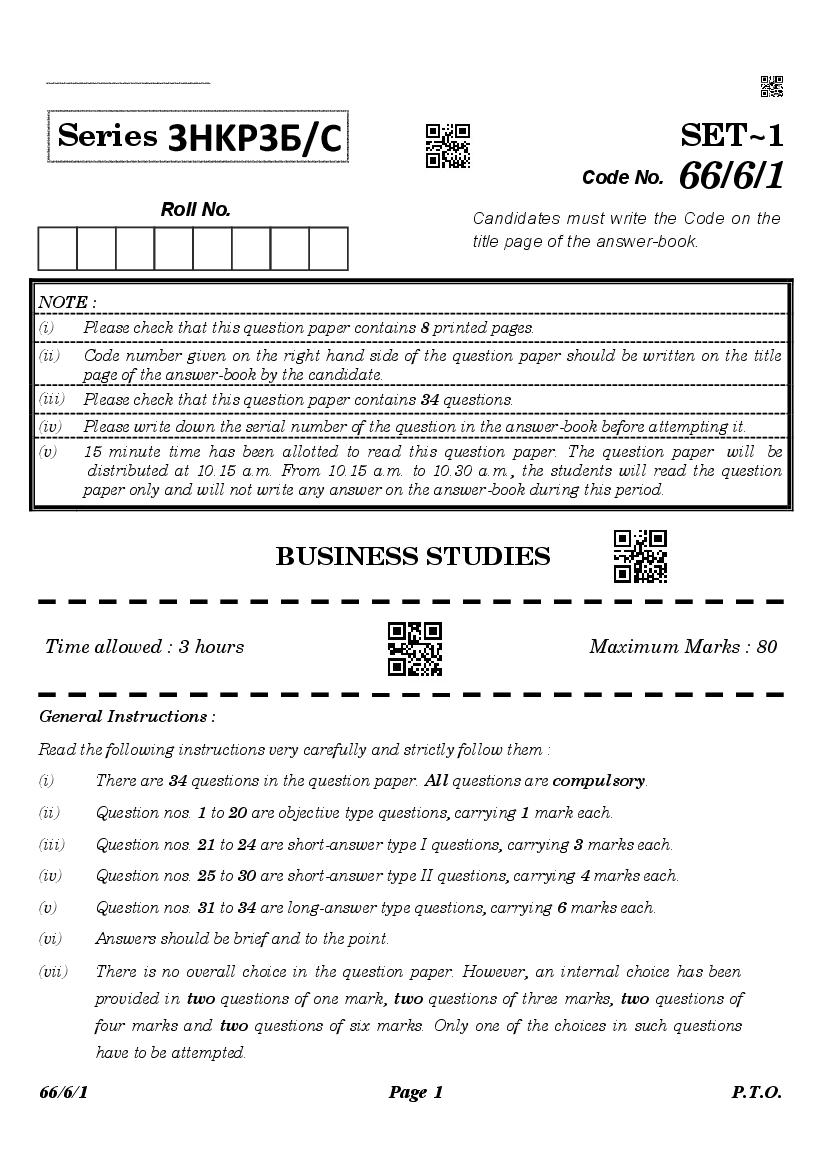
CBSE Class 12 Question Paper 2021 Business Studies (Compartment)
Finished viewing? Save it for later —
Download CBSE Class 12 Question Paper 2021 Business Studies (Compartment) (PDF · 8 pages)About CBSE Class 12 Question Paper 2021 Business Studies (Compartment)
CBSE Class 12 Question Paper 2021 Business Studies (Compartment) is available here for free download. Published by CBSE for Class 12, this question paper can be viewed online or downloaded as a PDF (8 pages). Candidates preparing for Class 12 can use CBSE Class 12 Question Paper 2021 Business Studies (Compartment) to understand the exam pattern, the type of questions asked, and the overall difficulty level.
Frequently Asked Questions
How can I download CBSE Class 12 Question Paper 2021 Business Studies (Compartment)?
Open this page and click the Download button to save CBSE Class 12 Question Paper 2021 Business Studies (Compartment) as a PDF. It is completely free on AglaSem Docs.
Is CBSE Class 12 Question Paper 2021 Business Studies (Compartment) free to download?
Yes. CBSE Class 12 Question Paper 2021 Business Studies (Compartment) can be viewed online and downloaded as a PDF free of cost on AglaSem Docs.
How many pages does CBSE Class 12 Question Paper 2021 Business Studies (Compartment) have?
CBSE Class 12 Question Paper 2021 Business Studies (Compartment) contains 8 pages, which you can read online or download together as a single PDF.
Where can I find more Class 12 study material?
You can find more Class 12 question papers, sample papers, syllabus, and answer keys on AglaSem Docs.
CBSE Class 12 Question Paper 2021 Business Studies (Compartment) – Text
Read the full text of this question paper below — useful to quickly search, copy and reference the content online without downloading the PDF.
📄 View text version (8 pages)
Page 1
Code No. 66/6/1
Roll No. Candidates must write the Code on the
title page of the answer-book.
NOTE :
(i) Please check that this question paper contains 8 printed pages.
(ii) Code number given on the right hand side of the question paper should be written on the title
page of the answer-book by the candidate.
(iii) Please check that this question paper contains 34 questions.
(iv) Please write down the serial number of the question in the answer-book before attempting it.
(v) 15 minute time has been allotted to read this question paper. The question paper will be
distributed at 10.15 a.m. From 10.15 a.m. to 10.30 a.m., the students will read the question
paper only and will not write any answer on the answer-book during this period.
BUSINESS STUDIES
Time allowed : 3 hours Maximum Marks : 80
General Instructions :
Read the following instructions very carefully and strictly follow them :
(i) There are 34 questions in the question paper. All questions are compulsory.
(ii) Question nos. 1 to 20 are objective type questions, carrying 1 mark each.
(iii) Question nos. 21 to 24 are short-answer type I questions, carrying 3 marks each.
(iv) Question nos. 25 to 30 are short-answer type II questions, carrying 4 marks each.
(v) Question nos. 31 to 34 are long-answer type questions, carrying 6 marks each.
(vi) Answers should be brief and to the point.
(vii) There is no overall choice in the question paper. However, an internal choice has been
provided in two questions of one mark, two questions of three marks, two questions of
four marks and two questions of six marks. Only one of the choices in such questions
have to be attempted.
66/6/1 Page 1 P.T.O.
Page 2
The above lines highlight which of the following objectives of management ? 1
(A) Organisational objectives
(B) Social objectives
(C) Personal objectives
(D) Both (B) and (C)
2.
the needs of the envi
here ? 1
(A) Management is all pervasive.
(B) Management is multi-dimensional.
(C) Management is a group activity.
(D) Management is a dynamic function.
3. ____________ environment of business includes forces relating to scientific
improvements and innovations which provide new ways of producing goods and services
and new methods and techniques of operating a business. 1
(A) Social
(B) Political
(C) Technological
(D) Economic
4. Business environment consists of numerous inter-related and dynamic conditions or
environment being highlighted here. 1
(A) Inter-relatedness
(B) Dynamic nature
(C) Complexity
(D) Relativity
5. The process of management which synchronises the activities of different departments
in an orderly manner is : 1
(A) Planning
(B) Staffing
(C) Controlling
(D) Coordination
6. Which of the following headings does not highlight the importance of business
environment ? 1
(A) Tapping useful resources
(B) Coping with rapid changes
(C) Improving performance
(D) Promoting innovative ideas
66/6/1 Page 2
Page 3
industries during COVID-19 pandemic. Which dimension of business environment is
being discussed here ? 1
(A) Political
(B) Economic
(C) Technological
(D) Social
8. Delegation 1
(A) At two levels
(B) At three levels
(C) At multiple levels
(D) Authority and responsibility cannot be shared
9. The step of organising process in which each individual comes to know from whom he
has to take orders and to whom he is accountable is called : 1
(A) Identification and division of work
(B) Departmentalisation
(C) Assignment of duties
(D) Establishing reporting relationships
10. Which of the following headings does not highlight the importance of controlling
function of management ? 1
(A) Ensuring order and discipline
(B) Initialising action by people in the organisation
(C) Making efficient use of resources
(D) Improving employees motivation
11. (a) Which of the following is a financial incentive ? 1
(A) Perquisites
(B) Status
(C) Job-enrichment
(D) Job-security
OR
(b) Which of the following is not a step in the selection process ? 1
(A) Reference and background checks
(B) Selection decision
(C) Job offer
(D) Performance appraisal
66/6/1 Page 3 P.T.O.
Page 4
(A) Identifying the needs of the customers.
(B) Analysing the available opportunities and threats in the organisation.
(C) Increasing the level of production, promotion of product etc., and
specifying the action programmes.
(D) Developing repeat purchases by the customers.
OR
(b) In Column I of the following table the important components of product are
given and in Column II their respective meanings are given : 1
Column I Column II
a. Branding i. Act of designing and producing the container
or wrapper of a product.
b. Packaging ii. Putting identification marks on the package.
c. Labelling iii. Process of giving a name or a sign or a
symbol to the product.
Which of the following matches is correct ?
a b c
(A) i ii iii
(B) iii ii i
(C) iii i ii
(D) ii iii i
Read the following paragraph and answer question nos. 13 16 on the basis of the same :
Mayank Ltd. is a real estate company. Since its establishment, the company acquired a
good market share. With the boom in the Indian economy, the real estate sector is also
witnessing a boom due to lower interest rates on housing loans and accompanying
income-tax concessions.
For meeting this increasing demand, the finance manager of the company suggested to
raise < 1,250 crore by issuing shares and < 750 crore by way of loan from the bank.
He was of the opinion that this will increase per share earnings of the shareholders.
The directors of the company wanted to raise capital more quickly and suggested that it
would be better to allot the securities to some selected individuals. They also suggested
that instead of taking loan from the bank the privilege can be given to existing
shareholders to subscribe to a new issue of shares for < 750 crore.
66/6/1 Page 4
Page 5
(A) Offer for sale
(B) Offer through prospectus
(C) Private placement
(D) e-IPOs
14. that it
would be
In the above lines the method of floatation of new issues suggested by the directors is : 1
(A) Offer for sale
(B) Offer through prospectus
(C) Private placement
(D) e-IPOs
15.
to existing shareholders to subscribe to a new issue of shares for <
The method of floatation of new issues discussed in the above lines is : 1
(A) Offer for sale
(B) Offer through prospectus
(C) Private placement
(D) Rights issue
16. The market through which the financial manager and the directors wanted to collect
funds is : 1
(A) Money Market
(B) Capital Market
(C) Both (A) and (B)
(D) Neither (A) nor (B)
Read the following paragraph and answer question nos. 17 20 on the basis of the same :
Kshitij just completed his MBA from IIM Ahmedabad. He was not interested in doing a
job. So he decided to start his own start-up. He along with his friend Naitik decided to
start a dairy business for providing fresh and pure milk to people. For this, they
gathered and analysed market information. They found that people were interested in
milk, they purchased
50 cows. They installed a plant for pasteurisation of the milk. Fresh milk was
pasteurised and packed in glass bottles. On the bottles, all information related to milk
such as Date of Manufacturing, Nutrition value, Quantity, MRP, etc. was given. They
For distribution of milk, they hired delivery boys who supply this milk door to door.
resh Delight an use such name in
the country.
66/6/1 Page 5 P.T.O.
Page 6
cows ? 1
(A) Marketing Planning
(B) Packaging and Labelling
(C) Gathering and Analysing Market Information
(D) Branding
18.
known as : 1
(A) Branding
(B) Brand Name
(C) Trade Mark
(D) Packaging
19. On the bottles, all information related to milk was given
related decision is : 1
(A) Packaging
(B) Labelling
(C) Branding
(D) Both (A) and (C)
20. For distribution of milk, they hired delivery boys who supply this milk door to door.
The element of marketing mix highlighted here is : 1
(A) Product
(B) Price
(C) Place/Physical distribution
(D) Both (A) and (B)
21. Identify the characteristic of management which states that the activities involved in
managing an enterprise are common to all organisations whether economic, social or
political. Also state two other characteristics of management. 3
22.
relations with followers and motivate them to contribute towards achieving
, explain any two styles of
1
leadership. 2 1 =3
2
66/6/1 Page 6
Page 7
23. (a) 1 +1 =3
2 2
OR
(b) Actual performance of employees is measured in the second step of controlling
process. Explain the next three steps in the process. 3 1=3
24. (a) State any three objectives of Securities and Exchange Board of India. 3 1=3
OR
(b) State any three functions of Stock Exchange. 3 1=3
25. State the first four steps in the process of staffing . 4 1=4
26. Explain the following methods of training : 2 2=4
(a) Vestibule training
(b) Apprenticeship training
27. (a) Identify and explain the elements of directing in the following cases : 2+2=4
(i) Mohan guides the efforts of his subordinates to accomplish the desired
objectives and gives instructions to ensure optimum utilisation of
resources and achievement of work targets.
(ii) S.S. Tripathi, Managing Director, explains the plan in writing to the
departmental managers and receives their feedback.
OR
(b)
statements and also state the four assu theory is
1 1
based. ( + ) 4=4
2 2
(i) These needs refer to affection, sense of belongingness, acceptance and
friendship.
(ii) It refers to the drive to become what one is capable of becoming.
(iii) These needs include factors such as self-respect, autonomy status,
recognition and attention.
(iv) These needs provide security and protection from physical and emotional
harm.
28. (a) Explain any two factors that affect the dividend decision of a company. 2 2=4
OR
(b) Explain any two factors that affect the financing decision of a company. 2 2=4
66/6/1 Page 7 P.T.O.
Page 8
the plant and acquiring other fixed assets he needs < 80 lakh.
Explain any two factors which affect the requirement of fixed capital of this company. 2 2=4
30. Explain the following rights of consumers as per the Consumer Protection Act, 1986 : 2 2=4
(a) Right to be informed
(b) Right to seek redressal
31. Explain the following techniques of Scientific Management : 3 2=6
(a) Method study
(b) Motion study
(c) Time study
32. (a) Planning provides direction, reduces the risk of uncertainty and promotes
innovative ideas . Explain. 2 3=6
OR
(b) All the available alternatives are evaluated in the light of their feasibility and
consequences. This is one of the steps in the process of planning . Explain the
steps followed by this. 2 3=6
33. Kartik opens a bakery shop in the local market. With the increasing demand of his
bakery products he feels it will be impossible for him to handle all the work himself. So
he appoints Bhavana to perform tasks on his behalf, thereby reducing his workload. It
enables Kartik to use his time on high priority activities.
(a) Identify and explain the concept of organising discussed in the above case.
(b) Explain the two essential elements of the concept identified in (a) above. 2+2+2=6
34. (a) Explain any three factors that affect the price determination of a product. 3 2=6
OR
(b) Explain any three elements of promotion mix. 3 2=6
66/6/1 Page 8
Document Details
| Board / Org | CBSE |
| Exam | Class 12 |
| Type | Question Paper |
| Pages | 8 |
| Language | english |
| Updated | 22 Jul 2026 |