CBSE Class 12 Question Paper 2021 Economics (Compartment)
Finished viewing? Save it for later —
Download CBSE Class 12 Question Paper 2021 Economics (Compartment) (PDF · 16 pages)About CBSE Class 12 Question Paper 2021 Economics (Compartment)
CBSE Class 12 Question Paper 2021 Economics (Compartment) is available here for free download. Published by CBSE for Class 12, this question paper can be viewed online or downloaded as a PDF (16 pages). Candidates preparing for Class 12 can use CBSE Class 12 Question Paper 2021 Economics (Compartment) to understand the exam pattern, the type of questions asked, and the overall difficulty level.
Frequently Asked Questions
How can I download CBSE Class 12 Question Paper 2021 Economics (Compartment)?
Open this page and click the Download button to save CBSE Class 12 Question Paper 2021 Economics (Compartment) as a PDF. It is completely free on AglaSem Docs.
Is CBSE Class 12 Question Paper 2021 Economics (Compartment) free to download?
Yes. CBSE Class 12 Question Paper 2021 Economics (Compartment) can be viewed online and downloaded as a PDF free of cost on AglaSem Docs.
How many pages does CBSE Class 12 Question Paper 2021 Economics (Compartment) have?
CBSE Class 12 Question Paper 2021 Economics (Compartment) contains 16 pages, which you can read online or download together as a single PDF.
Where can I find more Class 12 study material?
You can find more Class 12 question papers, sample papers, syllabus, and answer keys on AglaSem Docs.
CBSE Class 12 Question Paper 2021 Economics (Compartment) – Text
Read the full text of this question paper below — useful to quickly search, copy and reference the content online without downloading the PDF.
📄 View text version (16 pages)
Page 1
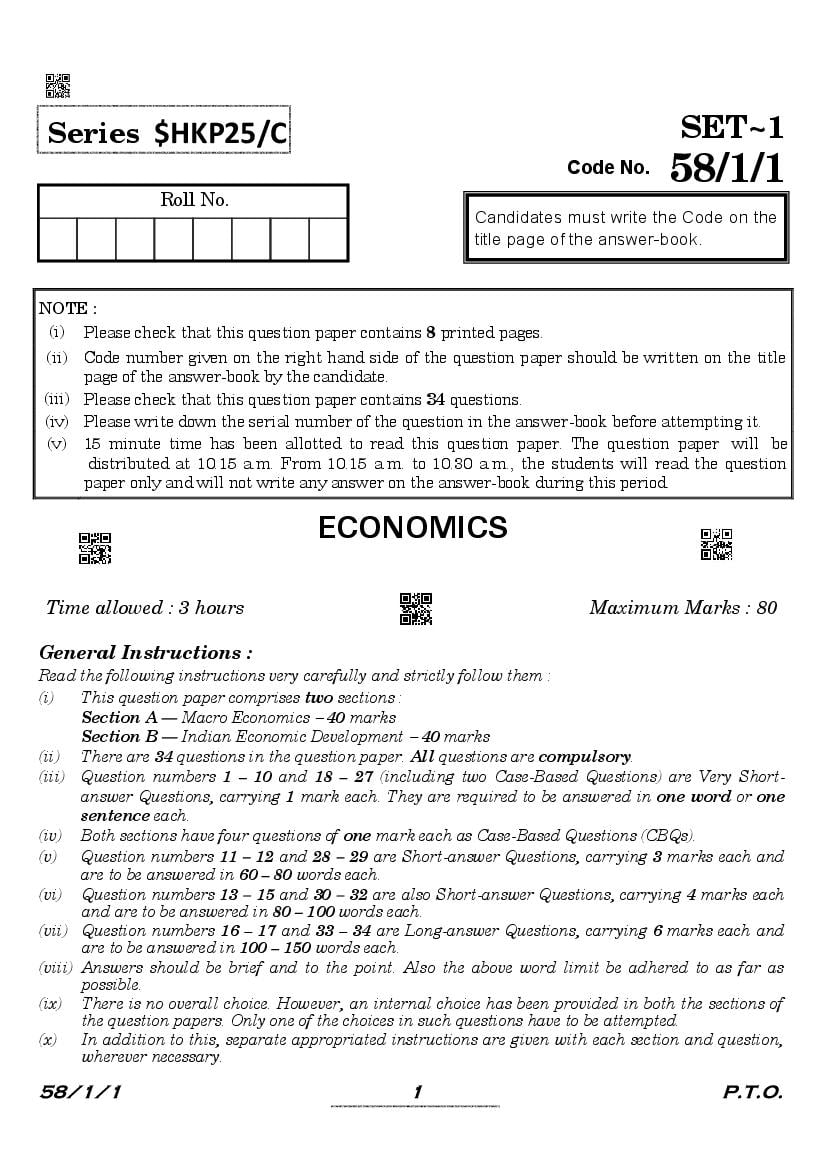
Code No. 58/1/1
Roll No.
Candidates must write the Code on the
title page of the answer-book.
NOTE :
(i) Please check that this question paper contains 8 printed pages.
(ii) Code number given on the right hand side of the question paper should be written on the title
page of the answer-book by the candidate.
(iii) Please check that this question paper contains 34 questions.
(iv) Please write down the serial number of the question in the answer-book before attempting it.
(v) 15 minute time has been allotted to read this question paper. The question paper will be
distributed at 10.15 a.m. From 10.15 a.m. to 10.30 a.m., the students will read the question
paper only and will not write any answer on the answer-book during this period.
ECONOMICS
Time allowed : 3 hours Maximum Marks : 80
General Instructions :
Read the following instructions very carefully and strictly follow them :
(i) This question paper comprises two sections :
Section A Macro Economics 40 marks
Section B Indian Economic Development 40 marks
(ii) There are 34 questions in the question paper. All questions are compulsory.
(iii) Question numbers 1 10 and 18 27 (including two Case-Based Questions) are Very Short-
answer Questions, carrying 1 mark each. They are required to be answered in one word or one
sentence each.
(iv) Both sections have four questions of one mark each as Case-Based Questions (CBQs).
(v) Question numbers 11 12 and 28 29 are Short-answer Questions, carrying 3 marks each and
are to be answered in 60 80 words each.
(vi) Question numbers 13 15 and 30 32 are also Short-answer Questions, carrying 4 marks each
and are to be answered in 80 100 words each.
(vii) Question numbers 16 17 and 33 34 are Long-answer Questions, carrying 6 marks each and
are to be answered in 100 150 words each.
(viii) Answers should be brief and to the point. Also the above word limit be adhered to as far as
possible.
(ix) There is no overall choice. However, an internal choice has been provided in both the sections of
the question papers. Only one of the choices in such questions have to be attempted.
(x) In addition to this, separate appropriated instructions are given with each section and question,
wherever necessary.
Page 2
(Macro Economics) (40 marks)
1. (a) Which of the following transactions is not included in National Income ?
(Choose the correct alternative) 1
(i) Brokerage paid to broker for facilitating sale of second-hand goods.
(ii) Services of a housewife.
OR
(b) 1
2. __________ is responsible for issuing < 1 currency note in India.
(Fill in the blank by choosing the correct alternative) 1
(A) Reserve Bank of India
(B) Ministry of Commerce
(C) Ministry of Finance
(D) NITI Aayog
3. State, whether the following statement is true or false :
1
4. An Indian company acquires a British car company. This transaction would be recorded
on ___________ side of ___________ account.
(Fill in the blanks by choosing the correct alternative) 1
(A) debit, capital
(B) credit, capital
(C) debit, current
(D) credit, current
5. 1
6. If $ 1 = < 80·50, then $ _________ (approximately) would be needed to exchange
< 2,00,000. (Fill in the blank by choosing the correct alternative) 1
(A) 2,484
(B) 2,844
(C) 2,448
(D) 2,882
Page 3
Study the following text carefully and answer question numbers 7 10 :
Government of India announced a lockdown for all the economic and non-economic
activities (except emergency ones and selected essential ones) to fight the scare caused
by the COVID-19 pandemic. This has caused :
A massive wave of involuntary unemployment particularly in the unorganised and
informal sector.
Fall in demand of a large number of goods and services.
Shortage of supply of essentials (specific to health and household) and a lot more.
To overcome the situation of lack of consumption demand in the market period, the
government is expected to continue its consumption and investment expenditure. These
types of government expenditures are expected to push the disposable income of the
common man. To ensure rise in consumption and investment expenditure of household
sector.
confidence fell to an all-time low. A majority of respondents reporting pessimism
relating to employment, inflation and income.
7. State; whether the following statement is true or false :
1
8. __________ in government expenditure may reduce deflationary gap.
(Fill in the blank with the correct answer) 1
9. Private consumption expenditure is directly related to ______________ (income/savings)
of the households. (Fill in the blank by choosing the correct alternative) 1
10. Identify the correct statement from the following : 1
(a) Under the situation of inflationary gap, Aggregate Demand exceeds Aggregate
Supply, at full employment level of income.
(b) Under the situation of inflationary gap, Aggregate Demand falls short of
Aggregate Supply, at full employment level of output.
11.
Do you agree with the given statement ? Support your answer with valid example. 3
12. (a) Deficit must exist if a country is facing a situation of Current Account
D
Justify the given statement. 3
OR
(b)
Defend or refute the given statement with valid arguments. 3
13.
4
Page 4
used to reduce deficient demand. 4
OR
(b) In an economy, investment increases by < 1,000 crore and marginal propensity
to save is 0·25.
Calculate :
(i) Investment multiplier (K) 2
(ii) Total increase in income ( Y) 2
15. Define : 2+2=4
(a) Autonomous Consumption Expenditure
(b) Average Propensity to Consume
16. (a) Year 2016 17 2017 18 2018 19
Nominal GDP 6·5 8·4 9
GDP deflator 100 140 125
On the basis of the hypothetical information given above, state for which year
are Real GDP and Nominal GDP equal. 6
OR
(b) (i) 4
S. Amount
Items
No. (in < Crore)
1. Net Value Added at Factor Cost 800
2. Subsidies 40
3. Change in Stock ( ) 70
4. Sales ?
5. Intermediate Consumption 450
6. Consumption of Fixed Capital 40
(ii)
Justify the given statement. 2
Page 5
requirements of the country
Do you agree with the given statement ? Support your answer with valid
reasons. 4
(b) 2
SECTION B
(Indian Economic Development) (40 marks)
18. Under the Industrial Policy Resolution of 1956, industries were classified in
____________ (two/three) categories.
(Fill in the blank by choosing the correct alternative) 1
19. Study the following statements Assertion (A) and Reason (R) :
Assertion (A) : During colonial rule, both mortality rates and infant mortality
rates were very high.
Reason (R) : British never paid any heed towards improvement of public health
facilities in India.
Choose the correct alternative from the following : 1
(A) Both Assertion (A) and Reason (R) are true.
(B) Both Assertion (A) and Reason (R) are false.
20. Choose the correct pair of statements given in columns I and II below : 1
Column I Column II
a. Subsidies i. Maximum quantity of goods that can be
imported
b. Karve Committee, 1955 ii. Using small-scale industries to promote
rural development
c. Import Substitution iii. To encourage farmers for adopting new
Policy technology
d. Quota iv. To protect domestic firms
Alternatives :
(A) a i
(B) b ii
(C) c iii
(D) d iv
Page 6
of goods between Britain and India.
(Fill in the blank with the correct answer) 1
OR
(b) 1
22. In India the maternal mortality rate is higher ___________ (China/Pakistan).
(Fill in the blank by choosing the correct alternative) 1
23. Study the following information and fill in the blank by choosing the correct alternative : 1
Country A Country B Country C
Human Development
Index (HDI) Value
0·648 0·759 0·562
Country _______ (A/B/C) can be termed as the best on the HDI indicator.
Case Study 2
Study the following text carefully and answer question numbers 24 27 :
quality inputs. Project Simran used agricultural best practices for the same. Simran
Agro works towards providing fair price markets to the farmers. Tomato is the major
crop of the area.
Objectives of Project Simran :
To set up an ideal tomato crop management system for farmers.
To implement modern technology.
To provide marketing support to the farmers.
Project Simran used the soil testing technique for selection of seeds. It procured all the
inputs for farmers, to reduce the production cost. Training by agro-scientists has also
helped in reducing crop failures.
24. Project Simran adopted agricultural best practices for ensuring ____________ .
(Fill in the blank with correct answer) 1
25. State any one objective associated with Project Simran. 1
Page 7
in reducing crop failure. (Fill in the blank with the correct alternative) 1
27. ____________ (Use of better technology/Use of costly technology) may not generally lead
to higher income for the farmers. (Fill in the blank by choosing the correct alternative) 1
28. (a)
Do you agree with the given statement ? Explain with a valid argument. 3
OR
(b) Is environmental crisis a recent phenomenon ? If so, why ? 3
29. The following diagram shows distribution of workforce in India. Analyse and compare
the nature of workforce distribution. 3
Areawise Employment Distribution
30.
Explain the given statement. 4
Page 8
Resolution, 1956. 4
OR
(b) under the New Economic
Policy of 1991. 4
32. Discuss any two similar developmental strategies followed by India and Pakistan after
1947. 4
33. (a) What is meant by Poverty Line ? State any two limitations of Poverty Line. 4
(b) 2
34. (a) Comment upon the following statements : 3+3=6
(i) Traditional knowledge and practices are still applicable in ensuring
sustainable development.
(ii) A well-structured rural banking system is important for the
development of a nation.
OR
(b) State, giving valid reasons whether the following statements are true or false : 3+3=6
(i) Capital formation is the key to eradication of poverty.
(ii)
Page 9
H$moS> Z§. 58/1/1
amob Z§.
narjmWu H$moS >H$mo CÎma-nwpñVH$m Ho$ _wI-n¥ð
>na Adí` {bIo§ &
ZmoQ> :
(i) H¥$n`m Om±M H$a b| {H$ Bg àíZ-nÌ _o§ _w{ÐV n¥ð> 8 h¢ &
(ii) àíZ-nÌ _| Xm{hZo hmW H$s Amoa {XE JE H$moS >Zå~a H$mo N>mÌ CÎma -nwpñVH$m Ho$ _wI-n¥ð> na {bI| &
(iii) H¥$n`m Om±M H$a b| {H$ Bg àíZ-nÌ _| >34 àíZ h¢ &
(iv) H¥$n`m àíZ H$m CÎma {bIZm ewê$ H$aZo go nhbo, CÎma-nwpñVH$m _| àíZ H$m H«$_m§H$ Adí` {bI| &
(v) Bg àíZ-nÌ 15 {_ZQ >H$m g_` {X`m J`m h¡ & àíZ- 10.15 ~Oo {H$`m
OmEJm & 10.15 ~Oo go 10.30 ~Oo VH$ N>mÌ Ho$db àíZ- -nwpñVH$m na H$moB©
CÎma Zht {bI|Jo &
AW©emñÌ
:3 : 80
:
:
(i) :
40
40
(ii) 34
(iii) 1 10 18 27
1
(iv)
(v) 11 12 28 29 3 60
80
(vi) 13 15 30 32 4
80 100
(vii) 16 17 33 34 6 100
150
(viii)
(ix)
(x)
Page 10
(g_{ï> AW©emñÌ) (40 A§H$)
1. (a) {ZåZ{b{IV _| go {H$g boZ-XoZ H$mo amîQ´>r` Am` H$s JUZm _| em{_b {H$`m OmEJm ?
(ghr {dH$ën H$m M`Z H$s{OE) 1
(i) eo`a Xbmb H$mo nwamZo _mb Ho$ {dH«$` _| ghm`Vm Ho$ {bE Xbmbr H$m ^wJVmZ &
(ii) EH$ J¥hUr H$s godmE± &
AWdm
(b) ñQ>m°H$ _| n[adV©Z H$s JUZm Ho$ gyÌ H$m CëboI H$s{OE & 1
2. ^maV _| < 1 Ho$ H$a|gr ZmoQ> Omar H$aZo H$s {µOå_oXmar ____________ H$s h¡ &
(ghr {dH$ën MwZH$a [aº$ ñWmZ H$s ny{V© H$s{OE) 1
(A) ^maVr` [aµOd© ~¢H$
(B) dm{UÁ` _§Ìmb`
(C) {dÎm _§Ìmb`
(D) Zr{V (NITI) Am`moJ
3. CëboI H$s{OE, {H$ {ZåZ{b{IV H$WZ h¡ AWdm :
dm{UpÁ`H$ ~¢H$m| Ho$ nmg CZH$s G$U à{H«$`m Ho$ _mÜ`_ go Omo _m±J O_m dmng AmVr h¡, Cgo {ÛVr`H$ O_m H$hm
OmVm h¡ & 1
4. EH$ ^maVr` H$ånZr {~«{Q>e H$ma H$ånZr H$m A{YJ«hU H$aVr h¡ & Bg boZ -XoZ H$mo _________ ImVo Ho$
_________ nj _| {bIm OmEJm & (ghr {dH$ën MwZH$a [aº$ ñWmZm| H$s ny{V© H$s{OE) 1
(A) ny±Or, S>o{~Q>
(B) ny±Or, Ho«${S>Q>
(C) Mmby, S>o{~Q>
(D) Mmby, Ho«${S>Q>
5. Mmby ImVm A{Yeof H$m AW© {b{IE & 1
6. `{X $ 1 = < 80·50 h¡, Vmo < 2,00,000 H$mo ~XbZo Ho$ {bE $ _________ (bJ^J) H$s Amdí`H$Vm
hmoJr & (ghr {dH$ën MwZH$a [aº$ ñWmZ H$s ny{V© H$s{OE) 1
(A) 2,484
(B) 2,844
(C) 2,448
(D) 2,882
Page 11
7 10 :
H$mo{dS>-19
µJ¡a-Am{W©H$ J{V{d{Y`m| (AmnmVH$mbrZ d M`{ZV Amdí`H$ (A{Zdm`©) J{V{d{Y`m| H$m
H$s KmofUm H$s Wr & BgHo$ H$maU {ZåZ{b{IV n[aUm_ gm_Zo AmE :
AZ¡pÀN>H$ ~oamoµOJmar H$s ì`mnH$ bha, {deofH$a Ag§J{R>V d AZm¡nMm[aH$ joÌ _| &
dñVwAm| Am¡a godmAm| H$s _m±J _| ^mar {JamdQ> &
Amdí`H$ dñVwAm| ({deofH$a ñdmñÏ` d J¥hñW joÌH$ go) d AZoH$ Am¡a H$s Amny{V© _| H$_r &
Cn^moJ _m±J H$s H$_r H$s pñW{V H$mo Xÿa H$aZo Ho$ {bE, gaH$ma Ûmam AnZo Cn^moJ d {Zdoe ì`` H$mo Omar aIZo
H$s Cå_rX h¡ & Bg àH$ma Ho$ gaH$mar ì``m| go Am_ AmX_r H$s à`moÁ` Am` _| d¥{Õ H$s Amem h¡ & `h Kaoby
joÌH$ Ho$ Cn^moJ d {Zdoe ì`` _| ^r d¥{Õ gw{ZpíMV H$a gH$Vm h¡ &
OwbmB© 2020 Ho$ _mh _| ^maVr` [aµOd© ~¢H$ Ho$ gd©ojU go Cn^moº$m {dídmg Ho$ A~ VH$ Ý`yZV_ hmoZo Ho$ g§Ho$V
{_bVo h¢ & A{YH$Va ì`{º$`m| Zo amoµOJma, _wÐm-ñ\$s{V VWm Am` go g§~§{YV {ZamemdmX H$s gyMZm Xr h¡ &
7. CëboI H$s{OE {H$ {ZåZ{b{IV H$WZ h¡ AWdm :
AZ¡pÀN>H$ ~oamoµOJmar ^maV _| bm°H$S>mCZ H$m n[aUm_ Wm & 1
8. gaH$mar ì`` _| _____________ Adñ\$s{VH$ A§Vamb _| H$_r H$a gH$Vr h¡ & 1
(ghr CÎma Ûmam [aº$ ñWmZ H$s ny{V© H$s{OE)
9. J¥hñWm| H$s ______________ (Am`/~MV) H$m {ZOr Cn^moJ ì`` Ho$ gmW grYm g§~§Y hmoVm h¡ &
(ghr {dH$ën MwZH$a [aº$ ñWmZ H$s ny{V© H$s{OE) 1
10. {ZåZ{b{IV _| go ghr H$WZ H$s nhMmZ H$s{OE : 1
(a) _wÐm-ñ\$s{VH$mar A§Vamb H$s pñW{V _|, Am` Ho$ nyU© amoµOJma ñVa na g_J« _m±J g_J« ny{V© go A{YH$
hmoVr h¡ &
(b) _wÐm-ñ\$s{VH$mar A§Vamb H$s pñW{V _|, CËnmXZ Ho$ nyU© amoµOJma ñVa na g_J« _m±J g_J« ny{V© go H$_
hmoVr h¡ &
11. Kaoby Am` _| d¥{Õ Ho$ n[aUm_ñdê$n, amîQ´>r` Am` _| gX¡d d¥{Õ hmoVr h¡ &
? AnZo CÎma Ho$ nj _| _mÝ` CXmhaU Xr{OE & 3
12. (a) `{X H$moB© Xoe Mmby ImVm KmQ>o H$s pñW{V H$m gm_Zm H$a ahm h¡, Vmo ì`mnma KmQ>m Adí` {dÚ_mZ
hmoVm h¡ &
{XE JE H$WZ H$m Am¡{MË` {gÕ H$s{OE & 3
AWdm
(b) ny±OrJV ImVm boZ-XoZ ^{dî` Ho$ Xmdm| H$mo OÝ_ XoVr h¢ &
_mÝ` VH$mªo Ûmam {XE JE H$WZ H$m g_W©Z `m I§S>Z H$s{OE & 3
13. _wÐm JwUH$ ~¢qH$J àUmbr H$s gmI {Z_m©U e{º$ Ho$ {ZYm©aU _| _hÎdnyU© ^y{_H$m {Z^mVm h¡ & C{MV
g§»`mË_H$ CXmhaU Ûmam H$WZ H$s ì`m»`m H$s{OE & 4
Page 12
Cnm`m| H$m gwPmd Xr{OE & 4
AWdm
(b) EH$ AW©ì`dñWm _|, {Zdoe _| d¥{Õ < 1,000 0·25 h¡ &
JUZm H$s{OE :
(i) {Zdoe JwUH$ (K) 2
(ii) Am` _| Hw$b d¥{Õ ( Y) 2
15. n[a^m{fV H$s{OE : 2+2=4
(a) ñdm`Îm Cn^moJ ì``
(b) Am¡gV Cn^moJ àd¥{Îm
16. (a) df© 2016 17 2017 18 2018 19
_m¡{ÐH$ GDP 6·5 8·4 9
GDP Adñ\$s{VH$ 100 140 125
Cn`w©º$ H$mën{ZH$ gyMZm Ho$ AmYma na ~VmBE {H$ {H$g df© Ho$ {bE dmñV{dH$ GDP VWm _m¡{ÐH$
GDP ~am~a h¢ & 6
AWdm
(b) (i) {ZåZ{b{IV {~H«$s Ho$ _yë` H$s JUZm H$s{OE : 4
H«$.g§. _X| am{e (< _|)
1. gmYZ bmJV na ewÕ _yë` d¥{Õ 800
2. CnXmZ 40
3. ñQ>m°H$ _| n[adV©Z ( ) 70
4. {~H«$s ?
5. _Ü`dVu Cn^moJ 450
6. ñWm`r ny±Or H$m Cn^moJ 40
(ii) Am` Ho$ MH«$s` àdmh H$m {gÕm§V Bg AdYmaUm na AmYm[aV h¡ {H$ EH$ H$m ì`` Xÿgao
H$s Am` ~ZmVm h¡ &
{XE JE H$WZ H$m Am¡{MË` {gÕ H$s{OE & 2
Page 13
h¡ &
? AnZo CÎma Ho$ g_W©Z _| _mÝ` H$maU$ Xr{OE & 4
(b) àË`j H$a H$s n[a^mfm {b{IE & 2
IÊS> I
(^maVr` AW©ì`dñWm H$m {dH$mg) (40 A§H$)
18. 1956 Ho$ Am¡Úmo{JH$ Zr{V àñVmd Ho$ A§VJ©V CÚmoJm| H$mo __________ (Xmo/VrZ) lo{U`m| _| dJuH¥$V {H$`m J`m
Wm & (ghr {dH$ën MwZH$a [aº$ ñWmZ H$s ny{V© H$s{OE) 1
19. {ZåZ{b{IV H$WZm| (A) VWm (R) H$m AÜ``Z H$s{OE :
(A) : Am¡n{Zdo{eH$ emgZ Ho$ Xm¡amZ _¥Ë`w-Xa Am¡a {eew _¥Ë`w-Xa XmoZm| ~hþV A{YH$ Wt &
(R) : {~«{Q>e emgZ Zo ^maV _| gmd©O{ZH$ ñdmñÏ` gw{dYmAm| _| gwYma Ho$ {bE H$^r ^r H$moB©
Ü`mZ Zht {X`m &
{ZåZ{b{IV _| go ghr {dH$ën H$m M`Z H$s{OE : 1
(A) A{^H$WZ (A) Am¡a H$maU (R) XmoZm| gË` h¢ &
(B) A{^H$WZ (A) Am¡a H$maU (R) XmoZm| AgË` h¢ &
20. ZrMo {XE JE H$m°b_ I Am¡a II _| go H$WZm| Ho$ ghr `w½_ H$m M`Z H$s{OE : 1
I II
a. CnXmZ i. Am`m{VV dñVwAm| H$s A{YH$V_ _mÌm
J«m_rU {dH$mg Ho$ {bE bKw CÚmoJm| H$m
b. H$d©o H$_oQ>r, 1955 ii.
à`moJ
c. Am`mV à{VñWmnZ Zr{V iii. ZB© VH$ZrH$s$ H$mo J«hU H$aZo Ho$ {bE H¥$fH$m| H$mo
àmoËgm{hV H$aZm
d. H$moQ>m iv. Kaoby \$_mªo H$s gwajm H$aZm
:
(A) a i
(B) b ii
(C) c iii
(D) d iv
Page 14
(ghr CÎma go [aº$ ñWmZ H$s ny{V© H$s{OE) 1
AWdm
(b) àewëH$ (Tariff) H$s n[a^mfm {b{IE & 1
22. ^maV H$s VwbZm _| __________ (MrZ/nm{H$ñVmZ) _| _mV¥ _¥Ë`w-Xa A{YH$ h¡ &
(ghr {dH$ën MwZH$a [aº$ ñWmZ H$s ny{V© H$s{OE) 1
23. {ZåZ{b{IV gyMZm H$m AÜ``Z H$s{OE d ghr {dH$ën MwZH$a [aº$ ñWmZ H$s ny{V© H$s{OE : 1
amîQ´> H$$ amîQ´> I amîQ´> J $
_mZd {dH$mg gyMH$m§H$ (HDI) _yë` 0·648 0·759 0·562
amîQ´> __________ (H$/I/J) H$mo HDI gyMH$m§H$ na gd©loð> H$hm Om gH$Vm h¡ &
Ho$g AÜ``Z 2
24 27 :
`h H$hmZr h¡, {g_aZ EoJ«mo {b{_Q>oS> H$s n[a`moOZm {g_aZ
AmJVm| Ho$ Cn`moJ _| d¥{Õ H$a {H$gmZm| H$s CËnmXH$ j_Vm _µO~yV H$aZm Wm & n[a`moOZm {g_aZ Zo H¥${f g§~§Yr
gdm©oÎm_ àWmAm| H$m Cn`moJ {H$`m & {g_aZ EoJ«mo {H$gmZm| H$mo C{MV _yë` ~mµOma CnbãY H$amZo H$s {Xem _|
H$m`©aV h¡ & Bg joÌ _| Q>_mQ>a à_wI µ\$gb h¡ &
n[a`moOZm {g_aZ Ho$ CÔoí` :
H¥$fH$m| Ho$ {bE AmXe© Q>_mQ>a µ\$gb à~§YZ àUmbr ñWm{nV H$aZm &
AmYw{ZH$ VH$ZrH$s H$mo bmJy H$aZm &
H¥$fH$m| H$mo {dnUZ _| ghm`Vm àXmZ H$aZm &
n[a`moOZm {g_aZ Zo ~rO Ho$ M`Z Ho$ {bE _¥Xm narjU VH$ZrH$ H$m Cn`moJ {H$`m & BgZo CËnmXZ bmJV H$mo H$_
H$aZo Ho$ {bE {H$gmZm| Ho$ {bE g^r AmJV| IarXr & H¥${f-d¡km{ZH$m| Ûmam à{ejU go µ\$gb {d\$bVm H$mo H$_
H$aZo _| ^r ghm`Vm {_br &
24. n[a`moOZm {g_aZ Zo __________ H$mo gw{ZpíMV H$aZo Ho$ {bE H¥${f H$s gdm©oÎm_ àWmAm| H$mo AnZm`m &
(ghr CÎma Ûmam [aº$ ñWmZ H$s ny{V© H$s{OE) 1
25. E& 1
Page 15
^y{_H$m {Z^mB© Wr & (ghr {dH$ën Ûmam [aº$ ñWmZ H$s ny{V© H$s{OE) 1
27. _________ (~ohVa VH$ZrH$s H$m à`moJ/_h±Jr VH$ZrH$s H$m Cn`moJ) gmYmaUV: H¥$fH$m| H$mo A{YH$ Am` Zht
àXmZ H$a gH$Vm h¡ & (ghr {dH$ën MwZH$a [aº$ ñWmZ H$s ny{V© H$s{OE) 1
28. (a) AmYm[aH$ g§aMZm EH$ Xoe Ho$ Am{W©H$ {dH$mg _| gH$mamË_H$ `moJXmZ H$aVr h¡ &
? _mÝ` VH©$ Ûmam ì`m»`m H$s{OE & 3
AWdm
(b) Ur` g§H$Q> EH$ ZdrZ n[aKQ>Zm h¡ ? `{X hm±, ? 3
29. {ZåZ{b{IV {MÌ ^maV _| H$m`©~b Ho$ {dVaU H$mo Xem©Vm h¡ & H$m`©~b {dVaU H$s àH¥${V H$m {díbofU Am¡a
VwbZm H$s{OE & 3
joÌmZwgma amoµOJma {dVaU
30. H¥${f joÌ Am{W©H$ gwYma à{H«$`m go à{VHy$b ê$n go à^m{dV hþAm àVrV hmoVm h¡ &
{XE JE H$WZ H$s ì`m»`m H$s{OE & 4
Page 16
AWdm
(b) 1991 H$s ZB© Am{W©H$ Zr{V Ho$ A§VJ©V {H$Ýht Xmo _w»` H$a gwYmam| H$m CëboI d MMm© H$s{OE & 4
32. 1947 Ho$ níMmV² ^maV d nm{H$ñVmZ Ûmam AnZmB© JB© {H$Ýht Xmo g_mZ {dH$mgmË_H$ aUZr{V`m| H$s MMm©
H$s{OE & 4
33. (a) µJ ? µJar~r aoIm H$s$ {H$Ýht Xmo gr_mAm| H$m CëboI H$s{OE & 4
(b) é½UVm Xa H$m AW© {b{IE & 2
34. (a) {ZåZ{b{IV H$WZm| na {Q>ßnUr H$s{OE : 3+3=6
(i) YmaUr` {dH$mg gw{ZpíMV H$aZo _| nma§n[aH$ kmZ d ì`dhma _hÎdnyU© ^y{_H$m {Z^m gH$Vo h¢ &
(ii) EH$ gwg§a{MV J«m_rU ~¢qH$J àUmbr EH$ amîQ´> Ho$ {dH$mg Ho$ {bE _hÎdnyU© h¡ &
AWdm
(b) _mÝ` H$maUm| g{hV, CëboI H$s{OE {H$ {ZåZ{b{IV H$WZ h¢ AWdm : 3+3=6
(i) ny±Or {Z_m©U µJar~r CÝ_ybZ H$s Hw±$Or h¡ &
(ii) Am{W©H$ {dH$mg H$mo gw{ZpíMV H$aZo _| H$m¡eb {dH$mg EH$ à_wI H$maH$ h¡ &
Document Details
| Board / Org | CBSE |
| Exam | Class 12 |
| Type | Question Paper |
| Pages | 16 |
| Language | english |
| Updated | 22 Jul 2026 |