Manipur Board Class 12 Syllabus 2027 Psychology
Finished viewing? Save it for later —
Download Manipur Board Class 12 Syllabus 2027 Psychology (PDF · 4 pages)About Manipur Board Class 12 Syllabus 2027 Psychology
Manipur Board Class 12 Syllabus 2027 Psychology is available here for free download. Published by Manipur Board for Class 12, this syllabus can be viewed online or downloaded as a PDF (4 pages). Candidates preparing for Class 12 can use Manipur Board Class 12 Syllabus 2027 Psychology to understand the exam pattern, the type of questions asked, and the overall difficulty level.
Frequently Asked Questions
How can I download Manipur Board Class 12 Syllabus 2027 Psychology?
Open this page and click the Download button to save Manipur Board Class 12 Syllabus 2027 Psychology as a PDF. It is completely free on AglaSem Docs.
Is Manipur Board Class 12 Syllabus 2027 Psychology free to download?
Yes. Manipur Board Class 12 Syllabus 2027 Psychology can be viewed online and downloaded as a PDF free of cost on AglaSem Docs.
How many pages does Manipur Board Class 12 Syllabus 2027 Psychology have?
Manipur Board Class 12 Syllabus 2027 Psychology contains 4 pages, which you can read online or download together as a single PDF.
Where can I find more Class 12 study material?
You can find more Class 12 question papers, sample papers, syllabus, and answer keys on AglaSem Docs.
Manipur Board Class 12 Syllabus 2027 Psychology – Text
Read the full text of this syllabus below — useful to quickly search, copy and reference the content online without downloading the PDF.
📄 View text version (5 pages)
Page 1
Manipur Board Class
12 Syllabus 2027
Psychology
EXAM YEAR TYPE SUBJECT
Manipur Class 12 2027 Syllabus Psychology
Notes · Sample Papers · Previous Year Papers · Mock Tests
Page 2
m .co
m .co s e m
se g l a
a
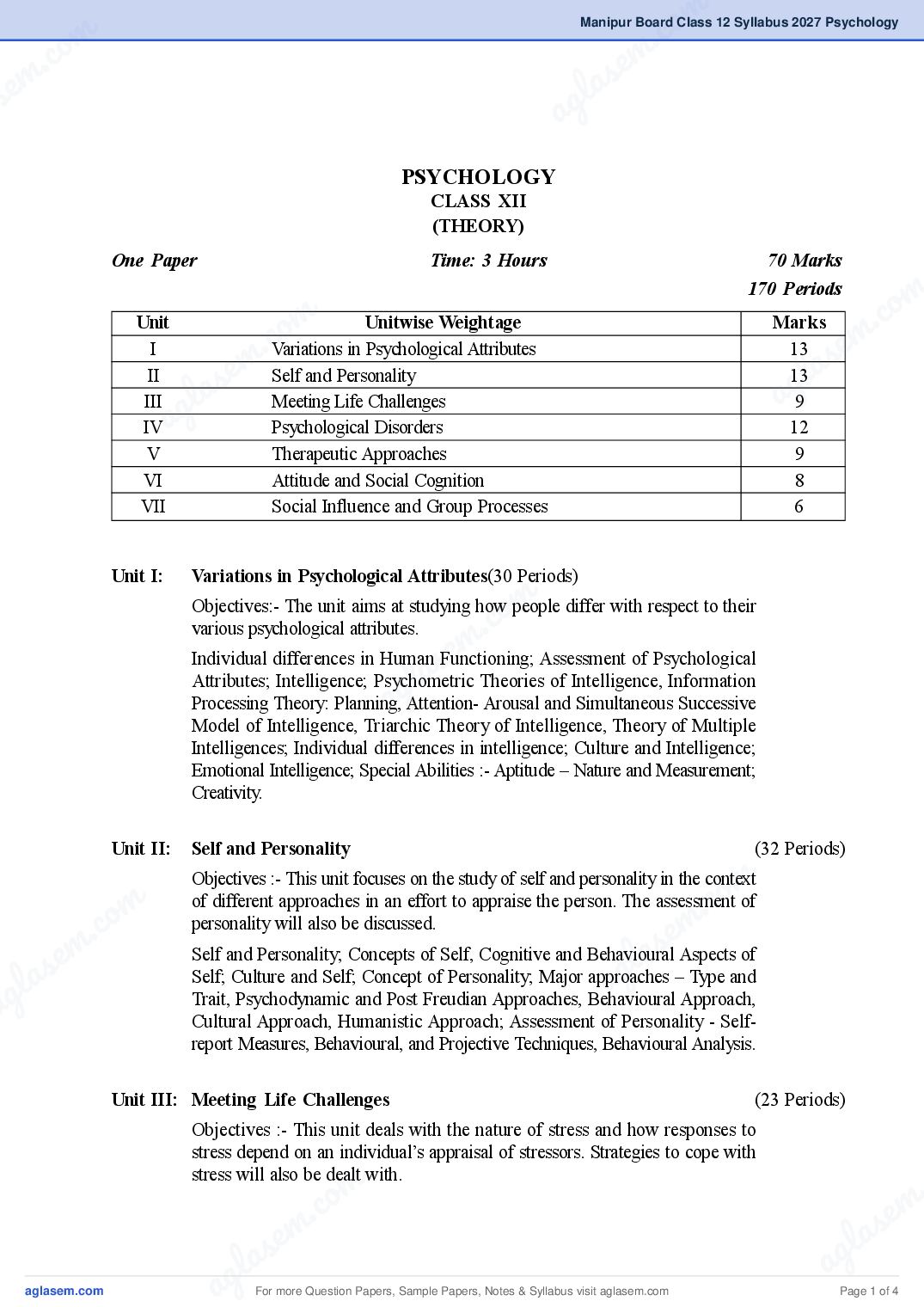
PSYCHOLOGY
CLASS XII
(THEORY)
One Paper Time: 3 Hours 70 Marks
170 Periods
m
m .co
.co
Unit Unitwise Weightage Marks
e m
I
em Variations in Psychological Attributes 13
l as
II
l as Self and Personality
ag
13
III
IV ag Meeting Life Challenges
Psychological Disorders
9
12
V Therapeutic Approaches 9
VI Attitude and Social Cognition 8
VII Social Influence and Group Processes 6
Unit I: Variations in Psychological Attributes(30 Periods)
m
.co
Objectives:- The unit aims at studying how people differ with respect to their
various psychological attributes.
e m
s
Individual differences in Human Functioning; Assessment of Psychological
la
ag
Attributes; Intelligence; Psychometric Theories of Intelligence, Information
Processing Theory: Planning, Attention- Arousal and Simultaneous Successive
Model of Intelligence, Triarchic Theory of Intelligence, Theory of Multiple
Intelligences; Individual differences in intelligence; Culture and Intelligence;
Emotional Intelligence; Special Abilities :- Aptitude – Nature and Measurement;
Creativity.
Unit II: Self and Personality (32 Periods)
Objectives :- This unit focuses on the study of self and personality in the context m
m of different approaches in an effort to appraise the person. The assessment of
.co
m .co personality will also be discussed.
s e m
s e l a
Self and Personality; Concepts of Self, Cognitive and Behavioural Aspects of
g la ag – Type and
Self; Culture and Self; Concept of Personality; Major approaches
a Trait, Psychodynamic and Post Freudian Approaches, Behavioural Approach,
Cultural Approach, Humanistic Approach; Assessment of Personality - Self-
report Measures, Behavioural, and Projective Techniques, Behavioural Analysis.
Unit III: Meeting Life Challenges (23 Periods)
Objectives :- This unit deals with the nature of stress and how responses to
stress depend on an individual’s appraisal of stressors. Strategies to cope with
stress will also be dealt with.
m .
.co s e m
s em l a
g la ag
a For more Question Papers, Sample Papers, Notes & Syllabus visit Page 1 of 4
Page 3
Health - Stress and Health, General Adaptive Syndrome, Stress and Immune
System, Life Style; Coping with Stress - Stress Management Techniques;
Promoting Positive Health and Well-Being - Life Skills, Positive Health.
Unit IV: Psychological Disorders (30 Periods)
Objectives :- This unit discusses the concepts of normality and abnormality and
the major psychological disorders.
Concepts of Abnormality and Psychological Disorders - Historical Background;
Classification of Psychological Disorders; Factors Underlying Abnormal
Behaviour; Major Psychological Disorders – Anxiety, Obsessive- Compulsive
and Related Disorder, Trauma and Stressor Related Disorders, Somatic Symptom
and Related Disorder, Dissociative Disorder, Depressive Disorder, Bipolar and
Related Disorders, Schizophrenia Spectrum and other Psychotic Disorders,
Neuro developmental Disorders, Disruptive, Impulse- Control and Conduct
Disorders, Feeding and Eating Disorder, Substance related and Addictive
Disorders.
Unit V: Therapeutic Approaches (25 Periods)
Objectives :- The unit discusses the goals, techniques, and effectiveness of
different approaches to treat psychological disorders.
Nature and process of Psychotherapy - Therapeutic relationship; Types of
therapies - Behaviour Therapy, Cognitive Therapy, Humanistic - Existential
Therapy, Alternative therapies; Factors contributing to healing in Psychotherapy,
Ethics in Psychotherapy; Rehabilitation of mentally ill.
Unit VI: Attitude and Social Cognition (16 Periods)
Objectives :- This unit focuses on formation and change of attitudes,cultural
influences on attributional tendencies and conditions influencing pro-social
behaviour.
Explaining Social Behaviour; Nature and Components of Attitudes; Attitude
Formation and Change - Attitude Formation, Attitude Change, Attitude -
Behaviour Relationship; Prejudice and Discrimination; Strategies for Handling
Prejudice.
Unit VII: Social Influence and Group Processes (14 Periods)
Objectives :- The unit deals with the concept of group and its functions. Different conflict
resolution strategies will also be discussed.
Nature and Formation of Groups; Types of Groups; Influence of Group on Individual
Behaviour - Social Loafing, Group Polarisation.
For more Question Papers, Sample Papers, Notes & Syllabus visit Page 2 of 4
Page 4
m .co
m .co s e m
se g l a
a
PRACTICAL PAPER
CLASS XII
o m
o m . c
One Paper
. c 3 Hours 30 Marks
e m
em
(Projects, Psychological Testing, Case Studies, etc.) 60
as
Periods
l
a s
The lstudents a grelated
g covered in the course. The case profile will include developmental History of the
to theatopics
shall be required to prepare one case profile and conduct five practicals
subject, using both qualitative (observation, interview, rating etc.) and quantitative approaches.
Practicals would involve using standardised psychological assessment devices in different domains
(intelligence, personality, aptitude, adjustment, attitude, self-concept, and anxiety).
PRESCRIBED TEXTBOOK:
Introduction to Psychology Part II
m
.co
(A Textbook for Class XII)
Published by: NCERT, New Delhi.
s em
g la
a ——§§§——
m
m .co
m .co s e m
s e g l a
g la a
a
m .
.co s e m
s em l a
g la ag
a For more Question Papers, Sample Papers, Notes & Syllabus visit Page 3 of 4
Page 5
DESIGN OF
QUESTION PAPER
Subject : PSYCHOLOGY
Paper : Theory
Class : XII
Full Mark : 70
Time : 3 hours
WEIGHTAGE TO OBJECTIVES
Objectives Marks Percentage
Knowledge (K) 10 15
I Understanding (U) 35 50
Application (A) 21 30
Skill (S) 4 5
Total : 70 100
WEIGHTAGE TO FORMS OF QUESTIONS:
Form of Questions No. of Question Time (in Marks Percentage
minute)
Essay/Long Answer(E/LA) 3 60 15 21
II Short Answer(SA-I) 6 36 18 26
Short Answer(SA-II) 10 40 20 29
Very Short Answer(VSA) 7 21 7 10
MCQ 10 20 10 14
Total: 36 180 70 100
WEIGHTAGE TO CONTENT:
UNIT/CONTENTS : Marks
I Variations in Psychological Attributes 13
II Self and Personality 13
III Meeting Life Challenges 9
III
IV Psychological Disorders 12
V Therapeutic Approaches 9
VI Attitude and Social Cognition 8
VII Social Influence and Group Processes 6
Total : 70
IV SCHEME OF SECTIONS : Nil
V SCHEME OF OPTIONS : Internal option will be given in Essay Type Question & SA-I.
VI DIFFICULTY LEVEL :
Difficult : 30% of the total marks
Average : 50% of the total marks
Easy : 20% of the total marks
Special Instruction: 1) Two questions of MCQ will be assertion-reason type question.
2) One question of SA-I will be source based question
Abbreviation : K(Knowledge), U(Understanding), C(Comprehension), Exp.(Expression), Skill(S),
E(Essay Type), SA (Short Answer Type), VSA (Very Short Answer Type),
MCQ(Multiple Choice Question)
For more Question Papers, Sample Papers, Notes & Syllabus visit Page 4 of 4
Document Details
| Board / Org | Manipur Board |
| Exam | Class 12 |
| Type | Syllabus |
| Pages | 4 |
| Updated | 04 Nov 2026 |