APTET Syllabus for Mathematics and Science Paper II-A
Finished viewing? Save it for later —
Download APTET Syllabus for Mathematics and Science Paper II-A (PDF · 14 pages)About APTET Syllabus for Mathematics and Science Paper II-A
APTET Syllabus for Mathematics and Science Paper II-A is available here for free download. Published by Andhra Pradesh Exams for AP TET, this syllabus can be viewed online or downloaded as a PDF (14 pages). Candidates preparing for AP TET can use APTET Syllabus for Mathematics and Science Paper II-A to understand the exam pattern, the type of questions asked, and the overall difficulty level.
Frequently Asked Questions
How can I download APTET Syllabus for Mathematics and Science Paper II-A?
Open this page and click the Download button to save APTET Syllabus for Mathematics and Science Paper II-A as a PDF. It is completely free on AglaSem Docs.
Is APTET Syllabus for Mathematics and Science Paper II-A free to download?
Yes. APTET Syllabus for Mathematics and Science Paper II-A can be viewed online and downloaded as a PDF free of cost on AglaSem Docs.
How many pages does APTET Syllabus for Mathematics and Science Paper II-A have?
APTET Syllabus for Mathematics and Science Paper II-A contains 14 pages, which you can read online or download together as a single PDF.
Where can I find more AP TET study material?
You can find more AP TET question papers, sample papers, syllabus, and answer keys on AglaSem Docs.
APTET Syllabus for Mathematics and Science Paper II-A – Text
Read the full text of this syllabus below — useful to quickly search, copy and reference the content online without downloading the PDF.
📄 View text version (14 pages)
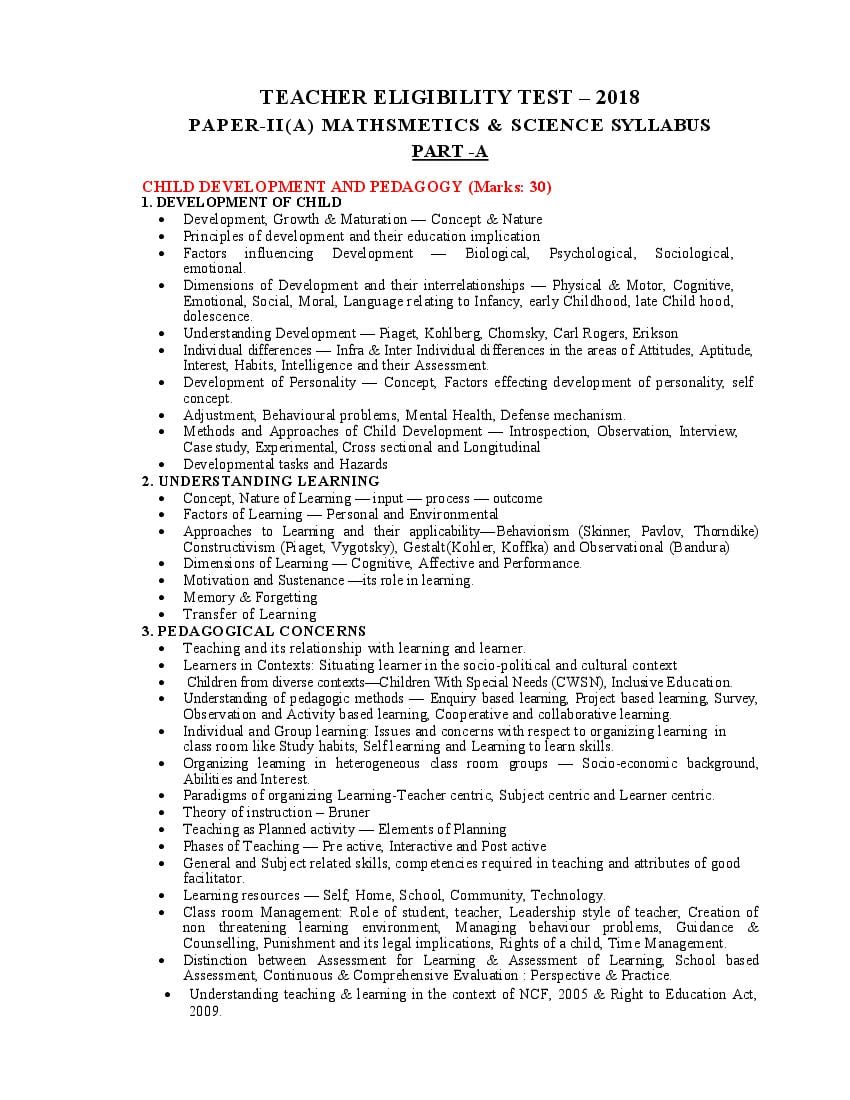
Page 1
PAP ER-II(A) M ATHSMETICS & SCIENCE SYLLABUS
PART -A
CHILD DEVELOPMENT AND PEDAGOGY (Marks: 30)
1. DEVELOPMENT OF CHILD
Development, Growth & Maturation — Concept & Nature
Principles of development and their education implication
Factors influencing Development — Biological, Psychological, Sociological,
emotional.
Dimensions of Development and their interrelationships — Physical & Motor, Cognitive,
Emotional, Social, Moral, Language relating to Infancy, early Childhood, late Child hood,
dolescence.
Understanding Development — Piaget, Kohlberg, Chomsky, Carl Rogers, Erikson
Individual differences — Infra & Inter Individual differences in the areas of Attitudes, Aptitude,
Interest, Habits, Intelligence and their Assessment.
Development of Personality — Concept, Factors effecting development of personality, self
concept.
Adjustment, Behavioural problems, Mental Health, Defense mechanism.
Methods and Approaches of Child Development — Introspection, Observation, Interview,
Case study, Experimental, Cross sectional and Longitudinal
Developmental tasks and Hazards
2. UNDERSTANDING LEARNING
Concept, Nature of Learning — input — process — outcome
Factors of Learning — Personal and Environmental
Approaches to Learning and their applicability—Behaviorism (Skinner, Pavlov, Thorndike)
Constructivism (Piaget, Vygotsky), Gestalt(Kohler, Koffka) and Observational (Bandura)
Dimensions of Learning — Cognitive, Affective and Performance.
Motivation and Sustenance —its role in learning.
Memory & Forgetting
Transfer of Learning
3. PEDAGOGICAL CONCERNS
Teaching and its relationship with learning and learner.
Learners in Contexts: Situating learner in the socio-political and cultural context
Children from diverse contexts—Children With Special Needs (CWSN), Inclusive Education.
Understanding of pedagogic methods — Enquiry based learning, Project based learning, Survey,
Observation and Activity based learning, Cooperative and collaborative learning.
Individual and Group learning: Issues and concerns with respect to organizing learning in
class room like Study habits, Self learning and Learning to learn skills.
Organizing learning in heterogeneous class room groups — Socio-economic background,
Abilities and Interest.
Paradigms of organizing Learning-Teacher centric, Subject centric and Learner centric.
Theory of instruction – Bruner
Teaching as Planned activity — Elements of Planning
Phases of Teaching — Pre active, Interactive and Post active
General and Subject related skills, competencies required in teaching and attributes of good
facilitator.
Learning resources — Self, Home, School, Community, Technology.
Class room Management: Role of student, teacher, Leadership style of teacher, Creation of
non threatening learning environment, Managing behaviour problems, Guidance &
Counselling, Punishment and its legal implications, Rights of a child, Time Management.
Distinction between Assessment for Learning & Assessment of Learning, School based
Assessment, Continuous & Comprehensive Evaluation : Perspective & Practice.
Understanding teaching & learning in the context of NCF, 2005 & Right to Education Act,
2009.
Page 2
1) | >± :
) | +/ > +
2) 6 +& 10 :
)
_) |]# +
)
&)
)
3) | +: (6 +& 10 )
)
_) |
)
&)
)
&)
)
4) :
) |
( , , , , , +, +, +, ,
, | , +, >± , .)
_) +<
,> , , +<
, , , , , , ,>
+<
)
< +< , , , , , .
&) #+<
) ( ,# , , ).
, , , )
) +, # + .
) ( , , , , , ], ,
). ,| .
Page 3
Page 4
1. :
2. ( )
3. : , ,
: ,
, , , , , |,
|, , ,
4. , , ,
, ,
5. , , ,
6. ° ( ) (
)
Page 5
Page 6
I. ׬kÕùLôsÞRp - ®ûPV°jRp
A) A±Vôf ùNnÙs B) A±Vôl Tj§
II. 6Bm YÏl©-ÚkÕ 10Bm YÏl×YûW Rªr
TôPl×jRLj§Ûs[ Aû]jÕm.
A) Øû\Ls - Ti×Ls B) L®Oo, ×XYo B£¬Vo ϱl×
C) £\l× AmNeLs
III. ùNôpXôdLm :
A) ùNôtùTôÚs B) JÚùNôp TXùTôÚs C) JÚùTôÚs
TXùNôp
D) CÚùTôÚs E) úNojÕ GÝÕL F) ©¬jÕ GÝÕL
G) ¨ßjRtϱLs H) YZdÏ I) YÝ J) UW×jùRôPo
K) ©\ùUô¯ ùNôpÛdÏ RªrfùNôp
Oriya: Content (30 Marks)
1. :-
a) b)
2. :-
a) , b) /
c)
3. :- :-
a) b) c)
d) e) f)
g) h) , i)
j) , , , , ,
4. :-
a) , , ,
b) – , , ,
c) – , ,
d) – , , , ,
e) - , , ,
f) - ( , , ) ( , ,
)
g) – ( , , ), ,
Page 7
1. : : :
:
2. : : :
3. : :
4. :
5. :
:
:
English: (Content &Methodology) (Marks: 30)
VOCABULARY LEVEL OF TESTING
Synonyms Identification
Antonyms Identification
Homophones Identification
Homonyms Identification
Hypernyms and Hyponyms Identification
Spelling Spelling
Phrasal Verbs Identification of Meaning
Word Formation Suffixes and Prefixes
Referring to Persons / Professions and
One word substitutes
Places
Commonly used short forms and full
Short forms and Full forms
forms in English
Commonly used Abbreviations and their
Abbreviations and Full forms
full forms
GRAMMAR LEVEL OF TESTING
Helping Verbs Forms, contractions
Modal Auxiliaries Form, Function & Contractions
Ordinary Verbs Form, Function & Contractions
Articles Use of Articles
Simple Prepositions Including
Prepositions
Prepositions following Certain Words
Page 8
Clauses Noun Clauses, If Clauses, Relative
Clauses
Sentence Structures Basic Sentence Structures
Form, Function, Construction,
Degrees of Comparison
Transformation
Language Functions with social norms
Language Functions
(Formal and Informal)
Question Tags Imperatives and Statements
Types of Sentences Types of Sentences
Direct Speech & Indirect Speech Statements, Questions, Imperatives
Active Voice & Passive Voice Active Voice & Passive Voice
Use of tenses and framing including IF
Tenses
conditionals Type 1 &3
Agreement between subject &
Agreement between Subject & Verb
Verb
Word Order Word Order in a phrase or a sentence
Nouns, Pronouns, Adjectives, Adverbs,
Parts of Speech
Conjunctions - Types and functions
Linkers Linkers
Simple, Compound and Complex
Transformation of Sentences
Sentences
Based on all Vocabulary and Grammar
Common Errors
Topics
MECHANICS OF WRITING LEVEL OF TESTING
Use of capital letters, comma, full stop,
Punctuation and Capitalization question mark, exclamation mark and
inverted commas
DISCOURSES LEVEL OF TESTING
Writing of Discourses Letter Writing and News Report
DICTIONARY SKILLS LEVEL OF TESTING
DICTIONARY SKILLS DICTIONARY SKILLS
READING COMPREHENSION LEVEL OF TESTING
Prose Prose (general)
Page 9
Mathematics Content (24Marks)
I. Arithmetic
Ratio and Proportion - Applications of Ratio- Comparing Quantities using proportion -Direct and
Inverse proportion
II. Number System
Knowing Our Numbers –rounding of numbers - Whole Numbers- predecessor – successor –
number line -Playing With Numbers – divisibility rules -LCM & HCF -Integers - Fractions -
Decimals -Rational Numbers -Squares, cubes Square roots, Cube roots
Real numbers -Representing irrational numbers on Number line – representing real numbers on
the number line through successive magnification – rationalisation –Real numbers- operations on
real numbers- law of exponents for real numbers- surds( exponential form & radical form )
Euclid’s division lemma & its application in finding HCF – fundamental theorem of Arithmetic &
its application (HCF & LCM, decimal representation of rational numbers (terminating or non-
terminating recurring and vice versa))
Non-terminating & non recurring decimals as irrationals – irrationality of 2, 3 etc.- properties
of irrational numbers
Logarithm -Logarithm-exponential & logarithmic forms-Properties & Laws of logarithms-
standard base of logarithm- use of logarithms in daily life situation-
Sets –& its representation (Roster form& set builder form)-examples- classification of sets(empty,
finite, infinite, subset& super set, universal set, disjoint sets, power set of a set, equality of sets)
Venn diagram – operations on sets ( union, intersection, difference, cardinal number of a set
III. Geometry
Measures of Lines and Angles - Symmetry - -Understanding 3D, 2D Shapes -Representing 3D in
2D-Lines and Angles -Triangle and Its Properties -Congruency of Triangles- -Quadrilaterals -
Practical Geometry -Construction of Triangles Construction of Quadrilaterals - Exploring
Geometrical Figures-
The Elements of Geometry - Area – Circles
Similar Triangles & Tangents and secants to a circle
Proofs in Mathematics
IV. Mensuration
Perimeter and Area - Area of Plane Figures -Surface areas and Volumes
V. Algebra
Introduction to Algebra- Simple Equations- Exponents - Algebraic Expressions
- Exponents & Powers - Linear Equations in one variable – Factorisation
Polynomials & Factorisation - Linear Equations in Two Variables - Pair of Linear Equations in
Two Variables - Quadratic Equations- Progressions- Sequences and series- Arithmetic
Progression- properties of A.P.- Arithmetic mean –Geometric Progression –nth term–properties
of AP,G.P.
Page 10
DATA HANDLING - Frequency Distribution Tables and Graphs- Grouped data-ungrouped data
– Measrues of Central Tendency -Mean, median & mode of grouped and ungrouped data – ogive
curves.
VII. Probability
Probability - Random experiment and outcomes -Equally likely outcomes - Trail and Events -
Linking the chance to Probability - uses of probability in real life
Probability-a theoretical approach – probability & modeling – equally likely events -mutually
exclusive events –finding probability – elementary event –exhaustive events - complementary
events & probability – impossible & certain events – deck of cards & Probability –use &
applications of probability -
VIII. Coordinate Geometry
Cartesian system-Plotting a point in a plane if its co-ordinates are given.
Distance between two points - Section formula (internal division of a line segment in the ratio m :
n) – centroid of a triangle – trisectional points of a line segment -Area of triangle on coordinate
plane- collinearity –straight lines -Slope of a line joining two points
IX. Trigonometry
Trigonometry - Naming the side in a right triangle-trigonometric ratios – defining trigonometric
ratios –trigonometric ratios of some specific angles (450, 30 0 &60 0, 0 0 &90 0) –trigonometric ratios
of complementary angles – trigonometric identities –
Applications of Trigonometry - Line of sight & horizontal -Angle of elevation & depression -
Drawing figures to solve problems – solution for two triangles
Methodology (06 Marks)
1. Meaning and Nature of Mathematics, History of Mathematics.
2. Contributions of Great Mathematicians - Aryabhatta, Bhaskaracharya, Srinivasa
Ramanujan, Euclid, Pythagoras, George cantor.
3. Aims and Values of teaching Mathematics, Instructional objectives (Blooms taxonomy)
4. Mathematics curriculum: Principles, approaches of curriculum construction, -Logical and
Psychological, Topical and Concentric, Spiral approaches. Qualities of a good
Mathematics text book.
5. Methods of teaching mathematics- Heuristic method, Laboratory method, Inductive and
Deductive methods, Analytic and Synthetic methods, Project method and Problem Solving
method.
6. Unit Plan, Year Plan, Lesson Planning in Mathematics.
7. Instructional materials, Edgar Dale's Cone of Experience.
8. Evolving strategies for the gifted students and slow learners,
9. Techniques of teaching mathematics like Oral work, Written work, Drilling, Assignment,
Project, Speed and Accuracy.
10.Mathematics club, Mathematics structure, Mathematics order and pattern sequence.
11. Evaluation - Types, Tools and Techniques of Evaluation, Preparation of SAT
Analysis, Characteristics of a good test.
Page 11
CONTENT (Marks: 12)
1. Measurement:
Measurement of length, area, volume and time. CGS and SI units of length, area, volume and
time. Conversion of units from CGS to S.I and Vice versa.
2. Motion:
Motion and Rest, Types of motion (Translatory, Rotatory and oscillatory), Scalars and vectors
distance, displacement, speed, velocity, Average speed, average velocity, Uniform motion, equations
of uniform accelerated motion
3. Force and Friction:
Types of forces (field force and contact force), Net force (free body diagrams), Effects of net
force, Pressure, types of friction (static, Sliding and Rolling), Factors affecting Friction
(Roughness, normal force, area etc), Methods of reducing fraction, Fluid friction
4. Newton’s law of motion:
History of laws of motion (Aristotle and Galilean view), Newton’s I, II and III laws of motion,
Linear momentum, Atwood machine ( Application of Newton’s law), Conservation of linear
momentum and Impulse.
5. Gravitation:
Uniform circular motion (centripetal acceleration and centripetal force), Universal law of
gravitation, acceleration due to gravity (g) (direction of (g). factors affecting (g), weight), Changes
during free fall, Centre of gravity and stability
6. Floating bodies:
Density and relative density, Lactometer, Upward forces of liquids, Atmospheric pressure, its
measurement, Pressure of liquids at different depths, Archomedes principle, its application, Pascal’s
principle, its applications.
7. Work, Energy:
Work (Scientific meaning, formula, positive, negative and zero work conditions etc), Types of
mechanical energy (Potential energy and kinetic energy), Numerical expressions and examples of
mechanical energy, Conservation of mechanical energy, Energy inside huan body
8. Sound :
Sound - a form of energy, Production of sound, Structure of larynx and voice box, Structure
and functioning of eardrum, Propagation of sound, Types of waves (longitudinal and transverse),
Characteristics of sound waves (Wavelength, attitude, frequency and speed), Relation between
frequency and time period, Characteristics of musical sound (pitch, loudness and quality), Audible
range of frequencies. Reflection of sound, echo and reverberation. Uses of multiple reflection of
sound (mega phone, horn, stethoscope, Designing of concert halls and Cinema halls), Applications of
ultra sound (Industrial and medical applications), Sonar, working, Sound pollution (Measures, effects
and control).
9. Heat:
Heat and temperature, Units of temperature (centigrade, Fahrenheit and Kelvin, conversion
from, centigrade to Fahrenheit and Viceversa conversion from centigrade to Kelvin and Vice versa),
Expansion of liquids due to heat, Types of thermometers (meruny, alcohol, clinical, six maximum,
minimum, thermometers), Temperature and Kinetic energy relation, Specific heat (formula, units,
Page 12
Boiling, Melting and freezing, Latent heat, Temperature time graph
10. Light:
Light, Shadows and Images, Reflection of light by plane surfaces (laws of reflection,
periscope, multiple images, kaleidoscope, characteristics of image formed by plant mirrors),
Reflection of light by curved surfaces (Virtual images, read images, Ray diagram for concave and
curved mirrors, formula of curved mirrors regarding focal length and magnification application of
spherical mirrors. Refraction of light at plane surface (condition of Refraction, Refractive Index,
Relative Refractive Index, factors as which refractive Index of Medium depend comparison between
linear and optical density, Snell’s law, Total Internal Reflection and its applications, Refraction
through Glass slab, vertical and lateral shifts), Refraction through Curved Surfaces (When light enters
into medium of Refractive Index ‘n2’ from ‘n1’ at curved surface with radius of curvature ‘R’, Len’s
formula, (Len’s makers formula, Different types of lenses and ray diagrams regarding concave and
convex lenses), Human eye and colourful world. (Human eye, its structure and optical measurements,
eye defects, Myopia, hypermatropia, pressbiopia and their corrections , Dispersion of light through
prism. i-d curve, Rainbow, Scattering of light, and colour of sky)
11. Electricity:
Simple electric circuits, Conductors, Insulators, Type of cells (Dry and liquid), Electric
symbols and uses, Series of parallel connection of cells and Bulbs, Heating effects of Electricity,
Understanding of CFL, Fuse and MCBs, Electric current, potential difference and EMF, Drift velocity
and working of a cell, Ohm’s law (Circuit, graph (I-V graph limitations and applications), Factors
affecting Resistance of a material (Temperature, Material, length and Area of Cross section),
Resistivity, series of parallel connections of resistances. Kirchhoff’s laws (Junction law of loop law)
Electric power (Calculation of House hold electricity and rlating of Electric appliances)
12. Electro-Magnetism:
Types of Magnets, Properties of Magnets, Magnetic compass, Earth as a Magnet, Magnetic
Induction, Oirsted’s experiment, Magnetic Fled, Magnetic field due to currents (straight, circular coil,
electric motor), Electromagnetic Induction (Faradays’ law of Induction and its applications, magneto
motive force and electric Generator, Lenz law)
13. Some Natural Phenomenon:
Electric charge, and Basic properties of electric charge, Types of charges and their
interactions. Transfer of change, lighting , lighting safety, lighting conductors. Earthquake, Tsunami,
Causes and effects, Protective measures.
14. Stars and solar system:
Movement of the sun, Phases of Moon, Eclipces (Solar and lunar eclipses) types of Eclipces
Movement of Stars (Constellation, pole star, Solar System, Artificial Satellites.
15. Separation of Substances:
Mixtures, Methods of separation – handpicking winnowing. Sedimentation, decantation,
Sieving, Filtration sublimation, chromatography, Distillation and fractional distillation.
16. Changes around us:
Slow/fast changes, Temporary/permanent changes, Natural/man made changes, Physical/
chemical changes, Galvanization and corrosion, Rancidity, Oxidation / reduction
17. Matter:
States of matter, Properties of solids, liquids and gases, Effects of Temperature, pressure
surface area and Humidity on change of states of matter. Homogeneous mixtures Heterogeneous
mixtures. Solutions – Types of Solutions – Concentration of solution. Expressing Concentration of
Solutions, Suspension – Colloids, Separation of mixtures by sublimation evaporation and
Page 13
and mixtures.
18. Metals and Non metals:
Physical properties of metals, Chemical properties of metals, Metal – non metal classification
Reactivity of metals, Uses of metals, Minerals – ore, Occurrence of metals in nature, Examples of
metals and non metal, Reactivity order of metals
19. Synthetic fibers and Plastics:
Natural / synthetic fibers, Identifying fibers – burning test, Synthetic fibers preparation and
uses, Resin identification codes, Types of plastics, Plastics and environment, Biodegradable – non
bio degradable, Reduce, Recycle, Re use and Recover – 4R principle.
20. Coal and petroleum:
Exhaustible and in exhaustible Resources, Fuels – Types, Uses of Coal and Petroleum and
Coal products, Refining of petroleum, Petrochemical products in various sectors, Formation of
coal and petroleum. Misuse of Energy resources and Consequences.
21. Combustion fuels and flame:
Combustion – Supporter combustion – Irruption Temperature. Types of Combustion. Fuels
Fire control. Structure of flame – colors zone – Intensity.
22. Water:
Process of water filtration, Types of impurities, Deceases caused by impure water, Acid rain
particular pollutants, Water pollution, Strategies to control water pollution.
23. Acids, Bases and Salts:
Indicators – Natural indicator, Acidic substances and Basic Substances, Neutral substances
and Salt, Neutralization, Chemical properties of acids and Bases, Reaction of Metal oxides with
base/ Reaction of non metals with acids. Electrical conductivity of acids and bases, Strength of
acids and bases, Concentration acids and bases, pH Scale Importance of pH in everyday life.,
pH of salts, Bleaching powder, washing soda and baking soda and their uses. Plaster of Paris.
Methodology: (03 Marks)
1. Definition, Nature, Structure and History of Science
2. Aims, Values , Instructional Objectives of teaching Science and Academic Standards in
Science
3. Methods of Teaching Science
4. Teaching Learning Material in Teaching of Science - TLM in Science – Use of ICT.
5. Instructional Planning
6. Science Laboratory
7. Science Teacher - Changing Roles
8. Science Curriculum and its transaction, NCF-2005, SCF-2011
9. Science Textbooks.
10. Evaluation - CCE - Formative Assessment, Summative Assessment - Designing and
Administration- Analysis of Scholastic Achievement Test (SAT)
Page 14
CONTENT (Marks: 12)
1. Living world:- What is Science, Living and None living thing. Diversity in living organisms, Cell
the basic unit of life, Cell its structure and factions, plant tissues, Animal tissues, Cell division,
Plasma membrane, Habitat, Animal behavior, Movements in animals, Story of micro organisms,
Fiber to Fabric, Production of food from plants and animals, Challenges in improving agricultural
products, Challenges in improving in Agricultural product. Why do we fall ill.
2. Life Processes:- Our food, Food components, Nutrition In plants, Plants – Parts and functions,
Reproduction plants, seed dispersal, Organ systems in Man, Sense Organs, Animal Behavior -
What do animals eat, Nutrition – Food Supplying System, Malnutrition, Respiration- The energy
releasing system, Transportation – The circulatory system. Excretion – The wastage disposing
system. Coordination – The linking system. Attaining the age of Adolescence, Reproduction –
The generating system. Reproduction in animals, Reproductive health, Coordination in life
processes, Heredity and evolution – from parent to progeny.
3. Our Environment:- Our Environment – Our concern. Biodiversity - Biodiversity and its
Conservation, Diversity in living organism, Soil our life, Soil pollution, Forests our life, Natural
resources. Renewable and non renewable resources. Not for Drinking, Not for Breathing, Different
Eco systems, adaptations in different ecosystems. Global Environmental Issues, Green house
effect, Global warming, Bio- geo –Chemical cycle.
Methodology: (3 Marks)
1. Definition, Nature, Structure and History of Biological Science
2. Aims, Values , Instructional Objectives of teaching Science and Academic Standards in
Science
3. Methods of Teaching Science
4. Teaching Learning Material in Teaching of Science - TLM in Science – Use of ICT.
5. Instructional Planning
6. Science Laboratory
7. Science Teacher - Changing Roles
8. Science Curriculum and its transaction, NCF-2005, SCF-2011
9. Science Textbooks.
10. Evaluation - CCE - Formative Assessment, Summative Assessment - Designing and
Administration- Analysis of Scholastic Achievement Test (SAT)
Document Details
| Board / Org | Andhra Pradesh Exams |
| Exam | AP TET |
| Type | Syllabus |
| Pages | 14 |
| Updated | 30 Apr 2026 |