APTET Syllabus for Language Paper II-A
Finished viewing? Save it for later —
Download APTET Syllabus for Language Paper II-A (PDF · 21 pages)About APTET Syllabus for Language Paper II-A
APTET Syllabus for Language Paper II-A is available here for free download. Published by Andhra Pradesh Exams for AP TET, this syllabus can be viewed online or downloaded as a PDF (21 pages). Candidates preparing for AP TET can use APTET Syllabus for Language Paper II-A to understand the exam pattern, the type of questions asked, and the overall difficulty level.
Frequently Asked Questions
How can I download APTET Syllabus for Language Paper II-A?
Open this page and click the Download button to save APTET Syllabus for Language Paper II-A as a PDF. It is completely free on AglaSem Docs.
Is APTET Syllabus for Language Paper II-A free to download?
Yes. APTET Syllabus for Language Paper II-A can be viewed online and downloaded as a PDF free of cost on AglaSem Docs.
How many pages does APTET Syllabus for Language Paper II-A have?
APTET Syllabus for Language Paper II-A contains 21 pages, which you can read online or download together as a single PDF.
Where can I find more AP TET study material?
You can find more AP TET question papers, sample papers, syllabus, and answer keys on AglaSem Docs.
APTET Syllabus for Language Paper II-A – Text
Read the full text of this syllabus below — useful to quickly search, copy and reference the content online without downloading the PDF.
📄 View text version (21 pages)
Page 1
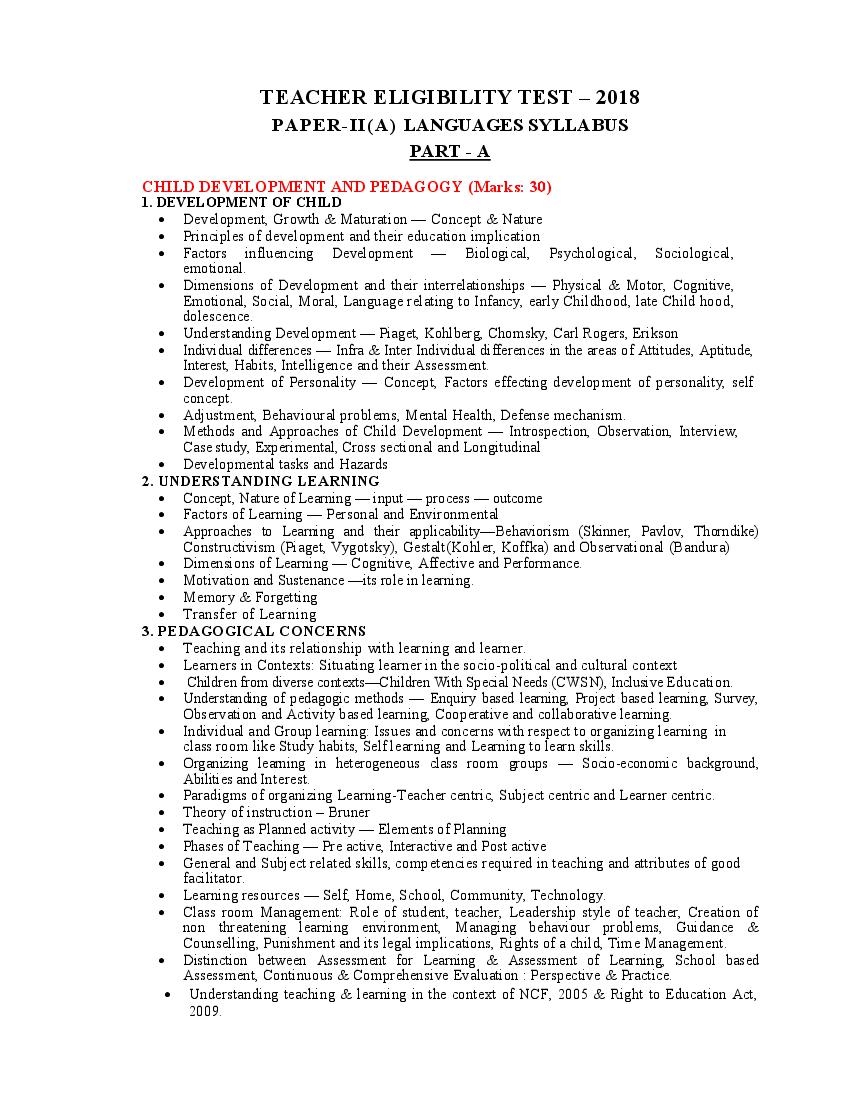
PAPER-II(A) LANGUAGES SYLLABUS
PART - A
CHILD DEVELOPMENT AND PEDAGOGY (Marks: 30)
1. DEVELOPMENT OF CHILD
Development, Growth & Maturation — Concept & Nature
Principles of development and their education implication
Factors influencing Development — Biological, Psychological, Sociological,
emotional.
Dimensions of Development and their interrelationships — Physical & Motor, Cognitive,
Emotional, Social, Moral, Language relating to Infancy, early Childhood, late Child hood,
dolescence.
Understanding Development — Piaget, Kohlberg, Chomsky, Carl Rogers, Erikson
Individual differences — Infra & Inter Individual differences in the areas of Attitudes, Aptitude,
Interest, Habits, Intelligence and their Assessment.
Development of Personality — Concept, Factors effecting development of personality, self
concept.
Adjustment, Behavioural problems, Mental Health, Defense mechanism.
Methods and Approaches of Child Development — Introspection, Observation, Interview,
Case study, Experimental, Cross sectional and Longitudinal
Developmental tasks and Hazards
2. UNDERSTANDING LEARNING
Concept, Nature of Learning — input — process — outcome
Factors of Learning — Personal and Environmental
Approaches to Learning and their applicability—Behaviorism (Skinner, Pavlov, Thorndike)
Constructivism (Piaget, Vygotsky), Gestalt(Kohler, Koffka) and Observational (Bandura)
Dimensions of Learning — Cognitive, Affective and Performance.
Motivation and Sustenance —its role in learning.
Memory & Forgetting
Transfer of Learning
3. PEDAGOGICAL CONCERNS
Teaching and its relationship with learning and learner.
Learners in Contexts: Situating learner in the socio-political and cultural context
Children from diverse contexts—Children With Special Needs (CWSN), Inclusive Education.
Understanding of pedagogic methods — Enquiry based learning, Project based learning, Survey,
Observation and Activity based learning, Cooperative and collaborative learning.
Individual and Group learning: Issues and concerns with respect to organizing learning in
class room like Study habits, Self learning and Learning to learn skills.
Organizing learning in heterogeneous class room groups — Socio-economic background,
Abilities and Interest.
Paradigms of organizing Learning-Teacher centric, Subject centric and Learner centric.
Theory of instruction – Bruner
Teaching as Planned activity — Elements of Planning
Phases of Teaching — Pre active, Interactive and Post active
General and Subject related skills, competencies required in teaching and attributes of good
facilitator.
Learning resources — Self, Home, School, Community, Technology.
Class room Management: Role of student, teacher, Leadership style of teacher, Creation of
non threatening learning environment, Managing behaviour problems, Guidance &
Counselling, Punishment and its legal implications, Rights of a child, Time Management.
Distinction between Assessment for Learning & Assessment of Learning, School based
Assessment, Continuous & Comprehensive Evaluation : Perspective & Practice.
Understanding teaching & learning in the context of NCF, 2005 & Right to Education Act,
2009.
Page 2
1) | >± :
) | +/ > +
2) 6 +& 10 :
)
_) |]# +
)
&)
)
3) | +: (6 +& 10 )
)
_) |
)
&)
)
&)
)
4) :
) |
( , , , , , +, +, +, ,
, | , +, >± , .)
_) +<
,> , , +<
, , , , , , ,>
+<
)
< +< , , , , , .
&) #+<
) ( ,# , , ).
, , , )
) +, # + .
) ( , , , , , ], ,
). ,| .
Page 3
Page 4
1. :
2. ( )
3. : , ,
: ,
, , , , , |,
|, , ,
4. , , ,
, ,
5. , , ,
6. ° ( ) (
)
Page 5
Page 6
I. ׬kÕùLôsÞRp - ®ûPV°jRp
A) A±Vôf ùNnÙs B) A±Vôl Tj§
II. 6Bm YÏl©-ÚkÕ 10Bm YÏl×YûW Rªr
TôPl×jRLj§Ûs[ Aû]jÕm.
A) Øû\Ls - Ti×Ls B) L®Oo, ×XYo B£¬Vo ϱl×
C) £\l× AmNeLs
III. ùNôpXôdLm :
A) ùNôtùTôÚs B) JÚùNôp TXùTôÚs C) JÚùTôÚs
TXùNôp
D) CÚùTôÚs E) úNojÕ GÝÕL F) ©¬jÕ GÝÕL
G) ¨ßjRtϱLs H) YZdÏ I) YÝ J) UW×jùRôPo
K) ©\ùUô¯ ùNôpÛdÏ RªrfùNôp
Oriya: Content (30 Marks)
1. :-
a) b)
2. :-
a) , b) /
c)
3. :- :-
a) b) c)
d) e) f)
g) h) , i)
j) , , , , ,
4. :-
a) , , ,
b) – , , ,
c) – , ,
d) – , , , ,
e) - , , ,
f) - ( , , ) ( , ,
)
g) – ( , , ), ,
Page 7
1. : : :
:
2. : : :
3. : :
4. :
5. :
:
:
English: (Content) (Marks: 30)
VOCABULARY LEVEL OF TESTING
Synonyms Identification
Antonyms Identification
Homophones Identification
Homonyms Identification
Hypernyms and Hyponyms Identification
Spelling Spelling
Phrasal Verbs Identification of Meaning
Word Formation Suffixes and Prefixes
Referring to Persons / Professions and
One word substitutes
Places
Commonly used short forms and full
Short forms and Full forms
forms in English
Commonly used Abbreviations and their
Abbreviations and Full forms
full forms
GRAMMAR LEVEL OF TESTING
Helping Verbs Forms, contractions
Modal Auxiliaries Form, Function & Contractions
Ordinary Verbs Form, Function & Contractions
Articles Use of Articles
Simple Prepositions Including
Prepositions
Prepositions following Certain Words
Page 8
Clauses Noun Clauses, If Clauses, Relative
Clauses
Sentence Structures Basic Sentence Structures
Form, Function, Construction,
Degrees of Comparison
Transformation
Language Functions with social norms
Language Functions
(Formal and Informal)
Question Tags Imperatives and Statements
Types of Sentences Types of Sentences
Direct Speech & Indirect Speech Statements, Questions, Imperatives
Active Voice & Passive Voice Active Voice & Passive Voice
Use of tenses and framing including IF
Tenses
conditionals Type 1 &3
Agreement between subject &
Agreement between Subject & Verb
Verb
Word Order Word Order in a phrase or a sentence
Nouns, Pronouns, Adjectives, Adverbs,
Parts of Speech
Conjunctions - Types and functions
Linkers Linkers
Simple, Compound and Complex
Transformation of Sentences
Sentences
Based on all Vocabulary and Grammar
Common Errors
Topics
MECHANICS OF WRITING LEVEL OF TESTING
Use of capital letters, comma, full stop,
Punctuation and Capitalization question mark, exclamation mark and
inverted commas
DISCOURSES LEVEL OF TESTING
Writing of Discourses Letter Writing and News Report
DICTIONARY SKILLS LEVEL OF TESTING
DICTIONARY SKILLS DICTIONARY SKILLS
READING COMPREHENSION LEVEL OF TESTING
Prose Prose (general)
Page 9
, ( ) ] +(60 )
+{ (48 )
1) # :
, , ,_ , , , ,
< , .
2) # :
+& +, +& , .
>±+
+
<
3) :
+ + + ,
.
1) 6 +& 10 :
+, +< , , |]# , .
2) | +
,| , , , , , ,
.
3) :
+< , , #+< ( , , ) ( , )
| +, , >± , , (| , +, +,
, +, , , , +> , ,
.)
4) | >±
| +/ +
_. | : (12 )
1.
2.
3. +<
4. +
5. |
6. + |
Page 10
Content - Marks: 48
VOCABULARY LEVEL OF TESTING
Synonyms Identification of Shades of Meaning
Antonyms Identifying Antonyms in a Context
Homophones Identification & Usage
Homonyms Identification & Usage
Hypernyms & Hyponyms Identification & Usage
Spelling Spelling
Referring to Persons / Professions, Places,
One-word Substitutes
Collections
Phrasal Verbs Identification of Meaning and usage
Idiomatic Expressions Identification, Usage
Proverbs Proverbs
Word Formation Suffixes, Prefixes and other forms
Short Forms - Full Forms common Short Forms - Full Forms
Abbreviations - Full Forms Common Abbreviations - Full Forms
Word Collocations Word Collocations
Standard and common Foreign Phrases Used
Foreign Phrases Used in English
in English
GRAMMAR LEVEL OF TESTING
Helping Verbs Form, Function & Contractions
Modal Auxiliaries Form, Function & Contractions
Ordinary Verbs Form, Function & Contractions
Articles Use of Articles Including Omissions
Simple, Compound Prepositions Including
Prepositions Prepositions following Certain Words and
Prepositional Phrases
Main Clauses, sub-ordinate Clauses,
Adjectival Clauses, Noun Clauses,
Clauses
Adverbial Clauses, Relative Clauses, Finite
and Non-finite Clauses
Sentence Structures Sentence Structures
Form, Function, Construction,
Degrees of Comparison
Transformation
Language Functions with social norms
Language Functions
(formal and informal)
Imperatives and Statements with semi
Question Tags
negatives and indefinites subjects
Page 11
Sentence Improvement Sentence Improvement
Statements, Questions, Imperatives and
Direct Speech & Indirect Speech
Exclamatory Sentences
Active Voice & Passive Voice Active Voice & Passive Voice
Use of tenses and framing including IF
Tenses
conditionals Type 1, 2 &3
Agreement between subject & Verb Agreement between subject & Verb
Word Order Word Order In a phrase or a sentence
Nouns, Pronouns, Adjectives, Adverbs,
Parts of Speech Conjunctions, Interjections - Types and
functions
Linkers Linkers
Transformation of Sentences Simple. Compound and Complex Sentences
Based on all Vocabulary and Grammar
Common Errors
Topics
MECHANICS OF WRITING LEVEL OF TESTING
Use of capital letters, comma, full stop,
Punctuation and Capitalization question mark, exclamation mark and
inverted commas
COMPOSITION LEVEL OF TESTING
Letter Writing, News Report, Diary Entry,
Writing of Discourses
conversation
DICTIONARY SKILLS LEVEL OF TESTING
DICTIONARY SKILLS DICTIONARY SKILLS
PRONUNCIATION LEVEL OF TESTING
Phonetic Transcription and stress marking
Phonetics, Stress & Intonation
including intonation in context
READING COMPREHENSION LEVEL OF TESTING
Prose Prose (GENERAL)
Page 12
Poetical Types, Dramatic Types, The Essay,
Background of English Literature The Novel, The Short Story
* Parallelism, Prologue, epilogue, setting,
the character, metre, diction, imagery,
prosody, point of view, epic, mock epic,
choreography, narration, classic, chorus,
comedy, tragedy, conflict, plot, criticism,
discourse, empathy, sympathy, style,
Literary Terms theatre, feminism, soliloquy, folklore,
structure;
* Figures of Speech - Simile, Metaphor,
Apostrophe, Personification, Metonymy,
Synecdoche, irony and alliteration;
* Rhyme Scheme
Literary Comprehension
i) Poetry – (Sonnet, Ode, Elegy, Ballad,
Lyric, Dramatic, Monologue,
Meter, Diction, Imagery,
Prosody).
Poetry (Detailed Study) Ex:- William Wordsworth (1.
Anecdote for Fathers 2. A
Spring Morning. Alfred
Tennyson
(1. Home they brought their Warrior Dead)
1. How to Live to Be 200 (Stephen
Leacock)
Prose / Essay (Detailed Study)
2. Knowledge and Wisdom (Bertrand
Russell)
Novel (Fiction , Point of View, Setting,
Style, Narration).
Novels (Detailed Study) Ex:- Oscar Wilde (1. The Nightingale and
the Rose)
Stepin Leacock (1. How to Live to be 200)
Drama (In terms of Structure, Characters,
Dialogues, Setting).
Drama (Detailed Study) Ex:- W. Shakesphere (1. Macbeth)
T.S. Eliot (1. Murder in the Cathedral)
Short Story (Detailed Study) 1. Under the Banyan Tree (R.K.Narayan)
2. The Happy Prince (Oscar Wilde)
Page 13
1. Aspects of language (English
Language History, Nature,
Importance, Principles of English as
Second language and problems of
Teaching / learning English)
2. objectives of Teaching English
3. Development of language Skills
(Listening, Speaking, Reading and
Writing; Communicative Skills and
Imparting values through
Communication
4. Approaches, Methods and
Techniques of Teaching English
DETAILED STUDY WITH
(Introduction, Definition, Types of
UNDERSTANDING AND APPLICATION
Approaches, Methods and
Techniques of Teaching including
Remedial Teaching)
5. Teaching of Structures, Vocabulary
and Grammar
6. Teaching Learning Materials in
English
7. Lesson Planning
8. Curriculum and Textbooks -
Importance and need
9. Evaluation in English Language
10. pronunciation, Phonetics and
Phonetic Transcription
Hindi: (60 Marks)
CONTENT (Marks: 48)
1. , , ,
2.
3.
4.
5. , ,
6. ,( , , )
Page 14
, , , , , ,
, ,
7. ( )
( )
Methodology (Marks: 12)
1. (1) |
(2) , ,
(3)
2. (1) |
(2)
(3)
(4)
(5)
(6)
3. (1)
(2) :
,
, ,
,
4. (1)
(2)
(3) ( , , , , )
(4) |
(5)
(6) ( , , )
Page 15
(2)
(3)
(4)
6. (1)
(2)
(3)
(4)
(5)
(6)
Page 16
CONTENT (Marks: 48)
1. : : :
:
2. : :, :
3. : , :
4. :
5. : :
:
:
:
:
:
:
:
|:
6. : :
Methodology(12 Marks)
:
:
:
:
Page 17
Content : 48 Marks
Methodology : 12 Marks
Page 18
Content (48 Marks)
I. Rªr CXd¡V YWXôß :
* ×XYoLs, Lô®VeLs - ©\ TûPl×Ls - ®ÚÕLs - YôrdûL ϱl×Ls,
LRôTôj§WeLs - £\l× AmNeLs - TpúYß Øû\Ls - ûUVdLÚjÕ.
* RtLôX L®ûR SûP - Ti×Ls - L®OoLs
II. ùUô¯ YWXôß :
* YhPôW ùUô¯ - (Ti×, ©\l×, T¦) ¡û[ùUô¯ - ùTôÕùUô¯ - £\l×ùUô¯ -
ÏßùUô¯ - ÏZkûR ùUô¯ - SÅ] LôX ùUô¯ - EQof£ - A±Ü ùNVp
ùUô¯ - ùUô¯«u TiTôÓ - úTôXf ùNnRp - ùUô¯ C]eLs - JÚùTôÚh
¡[®Ls - A¯Ùm ùUô¯Ls - §Wô®P ùUô¯«]m.
* GÝjÕ ùUô¯ - úTfÑ ùUô¯
* ©\ùUô¯
* J- Uôt\m - ùTôÚs úYßTôÓ - GÝjÕ ©\l× CPeLs.
III. CXd¡V §\]ônÜ :
* CXd¡VeLs - YûWVû\Ls - CXd¡V èpL°u TVuLs - Suù]±Ls -
ùUô¯SûP - LXôfNôWôeLs - Ti×Ls - ®§Ls.
*****************
I. 3-ÚkÕ 10Bm YÏl× YûWÙs[ Rªrl TôPè-Ûs[ TôPlùTôÚs.
* TôP ûUVdLÚjÕ, ¨LrÜLs, LRôTôj§WeLs.
II. ùNôpXôdLm :
* AÚgùNôtùTôÚs, JÚùNôp TXùTôÚs, JÚùTôÚs TXùNôp, ùRôûLfùNôp,
©¬jÕ GÝÕL, úNojÕ GÝÕL, CÚùTôÚs.
III. ùUô¯j§\u :
* TRm - TÏTRm - TLôlTRm - LôXm - Tôp - ®û] YûLLs - Yôd¡V
YûLLs
* ×Qof£ (TôPl ×jRLj§Ûs[ûY UhÓm)
* A¦ (EYûU, ©±ÕùUô¯Rp, úYtßûU, ©uYÚ¨ûX A¦)
* ®]ô (®]ô®Ûs[ Aû]jÕ YûLLs) YÝ, YZô¨ûX - BÏùTVo
* úYtßûU - CXdLQ ϱl×
IV. ׬kÕùLôsÞRp - ®ûPV°jRp
* A±Vô ùNnÙs, A±Vô Tj§.
Methodology (12 Marks)
1. ùUô¯ - TpúYß LÚjÕdLs.
2. ùUô¯j §\uLs.
3. §hPªÓRp - TôPl×jRLeLs.
4. Lp® ùRô¯p ÖhT®Vp - ÕûQ Lp®f ùNVtTôÓLs.
5. CXd¡V ùNVpØû\Ls - Lt©jRp Øû\Ls.
6. U§lÀÓ Utßm úRoÜLs.
Page 19
Content (48 Marks)
1. –
, , , ,
2. : :-
, , , , ,
, , , ( ), ,
, ,
3. :-
– , , ,
, , , , , , ,
, , , , , ,
, , ,‘ ’ ,‘ ’ ,
, ,
4. :-
5. :-
a) , , , , ,
,
b) - , , , , , , , , ,
, , , , , , , , ,
6. :-
a) , , ,
b) , , , , ,
7. :-
Methodology (12 Marks)
1) -
2)
3)
4)
5)
6)
7) ( , , )
Page 20
Content (48 Marks)
Page 21
Document Details
| Board / Org | Andhra Pradesh Exams |
| Exam | AP TET |
| Type | Syllabus |
| Pages | 21 |
| Updated | 30 Apr 2026 |