APTET 2026 Syllabus
Finished viewing? Save it for later —
Download APTET 2026 Syllabus (PDF · 94 pages)About APTET 2026 Syllabus
APTET 2026 Syllabus is available here for free download. Published by Andhra Pradesh Exams for Andhra Pradesh Teacher Eligibility Test, this syllabus can be viewed online or downloaded as a PDF (94 pages). Candidates preparing for Andhra Pradesh Teacher Eligibility Test can use APTET 2026 Syllabus to understand the exam pattern, the type of questions asked, and the overall difficulty level.
Frequently Asked Questions
How can I download APTET 2026 Syllabus?
Open this page and click the Download button to save APTET 2026 Syllabus as a PDF. It is completely free on AglaSem Docs.
Is APTET 2026 Syllabus free to download?
Yes. APTET 2026 Syllabus can be viewed online and downloaded as a PDF free of cost on AglaSem Docs.
How many pages does APTET 2026 Syllabus have?
APTET 2026 Syllabus contains 94 pages, which you can read online or download together as a single PDF.
Where can I find more Andhra Pradesh Teacher Eligibility Test study material?
You can find more Andhra Pradesh Teacher Eligibility Test question papers, sample papers, syllabus, and answer keys on AglaSem Docs.
APTET 2026 Syllabus – Text
Read the full text of this syllabus below — useful to quickly search, copy and reference the content online without downloading the PDF.
📄 View text version (60 pages)
Page 1
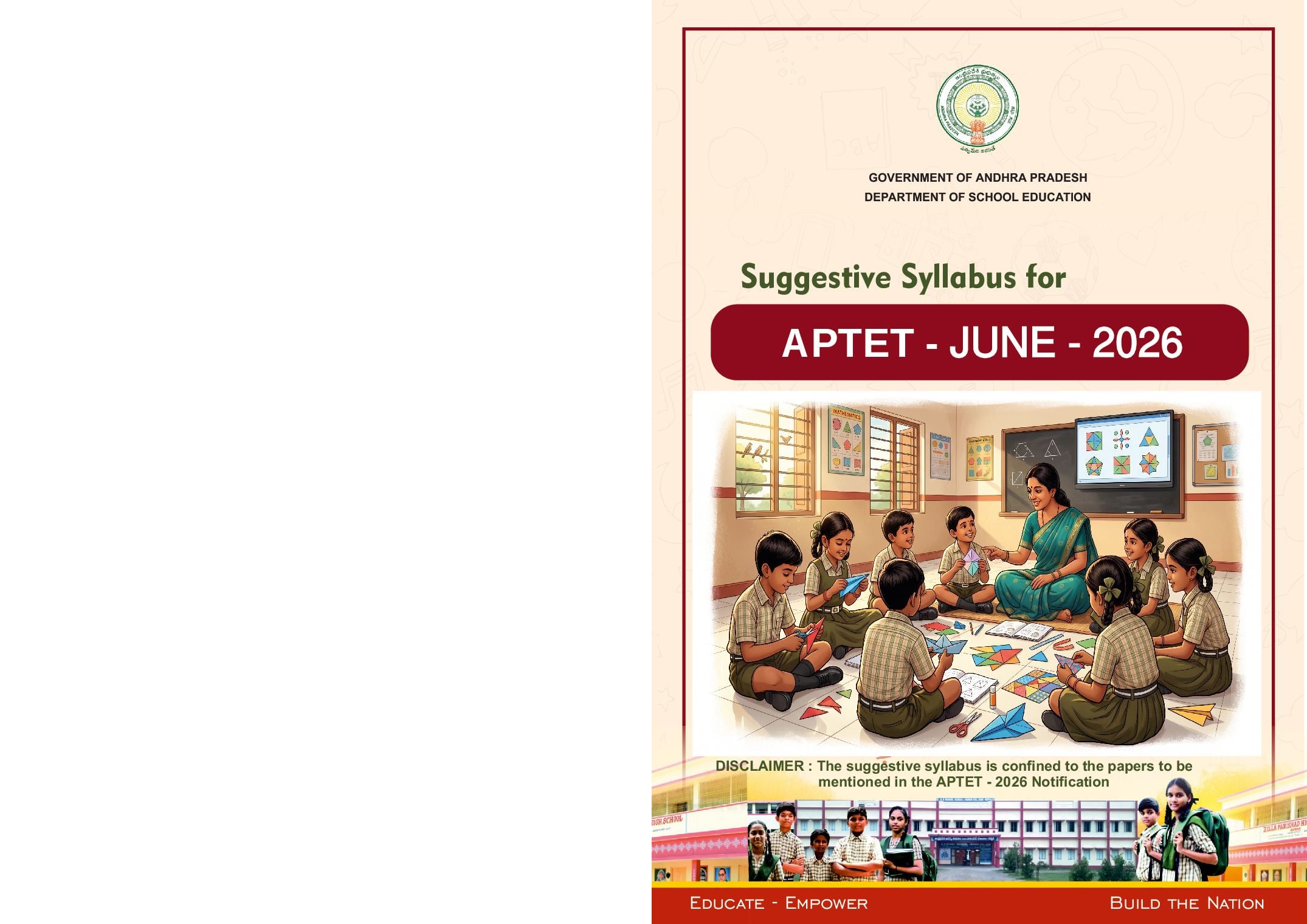
“We want that education by DEPARTMENT OF SCHOOL EDUCATION
which character is formed,
strength of mind is increased, Suggestive Syllabus for
the intellect is expanded,
and by which one can stand APTET - JUNE - 2026
on one’s own feet.”
- Swami Vivekananda
STATE COUNCIL OF EDUCATIONAL RESEARCH AND TRAINING (S.C.E.R.T)
DISCLAIMER : The suggestive syllabus is conned to the papers to be
mentioned in the APTET - 2026 Notication
empower
Nation
Educate - Empower Build the Nation Educate - Empower Build the Nation
Page 2
fundamental for “Education breeds
achieving full human confidence.
potential, developing Confidence breeds
an equitable hope.
Hope breeds
and just society,
peace.”
and promoting
national development. - CONFUCIUS
- NEP2020
Page 3
I. CHILD DEVELOPMENT AND PEDAGOGY (30 MARKS)....................................................3
B.1 LANGUAGE - I TELUGU (30 MARKS)..................................................................................7
B.2 LANGUAGE - I URDU (30 MARKS).....................................................................................8
B.3 LANGUAGE - I HINDI (30 MARKS).....................................................................................9
B.4 LANGUAGE - I KANNADA (30 MARKS)................................................................................10
B.5 LANGUAGE - I TAMIL (30 MARKS)...................................................................................11
B.6 LANGUAGE - I ODIA (30 MARKS).....................................................................................12
C. LANGUAGE – II ENGLISH (30 MARKS)................................................................................13
D. MATHEMATICS (30 MARKS)..................................................................................................15
E. ENVIRONMENTAL STUDIES(30 MARKS)................................................................................17
PAPER – I(B)...............................................................................................................................23
I. CHILD DEVELOPMENT AND PEDAGOGY (SPECIAL EDUCATION) (30 MARKS).......23
B.1 LANGUAGE - I TELUGU (30 MARKS)................................................................................25
B.2 LANGUAGE - I URDU (30 MARKS)....................................................................................26
B.3 LANGUAGE - I HINDI (30 MARKS)....................................................................................27
B.4 LANGUAGE - I KANNADA (30 MARKS)..................................................................................28
B.5 LANGUAGE - I TAMIL (30 MARKS)...................................................................................29
B.6 LANGUAGE - I ODIA (30 MARKS).....................................................................................30
C. LANGUAGE – II ENGLISH (30 MARKS)................................................................................31
D. MATHEMATICS (30 MARKS).................................................................................................33
E. ENVIRONMENTAL STUDIES (30 MARKS)................................................................................35
PAPER – II(A)..............................................................................................................................41
I. CHILD DEVELOPMENT AND PEDAGOGY (30 MARKS)......................................................41
B.1 LANGUAGE - I TELUGU (30 MARKS)................................................................................45
B.2 LANGUAGE - I URDU (30 MARKS) ...................................................................................46
B.3 LANGUAGE - I HINDI (30 MARKS)....................................................................................47
B.4 LANGUAGE - I KANNADA (30 MARKS)................................................................................48
1
Page 4
B.6 LANGUAGE - I ODIA (30 MARKS)......................................................................................50
B.7 LANGUAGE - I SANSKRIT (30 MARKS)................................................................................51
C. LANGUAGE – II ENGLISH (30 MARKS)................................................................................52
D.1 MATHEMATICS AND SCIENCE (60 MARKS).........................................................................55
D.1.1 MATHEMATICS (20 MARKS)..............................................................................................55
D.1.2 PHYSICAL SCIENCE (20MARKS).....................................................................................58
D.1.3 BIOLOGICAL SCIENCE (20MARKS)................................................................................63
D.2. SOCIAL STUDIES (60 MARKS)...........................................................................................65
D.3 TELUGU (60 MARKS).............................................................................................................68
D.3 ENGLISH (60 MARKS)............................................................................................................69
D.3 URDU (60 MARKS)..................................................................................................................72
D.3 HINDI (60 MARKS)..................................................................................................................73
D.3 KANNADA (60 MARKS).........................................................................................................75
D.3 TAMIL (60 MARKS)..................................................................................................................76
D.3 ODIA (60 MARKS)....................................................................................................................77
D.3 SANSKRIT (60 MARKS)..........................................................................................................78
PAPER – II(B)..............................................................................................................................79
I. CHILD DEVELOPMENT AND PEDAGOGY (SPECIAL EDUCATION) (30 MARKS)........79
B.1 LANGUAGE - I TELUGU (30 MARKS).................................................................................81
B.2 LANGUAGE - I URDU (30 MARKS)....................................................................................82
B.3 LANGUAGE - I HINDI (30 MARKS)....................................................................................83
B.4 LANGUAGE - I KANNADA (30 MARKS)................................................................................84
B.5 LANGUAGE - I TAMIL (30 MARKS)....................................................................................85
B.6 LANGUAGE - I ODIA (30 MARKS)......................................................................................86
B.7 LANGUAGE - I SANSKRIT (30 MARKS)................................................................................87
C. LANGUAGE – II ENGLISH (30 MARKS)................................................................................88
D. CATEGORY OF DISABILITY SPECIALIZATION AND PEDAGOGY (60 MARKS)...............89
2
Page 5
PAPER – I (A)
Structure and Content (All Compulsory)
A Child Development and Pedagogy, ICT Integration 30 MCQs 30Marks
B Language I (Telugu/Urdu/Hindi/Kannada/Tamil/ Odia) 30 MCQs 30Marks
C Language II (Compulsory Language - English) 30 MCQs 30Marks
D Mathematics 30 MCQs 30Marks
E Environmental Studies 30 MCQs 30Marks
Total 150 MCQs 150 Marks
I) CHILD DEVELOPMENT AND PEDAGOGY (30 Marks)
1. Understanding a Child:
A. Constructs of childhood
l Concept of childhood and its importance.
l Commonalities and diversities within the notion of childhood
l Multiple Childhoods in Indian & Global Context
l Role of Family, School in Socialization
l Parenting, Family and adult-child relationships
l Child rearing practices.
B. Methods and techniques of data collection:
Observation, Interviews, Reflective Journals, Anecdotal records and Narratives,
Introspection, Experimental method, Questionnaire, Case Study, Rating Scales, Longitudinal
and Cross-Cultural Approaches, Action Research in education
C. Perspectives in Development:
l Concept of Growth, Development and Maturation
l Principles of development
l Factors influencing development
l Developmental milestones & Hazards
l Branches of Psychology
l Physical – Motor Development
l Growth and maturation
l School culture, relationships with teachers
l Teacher expectations and School achievement
l Being out of school, Over-age learner
3
Page 6
l Concept and processes of socialization
l Role of family, peers, school, mass media and culture
l Role of competition, Cooperation, Discipline, Reward and Punishment Conflict, Aggression
and Bullying in Social Development
2. Emotional Development:
l Basic understanding of emotions, Types and their development
l Emotional maturity, Emotional quotient, and management of emotions
l Role of family and school in Emotional Development
3. Language development:
l Development of speech and language
l Perspectives in Language Development – Skinner, Bandura and Chomsky
4. Moral Development:
l Perspectives on various theories of moral development
l Cultural variations in moral reasoning
5. Play and development:
l Meaning of play and its functions
l Types and kinds of play
l Games and group dynamics: Rules of games and how children learn to negotiate differences
and resolve conflict
6. A sense of self:
l Self-Description, Self-Recognition, Self-Concept, Self-Esteem, Social Comparison,
Internalization And Self-Control
D. Cognition and Cognitive Development
l Cognition meaning, Stage wise cognitive development
l Developmental factors of Cognition: Perception, Thinking, Attention, Imagination, Problem
solving, Reasoning, Meta-cognition, Creativity
l Individual differences: Intelligence, Nature and theories of intelligence – Single Factor
Theory, Two Factor Theory, Multifactor Theory, Group Factor Theory, Guildford Model of
Intellect, Multiple Intelligences, IQ, Intelligence tests
l Perspectives on Cognitive Development – Piaget and Vygotsky
l Concept formation: Meaning of Concept, Concept formation – Bruner, Piaget
l Processes of Learning Content: Learning Processes among children – How do children
learn?
l Behaviourism – Fundamental concepts and Applications
l Thought and discrimination: The relation between thought process and learning, Cognition
– Learning, Cognition Development, Structuralism – Class room applications
l Building on children’s existing ideas, Making connections, Making of a meaning,
Relationship of concepts, Big ideas, Using graphic organizers and concept maps
4
Page 7
E. Personality
l Meaning, Definition, Characteristics and Elements of Personality
l Factors influencing personality, Physical and Socio-cultural factors
l Theories of Personality
l Assessment of Personality – Projective and non-projective techniques
l Mental Health, Adjustment, Defence mechanisms, Conflicts, Frustration Stress, Anxiety,
Maladjustment, Guidance and counselling
2. Understanding Learning
l Learning- Meaning, Nature , Types of learning, Learning Curves
l Contexts of learning: Home, School, and Environment
l Factors influencing learning: Maturation, Emotions, Learning environment, Motivation,
Interests, Aptitude, and Attitude
l Theories of learning: Trial and Error, Classical conditioning, Operant conditioning, learning
by Insight, Social Learning Theory, Bruner’s Theory of Instruction, Constructivism – Piaget,
Vygotsky, Reciprocal Teaching, Collaborative Learning, Construction of knowledge-5E
Method, Role of Language & a Teacher its Classroom applications
l Transfer of learning: Meaning, Types and Theories of Learning, Transfer of Learning,
Memory and Forgetting.
l Children with Special Needs: Learning disabilities, Importance of early intervention, IEP,
Differentiated learning
l Creating inclusive learner friendly environment: Inclusive Education, Importance, Need
for multiple resources, Ways and means of adapting to diverse needs, Flexible planning,
Classroom management, Inclusive schools
3 Pedagogy :
A. Pedagogy – Conceptions and Perspectives
l Learner, Knowledge, Learning - Types of Learning - Concept & Nature, Child’s abilities
before coming to school and its implications. Concept of Curriculum and its Components,
Schooling: Inter-linkages and relationships
l Critical examination of terminologies and notions associated with child centred education
such as Activity-based learning, Joyful learning etc.
l Critical understanding of various methods and approaches of teaching learning, Facilitating
learning, Teacher as reflective practitioner, Collaborative and Cooperative learning
B. Pedagogy - Resources and Practices
l Critical Pedagogy - Concept, Necessity, and Applications in Teaching-Learning process
l Reflections on school of thought and theories: Gijubhai , A.S. Neill - Summer hill School,
Totto-chan - Tomoe School, Makarenko, John Holt, Paulo Freire, Jean Piaget, Bruner,
Vygotsky and other Educationalists
l Inclusive and Special Practices
5
Page 8
l Range of physical resources and objects: Digital resources; Films and media etc.
l Connecting Children’s Pre-school Knowledge with School Subjects
l Classroom organization and management: Changing pedagogies and Classroom
management
l Assessment, Evaluation-types, Tools of assessment, CCE
l Analysis and interpretation of learner’s data using various statistical measures and graphs
for assessment and evaluation
l Latest educational policies and Acts of government ( State, Nation) such as Child Right
Act, RTI Act, RTE Act, NCF 2005, APSCF 2011, NEP 2020, National Curriculum
Framework for School Education NCFSE-2023 etc.
II. ICT (Information & Communication Technology)
A. ICT Fundamentals
l Core Concepts: Understanding ICT, computer hardware, software, input, output devices,
the internet, and netiquette. etc.
l Content Creation: Content development in various formats (text, documents, presentations,
spreadsheets etc.) and explore Open Educational Resources (OERs).
l ICT Policies & Learning
Policies: Key features of National and State-level ICT policies
Learning Processes: Utilize ICT to create effective learning environments and support
pedagogical practices, including educational games, puzzles, Quizzes, etc.
B. ICT Resources & Integration
Resource Exploration: Explore various hardware (CD/DVD, Projectors, Interactive boards)
and software (audio, video, multimedia, editing) in a computer lab setting.
Web & Media: Usage of web applications, the Internet, Animations, and Simulations etc.
l Evaluation & Adoption: Evaluate and adopt suitable ICT resources for educational purposes
l Pedagogical Integration: Content analysis and methods to map them with appropriate
ICTs, alternatives, and organization of classrooms for integrated lessons
l Assessment & Professional Development: Integrate ICT into assessment methods and
tools and professional development
l Cyber security & Tools: Cyber law, Security, Freeware, Snippets, and Multimedia utilities.
l Social Media: Importance of social media in learning
l Teacher Development: Usage of online courses and connected groups like subject forums
for Continuous Professional Development
l Educational Software: Educational software like Canva, Tutor, Moodle etc.
l Open Platforms: Utilization of Open Educational Resources and different ICT platforms
like MOOCs, DIKSHA etc.
6
Page 9
ø£+f…+{Ÿ (24 e÷s¡Tÿ\T)
1. |üsƒ¡Hêe>±Vü≤q
m) n|ü]∫‘· |ü<ä´+ _) n|ü]∫‘· >∑<ä´+
2. ‘Ó\T>∑T yê#·ø±\˝Àì
m) ø£$ |ü]#·j·÷\T _) $X‚cÕ+XÊ\T dæ) ñ<˚›XÊ\T, Ç‹eè‘êÔ\T &ç) Á|üÁøÏj·T\T
3. |ü<äC≤\+
m) nsêú\T _)|üsê´j·T|ü<ë\T dæ) Á|üø£è‹ ` $ø£è‘·T\T &ç) HêHêsêú\T
Ç) C≤rj·÷\T m|òt) kÕyÓT‘·\T õ) bı&ÉT|ü⁄ ø£<∏ä\T ôV≤#Y) e⁄´‘·Ôs¡Ô´sêú\T
◊) e÷+&É*ø£ |ü<ë\T
4.uÛ≤cÕ+XÊ\T
m) uÛ≤cÕuÛ≤>±\T _) ø±˝≤\T dæ) *+>±\T &ç) |ü⁄s¡Twü\T
m|òt) $sêeT ∫Vü‰ï\T õ) ÁøÏj·T\T ` s¡ø±\T ôV≤#Y) e#·Hê\T ◊) yê´ø£s¡D bÕ]uÛ≤wæø£ |ü<ë\T
C…) nø£ås¡ $uÛ≤>∑+ : n#·TÃ\T, Vü≤\T¢\T, ñuÛÑj·÷ø£åsê\T, ~«‘·«, dü+j·TTø±Ôø£åsê\T, |üs¡TcÕ\T düs¡fi≤\T,
nqTHêdæø±\T, }wüàeTT\T, n+‘·kÕú\T, es¡Zj·TT≈£îÿ\T, düŒsêÙ\T, dæúsê\T
¬ø) es√í‘·Œ‹Ô kÕúHê\T
m˝Ÿ) dü+<ÛäT\T ` ìs¡«#·Hê\T
‘Ó\T>∑T dü+<ÛäT\T ` n‘·«, Ç‘·«, ñ‘·«, j·T&Ü>∑eT, düs¡fi≤<˚$, >∑dü&É<äyê<˚X¯, ÄÁy˚T&ç‘·, ~«s¡Tø£Ô≥ø±s¡, \T, \,
q, \ dü+<ÛäT\T
dü+düÿè‘· dü+<ÛäT\T ` dües¡íBs¡È, >∑TD, j·TD≤<˚X¯, eè~∆dü+<äT\T
dü+<ÛäT\≈£î dü+ã+~Û+∫q |ü<ë\qT $&ÉBj·T&É+ dü+~Û #˚j·T&É+.
myéT) düe÷kÕ\T ` ìs¡«#·Hê\T
$Á>∑Vü≤yêø±´\qT >∑T]Ô+#·&É+, $Á>∑Vü≤yêø±´\qT düe÷dü |ü<ë\T>± ≈£Ls¡Ã&É+
mHé) #Û·+<ädüT‡ ` >∑Ts¡T \|òüTTe⁄\ \ø£åD≤\qT >∑T]Ô+#·&É+ ñ‘·‡\e÷\, #·+|üø£e÷\
ˇ) n\+ø±sê\T ` bÕsƒ¡´|ü⁄düÔø£eTTq+<ä* n\+ø±sê\T >∑T]Ô+#·&É+
|æ) yêø±´\T ` s¡ø±\T (ø£s¡Ô], ø£s¡àDÏ, Ä<ÛäTìø£ e#·q+, kÕe÷q´, dü+j·TTø£Ô, dü+•¢wüº yêø±´\T, $X‚<Ûës¡úø£
nqTeT‘·´s¡úø£, yÓTTˆˆ$)
‘Ó\T>∑T uÀ<ÛäHê |ü<ä∆‘·T\T (6 e÷s¡Tÿ\T)
m) uÛ≤wü ` e÷‘·èuÛ≤wü, #·]Á‘·, dü«uÛ≤e+, |ü]~Û
_) uÛ≤cÕ HÓ’|ü⁄D≤´\T ` e÷‘·èuÛ≤cÕ uÀ<ÛäHê \øå±´\T ` kÕ~Û+#ê*‡q kÕeTsêú´\T
dæ) uÀ<ÛäHê |ü<ä∆‘·T\T
&ç) Á|üD≤[ø± s¡#·q ` eqs¡T\ $ìjÓ÷>∑+
Ç) uÀ<ÛäHêuÛÑ´düq ñ|üø£s¡D≤\T
m|òt) eT÷˝≤´+ø£q+ ` ìs¡+‘·s¡ düeTÁ>∑ eT÷˝≤´+ø£q+ (ìsêàD≤‘·àø£, dü+Á>∑Vü≤D≤‘·àø£) <ä‘êÔ+X¯ $X‚¢wüD`|ü]|ü⁄wæº
7
Page 10
Page 11
Page 12
Page 13
Page 14
Page 15
Content 24M
TOPIC S.No. DETAILS OF THE TOPIC STRATA OF TESTING
1 Synonyms Recognition
2 Antonyms Recognition
3 Homophones Recognition
4 Homonyms Recognition
5 Idioms and Phrases Identification of meanings
6 Phrasal Verbs Identification of meanings
7 Spellings Identification of wrongly spelt
words, Differentiate between British
and American spellings
8 Word formation Suffixation, Prefixation,
Unscrambling letters, Conversion of
Verb-Noun, vice versa; Noun -
1 Vocabulary
Adjectives, vice versa,
Compound words
9 Singular- Plural Words Identification
10 One word Substitutes Identification of meanings
11 Collocations Identification of meanings
12 Ordinal numbers Understanding of position
13 Anagrams Identification
14 Figures of Speech Identification
1 Parts of Speech All types, their functions and usage
2 Articles All types, their functions and usage
3 Tenses All types, structure, forms and usage
4 Voice Active Voice to Passive Voice
conversion
5 Reported Speech/Direct For all types of sentences
Speech & Indirect Speech
6 Types of Sentences Assertive, Interrogative, Imperative
& Exclamatory
7 Degrees of Comparison Positive, Comparative, Superlative,
degrees of adjectives,
their identification and conversions
2. Grammar 8 Linkers Identification of functions, usages,
position, cohesion with appropriate
linkers
9 Language Functions Recognizing real life
communicative purposes
10 Agreement of subject with verb Right form of verbs
11 Clause If clause -Type 1,Type II, Main
Clause- Sub ordinate Clause,
Subject- Predicate, Noun Clause,
Adverbial Clause, Participle Clause,
Relative Clause, Finite, Non -finite
Clause
13
Page 16
Modal Auxiliaries Negatives
13 Framing Wh-Questions Identification of right Wh-word,
Syntax, Agreement of tense with
subject
14 Order of Adjectives Knowledge of standard order,
Correct placement, Contextual
appropriatness
15 Transitive -Intransitive Verbs Recognition
1 Puntuation and Capitalisation Usage of Capital letters, Full stop,
Comma, Question mark,
Exclamation mark, Inverted
3. Conventions
commas, Apostrophe, etc.
of Writing
1 Letter Writing Types, Format, Puntuation marks,
Features
2 Diary Entry Format, Features
3 e- mail Format, Features, Communication
4 Paragraph writing Format, Features
5 Dialogue writing Format, Features
4 Discourses 6 Notice /Invitation Format
7 Biographical Sketch Format, Features
8 Speech Format, Types of Speeches
1 Alphbetical order Recognition of letter sequences, word
sequences
5 Dictionary Skills 2 Dictionary Entry Efficiency in the usage of Dictionary
1 Prose Textual / General
6 Reading 2 Poetry Textual /General
Comprehension
Methodology (6 Marks)
METHODOLOGY STRATE OF TESTING
1. Aspects of language- English language history, nature, Detailed and deep understanding
importance, principles of English as second language with application in broader sense.
and- Problems of teaching / learning English
2. Objectives of teaching English
3. Development of language skills- Listening,
Speaking, Reading and Writing (LSRW)-
Communicative skills and imparting values through
communication.
4. Approaches, methods and techniques of teaching
English (Introduction, definition, types of approaches,
methods and techniques of teaching including
remedial teaching.
5. Teaching of structures, vocabulary and grammar.
6. Teaching learning materials in English
7. Lesson planning
8. Curriculum and textbooks – importance and need.
9. Evaluation in English language
14
Page 17
Content (24 Marks)
1. NUMBERS
Numbers - Four fundamental operations (Addition, Subtraction, Multiplication, Division)
- Knowing about Numbers - Hindu-Arabic system of numeration (Indian system of
numeration) - International system of numeration (British system of numeration) - Place
value and Face values of a digit in a number - Comparing and Ordering of Numbers -
Whole Numbers - Factors and Multiples - Prime and Composite numbers - Even and Odd
numbers - Tests for Divisibility of Numbers - Common Factors and Common Multiples -
Prime factorization - Highest Common Factor (G.C.D) - Lowest Common Multiple - Integers
- properties and fundamental operations - Fractions and decimals - Types of fractions -
comparison - Applications of fractions in daily life - four fundamental operations on fractions
and decimals - Rational Numbers - Properties of Rational Numbers - Rational Numbers
between two rational numbers - Four fundamental Operations on Rational Numbers - Product
of reciprocals - Squares - Square roots (Numbers and Decimals) - Properties of Square
Numbers - Cubes - Cube roots of Numbers - Playing with Numbers – Shifting Digits
2. ARITHMETIC
BODMAS rule - Ratios and Proportions (Direct, Inverse) - comparing quantities using
ratios, proportion, percentage and their applications - Profit and Loss - Discount - Sales
Tax/Value Added Tax/Goods and Services Tax - Simple, Compound Interest and their
applications.
3. GEOMETRY
Basic geometrical concepts (Point, Line, Line segment, Ray, Curves, Polygons, Angles) -
Measuring of Lines - Pairs of Lines - Elements of Angles - Measuring of Angles - Types of
Angles - Naming of the given 2D figures of Triangles, Square and Rectangle - The Triangle
- Types of Triangles and its Properties - Classification of Polygons - Angle sum property -
Kinds of Quadrilaterals (Trapezium, Kite, Parallelogram) - Some special parallelograms
(Rhombus, Rectangle, Square) - Constructing different types of Quadrilaterals - Views of
3D-Shapes - Identification of Edges, Vertices and Faces of 3D figures (Euler’s Rule) - Nets
for building 3D shapes.
4. DATA HANDLING
Reading and interpreting and analysing the Data (pictograph, tally marks, bar graphs, double
15
Page 18
Probability.
5. ALGEBRA
Patterns - making rules - The idea of variables - formation of algebraic expressions -Terms,
Factors and Coefficients - Linear equations in one variable - terms and types of algebraic
expressions - finding the value of an expression - Addition, Subtraction and Multiplication
of Algebraic Expressions - Multiplying a Monomial by a Monomial and polynomial -
Multiplying a Polynomial by a Polynomial - Standard Identities and their applications -
Applications of simple equations to practical situations - Exponents and Powers - Negative
exponents - Laws of exponents - Expressing large numbers in the standard form -
Factorisation - Division of Algebraic Expressions Continued (Polynomial ÷ Polynomial) -
Linear Graphs.
6. MENSURATION
Measuring Length, Weight, Capacity, Time-Seasons, Calendar, Money, Area - Symmetry
(Line and Rotational) - Perimeter of Triangle, Square, Rectangle, Rhombus, Trapezium,
Parallelogram, Circle and Polygon), Area of a Quadrilateral, Surface Area and Volume of
Cube, Cuboid and Cylinder – Volume.
Methodology (6 Marks)
l Histroy, Nature and Definitions of Mathematics
l Aims, values and instructional objectives of teaching Mathematics
l Methods of Teaching & Remedial measures in Mathematics
l Instructional Material, TLM and Resource Utilization in Mathematics
l Curriculum, Text Book & Instructional Planning.
l Assessment - Evaluation and Continuous Comprehensive Evaluation, Assessment analysis
- feedback
16
Page 19
Content (12 Marks)
E (i) SCIENCE
1. LIVING WORLD
Living and non-living things - Characteristics of living organisms
Plants -Types of plants- Herb, shrub, Tree, basing on habitat – Terrestrial, Aquatic, Desert
etc, plant parts -functions
Animals – Animals around us – Oviparous, viviparous; herbivore, carnivore, omnivore;
shelters of different animals, Birds – beaks, Domestic animals, Wild animals, Types of
animals basing on habitat, herbivore, carnivore, omnivore, Animals sounds, Movements in
animals, Different types of habitat and adaptation, Homes of animals, Nests of birds.
Human beings - Body parts, Healthy body – good habits, Sense organs and their care, concern
for differently abled persons, Good touch and Bad touch, Skeletal parts – Bones, Joints,
Cartilage; muscles, Safety measures – at home, school safety, Road safety, water hazards,
First- aid.
Food - Food, Need of food, Sources of food – plants, animals, Types of food, Cooked and
raw foods, Utensils, Mid-day meal, Methods of preparing food, Food wastage, Preservation
of food, Good food habits, Our food, Components of food, Balanced diet, Junk food,
Deficiency diseases
Agricultural Practices, Tools used in agriculture, Methods of agriculture, Storage of food,
Food from Animals, Food for birds and animals.
Family - Role of family members, Family Tree, Types of family, Changing family structure,
Family Budget, Shelter for all, Different types of houses, Home appliances, Migration –
Reasons, Effects, Slums, Homeless people.
Cell – The basic unit of life, Types of cells, Cell structure and function.
Microorganisms - Introduction to microorganisms – types, Useful Microorganisms, Harmful
microorganism.
Games and recreation- indoor, outdoor, local games, uses, materials used and the rules.
2. LIFE PROCESSES
Nutrition - Nutrition in plants – Autotrophic, Parasitic, saprophytic, Insectivorous, Different
ways of taking food, Digestion in humans, Digestion in grass eating animals, feeding and
digestion in amoeba.
Respiration - Types of respiration, Respiration in animals, Respiration in plants, Circulation
- Circulatory system in human being -Transport of substances in plants. Excretion in animals,
Coordination- Nervous system,
Reproduction - Modes of reproduction – sexual, asexual and vegetative, Seed dispersal,
Sexual and Asexual Reproduction in Animals, Adolescence and puberty – changes, role of
hormones, Reproductive phase, Sex determination, Hormones other than sex hormones,
Metamorphosis, Reproductive health
3. NATURAL PHENOMENA OBJECTS AND MATERIALS
Objects around us – Properties of materials - classification of materials, Properties and uses
17
Page 20
unsaturated solutions. Acids, bases and salts, indicators, Neutralization, Physical and chemical
changes, Rusting of Iron, Galvanization, Crystallization,
MEASUREMENT OF DISTANCES – MOTION
Measurement of distances, Standard units and non-standard units of measurements, Motion
and rest, Types of motion, Motion and time – speed, average speed, Uniform and non-uniform
motions, Measurement of time, Time period, Units of time and speed, Measuring speed,
Distance-time graph,
LIGHT
Light, shadows, and reflections, Transparent, opaque and translucent objects, pin hole camera,
mirrors and reflection, Regular and Diffused Reflection, multiple images, kaleidoscope,
periscope, Characteristics of images formed by mirrors, Spherical mirrors and images, Lenses
and images, Sunlight – dispersion, Human Eye, Care of the Eyes, Braille System, Visually
Impaired Persons
ELECTRICITY
Simple electric circuit and its components, Symbols of electric components, Electric
conductors and insulators, Heating effects of electric current, CFL, LED, Fuse and MCB,
Magnetic effects of electric current, Electromagnet, Electric bell, Chemical Effects Of Electric
Current, Good/Poor Conducting Liquids, Electroplating.
MAGNETISM
Magnets – Discovery of magnets, Magnetic and non magnetic substances, Types of magnets,
Properties of magnets, Magnetic compass, Storing of magnets.
HEAT
Heat – temperature, measuring temperature, Units of temperature, Types of Thermometers,
Transfer of heat – conduction, convection, radiation.
FORCE, FRICTION AND PRESSURE
Force – push or pull, Exploring forces, net force, Effect of force on objects, Contact and non
contact forces, Pressure, Fluid pressure, Atmospheric pressure, Friction, Factors effecting
friction, Friction: A necessary evil, Increasing and reducing friction, Types of friction.
COMBUSTION AND FUELS
Exhaustible and inexhaustible resources, Fuels – Types, Coal, Uses of Coal and Coal products,
Refining of petroleum, Petrochemical products in various sectors, Various Constituents of
Petroleum and their Uses, Formation of coal and petroleum, Natural Gas, Misuse of Energy
resources and Consequences. Combustion, Types of Combustion, Ignition temperature,
Inflammable substances, Flame, Fuel Efficiency, Burning of Fuels Leads to Harmful Products,
Fire control, Structure of flame – colour zones – Intensities.
SOUND
Sound - a form of energy, Production of sound, Some musical instruments, Propagation of
sound, Human ear, Hearing Impairment, Noise and Music, Types of waves (longitudinal and
transverse), Characteristics of sound waves (Wavelength, Frequency, Time period, Speed of
the wave), Pitch, Loudness and Quality, Audible and Inaudible sounds, Noise pollution.
SOME NATURAL PHENOMENA
The Story of Lightning, Charging by Rubbing, Electric charge and properties of electric charge,
Types of charges and their interactions, Transfer of charge, lightning, lightning safety, lightning
conductors, Earthquake, Tsunami, Causes and effects, Protective measures.
4. TRANSPORTATION AND COMMUNICATION
Transportation - Story of transport – Objects- signs and signboards used for transport- Places
associated with transport- Modes of travel in the present and in the past- Methods of transport in
18
Page 21
Rivers & Canals)- Need for an international transport -Import and export of the goods- different
means of transport of goods- Importance of tourism and seven wonders of the world.
Communication - Means and objects of Communication- Types of Communication both in Human
and Animals (different feelings and gestures) Modern forms of communication-
Communication used in the past and present- Advantage of Mass Communication-
Communication through Postcard, Cell Phone, E-Mail, News Paper, Radio, TV, and Social
Media etc., How communication and transport brings the entire world together.
5. PROFESSIONS AND SERVICES
House hold materials with reference to profession (farmer, cobbler, tailor etc)-Different
professions and their need to the society- villager/farmer (seeds/manure/ agri methods etc.,)
, helping agents ( bank, e- seva, PHC, panchayat office, post office/etc.,) Governance and
Services - Local Self Govt, State, Central Govt, Judiciary.
6. OUR ENVIRONMENT
Climate –Climate change, Weather-Climate-rain-floods-
Cyclones- disaster management,
Global environmental issues – Greenhouse effect, Global warming, Acid rains. Ecofriendly
activities, Say no to plastic.
Air - Presence of air, Components of air, Properties of air, Availability of oxygen to animals
and plants, Replacement of oxygen in the atmosphere, uses of air, Nitrogen cycle, Air pollution
-causes, effects and prevention.
Water - Forms of water, Use of water, source, scarcity, protected water, wastage of water,
Water resources, Tank pollution, safe drinking water, tank management, journey of rain drop
– Water cycle, water magic, water properties, Water resources, major rivers in AP, fisherman,
water transport, tragedy of rivers, drought and floods, water pollutions - Causes, effects and
prevention. Sewage, Treatment of polluted water, Better housekeeping practices, Sanitation
and Disease, Alternative arrangement for sewage disposal.
Biodiversity - Forests, Flora, fauna, interrelation of organisms, Green world, Advantages of
forests, Deforestation - effects, Chipko movement, Conservation of forest and wildlife –
Protecting areas, endangered and endemic species.
Methodology (3 Marks)
l Histroy, Nature and Definitions of Science
l Aims, values and instructional objectives of teaching Science
l Methods of Teaching & Remedial measures in Science
l Instructional Material, TLM and Resource Utilization in Science
l Curriculum, Text Book & Instructional Planning.
l Assessment - Evaluation and Continuous Comprehensive Evaluation, Assessment analysis
- feedback
19
Page 22
Content (12Marks)
1. OUR UNIVERSE
l The shape of the Earth, The Universe- Origin, solar System, Our Earth in the Solar System –
Celestial bodies, Constellations, Realms of the Earth- Latitudes and Longitudes -Movements
of Earth – Solar System- Globe-Model of Earth – Axis of Earth, Equinox – Eclipses.
l Maps – Directions, Scale, Symbols, Patterns, Types, where are We-Village, Mandal, District,
country maps.
l The Earth- Environment – Components, Interior of the Earth, Atmosphere, Biosphere, Pollution,
Disasters.
l Land Forms – Major Land Forms in AP, Podu cultivation, Diversity in Lifestyles.
l Forests-Climatic Regions - Types of Forests, Forests in AP, Uses- Deforestation, Conservation
of Forests.
l Land, Soil, Water, Natural Vegetation and Wildlife Resources.
2. PRODUCTION EXCHANGE AND LIVELIHOODS
l Resources – Types, Conservation, Mineral and Power Resources – Types of Minerals,
Distribution, Conservation Power Resources: Conventional, Non-Conventional.
l Human Resources- Distribution of Population, Density of Population, Population Change,
population composition.
l Agriculture – Types of farming, Major crops; industries- Classification and Distribution.
Manufacturing industries environmental degradation, control of environmental degradation.
Industrial pollution
l Public facilities, Water as a part of fundamental Right to Life- Govt. Role.
l Markets Around Us- Types of Markets- Consumer Protection.
l Transport system, International Transport, Exports and Imports, Global Village, Road ways,
My bicycle, Vehicles other than Transport, Transport in Hill areas, Forests, deserts, snowy
areas, rivers and canals, Road Safety, Traffic symbols, Road safety measures, pedestrian safety,
safe cycling, safety travelling. Lifelines of national economy. Major sea ports-international
trade, tourism as a trade.
l Development
l Money and credit
l Globalization and Indian economy
l Consumer rights.
3. POLITICAL SYSTEMS AND GOVERNANCE
l Early Life to Settled life- Early people, Nomadic life, Belum caves, Rock paintings, Growing
20
Page 23
Mahajanapadas, Magadha, Vaggi Kingdoms and Empires- Mauryan, Guptas, Satavahanas,
Pallava, Chalukya Dynasties.
l Delhi Sultanate, Kakatiyas, Vijayanagara Empire, Mughals, Contemporary Kingdoms.
l Governments – Types, Monarchy, Democracy, Different levels, Local and Self Government,
State and Central Governments; Parliament and the making of laws. The role of the Parliament,
Who are the people in the parliament?; State Government – Legislature, Executive, Judiciary-
Role, Independent Judiciary, Structure of Courts in India, Different Branches of the legal
system- Law and Social Justice – Bhopal gas Tragedy, Enforcement of Safety Laws, New
laws to protect the Environment.
l The Indian Constitution, key features – Fundamental Rights – Fundamental Duties;
Understanding Secularism, Understanding Laws.
l - Civilizing the “Native” Educating the nation- How the British saw Education? – What
happened to the local schools?- the agenda for a National Education, How Important are
Dates, How do we periodise, What is Colonial?,- From Trade to Territory-The Company
establishes Power, East India Company, Battle of Plassey, Tippu Sultan, The Doctrine of Lapse,
Setting up a new administration – Ruling the countryside – Diwani system, Munro system,
Demand for Indian Indigo, The Blue Rebellion and after – Tribals, Dikus and the vision of
Golden age-How did Tribal groups live?, How did colonial rule effect Tribal lives?, Forest
Laws and their impact- Birsa Munda.
l Indian Freedom struggle, When people Rebel 1857 and after- Policies and the people, Through
the Eyes of the people, A Mutiny becomes a popular Rebellion, the company fights back,
The making of the National Movement: 1870’s to 1947- The emergence of nationalism, The
growth of mass nationalism, The March to Dandi, Quit India and later.
l The rise of nationalism in Europe. The French revolution and the making of Germany and
Italy.
l The making of global world – The pre modern world, silk routs link the world, The 19th
century (1815 to 1914) A world economy take shapes. Role of technology later 19th century
colonialism, The cattle plague. The interior war economy. The grate depression and India and
the grate depression. Rebuilding a world economy.
l The age of industrialization – Before the industrial revolution, The pace of industrial change,
The age of Indian textiles etc.
l The print culture and modern world.
4. SOCIAL ORGANISATION AND INEQUITIES
l Towards Equality- Diversity, Discrimination, prejudice, stereo type, Types of Discrimination
– Inequality, Steps towards equality – Constitutional provisions, Remedial measures for
abolishing inequality, Will Discrimination and inequalities stop people from achieving their
goal.
21
Page 24
Reforms- Working towards change: Changing the lives of Widows, Girls begin going to School,
Women write about women, Caste and social reform: Gulamgiri who could enter, The Non
Brahman Movement.
l Understanding Marginalization – Adivasis and Development, Minorities and Marginalization-
Confronting Marginalization- Invoking Fundamental Rights-Laws for the Marginalized,
Protecting the rights of the Dalits and Adivasis, Adivasis Demands and the 1989 Act.
l Power sharing – Belgium and Srilanka majoritarianism in Srilanka, accomidation in Belgium,
Forms of power sharing etc.
l Federalism
l Political parties
l Outcomes of democracy
5. RELIGION AND SOCIETY
l Religions – Hinduism, Jainism, Buddhism, Islam and Sikhism, Unity in Diversity; Bhakthi
and Sufi Movements
l Gender, religion and caste
6. CULTURE AND COMMUNICATION
l Together with everyone – communication, Postal services, mobiles, E-mail, Mass
communication, Newspaper, Radio, TV, Social Media.
l Let us Visit-Historical and Tourist places in AP; Early Civilizations- Indus Valley civilization,
vedic period, vedic literature; Indian Culture, Languages.
Methodology (3 Marks)
l Histroy, Nature and Definitions of Social
l Aims, values and instructional objectives of teaching Social
l Methods of Teaching & Remedial measures in Social
l Instructional Material, TLM and Resource Utilization in Social
l Curriculum, Text Book & Instructional Planning.
l Assessment - Evaluation and Continuous Comprehensive Evaluation, Assessment analysis
- feedback
22
Page 25
PAPER – I(B)
Structure and Content (All Compulsory)
A Child Development and Pedagogy, ICT (Special Education) 30 MCQs 30Marks
B Language I (Telugu/Urdu/Hindi/Kannada/Tamil/ Odia) 30 MCQs 30Marks
C Language II (English) 30 MCQs 30Marks
D Mathematics 30 MCQs 30Marks
E Environmental Studies 30 MCQs 30Marks
Total 150 MCQs 150 Marks
I. CHILD DEVELOPMENT AND PEDAGOGY (SPECIAL EDUCATION) (30 Marks)
1. CHILD DEVELOPMENT:
l Nature of Child development
l Principles and approaches of growth and development
l Theories of learning
l Methods of child study
l Individual differences
2. PEDAGOGY IN SPECIAL EDUCATION
l Characteristics and educational needs of Children with Special Needs
l Types and approaches to assessment of Children with Special Needs
l Statistical Analysis of Student Assessment data
l Curriculum Development and Curricular adaptations
l Concept of Individual Educational Plan and Individualized Family Services Plan
l Teaching strategies for Children with Special Needs
l Individualized Education Plan (IEP)
3. EDUCATION COMMISSIONS AND POLICIES (SCHOOL EDUCATION)
l Constitutional provisions on education that reflect National Ideals: Equality, liberty,
secularism, and social justice
l National Commissions and Policies: Education Commission (1964), NPE and POA (1986,
1992), National Policy for Persons with Disabilities (2006), NCF-2005, RTE-2010,
APSCF-2011, National Education Policy 2020, NCFPE-2022, NCFSE-2023
l National Acts: RCI Act, 1992, PWD Act, 1995, NT Act, 1999, RTE Act (2009 & 2012).
23
Page 26
l Programmes and Schemes: IEDC (1974, 1983), SSA (2000, 2011), RMSA, 2009, IEDSS,
2009
l International Conventions and Policies: Salamanca Declaration and Framework, 1994;
UNCRPD,2006; MDG, 2015; INCHEON strategies
l New trends and strategies in implementing inclusive education for CWSN
l 4. ICT (Information & Communication Technology)
A. ICT Fundamentals
l Core Concepts: Understanding ICT, computer hardware, software, input, output devices,
the internet, and netiquette. etc.
l Content Creation: Content development in various formats (text, documents, presentations,
spreadsheets etc.) and explore Open Educational Resources (OERs).
l ICT Policies & Learning
l Policies: Key features of National and State-level ICT policies
l Learning Processes: Utilize ICT to create effective learning environments and support
pedagogical practices, including educational games, puzzles, Quizzes, etc.
B. ICT Resources & Integration
l Resource Exploration: Explore various hardware (CD/DVD, Projectors, Interactive boards)
and software (audio, video, multimedia, editing) in a computer lab setting.
l Web & Media: Usage of web applications, the Internet, Animations, and Simulations etc.
l Evaluation & Adoption: Evaluate and adopt suitable ICT resources for educational
purposes.
l Pedagogical Integration: content analysis and methods to map them with appropriate ICTs,
alternatives, and organization of classrooms for integrated lessons.
C. Assessment & Professional Development
l Assessment: Integrate ICT into assessment methods and tools.
l Cyber security & Tools: Cyber law, Security, Freeware, Snippets, and Multimedia utilities.
l Social Media: Importance of social media in learning.
l Teacher Development: Usage of online courses and connected groups like subject forums
for Continuous Professional Development.
l Educational Software: Educational software like Canva, Tutor, and Moodle.
l Open Platforms: Utilization of Open Educational Resources and different ICT platforms
like MOOCs, DIKSHA etc.
24
Page 27
ø£+f…+{Ÿ (24 e÷s¡Tÿ\T)
1. |üsƒ¡Hêe>±Vü≤q
m) n|ü]∫‘· |ü<ä´+ _) n|ü]∫‘· >∑<ä´+
2. ‘Ó\T>∑T yê#·ø±\˝Àì
m) ø£$ |ü]#·j·÷\T _) $X‚cÕ+XÊ\T dæ)ñ<˚›XÊ\T, Ç‹eè‘êÔ\T &ç) Á|üÁøÏj·T\T
3. |ü<äC≤\+
m) nsêú\T _) |üsê´j·T|ü<ë\T dæ) Á|üø£è‹`$ø£è‘·T\T &ç) HêHêsêú\T
Ç) C≤rj·÷\T m|òt) kÕyÓT‘·\T õ) bı&ÉT|ü⁄ ø£<∏ä\T ôV≤#Y) e⁄´‘·Ôs¡Ô´sêú\T
◊) e÷+&É*ø£ |ü<ë\T
4. uÛ≤cÕ+XÊ\T
m) uÛ≤cÕuÛ≤>±\T _) ø±˝≤\T dæ) *+>±\T &ç) $uÛÑ≈£îÔ\T
Ç) |ü⁄s¡Twü\T m|òt) $sêeT ∫Vü‰ï\T ôV≤#Y) e#·Hê\T ◊) yê´ø£s¡D bÕ]uÛ≤wæø£ |ü<ë\T
C…) nø£ås¡ $uÛ≤>∑+ : n#·TÃ\T, Vü≤\T¢\T, ñuÛÑj·÷ø£åsê\T, ~«‘·«, dü+j·TTø±Ôø£åsê\T, |üs¡TcÕ\T düs¡fi≤\T,
nqTHêdæø±\T, }wüàeTT\T, n+‘·kÕú\T, es¡Zj·TT≈£îÿ\T, düŒsêÙ\T, dæúsê\T ¬ø) es√í‘·Œ‹Ô kÕúHê\T :
m˝Ÿ) dü+<ÛäT\T ` ìs¡«#·Hê\T
‘Ó\T>∑T dü+<ÛäT\T ` n‘·«, Ç‘·«, ñ‘·«, j·T&Ü>∑eT, düs¡fi≤<˚X¯, >∑dü&É<äyê<˚X¯, ÄÁy˚T&ç‘·, ~«s¡Tø£Ô≥ø±s¡, \T, \,
q, \ dü+<ÛäT\T, dü+düèÿ‘· dü+<ÛäT\T ` dües¡íBs¡È, >∑TD, j·TD≤<˚X¯, eè~∆dü+<äT\T
dü+<ÛäT\≈£î dü+ã+~Û+∫q |ü<ë\qT $&ÉBj·T&É+ dü+~Û #˚j·T&É+
myéT) düe÷kÕ\T ` ìs¡«#·Hê\T
$Á>∑Vü≤yêø±´\qT >∑T]Ô+#·&É+, $Á>∑Vü≤yêø±´\qT düe÷dü |ü<ë\T>± ≈£Ls¡Ã&É+
mHé) #Û·+<ädüT‡ ` >∑Ts¡T \|òüTTe⁄\ \ø£åD≤\qT >∑T]Ô+#·&É+, #·+|üø£e÷\ |ü<ä´ \ø£åD≤\T
ˇ) n\+ø±sê\T ` bÕsƒ¡´|ü⁄düÔø£eTTq+<ä* n\+ø±sê\T >∑T]Ô+#·&É+.
|æ) yêø±´\T ` s¡ø±\T, ÁøÏj·T\T ` s¡ø±\T
‘Ó\T>∑T uÀ<ÛäHê |ü<ä∆‘·T\T (6 e÷s¡Tÿ\T)
m) uÛ≤wü ` e÷‘·èuÛ≤wü, #·]Á‘·, dü«uÛ≤e+, |ü]~Û
_) uÛ≤cÕ HÓ’|ü⁄D≤´\T ` e÷‘·èuÛ≤cÕ uÀ<ÛäHê \øå±´\T ` kÕ~Û+#ê*‡q kÕeTsêú´\T
dæ) uÀ<ÛäHê |ü<ä∆‘·T\T
&ç) Á|üD≤[ø± s¡#·q ` eqs¡T\ $ìjÓ÷>∑+
Ç) uÀ<ÛäHêuÛÑ´düq ñ|üø£s¡D≤\T
m|òt) eT÷˝≤´+ø£q+ ` ìs¡+‘·s¡ düeTÁ>∑ eT÷˝≤´+ø£q+ (ìsêàD≤‘·àø£, dü+Á>∑Vü≤D≤‘·àø£) <ä‘êÔ+X¯ $X‚¢wüD`|ü]|ü⁄wæº
25
Page 28
Page 29
Page 30
Page 31
Page 32
Page 33
Content (24 Marks)
TOPIC S.No. DETAILS OF THE TOPIC STRATA OF TESTING
1 Synonyms Recognition
2 Antonyms Recognition
3 Homophones Recognition
4 Homonyms Recognition
5 Idioms and Phrases Identification of meanings
6 Phrasal Verbs Identification of meanings
7 Spellings Identification of wrongly
spelt words, Differenciate
between British and American
1 Vocabulary spellings
8 Word formation Suffixation, Prefixation,
Unscrambling letters
Conversion of Verb-Noun,
vice versa; Noun -
Adjectives, vice versa,
Compound words
9 Singular- Plural Words Identification
10 One word Substitutes Identification of meanings
11 Collocations Identification of meanings
12 Ordinal numbers Understanding of position
13 Anagrams Identification
14 Figures of Speech Identification
1 Parts of Speech All types, their functions
and usage
2 Articles All types, their functions
and usage
3 Tenses All types, structure, forms
and usage
4 Voice Active Voice to Passive
Voice conversion
5 Reported Speech/Direct For all types of sentences
Speech & Indirect Speech
6 Types of Sentences Assertive, Interrogative,
Imperative & Exclamatory
2 Grammar 7 Degrees of Comparision Positive, Comparitive,
Superlative, degrees of
adjectives, their
identification and
conversions
8 Linkers Identification of funtions,
usages, position , cohesion
with appropriate linkers
9 Language Functions Recognising real life
communicative purposes
10 Agreement of subject Right form of verbs
with verb
31
Page 34
Main Clause- Sub ordinate
Clause, Subject- Predicate,
Noun Clause, Adverbial
Clause, Participle Clause,
Relative Clause, Finite, Non -
finite Clause
12 Helping Verbs/ Modal Types, Form, Contractions,
Auxiliaries Negatives
13 Framing Wh-Questions Identification of right Wh-
word, Syntax, Agreement of
tense with subject
14 Order of Adjectives Knowledge of standard order,
Correct placement, Contextual
appropriatness
15 Transitive -Intransitive Verbs Recognition
1 Puntuation and Capitalisation Usage of Capital letters, Full
3 Conventions of Writing stop, Comma, Question mark,
Exclamation mark, Inverted
commas, Apostrophe, etc.
1 Letter Writing Types, Format, Puntuation
marks, Features
2 Diary Entry Format, Features
3 e- mail Format, Features,
4 Discourses Communication
4 Paragraph writing Format, Features
5 Dialogue writing Format, Features
6 Notice /Invitation Format
7 Biographical Sketch Format, Features
8 Speech Format, Types of Speeches
1 Alphbetical order Recogntion of letter
5 Dictionary Skills sequences, word sequences
2 Dictionary Entry Efficiency in the usage of
Dictionary
6Reading Comprehension 1 Prose Textual / General
2 Poetry Textual /General
Methodology (6Marks)
METHODOLOGY STRATA OF TESTING
1. Aspects of language-English language history, nature, Detailed and deep
importance, principles of English as second language and- understanding with
Problems of teaching / learning English application in broader sense.
2. Objectives of teaching English
3. Development of language skills-Listening, Speaking,
Reading and Writing (LSRW)-Communicative skills and
imparting values through communication.
4. Approaches, methods and techniques of teaching English
(Introduction, definition, types of approaches, methods and
techniques of teaching including remedial teaching.
5. Teaching of structures, vocabulary and grammar.
6. Teaching learning materials in English
7. Lesson planning
8. Curriculum and textbooks – importance and need.
9. Evaluation in English language
32
Page 35
Content (24 Marks)
1. NUMBERS
Numbers - Four fundamental operations (Addition, Subtraction, Multiplication, Division)
- Knowing about Numbers - Hindu-Arabic system of numeration (Indian system of
numeration) - International system of numeration (British system of numeration) - Place
value and Face values of a digit in a number - Comparing and Ordering of Numbers -
Whole Numbers - Factors and Multiples - Prime and Composite numbers - Even and Odd
numbers - Tests for Divisibility of Numbers - Common Factors and Common Multiples -
Prime factorization - Highest Common Factor (G.C.D) - Lowest Common Multiple - Integers
- properties and fundamental operations - Fractions and decimals - Types of fractions -
comparison - Applications of fractions in daily life - four fundamental operations on fractions
and decimals - Rational Numbers - Properties of Rational Numbers - Rational Numbers
between two rational numbers - Four fundamental Operations on Rational Numbers - Product
of reciprocals - Squares - Square roots (Numbers and Decimals) - Properties of Square
Numbers - Cubes - Cube roots of Numbers - Playing with Numbers – Shifting Digits.
2. ARITHMETIC
BODMAS rule - Ratios and Proportions (Direct, Inverse) - comparing quantities using
ratios, proportion, percentage and their applications - Profit and Loss - Discount - Sales
Tax/Value Added Tax/Goods and Services Tax - Simple, Compound Interest and their
applications.
3. GEOMETRY
Basic geometrical concepts (Point, Line, Line segment, Ray, Curves, Polygons, Angles) -
Measuring of Lines - Pairs of Lines - Elements of Angles - Measuring of Angles - Types of
Angles - Naming of the given 2D figures of Triangles, Square and Rectangle - The Triangle
- Types of Triangles and its Properties - Classification of Polygons - Angle sum property -
Kinds of Quadrilaterals (Trapezium, Kite, Parallelogram) - Some special parallelograms
(Rhombus, Rectangle, Square) - Constructing different types of Quadrilaterals - Views of
3D-Shapes - Identification of Edges, Vertices and Faces of 3D figures (Euler’s Rule) - Nets
for building 3D shapes.
4. DATA HANDLING
Reading and interpreting and analysing the Data (pictograph, tally marks, bar graphs, double
33
Page 36
Probability.
5. ALGEBRA
Patterns - making rules - The idea of variables - formation of algebraic expressions -Terms,
Factors and Coefficients - Linear equations in one variable - terms and types of algebraic
expressions - finding the value of an expression - Addition, Subtraction and Multiplication
of Algebraic Expressions - Multiplying a Monomial by a Monomial and polynomial -
Multiplying a Polynomial by a Polynomial - Standard Identities and their applications -
Applications of simple equations to practical situations - Exponents and Powers - Negative
exponents - Laws of exponents - Expressing large numbers in the standard form -
Factorisation - Division of Algebraic Expressions Continued (Polynomial ÷ Polynomial) -
Linear Graphs.
6. MENSURATION
Measuring Length, Weight, Capacity, Time-Seasons, Calendar, Money, Area - Symmetry
(Line and Rotational) - Perimeter of Triangle, Square, Rectangle, Rhombus, Trapezium,
Parallelogram, Circle and Polygon), Area of a Quadrilateral, Surface Area and Volume of
Cube, Cuboid and Cylinder –Volume.
Methodology (6 Marks)
l Histroy, Nature and Definitions of Mathematics
l Aims, values and instructional objectives of teaching Mathematics
l Methods of Teaching & Remedial measures in Mathematics
l Instructional Material, TLM and Resource Utilization in Mathematics
l Curriculum, Text Book & Instructional Planning.
l Assessment - Evaluation and Continuous Comprehensive Evaluation, Assessment analysis
- feedback
34
Page 37
Content (12 Marks)
E (i) SCIENCE
1. LIVING WORLD
Living and non-living things - Characteristics of living organisms
Plants -Types of plants- Herb, shrub, Tree, basing on habitat – Terrestrial, Aquatic, Desert etc,
plant parts -functions
Animals – Animals around us – Oviparous, viviparous; herbivore, carnivore, omnivore; shelters
of different animals, Birds – beaks, Domestic animals, Wild animals, Types of animals basing
on habitat, herbivore, carnivore, omnivore, Animals sounds, Movements in animals, Different
types of habitat and adaptation, Homes of animals, Nests of birds.
Human beings - Body parts, Healthy body – good habits, Sense organs and their care, concern
for differently abled persons, Good touch and Bad touch, Skeletal parts – Bones, Joints,
Cartilage; muscles, Safety measures – at home, school safety, Road safety, water hazards,
First- aid.
Food - Food, Need of food, Sources of food – plants, animals, Types of food, Cooked and raw
foods, Utensils, Mid-day meal, Methods of preparing food, Food wastage, Preservation of
food, Good food habits, Our food, Components of food, Balanced diet, Junk food, Deficiency
diseases
Agricultural Practices, Tools used in agriculture, Methods of agriculture, Storage of food,
Food from Animals, Food for birds and animals.
Family - Role of family members, Family Tree, Types of family, Changing family structure,
Family Budget, Shelter for all, Different types of houses, Home appliances, Migration –
Reasons, Effects, Slums, Homeless people.
Cell – The basic unit of life, Types of cells, Cell structure and function.
Microorganisms - Introduction to microorganisms – types, Useful Microorganisms, Harmful
microorganism.
Games and recreation- indoor, outdoor, local games, uses, materials used and the rules.
2. LIFE PROCESSES
Nutrition - Nutrition in plants – Autotrophic, Parasitic, saprophytic, Insectivorous, Different
ways of taking food, Digestion in humans, Digestion in grass eating animals, feeding and
digestion in amoeba.
Respiration - Types of respiration, Respiration in animals, Respiration in plants, Circulation -
Circulatory system in human being -Transport of substances in plants. Excretion in animals,
Coordination- Nervous system,
Reproduction - Modes of reproduction – sexual, asexual and vegetative, Seed dispersal, Sexual
and Asexual Reproduction in Animals, Adolescence and puberty – changes, role of hormones,
Reproductive phase, Sex determination, Hormones other than sex hormones, Metamorphosis,
Reproductive health
35
Page 38
OBJECTS AND MATERIALS
Objects around us – Properties of materials - classification of materials, Properties and uses of
Metals and Non-metals, Reactivity order of metals, Methods of separation– Saturated and
unsaturated solutions. Acids, bases and salts, indicators, Neutralization, Physical and chemical
changes, Rusting of Iron, Galvanization, Crystallization,
MEASUREMENT OF DISTANCES – MOTION
Measurement of distances, Standard units and non-standard units of measurements, Motion
and rest, Types of motion, Motion and time – speed, average speed, Uniform and non-uniform
motions, Measurement of time, Time period, Units of time and speed, Measuring speed,
Distance-time graph,
LIGHT
Light, shadows, and reflections, Transparent, opaque and translucent objects, pin hole camera,
mirrors and reflection, Regular and Diffused Reflection, multiple images, kaleidoscope,
periscope, Characteristics of images formed by mirrors, Spherical mirrors and images, Lenses
and images, Sunlight – dispersion, Human Eye, Care of the Eyes, Braille System, Visually
Impaired Persons
ELECTRICITY
Simple electric circuit and its components, Symbols of electric components, Electric conductors
and insulators, Heating effects of electric current, CFL, LED, Fuse and MCB, Magnetic effects
of electric current, Electromagnet, Electric bell, Chemical Effects Of Electric Current, Good/
Poor Conducting Liquids, Electroplating.
MAGNETISM
Magnets – Discovery of magnets, Magnetic and nonmagnetic substances, Types of magnets,
Properties of magnets, Magnetic compass, Storing of magnets.
HEAT
Heat – temperature, measuring temperature, Units of temperature, Types of Thermometers,
Transfer of heat – conduction, convection, radiation.
FORCE, FRICTION AND PRESSURE
Force – push or pull, Exploring forces, net force, Effect of force on objects, Contact and
noncontact forces, Pressure, Fluid pressure, Atmospheric pressure, Friction, Factors effecting
friction, Friction: A necessary evil, Increasing and reducing friction, Types of friction.
COMBUSTION AND FUELS
Exhaustible and inexhaustible resources, Fuels – Types, Coal, Uses of Coal and Coal products,
Refining of petroleum, Petrochemical products in various sectors, Various Constituents of
Petroleum and their Uses, Formation of coal and petroleum, Natural Gas, Misuse of Energy
resources and Consequences. Combustion, Types of Combustion, Ignition temperature,
Inflammable substances, Flame, Fuel Efficiency, Burning of Fuels Leads to Harmful Products,
Fire control, Structure of flame – colour zones – Intensities.
SOUND
Sound - a form of energy, Production of sound, some musical instruments, Propagation of
sound, Human ear, Hearing Impairment, Noise and Music, Types of waves (longitudinal and
transverse), Characteristics of sound waves (Wavelength, Frequency, Time period, Speed of
the wave), Pitch, Loudness and Quality, Audible and Inaudible sounds, Noise pollution.
SOME NATURAL PHENOMENA
The Story of Lightning, charging by Rubbing, Electric charge and properties of electric charge,
Types of charges and their interactions, Transfer of charge, lightning, lightning safety, lightning
36
Page 39
4. TRANSPORTATION AND COMMUNICATION
Transportation - Story of transport – Objects- signs and signboards used for transport- Places
associated with transport- Modes of travel in the present and in the past- Methods of transport in
different topographical conditions (Transport in hilly areas, Forest, Deserts, Snowy areas,
Rivers & Canals)- Need for an international transport -Import and export of the goods- different
means of transport of goods- Importance of tourism and seven wonders of the world.
Communication - Means and objects of Communication- Types of Communication both in Human
and Animals (different feelings and gestures) Modern forms of communication- Communication
used in the past and present- Advantage of Mass Communication- Communication through
Postcard, Cell Phone, E-Mail, News Paper, Radio, TV, and Social Media etc.,
How communication and transport brings the entire world together.
5. PROFESSIONS AND SERVICES
House hold materials with reference to profession (farmer, cobbler, tailor etc)-Different
professions and their need to the society- villager/farmer (seeds/manure/ agri methods etc.,) ,
helping agents ( bank, e- seva, PHC, panchayat office, post office/etc.,) Governance and Services
- Local Self Govt, State, Central Govt, Judiciary.
6. OUR ENVIRONMENT
Climate– Climate change, Weather- Climate- rain- floods- Cyclones- disaster management,
Global environmental issues – Green house effect, Global warming, Acid rains. Ecofriendly
activities, Say no to plastic.
Air - Presence of air, Components of air, Properties of air, Availability of oxygen to animals
and plants, Replacement of oxygen in the atmosphere, uses of air, Nitrogen cycle, Air pollution
-causes, effects and prevention.
Water - Forms of water, Use of water, source, scarcity, protected water, wastage of water,
Water resources, Tank pollution, safe drinking water, tank management, journey of rain drop
– Water cycle, water magic, water properties, Water resources, major rivers in AP, fisherman,
water transport, tragedy of rivers, drought and floods, water pollutions - Causes, effects and
prevention. Sewage, Treatment of polluted water, Better housekeeping practices, Sanitation
and Disease, Alternative arrangement for sewage disposal.
Biodiversity - Forests, Flora, fauna, interrelation of organisms, Green world, Advantages of
forests,
Deforestation - effects, Chipko movement, Conservation of forest and wildlife – Protecting
areas, endangered and endemic species.
Methodology (3 Marks)
l Histroy, Nature and Definitions of Science
l Aims, values and instructional objectives of teaching Science
l Methods of Teaching & Remedial measures in Science
l Instructional Material, TLM and Resource Utilization in Science
l Curriculum, Text Book & Instructional Planning.
l Assessment - Evaluation and Continuous Comprehensive Evaluation, Assessment analysis
- feedback
37
Page 40
Content (12Marks)
OUR UNIVERSE
l The shape of the Earth, The Universe- Origin, solar System, Our Earth in the Solar System –
Celestial bodies, Constellations, Realms of the Earth- Latitudes and Longitudes -Movements
of Earth – Solar System- Globe-Model of Earth – Axis of Earth, Equinox – Eclipses.
l Maps – Directions, Scale, Symbols, Patterns, Types, where are We-Village, Mandal, District,
country maps.
l The Earth- Environment – Components, Interior of the Earth, Atmosphere, Biosphere, Pollution,
Disasters.
l Land Forms – Major Land Forms in AP, Podu cultivation, Diversity in Lifestyles.
l Forests-Climatic Regions - Types of Forests, Forests in AP, Uses- Deforestation, Conservation
of Forests.
l Land, Soil, Water, Natural Vegetation and Wildlife Resources.
PRODUCTION EXCHANGE AND LIVELIHOODS
l Resources – Types, Conservation, Mineral and Power Resources – Types of Minerals,
Distribution, Conservation Power Resources: Conventional, Non-Conventional.
l Human Resources- Distribution of Population, Density of Population, Population Change,
population composition.
l Agriculture – Types of farming, Major crops; industries- Classification and Distribution.
Manufacturing industries environmental degradation, control of environmental degradation.
l Industrial pollution
l Public facilities, Water as a part of fundamental Right to Life- Govt. Role.
l Markets Around Us- Types of Markets- Consumer Protection.
l Transport system, International Transport, Exports and Imports, Global Village, Road ways,
My bicycle, Vehicles other than Transport, Transport in Hill areas, Forests, deserts, snowy
areas, rivers and canals, Road Safety, Traffic symbols, Road safety measures, pedestrian safety,
safe cycling, safety travelling. Lifelines of national economy. Major sea ports-international
trade, tourism as a trade.
l Development
l Money and credit
l Globalization and Indian economy
l Consumer rights.
POLITICAL SYSTEMS AND GOVERNANCE
l Early Life to Settled life- Early people, Nomadic life, Belum caves, Rock paintings, Growing
38
Page 41
Mahajanapadas, Magadha, Vaggi Kingdoms and Empires- Mauryan, Guptas, Satavahanas,
Pallava, Chalukya Dynasties.
l Delhi Sultanate, Kakatiyas, Vijayanagara Empire, Mughals, Contemporary Kingdoms.
l Governments – Types, Monarchy, Democracy, Different levels, Local and Self Government,
State and Central Governments; Parliament and the making of laws, The role of the Parliament,
Who are the people in the parliament?; State Government – Legislature, Executive, Judiciary-
Role, Independent Judiciary, Structure of Courts in India, Different Branches of the legal system-
Law and Social Justice – Bhopal gas Tragedy, Enforcement of Safety Laws, New laws to protect
the Environment.
l The Indian Constitution, key features – Fundamental Rights – Fundamental Duties;
Understanding Secularism, Understanding Laws.
l - Civilizing the “Native” Educating the nation- How the British saw Education? – What happened
to the local schools?- the agenda for a National Education, How Important are
l Dates, How do we periodise, What is Colonial?,- From Trade to Territory-The Company
establishes Power, East India Company, Battle of Plassey, Tippu Sultan, The Doctrine of Lapse,
Setting up a new administration – Ruling the countryside – Diwani system, Munro system,
Demand for Indian Indigo, The Blue Rebellion and after – Tribals, Dikus and the vision of
Golden age-How did Tribal groups live?, How did colonial rule effect Tribal lives?, Forest
Laws and their impact- Birsa Munda.
l Indian Freedom struggle, When people Rebel 1857 and after- Policies and the people, Through
the Eyes of the people, A Mutiny becomes a popular Rebellion, the company fights back,
The making of the National Movement: 1870’s to 1947- The emergence of nationalism, The
growth of mass nationalism, The March to Dandi, Quit India and Later.
l The rise of nationalism in Europe. The French revolution and the making of Germany and Italy.
l The making of global world – The pre modern world, silk routs link the world, The 19th century
(1815 to 1914) A world economy take shapes. Role of technology. Latr 19th century colonialism,
The cattle plague. The interior war economy. The grate depression and India and the grate
depression. Rebuilding a world economy.
l The age of industrialization – Before the industrial revolution, The pace of industrial change,
The age of Indian textiles etc.
l The print culture and modern world.
4.SOCIAL ORGANISATION AND INEQUITIES
l Towards Equality- Diversity, Discrimination, prejudice, stereo type, Types of Discrimination –
Inequality, Steps towards equality – Constitutional provisions, Remedial measures for abolishing
inequality, Will Discrimination and inequalities stop people from achieving their goal.
l Women Change the World, Women’s movement, Inspirational Women- Women, Caste and
39
Page 42
Women write about women, Caste and social reform: Gulamgiri who could enter, The Non
Brahman Movement.
l Understanding Marginalization – Adivasis and Development, Minorities and Marginalization-
Confronting Marginalization- Invoking Fundamental Rights-Laws for the Marginalized,
Protecting the rights of the Dalits and Adivasis, Adivasis Demands and the 1989 Act.
l Power sharing – Belgium and Srilanka majoritarianism in Srilanka, accomidation in Belgium.
Forms of power sharing etc.
l Federalism
l Political parties
l Outcomes of democracy.
5.RELIGION AND SOCIETY
l Religions – Hinduism, Jainism, Buddhism, Islam and Sikhism, Unity in Diversity; Bhakthi and
Sufi Movements
l Gender, religion and caste.
6.CULTURE AND COMMUNICATION
l Together with everyone – communication, Postal services, mobiles, E-mail, Mass
communication, Newspaper, Radio, TV, Social Media.
l Let us Visit-Historical and Tourist places in AP; Early Civilizations- Indus Valley civilization,
vedic period, vedic literature; Indian Culture, Languages.
Methodology (3 Marks)
l Histroy, Nature and Definitions of Social
l Aims, values and instructional objectives of teaching Social
l Methods of Teaching & Remedial measures in Social
l Instructional Material, TLM and Resource Utilization in Social
l Curriculum, Text Book & Instructional Planning.
l Assessment - Evaluation and Continuous Comprehensive Evaluation, Assessment analysis
- feedback
40
Page 43
PAPER – II(A)
Structure and Content
A Child Development and Pedagogy, ICT Integration 30 MCQs 30Marks
B Language I (Telugu/Urdu/Hindi/Kannada/Tamil/ Odia/Sanskrit) 30 MCQs 30Marks
C Language II (English) 30 MCQs 30Marks
D 1. Mathematics and Science (or) 60 MCQs 60Marks
2. Social Studies (or) 60 MCQs 60Marks
3. Language I (Telugu/English/Urdu/Hindi/Kannada/Tamil/ 60 MCQs 60Marks
Odia/Sanskrit)
Total 150 MCQs 150 Marks
A. Child Development and Pedagogy (30 Marks)
1. Development, Growth and Maturation
Approaches to Human Development
1.1 Concept of Growth, Development, and Maturation
1.2 Principles of Development
1.3 Stages of Growth and Development (Infancy, Childhood, Adolescence),
1.4 Dimensions of Growth and Development (Physical, Cognitive, Emotional, Social, Moral,
Language)
1.5 Longitudinal and Cross-Sectional Approaches to Understanding Development
2. Theories of Development
2.1 Piaget’s Cognitive Development Theory
2.2 Erikson’s Psychosocial Development Theory
2.3 Kohlberg’s Moral Development Theory
2.4 Freud’s Psychosexual Development Theory
2.5 Goleman’s Emotional Development Theory
3. Childhood as a Period of Socialization
3.1 Characteristics and Developmental Tasks of Childhood
3.2 Physical, Cognitive, Social, Emotional, Moral, and Language Development in Childhood
3.3 The Child in Different Socio-Cultural Contexts
3.4 The Process of Socialization – Conflict Resolution and Social Development
3.5 Stages of Social Development – Isolated Play, Parallel Play, and Social Play; Characteristics
of Socially Mature Individuals
4. Adolescence as a Period of Transition
4.1 Characteristics and Needs of Adolescence
41
Page 44
Moral, and Language Development
4.3 Adolescent Groups – Gangs
4.4 Adjustment Mechanisms with a Focus on Defense Mechanisms and Holistic Development
4.5 Leadership: Types of Leadership, Development of Leadership Qualities in Adolescents, and
Educational Implications
5. Individual Differences
5.1 Dimensions of Individual Differences – Cognitive Abilities, Thinking, Imagination,
Reasoning, Problem solving, Interests, Attitude, Personality, Aptitude, Creativity, Personality,
Needs and Values
5.2 Gardner’s Theory of Multiple Intelligences – Implications for Understanding Differences
in Children and other theories of Intelligence
5.3 Differences among children based on Learning Styles and Socio-Cultural Context (Home
Language vs. Instructional Language)
5.4 Individual Differences in Cognitive Abilities – Learning Difficulties, Slow Learners,
Intellectually Challenged, Intellectually Gifted – Implications for addressing Individual Variations
from a ‘Differences’ rather than ‘Deficits’ perspective
5.5 Encouraging Creativity in Children
6. Understanding Learning
Process of Learning
l Concept of learning, types of learning and factors influencing, Learning curves
l Learning process: Attention, sensation, perception, and concept formation
l Memory & forgetting: concept, types of memory, applicability to learning and strategies for
better management of memory, Retention
l Transfer of learning: concept, theories and types( Horizontal and Vertical)
l Role of motivation in learning; methods of improving motivation
Behaviourist Perspectives of Learning
l Trial and error – Thorndike, Laws of learning, concept and principles and classroom implications
l Classical Conditioning – Pavlov, concept and principles and classroom implications
l Operant Conditioning – Skinner, concept and principles and classroom implications
l Compare these perspectives in terms of their merits and applicability to classroom learning
Cognitive and Humanist Perspectives of Learning
l Cognitive perspectives of learning (Insight learning – Kohler, Discovery learning – Bruner,
Developmental theory of learning – Piaget, Social Learning – Bandura, Constructivism –
Vygotsky)
l Humanist perspectives of learning (Learner centered approach – Rogers)
7. Pedagogical concerns:
Teaching Process: Concept of teaching, teaching as a profession and teacher as a professional,
teaching as an art and science, Distinction between Instruction, training and teaching, Phases of
42
Page 45
as a model, facilitator, negotiator, co-learner, reflective practitioner and classroom researcher,
Functions of a teacher in classroom, school and community
Learning Environment and Learning Engagement
l Meaning of learning environment and learning engagement
l Creating positive and productive environment for learning – creation of emotionally safe learning
environment to increase learning
l Role of culture in the educative process, creating culturally responsive learning environment,
create cultural congruity between home and school
l Assisted performance, supervised discussion and reciprocal teaching as strategies to enhance
motivation and learning
Classroom Organization
l Classroom organization – Meaning and purpose
l Classroom Seating Arrangement for different purposes
l Characteristics of Classroom Environment – Learner friendly and inclusive
l Management and maintenance of physical and material resources to optimize access to learning;
Sharing of resources – School Complex
l Classroom Management: Managing with different types of students – Leader, Follower, passive,
l Classroom behaviour management – problems, mistakes, disciplinary practices, corporal
punishments, classroom rules, routines and regulations.
l Teacher as a Leader: Concept, Nature and Characteristics of a Leader, Types of Leadership,
Action Research in Education
l Mental Health and wellbeing
8. Assessment and Evaluation
Assessment, Evaluation-types, Tools of assessment, CCE
Analysis and interpretation of learner’s data using various statistical measures and graphs for
assessment and evaluation
Latest educational policies and Acts of government ( State, Nation) such as Child Right Act,
RTI Act, RTE Act, NCF 2005, APSCF 2011, NEP 2020, National Curriculum Framework for
School Education NCFSE-2023 etc..
9. Information and Communication Technology (ICT):
Educational Technology – Concept, Growth, Objectives, Characteristics, Advantages,
Challenges, and Impact, Communication – Concept, Elements, Process, Barriers & Types;
Teaching as Communication – Communication Technology and Its Application in Education,
Instructional Media and Aids – Aural, Print, Visual, and Multimedia
43
Page 46
Knowledge Acquisition and Multi-Sensory Approaches, Classroom Communication and
Communicative Skills for Teachers and Students – Flanders Interaction Analysis Category System
Individualized Instruction – Concept, Need, Principles, and Techniques
9.2 Programmed Learning – Principles, Types, Modes of Presentation, Development, Application,
and the Role of the Teacher
9.3 Computer Fundamentals and Applications
l Types, Characteristics, and Features of Computers
l Components of Computers – Hardware, Software, Memory, and Maintenance
l Operating Systems – DOS, Windows, Macintosh, and Mobile Apps for Teaching
l Software for Word Processing, Presentations, Statistical & Graphical Applications, Page
Layout, Multimedia, and Webpage Creation
l The Concept, Applications, and Challenges of Computer Networks, the Internet, Email, and
Digital Space
9.4 ICT-Enriched Learning Experiences
l The Application of ICT for Enriching Classroom Experiences
l Using Multimedia Educational Software in the Classroom
l Leveraging Internet-Based Media for Teaching and Learning Enrichment
l Project-Based Learning Utilizing Computers, the Internet, and Related Activities
l Collaborative Learning Through Group Discussions, Projects, Field Visits, Blogs, etc.
9.5 Application of Computers in Education
l Computers as Learning Tools – The Concept of E-Learning
l Web 2.0 Technologies – Characteristics, Types, and Examples Educational software like
Canva, Tutor, and Moodle etc.
l Virtual Classrooms, Smart Boards, Tools, and Opportunities
l Open Educational Resources – Concept and Significance Utilization of Open Educational
Resources and different ICT platforms like MOOCs, DIKSHA etc.
l Critical Issues in Internet Usage – Authenticity, Addiction, Plagiarism,
l Ethical and Legal Standards
44
Page 47
1) |üsƒ¡Hêe>±Vü≤q :
m) n|ü]∫‘· |ü<ä´+ / n|ü]∫‘· >∑<ä´+
2) 6e ‘·s¡>∑‹ qT+&ç 10e ‘·s¡>∑‹ es¡≈£L ‘Ó\T>∑T yê#·ø±\T :
m) Á|üÁøÏj·T\T ` \ø£åD≤\T _) ø£e⁄\T ` s¡#·sTT‘·\ |ü]#·j·T+ dæ) $X‚cÕ+XÊ\T &ç) Ç‹eè‘êÔ\T
Ç) H˚|ü<Ûë´\T m|òt) ñ<˚›XÊ\T
3) |ü<äC≤\+ : (1 qT+&ç 10e ‘·s¡>∑‹ kÕúsTT es¡≈£î)
m) nsêú\T _) |üsê´|ü<ë\T dæ) HêHêsêú\T &ç) e⁄´‘·Œ‘·Ô´sêú\T
Ç) Á|üø£è‹ ` $ø£è‘·T\T m|òt) C≤rj·÷\T õ) kÕyÓT‘·\T ôV≤#Y) bı&ÉT|ü⁄ ø£<∏ä\T
◊) e÷+&É*ø£ |ü<ë\T
4) uÛ≤cÕ+XÊ\T
m) yê´ø£s¡D bÕ]uÛ≤wæø£ |ü<ë\T
(‘·‘·‡eT+, ‘·<ä“e+, Ä>∑eT+, Ä<˚X¯+, ì‘·´+, $ø£\Œ+, ãVüQfi¯+, Á<äTe Á|üø£è‹ø£+, ÁbÕ‹|ü~ø£, Á|ü‘·´j·T+,
ø£fi¯\T, uÛ≤cÕuÛ≤>±\T, $uÛÑ≈£îÔ\T, es√í‘·Œ‹ÔkÕúHê\T)
_) dü+<ÛäT\T ` ìs¡«#·Hê\T
dü+düÿè‘· ` dües¡íBs¡È, >∑TD, eè~∆, j·TD≤<˚X¯ dü+<ÛäT\T e÷Á‘·y˚T
‘Ó\T>∑T ` n‘·«, Ç‘·«, ñ‘·«, j·T&Ü>∑eT, ÄÁy˚T&ç‘·, ~«s¡Tø£Ô≥ø±s¡, <äè‘·Á|üø£è‹ø£ / düs¡fi≤<˚X¯, ~«s¡Tø£Ô≥ø±\
>∑dü&É<äyê<˚X¯, \T \q\ dü+<ÛäT\T e÷Á‘·y˚T
dæ) düe÷kÕ\T ` ìs¡«#·Hê\T
<ä«+<ä«, ~«>∑T, ‘·‘·TŒs¡Twü, ø£s¡à<Ûës¡j·T, ãVüQÁMVæ≤, ne´sT÷uÛ≤e düe÷kÕ\T
&ç) #Û·+<ädüT‡ ` ìs¡«#·Hê\T
ñ‘·Œ\e÷\, #·+|üø£e÷\, XÊs¡÷›\+, eT‘˚Ô»+
Ç) n\+ø±sê\T
X¯u≤›\+ø±sê\T (eè‘·Ô´qTÁbÕdü, #˚ø±qTÁbÕdü, ˝≤{≤qT ÁbÕdü, n+‘ê´qTÁbÕdü, j·TeTø£eTT, eTTø£Ô|ü<äÁ>∑düÔeTT)
n\+ø±sê\T (ñ|üe÷, s¡÷|üø£, ñÁ‘˚Œø£å, n‹X¯jÓ÷øÏ )
m|òt) ÁøÏj·T\T s¡ø±\T ` ø±Ô´s¡ú+, #˚<äs¡úø£+ yÓTT<ä\>∑Tq$
õ) yêø±´\T uÛÒ<ë\T
(kÕe÷q´, dü+j·TTø£Ô, dü+•¢wüº, ÄX¯Ãsê´s¡úø£, Á|üXÊïs¡úø£, ø£s]¡Ô , ø£s¡àDÏ, e´‹πsø±s¡úø£ yêø±´\T, Á|ü‘·´ø£å |üs√ø£å
ø£<∏äHê\T yÓTT<ä\>∑Tq$)
45
Page 48
Page 49
Page 50
Page 51
Page 52
Page 53
Page 54
TOPICS DETAILS OF THE TOPIC STRATA OF TESTING
1 Synonyms Recognition
2 Antonyms Recognition
3 Homophones Recognition
4 Homonyms Recognition
5 Idioms and Phrases Identification of
meanings
6 Phrasal Verbs Identification of
meanings
7 Spellings Identification of wrongly spelt words;
1. Vocabulary
Differenciate between British and
American spellings
8 Word formation Suffixation, Prefixation,
Unscrambling letters,
Conversion of Verb -
Noun - vice versa; Noun -
Adjectives vice versa,
Compound words
9 Singular- Plural Words Identification
10 One word Substitutes Identification of
meanings
11 Collocations Identification of
meanings
12 Ordinal numbers Understanding of
position
13 Anagrams Identification
14 Figures of Speech Identification
1 Parts of Speech All types, their functions
and usage
2 Articles All types, their functions
and usage
3 Tenses All types, structure,
2. Grammar forms and usage
4 Voice Active Voice to Passive
Voice conversion
5 Reported Speech/Direct Assertive, Interrogative,
Speech & Indirect Speech Imperative, Exclamatory,
Optative Sentences
52
Page 55
Imperative & Exclamatory
7 Degrees of Comparision Positive,Comparitive,
Superlative, - degrees
identification,
Conversions
8 Linkers Identification of funtions,
usages, position , cohesion
with appropriate linkers
9 Language Functions Recognising real life
communicative purposes
10 Agreement of subject with Right form of verbs
verb
11 Helping Verbs/ Modal Form, Contraction, Negatives
Auxiliaries
12 Framing Wh-Questions Identification of Right Wh-
word, Syntax, Agreement of
tense with subject
13 Order of Adjectives Knowledge of standard
order, Correct placement,
Contextual appropriatness
14 Transitive-Intransitive Verbs Recognition
15 Question Tags Form, Structure, Contraction
16 Common Errors Identification
17 Transformation/ Synthesis Simple, Complex,
of sentences Compound Sentences
18 Clauses If clause -Type 1,Type II, Type III
Main Clause- Sub ordinate
Clause, Subject- Predicate,
Noun Clause, Adverbial,
Participle, Relative clause,
Finite, Non -finite Clause
3. Conventions 1 Puntuation and Usage of Capital letters, Full
of writing Capitalisation stop, Comma, Question
mark, Exclamation mark,
Inverted comma, Apostrophe, etc.
53
Page 56
marks, Features
2 Diary Entry Format, Features
3 e- mail Format, Features,
Communication
4. Discourses 4 Paragraph writing Format, Features
5 Dialogue Writing Format, Features
6 Notice /Invitation Format
7 Biographical Sketch Format, Features
8 Speech Format, Types of Speeches
1 Alphbetical order Recogntion of letter
sequences, word sequences
5. Dictionary Skill
2 Dictionary Entry Efficiency in the usage of
Dictionary
1 Seen passages Textual
6. Reading
2 Unseen passages Non textual
Comprehention
3 All poems Textual
1 Vowel & Consonent Sounds Identification
2 Voiced , Voiceless sounds Identification, Classification
3 Articulation Identification, Classification
4 Phonemes Identification
7. Phonetics 5 Morphemes Identification
6 Syllables Identification, Classification
7 Stress & Intonation Identification
8 Silent letters Identification
9 Odd Sounds Identification
54
Page 57
D.1.1. MATHEMATICS ( 20 MARKS)
Content (16 Marks)
1. NUMBER SYSTEM
Numbers - Four fundamental operations (Addition, Subtraction, Multiplication, Division) -
Knowing about Numbers - Hindu-Arabic system of numeration (Indian system of numeration)
- International system of numeration (British system of numeration) - Place value and Face
values of a digit in a number - Comparing and Ordering of Numbers - Whole Numbers -
Factors and Multiples - Prime and Composite numbers - Even and Odd numbers - Tests for
Divisibility of Numbers - Common Factors and Common Multiples - Prime factorization -
Highest Common Factor (G.C.D) - Lowest Common Multiple - Integers - properties and
fundamental operations - Fractions and decimals - Types of fractions - comparison - Applications
of fractions in daily life - four fundamental operations on fractions and decimals - Rational
Numbers - Properties of Rational Numbers - Representation of Rational Numbers on the Number
line - Rational Numbers between two rational numbers - Four fundamental Operations on
Rational Numbers – Rational numbers and their decimal expansions - Non-terminating, recurring
decimals in rational numbers - Product of reciprocals - Squares - Square roots (Numbers and
Decimals) - Properties of Square Numbers - Cubes - Cube roots of Numbers - Playing with
Numbers - Games with Numbers - Letters for Digits - Irrational numbers - Real Numbers and
their Decimal Expansions - Operations on Real Numbers - Laws of Exponents for Real Numbers
– Properties.
Sets and their representation (Roster form and Set builder form) – Classification of sets (Empty,
Universal, subset, Finite & Infinite, disjoint sets) - difference of sets - Equal sets - Using
diagrams to represent sets - Venn diagrams and cardinality of sets - Basic operations on sets
(Union, Intersection).
2. ARITHMETIC
BODMAS rule - Ratios and Proportions (Direct, Inverse) - comparing quantities using ratios,
proportion, percentage and their applications - Profit and Loss - Discount - Sales Tax/Value
Added Tax/Goods and Services Tax - Simple, Compound Interest and their applications.
3. GEOMETRY
Basic geometrical concepts (Point, Line, Line segment, Ray, Curves, Polygons, Angles) -
Measuring of Lines - Pairs of Lines - Intersecting Lines and Non-intersecting Lines – Lines
parallel to the same line - Elements of Angles - Measuring of Angles - Types of Angles – Pairs
55
Page 58
- Types of Triangles and its Properties – Congruence and some properties of Triangles - Some
more criteria for Congruence of Triangles – Criteria for similarity of triangles – Areas of similar
triangles – Classification of Polygons - Angle sum property - Kinds of Quadrilaterals (Trapezium,
Kite, Parallelogram) - Some special parallelograms (Rhombus, Rectangle, Square) - Views of
3D-Shapes - Identification of Edges, Vertices and Faces of 3D figures (Euler’s Rule) - Nets for
building 3D shapes – Introduction to Euclid’s geometry – Euclid’s definitions, axioms and
postulates - Angle Subtended by a Chord at a Point - Perpendicular from the Centre to a Chord
- Equal Chords and Their Distances from the Centre - Angle Subtended by an Arc of a Circle -
Cyclic Quadrilaterals – Tangents of a circle – Number of Tangent to a Circle from any point –
Segment of a circle formed by a Secant.
4. STATISTICS
Reading and interpreting and analysing the Data (pictograph, tally marks, bar graphs, double
bar graph, pie charts) - Graphical Representation of Data (Bar graphs, Histogram, Frequency
polygons)
– Measures of Central tendency - Arithmetic Mean - Mode - Median of un-grouped, grouped
data.
5. ALGEBRA
Patterns - making rules - The idea of variables - formation of algebraic expressions -Terms,
Factors and Coefficients - Linear equations in one variable – Linear equations in two variables
- Solutions of Pair of Linear Equations in Two Variables – Algebraic methods of finding the
solutions for a pair of linear equations. Nature of roots - terms and types of algebraic expressions
- finding the value of an expression - Addition, Subtraction and Multiplication of Algebraic
Expressions - Multiplying a Monomial by a Monomial and polynomial - Multiplying a Polynomial
by a Polynomial - Standard Identities and their applications - Applications of simple equations
to practical situations - Exponents and Powers - Negative exponents - Laws of exponents -
Expressing large numbers in the standard form - Factorization - Division of Algebraic Expressions
Continued (Polynomial ÷ Polynomial) - Linear Graphs – Polynomials in one variable – Degree,
Value, zeroes of a polynomial - Geometrical meaning of the Zeroes of a Polynomial - Graphical
representation of linear, Quadratic and Cubic Polynomials - Factorization of Polynomials
- Algebraic Identities - Working with Polynomials – Division algorithm for polynomials -
Arithmetic progressions – Parameters of Arithmetic progressions – nth term of an Arithmetic
progression – Sum of first n terms in Arithmetic progression – Geometric progressions – nth
term of a GP.
56
Page 59
Measuring Length, Weight, Capacity, Time-Seasons, Calendar, Money, Area - Symmetry (Line
and Rotational) - Perimeter of Triangle, Square, Rectangle, Rhombus, Trapezium, Parallelogram,
Circle and Polygon, Properties of a Parallelogram - The Mid-point Theorem - Area of a
Quadrilateral, Surface Area and Volume of Cube, Cuboid and Cylinder -Volume and capacity -
Surface Area and volume of a Sphere - Volume of a Right Circular Cone – Surface area of the
combination of Solids
– Volume of combination of solids – Conversion of solid from one shape to another -
7. PROBABILITY
Probability - Linking chances to probability - Chance and probability related to real life -
Probability
- a theoretical approach - Mutually exclusive events - Finding probability - Complementary
events and probability - Impossible and certain events - Deck of Cards and Probability – Use
and Applications of probability.
8. CO-ORDINATE GEOMETRY
Cartesian System – Distance between two points – distance between two points on a line parallel
to the co-ordinate axis – Distance between any two points on a line in the x-y plane – Section
formula – centroid of a triangle – Tri-sectional points of a line – Area of the triangle – Heron’s
formula- Collinearity – Straight lines – Slope of the straight line – slope of a line joining two
points.
9. TRIGONOMETRY
Trigonometry – Naming the sides in a Right triangle – Trigonometric Ratios – Defining
Trigonometric Ratios – Trigonometric ratios of some specific and complementary angles –
Trigonometric identities – Applications of Trigonometry – Drawing figures to solve problems
– solutions for two triangles.
Methodology (4 Marks)
l Nature, Scope, History of Mathematics, Aims and Values of teaching Mathematics
l Instructional objectives (revised Blooms taxonomy) - Academic Standards
l Methods of teaching mathematics
l Curriculam resources - NCF-2005, RTE-2010, SCF-2011, NCF-2020, NCFPE - 2022,
NCFSE-2023
l Planning – Instructional materials in Mathematics.
l Assessment - Evaluation - Preparation of SAT Analysis - Feedback
57
Page 60
Content (16 Marks)
1. MEASUREMENT
Story of transport, Non- standard units of Measurements, Measuring the length of a Curved
line, Measurement of length, area, volume and time. CGS and SI units of length, area,
volume and time, Conversion of units from CGS to S.I and Vice versa.
2. MOTION
Describing Motion, Motion and Rest, Motion Along a Straight Line, Types of motion
(Translatory, Rotatory and oscillatory), Scalars and vectors, Distance, Displacement, Speed,
Velocity, Average speed, Average velocity, Acceleration, Graphical Representation of
Motion, Distance-Time Graphs, Velocity-Time Graphs, Uniform Motion and Non- Uniform
Motion, Equations of Motion, Uniform Circular Motion, Laws of Motion, Balanced and
Unbalance Forces, First Law of Motion, Inertia and Mass, Momentum, Second Law of
Motion, Third law of motion.
3. FORCE, FRICTION AND PRESSURE
Force – A Push or a Pull, Exploring Forces, Effect of Force on Objects, Types of forces
(field force and contact force), Net force, Types of friction (static, Sliding and Rolling),
Factors affecting Friction, Friction: A Necessary Evil, Increasing and Reducing Friction,
Fluid friction, Pressure, Pressure Exerted by Liquids and Gases, Pressure of liquids at
different depths, Atmospheric Pressure.
4. GRAVITATION
Uniform circular motion, Universal law of gravitation, Free Fall, Acceleration due to
Gravity, Motion of Objects Under the Influence of Gravitational Force of the Earth, Mass
and Weight, Thrust and Pressure, Pressure in Fluids, Buoyancy, Floating and Sinking
Objects, Archimedes’ Principle.
5. WORK, ENERGY
Scientific Conception of Work, Work Done by a Constant Force, Energy, Forms of Energy,
Kinetic Energy, Potential Energy, Mechanical Energy. Law of Conservation of Energy,
Conversion of Energy from one form to another, Power and its units.
6. SOUND
Sound - a form of energy, Production of sound, Some musical instruments, Sound Needs a
Medium for Propagation, Human ear, Hearing Impairment, Noise and Music, Propagation
58
Document Details
| Board / Org | Andhra Pradesh Exams |
| Exam | Andhra Pradesh Teacher Eligibility Test |
| Type | Syllabus |
| Pages | 94 |
| Language | english |
| Updated | 24 Sep 2026 |