APTET Syllabus for Paper I-A
Finished viewing? Save it for later —
Download APTET Syllabus for Paper I-A (PDF · 13 pages)About APTET Syllabus for Paper I-A
APTET Syllabus for Paper I-A is available here for free download. Published by Andhra Pradesh Exams for Andhra Pradesh Teacher Eligibility Test, this syllabus can be viewed online or downloaded as a PDF (13 pages). Candidates preparing for Andhra Pradesh Teacher Eligibility Test can use APTET Syllabus for Paper I-A to understand the exam pattern, the type of questions asked, and the overall difficulty level.
Frequently Asked Questions
How can I download APTET Syllabus for Paper I-A?
Open this page and click the Download button to save APTET Syllabus for Paper I-A as a PDF. It is completely free on AglaSem Docs.
Is APTET Syllabus for Paper I-A free to download?
Yes. APTET Syllabus for Paper I-A can be viewed online and downloaded as a PDF free of cost on AglaSem Docs.
How many pages does APTET Syllabus for Paper I-A have?
APTET Syllabus for Paper I-A contains 13 pages, which you can read online or download together as a single PDF.
Where can I find more Andhra Pradesh Teacher Eligibility Test study material?
You can find more Andhra Pradesh Teacher Eligibility Test question papers, sample papers, syllabus, and answer keys on AglaSem Docs.
APTET Syllabus for Paper I-A – Text
Read the full text of this syllabus below — useful to quickly search, copy and reference the content online without downloading the PDF.
📄 View text version (13 pages)
Page 1
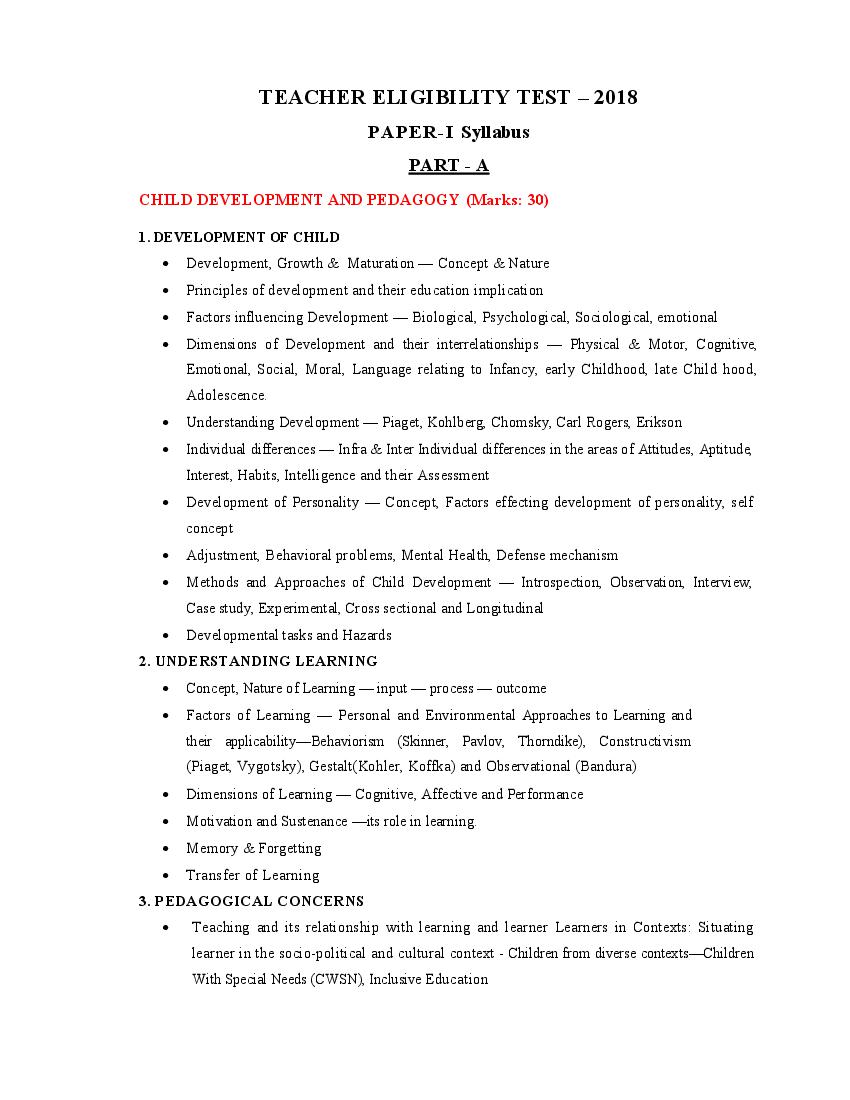
PAPER-I Syllabus
PART - A
CHILD DEVELOPMENT AND PEDAGOGY (Marks: 30)
1. DEVELOPMENT OF CHILD
Development, Growth & Maturation — Concept & Nature
Principles of development and their education implication
Factors influencing Development — Biological, Psychological, Sociological, emotional
Dimensions of Development and their interrelationships — Physical & Motor, Cognitive,
Emotional, Social, Moral, Language relating to Infancy, early Childhood, late Child hood,
Adolescence.
Understanding Development — Piaget, Kohlberg, Chomsky, Carl Rogers, Erikson
Individual differences — Infra & Inter Individual differences in the areas of Attitudes, Aptitude,
Interest, Habits, Intelligence and their Assessment
Development of Personality — Concept, Factors effecting development of personality, self
concept
Adjustment, Behavioral problems, Mental Health, Defense mechanism
Methods and Approaches of Child Development — Introspection, Observation, Interview,
Case study, Experimental, Cross sectional and Longitudinal
Developmental tasks and Hazards
2. UNDERSTANDING LEARNING
Concept, Nature of Learning — input — process — outcome
Factors of Learning — Personal and Environmental Approaches to Learning and
their applicability—Behaviorism (Skinner, Pavlov, Thorndike), Constructivism
(Piaget, Vygotsky), Gestalt(Kohler, Koffka) and Observational (Bandura)
Dimensions of Learning — Cognitive, Affective and Performance
Motivation and Sustenance —its role in learning.
Memory & Forgetting
Transfer of Learning
3. PEDAGOGICAL CONCERNS
Teaching and its relationship with learning and learner Learners in Contexts: Situating
learner in the socio-political and cultural context - Children from diverse contexts—Children
With Special Needs (CWSN), Inclusive Education
Page 2
Survey, Observation and Activity based learning, Cooperative and collaborative
learning
Individual and Group learning: Issues and concerns with respect to organizing
learning in class room like Study habits, Self learning and Learning to learn
skills
Organizing learning in heterogeneous class room groups — Socio-economic background,
Abilities and Interest
Paradigms of organizing Learning-Teacher centric, Subject centric and Learner centric
Theory of instruction - Bruner
Teaching as Planned activity — Elements of Planning
Phases of Teaching — Pre active, Interactive and Post active
General and Subject related skills, competencies required in teaching and attributes of good
facilitator
Learning resources — Self, Home, School, Community, Technology
Class room Management: Role of student, teacher, Leadership style of teacher, Creation of
nonthreatening learning environment, Managing behavior problems, Guidance &
Counselling, Punishment and its legal implications, Rights of a child, Time Management.
Distinction between Assessment for Learning & Assessment of Learning, School
based Assessment, Continuous & Comprehensive Evaluation : Perspective &
Practice
Understanding teaching & learning in the context of NCF, 2005 & Right To Education Act,
2009.
Page 3
1) | >± :
) | + _) > +
2) :
) |]# _) ) ,
3) | +:
) _) | )
&) ) )
4) :
) >± _) ) +>±
&) ) ) |
, , , , ,| , , ,
, , , ).
) +<
+< , , , +<
+< ,> , , +<
+< | +, # +.
)
> +# +, | >± +.
) #+< > , > +# +.
×) +< > +# +.
) , , > +# +.
| :6
)
_) +#
) |
) ± +
)
) + +( , )
Page 4
Urdu:
Content: 24 Marks
Methodology: 06 Marks
Page 5
Kannada: (30 Marks)
Content: (24Marks)
Page 6
Page 7
Tamil (30 Marks)
Content (24 Marks)
I. ׬kÕùLôsÞRp - ®ûPV°jRp
A) A±Vôl Tj§ B) A±Vôf ùNnÙs
II. 3Bm YÏl©-ÚkÕ 8Bm YÏl× YûW Rªr TôPl ×jRLj§Ûs[
Aû]jÕm.
A) B£¬Vo ϱl× (3Bm YÏl©-ÚkÕ 8Bm YÏl×YûW)
B) £\lTmNeLs (3Bm YÏl©-ÚkÕ 8Bm YÏl×YûW ùNnÙs)
ùNôpXôdLm :
3Bm YÏl©-ÚkÕ 8Bm YÏl×YûWÙs[
A) ùNôtùTôÚs B) ùRôûLfùNôp C) ©¬jÕ GÝÕL
D) úNojÕGÝÕL E) UW×f ùNôtLs F) ©\ùUô¯ ùNôpÛdÏ RªrfùNôp
G) YZdÏ (úTfÑ, GÝjÕ) H) JÚ ùTôÚs ϱjR TX ùNôtLs.
III. ùUô¯j§\u :
3Bm YÏl©-ÚkÕ 8Bm YÏl×YûWÙs[
A) GÝjÕ (ØRùXÝjÕ, NôoùTÝjÕ) B) LôXm C) Tôp D) CPm E) §ûQ
F) êYûLlúTô- G) SôpYûLfùNôtLs H) úYtßûU EÚ×UhÓ I) ×Qof£
(CVp×, ®LôWm) J) Vôl× (AûNLû[ AûPVô[m LôQp) K) A¦ ùNnÙ°p
AûUkÕs[ A¦ûV AûPVô[m Lôi) J[) ùRôPoLs (ùNn®û], EQof£,
LhPû[, G§oUû\)
Methodology (06 Marks)
* RªrùUô¯ Lt©jRp Øû\Ls :
ØRXôm BiÓ D.Ed.
* Rªr ùUô¯j§\u Y[ojRp.
* ùUô¯«u CVp×m Lt©jRÛm.
* A¥lTûPj §\uLs - TôPeLû[d Lt©jRp.
* TôPm Lt©l×j §hPm.
CWiPôm BiÓ D.Ed.
* TôP HtTôÓ - ùNôtL[g£Vm ùTÚdÏRp.
* Rªr ùUô¯j§\u Y[ojRp.
* Rªr Lt©jR-p RLYp ùRô¯p ÖhTm.
* úRoÜm - U§lÀÓm.
Page 8
Odiya:
Content (24 Marks)
1. :-
a) b)
2. :-
a) / b)
3. :- :-
a) b)
c) d)
e) f)
g) , h)
i) -
4. :-
a) , , , , ,
b) – , , ,
–
c) – , , ,
d) – , ,
e) - , ,
f) - , , ,
( , , )
g) – , , ,
Methodology :- [6 Marks]
1) ,
2)
3)
4)
5) [CCE]
Page 9
VOCABULARY LEVEL OF TESTING
Synonyms Identification
Antonyms Identification
Homophones Identification
Homonyms Identification
Spelling Spelling
Phrasal Verbs Identification of Meaning
Word Formation Suffixes and Prefixes
GRAMMAR LEVEL OF TESTING
Helping Verbs Forms, contractions
Modal Auxiliaries Form, Function & Contractions
Ordinary Verbs Form, Function & Contractions
Articles Use of Articles
Simple Prepositions Including
Prepositions
Prepositions following Certain Words
Main Clauses, sub-ordinate Clauses,
Clauses Noun Clauses, If Clauses, Relative
Clauses
Sentence Structures Basic Sentence Structures
Form, Function, Construction,
Degrees of Comparison
Transformation
Language Functions with social norms
Language Functions
(School and domestic context)
Question Tags Imperatives and Statements
Types of Sentences Types of Sentences
Direct Speech & Indirect Speech Statements, Questions, Imperatives
Active Voice & Passive Voice Active Voice & Passive Voice
Use of tenses and framing including IF
Tenses
conditionals Type 1 &3
Agreement between subject &
Agreement between subject & Verb
Verb
Word Order Word Order In a phrase or a sentence
Nouns, Pronouns, Adjectives, Adverbs,
Parts of Speech
Conjunctions - Types and functions
Linkers Linkers
Simple, Compound and Complex
Transformation of Sentences
Sentences
Based on all Vocabulary and Grammar
Common Errors
Topics
Page 10
Use of capital letters, comma, full stop,
Punctuation and Capitalization
question mark and exclamation mark
DISCOURSES LEVEL OF TESTING
Writing of Discourses Letter Writing, Diary writing, Description
DICTIONARY SKILLS LEVEL OF TESTING
DICTIONARY SKILLS DICTIONARY SKILLS
READING COMPREHENSION LEVEL OF TESTING
Prose Prose (general)
METHODOLOGY LEVEL OF TESTING
1. Aspects of language (English DETAILED AND DEEP
Language History, Nature, UNDERSTANDING WITH
Importance, Principles of APPLICATION IN BRODER SENSE
English as Second language
and problems of Teaching /
learning English)
2. Objectives of Teaching English
3. Development of language
Skills (Listening, Speaking,
Reading and Writing;
Communicative Skills and
Imparting values through
Communication
4. Approaches, Methods and
Techniques of Teaching
English (Introduction,
Definition, Types of
Approaches, Methods and
Techniques of Teaching
including Remedial Teaching)
5. Teaching of Structures,
Vocabulary and Grammar
6. teaching Learning Materials in
English
7. Lesson Planning
8. Curriculum and Textbooks -
Importance and need
9. Evaluation in English
Language
Page 11
Maths Content (24Marks)
I .Day to Day Mathematics
Pre Mathematical concepts - Money & Time
II. Arithmetic
Ratio and Proportion - Applications of Ratio- Comparing Quantities using proportion -Direct and
Inverse proportion
III. Number System
Numbers – four fundamental operations (addition, subtraction, multiplication & division)
Patterns in Numbers.
Knowing Our Numbers-Indian & international systems – Rounding of numbers- Whole Numbers
- Playing With Numbers-divisibility rules-LCM & HCF -Integers - Fractions - Decimals -Rational
Numbers -Squares, cubes, Square roots, Cube roots
IV. Geometry
SHAPES– PATTERNS - Basic geometrical ideas - Measures of Lines and Angles - Symmetry -
Understanding 3D, 2D Shapes -Representing 3D in 2D-Lines and Angles -Triangle and Its
Properties -Congruency of Triangles- -Quadrilaterals - Practical Geometry -Construction of
Triangles - Construction of Quadrilaterals - Exploring Geometrical Figures
V. Mensuration
SPATIAL UNDERSTANDING -Length – Weight – capacity - Perimeter & Area of Plane Figures
(triangle, square, rectangle, rhombus, circle, trapezium, parallelogram)
VI. Algebra
Introduction to Algebra- Simple Equations- - Algebraic Expressions - Exponents & Powers -
Linear Equations in one variable - Factorization
VII. Statistics
DATA HANDLING - Frequency Distribution Tables and Graphs
Mathematics Methodology (D.El.Ed.) (06 Marks)
1. Nature and Definitions of Mathematics
2. Aims, values and instructional objectives of teaching Mathematics
3. Methods of Teaching & Remedial measures in Mathematics
4. Instructional Material, TLM and Resource Utilization in Mathematics
5. Curriculum, Text Book & Instructional Planning.
6. Evaluation and Continuous Comprehensive Evaluation
Page 12
Science:
CONTENT (Marks: 12)
1. Living World – Non Living and living organisms, life and its characteristics, Family,
Members of the family, Changing family structure, Friends, Relations, Works, Games,
Different games rules, Our Village, Mapping skills, Shelter, Things we make cloth, Travel,
Find the way – direction, from village to Delhi, Public Institutions, House, Construction –
Sanitation, Our laces, Our culture. Story of microbial world, Use full and harm full micro
organisms. Materials, things, Air - Importance of air, composition of air, atmospheric pressure,
and diseases spread through air and their prevention, air pollution - causes, its impact, and
measures to prevent, Green House effect. Water - Importance, water resources, tanks, aquatic
flora and fauna, measurement of liquids, Water pollution - causes, impact, measures to prevent,
purification of water, drought, floods, Water cycle, Draught waste water Treatment. Weather,
Climate, Soil our life, rain, floods, Cyclones, disaster management, Habitat, Movements in
animals, Production of food from animals and plants, Agricultural operation, Cultivation of
Craps, disease to plants and control, improvement of crop yield storage, Preservation and
protection of food and plant products, Classification of living organisms, Branches of
Sciences, Recent trends in Science, Hybridization, animal husbandry. Why do we fall ill?
2. Life processes – Cell, cell organelles parts of plants and functions. Animals, different types of
Animals, Animals base of our life, Our body parts, External, Internal parts of our body, Bones,
Muscles, Sense organs, Organ systems in animals. Nutrition in plants and animals, excretion,
respiration control and coordination, reproduction, seed dispersal in plants and control and
coordination in organisms. Our food, food components, Nutritious food, Health, Cleanliness,
Balanced diet, Malnutrition. Midday Meals, food preservation methods, Wastage of food, How
we get food, green revolution, Nutrition of food, Food Pyramid, Junk food, First Aid. Heredity
genes, variations.
3. Natural Phenomena – Changes around us separation of substances, fiber to fabric synthetic
fibers, Plastics metals and non metals, matter, Acids and bases. Motion and time, Energy,
Forms of Energy - Energy resources, Renewable and non renewable resources, conservation of
energy Temperature and its measurement. Electricity, Electric circuits, Current and its effects,
Sound, reflection of light, Shadows, Playing with magnets, friction, force speed, velocity,
combustion, fuels and flame. How to measure things, Coal, Petrol, Petroleum products.
4. Our Environment - Bio diversity, Diversity in plants and animals, lets plants, trees,
endangered, endemic species, Forest – Tribes – Tribal life – diversity in forests. Different
Ecosystems, Ecology, Bio mass, A biotic, Biotic factors, Global Environmental Issues. Global
warming, Acid rains, depletion of Ozone layer. Stars and Solar systems. River, Lively hood,
Atmosphere – wind – safety measures – Historical sites – Our Country – World, Our
constitution, Child rights.
Methodology: (3 Marks)
1. Concept and scope of Environmental Studies (Science)
2. Aims & Objectives of teaching Environmental Studies (Science) Academic Standards of
Teaching EVS
3. Relation to Science
4. Curriculum and its transactional process – Teaching Methodology
5. Teaching Learning Material (TLM)
6. Evaluation procedures – CCE.
Page 13
Social Studies
(Content 12 Marks):
Theme - I: Diversity on the Earth
Reading, Making and analysis of Maps – different kinds of maps. - Globe – A Model of the Earth
- Land Forms of Andhra Pradesh Penamakuru ,A Village in the Krishna Delta - Salakamcheruvu,
A Village on the Plateau - Kunavaram ,Tribal Villages on the Hills -Rain and Rivers-Tanks and
Ground Water – Oceans and Fishing – Continents – Europe – Africa –Energy from the Sun - Earth
Movements and Seasons - The Polar Regions - Forests:Using and Protecting them - Minerals and
Mining
Theme - II: Production Exchange and Livelihoods
From Gathering Food to Growing food – The Earliest People - Agriculture in Our Times - Trade
in Agricultural Produce - Trade in Agricultural Produce - Handicrafts and Handlooms -
Industrial Revolution - Production in a Factory - A Paper Mill - Importance of Transport System
– Safety measures - Money and Banking - Impact of Technology on Livelihoods - Public Health
and the Government
Theme -III: Political Systems and Governance
Community Decision Making in a Tribe - Emergence of Kingdoms and Republics - First
Empires - Democratic Government - Village Panchayats - Local Self – Government in Urban
Areas - New Kings and Kingdoms - The Kakatiyas - Emergence of a Regional Kingdom - The
Kings of Vijayanagara - Mughal Empire - Establishment of British Empire in India - Landlords
and Tenants under the British and the Nizam - National Movement - The Early Phase 1885-1919
- National Movement - The Last Phase 1919-1947 - Freedom Movement in Hyderabad State -
The Indian Constitution - Parliament and Central Government - Making of Laws in the State
Assembly - Implementation of Laws in the District - Law and Justice.
Theme -IV: Social Organisation and Inequities
Diversity in Our Society - Towards Gender Equality -Caste Discrimination and the Struggle for
Equalities - Livelihood and Struggles of Urban Workers - Abolition of Zamindari System -
Understanding Poverty - Rights Approach to Development
Theme - V: Religion and Society
Religion and Society in Early Times - Devotion and Love towards God - Folk – Religion -
Devotional Paths to the Divine - Social and Religious Reform Movements - Understanding
Secularism
Theme -VI: Culture and Communication
Language, Writing and Great Books - Sculptures and Buildings - Rulers and Buildings -
Performing Arts and Artistes in Modern Times - Film and Print Media - Sports: Nationalism and
Commerce.
Methodology: 03 Marks
1. Nature and Scope of Social Studies
2. Aims, Objectives and Values of Teaching Social Studies
3. Methods of Teaching Social Studies
4. Resource Utilization, Content Enrichment material
5. Curriculum, Text Book and Instructional Planning
6. Evaluation and Continuous Comprehensive Evaluation
Document Details
| Board / Org | Andhra Pradesh Exams |
| Exam | Andhra Pradesh Teacher Eligibility Test |
| Type | Syllabus |
| Pages | 13 |
| Updated | 30 Apr 2026 |