Kerala SET 2019 Jul Question Paper _23_
Finished viewing? Save it for later —
Download Kerala SET 2019 Jul Question Paper _23_ (PDF · 14 pages)About Kerala SET 2019 Jul Question Paper _23_
Kerala SET 2019 Jul Question Paper _23_ is available here for free download. Published by Default for Govt Jobs Exams, this question paper can be viewed online or downloaded as a PDF (14 pages). Candidates preparing for Govt Jobs Exams can use Kerala SET 2019 Jul Question Paper _23_ to understand the exam pattern, the type of questions asked, and the overall difficulty level.
Frequently Asked Questions
How can I download Kerala SET 2019 Jul Question Paper _23_?
Open this page and click the Download button to save Kerala SET 2019 Jul Question Paper _23_ as a PDF. It is completely free on AglaSem Docs.
Is Kerala SET 2019 Jul Question Paper _23_ free to download?
Yes. Kerala SET 2019 Jul Question Paper _23_ can be viewed online and downloaded as a PDF free of cost on AglaSem Docs.
How many pages does Kerala SET 2019 Jul Question Paper _23_ have?
Kerala SET 2019 Jul Question Paper _23_ contains 14 pages, which you can read online or download together as a single PDF.
Where can I find more Govt Jobs Exams study material?
You can find more Govt Jobs Exams question papers, sample papers, syllabus, and answer keys on AglaSem Docs.
Kerala SET 2019 Jul Question Paper _23_ – Text
Read the full text of this question paper below — useful to quickly search, copy and reference the content online without downloading the PDF.
📄 View text version (14 pages)
Page 1
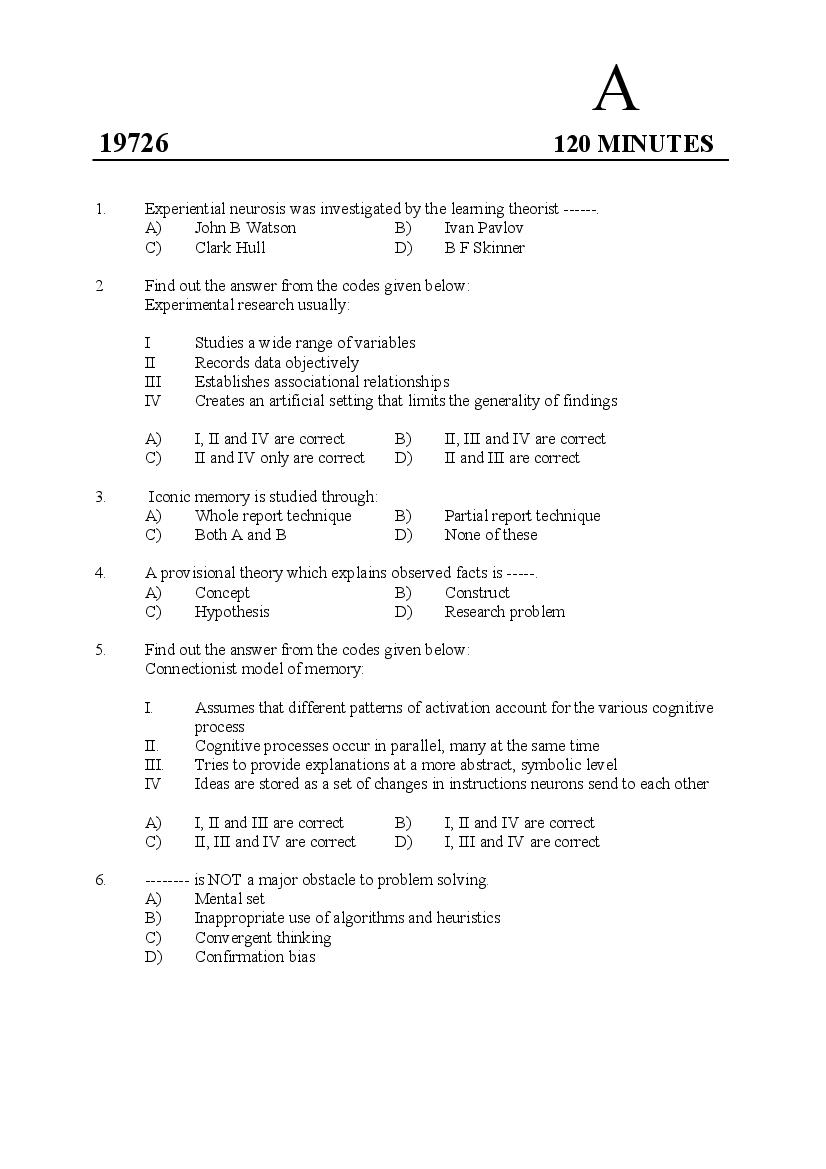
19726 120 MINUTES
1. Experiential neurosis was investigated by the learning theorist ------.
A) John B Watson B) Ivan Pavlov
C) Clark Hull D) B F Skinner
2 Find out the answer from the codes given below:
Experimental research usually:
I Studies a wide range of variables
II Records data objectively
III Establishes associational relationships
IV Creates an artificial setting that limits the generality of findings
A) I, II and IV are correct B) II, III and IV are correct
C) II and IV only are correct D) II and III are correct
3. Iconic memory is studied through:
A) Whole report technique B) Partial report technique
C) Both A and B D) None of these
4. A provisional theory which explains observed facts is -----.
A) Concept B) Construct
C) Hypothesis D) Research problem
5. Find out the answer from the codes given below:
Connectionist model of memory:
I. Assumes that different patterns of activation account for the various cognitive
process
II. Cognitive processes occur in parallel, many at the same time
III. Tries to provide explanations at a more abstract, symbolic level
IV Ideas are stored as a set of changes in instructions neurons send to each other
A) I, II and III are correct B) I, II and IV are correct
C) II, III and IV are correct D) I, III and IV are correct
6. -------- is NOT a major obstacle to problem solving.
A) Mental set
B) Inappropriate use of algorithms and heuristics
C) Convergent thinking
D) Confirmation bias
Page 2
List-I List –II
a. Trait 1. Captures active nature of human thoughts
b. Cognitive 2. Emphasis on self as it struggles to cope with emotions
c. Interactionist 3. Good individual assessment techniques
d. Neo-Analytic 4. We are different selves in different situations
A) a - 1, b - 3, c - 2, d - 4 B) a - 3, b - 1, c -4, d - 2
C) a - 3, b - 4, c - 2, d - 1 D) a -4, b - 3, c - 1, d - 2
8. Tendencies that are the least conspicuous generalized and consistent are known as-----.
A) Secondary dispositions B) Cardinal traits
C) Central traits D) Primary dispositions
9. Trait scales in Big-Five factors is arranged as given below:
A) Agreeableness- Neuroticism- Openness to experience
B) Neuroticism- Openness to experience- Conscientiousness
C) Extraversion- Neuroticism- Conscientiousness
D) Neuroticism- Agreeableness- Extraversion
10. Scientists believe that some people become obese because their ancestors were -----
and more likely to store up for future times of famine.
A) Hunter-gatherers B) Herder-farmers
C) Agriculturalists D) Big overeaters
11. -------- is not a real physical disorder.
A) psychosomatic disorder B) psychophysiological disorder
C) somatoform disorder D) disease of adaptation
12. Modern psychodynamic therapy is ------ compared to traditional psychoanalysis:
A) more directive B) less directive
C) more action oriented D) more focused on the id
13. Why people don’t use medical screening services is initially explained with the help of
A) Cognitive appraisal model B) Self-determination theory
C) Stress- diathesis model D) Health belief model
14. Phrenology is developed by ------.
A) Gall and Spurzheim B) Broca and Wernicke
C) Darwin and Fechner D) Alton and Wundt
15. Which of the following is a law of learning?
A) Law of readiness B) Law of exercise
C) Law of effect D) All the above.
16. The most effective method for encouraging self learning:
A) Demonstration method B) Lecture method
C) Observation method D) Task method.
2
Page 3
A) Descartes B) Rousseau C) Aristotle D) Plato
18. The state of being first creates a strong almost unusable impression. This is ----.
A) Law of primacy B) Law of intensity
C) Law of recency D) Law of effect
19. The idea that you can assess someone’s personality by studying their face is called:
A) phrenology B) physiology C) somatology D) physiognomy
20. The “S-R” concept was first established by:
A) J.B Watson B) Wilhelm Wundt
C) William James D) I.P. Pavlov
21. Match List-I with List-II
List-I List-II
a. Purposive or judgment sampling 1. Observational design
b. Pre-planned design for analysis 2. Operational design
c. Unstructured instruments for collection of data 3. Sampling design
d. Advanced decisions about operational Procedures 4. Statistical design
A) a-4, b-1, c-2, d-3 B) a-2, b-1, c- 4, d- 3
C) a-3, b-2, c-1, d- 4 D) a-3, b- 4, c-1, d- 2
22. While making rational choices
1. Managers select the first alternative that is satisfactory.
2. Managers recognize that their conception of the world is simple.
3. Managers are comfortable making decisions without determining all the alternatives.
4. Managers make decisions by rules of thumb or heuristics.
Which options given below are correct for Bounded rationality?
A) 1, 2 and 4 B) 2, 3 and 4
C) All the above D) None of the above
23. It was ----- who adapted the French intelligence test for use with American children.
A) Alfred Binet B) Lewis M Terman
C) David Wechsler D) William Stein
24. In McClelland’s need for achievement, which one of the following is not a
characteristic of an achiever?
A) Risk taking B) Delay of gratification
C) Being on the move D) Desire for optimum balance of time for
self and others
25. Repeated exposure to a particular piece of music leads to greater liking for it. The
theory behind this idea is proposed by
A) Festinger B) Schachter
C) Zajonc D) McClelland
3
Page 4
explained better?
A) If you think like me, I will like you
B) Misery loves miserable company
C) All begin with Cinderella
D) It must be love, not war
27. Berkowitz (1969) has revisited frustration-aggression hypothesis with the help of an
experimental procedure known as----.
A) Taylor interaction tasks B) Perry Mason scales
C) Robert caves D) Buss aggression machine
28. If watching violence tends to make us less aggressive, it has ------ effect on us.
A) Modeling B) Sublimation C) Catharsis D) Cultural
29. Assertion (A): In factorial designs, the effects of varying more than one factor are to
be determined
Reason (R): In this design, the extraneous variable to be controlled by homogeneity
is called the control variable
A) Both (A) and (R) are true and (R) is the correct explanation of (A)
B) Both (A) and (R) are true, but (R) is not the correct explanation of (A)
C) (A) is true, but (R) is false
D) (A) is false, but (R) is true
30. Find out the correct answer from the codes given below:
Testing of hypothesis include:
I. Decision rule
II. Type I and II errors can be reduced simultaneously
III. Alternative hypothesis is the one which is to be disproved
IV. Level of significance is the probability of Type I error
A) I, II and IV are correct B) I and IV are correct
C) II, III and IV are correct D) II and IV are correct
31. Point on a centimeter scale indicates
A) Interval scale B) Nominal scale
C) Ratio scale D) Ordinal scale
32. The theory developed out of the motivational study on 200 accountants and engineers
employed by firms in and around Western Pennsylvania:
A) John Holland’s theory B) Herzberg’s theory
C) Murray’s theory D) Maslow’s theory
33. If you have pets at home, it is difficult to avoid ----.
A) Observer bias B) Type I error
C) Anthropomorphic error D) Type II error
4
Page 5
using the codes given below.
Assertion (A) : The blood of persons with schizophrenia contains a certain chemical
not found in the general population and that chemical causes
schizophrenia.
Reason (R) : Correlation does not demonstrate causation.
A) Both (A) and (R) are true and (R) is the correct explanation of (A)
B) Both (A) and (R) are true, but (R) is not the correct explanation of (A)
C) (A) is true, but (R) is false
D) (A) is false, but (R) is true
35. Elevated ----- levels make a person less sensitive to pain.
A) Acetylcholine B) Endorphin
C) Oxytocin D) Enkephalin
36. Persons with right - hemisphere damage pay no attention to the left side of the visual
space.This problem is known as:
A) Aphasia B) Agnosia
C) Neurological soft signs D) Spatial neglect
37. Early in life, the learning of basic skills is most effective when parents respect the ----.
A) value of reactive maternal environment
B) fact that babies cannot imitate adult actions until they are 18 months old
C) principle of readiness
D) principle of early maturation
38. Match List-I with List-II
List-I List-II
a. Sensorimotor 1. Abstract or hypothetical
b. Preoperational 2. Purposeful movement
c. Concrete operational 3. Intuitive thought
d. Formal operations 4.Reversibility thought
A) a-2, b- 4, c-1, d-3 B) a-3, b- 1, c-4, d-2
C) a-2, b- 1, c-3, d-4 D) a-2, b-4, c-3, d-1
39. Which one among the following is the main demerit of percentile norms?
A) Percentage confusion is created
B) Calculation of percentile norms is difficult
C) Percentile norms are subjective norms
D) Units of scale based on percentile norms is unequal
5
Page 6
List-I List-II
a. Charles Darwin 1. In the 1950s, this research team discovered self-
stimulation sites in the rat brain and named “pleasure
centres”
b. Solomon Snyder 2. These researchers conducted the original split-brain
studies, which demonstrated that the right and
left hemispheres of the brain each have their own
special abilities
c. Roger Sperry and Michael 3. This researcher showed that morphine exerts its
Gazzaniga effects by binding to specialized receptors in the
brain, leading to the discovery of endorphins
d. James Olds and Peter Milner 4. The 19th -century theorist, who invented the
concepts of fitness and natural selection
A) a-4, b- 1, c-2, d-3 B) a-4, b- 1, c- 3, d-2
C) a-1, b- 4, c-2, d-3 D) a-4, b-3, c-2, d- 1
41. Match List-I with List-II
List-I List-II
a. Cannabis 1. Health risks of concern include respiratory and
pulmonary disease and lung cancer
b. Stimulants 2. Used as a “sleeping pill” because it reduces CNS
activity
c. Sedatives 3. May lead to insightful or “mystical” experiences
d. Hallucinogens 4. Creates increased alertness and energy, buoyant
relation, reduced fatigue
A) a-4, b- 1, c-2, d-3 B) a-1, b- 4, c- 2, d- 3
C) a-2, b- 4, c-1, d-3 D) a-4, b-3, c-2, d- 1
42. A gradual decline in sensitivity to prolonged stimulation is known as -----.
A) Sensitization B) Learned helplessness
C) Sensory adaptation D) Subliminal perception
43. An illusion in which objects can be represented in two-dimensional pictures but cannot
exist in three-dimensional space is called --------.
A) Impossible figures B) Ambiguous figures
C) Ames room D) Ponzo illusion
44. Hypnosis creates a dissociation in consciousness is proposed by:
A) Theodore Barber B) Ernest Hilgard
C) Nicholas Spanos D) Martin Orne
45. Caffeine and nicotine are----.
A) Stimulants B) Hallucinogens
C) Sedatives D) Depressants
6
Page 7
A) Physical dependence B) Psychological dependence
C) Subjectivity of experience D) Tolerance
47. Whenever you have a cold, you rest in bed, take aspirin, and drink plenty of fluids.
You cant determine which remedy is most effective because of which of the following
problems?
A) sampling bias B) distorted self-report data
C) confounding of variables D) experimenter bias
48. A common driving experience is “highway hypnosis”, in which one’s consciousness
seems to be divided between the driving itself and one’s conscious train of thought.
This phenomenon is inconsistent with the idea that hypnosis is:
A) an exercise in role playing B) a dissociative state of consciousness
C) a goal-directed fantasy D) not an altered state of consciousness.
49. Niyama is said to be:
A) Rules for healthy personality
B) One among the three parts of breath
C) One among the eight limbs of yoga
D) One among the five personal disciplines of dharma
50. Which of the following is associated with REM sleep?
A) sleep apnea B) somnambulism
C) night terrors D) nightmares
51. Stimulant is to depressant as:
A) cocaine is to alcohol B) mescaline is to barbiturates
C) caffeine is to amphetamines D) alcohol is to barbiturates
52. Research on avoidance learning suggests that a fear response is acquired through ------
conditioning; the avoidance response is maintained as a result of -------conditioning.
A) classical; operant B) operant; classical
C) classical; classical D) operant; operant
53. Research suggests that bilingualism has a negative effect on:
A) language development B) cognitive development
C) metalinguistic awareness D) none of the above
54. The linguistic relativity hypothesis is the notion that:
A) one’s language determines the nature of one’s thought
B) one’s thought determines the nature of one’s language
C) language and thought are separate and independent processes
D) language and thought interact, with each influencing the other.
55. The theory of bounded rationality was originally developed by:
A) Noam Chomsky B) Herbert Simon
C) Steven Pinker D) Gerd Gigerenzer
7
Page 8
A) monitoring physiological indices of autonomic arousal
B) directly assessing the truthfulness of a person’s statements
C) monitoring the person’s facial expressions
D) the fear of success
57. The elaboration likelihood model of attitude change suggests that:
A) the peripheral route results in more enduring attitude change
B) the central route results in more enduring change
C) only the central route to persuasion can be effective
D) None of the above
58. Deindividuation is a potential cause of:
A) Regression B) Compensation
C) Jealousy D) Aggression
59. In omission training, reinforcement is dropped only if:
A) a particular stimulus is presented
B) a particular response is made
C) biological constraints are there
D) zero transfer is found
60. According to Sullivan, the autistic state of communication reflects a:
A) Paradoxic mode B) Syntaxic mode
C) Prototaxic mode D) Symbolic representation
61. One example for illusion is:
A) Feature detectors
B) The Ames room
C) Apparent Distance Hypothesis
D) Binocular disparity
62. Which of the following does NOT occur in classical conditioning?
A) Spontaneous recovery B) Set learning
C) Discrimination D) Extinction
63. Person performing the data analysis wants to prove a predetermined assumption:
A) Hindsight bias B) Confirmation bias
C) Extremity bias D) Overconfidence bias
64. Learned helplessness is often associated with:
A) MPD B) Mania C) Depression D) Anxiety
65. Need for Achievement can be measured by:
A) Rorschach Ink bloat test
B) SPM
C) Thematic Apperception test
D) Polygraph
8
Page 9
on faraway objects. It is called:
A) Texture gradient B) Convergence
C) Habituation D) Accommodation
67. According to Kohlberg moral reasoning typical of adoloscents
A) Conventional B) Post conventional
C) Pre conventional D) Formal
68. The deficiency of the neurotransmitter ----may play a role in Parkinson’s disease.
A) Serotonin B) Dopamine
C) Acetylcholine D) Nor-epinephrine
69. The personality theorist who introduced Feminist Psychology:
A) Erik Erikson B) Raymond Cattell
C) Erich Fromm D) Karen Horney
70. Which of the following factors doesnot contribute to bystander effect?
A) Ambiguity B) Group Cohesiveness
C) Diffusion of responsibility D) Denial of reality
71. Find out the answer from the codes given below:
Carl Jung
I. Founded analytical Psychology
II. Used synchronicity in Psychotherapy
III. Introduced the concept of archetypes
IV. Called emotionally charged associations as complex
A) I, II and IV are correct B) II and III are correct
C) I, II, III and IV are correct D) I, III and IV are correct
72. Find out the answer from the codes given below:
In process of‘Attitude change’
I. There can be cognitive dissonace
II. Compliance,identification and internalisation represent different levels .
III. Emotion doesnot play a major role
IV. Elaboration likelihood model explain depth of attitude change
A) I, II and III are correct B) II and III are correct
C) I, II, III and IV are correct D) I, II and IV are correct
73. The ratio of standard deviation to mean is known as:
A) Coefficient of variation
B) Coefficient of distribution
C) Relative median
D) Relative standard error
74. Inverted U is related to ------ of motivation.
A) Maslow’s theory B) The arousal theory
C) The Expectancy theory D) The need affiliation theory
9
Page 10
A) Time urgency B) Ambitious
C) Outgoing D) Insensitive
76. According to the Moral development theory of Kohlberg, self- interest orientation is
characteristic of:
A) Conventional morality B) Pre-conventional morality
C) Post-conventional morality D) Formal Morality
77. Find out the answer from the codes given below:
PDP model of Memory
I. Assumes that system functions with imperfect information
II. Support spontaneous generalisations
III. Support default assignment
IV. Assumes that knowledge is stored in connections between units
A) I, II and III are correct B) II and III are correct
C) I, II, IIIand IV are correct D) I, III and IV are correct
78. The personality inventory based on Cattel’s theory of personality:
A) MBTI B) MMPI C) EPI D) 16PF
79. Graphic representation of interpersonal relationships in a group:
A) Sociogram B) Cliques
C) Organisational chart D) Sociomapping
80. Find out the answer from the codes given below:
Norm referenced tests
I. Percentage ranking compared to average population
II. Estimate how well a person learned a specific body of knowledge and skills
III. Estimate position of tested individual in predefined population
IV. Does not include IQ tests
A) I, II and III are correct B) I and III are correct
C) II and IV are correct D) I, III and IV are correct
81. All the following are Intelligence tests EXCEPT:
A) WAPIS B) SPM C) MISIC D) WMS
82. A statistic that tells us where a score lies in relation to the population mean:
A) a t-score B) Z score
C) Deviation coefficient D) Variance Determination
83. A group of workers who do the same or similar work, who meet regularly to identify,
analyze and solve work-related problems.
A) Sensitivity training group B) Survey feedback
C) Quality Circles D) Process consultation group
10
Page 11
reinforcement?
A) Variable schedules B) Fixed schedules
C) Partial schedule D) Mixed Schedules
85. The approache to analyze written, vocal, or sign language use, or any
significantsemiotic event in qualitative research:
A) Hermeneutics B) Action Research
C) Phenomenology D) Discourse analysis
86. Which of the following is an experimental design that has two or more groups of
subjects each being tested by a different testing factor simultaneously?
A) With in group design B) Between group design
C) Factorial design D) Mixed subject design
87. If in attempting to compare two treatment groups, your analysis accepts the null
hypothesis, it means that
A) There is no difference between the two groups
B) There is a difference between the two groups
C) Any difference between the two groups that do exist are valid
D) Research hypothesis is accepted
88. Find out the answer from the codes given below:
The Digambara tradition of Jainism
I. Believe Rishabha, Vasupujya and Neminatha were the three tirtankaras
II. Reject the theory of difference in Parshvanatha and Mahāvīra's teachings.
III. Wears seamless white clothes
III. Icons are decorated and colored to be more lifelike
A) I, II and III are correct B) I and II are correct
C) II and III are correct D) I, III and IV are correct
89. Disorder marked by the person's acceptance that the characteristics and behaviours
displayed as a result of disorder are compatible with their self image, or are otherwise
appropriate, correct or reasonable:
A) OCD B) Phobic states
C) Depression D) OCPD
90. Which of the following is a negative symptom of schizophrenia?
A) Apathy B) Delusion
C) Hallucination D) Disorganized speech
91. According to Gaia the yoga which is a blend of Bhakthi yoga, Shakthi yoga and Raja
yoga?
A) Laya yoga B) Hatha yoga
C) Kundalini yoga D) Karma yoga
11
Page 12
of newer information
Reason(R): Recall of an event is better when the environmental conditions underwhich
the event occurred and the conditions under which recall occur are similar.
A) Both (A) and (R) are true and (R) is the correct explanation of (A).
B) Both (A) and (R) are true, but (R) is not the correct explanation of (A).
C) (A) is true, but (R) is false.
D) (A) is false, but (R) is true
93. Which of the following scales have absolute zero?
A) Interval scale B) Ratio scale
C) Nominal Scale D) Ordinal scale
94. Match List I with List II and choose your answer from the codes given below:
List I List II
a. Sensory motor 1. Abstract concept
b. Pre-operational 2. Object permanence
c. Concrete operational 3. Symbolic thought
d. Formal operational 4. Operational thought
A) a-3, b-2, c-4, d-1 B) a-2, b-4, c-3, d-1
C) a-2, b-1, c-3, d-4 D) a-2, b-3, c-4, d-1
95. Which theorist used a Factor analysis while assessing personality?
A) Gordon Allport B) Erik Erikson
C) Raymond Cattell D) Henry Murray
96. Which law states that smallest detectable difference for any intensity of a stimulus is a
constant function of the intensity of the stimulus?
A) Weber law B) Fechner law
C) Steven Power law D) Law of effect
97. Irrational fear of heights is known as:
A) Claustrophobia B) Agoraphobia
C) Social Phobia D) Acrophobia
98. World is filled with rich array of information which alone is needed for perception.
This is the idea behind:
A) Direct Perception theory B) Constructive perception theory
C) Prototype theory D) Linear perspective
99. Competence motivation is largely:
A) Intrinsic B) Extrinsic
C) Passive D) Intrinsic and passive
12
Page 13
A) Template matching B) Feature Analysis
C) Bottom – up processing D) Top down processing
101. Assertion (A) : Being in an elated mood can interfere with the learning of certain
tasks.
Reason (R) : Too much elation can also interfere with cognitive processing.
A) A and R are true and R is the correct explanation of A.
B) A and R are true but R is not the correct explanation of A.
C) A is true R is false.
D) A is false R is true.
102. Incubation is a stage of creative thinking which involves:
A) Insight experience B) Unconscious thought process
C) New solution D) Aha experience
103. Identify the odd one from the following:
A) Chunking B) Method of loci
C) Mnemonics D) Number and letter peg system
104. Functional fixedness is just one of the mental blocks that prevent:
A) Learning B) Memory C) Image D) Insight
105. Distinguishing call of birds is an example of:
A) Verbal learning B) Conceptual learning
C) Perceptual learning D) Insight learning
106. Motive is a ----.
A) General trait B) Specific trait C) Desire D) Behaviour
107. The therapy which carefully avoids directly challenging their client's way of
communicating themselves in the session in order to enable a deeper exploration of
the issues most intimate to them and free from external referencing is:
A) Cognitive therapy B) Behaviour Therapy
C) Client centered therapy D) Cognitive Behavioural therapy
108. A behavioural approach generally used to shape a desired behaviour is:
A) Behaviouaral contracting B) Modelling
C) Assertive Training D) Token Economies
109. Rejection of null hypothesis when it is true is
A) Type I error B) Type II error
C) Type III error D) None of the above
110. Job rotation:
A) Increases monotony B) Decreases monotony
C) Decreases production D) None of above
13
Page 14
A) Germany B) Japan C) France D) USA
112. The Stanine scale is:
A) Condensed form of the T scale
B) Z scale
C) Totally different from T scale
D) None of the above
113. Which of the following tests can be used with illiterate people also?
A) Kaufman Adolescent and Adult Intelligence Test
B) Wechsler Adult Intelligence Scale
C) Raven’s progressive matrices
D) Stanford Binet scales
114 Reconstruction in memory is sometimes called:
A) Confabulation B) Forgetting
C) Subjective organisation D) Schemata
115. Which of the following makes the most prominent use of statistics in its scoring
procedures?
A) MMPI B) TAT C) Blacky Test D) Rorschach Test
116. A therapeutic technique where a patient is suddenly exposed to the actual situation
that involve anxiety until the situation loses it’s threat is:
A) Systematic desensitization B) In vitro desensitization
C) Flooding D) Implosion
117. Learning become evident in performance when situation arises is:
A) Set Learning B) Latent Learning
C) Motor Learning D) Vicarious Learning
118. Dysthymic disorders are:
A) Mood disorders B) Sexual disorders
C) Substance-related disorders D) Schizophrenic disorders
119. Studies conducted on the behaviour which occurs in the natural habitat are called:
A) Case studies B) Field studies
C) Genetic studies D) Social studies
120. Match List I and List II
List I List II
a. Mean 1. The midpoint score
b. Median 2. The average score
c. Mode 3. A descriptive measure of sample
d. Statistic 4. The most frequently occurring score in the
distribution
A) a-2, b-1, c-4, d-3 B) a-3, b-2, c-4, d-1
C) a-4, b-1,c-2, d-3 D) a-3, b-4,c-1, d-2
_______________
14
Document Details
| Board / Org | Default |
| Exam | Govt Jobs Exams |
| Type | Question Paper |
| Pages | 14 |
| Updated | 22 Jul 2026 |