Manipur Board Class 12 Syllabus 2027 Business Studies
Finished viewing? Save it for later —
Download Manipur Board Class 12 Syllabus 2027 Business Studies (PDF · 8 pages)About Manipur Board Class 12 Syllabus 2027 Business Studies
Manipur Board Class 12 Syllabus 2027 Business Studies is available here for free download. Published by Manipur Board for Class 12, this syllabus can be viewed online or downloaded as a PDF (8 pages). Candidates preparing for Class 12 can use Manipur Board Class 12 Syllabus 2027 Business Studies to understand the exam pattern, the type of questions asked, and the overall difficulty level.
Frequently Asked Questions
How can I download Manipur Board Class 12 Syllabus 2027 Business Studies?
Open this page and click the Download button to save Manipur Board Class 12 Syllabus 2027 Business Studies as a PDF. It is completely free on AglaSem Docs.
Is Manipur Board Class 12 Syllabus 2027 Business Studies free to download?
Yes. Manipur Board Class 12 Syllabus 2027 Business Studies can be viewed online and downloaded as a PDF free of cost on AglaSem Docs.
How many pages does Manipur Board Class 12 Syllabus 2027 Business Studies have?
Manipur Board Class 12 Syllabus 2027 Business Studies contains 8 pages, which you can read online or download together as a single PDF.
Where can I find more Class 12 study material?
You can find more Class 12 question papers, sample papers, syllabus, and answer keys on AglaSem Docs.
Manipur Board Class 12 Syllabus 2027 Business Studies – Text
Read the full text of this syllabus below — useful to quickly search, copy and reference the content online without downloading the PDF.
📄 View text version (9 pages)
Page 1
Manipur Board Class
12 Syllabus 2027
Business Studies
EXAM YEAR TYPE SUBJECT
Manipur Class 12 2027 Syllabus Business Studies
Notes · Sample Papers · Previous Year Papers · Mock Tests
Page 2
m .co
m .co s e m
se g l a
a
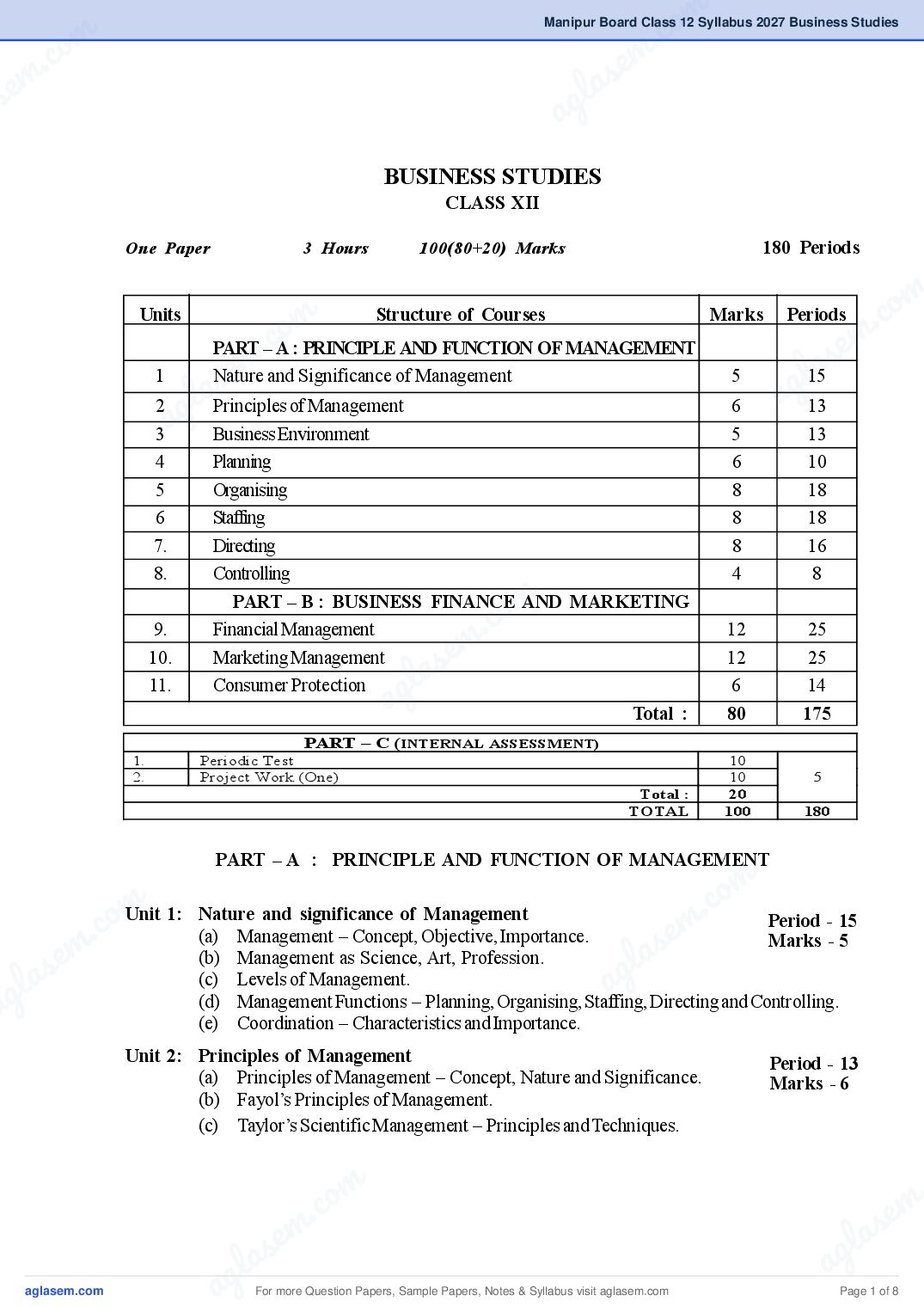
BUSINESS STUDIES
CLASS XII
One Paper 3 Hours 100(80+20) Marks 180 Periods
m
Units
m Structure of Courses Marks Periods
.co
.co
PART – A : PRINCIPLE AND FUNCTION OF MANAGEMENT
s e m
s em l a
ag 13
1 Nature and Significance of Management 5 15
a
2 gl Principles of Management 6
3a Business Environment 5 13
4 Planning 6 10
5 Organising 8 18
6 Staffing 8 18
7. Directing 8 16
8. Controlling 4 8
m
.co
PART – B : BUSINESS FINANCE AND MARKETING
9. Financial Management 12 25
10. Marketing Management s em 12 25
l a
ag
11. Consumer Protection 6 14
Total : 80 175
PART – C (INTERNAL ASSESSMENT)
1. Periodic Test 10
2. Project Work (One) 10 5
Total : 20
TOTAL 100 180
PART – A : PRINCIPLE AND FUNCTION OF MANAGEMENT
m
m
c. o Unit 1: Nature and significance of Management
m .co
Period - 15
m (a) Management – Concept, Objective, Importance.
s e Marks - 5
s e (b) Management as Science, Art, Profession.
g l a
g la (c) Levels of Management. a
a (d) Management Functions – Planning, Organising, Staffing, Directing and Controlling.
(e) Coordination – Characteristics and Importance.
Unit 2: Principles of Management Period - 13
(a) Principles of Management – Concept, Nature and Significance. Marks - 6
(b) Fayol’s Principles of Management.
(c) Taylor’s Scientific Management – Principles and Techniques.
m .
.co s e m
s em l a
g la ag
a For more Question Papers, Sample Papers, Notes & Syllabus visit Page 1 of 8
Page 3
(a) Business Environment – Concept, Importance. Marks - 5
(b) Dimensions of Business Environment – Economic, Social, Technological, Political and
Legal.
(c) Concept of Liberalization, Privatization and Globalization Business and Industry.
Unit 4: Planning Period - 10
Marks - 6
(a) Concept, Importance, Limitations.
(b) Planning Process.
(c) Types of plans – Objective, Strategy, Policy, Procedure, Method, Rule, Budget, Programme.
Unit 5: Organising
(a) Concept and importance. Period - 18
Marks - 8
(b) Steps in the process of Organising.
(c) Structure of Organisation – Functional and Divisional.
(d) Formal and Informal Organisation.
(e) Delegation : Concept, Elements and Importance.
(f) Decentralization : Concept and Importance.
Unit 6: Staffing
(a) Concept and Importance of staffing. Period - 18
Marks - 8
(b) Staffing as a part of Human Resource Management.
(c) Staffing Process –
: Recruitment – Meaning and Sources
: Selection – Process
(d) Training and Development – Concept and Importance.
Unit 7: Directing
(a) Concept and Importance. Period - 16
Marks - 8
(b) Elements of Directing
– Supervision – Concept, Functions of a Supervisor.
– Motivation – Concept, Maslow’s hierarchy of needs.
– Financial and Non Financial Incentives.
– Communication –Concept, Formal and Informal Communication,
Barriers to effective communication.
How to overcome the barriers.
For more Question Papers, Sample Papers, Notes & Syllabus visit Page 2 of 8
Page 4
m .co
m .co s e m
se g l a
a
Unit 8: Controlling Period - 8
(a) Concept and Importance. Marks - 4
(b) Relationship between Planning and Controlling.
(c) Steps in the process of Control.
m
.co
PART – B : BUSINESS FINANCE AND MARKETING
m
Unit 9:
m .co
Financial Management
(a) Concept, Objective of financial management.
Period - 25
Marks - 12 s e m
s e l a
ag
(b) Decisions relating to Investment, Financing and Dividend.
g l a(c) Financial Planning : Concept and Importance
a (d) Financial Structure – Concept and Factors affecting
(e) Fixed and Working capital – Concept and Factors affecting its requirements.
Unit 10: Marketing Management Period - 25
(a) Marketing – Meaning, Functions, Marketing v/s Selling. Marks - 12
(b) Marketing Management Philosophies.
(c) Marketing Mix – Concept.
m
.co
• Product – Concept, Branding, Labeling and Packaging.
m
e
• Price – Factors determining price.
s
of channels.
g la
• Physical Distribution – Concept, Channels of distribution : Types, Choice
a
• Promotion – Concept and Elements; Advertising – Concept, role,
Objections against Advertising, Personal selling – Concept and Qualities
of a good salesman, Sales Promotion – Concept and Techniques, Publicity –
Concept and Role.
Unit 11: Consumer Protection Period - 14
(a) Concept and Importance of Consumer Protection. Marks - 6
(b) Consumer Protection Act 2019.
– Meaning of Consumer and consumer protection.
m
.co
– Rights and Responsibilities of consumers
m
.co
– Who can file a complaint and against whom ?
e m
e m
– Redressal Machinery.
– Remedies available.
l as
las (c) Consumer Awareness – Role of consumer organizations and NGOs. ag
ag PRESCRIBED TEXTBOOK :
1. Comprehensive Business Studies (for Class XII)
By: S.A. Siddiqui
Published by: Laxmi Publications (P) Ltd., New Delhi
REFERENCE BOOK :
1. Business Studies (For Class XII)
m .
.co
By: Poonam Gandhi
Published by : V.K. (India) Enterprises, New Delhi. e m
em l as
las ——§§§——
ag
ag For more Question Papers, Sample Papers, Notes & Syllabus visit Page 3 of 8
Page 5
QUESTION PAPER
Subject : BUSINESS STUDIES
Paper : Theory
Class : XII
Full Mark : 100(80+20)
Time : 3 Hours
WEIGHTAGE TO OBJECTIVES:
Objectives Marks Percentage
Knowledge(K) 12 15
I Understanding (U) 44 55
Application (A) 24 30
Total: 80 100
WEIGHTAGE TO FORMS OF QUESTIONS:
FORM OF QUESTIONS No. of questions Time (in minutes) Marks Percentage
Essay/Long Answer (E/LA) 3 74 24 30
II Short Answer Type-I (SA-I) 6 42 24 30
Short Answer Type-II (SA-II) 6 24 12 15
Very Short Answer(VSA) 8 16 8 10
MCQ 12 24 12 15
Total: 35 180 m 80 100
WEIGHTAGE TO CONTENT:
PART- A (PRINCIPLE AND FUNCTIONS OF MANAGEMENT) Marks Percentage
1 Nature and Significance of Management 5 6.25
2 Principle of Management 6 7.50
3 Business Environment 5 6.25
4 Planning 6 7.50
5 Organising 8 10.00
6 Staffing 8 10.00
7 Directing 8 10.00
8 Controlling 4 5.00
PART- B (BUSINESS FINANCE AND MARKETING)
7 Financial Management 12 15.00
III 8 Marketing Management 12 15.00
9 Consumer Protection 6 7.50
Total: 80 100
PART- C (INTERNAL ASSESSMENT)
I. Periodic Test 10
IV
II. Project Work(one) 10
Total 20
V SCHEME OF SECTIONS: NIL
VI SCHEME OF OPTIONS: 50% in SA-I & 100% in Essay/ (LA)Type Questions.
DIFFICULTY LEVEL :
Difficult : 30% of the total marks
VII
Average : 50% of the total marks
Easy : 20% of the total marks
Special Instruction: 1) Two questions of MCQ will be assertion-reason type question.
2) One question of SA-I will be source based question
Abbreviation: K(Knowledge), U(Understanding), A(Application),S(Skill), E(Essay Type),
SA(Short Answer Type), VSA(Very Short Answer Type), O(Objective Type).
MCQ (Multiple Choice Question).
For more Question Papers, Sample Papers, Notes & Syllabus visit Page 4 of 8
Page 6
m .co
m .co s e m
se g l a
a
PROJECT WORK IN BUSINESS STUDIES FOR CLASS XII
Introduction
The project work in Business studies aims to help students understand the framework within
m
.co
which the business operates and its interaction with the social, economic, technological and legal
environment .
m
.co
It also aims to empower the teachers to relate all concepts with what is happening around the
s e m
s em
world and the students’ surroundings, making them appear more clear and contextual.
g l a
l a a
g from the classroom, giving them opportunities to refer materials, gather information, analyse
With the help of project work, the students are exposed to real world beyond the knowledge
a
acquired
it further to obtain relevant information and decide what matter to keep.
Objectives of Project Work
By undertaking project work in Business Studies , the students will be able :
1. To develop a practical approach by using modern technologies in the field of business and
management.
m
2. To get an opportunity for exposure to the operational environment in the field of business
o
management and related services.
. c
3. To inculcate skills of team work, problemm
e to derive meaningful conclusions.
solving , time management, information collection,
la s
analysing and synthesizing relevant information
4. To get involved in the process g
working independently.
a of research work and demonstrate his or her capabilities while
Guidelines For Teachers
In order to enable students to undertake the projects with confidence, it is very necessary on the part
of the teachers to interact, support, guide, facilitate and encourage students while assigning projects to
them. The teachers should guide the students right from selection of the topic after consultation with
them. Students should be facilitated in terms of providing materials or suggesting websites or
obtaining required permission from business houses, malls for their project.
m
m The following steps are required to be followed:
.co
m .co 1. Students must take any one topic during the academic session.
s em
s e 2. The project may be done in a group or individually.
g la
g la a in the class and should then be
3. The topic should be assigned after discussion with the students
a discussed at every stage of submission of the draft/final project work.
4. The teacher should encourage students to enhance their self esteem and carry out the project
with joy.
___
m .
.co s e m
s em l a
g la ag
a For more Question Papers, Sample Papers, Notes & Syllabus visit Page 5 of 8
Page 7
(The teacher should help students to identify any one project from the given topics)
Project One : Elements of Business Environment
1. Changes witnessed over the last few years on mode of packaging and its economic impact.
The teacher may guide the students to identify the following changes:
The changes in transportation of fruits and vegetables such as cardboard crates being
used in place of wooden crates etc.
Milk being supplied in glass bottles , later in plastic bags and now in tetra pack and
through vending machines.
Plastic furniture (doors and stools) gaining preference over wooden furniture.
Brown paper bags packing to recycled bags to plastic bags and cloth bags.
Reuse of packaging (bottles, jars and tins) to attract customers for their products
Packaging used as means of advertisements.
2. Changing role of the women in the past 25 years relating to joint families, nuclear families,
women as a bread earner of the family, changes in the requirement trend of mixers, washing
machines. micro waves and standard of living.
3. The trend in the changing interest rates and their effect on savings.
4. A study on child labour laws, its implementation and consequences.
5. The state of ‘Anti plastic campaign,’ the law , its effects and implementation.
6. Social factors affecting acceptance and rejection of an identified product(Dish washer, Atta
Maker etc.)
7. What has the effect of change in environment on the types of goods and services ?
a. Washing machines , micro waves, mixers and grinder.
b. Need for Creche , day care centre for young and old.
c. Ready to eat food, eating food outside, tiffin centres.
8. Effect of changes in technological environment on the behaviour of employees
Project Two: Principles of Management
Students are required to visit any one of the followings:
a. A departmental store
b. An Industial unit
c. A fast food outlet
d. Any other organization approved by the teacher
They are required to observe the application of geneal Principles of Management
advocated by Henry Fayol
Or
They may enquire into application of Scientific Management Techniques introduced by F. W.
Taylor in the unit visited.
The observations may be made on the basis of:
a. The different stages of division of work resulting to specialization.
b. Following instructions and accountability of subordinates to higher authorities.
c. Visibility of order and equity in the unit
For more Question Papers, Sample Papers, Notes & Syllabus visit Page 6 of 8
Page 8
m .co
m .co s e m
se g l a
a
d. Balance of authority and responsibility
e. Communication levels and pattern in the organization.
f. Methods and techniques followed by the organization for unity of direction and
coordination amongst all.
g. Methods of wage payments followed.
m
.co
h. The arrangement of fatigue study
m
.co
i. Derivation and advantages of time study and method study.
j. Organisational Chart of Functional Foremanship. e m
e:mMarketing l as
l as
Project Three
a g
aga. Camera,
Electrical appliances (such as Refrigerators, Washing machine, Inverter,
Mobile Phones, Air Conditioners, Mixer etc.)
b. Day to day used Household items ( Bathing shop, bathroom cleaner, Hair dry,
Hair oil, fairness cream, Shampoo, Shaving cream, toothpaste, washing
detergent etc.)
c. Daily food items used in Home (Bread, Breakfast, cereals, butter, coffee, tea,
noodles, ready soups, roasted snacks etc.)
d.
m
Garments and other ladies items ( Blanket, Jeans, Sarees, jewellery, Kurti,
Ladies bag, ladies footwear. Shoes etc.
.co
em
Students are required to identify one product from the above which the students make
s
like to manufacture or provide .
g l a
Next, students are required to a
make a project on the identified product/ service keeping
in mind the following :
1. Why have they selected this product/ Service ?
2. Find out 5 competitive brands that exist in the market.
3. What permission and licences would be required to make the product ?
4. Does your product have any range? Give details
m
.co
5. What is the name of your product ?
m
m .co 6. Enlist its features .
s e m
s e 7. Draw the label of your product.
g l a
g la 8. Draw a logo for your product,. a
a 9. What is the selling price of your product?
a. To consumer
b. To retailer
c. To wholesaler
10. How will your product be packaged ?
m
11. Which channel of distribution will be used ? Give reasons for selection
.
.co
12. List 5 ways of promoting your product.
s e m
s em l a
g la ag
a For more Question Papers, Sample Papers, Notes & Syllabus visit Page 7 of 8
Page 9
14. What cost effective techniques will you follow for your product and promotional plan ?
On the basis of the work done by the students the project report should include the
following:
a. Type of Product/service identified and the process involve therein.
b. Brand name and the product
c. Range of the product
d. Identification Mark or Logo.
e. Tagline
f. Labelling and packaging.
g. Price of the product and basis of price fixation.
h. Selected channels of distribution and reason thereof.
i. Decisions related to transportation and warehousing. State reasons.
j. Promotional Techniques used and stating reasons for deciding the particular
technique.
k. Grading and standardization.
Presentation and submission of Project Report
At the end of the stipulated term, each student will prepare and submit his/her project report.
Following essentials are required to be fulfilled for its preparation and submission
The total length of the project will be of 25 to 30 pages and it should be handwritten.
The project will be presented in a neat folder.
The project report will be developed in the following sequence –
a. Cover page should include the Project Title, Student information, school and year.
b. List of contents.
c. Acknowledgements and preface (acknowledging the institution, places visited
and persons who have helped.
d. Introduction.
e. Topic with Suitable Heading
f. Planning and activities done during the project.
g. Conclusions(summarized suggestions or findings, future scope of study.
h. Teacher report/observation.
i. Teachers will initial preface page.
j. The projects will be returned after evaluation. The school may keep the best
projects.
Assessment:
The Marks will be allocated on the following heads:
a. Introduction and Objectives : 2
b. Findings /contents/observations 3
c. Analysis and conclusion 2
d. Viva 3
Total =10
For more Question Papers, Sample Papers, Notes & Syllabus visit Page 8 of 8
Document Details
| Board / Org | Manipur Board |
| Exam | Class 12 |
| Type | Syllabus |
| Pages | 8 |
| Updated | 04 Nov 2026 |