NCERT Solutions Class 4 The World Around Us Chapter 4 Growing Up with Nature
Finished viewing? Save it for later —
Download NCERT Solutions Class 4 The World Around Us Chapter 4 Growing Up with Nature (PDF · 21 pages)About NCERT Solutions Class 4 The World Around Us Chapter 4 Growing Up with Nature
NCERT Solutions Class 4 The World Around Us Chapter 4 Growing Up with Nature is available here for free download. Published by NCERT for Class 4, this solution can be viewed online or downloaded as a PDF (21 pages). Candidates preparing for Class 4 can use NCERT Solutions Class 4 The World Around Us Chapter 4 Growing Up with Nature to understand the exam pattern, the type of questions asked, and the overall difficulty level.
Frequently Asked Questions
How can I download NCERT Solutions Class 4 The World Around Us Chapter 4 Growing Up with Nature?
Open this page and click the Download button to save NCERT Solutions Class 4 The World Around Us Chapter 4 Growing Up with Nature as a PDF. It is completely free on AglaSem Docs.
Is NCERT Solutions Class 4 The World Around Us Chapter 4 Growing Up with Nature free to download?
Yes. NCERT Solutions Class 4 The World Around Us Chapter 4 Growing Up with Nature can be viewed online and downloaded as a PDF free of cost on AglaSem Docs.
How many pages does NCERT Solutions Class 4 The World Around Us Chapter 4 Growing Up with Nature have?
NCERT Solutions Class 4 The World Around Us Chapter 4 Growing Up with Nature contains 21 pages, which you can read online or download together as a single PDF.
Where can I find more Class 4 study material?
You can find more Class 4 question papers, sample papers, syllabus, and answer keys on AglaSem Docs.
NCERT Solutions Class 4 The World Around Us Chapter 4 Growing Up with Nature – Text
Read the full text of this solution below — useful to quickly search, copy and reference the content online without downloading the PDF.
📄 View text version (21 pages)
Page 1
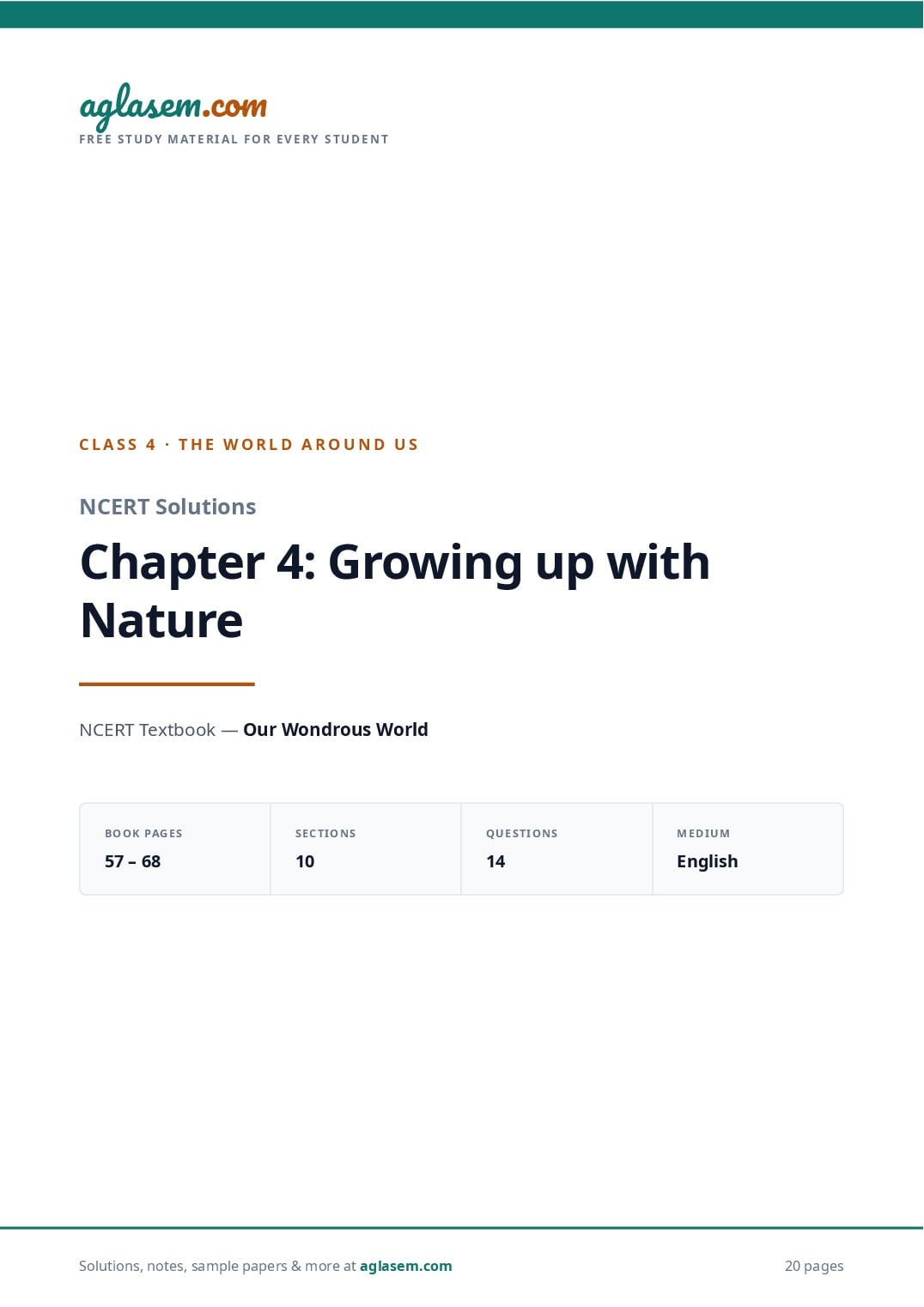
CLASS 4 · THE WORLD AROUND US
NCERT Solutions
Chapter 4: Growing up with
Nature
NCERT Textbook — Our Wondrous World
BOOK PAGES SECTIONS QUESTIONS MEDIUM
57 – 68 10 14 English
Solutions, notes, sample papers & more at 20 pages
Page 2
CLASS 4 · THE WORLD AROUND US · OUR WONDROUS WORLD
NCERT Solutions — Chapter 4: Growing up with Nature
Reena and Amit visit their village near a forest for a harvest festival. They see houses of clay and hay, colours
made from flowers, grain stored in neem-lined pots, and a whole village lit by the sun.
TEXTBOOK BOOK PAGES
Our Wondrous World (Class 4) 57 – 68
SECTIONS QUESTIONS
10 14
MEDIUM
English
Activity 1 — Page 58
Welcome to the Village!
ACTIVITY
Q1 Write names of five colourful flowers in your area. For example, Palash is called
Kesuda in Gujarat.
This is a finding-out activity. Look at real flowers near you and write both their names.
NAME OF THE LOCAL DRAW AND COLOUR FLOWER OF YOUR
FLOWER NAME CHOICE
What to do
1. Walk around your home, your school and a nearby park.
2. Look for flowers with bright colours. Note five of them.
3. Ask an elder the name people use for each flower in your language.
4. Write the common name and the local name side by side.
5. Pick one flower you like and draw it. Colour it the way you saw it.
What a correct answer shows: the same flower often has a different name in each state.
Palash is called Kesuda in Gujarat and Tesu in many other places.
Page 1 of 20
Page 3
Sample answer:
NAME OF THE LOCAL NAME DRAW AND COLOUR FLOWER OF YOUR
FLOWER CHOICE
Palash Kesuda (Gujarat), An orange-red flower shaped like a parrot’s beak
Tesu
Marigold Genda A round yellow or orange flower with many petals
Hibiscus Gudhal, Jaswand A big red flower with five petals
Rose Gulab A pink flower with soft curled petals
Sunflower Surajmukhi A large yellow flower with a brown centre
Why it happens: people in each region name a flower in their own language. So one
flower can have many names, but it is still the same flower.
Note about the book: the question asks for five flowers, but the printed table has
only three rows. Write three in the book and the last two in your notebook.
Did you know? Palash is called the ‘flame of forest’ because a forest full of these
flowers looks reddish-orange from far away.
Activity 2 — Page 60
Welcome to the Village!
ACTIVITY
Q1 Make the model of a house using materials from nature such as clay, wooden sticks,
hay, grass, leaves, etc. Decorate it with an art form of your choice.
Build a small hut with things you can collect outside. Here is one simple way.
What to collect
Soft clay or mud, and a little water
Thin wooden sticks or twigs
Dry grass, hay or straw
Big dry leaves
Page 2 of 20
Page 4
A piece of cardboard for the base
Steps
1. Put the cardboard flat. This is the ground of your house.
2. Push four sticks into small lumps of clay to make the corners.
3. Roll the clay into flat strips. Press them between the sticks to make walls.
4. Leave one gap for a door and one small gap for a window.
5. Tie a few sticks into a slanting frame for the roof.
6. Spread hay, grass or leaves over the frame. The roof is ready.
7. Let the clay dry for a day.
8. Decorate the walls with an art form you like.
Clay walls, stick frame, hay roof
base
A simple model hut: clay walls on a cardboard base, a stick frame, and a roof of dry hay.
Sample answer: “I made a mud hut on a cardboard base. The walls are of clay and the roof is of
dry hay. I painted the front wall with white lines and flowers, like Gond art. I used a dye made
from rice flour and water, as Amit’s grandmother did.”
Why houses are made this way: clay, hay and cow dung are found right there in
the village. They cost nothing, and they keep the house cool in summer and warm in
winter.
Page 3 of 20
Page 5
a
Class 4 The World Around Us Chapter 4 Growing up with Nature
g l AglaSem · NCERT Solutions
co m
m.
Tip: the walls in the chapter are painted with a dye made by mixing rice flour and
m as e
l
water. You can make the same paste at home and paint your model with it.
m .co a g
l a se
a g
Activity 3 — Page 60
com
. ag
Welcome to the Village!
e m
ACTIVITY
g l as
a
Q1 Let us prepare a natural dye. Step 1. Collect some flowers, leaves, barks, and roots,
co m
m.
such as beetroot, hibiscus, and marigold that have colouring properties. Step 2. Boil
o m l a se
any of the collected plant parts in approximately 1 – 2 litres of water for 30 minutes
c hour covering the container with a plate. (Please take
to.an a ghelp from your teacher
m
se or an elder.) Step 3. Strain the liquid to remove the plant materials, leaving behind
a
agl the natural dye. Now, try to paint a piece of cloth such as a light-coloured
s
handkerchief or hand towel using the dye you have prepared. Note that you need
m a
.co agl
to soak the cloth overnight, squeeze it and dry it the next morning.
se m
g l a
a
Do the three steps in order, with an elder near you. Then dye a small white cloth.
co m
What to do
m .
m as e
cowell. g l
1. Collect one plant part that has strong colour. Beetroot, hibiscus petals or marigold petals
. a
sem
work
a 2. Put it in a pot with about 1 to 2 litres of water.
agl 3. Cover the pot with a plate. Boil for 30 minutes to 1 hour. Ask a teacher or an elder to do
se m
coam l a
the boiling.
. a g
m
4. Let it cool. Strain it through a cloth or sieve. The coloured water left behind is your dye.
l a se in the dye. Leave it soaked overnight.
ag cloth and dry it in the shade.
5. Put a light-coloured handkerchief
6. Next morning, squeeze the
What a correct result looks like
co m
m .
m as e
.co
PLANT PART USED COLOUR YOU SHOULD GET
a g l
a s em Beetroot
gl
Pink to deep red
a c
m .
e
Hibiscus petals Purple-red
m Bright yellow a s
Marigold petals
e m . co agl
g l as
Onion skins
a Golden brown
co m
m .
m ase
.co
a g l Page 4 of 20
Page 6
Sample answer: “I boiled beetroot pieces in water for about half an hour. The water turned
deep pink. I strained it and soaked my white handkerchief in it all night. In the morning I
squeezed it and dried it. My handkerchief became pink.”
Why it works: the colour is already stored inside the flower, the root or the bark. Hot
water pulls that colour out of the plant and holds it. That coloured water is a natural
dye.
Safety tip: never boil the water yourself. Stand away from the hot pot and let an
elder strain the liquid.
Activity 4 — Page 62
Welcome to the Village!
ACTIVITY
Q1 Find out some traditional ways of preserving grains and vegetables at your place,
and fill the following table. One example is given.
NAME COMMONLY USED IN DETAILS OF THE CONTAINER
WHICH STATE
Tumri Uttarakhand Constructed with a round or oval shaped
dried bottle gourd
The table as it is printed in the book, with the one example already filled in.
Ask at home how grain was stored before plastic and steel came. Then fill the table.
Page 5 of 20
Page 7
NAME COMMONLY USED IN WHICH DETAILS OF THE CONTAINER
STATE
Tumri Uttarakhand Constructed with a round or oval shaped dried
bottle gourd
What to do
1. Ask your grandmother or a neighbour how they stored rice, wheat or dal long ago.
2. Ask what the container was made of, and what was put inside with the grain.
3. Write the name people use for that container.
4. Write the state where it is used, and one line about how it is made.
Sample answer:
NAME COMMONLY USED IN DETAILS OF THE CONTAINER
WHICH STATE
Tumri Uttarakhand Constructed with a round or oval shaped dried bottle
gourd
Matka (earthen Many states A baked clay pot. Neem leaves are spread inside
pot) before the grain is poured in.
Tokri (bamboo Assam, Odisha, Nagaland A basket woven from bamboo strips. Cow dung is
basket) coated on the outside.
Kothi (mud Rajasthan, Madhya Pradesh A large bin built of clay and straw. It stands inside the
bin) house and has a small mouth on top.
Why these containers work: the chapter tells us the secret. Neem leaves inside the
pot and cow dung outside the basket keep insects and pests away. So the grain stays
good for many months without any medicine.
Tip: your own answer should name containers used in your state. The table above is
only a sample to compare with.
Activity 5 — Page 63
Page 6 of 20
Page 8
Welcome to the Village!
ACTIVITY
Q1 Discuss with the elders in your family and write the name of the plant, its parts,
and its uses, in the table given below.
NAME OF THE PLANT PARTS OF THE PLANT USE(S)
Indian basil (Tulsi) Leaves
Carom seeds (Ajwain)
The table as it is printed in the book, with the first two plant names already filled in.
Ask the elders at home which plants they use when someone is unwell. Then fill the table.
NAME OF THE PLANT PARTS OF THE PLANT USE(S)
Indian basil (Tulsi) Leaves
Carom seeds (Ajwain)
What to do
1. Ask your mother, father or grandparents about home remedies they use.
2. For each one, ask which part of the plant is used — leaf, seed, root or bark.
3. Write the plant name, the part, and what it is used for.
Sample answer:
Page 7 of 20
Page 9
NAME OF THE PARTS OF THE USE(S)
PLANT PLANT
Indian basil (Tulsi) Leaves Boiled in tea or chewed for cough and cold
Carom seeds (Ajwain) Seeds Boiled in water and taken for stomach pain
Neem Leaves and oil Leaves are kept with stored grain; neem oil keeps
mosquitoes away
Ginger (Adrak) Underground stem Put in tea for sore throat and cough
Turmeric (Haldi) Root Mixed in warm milk; a paste is put on a small cut
Why this matters: many medicines start as plants. Different parts hold different
useful things — the leaf of tulsi, the seed of ajwain, the root of turmeric. That is why
we must say which part is used.
Tip: the chapter shows this too. Dada ji’s bottle holds a mixture made with neem oil,
and rubbing it on hands and feet keeps mosquitoes away.
Discuss — Page 63
Welcome to the Village!
DISCUSS
Q1 What things should be kept in a first-aid box?
A first-aid box should hold simple things that help with a small injury.
Cotton wool and a roll of bandage
Sticking plaster (band-aid) of two or three sizes
An antiseptic liquid, such as Dettol, to clean a wound
An antiseptic cream for cuts and scrapes
A pair of small scissors
A thermometer
Packets of ORS for loose motions
Mosquito repellent cream, or a neem oil mixture like Dada ji’s
Simple medicines given by a doctor, and a torch
Page 8 of 20
Page 10
a
Class 4 The World Around Us Chapter 4 Growing up with Nature
g l AglaSem · NCERT Solutions
co m
em.
cm
A ofirst-aid box
g l as
m . a
a s e
agl
co m
em . ag
g l as
a
co m
m.
cotton antiseptic
m as e
.co a g l
se m
g l a
a A first-aid box carries a red cross, and holds cotton, bandage and an antiseptic bottle.
m a s
e
. c o
m be cleaned first and then covered. The agl
s
Why these things: a small hurt must
a g la and the bandage covers so that dust and germs
antiseptic cleans, the cotton wipes,
stay out.
. c om
m a s
Tip: keep the box in one fixed place, where everyone at home can emreach it quickly.
. co take a medicine from it without asking an elder. agl
em
Never
a s
agl
se m
Q2
com
Why do you think providing first-aid is important if someone gets injured?
g l a
m . a
ase
agl
First-aid is the first help given right after someone gets hurt, before a doctor comes.
co m
.
It is important for four reasons.
em
om
1. It stops the bleeding quickly.
g l as
2..cIt cleans the wound, so germs and dirt do not go in. a
asem
agl
3. It reduces the pain and makes the hurt person feel calm.
4. It stops a small injury from becoming a big one.
.c
s e m
m a
co agl
Example: a child falls and scrapes her knee. You wash the knee, put antiseptic on it and cover it
m .
e
with a bandage. The wound stays clean and heals fast.
g l as
a
com
m .
m ase
.co
a g l Page 9 of 20
Page 11
Why speed matters: an open wound lets germs in. The sooner it is cleaned and
covered, the less chance there is of the wound getting infected.
Remember: first-aid is only the first step. For a deep cut, a burn or a bad fall, always
take the person to a doctor.
Activity 6 — Page 65
Sparkling Light, Happy Life
ACTIVITY
Q1 Find out the traditional dances and songs of your region. Perform a traditional
dance with the help of your classmates and teachers for the Annual Day of your
school.
First find out, then practise, then perform. Here is how.
What to do
1. Ask your grandparents and your teacher the name of the dance of your region.
2. Ask when it is danced — at harvest, at a festival, or at a wedding.
3. Find out the dress and the instruments used, such as the dhol or the nagada.
4. Learn the song that goes with it. Write down two or three lines.
5. Make a group of six to eight friends and practise the steps together.
6. Perform it on Annual Day with your teacher’s help.
Sample answer — some traditional dances of India:
DANCE STATE WHEN IT IS DANCED
Bihu Assam At the Bihu harvest festival
Garba Gujarat During Navratri
Bhangra Punjab At Baisakhi, after the harvest
Ghoomar Rajasthan At festivals and weddings
Lavani Maharashtra At fairs and festivals
Bhangra / Chhau / Karma Jharkhand, Odisha At sowing and harvest time
Page 10 of 20
Page 12
Why so many dances come at harvest: a good harvest is a gift from nature. People
dance and sing to say thank you for it. In the chapter, the villagers first offer prayers
to God and to mother nature, and only then the dhol and nagada begin.
Tip: write your own state’s dance in the first row. The table above is only a sample.
Discuss — Page 65
Sparkling Light, Happy Life
DISCUSS
Q1 Imagine if there is no electricity in your area for two days. What changes will you
see in your life?
Almost everything that runs on a switch would stop. Life would slow down.
WHAT STOPS WHAT WE WOULD DO INSTEAD
Lights at night Use candles, an oil lamp or a torch
Fan and cooler Use a hand fan and sit outside in the breeze
Fridge Cook only as much food as we can eat at once
TV, mobile charging Play outdoor games and talk with the family
Water pump Draw water from a handpump or a well
Mixer, iron, washing machine Grind on a stone and wash clothes by hand
Sample answer: “For two days our house would be dark after sunset. I would finish my
homework in daylight and sleep early. We would eat fresh food because the fridge would not
work. Water would have to be carried from the handpump.”
Why this is worth thinking about: it shows how much we depend on electricity.
That is why Reena and Amit’s village turned to the sun. Solar panels make electricity
from sunlight, so the village can stay lit without burning anything.
Page 11 of 20
Page 13
Tip: we can save electricity every day. Switch off lights and fans when you leave a
room.
Activity 7 — Page 66
Sparkling Light, Happy Life
ACTIVITY
Q1 Talk to your elders and find out the rituals in connection to animals and plants
which are celebrated in your locality. A few examples are given below.
Ask the elders which festivals in your place are tied to a plant or an animal. Then fill the two
empty rows.
NAME OF THE FESTIVAL PLANTS/ANIMALS ASSOCIATED ACTIVITY
Vat Purnima Banyan tree Worshipping
Hari Jiroti Fruit-bearing trees Plantation
Kaziranga Elephant Festival Elephant Awareness drive
What to do
1. Ask your grandparents which festivals in your locality are about a tree or an animal.
2. Ask what people actually do on that day — worship, plant saplings, or feed animals.
3. Write the festival, the plant or animal, and the activity.
Sample answer:
Page 12 of 20
Page 14
NAME OF THE PLANTS/ANIMALS ACTIVITY
FESTIVAL ASSOCIATED
Vat Purnima Banyan tree Worshipping
Hari Jiroti Fruit-bearing trees Plantation
Kaziranga Elephant Elephant Awareness drive
Festival
Tulsi Vivah Tulsi plant Worshipping and decorating the plant
Mattu Pongal Cows and bulls Bathing, decorating and feeding the
cattle
Other examples you may hear about: Nag Panchami (snakes are worshipped), Van Mahotsav
(saplings are planted), and Chhath (the Sun is thanked with fruit and sugarcane).
Why we do this: the chapter says it plainly. We worship many plants and animals in
different parts of our country, and this shows our rich tradition of respecting and
protecting nature.
Notes about the book: (1) The English book calls the banyan-tree festival Vat
Purnima, while the Hindi book calls it Vat Savitri. Both names are used in India for a
festival of the banyan tree. (2) On page 67 the book prints “Oraganise a clean-up
drive”. The correct spelling is “Organise”.
Let us reflect — Pages 67–68
Caring for plants and animals
LET US REFLECT
Q1 What are the things that we use from nature in our daily life?
We take something from nature for almost every need. Fill the table like this.
Page 13 of 20
Page 15
a
Class 4 The World Around Us Chapter 4 Growing up with Nature
g l AglaSem · NCERT Solutions
co m
m.
ACTIVITIES COLLECTED FROM NATURE
m as e
Eating
.co
Fruits
a g l
se m
g l a
Clothing Cotton
a
Healthcare Neem
co m
Any other
em . ag
g l as
Completed table: a
co m
m.
ACTIVITIES COLLECTED FROM NATURE
m as e
Eating
.co
Fruits Vegetables
a
Rice and wheat
g l Milk and honey
se m
g l a
Clothing Cotton
a
Jute Wool Silk
s
Healthcare Neem Tulsi Ajwain Turmeric
coformpots Bamboo for baskets a
Any other
e m . agl
as
Wood for furniture Clay Water and air
a g l
Why the list is so long: nothing we use is made out of nothing. Our food, clothes,
medicines and homes all begin with a plant, an animal, the soil or the water. That is
co m
m .
why nature must be looked after.
m ase
.co a g l
s m look around your own room. Count how many things came from a plant, an
eTip:
gl a
a animal or the earth. You will be surprised.
se m
com g l a
m . a
gl ase
a
Q2 What challenges arise when we overuse natural resources? For example, if we
overuse wood from nature, our forests deplete. Water: ______ Soil: ______ Sea products:
______ Any other: ______
co m
m .
m as e
.co
a g l
s e mOverusing anything from nature leaves less of it for later. Fill the blank lines like this.
agla
.c
s e m
m a
e m . co agl
g l as
a
co m
m .
m as e
.co
a g l Page 14 of 20
Page 16
RESOURCE WRITE HERE
Water
Soil
Sea products
Any other
Answer:
RESOURCE WHAT GOES WRONG WHEN WE OVERUSE IT
Water Wells, ponds and rivers dry up. There is less water to drink and less for the fields.
Soil The soil becomes weak and bare. Crops grow poorly and the land turns hard.
Sea products Fish become fewer. Fishermen catch less, and some sea animals may disappear.
Any other (wood) Forests are cut down. Birds and animals lose their homes and the air gets dirtier.
Why this happens: nature fills up slowly. A tree takes many years to grow and rain
fills a pond only once a year. If we take faster than nature can replace, the store runs
out.
Try this: close the tap while brushing your teeth. Count how many mugs of water
you save in one week.
Q3 How can we protect the natural environment around us? At home / At school / In
parks / In our locality
The book gives four places. Write one or two simple acts under each picture.
Page 15 of 20
Page 17
At home At school In parks In our locality
Four places from the book — a home, a school, a park and a locality — with an empty box under
each.
Answer:
PLACE WHAT WE CAN DO
At home Save water and switch off lights and fans. Grow plants in pots. Carry a cloth bag to the market.
At school Plant trees in the school garden. Use both sides of the paper. Keep a bowl of water for birds.
In parks Do not pluck flowers or leaves. Throw wrappers only in the dustbin. Do not trouble the birds.
In our locality Join a clean-up drive. Say no to plastic. Plant saplings and tell others to save trees.
Why small acts count: a park stays green because many people each do one small
thing. One person picking up one wrapper, done by a hundred people, cleans a
whole park.
Tip: the chapter lists three ways on page 66 — reduce paper waste, say no to plastic,
and spread awareness about saving plants. Use them in your answer.
Page 16 of 20
Page 18
Q4 Design your herbal garden. Here is a space for your herbal garden. Draw pictures of
your favorite herbs in different parts of the garden and write down their names.
Are there some herbs that you like less? Draw them too!
An herbal garden is a garden of plants used as medicine. Draw your own inside the space given.
MY GARDEN
The empty garden space printed in the book, with a signboard that reads MY GARDEN.
What to do
1. Divide the white space into four or five patches with light pencil lines.
2. Draw one herb in each patch. Keep the drawing simple.
3. Write the name of the herb neatly below each drawing.
4. Now draw one or two herbs you like less, in a corner patch. Name them too.
5. Colour the leaves green and the flowers in their own colours.
Herbs you can draw
Page 17 of 20
Page 19
HERB HOW TO DRAW IT WHAT IT IS USED FOR
Tulsi A short bushy plant with small pointed leaves Cough and cold
Pudina (Mint) Low plant with round crinkled leaves Stomach upset; put in chutney
Ajwain Thick soft leaves close to the ground Stomach pain
Aloe vera Long thick leaves with tiny spikes at the edge Burns and skin problems
Adrak (Ginger) Tall thin leaves; draw the root below the soil Sore throat and cough
Neem A small tree with many narrow leaves on one stalk Keeps insects away
Tulsi Pudina
Aloe vera Ajwain
MY GARDEN
Sample answer: the garden divided into four patches, one named herb drawn in each.
Sample answer: “My garden has four patches. Tulsi is in front because we use it most. Pudina is
beside it. Aloe vera and ajwain are at the back. I also drew neem in a corner, although I do not
like its bitter smell.”
Why draw the ones you like less too: a herb is useful even when we do not like its
taste or smell. Neem is bitter, but it keeps insects away from stored grain. Usefulness
and liking are not the same thing.
Page 18 of 20
Page 20
a
Class 4 The World Around Us Chapter 4 Growing up with Nature
g l AglaSem · NCERT Solutions
co m
m.
Note about the book: page 68 prints “favorite”. The rest of the book uses British
m as e
l
spelling, so it should read “favourite”.
.co a g
a s em
gl this: plant one tulsi or pudina cutting in a pot at home. Water it a little every day
aTry
and watch it grow.
com
e m . ag
g l as
a
Chapter at a glance
co m
se m.
m a
Reena and Amit travel to their village near a forest at harvest time.
o
.c day their village became a fully solar-powered village. ag l
m
On that
l a se houses are made of clay, hay, cow dung and other natural materials.
g
Village
a Grandmother's paints come from flowers, leaves and powdered coloured stones.
s
Neem leaves inside pots and cow dung outside baskets keep stored grain safe.
m a
.co
People pray to nature, dance to the dhol and nagada, and protect sacred groves.
m agl
l a se
a g
co m
m .
m as e
.co a g l
se m
g l a
a
se m
com g l a
m . a
ase
agl
co m
m .
m as e
.co a g l
se m
g l a
a c
m .
m a s e
e m . co agl
g l as
a
co m
m .
m ase
.co
a g l Page 19 of 20
Page 21
Quick revision
WORD WHAT IT MEANS WHERE IT COMES IN THE KEEP IN MIND
CHAPTER
Palash A tree with bright orange-red Reena sees it as the family It is called the ‘flame of
flowers enters the village, page 58 forest’
Kesuda The name for Palash used in Activity 1, page 58 One flower can have many
Gujarat local names
Natural Colour made by boiling Activity 3, page 60 Beetroot, hibiscus and
dye flowers, leaves, bark or roots marigold give colour
Gond art Painting on walls with natural Do you know? box, page 60 Artists draw trees, animals,
colours birds and people
Neem Leaves lined inside earthen Page 61 They keep stored grains safe
leaves pots from insects
Tumri A container made from a dried Activity 4, page 62 It is used in Uttarakhand
bottle gourd
Jenu A tribe of Karnataka whose Do you know? box, page 62 They sing to say sorry to the
Kurubas name means honey bees
First-aid A box of things used to treat a Page 63 Reena keeps medicines and
box small injury mosquito cream in it
Sacred A small patch of forest cared Do you know? box, page 65 Its trees and wild animals
Grove for by local people stay safe
Vat A festival in which the banyan Activity 7, page 66 We worship many plants and
Purnima tree is worshipped animals
Herbal A garden of plants that are Let us reflect, page 68 Tulsi and ajwain are herbs
garden used as medicine
Page 20 of 20
Document Details
| Board / Org | NCERT |
| Exam | Class 4 |
| Type | Solution |
| Pages | 21 |
| Language | english |
| Updated | 19 Sep 2026 |