Kerala SET 2019 Jul Question Paper _26_
Finished viewing? Save it for later —
Download Kerala SET 2019 Jul Question Paper _26_ (PDF · 11 pages)About Kerala SET 2019 Jul Question Paper _26_
Kerala SET 2019 Jul Question Paper _26_ is available here for free download. Published by Kerala Exams for Kerala SET, this question paper can be viewed online or downloaded as a PDF (11 pages). Candidates preparing for Kerala SET can use Kerala SET 2019 Jul Question Paper _26_ to understand the exam pattern, the type of questions asked, and the overall difficulty level.
Frequently Asked Questions
How can I download Kerala SET 2019 Jul Question Paper _26_?
Open this page and click the Download button to save Kerala SET 2019 Jul Question Paper _26_ as a PDF. It is completely free on AglaSem Docs.
Is Kerala SET 2019 Jul Question Paper _26_ free to download?
Yes. Kerala SET 2019 Jul Question Paper _26_ can be viewed online and downloaded as a PDF free of cost on AglaSem Docs.
How many pages does Kerala SET 2019 Jul Question Paper _26_ have?
Kerala SET 2019 Jul Question Paper _26_ contains 11 pages, which you can read online or download together as a single PDF.
Where can I find more Kerala SET study material?
You can find more Kerala SET question papers, sample papers, syllabus, and answer keys on AglaSem Docs.
Kerala SET 2019 Jul Question Paper _26_ – Text
Read the full text of this question paper below — useful to quickly search, copy and reference the content online without downloading the PDF.
📄 View text version (11 pages)
Page 1
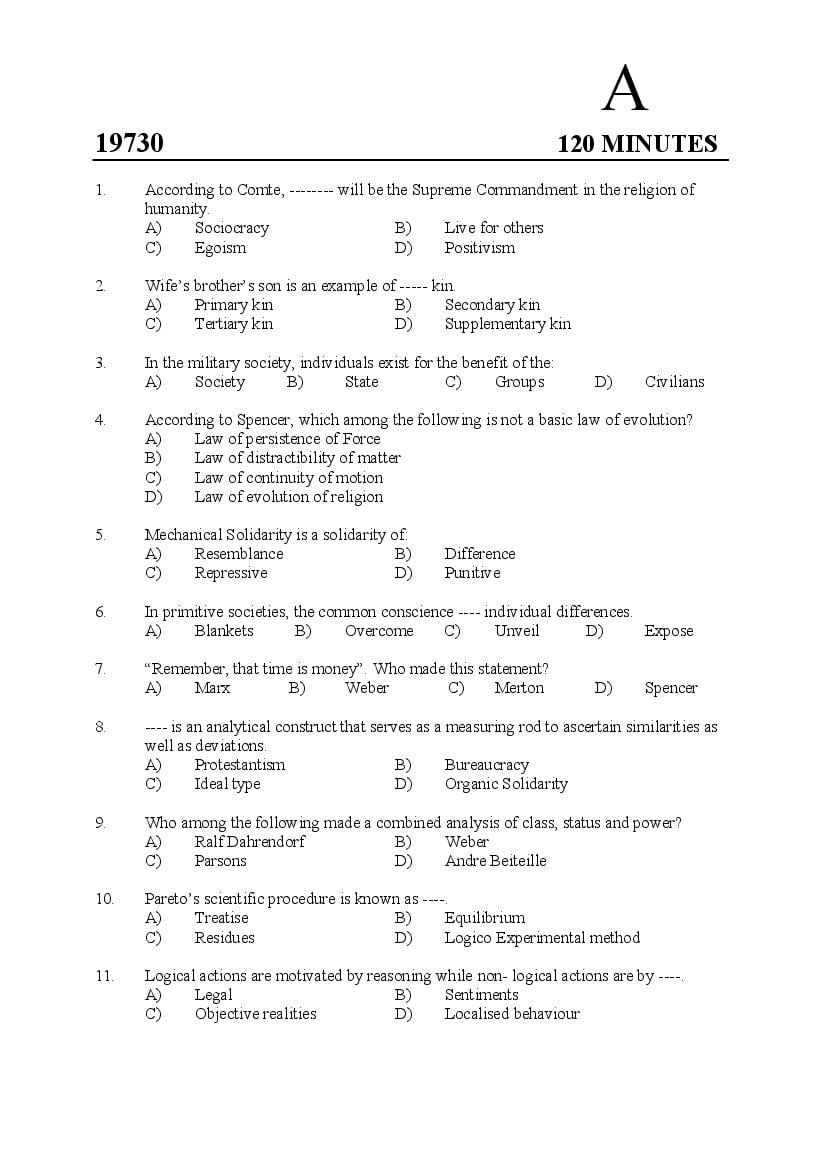
19730 120 MINUTES
1. According to Comte, -------- will be the Supreme Commandment in the religion of
humanity.
A) Sociocracy B) Live for others
C) Egoism D) Positivism
2. Wife’s brother’s son is an example of ----- kin.
A) Primary kin B) Secondary kin
C) Tertiary kin D) Supplementary kin
3. In the military society, individuals exist for the benefit of the:
A) Society B) State C) Groups D) Civilians
4. According to Spencer, which among the following is not a basic law of evolution?
A) Law of persistence of Force
B) Law of distractibility of matter
C) Law of continuity of motion
D) Law of evolution of religion
5. Mechanical Solidarity is a solidarity of:
A) Resemblance B) Difference
C) Repressive D) Punitive
6. In primitive societies, the common conscience ---- individual differences.
A) Blankets B) Overcome C) Unveil D) Expose
7. “Remember, that time is money”. Who made this statement?
A) Marx B) Weber C) Merton D) Spencer
8. ---- is an analytical construct that serves as a measuring rod to ascertain similarities as
well as deviations.
A) Protestantism B) Bureaucracy
C) Ideal type D) Organic Solidarity
9. Who among the following made a combined analysis of class, status and power?
A) Ralf Dahrendorf B) Weber
C) Parsons D) Andre Beiteille
10. Pareto’s scientific procedure is known as ----.
A) Treatise B) Equilibrium
C) Residues D) Logico Experimental method
11. Logical actions are motivated by reasoning while non- logical actions are by ----.
A) Legal B) Sentiments
C) Objective realities D) Localised behaviour
Page 2
society, according to Marx.
A) Basic structure B) Superstructure
C) Dialectical process D) Conflict
13. At the height of the class conflict the pety bourgeoisie and the lumpen proletariat
became drawn into the rank of ----.
A) Bourgeoisie B) Pety bourgeoisie
C) Proletariat D) Capitalist
14. Marx identified four stages of human history on the basis of mode of production. They
are primitive Communism, ----, feudalism and Capitalism.
A) Ancient Slave production B) Semi-feudalism
C) Pre-capitalism D) None of these
15. Which of the following logic of Hegel was rejected by Marx?
A) Idealistic trammel B) Dialectics
C) Idealism D) Materialism
16. Protestant Ethic insists that work is a virtue in itself since it contributes to the ----.
A) Salvation B) Development of capitalism
C) Asceticism D) Glory of God
17. Who among the following explained Sociology as a humanistic discipline?
A) Thomas Luckman B) Derrida
C) Peter Berger D) Althusser
18. Adaptation, goal attainment, integration and --- are the functional prerequisites
according to Parsons.
A) Social change B) Equilibrium
C) Socialisation D) Pattern maintenance
19. Who advocated the functional unity of society?
A) Bronislaw Malinowski B) Coser
C) Parsons D) Robert K Merton
20. “Function refers to partial activity make to the total activity of which it is the part”.
Who defined?
A) Radcliff Brown B) Malinowski
C) Levistrauss D) Frans Boas
21. Malinowski’s functional analysis is largely based on ----.
A) Needs B) Tribes C) Culture D) Values
22. Authority Structure according to Dahrendorf involves relations of ---- and ----.
A) Superordination ,Subordination
B) Exploitation , Exploited
C) Function , non function
D) Legal , non legal principles
2
Page 3
A) Mind B) Vision
C) Looking glass self D) Feelings
24. Match the following:
List I List II
a. Homo Hierarchicus 1. Peter Bergert
b. Invitation to Sociology 2. Louis Dumont
c. Development as Freedom 3. Mead
d. Philosophy of the Present 4. Amarthya Sen
A) a-4, b-3, c-1, d-2 B) a-2, b-1, c-4, d-3
C) a-3, b-2, c-4, d-1 D) a-1, b-3, c-2, d-4
25. Who among the following introduced phenomenology to American Sociology?
A) Peter Berger B) Thomas Luckman
C) Alfred Schutz D) Humans
26. The study of folk or common sense methods employed by people to make sense of
everyday activities by constructing and maintaining social reality is called -----
A) Phenomenology B) Ethnomethodology
C) Dramaturgy D) Epistemology
27. ----- is a political act beyond the rules of established political system.
A) Ethnic conflict B) Subnationalism
C) Corruption D) Terrorism
28. The means by which a ruling/dominant group wins over a subordinated group through
ideas. Such a process according to Gramsci is called:
A) Hegemony B) Segregation
C) Restoration D) Social Cohesion
29. Power is not simply repressive or coercive but can be productive. Who proposed this
view?
A) Derrida B) Bourdieu C) Foucault D) Althusser
30. In Foucault’s discourse, he developed four strategies of knowledge and power which is
collectively called ----.
A) Disciplinary society B) Discontinuities
C) Proactive behaviour D) Biopower
31. Distanciation refers to the fact that:
A) Relationships are tied to locals
B) Relationships are no longer tied to specific locals
C) Relationships are unlimited
D) More relations are dangerous
32. ‘Recursivity’ according to Giddens theory of Structuration refers to ---.
A) Feedback B) Agency C) Structure D) Reflexivity
3
Page 4
A) Class consciousness B) False consciousness
C) Rationality D) None of these
34. “Human nature is freedom”. Who explained this?
A) Althusser B) Gramsci C) Habermas D) Homans
35. Match the following:
List I List II
a. Protection of certain Rights regarding freedom of speech 1. Article 334
b. Equality of Opportunity in public employment 2. Article 16
c. Reservation of seats in legislative bodies for SCs & STs 3. Article 338
d. National Commission for SCs & STs 4. Article 19
A) a-4, b-3, c-1, d-2 B) a-2, b-4, c-3, d-1
C) a-3, b-2, c-4, d-1 D) a-4, b-2, c-1, d-3
36. Public Sociology is associated with:
A) American Sociological Association
B) Indian Sociology
C) British Sociology
D) Marxian Sociology
37. Which of the following statement is correct?
A) Hypothesis must be specific
B) Hypothesis must be consistent with laws of nature
C) Hypothesis should be related to a body of theory
D) Hypothesis should always be correct
38. The role of concept is to establish some kind of ----
A) Link with social world B) Link with theory
C) Link with hypothesis D) Link with null hypothesis
39. Measurement of variables can be performed at four levels. They are nominal, ordinal,
interval and ---
A) Ratio B) Numerical C) Quantitative D) Explanatory
40. The sum total of all units that conform to some designated set of specification is called -----.
A) Sample B) Element C) Universe D) Parameters
41. Lottery method is an example of ----.
A) Non Probability B) Convenient sampling
C) Probability D) Quota sampling
42. ----- is a small scale replica and a rehearsal of the main study.
A) Pre test B) Pilot study
C) Action study D) Situation study
43. Research design provides us a ----.
A) Theory B) Sample
C) Experimental method D) Blueprint
4
Page 5
A) Indicators B) Responses
C) Dimensions D) Relative intensity
45. One of the limitations of questionnaire is:
A) Low cost B) Time saving
C) Greater anonymity D) Only for educated people
46. Focused Interview is one which is focused on a specific -----.
A) Group B) Topic C) Area D) Interest
47. Which among the following is not a purpose of Case study?
A) To probe the phenomenon deeply
B) To get anecdotal evidence
C) To refute a universal generalisation
D) To analyse the context
48. ---- is the most frequent value or score in the distribution.
A) Mean B) Median C) Mode D) Dispersion
49. Correlation between tests and criterion are called -----.
A) Validity Coefficient B) Reliability
C) Operational validity D) Pragmatic validity
50. Summated Rating scale is associated with -----.
A) Guttman B) Bogardus C) Likert D) Thurston
51. ------ is a firm belief that man is a reasonable animal able to think out of difficulty and
to serenity.
A) Anthropocentrism B) Rationalism
C) Idealism D) Humanism
52. ------ is a belief that through the use of science, reality could be understood and human
life could be made better.
A) Empiricism B) Intellectualism
C) Humanitarianism D) None of these
53. A way of writing for change and of relating to the world through policy initiative,
activism, and social movements is called ------.
A) Public Sociology B) Engaged Sociology
C) Reflexive Sociology D) Political Sociology
54. Assertion (A) : In a plural society minority groups often develop mistrust of the
majority.
Reason (R) : Minority groups are frequent targets of prejudice and discrimination.
A) Both (A) and (R) are true and (R) is the correct explanation of (A).
B) Both (A) and (R) are true and (R) is not the correct explanation of (A).
C) (A) is true, but (R) is false
D) (A) is false, but (R) is true
5
Page 6
A) Global warming B) Climate change
C) Waste disposal D) Rural Community care
56. Who among the following consider that class struggle as the engine of social change
and development?
A) Max Weber B) Marxian thinkers
C) Andre Gundar Frank D) Samir Amin
57. Who among the following proposed Intermediate technology for development?
A) Wallerstein B) Rostow C) M.K Gandhi D) Schumacher
58. Socialist conception of development proposes ------.
A) Structural flexibility B) Wellbeing
C) Social security D) Education of all
59. Champaran Agitation in Bihar was led by:
A) Gandhiji B) Naxals
C) Zagoria D) Communist party
60. Tebhaga movement was organised by -------.
A) Kisan Sabha B) Cultivators
C) Tenants D) Kisan unions
61. According to G.S Ghurye, which among the following is not a foundation of culture?
A) Toleration B) Religious consciousness
C) Justice D) Civilisation
62. Who among the following gave great importance to the role of language in the process
of nation building in India?
A) S.C Dube B) Ambedkar C) Kosambi D) G.S Ghurye
63. Match the following:
List I List II
a. Sociology 1. Ferdinand Tonnies
b. Sociography 2. E O Wilson
c. Sociobiology 3. J L Moreno
d. Sociometry 4. Auguste Comte
A) a-2, b-1, c-4, d-3 B) a-2, b-4, c-3, d-1
C) a-4, b-1, c-2, d-3 D) a-4, b-2, c-1, d-3
64. M.N Srinivas described the concept of ----- by explaining the interaction in ritual
context of different castes in Coorgs.
A) Functional unity B) Values
C) Varnas D) Purities
65. Who among the following conducted Village study at ‘Shamirpet’?
A) N.K Bose B) Yogendra Singh
C) S.C Dube D) Ranjit Guha
6
Page 7
culture:
A) M.N Srinivas B) A.R Desai
C) D. D Kosambi D) Radhakamal Mukerji
67. The Indian sociologist who considered that property relations are crucial because they
shape and control the objectives underlying production:
A) Dhanagare B) Andre Beteillie
C) A. R Desai D) T.K Oommen
68. The Indian sociologist who preferred to call him a “Marxiologist”:
A) D P Mukherji B) Romila Thapar
C) Louis Dumont D) Yogendra Singh
69. Facial expression is an example of ------ communication.
A) Paralanguage B) Para linguistics
C) Verbal D) Non verbal
70. Who among the following argued that Dalits should come forward, educate, organise
and agitate?
A) Sree Narayana Guru B) Ayyankali
C) Ambedkar D) Gandhiji
71. What was the purpose of Vienna Convention?
A) Control Global warming B) Protection of ozone layer
C) Promotion of education D) Strengthening technology
72. The ISO 14000 is a series of International Standards for -------.
A) Environmental Management
B) Environmental pollution
C) Environmental efficiency
D) Environmental degradation
73. Kyoto Protocol is a legally binding international agreement to reduce ------.
A) Air pollution B) Water pollution
C) Soil pollution D) Greenhouse gas emission
74. The book ----- is a milestone marking the birth of Environmental movements.
A) Threatened forest B) Silent Spring
C) Species Diversity D) Ecological Sanitation
75. The United Nations conference on Human Environment held in Stockholm was
implemented by the Government of India by creating the:
A) Environment Protection Act
B) Water Pollution Act
C) Air Pollution Act
D) Wildlife Protection Act
7
Page 8
solidarity is a necessary condition for political action?
A) K.C Alexander B) T.K Oommen
C) Barrington Moore D) William Logan
77. The Bill which conferred fixity of tenure to all types of tenants?
A) Kerala Agrarian Relations Bill
B) Abolition of Zamindari Bill
C) Janmikaram Payment Abolition Bill
D) Kudikidappu Bill
78. Janmom land in Cochin is known as ----- land.
A) Pandaravaka B) Puravaka
C) Verumpattom D) Pattomvaka
79. Among the following, who made a detailed analysis about land tenures in Kerala?
A) T.C Varghese B) Andre Beiteille
C) Robin Jefferey D) K.P Kannan
80. The patterns of settlement and dispersal of a population is called:
A) Population Explosion B) Population Change
C) Population distribution D) Population density
81. The process of entering one country from another to take a permanent or semi
permanent residence is called ------.
A) Migration B) Immigration
C) Net migration D) Out migration
82. Agrarian relation refers to the relation between:
A) Land owners and landless
B) Workers and non workers
C) Landlords and tenants
D) Those people engaged in the process of production
83. The committee which emphasised the principles of three-tier structure of local
governing bodies:
A) Sarkaria B) Ashok Mehta
C) Balwant Rai D) L.M Singhvi
84. One of the causes of failure of Gram Sabhas:
A) Lack of people’s participation
B) Lack of programmes
C) Lack of audit
D) Lack of Funds
85. Who among the following advocated free and compulsory education for Pulaya
peasants and workers?
A) Sree Narayana Guru B) Ayyankali
C) T.K Madhavan D) K. Kelappan
8
Page 9
awareness of their exploitation.
Reason (R) : Life history research encourages people to reflect upon the factors that
have shaped their life experiences.
A) Both (A) and (R) are true and (R) is the correct explanation of (A).
B) Both (A) and (R) are true and (R) is not the correct explanation of (A).
C) (A) is true, but (R) is false
D) (A) is false, but (R) is true
87. ------- refers to electronic media that work on digital codes.
A) Digital arts B) Digital media
C) Digital Convergence D) Digital technology
88. D P Mukherji asserted three principles of change which are recognised in Indian
tradition. They are Sruthi, Smriti and ------.
A) Beliefs B) Dharma C) Karma D) Anubhava
89. ------ are being established online and transcend geographical boundaries, eliminating
social restriction.
A) Internet B) Virtual Communities
C) Facebook D) Globalisation of news
90. ------ is an evolving business practice that incorporates sustainable development to a
company’s business model.
A) Corporate Social responsibility
B) Targeted marketing
C) Sustainable business
D) Conscious capitalism
91. ------- is an area of social living marked by some degree of social cohesion.
A) Society B) Association C) Committee D) Community
92. The Rotary Club is an example of ------.
A) Institution B) Association C) Committee D) Social group
93. W.G Sumner’s ------- book classified groups into ingroups and outgroups.
A) Groups B) Folklore C) Folkways D) Aggregates
94. ------ is a condition of competition.
A) Scarcity B) Values C) Conflict D) Morality
95. Caste system is believed to have a divine origin, while class is:
A) Conservative B) Closed
C) Secular D) Ascribed status
96. The feeling that one’s own culture is better than the other is called -----.
A) Acculturation B) Ethnocentrism
C) Diffusion D) Cultural relativism
9
Page 10
A) Sanction B) Contract C) Agreement D) Sacrament
98. ----- is a grouping of class which are related by traditions of common descent.
A) Moieties B) Phratry C) Avoidance D) Amitate
99. Who among the following had said that “Knowledge is Power “?
A) Francis Bacon B) Ivan Illich
C) Wilbert .E Moore D) Kingsley Davis
100. The major role of educational system according to Bourdieu is -----.
A) Elimination B) Power position
C) Accumulation of knowledge D) Inequality
101. The process whereby an individual internalises the norms of the group is called -----.
A) Self B) Culture C) Socialisation D) Learning
102. ------- is called Learned way of behaviour.
A) Subculture B) Culture C) Norms D) Personality
103. Who among the following used the term ‘Dominant Castes’?
A) M.N Srinivas B) G.S Ghurye
C) S.C Dube D) Senart
104. The practise of several brothers sharing the same wife is called:
A) Polyandry B) Non fraternal
C) Wife lending D) Fraternal Polyandry
105. Emotional base is a fundamental characteristic of -------.
A) Caste B) Family C) Class D) Kinship
106. Caste and class are the two aspects of -----.
A) Dialectics B) Social system
C) Stratification D) Social processes
107. Who among the following enlarged Durkheim’s concept of anomie into a general
theory of deviant behaviour?
A) R.K Merton B) Parsons C) Malinowski D) Pareto
108. Indian democracy is an example of -------.
A) Direct democracy B) Indirect democracy
C) Simple democracy D) Pure democracy
109. According to 2011 census, the density of population of India is:
A) 382 per sq. km B) 927 per sq. km
C) 933 per sq. km D) None of these
110. ------ is one of the factors that has contributed to the degradation of Indian politics.
A) Corruption B) Religion C) Terrorism D) Regionalism
10
Page 11
A) Corporates B) Multinationals
C) Bribe D) Black money
112. ------- poverty refers to whether or not individuals or groups feel they are poor.
A) Subjective poverty B) Relative poverty
C) Absolute poverty D) Visual poverty
113. Who wrote the famous book “Sociological Imagination”?
A) Max Weber B) C. Wright Mills
C) Giddens D) John Stewart Mills
114. ------ is the belief that ethnic or cultural groups can peacefully co-exist in a society and
show respect for one another’s cultures.
A) Globalisation B) Multiculturalism
C) Cultural racism D) Racialism
115. ------- refers to the culture of ordinary people particularly those living in pre-industrial
societies.
A) Mass culture B) Sub culture
C) Folk culture D) Popular culture
116. Who among the following examined the institution of family as a Universal social
institution?
A) George Peter Murdock B) Edmund Leach
C) William J. Goode D) Robin Fox
117. One of the functional pre requisite according to Parsons is -------.
A) Socialisation B) Equilibrium
C) Institutions D) Adaptation
118. Language is the ------ of culture.
A) Supportive B) Vehicle C) Dimension D) Foundation
119. ------ is a rule of marriage in which an individual has to marry outside his own group.
A) Endogamy B) Gotra Exogamy
C) Exogamy D) Village Exogamy
120. Static is tantamount to ----according to Comte.
A) Structure B) Dynamics C) Change D) Function
_____________________
11
Document Details
| Board / Org | Kerala Exams |
| Exam | Kerala SET |
| Type | Question Paper |
| Pages | 11 |
| Updated | 23 Oct 2026 |