Goa Board Class 10 Sample Paper 2026 Mathematics (E)
Finished viewing? Save it for later —
Download Goa Board Class 10 Sample Paper 2026 Mathematics (E) (PDF · 50 pages)About Goa Board Class 10 Sample Paper 2026 Mathematics (E)
Goa Board Class 10 Sample Paper 2026 Mathematics (E) is available here for free download. Published by Goa Board for Class 10, this sample paper can be viewed online or downloaded as a PDF (50 pages). Candidates preparing for Class 10 can use Goa Board Class 10 Sample Paper 2026 Mathematics (E) to understand the exam pattern, the type of questions asked, and the overall difficulty level.
Frequently Asked Questions
How can I download Goa Board Class 10 Sample Paper 2026 Mathematics (E)?
Open this page and click the Download button to save Goa Board Class 10 Sample Paper 2026 Mathematics (E) as a PDF. It is completely free on AglaSem Docs.
Is Goa Board Class 10 Sample Paper 2026 Mathematics (E) free to download?
Yes. Goa Board Class 10 Sample Paper 2026 Mathematics (E) can be viewed online and downloaded as a PDF free of cost on AglaSem Docs.
How many pages does Goa Board Class 10 Sample Paper 2026 Mathematics (E) have?
Goa Board Class 10 Sample Paper 2026 Mathematics (E) contains 50 pages, which you can read online or download together as a single PDF.
Where can I find more Class 10 study material?
You can find more Class 10 question papers, sample papers, syllabus, and answer keys on AglaSem Docs.
Goa Board Class 10 Sample Paper 2026 Mathematics (E) – Text
Read the full text of this sample paper below — useful to quickly search, copy and reference the content online without downloading the PDF.
📄 View text version (44 pages)
Page 1
ALTO-BETIM GOA 403521
Grade 10 Subject: MATHEMATICS
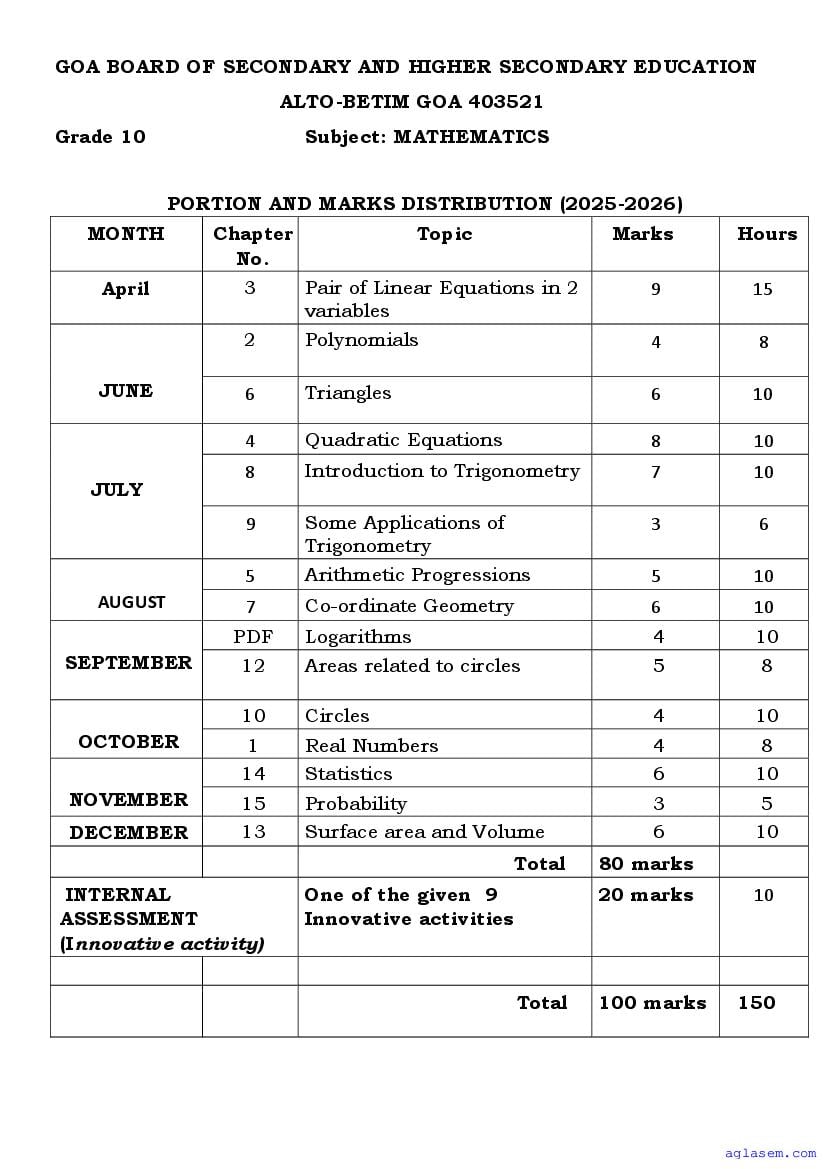
PORTION AND MARKS DISTRIBUTION (2025-2026)
MONTH Chapter Topic Marks Hours
No.
April 3 Pair of Linear Equations in 2 9 15
variables
2 Polynomials 4 8
JUNE 6 Triangles 6 10
4 Quadratic Equations 8 10
8 Introduction to Trigonometry 7 10
JULY
9 Some Applications of 3 6
Trigonometry
5 Arithmetic Progressions 5 10
AUGUST 7 Co-ordinate Geometry 6 10
PDF Logarithms 4 10
SEPTEMBER 12 Areas related to circles 5 8
10 Circles 4 10
OCTOBER 1 Real Numbers 4 8
14 Statistics 6 10
NOVEMBER 15 Probability 3 5
DECEMBER 13 Surface area and Volume 6 10
Total 80 marks
INTERNAL One of the given 9 20 marks 10
ASSESSMENT Innovative activities
(Innovative activity)
Total 100 marks 150
Page 2
ALTO-BETIM GOA 403521
Rationalised syllabus 2025 – 2026
Sub: Mathematics ( Level 1 and Level 2 )
Grade 10
Chapter Dropped topics Dropped topics
(Level 1) (Level 2)
1: Real Numbers 1.2 Euclid’s Division Lemma 1.2 Euclid’s Division Lemma
1.5 Revisiting Rational Numbers 1.5 Revisiting Rational Numbers
and their Decimal Expansions and their Decimal Expansions
2: Polynomials 2.4 Division Algorithm for 2.4 Division Algorithm for
Polynomials Polynomials
3: Pair of linear 3.4.3 Cross – Multiplication 3.4.3 Cross – Multiplication
equations in two Method Method
variables 3.5 Equation Reducible to a Pair 3.5 Equation Reducible to a Pair
of Linear Equations in Two of Linear Equations in Two
Variables. Variables.
4: Quadratic equations 4.4 Solution of a Quadratic 4.4 Solution of a Quadratic
Equation by Completing the Equation by Completing the
Square Square
* Word problems
5: Arithmetic No Deletions No Deletions
Progressions
6: Triangles 6.5 Areas of Similar Triangles 6.5 Areas of Similar Triangles
6.6 Pythagoras Theorem 6.6 Pythagoras Theorem
* Riders
7: Coordinate 7.4 Area of a Triangle 7.4 Area of a Triangle
geometry
8: Introduction to 8.4 Trigonometric Ratios of 8.4 Trigonometric Ratios of
Trigonometry Complementary Angles Complementary Angles
9: Some applications of No Deletions No Deletions
Trigonometry
10: Circles No Deletions No Deletions
11: Construction Entire chapter deleted Entire chapter deleted
Page 3
Circles Plane Figures Plane Figures
13: Surface Areas and 13.4 Conversion of Solid from 13.4 Conversion of Solid from
Volumes one Shape to Another one Shape to Another
13.5 Frustum of a Cone 13.5 Frustum of a Cone
14: Statistics 14.5 Graphical Representation 14.5 Graphical Representation
of Cumulative Frequency of Cumulative Frequency
Distribution Distribution
* Finding mean by Step –
Deviation method
15: Probability No Deletions No Deletions
*Logarithms (PDF) No Deletions No Deletions
# Note: For Level 2 ( Basic)
1) In the Chapter Pair of Linear Equations in Two Variables word
problems involving only lower order thinking skills to be included.
2) In the Chapter Introduction to Trigonometry, proving trigonometric
identities involving only lower order thinking skills to be included.
3) In the Chapter Some Applications of Trigonometry, word problems on
heights and distances involving only one angle (either angle of
elevation or depression) to be included.
Page 4
ALTO-BETIM GOA 403521
Exhaustive list of Activities to be performed as Internal Assessment
2025 – 2026
Sub: Mathematics ( Level 1 and Level 2 )
Grade 10
Sr.no. TITLE OF ACTIVITY
1) To find the mean, median and mode of data collected and draw its
cumulative frequency curves.
2) Body Mass Index (BMI).
3) Relationship between volume of a Cylinder and volume of a Cone
having equal heights and equal base areas.
4) To estimate the number of tiles required for the floor of a
classroom and cost of painting its walls.
5) Comparing the volume of Cylinders obtained by folding a
rectangular tin/cardboard/thick chart paper sheet along its length
and breadth.
6) To investigate the relationship between the dimensions of a
Cuboid, its total surface area and volume.
7) Fibonacci sequence and Golden rectangle.
8) Pascal’s Triangle.
9) To measure heights and distances using a Clinometer.
1
Page 5
cumulative frequency curves.
Aim: To find the mean, median and mode of the data collected and draw its
cumulative frequency curves.
Guidelines for students:
• Collect data [ for example – marks obtained in mathematics by the SSC
students of the previous year.]
• Construct a grouped frequency distribution table.
• Find the mean of the data by direct, assumed and step-deviation methods.
• Find the median and the mode of the data.
• Verify the empirical relationship between the three measures of central
tendency.
• Draw cumulative frequency curves of the less than type and the more than
type on a graph paper.
• Find the median of the data from the graph.
Learning outcomes:
This activity will help the students to
• gain practical knowledge of collecting data and calculating mean, median
and mode of grouped data.
• understand the graphical representation of cumulative frequencies.
• enhance their statistical and graphical skills in analyzing and interpreting
data.
• appreciate the practical application of descriptive statistics and graphical
methods in summarizing data.
2
Page 6
Aim: To calculate the Body Mass Index (BMI) of school students and its
implications on personal health Guidelines for students:
• Explore the concept of BMI, the BMI categories: underweight, normal
weight, overweight and obesity and their implications on health.
• Select minimum ten schoolmates and record their height (in meters) and
weight (in kilograms) in the table given below:
Schoolmate height(m) weight(kg) 𝑤𝑒𝑖𝑔ℎ𝑡 Inference
𝐵𝑀𝐼 =
(ℎ𝑒𝑖𝑔ℎ𝑡)²
1.
2.
10.
• Calculate the BMI for each selected schoolmate using the formula:
𝐵𝑀𝐼 = weight÷(ℎ𝑒𝑖𝑔ℎ𝑡)2 ; 𝑤ℎ𝑒𝑟𝑒 𝑤𝑒𝑖𝑔ℎ𝑡 𝑖𝑠 𝑖𝑛 𝑘𝑔 𝑎𝑛𝑑 ℎ𝑒𝑖𝑔ℎ𝑡 𝑖𝑠 𝑖𝑛 𝑚𝑒𝑡𝑒𝑟𝑠
• Record the calculated BMI values in the above table and draw inference
with the help of the table given below:
BMI INFERENCE
below 18.5 underweight
18.5 -24.9 healthy
25 and 29.9 overweight.
30 & above obesity
• Calculate the average BMI and the percentage of students of the different
categories for the selected group of school mates.
• Represent the data using a pie chart.
Note: The BMI of students of the whole school (if number is less) can finally be
compiled and represented by a pie chart.
Learning outcomes:
This activity will help the students to
• gain practical experience in calculating BMI and analyzing health data.
• understand the importance of BMI in assessing and maintaining personal
health.
• promote awareness of healthy lifestyle choices and provide guidance on
maintaining a balanced BMI.
3
Page 7
having equal heights and equal base areas.
Aim : To find the relationship between volume of a Cylinder and volume of a
Cone having equal heights and equal base areas.
Guidelines for students:
• Prepare a Cylinder and a Cone having same height and base area using
thick chart paper/cardboard.
• Calculate the volume of the Cylinder and the Cone using the formulae.
• Compare the calculated volumes of the Cylinder and the Cone.
• Verify the relationship by filling the Cone with fine sand/salt to its brim
and emptying it in the Cylinder until it is completely filled.
Learning outcomes:
This activity will help the student to
• gain practical experience in making geometric shapes (Cylinder and Cone)
• find out and appreciate the relationship between the volume of Cylinder
and Cone having equal heights and equal base areas leading to a deeper
understanding of the concept of volume of Cylinder and Cone.
4
Page 8
classroom and cost of painting its walls.
Aim: To draw the floor plan of a classroom and estimate the number of tiles needed
for the floor and the amount of paint required for the 4 walls. Guidelines for
students :
• Measure the length, breadth and height of a classroom.
• Measure the length and breadth of the door and windows of the classroom.
• Draw the plan of the classroom, including doors and windows on a graph
paper by choosing an appropriate scale for the above measurements.
• Calculate the total floor area of the classroom.
• Find the dimensions of the tile to be used for the floor and calculate its
area.
• Calculate the number of tiles needed to cover the entire floor area.
• Estimate the number of tile boxes required for the entire floor assuming
that there are 10 tiles in each box.
• Calculate the total area of the 4 walls.
• Calculate the total area of the door and windows.
• Calculate the area to be painted.
• Find the cost of painting the 4 walls given the cost per square meter and
estimate the amount of paint required in litres to paint the 4 walls.
Learning Outcomes:
This activity will help the students to
• gain practical experience in taking measurements, drawing plan,
calculating area, and estimating material requirements for tiling and
painting.
• enhance their skills in measurement, area calculation and estimation.
5
Page 9
rectangular tin/cardboard/thick chart paper sheet along its length and
breadth.
Aim: To compare the volumes of right circular Cylinders obtained by folding a
rectangular tin sheet/cardboard/thick chart paper along its length and breadth.
Guidelines for students:
• Take two congruent rectangular tin/cardboard/ thick chart paper sheets
where length is twice the breadth.
• Fold the first rectangular tin/cardboard/thick chart paper sheet along its
length to form a hollow cylinder. Fix a circular base, whose circumference
is equal to the breadth of the rectangle. Record the radius of the base and
height of the resulting Cylinder.
• Similarly create another Cylinder by folding along its breadth. Record the
dimensions of this second Cylinder.
• Calculate the volumes V₁ & V₂ of the two Cylinders using the formula :
• Repeat the same procedure for another set of congruent rectangles where
length is thrice the breadth.
• Record the observations in the following table
(I) Rectangle Dimensions: L× 𝑩; where L= 𝟐𝑩
Case i Case ii Comparison by taking
Cylinder obtained Cylinder obtained Positive Ratio
by folding along its by folding along its Difference
length breadth
r₁= ________ r₂= ________
V₁ −V₂ 𝑉₁
h₁= ________ h₂= ________
V₁= ________ V₂= ________ 𝑉₂
(II) Rectangle Dimensions: L× 𝑩; where L= 𝟑𝑩
Case i Case ii Comparison by taking
Cylinder obtained Cylinder obtained Positive Ratio
by folding along its by folding along its Difference
length breadth
r₁= ________ r₂= ________
V₁ −V₂ 𝑉₁
h₁= ________ h₂= ________
V₁= ________ V₂= ________ 𝑉₂
6
Page 10
rectangular tin/cardboard/ thick chart paper sheet along its length and
breadth in both the cases.
• Explain how changes in dimensions impact the volumes of the Cylinders.
• Conclude by summarizing the key observations and inferences.
Learning Outcomes:
This activity will help the students to
• gain a practical understanding of how folding a rectangular tin /cardboard
/thick chart paper sheet along its length and breadth affects the volumes
of the resulting Cylinders.
• observe the impact of changes in dimensions on the volumes of the
cylinders.
• connect geometric concepts with real-life applications and enhance their
spatial reasoning skills.
7
Page 11
Cuboid, its total surface area and volume.
Aim: To manipulate the dimensions of a Cuboid while keeping the total surface
area fixed and observe how these changes affect the Cuboid's volume, specifically
identifying a case where the volume is maximized.
Guidelines for students :
Three Dimensional Manipulations:
Manipulation 1 - Unequal dimensions ( l ≠ 𝑏 ≠ ℎ ):
• Prepare a Cuboid with all three dimensions l , b and h different .
• Calculate the Total Surface Area and Volume of the Cuboid.
Manipulation 2 – Any two dimensions equal ( l = b ≠ ℎ):
• Prepare another Cuboid having same total surface area, by choosing any
two dimensions equal and calculate the volume of the resulting Cuboid.
Manipulation 3 – Equal dimensions ( l = b = h ):
• Set all three dimensions equal to create a Cube having same total surface
area.
• Calculate the volume of the Cube.
• Record your observations in the table given below:
Solid Length Breadth Height TSA Volume
1 Cuboid
2 Cuboid
3 Cube
• Observe the relationship between the dimensions and the volume when
the total surface area is kept constant.
• Identify the manipulation that results in the maximum volume.
Learning Outcomes:
This activity will help the students to
• gain hands-on experience in manipulating dimensions of a Cuboid while
keeping the total surface area fixed.
• observe how changes in dimensions impact the volume of the Cuboid.
• enhance their understanding of optimization in geometry.
• appreciate the mathematical concepts involved in achieving specific
outcomes, such as maximizing volume while fixing the total surface area.
8
Page 12
Aim: To explore patterns in numbers through the Fibonacci sequence and the
golden rectangle and to understand their applications in real-life situations.
Guidelines for students:
• Explore the Fibonacci sequence as a series of numbers where each
number is the sum of the two preceding ones: 0, 1, 1, 2, 3, 5, 8, 13, 21, ...
• Explore the concept of the golden ratio and the golden rectangle, which
arises from the Fibonacci sequence.
• Explore the properties and patterns observed in the Fibonacci sequence,
such as the golden ratio (approximately 1.618) and its occurrence in
nature, art and architecture.
• Explore the properties and characteristics of the golden rectangle,
including its proportions and aesthetic appeal.
• Explore applications of the golden ratio and golden rectangle in art, design,
and aesthetics, such as in the compositions of paintings, sculptures, and
architecture.
• Investigate examples of the golden ratio and Fibonacci sequence in nature,
such as the spiral patterns of sunflowers, pinecones, and seashells.
• Construct a golden rectangle using the golden ratio and discuss the
properties and aesthetic appeal of the constructed golden rectangle.
Learning Outcomes:
This activity will help the students to
• gain an understanding of the properties and patterns of the Fibonacci
sequence and the golden rectangle.
• appreciate the applications of these mathematical concepts in various
disciplines, including art, architecture and nature.
• foster creativity and critical thinking by exploring real-life examples and
applications of mathematical patterns.
9
Page 13
Aim: To explore Pascal's Triangle, identify patterns within Pascal's Triangle and
understand their applications in real-life situations.
Guidelines for students:
• Explore Pascal's Triangle, its basic properties and its formation, where
each number in the triangle is the sum of the two numbers directly above
it.
• Explore the patterns within Pascal's Triangle, such as Fibonacci numbers,
binomial coefficients and triangular numbers.
• Observe how Pascal's Triangle relates to various mathematical concepts
like binomial expansions and probability.
• Create own variations of Pascal's Triangle such as rotating it, skipping
rows or using different starting numbers.
• Create visual representations of Pascal's Triangle and its patterns, using
diagrams or presentations.
• Prepare a report summarizing the project findings, including explanations
of observed patterns and connections to other mathematical concepts.
Learning Outcomes:
This activity will help the students to
• gain an understanding of the properties and patterns of Pascal's Triangle.
• appreciate the applications of Pascal's Triangle in Probability and Algebra.
• foster critical thinking and problem-solving skills by exploring real-life
examples and applications of mathematical patterns.
10
Page 14
Aim: To enable the students to measure the heights and distances of any object
in real life scenarios using a Clinometer.
Guidelines for students:
• Explore the importance of measuring heights and distances accurately
in various fields such as surveying, engineering and navigation.
• Prepare a clinometer- a tool to measure angles and know its basic
working principle. (Video link is given below for reference)
https://youtu.be/gHeiueRpX7U?si=-kaiAyxAL4tKc9fK
• Align the clinometer with the line of sight and measure the angle of
elevation/depression.
• Calculate the height/distance of the object using trigonometric ratios.
• In case you want only angles of elevation of 30⁰, 45⁰ or 60⁰ then adjust
your distance in front of the object till you obtain the above angles, then
take the required measurement and find the height of the object.
Learning Outcomes:
This activity will help the students to
• enhance their understanding of trigonometric concepts and their
practical applications in real-life scenarios.
• summarize the practical applications of using a clinometer in measuring
heights and distances.
11
Page 15
ALTO-BETIM GOA 403521
INTERNAL ASSESSMENT SCHEME 2025 - 2026
Sub: Mathematics ( Level 1 and Level 2 )
Grade 10
A list of 9 activities for Internal Assessment of 20 marks are given.
Student may choose any one activity based on his/her capacity.
Guidelines for each activity is provided for students. Teacher is free to give
additional guidelines.
Each activity is allotted maximum 20 marks.
Record of the activity (hard/ soft copy) of each student has to be
maintained, for scrutiny by the Board.
Assessment criteria for the activities is given below:
CRITERIA MARKS
1) Model prepared/Data collection 4mks.
(accuracy, neatness, creativity)
2) Computation 4mks
(logarithms may be used for calculations)
3) Project report 4mks
(Mathematical content, organisation ,
presentation, neatness, creativity, diagram if
any, resources used)
4) Oral presentation 4mks
(clarity, logical sequence, effective
communication)
5) Viva 4mks
(mathematical reasoning, critical thinking)
TOTAL 20 MARKS
Page 16
Criteria Excellent Good Satisfactory Needs
(4) (3) (2) improvement
(1)
Model prepared/ The model is The model is The model is The model is not
Data collected exceptionally attractive in acceptably attractive in
attractive in terms of attractive in terms of
terms of creativity, design terms of creativity, design
creativity, design and neatness creativity, design and neatness
and neatness and neatness
Data collected is Data collected is Data collected is Data collected is
exceptionally comprehensive somewhat not
comprehensive and neatly comprehensive comprehensive
and neatly organised and neatly and unorganised
organised organised
Content, Extremely good Good content Content and Content and
Resources, content and and resources resources used resources used
diagrams and resources used, used, Diagrams are satisfactory, are
computations Diagrams and and Diagrams and unsatisfactory,
computations are computations are computations are Diagrams and
accurate mostly accurate somewhat computations are
accurate not accurate
Activity Report Report is Report is well Report is Report is
extremely well organised and satisfactorily unorganised and
organised and written providing organised and written providing
written providing most of the written providing hardly any details
all the necessary necessary details few details.
details.
Oral Presented Presented with Presented with Not confidently
presentation confidently with good confidence logical sequence presented and no
precise logical and acceptably and clarity with logical sequence
sequence and precise logical satisfactory and clarity
clarity sequence and confidence
clarity
Viva Answered all the One or two Half of the One or two
questions correct questions questions questions
answered wrong. answered wrong. answered correct
Page 17
ALTO-BETIM GOA 403521
Mapping Syllabus with Curricular Goals and Competencies
2025 – 2026
Sub: Mathematics ( Level 1 and Level 2 )
Grade 10
Sr. Chapter Curricular Goals Competencies
No
1. Real Numbers CG – 1 C - 1.1
CG – 2 C - 2.1
2. Polynomials CG – 3 C - 3.1
C - 3.2
3. Pair of Linear Equations in CG – 3 C – 3.2
Two Variables CG - 4 C - 4.5
4. Quadratic Equations CG – 3 C - 3.2
C – 3.3
5. Arithmetic Progressions CG – 1 C- 1.1
CG – 9 C – 9.1
6. Triangles CG – 4 C - 4.1
C – 4.2
CG – 7 C – 7.3
CG – 9 C – 9.1
7. Coordinate Geometry CG – 4 C – 4.5
8. Introduction to Trigonometry CG – 4 C - 4.6
9. Some applications of CG – 4 C - 4.6
Trigonometry
10. Circles CG – 4 C - 4.3
C – 4.4
CG – 7 C – 7.3
11. Constructions Chapter deleted
Page 18
C – 4.4
CG – 7 C – 7.3
13. Surface Areas and Volumes CG – 5 C – 5.2
CG – 8 C – 8.2
C - 8.3
14. Statistics CG – 6 C - 6.1
CG - 9 C – 9.1
C – 9.2
15. Probability CG – 6 C – 6.2
CG - 11 C – 11.1
PDF Logarithms CG – 9 C - 9.1
C – 9.3
Competency Based Learning Outcomes
Sub: Mathematics Std: X
Chapter Name and Learning Outcomes
Serial No:
1. Real Number The learner
● Generalises properties of numbers and
relations among them studied earlier to evolve
results such as Fundamental theorem of
Arithmetic and applies them to solve problems
related to real life contexts.
● Finds LCM and HCF of the given two numbers
● Identifies and proves a given number is an
irrational number
2. Polynomials The learner
● Develops a relationship between algebraic and
graphical methods of finding the zeroes of a
polynomial
Page 19
and coefficients of a Polynomial
3. Pair of linear The learner
Equations in ● Finds solutions of pairs of linear equations in
two variables two variables using algebraic methods and the
graphical method.
● Solves problems related to real life context
4. Quadratic The learner
Equations ● Demonstrates strategies of finding roots and
determining the nature of roots of a quadratic
equation
● Formulates and solves the word problems
reducible to quadratic equations
5. Arithmetic The learner
Progressions ● Identifies the A.P from the given patterns of
numbers
● Applies the formulae of finding nthterm and
sum of n terms of an A.P to solve problems
● Develops strategies to apply the concept of A.P
to daily life situations
6. Triangles The learner
● Works out ways to differentiate between
congruent and similar triangles
● Identifies similar triangles using the definition
● Applies criteria of similarity of triangles to
prove two triangles are similar
● Applies the concept of similarity of two
triangles to find unknown angles, lengths or
perimeter.
● Establishes properties for similarity of two
triangles logically using different geometric
criteria established earlier such as Basic
Proportionality Theorem etc.
Page 20
Geometry ● Derives formulae to establish relations for
geometric shapes in context of coordinate
plane such as finding the distance between
two given points, to determine the coordinates
of a point between any two given points
● Applies distance formula and section formula
to solve the problems
8. Introduction The learner
to ● Determines all trigonometric ratios with
Trigonometry respect to a given acute angle of a right
triangle
● Finds the other trigonometric ratios when one
of the ratio is given
● Applies basic trigonometric identities to solve
the problems
9. Some The learner
applications ● Identifies angle of elevation and angle of
of depression
Trigonometry ● Uses trigonometric ratios in solving problems in
daily life contexts like finding heights of
different structures or distance from them
10. Circles The learner
● Demonstrates that the tangent to a circle is
special case of secant and only two tangents
can be drawn to a circle
● Derives proofs of theorems related to the
tangents of a circle
● Applies theorems to solve problems
11. Constructions Chapter deleted
12. Areas related The learner
to circles
Page 21
of sector and segments of circles to solve the
problems
● Develops strategies to apply the concept of
sector and segments of a circle to daily life
situations
13. Surface Areas The learner
and Volumes ● Find surface areas and volumes of objects in
the surroundings by visualising them as as a
combination of different solids like cylinder
and a hemisphere, combination of different
cubes etc.
● Applies the knowledge to solve real life
problems
14. Statistics The learner
● Calculates mean, median and mode for
different sets of data related with real life
contexts
15. Probability The learner
● Determines the probability of an event and
applies the concept in solving daily life
problems
16. Logarithms The learner
● Understands and applies laws of logarithms to
simplify the algebraic expressions
● Applies logarithms to solve real life problems
3.6.1 Pedagogy for Mathematics
Page 22
c.
d.
e.
f.
g.
h.
3.6.1.2 Some suggested methods of teaching
b.
c.
d.
e.
3.6.1.3 Integrating Mathematics with other Curricular Areas
a.
b.
Revised Bloom’s Taxonomy
Page 23
● Remembering: Exhibit memory of previously learned material
by recalling facts, terms, basic concepts and answers.
● Understanding: Demonstrate understanding of facts and ideas
by organizing, comparing, translating, interpreting, giving
descriptions and stating main ideas.
● Applying : Solve problems to new situations by applying
acquired knowledge, facts, techniques and rules in a different
way.
● Analysing: Examine and break information into parts by
identifying motives or causes. Make inferences and find
evidence to support generalization.
● Evaluating: Present and defend opinions by making judgments
about information, validity of ideas, or quality of work based on
asset of criteria.
● Creating: Compile information together in a different way by
combining elements in a new pattern or proposing alternative
solutions.
Page 24
ALTO-BETIM GOA 403521
DESIGN OF SSC FINAL EXAM QUESTION PAPER (2025-2026)
Subject : MATHEMATICS (E) - LEVEL 2 ( Basic )
Time : 3 hrs Grade 10 Max. Marks :80
**********************************************************************************
The weightage or the distribution of marks over different dimensions of the question
paper shall be as follows:
1. Weightage to the Learning objectives
Sr. No. Learning Objectives Marks Percentage of Marks
1. Remembering and 54 67.5%
Understanding
2. Applying 15 18.75%
3. Analysing , Evaluating 11 13.75%
and Creating
Total 80 100%
2.Weightage to the different areas of Content
Chapter No. Topic Marks
1. Real Numbers 04
2. Polynomials 04
3. Pair of Linear Equations in Two Variables 09
4. Quadratic Equations 08
5 Arithmetic Progressions 05
6. Triangles 06
7. Coordinate Geometry 06
8. Introduction to Trigonometry 07
9. Some Applications of Trigonometry 03
10. Circles 04
11. Areas Related to Circles 05
12. Surface Areas and Volumes 06
13. Statistics 06
14. Probability 03
PDF Logarithms 04
Total 80
Page 25
Sr. No. Form of Questions Marks for Number of Total
each question questions Marks
1. Very Short Answer Type (VSA) 1 20 20
2. Short Answer Type I (SA-I) 2 11 22
3. Short Answer Type II (SA-II) 3 10 30
4. Long Answer Type (LA) 4 2 08
Total 43 80
4. The expected time for different type of questions would be as follows:
Sr. No. Form of Questions Approx. time Number Approx. time
for each of for each form
question in questions of questions in
mins (t) (n) mins (t) x (n)
1. Very Short Answer Type (VSA) 2 20 40
2. Short Answer Type I (SA-I) 3 11 33
3. Short Answer Type II (SA-II) 8 10 80
4. Long Answer Type(LA) 13.5 02 27
Total 43 180
5. Weightage to difficulty level of questions:
Sr. No. Estimated difficulty level of questions Percentage
1. Easy 25%
2. Average 60%
3. Difficult 15%
Total 100%
6. Number of Questions:
There will be 43 questions
Page 26
Blue Print of SSC Final Exam Question Paper 2025-2026
Std X : Mathematics ( E ) - Level 2 (Basic Mathematics)
Objectives
Sr.
No. Topic Remembering & Applying Analysing , Evaluating Total
Understanding &Creating
VSA SAI SAII LA VSA SAI SAII LA VSA SAI SAII LA
1mk 2mk 3mk 4mk 1mk 2mk 3mk 4mk 1mk 2mk 3mk 4mk
1 Real 1(1) 21(2) 3(4)
Numbers 2(1)
2 Polynomials 3(1) 22(2) 15(1) 3(4)
3 Pair of Linear 4(1) *32(3) 19(1) 43(4) 4(9)
Equations in
Two
Variables
4 Quadratic 5(1) 33(3) 4(8)
Equations 6(1) 34(3)
5 Arithmetic 7(1) 23(2) 3(5)
Progressions 24(2)
6 Triangles 25(2) 35(3) 20(1) 3(6)
7 Coordinate 8(1) *26(2) 41(3) 3(6)
Geometry
8 Introduction 9(1) *27(2) 16(1) 28(2) 5(7)
to 10(1)
Trigonometry
9 Some 38(3) 1(3)
Applications
of
Trigonometry
10 Circles 36(3) 17(1) 2(4)
11 Areas 11(1) 37(3) 18(1) 3(5)
Related to
Circles
12 Surface 12(1) *39(3) 29(2) 3(6)
Areas and
Volumes
13 Statistics 30(2) 42(4) 2(6)
14 Probability 13(1) 31(2) 2(3)
15 Logarithms 14(1) 40(3) 2(4)
Total 14(14) 9(18) 6(18) 1(4) 4(4) 1(2) 3(9) 0(0) 2(2) 1(2) 1(3) 1(4)
30(54) 8(15) 5(11) 43(80)
NOTE: Figures outside the bracket indicate the question number and figures within the bracket indicate marks .
*In the topic of “Pair of Linear equations in two variables” , Word problem OR Finding the solution of a pair of linear
equations in two variables by Graphical method may be tested. ( Question no. 43)
* Indicates any one concept will be tested from that chapter
This is a model Blueprint, paper setter may make changes in the objectives chapter
Page 27
ALTO-BETIM GOA 403521
GRADE 10 MARCH 2026 EXAM
MODEL PAPER
SUBJECT : MATHEMATICS (E) – ( BASIC )
Time : 3 hrs Max. Marks: 80
GENERAL INSTRUCTIONS:
Read the following instructions very carefully and follow them :.
i) This question paper consists of 43 questions. All questions are compulsory.
ii) The question paper is divided into four Sections A, B, C, and D.
iii) In Section A, question numbers 1 to 18 are multiple choice questions (MCQs) and question
numbers 19 and 20 are Assertion – Reason based questions of 1 mark each.
iv) In Section B, question numbers 21 to 31 are short answer type I (SA-I) questions
carrying 2 marks each.
v) In Section C, question numbers 32 to 41 are short answer type II (SA-II) questions
carrying 3 marks each.
vi) In Section D, question numbers 42 and 43 are long answer (LA) questions carrying 4 marks each.
vii) There is no overall choice. However, an internal choice has been provided in two
questions of 2 marks each in Section B and two questions of 3 marks each in Section C.
viii) Logarithm and Antilogarithm tables are printed on the last page of the question paper.
ix) Use of calculator is NOT permitted.
Section A (1 mark each)
Select and write the correct alternative from those given below each statement for
question 1 to 18:
1 The irrational number from the following is:
● 3√3 ● √3 × 3 ● 3√32 ● 3 + √9
2 If the product of two numbers is 315 and their HCF is 3, then their LCM is:
●15 ● 45 ● 105 ● 945
3 The sum of the zeros of the quadratic polynomial 6x 2 – 14x + 4 is:
−7 −2 2 7
● ● ● ●
3 3 3 3
4 If 19x + 17y = 55 and 17x + 19y = 53, then the value of x – y is:
●1 ● 3 ● -1 ● -3
5 2
If the quadratic equation ax + bx + c = 0 has no real roots, then:
● 𝑏2 – 4ac > 0 ● 𝑏2 – 4ac = 0 ● 𝑏2 – 4ac < 0 ● 𝑏2 – 4ac ≥ 0
6 If one of the roots of the quadratic equation 2𝑥 2 − px + 4 =0 is 2, then the value of p is:
● -6 ● 2 ● 4 ● 6
7 The common difference for the AP: -5, -1, 3,…….is:
● 4 ● -4 ● 6 ● -6
Page 28
P(4, 6) are:
● ( 0, 6 ) ● ( 4, 0 ) ● ( 2, 3 ) ● ( -2, -3 )
9 If 𝑠𝑖𝑛 2 𝐵 + 𝑐𝑜𝑠 2 52° = 1, where B is an acute angle, then the value of B is :
● 26° ● 38° ● 48° ● 52°
10 If 2sin𝜃 = √3 then the value of 𝜃 𝑖𝑠 :
● 30° ● 45° ● 60° ● 90°
11 The circumference of a circle is 22 cm. If the central angle of a sector of the circle is 144°, then
the area of the sector is :
A) 12.6 cm² B) 15.4 cm² C) 18.7cm² D) 9.5 cm²
12 The total surface area of a solid hemisphere of radius 1 cm is :
2 4
● π cm² ● 2π cm² ● 3π cm² ● π cm²
3 3
13 If a letter is chosen at random from the letters of the English alphabet, then the
probability that it is a letter of the word ADDITION is:
2 3 4 5
● ● ● ●
13 13 13 26
14 The value of log10 1 is :
●0 ● 0.1 ● 1 ● 10
15 If 𝛼 and 𝛽 are the zeros of a quadratic polynomial such that 𝛼 + 𝛽 = 15 and 𝛼 − 𝛽 = 9.
The quadratic polynomial having 𝛼 and 𝛽 as its zeros is :
• x2 +15x + 36
• x2 −15x + 36
• x2 − 9x + 15
• x2 + 9x + 15
16 In the figure, RQ is the diameter of the circle. C
Therefore the value of tan R × tan Q is:
1
● ● 1 ● √3 ● 3 R Q
√3 O
17 AX and AY are tangent segments from external point A to a circle with centre O .
If ∠XAY =100°, then ∠XYO is :
● 40° ● 50° ● 80° ● 100°
18 The perimeter of the wall-hanging in the form of a sector with radius
10.5 cm and sector angle 60º is:
● 48 cm ●96 cm ● 64 cm ● 32 cm
Directions :
In Q. No. 19 and 20, a statement of Assertion(A) is followed by a statement of
Reason( R ) . Select and write the correct option from the following :
• Both, Assertion (A) and Reason (R) are true. Reason (R) explains Assertion (A)
completely.
• Both , Assertion (A) and Reason (R) are true . Reason (R) does not explain
Assertion (A).
• Assertion (A) is true but Reason (R) is false.
• Assertion (A) is false but Reason (R) is true.
Page 29
Assertion (A): The pair of linear equations 5x + 2y + 6 = 0 and
7x + 6y + 18 = 0 have infinitely many solutions.
Reason (R) : The pair of linear equations a1x + b1y + c1 = 0
and a2x + b2y + c2 = 0 have infinitely many solution if
𝑎1 𝑏1 𝑐1
= =
𝑎2 𝑏2 𝑐2
20 Assertion (A): D and E are points on the sides AB and AC respectively of a ΔABC
such that DE║BC then the value of x is 4, when AD = x cm,
DB = (x –2) cm, AE = (x + 2) and EC = (x –1) cm.
Reason (R) : If a line is parallel to one side of a triangle then it divides the other
two sides in the same ratio.
Section B (2 marks each)
21 Find the LCM of 330 and 242 by prime factorization method.
22 3 4
Write a polynomial in ‘x’ whose zeros are – and
2 5
23 Find the sum of first 15 terms of the Arithmetic Progression : 6, 13, 20,…
24 The 10𝑡ℎ term of an Arithmetic Progression is 52 and the 15𝑡ℎ term is 77. Find the first
term.
25 In triangle PQR, XY // QR, such that P-X-Q P
and P-Y-R
𝑃𝑋 3 𝑄𝑅 X Y
If
𝑄𝑋 = then find the value of
5 𝑋𝑌
Q R
26 Find the distance between the points A( 5 , -7 ) and B ( 2 , -3).
OR
Point P( x, y ) divides the line segment joining points A( 3, 7) and B( -5, 2) in the ratio
3 : 2 . Find the values of ‘x’ and ‘y’.
27 In ∆𝑃𝑄𝑅 , ∠ PQR = 90° and tan R = .
8
15 P
Find the length of PR and the value of sec P.
Q R
OR
Evaluate the following expression using known numerical values of trigonometric
ratios :
𝑐𝑜𝑠 2 30°
1+𝑐𝑜𝑠𝑒𝑐 2 45°
Page 30
cot A + tan A = sec A cosec A
29 A vessel is in the form of a hollow cylinder mounted on a hollow hemisphere. The
diameter of the hemisphere is 10 cm and the total
height of the vessel is 19 cm. Find the inner surface
area of the vessel.
(Take 𝜋 = 3.14)
30 The table given below shows marks scored by 40 students in a maths test.
Find the median of the data.
Marks No of students
0 – 10 2
10 – 20 8
20 – 30 16
30 – 40 8
40 – 50 6
31 A box contains cards bearing numbers 1,2,3,4, ………, 20. A card is drawn at random
from the box. Find the probability that the number on the card drawn is :
(i) a prime number
(ii) divisible by 2 or 3
Section C (3 marks each )
32 Find the solution of the pair of linear equations 3x + 4y = 10 and 5x – 2y = 8 by
Elimination method.
OR
Find the solution of the pair of linear equations 3x – y = 2 and 5x – 2y = 1
by Substitution method.
33 Find the roots of the quadratic equation 6𝑥 2 - 19 x + 8 = 0 by Factorisation Method.
34 Find the roots of the quadratic equation 3𝑥 2 + 8x + 5 = 0 by using the Quadratic Formula.
35 In triangle PQR, ST // QR, SM ⊥ PR,
𝑃𝑆 𝑃𝑇
Show that: =
𝑆𝑄 TR
36 In the figure, O is the centre of a circle
with a radius 6cm. R is a point in the
exterior of a circle, such that OR=10cm.
RA and RB are tangents to the circle.
Find the length of the tangents at points
A and B.
Page 31
22
of the major segment of the circle. (Take π = 7 )
38 A ladder is placed against a pole AB such that its upper end is touching the top of the
pole. If the pole is 3m high and the ladder makes an angle of 60° with the
horizontal, then find the length of the ladder. A
(Take √3 = 1.73)
3m
6
B R
39 A solid wooden toy is in the shape of a right circular cone mounted on a hemisphere. If
the radius of the hemisphere is 4.2 cm and the total height of the toy is 10.8 cm, find the
volume of the wooden toy.
22
(Take π = 7 )
OR
An iron pillar has some part in the form of a right circular cylinder and remaining in the
form of a right circular cone. The radius of the base of each of cone and cylinder is 8 cm.
The cylindrical part is 240 cm high and the conical part is 36 cm high. Find the total
surface area of 20 such pillars.
22
(Take π = 7 )
40 Evaluate the following expression by using the logarithm method.
√40.87 × (0.563)²
0.0879
41 If P(2, -1) , Q(7 , 3) and R (k , 4) are the vertices of an isosceles triangle with PQ = PR ,
then find the value of ‘k’.
Section D (4 marks each )
42 The table given below shows the daily expenditure of some families in a village.
Daily No of families Class mark 𝒇𝒊 𝒅𝒊
di = xi - a
Expenditure 𝒙𝒊
0 – 100 4
100 – 200 7
200 – 300 11
300 – 400 8
400 – 500 7
500 – 600 3
Total ∑𝒇𝒊 = _______ ∑𝒇𝒊 𝒅𝒊 = _______
Rewrite and complete the table and find the mean daily expenditure of the families by taking ‘a’
as the assumed mean of the interval 300-400 using the assumed mean method.
43 The sum of the digits of a two-digit number is 12. The number obtained by interchanging
the two digits exceeds the given number by 18. Find the number.
**************************************************************************************
Page 35
Page 36
ALTO-BETIM GOA 403521
DESIGN OF SSC FINAL EXAM QUESTION PAPER (2025-2026)
Subject : MATHEMATICS (E) - LEVEL 1 (Standard )
Time : 3 hrs Grade 10 Max. Marks :80
***********************************************************************************************
The weightage or the distribution of marks over different dimensions of the question
paper shall be as follows:
1. Weightage to the Learning objectives
Sr. No. Learning Objectives Marks Percentage of Marks
1. Remembering and 44 55%
Understanding
2. Applying 19 24%
3. Analysing , Evaluating 17 21%
and Creating
Total 80 100%
2.Weightage to the different areas of Content
Chapter No. Topic Marks
1. Real Numbers 04
2. Polynomials 04
3. Pair of Linear Equations in Two Variables 09
4. Quadratic Equations 08
5 Arithmetic Progressions 05
6. Triangles 06
7. Coordinate Geometry 06
8. Introduction to Trigonometry 07
9. Some Applications of Trigonometry 03
10. Circles 04
11. Areas Related to Circles 05
12. Surface Areas and Volumes 06
13. Statistics 06
14. Probability 03
PDF Logarithms 04
Total 80
Page 37
Sr. No. Form of Questions Marks for Number of Total
each question questions Marks
1. Very Short Answer Type (VSA) 1 20 20
2. Short Answer Type I (SA-I) 2 9 18
3. Short Answer Type II (SA-II) 3 10 30
4. Long Answer Type (LA) 4 3 12
Total 42 80
4. The expected time for different type of questions would be as follows:
Sr. No. Form of Questions Approx. time Number Approx. time
for each of for each form
question in questions of questions in
mins (t) (n) mins (t) x (n)
1. Very Short Answer Type (VSA) 2 20 40
2. Short Answer Type I (SA-I) 3 9 27
3. Short Answer Type II (SA-II) 8 10 80
4. Long Answer Type(LA) 11 03 33
Total 42 180
5. Weightage to difficulty level of questions:
Sr. No. Estimated difficulty level of questions Percentage
1. Easy 20%
2. Average 60%
3. Difficult 20%
Total 100%
6. Number of Questions:
There will be 42 questions
Page 38
Blue Print of SSC Final Exam Question Paper 2025-2026
Std X : Mathematics ( E ) - Level 1 (Standard Mathematics)
Objectives
Sr.
No. Topic Remembering & Applying Analysing , Evaluating & Total
Understanding Creating
VSA SAI SAII LA VSA SAI SAII LA VSA SAI SAII LA
1mk 2mk 3mk 4mk 1mk 2mk 3mk 4mk 1mk 2mk 3mk 4mk
1 Real Numbers 1(1) 26(2) 3(4)
2(1)
2 Polynomials 3(1) 15(1) 27(2) 3(4)
3 Pair of Linear 4(1) *30(3) 19(1) 41(4) 4(9)
Equations in
Two Variables
4 Quadratic 5(1) *31(3) 42(4) 3(8)
Equations
5 Arithmetic 6(1) 32(3) 16(1) 3(5)
Progressions
6 Triangles 21(2) 34(3) 20(1) 3(6)
7 Coordinate 7(1) *22(2) 39(3) 3(6)
Geometry
8 Introduction 8(1) *23(2) 17(1) 35(3) 4(7)
to
Trigonometry
9 Some 36(3) 1(3)
Applications
of
Trigonometry
10 Circles 9(1) 24(2) 3(4)
10(1)
11 Areas Related 11(1) 33(3) 18(1) 3(5)
to Circles
12 Surface Areas 12(1) 25(2) 37(3) 3(6)
and Volumes
13 Statistics 28(2) 40(4) 2(6)
14 Probability 13(1) 29(2) 2(3)
15 Logarithms 14(1) 38(3) 2(4)
Total 14(14) 7(14) 4(12) 1(4) 4(4) 0(0) 5(15) 0(0) 2(2) 2(4) 1(3) 2(8)
26(44) 9(19) 7(17) 42(80)
NOTE: Figures outside the bracket indicate the question number and figures within the bracket indicate marks.
*In the topic of “Pair of Linear equations in two variables” , Word problem OR Finding the solution of a pair of linear
equations in two variables by Graphical method may be tested. (Question no. 41)
*Indicates any one concept will be tested from that chapter
This is a model Blueprint, paper setter may make changes in the objectives chapter wise.
Page 39
ALTO-BETIM GOA 403521
GRADE 10 MARCH 2026 EXAM
MODEL PAPER
SUBJECT : MATHEMATICS (E) - (REGULAR )
TIME : 3 Hrs MAX. MARKS : 80
GENERAL INSTRUCTIONS:
Read the following instructions very carefully and follow them :
i) This question paper consists of 42 questions. All questions are compulsory.
ii) The question paper is divided into four Sections A, B, C and D.
iii) In Section A, question numbers 1 to 18 are multiple choice questions (MCQs) and question
numbers 19 and 20 are Assertion – Reason based questions of 1 mark each.
iv) In Section B, question numbers 21 to 29 are short answer type I (SA-I) questions
carrying 2 marks each.
v) In Section C, question numbers 30 to 39 are short answer type II (SA-II) questions
carrying 3 marks each.
vi) In Section D, question numbers 40 to 42 are long answer (LA) questions carrying 4 marks each.
vii) There is no overall choice. However, an internal choice has been provided in two
questions of 2 marks each in Section B and two questions of 3 marks each in Section C.
viii) Logarithm and Antilogarithm tables are printed on the last page of the question paper.
ix) Use of calculator is NOT permitted.
SECTION A ( 1 mark each )
Select and write the correct alternative from those given below each statement for question 1
to 18 :
1 The number 200 when expressed as product of prime numbers is written as:
• 5×2⁴
• 5³×2²
• 5³×2³
• 5²× 2³
2 If the product of two numbers is 1690 and their HCF is 13 , then their LCM is:
• 13
• 130
• 169
• 2197
Page 40
3 A quadratic polynomial in ‘x’ whose zeros are 2 and 5 is:
• x2 + 13x + 15
• x2 –13x + 15
• 2x2 + 13x + 15
• 2x2 –13x +15
𝑥
4 If x + y = 5 and x – y = 1 then the value of 𝑦 is:
−3
• 2
−2
• 3
2
• 3
3
• 2
5 If the discriminant of the quadratic equation 3x 2 – 10x + k = 0 is 196 then the value of k is:
• −8
• 7
• 8
• 14
6 The 27𝑡ℎ term from the last term of the AP: 3, 8, 13,……, 253 is:
• 116
• 123
• 153
• 162
7 The ratio in which the point ( −1 , 6) divides the line segment joining the points A( −3 , 10)
and B( 6 , −8) internally is:
• 2:1
• 1:2
• 2:7
• 7:2
8 If 3cos A= 5 then the value of sec A is:
3
• 5
• 1
5
• 3
• 2
Page 41
∠FGO=55° , then ∠ FOH is:
• 35°
• 40°
• 70°
• 110°
10 Point P is at a distance of 13 cm from the centre O of a circle with a radius of 5 cm. The length
of the tangent segment from point P to the circle is:
• 8 cm
• 12 cm
• 25 cm
• 144 cm
11 If the circumference and the area of a circle are numerically equal then the diameter of the
circle is:
• 1 cm
• 2 cm
• 3 cm
• 4 cm
12 Two cubes of side 3 cm are joined end to end. Therefore the surface area of the resulting
cuboid is:
• 45 cm²
• 54 cm²
• 90 cm²
• 108 cm²
13 Which of the following can be the probability of an event?
0.1
• 0.001
0.03
• 0.3
0.5
• 0.05
1.3
• 1.2
14 The value of log 2 8 + log 2 4 is:
• 3
• 4
• 5
• 6
Page 42
the value of k is:
• -3
• -2
• 2
• 3
16 If x + 1 , 3x and 4x + 2 are the first three terms of an AP , then the fourth term is:
• 15
• 17
• 19
• 21
17 The value of 5𝑡𝑎𝑛 2𝜃 −5 𝑠𝑒𝑐 2 𝜃 is:
• −5
• 0
• 1
• 5
18 A pendulum swings through an angle of 30° and describes an arc 8.8 cm in length. The length
of the pendulum is:
• 15 cm
• 15.5 cm
• 16 cm
• 16.8 cm
Directions :
In Q. No. 19 and 20, a statement of Assertion(A) is followed by a statement of Reason( R ) .
Select the correct option from the following options :
• Both, Assertion (A) and Reason (R) are true. Reason (R) explains Assertion (A) completely.
• Both , Assertion (A) and Reason (R) are true . Reason (R) does not explain Assertion (A).
• Assertion (A) is true but Reason (R) is false.
• Assertion (A) is false but Reason (R) is true.
19 Assertion (A) : The lines for the pair of linear equations
5x + 2y + 6 = 0 and 10x + 4y -7 = 0
are parallel.
Reason (R) : The pair of linear equations a1x + b1y + c1 = 0
and a2x + b2y + c2 = 0 are called inconsistent
𝑎 𝑏 𝑐
pair of equations if 𝑎1 = 𝑏1 ≠ 𝑐1
2 2 2
Page 43
AX = 5.7 cm , XB = 9.5 cm , AY = 4.8 cm and YC = 8 cm , then XY is not parallel
to BC.
Reason (R) : If a line divides any two sides of a triangle in the same ratio , then it is parallel
to the third side.
SECTION B ( 2 marks each )
21 In the figure , PQRS is a trapezium in which PQ ∥ SR and its diagonals intersect at O.
If OR = (3x−1) cm , OP= 5 cm , OS = (2x+3) cm and OQ = 7 cm , then find the value of x.
S R
O
P Q
22 Find the value of ‘k’ if the point P( 3 , -2) is equidistant from the points A( 5 , k)
and B( k , -4 ).
OR
If the distance between the points P( k , 5) and Q ( 3 , -7 ) is 13 sq. units , then find the value
of k .
2
23 In ∆𝑋𝑌𝑍 , ∠ XYZ = 90° and cot Z = . X
√5
Find the length of XZ and the value of cosec X.
Y Z
OR
Evaluate the following expression using known numerical values of trigonometric ratios :
3
1+ 𝑐𝑜𝑠𝑒𝑐 2 60° − 4 𝑠𝑒𝑐 2 45°
24 ABCD is a quadrilateral such that ∠𝐷 = 90°. A circle with centre O touches the sides AB , BC ,
CD , and DA at P , Q , R and S respectively. If BC = 39cm , CD = 25 cm and BP = 28 cm , find the
radius of the circle. D R C
r
Q
S O
A
P B
Page 44
The conical part has a height of 4cm and a diameter of 6cm, as shown in the figure . Find the
total volume of the ice cream .
(Do not substitute the value of π)
4cm
26 In a school there are two sections , namely A and B of class X. Section A has 42 students and
Section B has 48 students. Find the minimum number of books required for their class library
so that they can be distributed equally among students of section A or section B.
27 Find the zeros of the quadratic polynomial x2 – 8x + 12 and verify the relation between the
zeros and the coefficients.
28 If the median height of 50 students in a class, based on the following frequency distribution, is
144 cm, find the missing frequencies x and y.
Height 125-130 130-135 135-140 140-145 145-150 150-155 155-160
(in cm)
No. of 2 4 x y 8 9 5
students
29 A pack of 52 playing cards has the black kings, the queen of diamonds and the jack of spades
removed. After reshuffling the remaining cards, one card is drawn at random. Find the
probability that the drawn card is:
(i) a red card
(ii) a face card
SECTION C ( 3 marks each )
30 Find the solution of the pair of linear equations 5x + 2y = 16 and 7x – 3y = 34 by
Elimination method .
OR
Find the solution of the pair of linear equations 2x +3y = 4 and 3x – y = −5 by
Substitution method.
31 Find the roots of the quadratic equation 6𝑥 2 − 19 x +10 = 0 by Factorisation method .
OR
Find the roots of the quadratic equation 2𝑥 2 − 8x + 7 = 0 by using the Quadratic formula.
32 A flower bed contains rows of rose plants, with the number of plants in each row decreasing
by 2. The first row has 43 rose plants, the second row has 41, and so on, until the last row,
which has 11 rose plants. How many rows are there in the flower bed?
Page 45
dimensions 25 m x 45 m. If the length of the rope is increased to 23 m, then find the
additional grassy area that the cow will be able to graze.
22
(Take π= )
7
34 D is any point on side BR of ∆𝐴𝐵R. DM∥ AB and DN∥ AR , A-N-B and A-M-R . MN and RB meet
at T when produced.
A
Prove that : 𝑇𝐷2 = TB × TR
M
N
T
B D R
35 Prove the trigonometric identity :
1+𝑠𝑒𝑐𝜃−tan 𝜃 1−𝑠𝑖𝑛𝜃
=
1+𝑠𝑒𝑐𝜃+ tan 𝜃 𝑐𝑜𝑠𝜃
36 From the top of a cliff AB 60√3 m high , the angles of depression of the top and bottom of a
tower DC are 45° and 60° respectively. A
45°
Find the height of the tower. 60°
60√3𝑚
E D
h
B C
37 A toy is shaped like a right circular cylinder with a hemisphere at one end and a cone at the
other. The cylindrical part has a height of 13 cm and a radius of 5 cm. The hemispherical and
conical parts have the same radius as the cylindrical part, and the conical part has a height of
12 cm. Calculate the cost of painting the toy at ₹8.50 per cm².
22
(Take π = 7 )
38 Evaluate the following expression by using the logarithm method.
(3.68)3 × 0.0072
√
9.253
39 If A( –2 , y) , B( –4,–2) , C ( x , –2) and D( 7,3) are the vertices of a parallelogram taken in
order, then find the length of the diagonal AC.
Page 46
40 The table below shows the number of people in various age groups attending a yoga camp.
Age group No. of people Class 𝒙𝒊 − 𝒂
𝒖𝒊 =
C.I (𝒇𝒊 ) mark 𝒉 𝒇𝒊 𝒖𝒊
(𝒙𝒊 )
20 – 30 36
30 – 40 28
40 – 50 16
50 – 60 10
60 – 70 7
70 – 80 3
Total ∑𝑓𝑖 = ___ 𝛴𝑓𝑖 𝑢𝑖 = ___
Taking the class mark denoted by ‘a’ of the class interval 40−50 as the assumed mean ,
rewrite and complete the table and then calculate the average age of the people attending the
camp using the step deviation method.
41 A train covered a certain distance at a uniform speed. If the train had been 6 km/h faster, it
would have taken 4 hours less than the scheduled time. If the train had been 6 km/h slower, it
would have taken 6 hours more than the scheduled time. Find the distance covered by the
train.
42 A piece of cloth costs ₹1080. If the piece was 3 metres longer and each meter of cloth cost ₹60
less, the cost of the piece would remain unchanged. Find the length of the piece and its
original rate per metre.
**************************************************************************************
Page 50
Document Details
| Board / Org | Goa Board |
| Exam | Class 10 |
| Type | Sample Paper |
| Pages | 50 |
| Updated | 24 Sep 2026 |