Edudel Syllabus Class 3 EVS
Finished viewing? Save it for later —
Download Edudel Syllabus Class 3 EVS (PDF · 7 pages)About Edudel Syllabus Class 3 EVS
Edudel Syllabus Class 3 EVS is available here for free download. Published by Delhi School Education for Class 3, this syllabus can be viewed online or downloaded as a PDF (7 pages). Candidates preparing for Class 3 can use Edudel Syllabus Class 3 EVS to understand the exam pattern, the type of questions asked, and the overall difficulty level.
Frequently Asked Questions
How can I download Edudel Syllabus Class 3 EVS?
Open this page and click the Download button to save Edudel Syllabus Class 3 EVS as a PDF. It is completely free on AglaSem Docs.
Is Edudel Syllabus Class 3 EVS free to download?
Yes. Edudel Syllabus Class 3 EVS can be viewed online and downloaded as a PDF free of cost on AglaSem Docs.
How many pages does Edudel Syllabus Class 3 EVS have?
Edudel Syllabus Class 3 EVS contains 7 pages, which you can read online or download together as a single PDF.
Where can I find more Class 3 study material?
You can find more Class 3 question papers, sample papers, syllabus, and answer keys on AglaSem Docs.
Edudel Syllabus Class 3 EVS – Text
Read the full text of this syllabus below — useful to quickly search, copy and reference the content online without downloading the PDF.
📄 View text version (8 pages)
Page 1
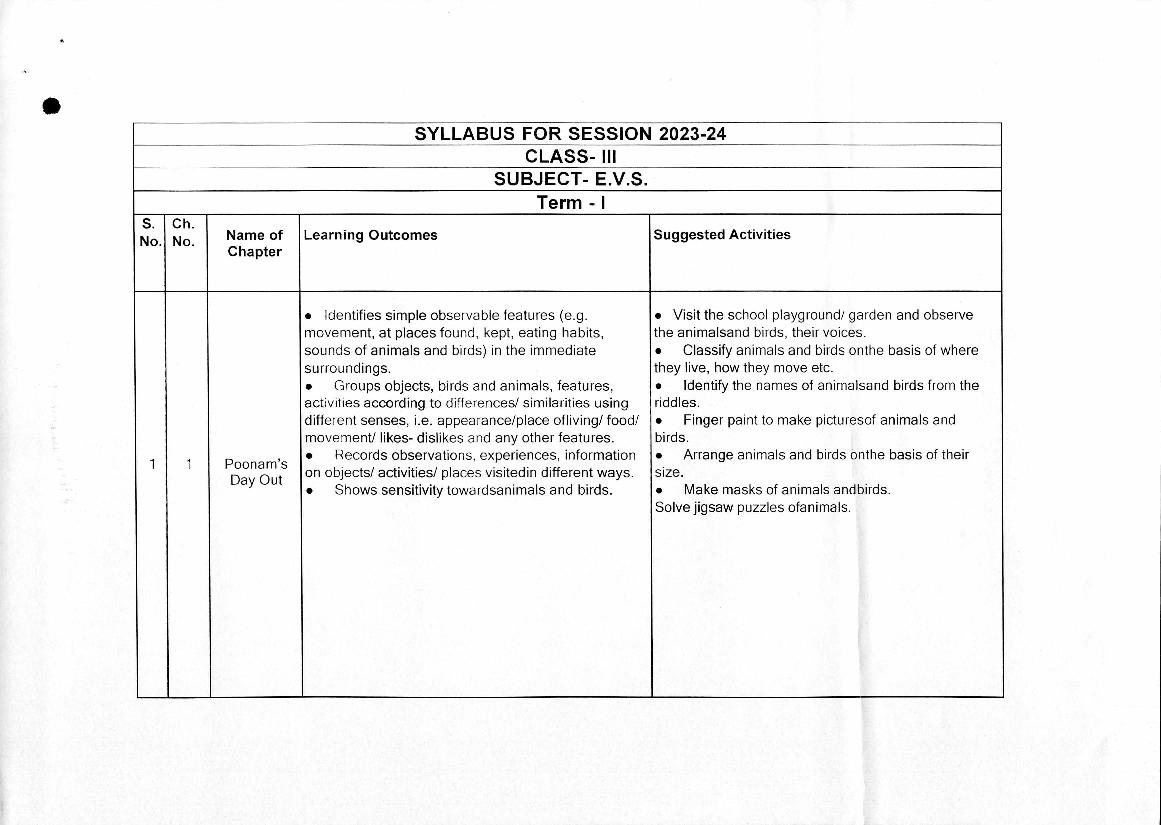
CLASS- III
SUBJECT- E.V.S.
Term - I
s. Ch.
No. No. Name of Learning Outcomes Suggested Activities
Chapter
• Identifies simple observable features (e.g. • Visit the school playground/ garden and observe
movement, at places found, kept, eating habits, the animalsand birds, their voices.
sounds of animals and birds) in the immediate • Classify animals and birds onthe basis of where
surroundings. they live, how they move etc.
• Groups objects, birds and animals, features, • Identify the names of animalsand birds from the
activities according to differences/ similarities using riddles.
different senses, i.e. appearance/place ofliving/ food/ • Finger paint to make picturesof animals and
movement/ likes- dislikes and any other features. birds.
• Records observations, experiences, information • Arrange animals and birds onthe basis of their
1 1 Poonam's
on objects/ activities/ places visited in different ways. size.
Day Out
• Shows sensitivity towardsanimals and birds. • Make masks of animals andbirds.
Solve jigsaw puzzles ofanimals.
Page 2
•
shape, colour, texture, aroma) of leaves, trunk • Role play on 'why we should notpluck flowers.'
and bark of plants in immediatesurroundings. • Classify leaves on the basis oftheir colours, shapes
• Records observations, experiences, and margins.
information on objects/ activities/ places visited • Identify the plant by smellingtheir leaves.
in different ways. • Use dry leaves to makepictures of animals.
The
Plant • Shows sensitivity towardsplants. • Take rubbings (prints) ofleaves and tree trunks.
2 2
Fairy • Creates drawings, designs,motifs of • Enlist things that have patterns of leaves and flowers
objects. onthem.
• Befriend a tree.
Identify the parts of real plantsin your school playground/
garden.
• Identifies relationships withand among
• Names of family members andrelationships we share
family members.
with them.
Our • Describes in his/her own words, the roles
• Resemblance between familymembers.
4 First of family members and the need of living
• Group discussion on 'advantages of living
3 School together.
together'
• Shows sensitivity towardsdiverse family • Things we learn from ourfamily.
set ups in surroundings.
Prompts students to share whatis special about any
member of their family.
• Describes in his/her own words, the need • Role play on 'Food needs ofvarious people'.
for food for people of different age groups. • Motivate students to bring theirfavourite food items and
• Shows awareness towardsmisuse/ classify them into healthy andunhealthy food.
wastage of food in family and school.
4 6 Foods • Identifies the ingredients present in the
We Eat food item
Page 3
act accordingly
• shows senstivity for differently abled
Saying • Discuss the needs of the differently abled and Dos and
peop .
People
5 7 Without Don'ts with differently-abled
Speaking • Identifies facial expressionslike happy
children.
,sad etc
• Identifies simple observable features (e.g.
movement, at places found, kept, eating habits, • Enact your favourite bird, i.e. the sounds it makes, how
sounds of birds) in the immediate it movesetc.
surroundings. • Identify the habitats ofdifferent birds.
• Groups, birds, features, activities according • Observe the various types ofbeaks.
to differences/ similarities using different • Match the birds to the foodthey eat.
6 8 Flying High • Classify birds according to different shapes, colours
senses, i.e. appearance/place of living/ food/
movement/ likes-dislikes and anyother features. and sizesof feathers.
• Records observations, experiences, • Enlist the animals that can fly.
information on objects/ activities/ places
visitedin different ways.
• Shows sensitivity towardsbirds.
• Differentiated between objects and
activities of presentand past, e.g. vessels
• Identify the utensils.
used etc.
• What are utensils made of?
• Records observations, experiences,
• Enlist the food items eatenraw, cooked or both
information on objects/ activities/ places
ways.
visitedin different ways.
7 10 What Is• • Write the steps of cooking your favourite dish
Shows awareness towardswastage of
Cooking without usingfire/flame.
food.
• Identify the various methods of cooking.
• Differentiates between rawand cooked
food. Fuels used for cooking in yourhouse.
• Identifies method of cooking.
• Identifies various fuels usedfor cooking.
Page 4
S. Chapter
Name of Chapter Learning Outcomes Suggested Activities
No. No.
• Identifies objects, signs
(means of communication,
transport, signboards) etc.
• Enlist the various means oftransport.
• Differentiates between • What are vehicles used for?
vehicles and activities of present • How many wheels do thevehicles
and past.
have?
8 11 From Here To There • Records observations, • Sounds of various vehicles.
experiences, information on
Discussion on situations requiring
objects/ activities/ places visited
emergency services.
in different ways.
• Identifies vehicles used for
specific purpose eg. ambulance
etc.
Page 5
• Read the picture and observethe various
kinds of work that people do.
• Records observations,
• Identify the work the people doand what
experiences, information on
they are called.
objects/ activities/ places visited
• Identify the building and workdone there.
in different ways.
• Observe the work done by people in your
• Differentiates between
9 12 Work We Do family- make a list of work done by family
activities and work done by
members inand outside the house.
people of present and past.
Observe the landmarks on theway from your
• Shows awareness of
home to school.
stereotypes for tasks in family
w.r.t. gender.
• Make Special Message Walls ingroups and
each student will write a positive note for other
members of the group.
• Shows sensitivity for the • Discuss how we can help theelderly.
elderly, differently-abled and • Play the blindfold game andshare your
10 13 Sharing Our Feelings experiences.
diverse family set ups in
surroundings. • Organise a Talent Show in theclass.
Motivate the students to
showcase their skills.
Page 6
stereotypes for tasks in family
w.r.t. gender.
• Make a list of food items you eat in a day
• Shows awareness towards
and classify into theirsources; i.e. plants or
misuse/ wastage of food in
animals.
family and school.
• Discuss the gender rolesrelated to
• Describes in his/her own
cooking.
11 14 The Story Of Food words the need for food for
• When you are sick, do you take any
people of different age groups,
medicine which we getfrom plants?
animals/ birds, availability of
Identify parts of plants eatenas food.
food. 1. Differentiates the food
items we get from plants and
animals.2. Identifies medicinal
plants .3 Identifies the part of
plant which is eaten.
• Observes rules in games • Which games do you play withyour family
(local, indoor, outdoor) and other members?
collective tasks. • Collect information on localsports
12 16 Games We Play
• Differentiates the games persons.
and related equipment T. Besides playing, what else doyou and your
Describes their hobbies. family members do?
Page 7
communication etc.
• Describes in his/her own • Write a letter to your friend on apostcard
words roles of family members and post it.
and the need of living together • Arrange the correct sequenceof the
through oral/ written/ other ways. journey of a letter.
13 17 Here Comes A Letter
• Differentiates the means of • Visit a post office and observehow letters
communication of present and reach there and are sent from there.
past. • Make your own telephone.
• Shows awareness of
stereotypes for tasks in family
w.r.t. gender.
• Describes in own words the • Group discussion on genderdefined
need for water and its availability. roles.
• Estimates quantity of water • Make posters/ slogans on`Save
in daily life and verifies using Water'.
14 20 Drop By Drop
symbols and non-standard units. • Suggest ways of saving water.
• Shows awareness of • Methods of collecting water.
stereotypes for tasks in family How can we reuse water athome?
w.r.t. gender.
Page 8
boards, etc places (types of
houses, shelter, bus stand,
petrol pump etc).
• Identifies directions, • Enlist the things to your left andright.
locations of objects, places in • Make your own symbols tocomplete
simple maps (of home the map.
classroom, school) using signs, • What do the signs indicate?
15 22 symbols, and verbally. • Map reading.
Left-Right
• Records observations,
experiences, information on
objects/ activities/ places visited Create own maps (like fromhome to
in different ways. school)
• Creates drawings, motifs,
designs, models, top, front, side
views of objects, simple maps
(of classroom, sections of home,
school, etc).
• Create houses using straws,clay,cloth,
• Identifies different types of paper craft, iceetc.
16 18 A House Like This houses and material used to • Draw pictures of different types
build the houses of houses.
Document Details
| Board / Org | Delhi Board |
| Exam | Class 3 |
| Type | Syllabus |
| Pages | 7 |
| Updated | 09 Jun 2026 |