Edudel Syllabus 2025 Class 3 Maths – Text
Read the full text of this syllabus below — useful to quickly search, copy and reference the content online without downloading the PDF.
📄 View text version (2 pages)
Page 1
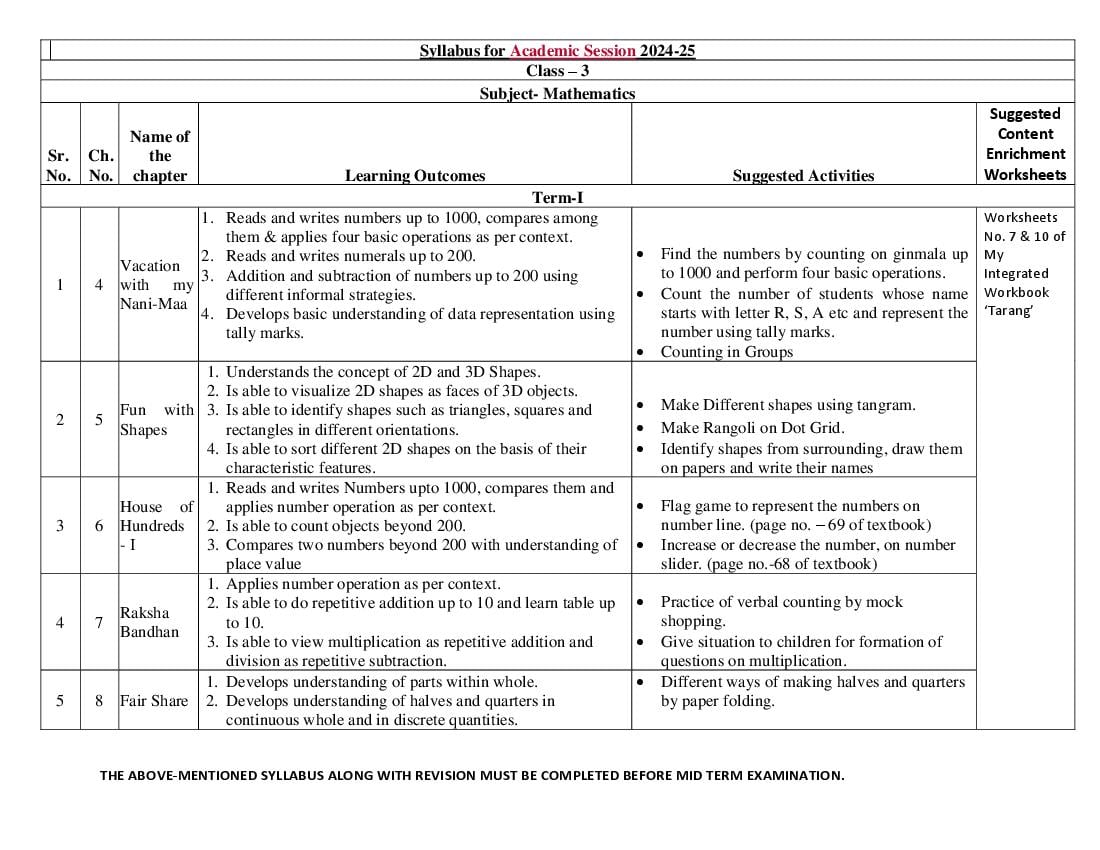
Syllabus for Academic Session 2024-25 Class – 3 Subject- Mathematics Suggested Name of Content Sr. Ch. the Enrichment No. No. chapter Learning Outcomes Suggested Activities Worksheets Term-I 1. Reads and writes numbers up to 1000, compares among Worksheets them & applies four basic operations as per context. No. 7 & 10 of 2. Reads and writes numerals up to 200. • Find the numbers by counting on ginmala up My Vacation to 1000 and perform four basic operations. Integrated 3. Addition and subtraction of numbers up to 200 using 1 4 with my different informal strategies. • Count the number of students whose name Workbook Nani-Maa 4. Develops basic understanding of data representation using starts with letter R, S, A etc and represent the ‘Tarang’ tally marks. number using tally marks. • Counting in Groups 1. Understands the concept of 2D and 3D Shapes. 2. Is able to visualize 2D shapes as faces of 3D objects. Fun with 3. Is able to identify shapes such as triangles, squares and • Make Different shapes using tangram. 2 5 Shapes rectangles in different orientations. • Make Rangoli on Dot Grid. 4. Is able to sort different 2D shapes on the basis of their • Identify shapes from surrounding, draw them characteristic features. on papers and write their names 1. Reads and writes Numbers upto 1000, compares them and House of applies number operation as per context. • Flag game to represent the numbers on 3 6 Hundreds 2. Is able to count objects beyond 200. number line. (page no. – 69 of textbook) -I 3. Compares two numbers beyond 200 with understanding of • Increase or decrease the number, on number place value slider. (page no.-68 of textbook) 1. Applies number operation as per context. 2. Is able to do repetitive addition up to 10 and learn table up • Practice of verbal counting by mock Raksha 4 7 to 10. shopping. Bandhan 3. Is able to view multiplication as repetitive addition and • Give situation to children for formation of division as repetitive subtraction. questions on multiplication. 1. Develops understanding of parts within whole. • Different ways of making halves and quarters 5 8 Fair Share 2. Develops understanding of halves and quarters in by paper folding. continuous whole and in discrete quantities. THE ABOVE-MENTIONED SYLLABUS ALONG WITH REVISION MUST BE COMPLETED BEFORE MID TERM EXAMINATION.
Page 2
Term-II • Measure different objects around them using Worksheet non-standard units such as such as handspan, s No. 15,16 1. Estimates & measures length and distance using standard footsteps etc. & 20 of My Fun at class units & adds and subtracts these units. • Look for objects around yourself whose length Integrated 6 10 Workbook party! 2. Measures different objects around them using formal and is one metre, less than one metre & more than informal tools for length. one metre ‘Tarang’ 3. Compares lengths of different objects using standard and • Measure with various fixed length objects like non-standard units. pencil, pen etc. 1. Estimates & measures weight and volume using standard • Identify various vessels at your home that can units & adds and subtracts these units. hold exactly one litre of water, more than 1 Filling and 2. Develops understanding of concept of 1 litre and draw litre and less than 1 litre of water. 7 11 Lifting conclusions about capacities of different vessels. • Collect different objects from your surrounding 3. Develops understanding of concept of 1 Kg and draw and arrange them in order of lightest to conclusions about weight of different objects. heaviest. 1. Applies number operation of addition and subtraction as Give and per context. • Provide opportunities to solve daily life 8 12 Take 2. Is able to use number line and dienes block for solving problems related to addition and subtraction. various problems with different strategies • Practice of verbal counting by Mock shopping. • Make a calendar for the month of January 2025 Time goes 1. Reads the time and date correctly using a clock and a • Make a clock with cardboard. 9 13 calendar. on • Practice patterns in Clock and Calendar. 2. Is able to read and make the calendar for a specific month. • Games based on Value System. 3. Is able to measure the duration of different events that take minutes, hours, days, months to complete. 1. Extends pattern/ symmetry of simple shapes, numbers & letters. 2. Is able to observe different patterns such as patterns in The cloth, tiling on the floor, Rangoli around them. • Collect different objects around yourself and 10 Surajkund 3. Is able to see the differences between symmetrical and classify them as symmetrical and Fair asymmetrical objects around them. asymmetrical. 14 4. Is able to create different tessellations by joining different • Draw and complete the symmetrical shapes. rangolis.(page – 181 of textbook) THE ABOVE-MENTIONED SYLLABUS MUST BE COMPLETED BY 31ST JANUARY 2025. REVISE THE SYLLABUS BEFORE ANNUAL EXAMINATION.