CBSE Class 12 Marking Scheme 2021 for History
Finished viewing? Save it for later —
Download CBSE Class 12 Marking Scheme 2021 for History (PDF · 9 pages)About CBSE Class 12 Marking Scheme 2021 for History
CBSE Class 12 Marking Scheme 2021 for History is available here for free download. Published by CBSE for Class 12, this sample paper can be viewed online or downloaded as a PDF (9 pages). Candidates preparing for Class 12 can use CBSE Class 12 Marking Scheme 2021 for History to understand the exam pattern, the type of questions asked, and the overall difficulty level.
Frequently Asked Questions
How can I download CBSE Class 12 Marking Scheme 2021 for History?
Open this page and click the Download button to save CBSE Class 12 Marking Scheme 2021 for History as a PDF. It is completely free on AglaSem Docs.
Is CBSE Class 12 Marking Scheme 2021 for History free to download?
Yes. CBSE Class 12 Marking Scheme 2021 for History can be viewed online and downloaded as a PDF free of cost on AglaSem Docs.
How many pages does CBSE Class 12 Marking Scheme 2021 for History have?
CBSE Class 12 Marking Scheme 2021 for History contains 9 pages, which you can read online or download together as a single PDF.
Where can I find more Class 12 study material?
You can find more Class 12 question papers, sample papers, syllabus, and answer keys on AglaSem Docs.
CBSE Class 12 Marking Scheme 2021 for History – Text
Read the full text of this sample paper below — useful to quickly search, copy and reference the content online without downloading the PDF.
📄 View text version (9 pages)
Page 1
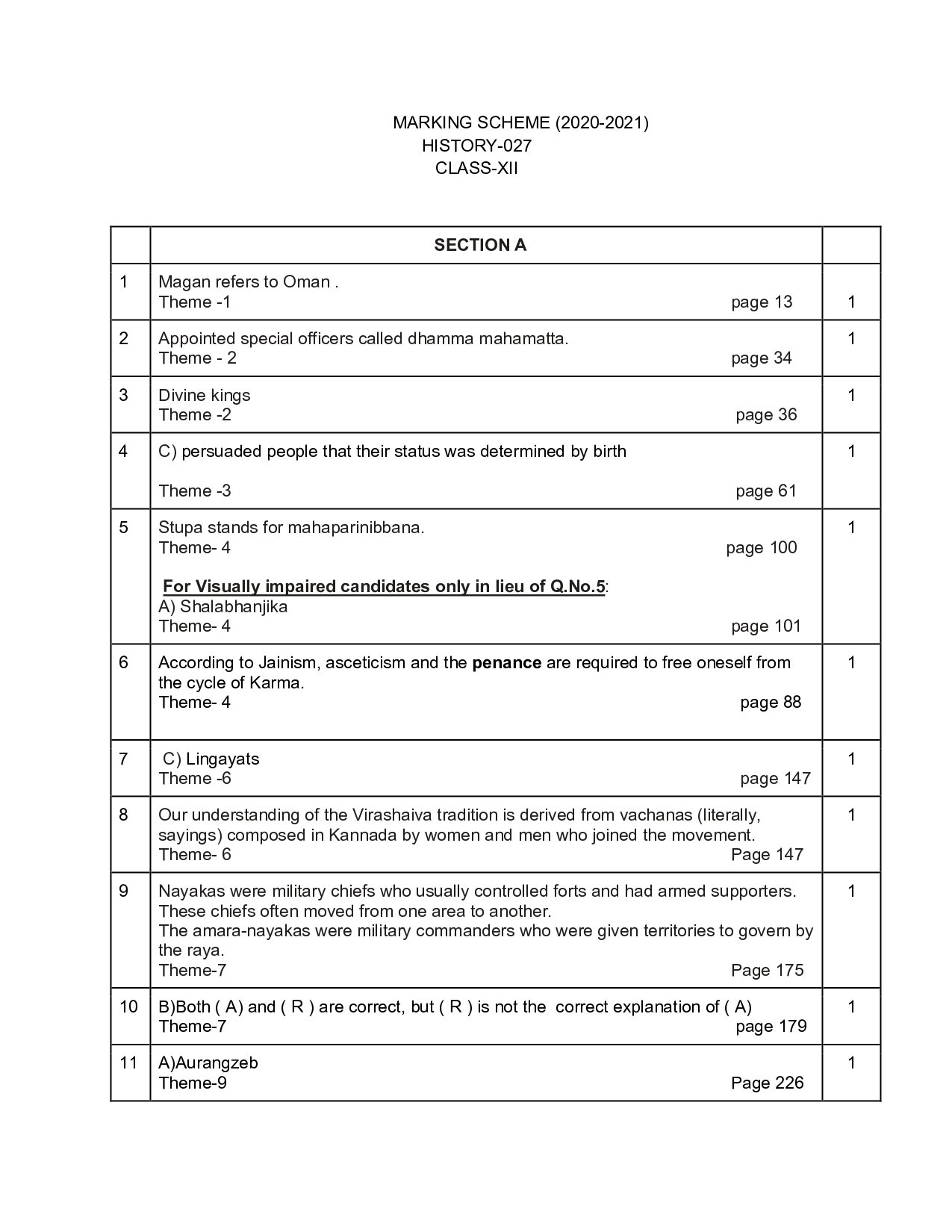
HISTORY-027
CLASS-XII
SECTION A
1 Magan refers to Oman .
Theme -1 page 13 1
2 Appointed special officers called dhamma mahamatta. 1
Theme - 2 page 34
3 Divine kings 1
Theme -2 page 36
4 C) persuaded people that their status was determined by birth 1
Theme -3 page 61
5 Stupa stands for mahaparinibbana. 1
Theme- 4 page 100
For Visually impaired candidates only in lieu of Q.No.5:
A) Shalabhanjika
Theme- 4 page 101
6 According to Jainism, asceticism and the penance are required to free oneself from 1
the cycle of Karma.
Theme- 4 page 88
7 C) Lingayats 1
Theme -6 page 147
8 Our understanding of the Virashaiva tradition is derived from vachanas (literally, 1
sayings) composed in Kannada by women and men who joined the movement.
Theme- 6 Page 147
9 Nayakas were military chiefs who usually controlled forts and had armed supporters. 1
These chiefs often moved from one area to another.
The amara-nayakas were military commanders who were given territories to govern by
the raya.
Theme-7 Page 175
10 B)Both ( A) and ( R ) are correct, but ( R ) is not the correct explanation of ( A) 1
Theme-7 page 179
11 A)Aurangzeb 1
Theme-9 Page 226
Page 2
Theme-9 Page 230
13 The power of jotedars was more effective than that of zamindars. Unlike zamindars 1
who often lived in urban areas, jotedars were located in the villages and exercised
direct control over a considerable section of poor villagers.
Theme -10 Page 261
14 ( i) ( ii) ( iii) ( iv) 1
B) (c) ( d) ( b) ( a)
Theme- 11 Page 292
15 A) (1) and (2) only 1
Theme-13 Page 356
16 B) Sardar Patel 1
Theme-15 Page 417
SECTION B
17 a) (i) 3
b) (i)
c) (i)
d) (i)
Theme - 2 Page 37
18 a (iv) 3
b) (i)
c) (i)
d) (iii)
Theme - 9 Page 249
For Visually impaired candidates only in lieu of Q.No.18 :
a) (ii)
b) (ii)
c) (iii)
d) C) Only (iii) and (iv)
Theme - 9 Page 242-243
19 a) (ii) 3
b) (i)
c) (iii)
d) (iii)
Theme - 10 Page 265
Page 3
20 Sources to reconstruct the history of Mauryan Empire: 3
i) Archaeological finds -sculptures, coins, rock edicts
ii) Accounts of Megasthenes
iii) Arthashastra composed by Kautilya
iv) Buddhist, Jaina, Puranic literature and Sanskrit literary works.
v) Accounts of Chinese travellers
vi) Inscriptions of Asoka
Theme-2 page 32
21 The Mughal nobility was recruited consciously by the Mughal rulers: 3
i)The Mughal nobility were the main pillars of Mughal state
ii)The Mughal nobility was chosen from different groups, both religiously and
ethnically so as to ensure a balance of power between the various groups.
iii)They are described as guldasta or a bouquet of flowers in the official chronicles
signifying their unity, held together by loyalty towards the Mughal emperor.
iv)They can be divided into four major groups ethnically, viz Irani, Turani, Rajputs and
Shaikhzadas or Indian Muslims.
v)All nobles were ranked or were allotted mansabs comprising of zat and sawar
vi)The nobles were also required to perform military service for the Emperor
vii)Any other relevant point.
(To be assessed as a whole)
Theme-9 Page 244-246
22 “The battle between the hoe and plough was a long one” 3
i)The Paharias had problems with the people living in the plains. They charged taxes
from them, raided into their areas etc. Therefore, the Paharias were pushed back into
the hills.
ii)Santhals were settled on the peripheries of the Rajmahal hills by the British and the
Paharias resisted it, they were forced to withdraw deeper into the hills.
iii)The Paharias had refused to use plough & settled agriculture.
iv)They were restricted from moving down to the lower hills and valleys.
v)They were confined to dry interior and to the barren and rocky upper hills.
vi)This severely affected their lives and impoverished them.
vii)Shifting agriculture depended on the ability to move to newer and newer lands.
viii)When forests were cleared for cultivation, the lives of hunters also got affected.
ix)Their earlier life of mobility was also affected.
(To be assessed as a whole)
Theme-10 Page 271
23 Rumours circulate only when they resonate with the deep fears and suspicion of the 3
people:
i) Foremost was the rumor of greased cartridges itself that infuriated the sepoys and
became the final trigger of discontent.
ii)The rumors about the British trying to pollute the religion of Indians by mixing the
bone dust of cows and pigs into the flour led people to avoid touching the flour and
bred animosity towards the British.
Page 4
Plassey also reinforced the call for the revolt against the masters
iv)The people formed a connection between the recent British policies of introducing
Western education and social reform that targeted cultural practices.
v)The annexations on the pretext of the Doctrine of Lapse also made the masses
suspicions of the British intentions
vi) Introduction of British system of administration, their own laws and land revenue
collection.
vii)The activities of the christians missionaries also bred doubt and discomfort
viii) Any other relevant point.
Any 3 points
Theme-11 Page 294,295
SECTION D
24 Most important idea of Jainism:- 8
i) The entire world is animated and hence Ahimsa is emphasized.
ii) Non injury to living beings
Impact on Indian thinking:-
i) Idea of Ahimsa left its mark on Indian thinking as a whole- Influenced Bhuddha and
Gandhiji
ii) Cycle of birth and rebirth through karma
iii) Renouncing the world to free oneself from the cycle of karma
iv) High moral thinking was advised through the vows like not stealing, killing, lying or
possessing property and observing celibacy
v) Simple way of life
vi) Vegetarianism
(Any other relevant point)
(2+6) Page 88
OR
Teachings of Buddha-
i) Buddha’s teachings are reconstructed from stories
ii) These stories are found in ‘Sutta Pitaka’
iii) They describe his miraculous powers
iv) They let us about how Buddha tried to convince people through reason and
persuasion rather than through supernatural powers
v) He convinced a woman who was in grief over the death of a child about the variable
nature of death and did not advice her to bring back her son to life
vi) He spoke in a simple language which common people could understand
vii) He said, world is transient (Anicca) and constantly changing
viii) It is soulless and there is nothing permanent about the world
ix) By following the path of moderation, human beings can rise above these worldly
troubles
x) Existence of God is irrelevant to Buddhism
xi) Buddha considered social world as the creation of humans rather than divine origin
xii) He advocated that people should follow ethics and be humane.
xiii) He believed that individual effort can change social relations
Page 5
rebirth
(To be assessed as a whole)
Theme-4 Page 91,92
25 The Mahanavami Dibba- 8
i) The name comes from the shape of the platform and the Mahanavami platform
which was observed there.
ii) Rituals associated with the structure- Dussehra, Durga Puja and Navratri or
Mahanavami
iii) The Vijayanagara kings displayed their prestige, power and suzerainty.
iv) The ceremonies performed on the occasion included worship of image, worship of
state horse, and the sacrifice of buffaloes and other animals.
v) Dances, wrestling match and procession of horses,elephants and chariots and
soldiers.
vi) Ritual presentations before the king and his guests by the chief nayakas and
subordinate kings marked the occasion.
vii) The ruler inspected the army.
viii) Nayakas brought gifts and tribute for the king. It had the two most impressive
platforms, the “Audience Hall” and the “ Mahanavami Dibba”.
ix) The entire complex was surrounded by high double walls with a street running
between them.
x) The Audience hall was a high platform with slots for wooden pillars at close and
regular intervals.
xi) It had a staircase going up to the second floor.
xii) The pillars were closely spaced.
xiii) The “Mahanavami Dibba” was a massive platform rising from a base of about
11,000 sq. ft to a height of 40 ft.
xiv) The platform must have supported a wooden structure and other perishable
material during festivals.
xv) The base of the platform is covered with relief carvings.
(To be assessed as a whole) Page180,181
OR
The Virupaksha Temple:
i)The Virupaksha Temple was an old temple dedicated to Lord Shiva, the guardian
deity
ii)It was enlarged with the establishment to the Vijayanagara Empire
iii)The hall in front of the main shrine was built by Krishnadeva Raya to mark his
accession
iv)This was decorated with delicately carved pillars
v) Gopurams, royal gateways that often dwarfed the towers on the central shrines, and
signalled the presence of the temple
vi) Central shrine (Garbha griha)
vii) There were mandapas or pillared corridors found in the temple
viii) Social importance-
-Images of God were placed to witness special programmes of music, dance and
dramas
-Used to celebrate the marriage of deities
-Others were meant to swing the deities
Page 6
x) Orders were signed in the name of Sri Virupaksha
xi) Rulers indicated close links with God using the title ‘Hindu Suratarna’
xii) Royal portraits sculptures were also displayed in temples
xiii) Kings visits to temples along with Amaranayakas were important occasions.
The Vitthala temple
i) The principle deity was Vitthala a form of Vishnu
ii) This temple had several halls and a unique shrine designed as a Chariot
iii) A characteristic feature of the temple complexes in the Chariot streets that
extended from the temple Gopuram in a straight line
iv) These streets were paved with stone slabs and lined with pillared pavilions in which
merchants set up their shops
(Any five from Virupaksha and any three from Vitthala temple)
(5+3)
Theme-7 Page184-188
26 Different kinds of sources that can be used to reconstruct the political career of 8
Gandhiji and the History of the National Movement.
i) Public voices and private scripts of an individual
ii) Speeches
iii) Letters to individuals
iv) Publications- Harijan, Young India etc.
v) Letters written to Gandhiji (A bunch of old letters) published.
vi) Gandhiji’s role understood through other publications
vii) Conversations with Nehru and others
viii) Gandhiji’s autobiography or other such autobiographies of other leaders of that
period.
ix) Government records
a)Fortnightly reports
b)Police reports..etc
x) Newspaper reports
xi)Time magazine reports on Gandhiji and Dandi march
xii) Oral sources (Rumors..etc.)
Any other relevant source
( To be assessed as a whole)
Page 367,369-373
OR
The Quit India Movement genuinely was a mass movement-
i) Failure of Cripps Mission led to the launch of Quit India Movement in August 1942
for the liquidation of British imperialism.
ii) Dissatisfaction from the Govt. of India 1935.
iii) Gandhi ji and other important leaders were arrested and jailed.
iv) The mass movement was left to the young people of India.
v) Younger activists organised strikes and acts of sabotage.
vi) Brought into the movement hundreds of Indians.
vii) Socialist members like Jayaprakash Narayan were very active in the underground
resistance.
viii) ‘Independent’ govt. Was proclaimed in many districts like Satara, Medinipur,etc
Page 7
x) Thousands of ordinary citizens joined the Movement
xi) Young people participated in large numbers
xii) Muslim League was working on expanding its base
xiii) In 1944, Gandhi was released from jail
(To be assessed as a whole)
Theme-13 Page 362-364
SECTION E
27 27.1) It is the most complete ancient system, since, it is :
(i)Carefully planned drainage system
27.2) Grid pattern means:
(i) Roads and streets, intersecting at right angles. 1
(ii) Streets with drains were laid out first and then houses built along them. +
(iii) Every house needed to have at least one wall along a street. 2
( any one point) +
27.3) The features of the domestic drainage system were : 2
(i) Every house had its own bathroom paved with bricks, =
(ii) Drains connected through the wall to the street drains. 5
Theme -1 Page 6,7
28 28.1) The rulers ,who patronised the Dargah;
(i) Muhammad bin Tughlaq , Sultan Ghiyasuddin Khalji of Malwa,Akbar
(any one )
28.2) The concept of Ziyarat,in context to the source:
(i)Pilgrimage to tombs of sufi saints 1
(ii) Seeking the sufi’s spiritual grace (barakat) +
(iii) People of various creeds, classes and social backgrounds have expressed 2
their devotion at the dargahs +
( any two points ) 2
28.3) The devotees showed their reverence at the Dargah by : =
(i) Reciting the zikr 5
(ii) Evoking His Presence through sama
(iii) Mystical chants performed by specially trained musicians or qawwals to
evoke divine ecstasy
( any two points )
Theme - 6 Page 155,156,157
29 29.1) Multicultural language means :
(i) A popular language of a large section of the people of India,
(ii) A composite language enriched by the interaction of diverse cultures
(iii) Understood by people from various regions
( any one point )
29.2) The characteristics of a national language ,in context to the source are : 1
(i) A combination of Sanskritised Hindi nor Persianised Urdu +
Page 8
(iii) Assimilate words from foreign languages +
( any two points ) 2
29.3) The spirit of patriotism as promoted by the language committee ; =
(i) It had decided, but not yet formally declared, that Hindi in the Devanagari script 5
would be the official language
(ii) For the first fifteen years, English would continue to be used for all official
purposes
(iii) Each province was to be allowed to choose one of the regional languages for
official work within the province
( any two points )
Theme -15 Page 425,426
SECTION F
30 ( 30.1) and (30.2)
Solved Map attached
30.2(A) Amritsar
30.1(b) Agra
3
30.1(a) Lothal +
2
=
5
30.1(c) Dandi
30.1(b) Calcutta
30.1(a) Sanchi
30.2(B) Bombay
For Visually impaired candidates in lieu of map question.
(30.1) Mature Harappan sites:
Harappa,Banawali,Kalibangan,Balakot,Rakhigarhi,Dholavira,Nageshwar, Lothal,
Mohenjodaro, Chanudaro, Kotdiji
(any three sites)
OR
Page 9
Bodh Gaya, Ajanta
( any three sites ) 3
(30.2) Main centres of the revolt : +
Delhi,Meerut,Jhansi,Lucknow,Kanpur,Azamgarh,Calcutta,Benares,Gwalior,Jabalpur, 2
Agra, Awadh =
( any two centres ) 5
Document Details
| Board / Org | CBSE |
| Exam | Class 12 |
| Type | Marking Scheme |
| Pages | 9 |
| Updated | 30 Apr 2026 |