CBSE Class 12 Marking Scheme 2021 for Khuchipudi
Finished viewing? Save it for later —
Download CBSE Class 12 Marking Scheme 2021 for Khuchipudi (PDF · 5 pages)About CBSE Class 12 Marking Scheme 2021 for Khuchipudi
CBSE Class 12 Marking Scheme 2021 for Khuchipudi is available here for free download. Published by CBSE for Class 12, this sample paper can be viewed online or downloaded as a PDF (5 pages). Candidates preparing for Class 12 can use CBSE Class 12 Marking Scheme 2021 for Khuchipudi to understand the exam pattern, the type of questions asked, and the overall difficulty level.
Frequently Asked Questions
How can I download CBSE Class 12 Marking Scheme 2021 for Khuchipudi?
Open this page and click the Download button to save CBSE Class 12 Marking Scheme 2021 for Khuchipudi as a PDF. It is completely free on AglaSem Docs.
Is CBSE Class 12 Marking Scheme 2021 for Khuchipudi free to download?
Yes. CBSE Class 12 Marking Scheme 2021 for Khuchipudi can be viewed online and downloaded as a PDF free of cost on AglaSem Docs.
How many pages does CBSE Class 12 Marking Scheme 2021 for Khuchipudi have?
CBSE Class 12 Marking Scheme 2021 for Khuchipudi contains 5 pages, which you can read online or download together as a single PDF.
Where can I find more Class 12 study material?
You can find more Class 12 question papers, sample papers, syllabus, and answer keys on AglaSem Docs.
CBSE Class 12 Marking Scheme 2021 for Khuchipudi – Text
Read the full text of this sample paper below — useful to quickly search, copy and reference the content online without downloading the PDF.
📄 View text version (5 pages)
Page 1
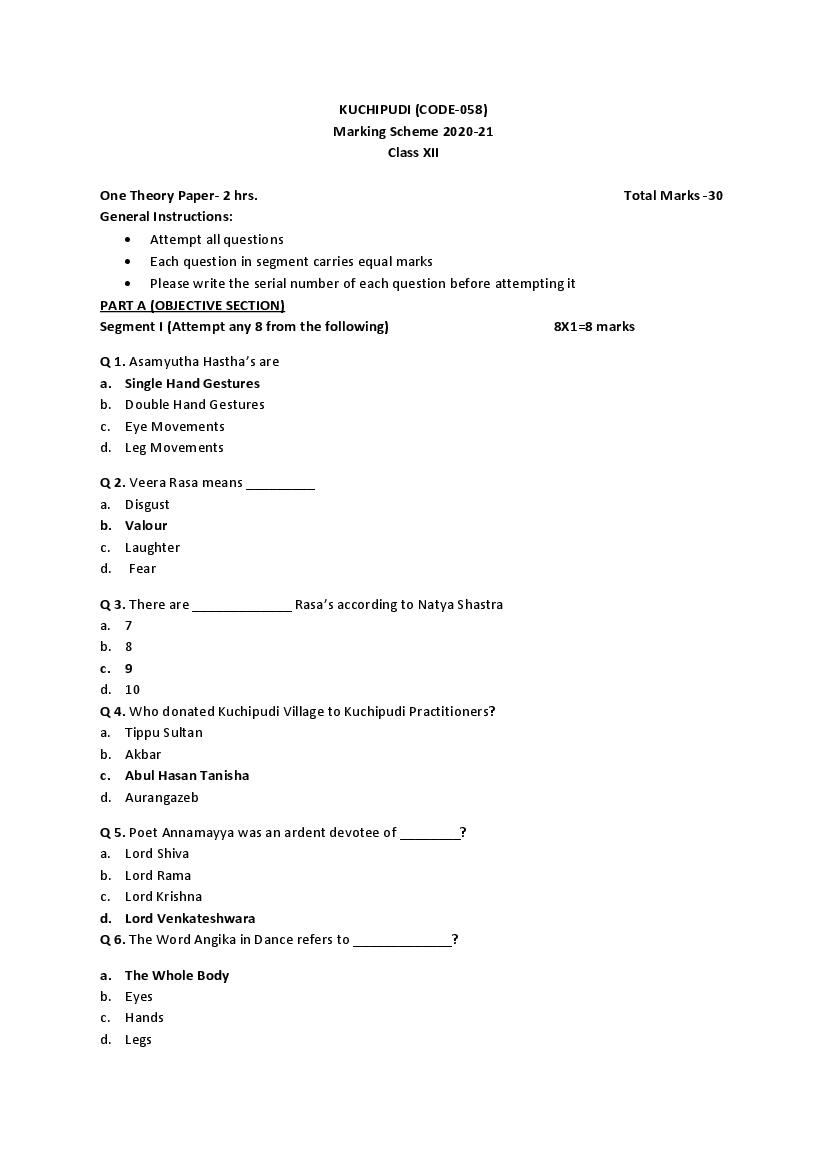
Marking Scheme 2020-21
Class XII
One Theory Paper- 2 hrs. Total Marks -30
General Instructions:
Attempt all questions
Each question in segment carries equal marks
Please write the serial number of each question before attempting it
PART A (OBJECTIVE SECTION)
Segment I (Attempt any 8 from the following) 8X1=8 marks
Q 1. Asamyutha Hastha’s are
a. Single Hand Gestures
b. Double Hand Gestures
c. Eye Movements
d. Leg Movements
Q 2. Veera Rasa means _________
a. Disgust
b. Valour
c. Laughter
d. Fear
Q 3. There are _____________ Rasa’s according to Natya Shastra
a. 7
b. 8
c. 9
d. 10
Q 4. Who donated Kuchipudi Village to Kuchipudi Practitioners?
a. Tippu Sultan
b. Akbar
c. Abul Hasan Tanisha
d. Aurangazeb
Q 5. Poet Annamayya was an ardent devotee of ________?
a. Lord Shiva
b. Lord Rama
c. Lord Krishna
d. Lord Venkateshwara
Q 6. The Word Angika in Dance refers to _____________?
a. The Whole Body
b. Eyes
c. Hands
d. Legs
Page 2
a. Sita
b. Radha
c. Rukmini
d. Satyabhama
Q8. The word Aharyam in Dance refers to ___________?
a. Hair
b. Jewellery
c. The whole Attire
d. Costume
Q 9. In Kuchipudi Dance the female characters were also performed by Male Brahmin boys
T/F-True
Segment II (Attempt any 2 from the following) 2X2=4 marks
Q11. Match the following
Table A Table B
Angika Body/Physicality
Vachika Sound
Satvika Expression
Aharya Attire
Q12. What is the correct order of the following?
a. Kartarimukha
b. Pataka
c. Ardha Pataka
d. Tripataka
i. dbac
ii. cadb
iii.adcb
iv.bdca
Q13. State True or Flase
a. Sringara is evoked as a result of Happiness
b. Bhibhatsa is evoked as a result of Disgust
i. Both a and b are true
ii. Both a and b are false
iii. a is true b is false
iv. b is true a is false
Page 3
Angikam bhuvanam yasya Vachikam sarva vangmayam Aharyam chandra taradi Tam numah
satvikam sivam
Q14.
a.Whom are we addressing to in this shloka? Lord Shiva
b.What is the meaning of Chandra? Moon
c.What mudra we use for showing Chandra? Ardha Chandra
PART B (SUBECTIVE SECTION)
Segment IV (Answer any 2 questions in ~40 words) 2X2=4 marks
Q16. Write a para on Bhama Kalaapam
A: Bhamakalapam by siddhendra Yogi is a blue diamond in a jewel necklace of kuchipudi. It
introduces the characters with their special introductory songs. Sri siddhendra Yogi depicts
jeevathma(soul) and paramathma(supreme being or great spirit) UNITY. In this dance drama,
jeevathma is Satya bhama and paramathma is lord Sri Krishna. Satya,Charming and elegant but
jealous wife of Sri Krishna behaves boastfully and shows her proudness before the paramatma and
there by gets abandoned of his love and affection. Later,with a character called madhavi(a Maya of
Krishna),who acts like a mediator between them, will help her to realize her mistake-arrogance and
finally reunites bhama with Sri Krishna. Yogi wanted to popularise this concept among the masses
and convey his message to them to leave their negative behaviours which impedes their way to the
salvation -“mukti marga". It's composed very beautifully as much as that the dancers wanted to
perform it at least once in their life time.
Q17. Name any 4 musical instruments that are used for a dance performance.
A: Veena, Flute, Symbols, Violin
Q18. Name any five uses of Hand Gesture Mushti in Classical Dance.
A: To Show Power, To hit. To break, To squeeze, To Hide something
Segment V (Answer any 2 questions in ~60 words) 3X2=6 marks
Q19. Name the Eye and Neck movements?
A: Eye Movements:
1. Sama: Eye kept still without any movement.
2. Alokita: Rolling your eye balls in a circular pattern.
3. Saachi: Looking through the corner of the eyes.
4. Pralokita: moving your eyes side to side.
5. Nimilita: It looks like a half shut eye. Here one tries to focus the eye ball towards the
heart.
6. Ullokita: Looking upwards.
7. Anuvritta: Rapid movement of the eyes up and down.
8. Avalokita: Looking down.
Neck Movements:
1. Sundari : Here the neck is moved from side to side. It is also called as Attami.
Page 4
3. Prarivartita: Here the neck is moved in a Semicircle or moonlike shape.
4. Prakampita: Here the neck is moved forward and back.
Q20. Name the Drishti Bhedas with Shloka
A: Sama, Alokita, Saachi, Pralokita, Nimilita, Ullokita, Anuvritta, Avalokita
Shloka:
Samam Alokitam Saachi pralokita Nimility
Ullokita-anuvritte cha tatha chaiva-avalokitam
Ithyashtho drishthi bhedaha syu kirtitah purvasuribhi
Q21. Mention the name of Indian Classical dances along with the states of their origin?
A: Indian classical dance, or ShastriyaNritya, is an umbrella term for various performance arts and
can be traced in the Sanskrit text NatyaShastra. The numbers of recognized classical dances are eight
in number.
1. Bharatanatyam - Tamilnadu
2. Kathak – Northern & Western India
3. Kathakali - Kerala
4. Kuchipudi – Andhra Pradesh
5. Odissi - Odisha
6. Sattriya - Assam
7. Manipuri – Manipur
8. Mohiniattam – Kerala
Segment VI (Answer in ~100-120 words)
Q22. Critically analyze and detail the knowledge of Tandava, Lasya, Lokadharmi&NatyaDharmi?
Tandava - Tandava is a divine dance performed by the Hindu god Shiva. Shiva's Tandava is described
as a vigorous dance that is the source of the cycle of creation, preservation and dissolution.
Lasya - The term Lasya, in the context of Hindu mythology, describes the dance performed by
Goddess Parvati as it expresses happiness and is filled with grace and beauty. She is believed to have
danced the Lasya in response to the male energy of the cosmic dance of Tandavaperformed by Lord
Shiva. In a literal sense, Lasya means beauty, happiness and grace.Lasya is an element which is
graceful, delicate and expresses emotions on a gentle level. It is associated with the dance of
women because Parvati, the consort of Lord Shiva taught it to Usha (daughter of Sage
Banasura). Then she passed on this art to women.
LokaDharmi - Lokadharmi (realistic), which involved the reproduction of human behaviour on the
stage and the natural presentation of objects
NatyaDharmi - Natyadharmi (conventional), which is the presentation of a play through the use of
stylized gestures and symbolism and was considered more artistic than realistic
Or
Write about the contributions of Guru Vempati Chinna Satyam?
Page 5
the Kuchipudi dance form.
Chinna Satyam was born in Kuchipudi, Andhra Pradesh. He was taught by Vedantam Lakshmi
Narayana Sastry. He then refined his art by learning from Sri Tadepally Perrayya Sastry and later was
trained by his elder brother Sri Vempati Pedda Satyam in expressions. As he learnt the nuances of
this style of dance, he was successful in popularising the Kuchipudi dance form all over the world. He
died of old age related problems at the age of 83 on 29 July 2012.
Chinna Satyam sublimated and systematised Kuchipudi, giving it a more classical basis. He refined
the art form, bringing it closer to the standards of Natya Shastra and gave it a whole new perspective
and introduced new elements, e.g. chari (leg movements) of Natya Shastra that are significantly
different from the interpretations of other dance authorities, such as Padma Subrahmanyam.
Previously, it had been considered a "rustic" (folk) form of dance
Chinna Satyam started the Kuchipudi Art Academy at Madras in 1963. The Academy has to its credit
more than 180 solo items and 15 dance dramas composed and choreographed by Satyam. These
solo items and dramas have been staged all over India and abroad. He composed his first dance
drama Sri Krishna Parijatham in the same period followed by another hit Ksheera Sagara
Madanam and played the lead role. His portrayal of Lord Shiva and his choreography was well
received.
Vempati Chinna Satyam was conferred with many titles and awards such as "Sangeet Peeth of
Bombay", "Asthana Natyacharya of Tirumala Tirupati Devasthanam", T.T.K. Memorial
Award by Madras Music Academy, "Natya Kalasaagara of Waltair", "Raja-Lakshmi Award of Madras",
"Kalaprapoorna" from Andhra University, "Natya Kala Bhushana of Guntur", "Bharatha
Kalaprapoorna of Hyderabad", D. Litt. from Sri Venkateswara University, "Asthana Natyacharya of
Pittsburgh", and "National Award from Central Sangeet Naatak Akademi, New Delhi". He was
awarded by many state governments of India such as Kalidas Puraskar by the Government of
Madhya Pradesh and Kalaimamani by the Government of Tamil Nadu. He was honored with a
Doctorate degree by Andhra University. He was also awarded the Padma Bhushan by
the Government of India
Document Details
| Board / Org | CBSE |
| Exam | Class 12 |
| Type | Marking Scheme |
| Pages | 5 |
| Updated | 30 Apr 2026 |