CBSE Class 12 Marking Scheme 2021 for NCC
Finished viewing? Save it for later —
Download CBSE Class 12 Marking Scheme 2021 for NCC (PDF · 9 pages)About CBSE Class 12 Marking Scheme 2021 for NCC
CBSE Class 12 Marking Scheme 2021 for NCC is available here for free download. Published by CBSE for Class 12, this sample paper can be viewed online or downloaded as a PDF (9 pages). Candidates preparing for Class 12 can use CBSE Class 12 Marking Scheme 2021 for NCC to understand the exam pattern, the type of questions asked, and the overall difficulty level.
Frequently Asked Questions
How can I download CBSE Class 12 Marking Scheme 2021 for NCC?
Open this page and click the Download button to save CBSE Class 12 Marking Scheme 2021 for NCC as a PDF. It is completely free on AglaSem Docs.
Is CBSE Class 12 Marking Scheme 2021 for NCC free to download?
Yes. CBSE Class 12 Marking Scheme 2021 for NCC can be viewed online and downloaded as a PDF free of cost on AglaSem Docs.
How many pages does CBSE Class 12 Marking Scheme 2021 for NCC have?
CBSE Class 12 Marking Scheme 2021 for NCC contains 9 pages, which you can read online or download together as a single PDF.
Where can I find more Class 12 study material?
You can find more Class 12 question papers, sample papers, syllabus, and answer keys on AglaSem Docs.
CBSE Class 12 Marking Scheme 2021 for NCC – Text
Read the full text of this sample paper below — useful to quickly search, copy and reference the content online without downloading the PDF.
📄 View text version (9 pages)
Page 1
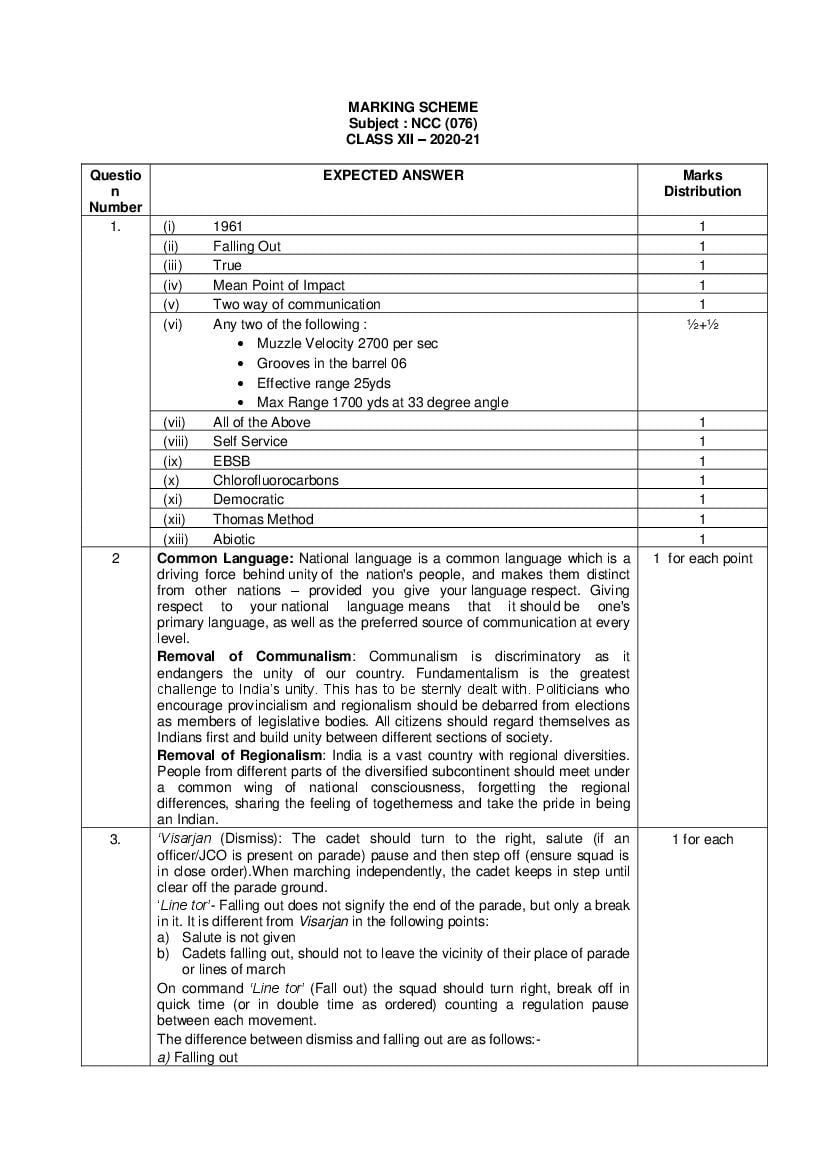
Subject : NCC (076)
CLASS XII – 2020-21
Questio EXPECTED ANSWER Marks
n Distribution
Number
1. (i) 1961 1
(ii) Falling Out 1
(iii) True 1
(iv) Mean Point of Impact 1
(v) Two way of communication 1
(vi) Any two of the following : ½+½
Muzzle Velocity 2700 per sec
Grooves in the barrel 06
Effective range 25yds
Max Range 1700 yds at 33 degree angle
(vii) All of the Above 1
(viii) Self Service 1
(ix) EBSB 1
(x) Chlorofluorocarbons 1
(xi) Democratic 1
(xii) Thomas Method 1
(xiii) Abiotic 1
2 Common Language: National language is a common language which is a 1 for each point
driving force behind unity of the nation's people, and makes them distinct
from other nations – provided you give your language respect. Giving
respect to your national language means that it should be one's
primary language, as well as the preferred source of communication at every
level.
Removal of Communalism: Communalism is discriminatory as it
endangers the unity of our country. Fundamentalism is the greatest
challenge to India’s unity. This has to be sternly dealt with. Politicians who
encourage provincialism and regionalism should be debarred from elections
as members of legislative bodies. All citizens should regard themselves as
Indians first and build unity between different sections of society.
Removal of Regionalism: India is a vast country with regional diversities.
People from different parts of the diversified subcontinent should meet under
a common wing of national consciousness, forgetting the regional
differences, sharing the feeling of togetherness and take the pride in being
an Indian.
3. ‘Visarjan (Dismiss): The cadet should turn to the right, salute (if an 1 for each
officer/JCO is present on parade) pause and then step off (ensure squad is
in close order).When marching independently, the cadet keeps in step until
clear off the parade ground.
‘Line tor’- Falling out does not signify the end of the parade, but only a break
in it. It is different from Visarjan in the following points:
a) Salute is not given
b) Cadets falling out, should not to leave the vicinity of their place of parade
or lines of march
On command ‘Line tor’ (Fall out) the squad should turn right, break off in
quick time (or in double time as ordered) counting a regulation pause
between each movement.
The difference between dismiss and falling out are as follows:-
a) Falling out
Page 2
ii) A word of command, to close the drill7 temporarily is given to a
body of cadets required to fall in again after a stipulated period
b) Dismiss
i) A word of command is given for closing drill.
ii) Denotes parade is completely terminated.
4. 1. Only Senior Division NCC cadets of above 18 years of age. 1x3
2. Associate NCC Officers.
3. They were not assigned the job of handling law and order situations and
active military duty at hotspot.
5. Main Components: ½ for naming
(a) Sleep each point and ½
(b) Bathing for its short
(c) Eating and Drinking explanation (One
(d) Care and Cleanliness of Skin, Hair and Teeth should write at
(e) Exercise least 3)
OR
Articles for Dressing of Wounds:
(a) Antiseptic (A/S) lotion.
(b) Cotton / gauze piece.
(c) A pair of Scissors.
(d) Bandages of different size and band aid plaster. (e) A/S ointment or
powder.
6. a) Aggressive 1 for three styles
b) Passive &
c) Assertive 1 for each point
OR explanation
(Any Four)
Telephone/Mobile Phone
Visitors 1 for each point
Paper with explanation
Lack of Planning
Socializing
Indecision
Television
Procrastination
7. (i) 1-(d) ½ x 4=2
2-(c)
3-(a)
4-(b)
(ii) Lieutenant 1
(iii) Defence Secretary 1
8. Any Four 1 for each point
(a) Bribery with very short
(b) Embezzlement, theft and fraud explanation
(c) Extortion and blackmail
(d) Abuse of discretion
(e) Favoritism and nepotism
(f) Improper Political Donations
OR
(a) Cancellation / permanent termination of the doctor’s license who
participates in fulfilling a client’s demand to do away with her girl child.
(b) Heavy penalty imposed on companies like GE that specialize in
marketing medical equipment used for illegal sex determination and abortion
in unlicensed clinics and hospitals.
(c) High fines and judicial action against „parents‟, who knowingly try to kill
Page 3
(d) Widespread campaigns and seminars for young adults and potential
parents to enlighten them about the ill effects of female feticide. Ignorance is
one of the major causes for the increase in the selective sex abortion cases.
Spreading awareness can go a long way in saving our future sisters,
mothers, friends and wives.
(e) High incentives for the education of the girl child, employment etc.
(f) Equal rights for women in the property of the parents / husband.
9. (a) Physical fitness. 1 for each point
(b) Agility (any 6 points) with
(c) Mental robustness. explanation
(d) Coordination and balance of mind and body.
(e) Improves risk-taking ability.
(f) Evaluating problem-solving skills.
(g) Over all team spirit.
Support with examples
OR
(a) Licensing
(b) Established Operators
(c) High Winds
(d) Visibility
(e) Passenger Age and Weight Restrictions
(f) Types of Equipment
(g) Altitude
(h) Ask Questions
(i) Release Form
10 Any four ½ for each point
1)Importance of drill
The primary importance of drill is to prepare troops for combat by rapidly
carrying out orders. Ceremonies go hand-in-hand with drill. During a
ceremony, troops align in various formations and carry out commands with
uniform precision.
Teach discipline
Control of body
Team work
Correct method of wearing uniform
Taking and delivering command
Duty,
Punctuality,
Orderliness,
Smartness,
Respect for the authorities,
Correct work ethos, and
Self- confidence.
2) Wrong Practices during drill
Rolling go eyes ½ for each point
Hopping and jumping (Any four point)
Dragging of foot
Clicking the heel
Moving figures inside the boots
3) Important Characteristics of performing drill
Hard work, ½ for each point
Sincerity of purpose,
(Any four point)
Honesty,
Ideal of selfless service,
Dignity of labor,
Page 4
Comradeship,
Spirit of adventure and
Sportsmanship.
Or
Procedure of Ceremonial Drill
1. VIP on arrival will be received by the Senior Officer/ Senior Cadet and
taken to the Saluting Dias. The Parade Commander will order `Parade
Savdhan` on seeing VIP.
2. When VIP is ready to take the salute, the Parade Commander will give
the words of command `Parade General Salute, Salami Shastra`.
3. Next Command is `Parade Bazu Shastra`. The parade commander
marches smartly to the saluting dias and reports the VIP ` Parade aapke
nirikshan ke liye hazir hai`.
4. After the VIPs permission has been obtained to let the parade stand at
ease and prior to commencement of the inspection.
5. Parade Commander gives the word of command ` _________Company
Khara rahe, Baki Vishram`.
6. After inspection is finished and VIP has turned to saluting dias, the
words of command will be given for the march past- Parade Savdhan,
Parade Nikat line Chal- Bagal Shastra- Parade Samne se Tez Chal.
ANSWER KEY OF SAMPLE PAPER
Special Subject: ARMY WING
11. Temple 1
12. 14.2 kg 1
13. North, South, East and West are known as the cardinal points. 2
14. (a) Radio Set ½ for each
(b) Click by fingers
(c) Clicks by using Tongue
(d) Whistle by the Mouth
(e) Use of line bedding
(f) Mini Flare
(g) Use of blacked out Torch
(h) Firing of Weapon
15. Calibre- 5.56 Effective range - 400 m 1 for each
16. 1. Savitri Khanolkar 1 for each part
2. Maj Somnath Sharma
3. Any two
Circular in shape
Made of bronze
Embossed on the obverse four replicas of "Indra's Vajra"
State Emblem embossed in the centre
Other side, Embossed “PARAM VIR CHAKRA” both in Hindi and in
English
Two lotus flowers between the Hindi and the English inscriptions
17. Advantages: 1.Reliable, 2. Relatively secure, 3.More capacity ½ for each point
Disadvantages: 1. Vulnerable to physical interference, 2. Take time to
construct, 3. Inflexible, 4. Expensive
Page 5
Notification. In Employment News and leading Daily News Papers. Notified correct info
by UPSC under the aegis of CDSE in May/ Jun and Nov/Dec
Eligibility Criteria
Age: Between 19 and 24 years as on first day of month in which course is
due to commence
Qualification : Graduation from recognised University
Marital Status : Unmarried
Likely SSB Date: Jul/ Aug and Mar/Apr
Date of Commencement of Training : Jan and Jul
Training Academy : IMA Dehradun
Duration of Training: 18 months
19. Methods of Judging Distance. There are six methods of Judging Distance. 2 marks for
These are as under:- names of methods
(a) Unit of measure and 1 for each
(b) Appearance method explanation
(c) Section average
(d) Key range
(e) Halving
(f) Bracketing
OR
Section Formation
A Section is the smallest sub unit of an Infantry Battalion and is capable of
undertaking independent task. It consists of ten persons who are organized 1 for definition +1
in Rifle group and Support Group. for types + 2 for
diamond section
There are 6 type of section formations in Army.
formation
Diamond.
Advantage: (i) Good for all round observation.2. Good for command and
control.
Disadvantage: 1.Presents an easy target to frontal fire.2. Vulnerable
Terrain conditions: 1. While negotiating open areas.2. When enemy threat is
imminent but the direction is not clear
ANSWER KEY OF SAMPLE PAPER
Special Subject: AIR FORCE WING
11. b. Gnats & MIG 21s 1
12. a. India Air Force 1
13. (a) Areas will be shown correctly ⅟2 + ⅟2 + ⅟2 + ⅟2
(b) Bearing measurement anywhere on the reduced earth will be identical to
the measurement on the earth.
(c) Shapes will be correct
(d) Distances will be measured accurately by use of a graduated scale which
is provided at the bottom of each map
14. (a) Troposphere - Up to about 11-16 km ⅟2 + ⅟2 + ⅟2 + ⅟2
(b) Stratosphere - Up to about 50 km above troposphere
(c) Mesosphere - 50 to 85 km
(d) Thermosphere - Above 85 km
15. *Any Two 1+1
a) Light Combat Aircraft (LCA).
b) Light Combat Helicopter (LCH).
c) Advanced Light Helicopter (ALH) or Dhruv.
Page 6
range, altitude, direction, or speed of objects. It can be used to detect
aircraft, ships, spacecraft, guided missiles, motor vehicles, weather
formations, and terrain.
*Any Two
(a) Primary Radar. Uses the principle of pulse technique to determine the
range and bearing of an object. Working on the echo and searchlight
principle, a transmitter transmits pulses. All objects in the path of the pulses
will reflect and scatter this energy. Some of the reflected energy reaches the
receiver. The reflected energy is processed to give the required information.
In this radar, the object‟s cooperation is not required in the entire process.
(b) Secondary Radar. A transmitter transmits a group of pulses. An aerial in
the path of the pulses receives the signals and passes it to the receiver. If
the pulses are identified, then the transmitter gives out a reply. In this radar
active cooperation of the other object is also required.
(c) Continuous Wave Radar. In this type of radar, both the transmission
and the reception take place continuously. This requires a set of two aerials,
one for transmission and one for the reception.
17. The following are the general safety code to be followed:- ½ for each point
*Any six (Any six point)
(a) Not to fly model aircraft in competition or the presence of spectators until
it has been proven to be airworthy by having been previously successfully
flight-tested.
(b) Not to fly model aircraft higher than approximately 400 feet within 3 miles
of an airport without notifying the airport operator.
(c) Give right of way to, and avoid flying in the proximity of full-scale aircraft.
Where necessary an observer shall be utilized to supervise flying to avoid
having models fly in the proximity of full-scale aircraft.
(d) Where established, abide by the safety rules for the flying site and
willfully and deliberately not to fly my models in a careless, reckless, and/or
dangerous manner.
(e) Only after completed a successful radio equipment ground range check
before the first flight of a new or repaired model.
(f) While flying the model the initial turn after takeoff away from the pit,
spectator, and parking areas, and thereafter perform maneuvers, flights of
any sort, or landing approaches over a pit, spectator, or parking area.
(g) Complete control system (including safety thong, where applicable) will
be inspection and pull test prior to flying.
(h) Flying area should be clear of all utility wires or poles.
18. The following are movement areas in an aerodrome: 1+2
(a) Runway (b) Taxi track or taxiway (c) Apron (d) Dispersal.
*Write any two:
Runway: These are paved surfaces intended for take-off and landing run of
aircraft. The number and orientation of runways at an airfield will depend
upon the volume of traffic, runway occupancy time and climatological data
on surface winds
Taxiway: These are paved surfaces provided for the taxiing of aircraft and
intended to provide a link between one part of the aerodrome and another.
Apron: Means that part of an airport, other than the maneuvering
area intended to accommodate the loading and unloading of passengers
and cargo, the refueling, servicing, maintenance, and parking of aircraft, and
any movement of aircraft, vehicles, and pedestrians necessary for such
purposes.
Dispersal: an area adjacent to an airfield runway connected to the runway
by taxi strips and used for parking airplanes in widely separated positions to
protect them from enemy air attacks
Page 7
conduct of flight are termed as Air Traffic Services.
Objectives of Air Traffic Services are:-
(a) To prevent collision between aircraft.
(b) To prevent collision between aircraft on the maneuvering area and
obstructions in that area.
(c) To expedite and maintain an orderly flow of traffic.
(d) To provide advice and information useful for the safe and efficient
conduct of flights.
(e) To notify appropriate organizations regarding aircraft in need of search
and rescue aid and assist such an organization as required.
19. Four force acting on an aircraft in flight: 1+2+1
(a) Lift, (b) Weight, (c) Thrust, (d) Drag
The four forces acting on an aircraft in flight are:-
(a) Lift is a positive force caused by the difference in air pressure under and
above a wing. The higher air pressure beneath a wing creates lift and is
affected by the shape of the wing. Changing a wing's angle of attack affects
the speed of the air flowing over the wing and the amount of lift that the wing
creates.
(b) Weight is the force that causes objects to fall downwards. In-flight, the
force of the weight is countered by the forces of lift and thrust.
(c) Thrust is the force that propels an object forward. An engine spinning a
propeller or a jet engine expelling hot air out the tailpipe are examples of
thrust. In bats, thrust is created by muscles making the wings flap.
(d) Drag is the resistance of the air to anything moving through it. Different
wing shapes greatly affect drag. Air divides smoothly around a wing's
rounded leading edge and flows neatly off its tapered trailing edge, this is
called streamlining.
Page 8
Special Subject: NAVY WING
11. (3) 6 MEN 1
12. (2) 5 OARS 1
13. Labelled diagram of an Anchor 1 (DIAGRAM)
+1(Labelling)
14. Carelessness with naked lights and cigarettes left about ½ x4
Clothes hung to dry on a hot surface
Paint and oil splashes in contact with heat
Cooking oil in the galley, if left unattended on the stove for a long time
Any other correct answer
15. 1. Polythene dust covers are to be used to cover machines and tools 1+1
2. The user should be instructed to clean the tools and machine parts after
use with a hand brush
16. Colours: The ceremony of hoisting the Naval Ensign and the National 1 for each
flag at the ensign and jack staff respectively 0800 hours on board ship in
harbour is called colours.
Sunset: The ceremony of hauling down the national flag and the naval
ensign at the time of sunset is called sunset.
Dressing Ship Overall: Ships are dressed overall on the days of national
celebrations such as independence and republic day by hosting
signaling flags and pennants from jack staff to the foremost to the
mainmast into the ensign staff.
Piping the Side: This is a mark of respect accorded to the President,
Governors, Defense Minister, Flag officers, Commanding officers, and to
all foreign Naval officers in uniform when they to ship.
Launching Cceremony: After the construction of the hull on a ship is
launched for the first time into the sea, it is customary to break a coconut
on the bow of the ship.
Page 9
recruits into brotherhood of seas and as subjects of Lord Varuna’s
oceanic majesty. This ceremony is conducted when crossed the
equator.
17. After the submarine has been detected and its exact position located. It is 1+2
attacked with antisubmarine warfare (ASW). These are:
1) Depth charge: The depth charge is a large explosive charge fitted in barrel
like cylinders and designated at a predetermined depth.
2) Torpedo: torpedo is an underwater weapon fired from the ship or
submarine to hit, an enemy ship or submarine. Main components of the
torpedo body are engine, depth keeping mechanism, gyroscope and tail
section.
18. Flag position (any three) 1+1+1
i. B: I am taking in or discharging explosives.
ii. E: I am altering my course to starboard.
iii. H: I have a pilot onboard.
iv. O: Man overboard
v. R: I have received your last signal
vi. W: I require medical assistance
19. Nautical mile: For purpose of navigation. The distance on the Earth 1 for each
surface which represent 1 minute of latitude is as standard
measurement at sea and is called a nautical mile (6080 feet).
True course: The angle between fore and aft line and the meridian
through the position is called true course.
Knot: The speed of one nautical mile per hour is called a knot.
Pilotage: It is an art of conduction of a ship in the neighbourhood of
dangers such as rocks and shoals and in the narrow waters such as
harbour channels and canals.
Meridian: These are semi great circle joining the poles and are
perpendicular to the equator.
Latitude: The latitude of a place is the angular distance of the place
North or South of the equator.
Navigation: It is the art of finding the position of a ship at sea and
conduction her safety from one place to another.
Equator: The great circle midway between the poles is known as the
equator. Every point on the equator is therefore 90 degrees from the
poles.
****END****
Document Details
| Board / Org | CBSE |
| Exam | Class 12 |
| Type | Marking Scheme |
| Pages | 9 |
| Updated | 30 Apr 2026 |