Manipur Board Class 12 Syllabus 2027 Economics
Finished viewing? Save it for later —
Download Manipur Board Class 12 Syllabus 2027 Economics (PDF · 5 pages)About Manipur Board Class 12 Syllabus 2027 Economics
Manipur Board Class 12 Syllabus 2027 Economics is available here for free download. Published by Manipur Board for Class 12, this syllabus can be viewed online or downloaded as a PDF (5 pages). Candidates preparing for Class 12 can use Manipur Board Class 12 Syllabus 2027 Economics to understand the exam pattern, the type of questions asked, and the overall difficulty level.
Frequently Asked Questions
How can I download Manipur Board Class 12 Syllabus 2027 Economics?
Open this page and click the Download button to save Manipur Board Class 12 Syllabus 2027 Economics as a PDF. It is completely free on AglaSem Docs.
Is Manipur Board Class 12 Syllabus 2027 Economics free to download?
Yes. Manipur Board Class 12 Syllabus 2027 Economics can be viewed online and downloaded as a PDF free of cost on AglaSem Docs.
How many pages does Manipur Board Class 12 Syllabus 2027 Economics have?
Manipur Board Class 12 Syllabus 2027 Economics contains 5 pages, which you can read online or download together as a single PDF.
Where can I find more Class 12 study material?
You can find more Class 12 question papers, sample papers, syllabus, and answer keys on AglaSem Docs.
Manipur Board Class 12 Syllabus 2027 Economics – Text
Read the full text of this syllabus below — useful to quickly search, copy and reference the content online without downloading the PDF.
📄 View text version (6 pages)
Page 1
Manipur Board Class
12 Syllabus 2027
Economics
EXAM YEAR TYPE SUBJECT
Manipur Class 12 2027 Syllabus Economics
Notes · Sample Papers · Previous Year Papers · Mock Tests
Page 2
m .co
m .co s e m
se g l a
a
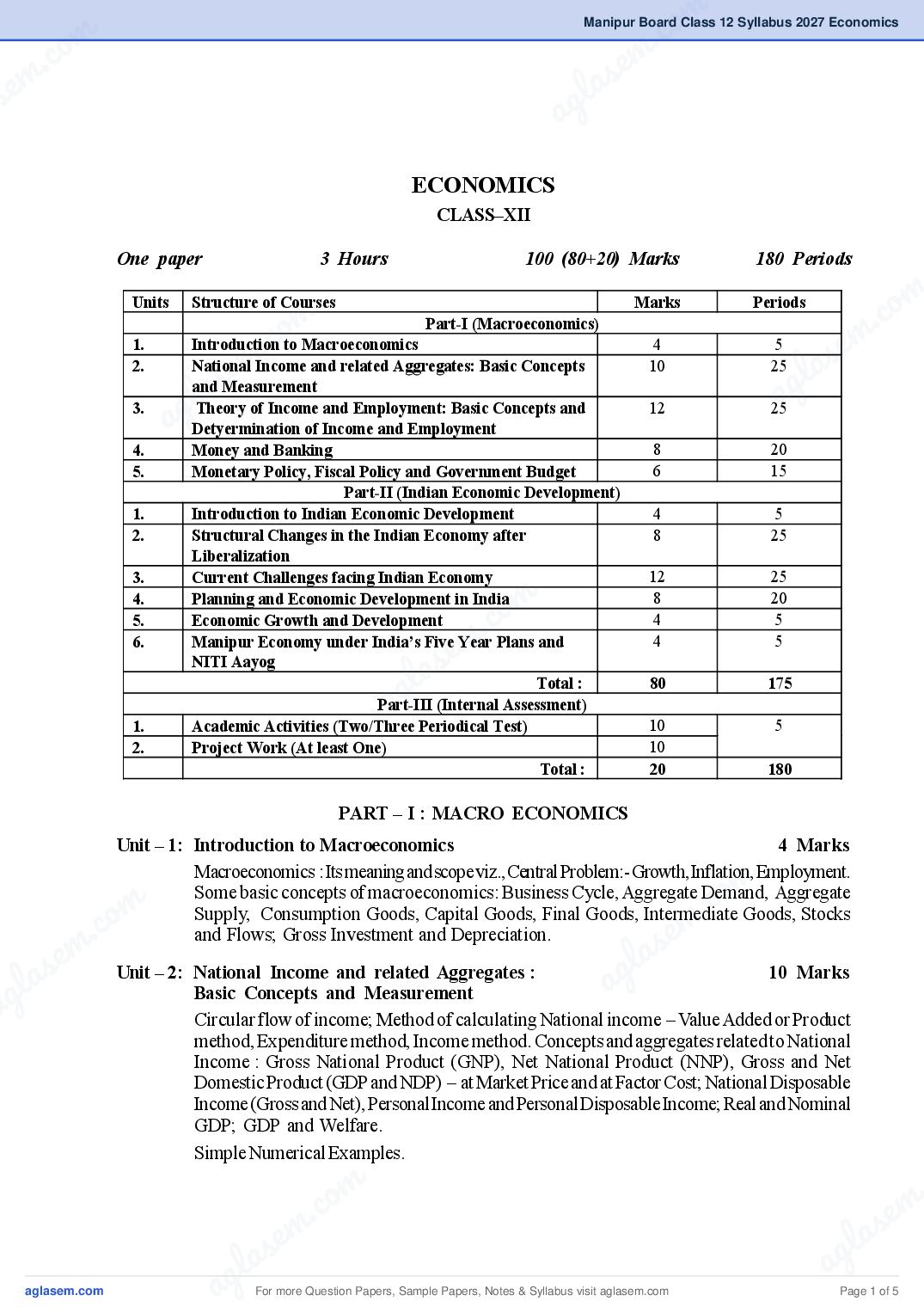
ECONOMICS
CLASS–XII
One paper 3 Hours 100 (80+20) Marks 180 Periods
m
.co
Units Structure of Courses Marks Periods
m
.co
Part-I (Macroeconomics)
e m
1.
2.
Introduction to Macroeconomics
e m
National Income and related Aggregates: Basic Concepts
4
10
5
25
l as
l as
and Measurement
ag
3.
ag Theory of Income and Employment: Basic Concepts and
Detyermination of Income and Employment
12 25
4. Money and Banking 8 20
5. Monetary Policy, Fiscal Policy and Government Budget 6 15
Part-II (Indian Economic Development)
1. Introduction to Indian Economic Development 4 5
2. Structural Changes in the Indian Economy after 8 25
Liberalization
3. Current Challenges facing Indian Economy 12 25
4. Planning and Economic Development in India m 8 20
5. Economic Growth and Development
m .co 4 5
6.
e
Manipur Economy under India’s Five Year Plans and
s
4 5
la
NITI Aayog
ag Total :
Part-III (Internal Assessment)
80 175
1. Academic Activities (Two/Three Periodical Test) 10 5
2. Project Work (At least One) 10
Total : 20 180
PART – I : MACRO ECONOMICS
Unit – 1: Introduction to Macroeconomics 4 Marks
m
Macroeconomics : Its meaning and scope viz., Central Problem:- Growth, Inflation, Employment.
.co
Some basic concepts of macroeconomics: Business Cycle, Aggregate Demand, Aggregate
m
.co m
Supply, Consumption Goods, Capital Goods, Final Goods, Intermediate Goods, Stocks
m and Flows; Gross Investment and Depreciation.
s e
s e g l a
g la Unit – 2: National Income and related Aggregates :
Basic Concepts and Measurement a 10 Marks
a Circular flow of income; Method of calculating National income – Value Added or Product
method, Expenditure method, Income method. Concepts and aggregates related to National
Income : Gross National Product (GNP), Net National Product (NNP), Gross and Net
Domestic Product (GDP and NDP) – at Market Price and at Factor Cost; National Disposable
Income (Gross and Net), Personal Income and Personal Disposable Income; Real and Nominal
GDP; GDP and Welfare.
Simple Numerical Examples.
m .
.co s e m
s em l a
g la ag
a For more Question Papers, Sample Papers, Notes & Syllabus visit Page 1 of 5
Page 3
and Employment. 12 Marks
Aggregate Demand, Aggregate Supply and their components. Consumption Function and
Investment Function, Propensity to Consume and Propensity to Save, Equilibrium Output,
Types of Unemployment.
Unit – 4: Money and Banking 8 Marks
Money – Meaning, Functions and types. Supply of money – Currency held by the public
and net demand deposits held by commercial banks – Definition and Functions, Money
and Credit Creation by Commercial banks. Central bank – Meaning and Functions.
Unit – 5: Monetary Policy, Fiscal Policy and Government Budget 6 Marks
Monetary Policy – Meaning, types and tools.
Fiscal Policy – Meaning, types and tools.
Government budget – meaning, objectives, components and types, classification of receipts –
revenue receipt and capital receipt; classification of expenditure – revenue expenditure
and capital expenditure. Various measures of government deficit - revenue deficit, fiscal
deficit, primary deficit; their meaning and implictions.
PART – II : INDIAN ECONOMIC DEVELOPMENT
Unit – 1: Introduction to Indian Economic Development 4 Marks
• Parameters of Development - Per Capita Income, Human Development in India.
• A brief introduction of the state of the Indian economy on the eve of independence.
Main features, problems and policies of Agriculture and Foreign Trade.
Unit – 2: Structural Changes in the Indian Economy After Liberalization
8 Marks
Meaning, Need, Significance and Features of Liberalization, Globalization, Disinvestment and
Privatization, Present Features of Indian Economy.
Unit – 3: Current Challenges facing Indian Economy 12 Marks
• Rural development : Key issues – credit and marketing – role of cooperatives; agricultural
diversification; alternative farming - organic farming.
• Human Capital Formation : How people become resource; Role of human capital in
economic development; Growth of Education Sector in India.
• Informal Economy, Employment: Problems and Policies.
• Sustainable Economic Growth : Meaning, Effects of Economic Development on Resources
and Environment.
Unit – 4: Planning and Economic Development in India 8 Marks
Objectives, Targets, Achievements and drawbacks of different Five Year Plans in India (A
brief account).
For more Question Papers, Sample Papers, Notes & Syllabus visit Page 2 of 5
Page 4
m .co
m .co s e m
se g l a
a
Unit – 5: Economic Growth and Development 4 Marks
Economic Growth and Development-Meaning and Difference, Comparative study of India
and China on the following indicators : (i) Unemployment, (ii) GDP growth, (iii) GDP per
capita, (iv) GDP purchasing power parity, (v) amount in direct foreign investment, (vi) inflation,
(vii) poverty.
o m
m 4 Marks .c
.co
Unit – 6: Manipur Economy under India’s Five Year Plans and NITI Aayog.
e m
- Objectives, Targets, Performances and Achievements of Five Year
e m l as
l as Plans of Manipur.
- Structures, Objectives and Functions of NITI Aayog. a20g Marks
ag
Unit – 7: Project Work
(The list of Projects is only exemplary not exhaustive. Project work should be done
during the course of studies. One student should complete at least one project from the
following list) :
(a) Macroeconomics :
(i) Effect of changing rate on interest on automobiles sale.
(ii) Collect logos of 10 Nationalized Commercial Banks also collect data on rates
of interest (last 1 year) (CRR, SLR). m
.co
(iii) Information and pictures projecting evolution of money.
m
(b) Economic Growth and Development :
s e
la
Identify any two indicators of Economic Growth and three indicators of Economic
g
Development.
a
Collect data on these indicators for the last five years for at least four countries
of which two are developing and two are developed.
Analyse the data that is collected to see the difference between economic growth
and economic development.
(c) Globalization :
Divide the class into suitable groups. Each group shall make a wall magazine or
collage that will citically analyse the impact of globalization on them and their families’
lives.
m
.co
(d) Unemployment & Poverty :
m
.co m
Conduct a comparative study of any 2 localities and present the data by questionnaire
m s e
or interview method to find out type of unemployment that exists and how it leads
s e to poverty.
g l a
g la PRESCRIBED TEXTBOOKS : a
a 1. Indian Economic Development
Published by : NCERT, New Delhi.
2. Introduction to Macroeconomics
By: H.L. Ahuja
Published by: S. Chand & Co., Ltd., New Delhi.
3. Economic Planning and Development in Manipur
By: Dr Arambam Sanatomba Singh
m
Published by : Ereima Book Club, Hiyangthang, Imphal West
.
.co s e m
s em l a
g la ag
a For more Question Papers, Sample Papers, Notes & Syllabus visit Page 3 of 5
Page 5
1. Introductory Macro-Economics
By : Radha Bahuguna
Published by: Dhanpat Rai & Co., New Delhi.
2. Introductory Macro-Economics
By : T.R. Jain & V.K. Ohri
Published by: VK Global Publication Pvt. Ltd., New Delhi.
3. Indian Economic Development
By : Radha Bahuguna
Published by: Dhanpat Rai & Co., New Delhi.
4. Indian Economic Development
By : T.R. Jain & V.K. Ohri
Published by: VK Global Publication Pvt. Ltd., New Delhi.
——§§§——
For more Question Papers, Sample Papers, Notes & Syllabus visit Page 4 of 5
Page 6
m .co
m .co s e m
se DESIGN OF g l a
QUESTION PAPERa
Subject : ECONOMICS
Class : XII
Full Mark : 80
Time : 3 Hours
WEIGHTAGE TO OBJECTIVES
Objectives Marks Percentage
Knowledge (K) 12 15
I Understanding (U) 40 50
m
m .co
Application (A) 24 30
.co m
Skill (S) 4 5
s e
em
Total: 80 100
s
WEIGHTAGE TO FORMS OF QUESTIONS:
l a
g laForm of Questions No. of Question
Time
Marks ag
Percentage
a Answer (E/LA)
Essay/Long 4
(in minute)
86 32 40
II Short Answer (SA-I) 6 42 24 30
Short Answer (SA-II) 4 20 8 10
Very Short Answer (VSA) 6 12 6 7.5
MCQ 10 20 10 12.5
Total: 30 180 80 100
WEIGHTAGE TO CONTENT:
UNIT CONTENTS Marks Percentage
m
.co
Part –I Macroeconomics
1. Introduction to Macroeconomics 4 5
e m
s
National Income and related Aggregate : Basic
2.
10 12.5
3.
Concepts & Measurement
g la
Theory of Income and Employment :
4.
a
Basic Concepts & Determination of Income and Employment.
8
12
10
15
III Money and Banking
5. Monetary Policy, Fiscal Policy & Government Budget 6 7.5
Part – II Indian Economic Development
1. Introduction to Indian Economic Development 4 5
2. Structural Changes in the Indian Economy After liberalization 8 10
3. Current Challenges facing Indian Economy 12 15
4. Planning and Economic Development in India 8 10
5. Economic Growth and Development. 4 5
m
.co
6. Manipur Economy under India’s Five Year Plans and NITI Aayog 4 4
m
.co m
Total : 80 100
m IV
Part – III Internal Assessment
s e
s e 1. Academic Activities (Two/Three Periodical Test)
g l a
10 50
la a
2. Project Work * (At least One) 10 50
ag V
Total : 20
SCHEME OF SECTIONS : Three sections: (i) Macroeconomics (40 marks), (ii) Indian Economic
100
Development (40 marks) and (iii) Internal Assessment (20 marks).
VI SCHEME OF OPTIONS : (i) 50% of SA-I & 100% of E/LA with internal option, (ii) Two questions of
MCQ will be Assertion-Reasoning Type Question and One Question of SA-I will be Source-based Question.
DIFFICULTY LEVEL :
Difficult : 30% of the total marks
VII
Average : 50% of the total marks
Easy : 20% of the total marks
m .
.co m
Abbreviation : K(Knowledge),U(Understanding),C(Comprehension), Exp.(Expression), Skill(S), E(Essay Type),
SA (Short Answer Type), VSA (Very Short Answer Type), MCQ(Multiple Choice Question).
s e
s em
* Components of Project Work: (i) Introduction (2 marks), (ii) Contents/Observation (4 marks), (iii) Conclusion (1 mark) and
l a
la
(iii) Viva Voce (3 marks).
g ag
a For more Question Papers, Sample Papers, Notes & Syllabus visit Page 5 of 5
Document Details
| Board / Org | Manipur Board |
| Exam | Class 12 |
| Type | Syllabus |
| Pages | 5 |
| Updated | 04 Nov 2026 |