Karnataka 2nd PUC Question Paper 2026 Biology
Finished viewing? Save it for later —
Download Karnataka 2nd PUC Question Paper 2026 Biology (PDF · 24 pages)About Karnataka 2nd PUC Question Paper 2026 Biology
Karnataka 2nd PUC Question Paper 2026 Biology is available here for free download. Published by Karnataka Board for Class 12, this question paper can be viewed online or downloaded as a PDF (24 pages). Candidates preparing for Class 12 can use Karnataka 2nd PUC Question Paper 2026 Biology to understand the exam pattern, the type of questions asked, and the overall difficulty level.
Frequently Asked Questions
How can I download Karnataka 2nd PUC Question Paper 2026 Biology?
Open this page and click the Download button to save Karnataka 2nd PUC Question Paper 2026 Biology as a PDF. It is completely free on AglaSem Docs.
Is Karnataka 2nd PUC Question Paper 2026 Biology free to download?
Yes. Karnataka 2nd PUC Question Paper 2026 Biology can be viewed online and downloaded as a PDF free of cost on AglaSem Docs.
How many pages does Karnataka 2nd PUC Question Paper 2026 Biology have?
Karnataka 2nd PUC Question Paper 2026 Biology contains 24 pages, which you can read online or download together as a single PDF.
Where can I find more Class 12 study material?
You can find more Class 12 question papers, sample papers, syllabus, and answer keys on AglaSem Docs.
Karnataka 2nd PUC Question Paper 2026 Biology – Text
Read the full text of this question paper below — useful to quickly search, copy and reference the content online without downloading the PDF.
📄 View text version (24 pages)
Page 1
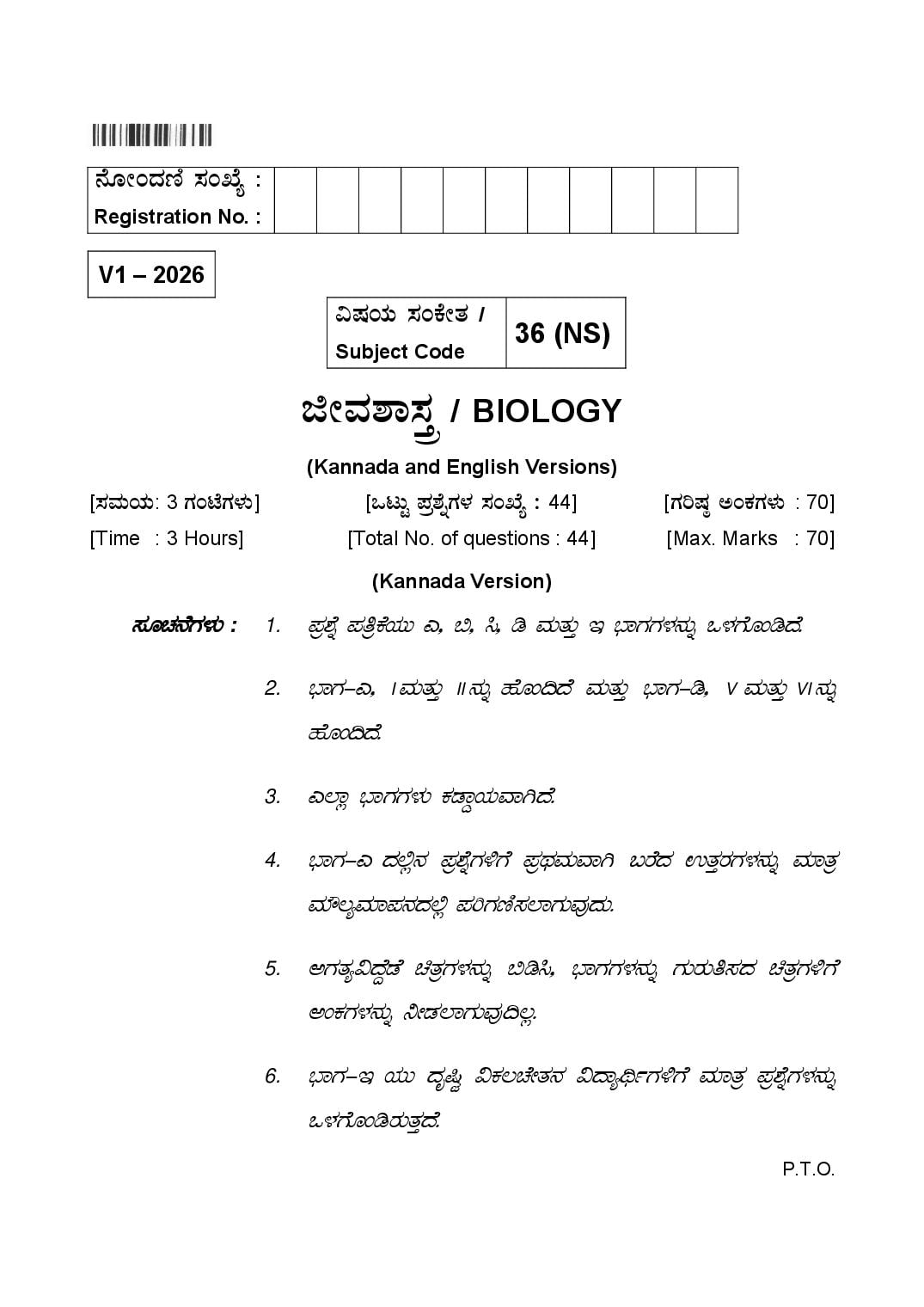
Registration No. :
V1 – 2026
«µÀAiÀÄ ¸ÀAPÉÃvÀ /
36 (NS)
Subject Code
fêÀ±Á¸ÀÛç / BIOLOGY
(Kannada and English Versions)
[¸ÀªÀÄAiÀÄ: 3 UÀAmÉUÀ¼ÀÄ] [MlÄÖ ¥Àæ±ÉßUÀ¼À ¸ÀASÉå : 44] [UÀjµÀ× CAPÀUÀ¼ÀÄ : 70]
[Time : 3 Hours] [Total No. of questions : 44] [Max. Marks : 70]
(Kannada Version)
¸ÀÆZÀ£ÉUÀ¼ÀÄ : 1. ¥Àæ±Éß ¥ÀwæPÉAiÀÄÄ J, ©, ¹, r ªÀÄvÀÄÛ E ¨sÁUÀUÀ¼À£ÀÄß M¼ÀUÉÆArzÉ.
2. ¨sÁUÀ-J, I ªÀÄvÀÄÛ II £ÀÄß ºÉÆA¢zÉ ªÀÄvÀÄÛ ¨sÁUÀ-r, V ªÀÄvÀÄÛ VI £ÀÄß
ºÉÆA¢zÉ.
3. J¯Áè ¨sÁUÀUÀ¼ÀÄ PÀqÁØAiÀĪÁVzÉ.
4. ¨sÁUÀ-J zÀÀ°è£À ¥Àæ±ÉßUÀ½UÉ ¥ÀæxÀªÀĪÁV §gÉzÀ GvÀÛgÀUÀ¼À£ÀÄß ªÀiÁvÀæ
ªÀiË®åªÀiÁ¥À£ÀzÀ°è ¥ÀjUÀt¸À¯ÁUÀĪÀÅzÀÄ.
5. CUÀvÀå«zÉÝqÉ avÀæUÀ¼À£ÀÄß ©r¹, ¨sÁUÀUÀ¼À£ÀÄß UÀÄgÀÄw¸ÀzÀ avÀæUÀ½UÉ
CAPÀUÀ¼À£ÀÄß ¤ÃqÀ¯ÁUÀĪÀÅ¢®è.
6. ¨sÁUÀ-E AiÀÄÄ zÀ馅 «PÀ®ZÉÃvÀ£À «zÁåyðUÀ½UÉ ªÀiÁvÀæ ¥Àæ±ÉßUÀ¼À£ÀÄß
M¼ÀUÉÆArgÀÄvÀÛzÉ.
P.T.O.
Page 2
¨sÁUÀ - J
I. F PɼÀV£À §ºÀÄ DAiÉÄÌ ¥Àæ±ÉßUÀ¼À°è ¸ÀjAiÀiÁzÀ GvÀÛgÀªÀ£ÀÄß DAiÉÄÌ ªÀiÁr :
(15 × 1 = 15)
1) ¥ÉÇõÀPÀ ºÉtÄÚ ¸À¸ÀåªÀÅ KPÀ°AV ¥ÀŵÀàUÀ¼À£ÀÄß GvÁࢸÀĪÀÅzÁVzÀÝgÉ,
PÀÈvÀPÀ ¸ÀAPÀgÀtzÀ°è EzÀgÀ CªÀ±ÀåPÀvɬÄgÀĪÀÅ¢®è.
a) aîUÀlÄÖ«PÉ b) aÃn ®UÀwÛ¸ÀĪÀÅzÀÄ
c) ªÀÄgÀÄaîUÀlÄÖ«PÉ d) ¥ËgÀĵÀ»Ã£ÀUÉƽ¸ÀÄ«PÉ
2) CAqÉÆæÃd£ï£ÀÄß ¸À櫸ÀĪÀ PÉÆñÀUÀ¼ÀÄ
a) ¸ÉmÉÆð° PÉÆñÀUÀ¼ÀÄ b) ¯ÉÊrUï PÉÆñÀUÀ¼ÀÄ
c) d£À£À PÉÆñÀUÀ¼ÀÄ d) «ÃAiÀiÁðtÄd£ÀPÀ PÉÆñÀUÀ¼ÀÄ
3) ¸ÀA¥ÀÇtðªÁV UÀÄt¥Àr¸À§ºÀÄzÁzÀ ¯ÉÊAVPÀ ¸ÀA¥ÀPÀð¢AzÀ ºÀgÀqÀĪÀ
¸ÉÆÃAPÀÄ
a) UÉÆãÉÆÃjAiÀiÁ b) ºÉ¥ÀmÉÊn¸ï-©
c) Kqïì d) eÉ£ÉÊl¯ï ºÀ¦ð¸ï
4) ¸ÀjAiÀiÁzÀ ºÉÆA¢PÉAiÀÄ£ÀÄß UÀÄgÀÄw¹.
a) XO – UÀAqÀÄ «ÄqÀvÉ b) XX – UÀAqÀÄ qÁæ¸ÉÆæü¯Á
c) ZW – UÀAqÀÄ ¥ÀQë d) ZZ - ºÉtÄÚ ¥ÀQë
Page 3
5) ºÉýPÉ I : IC –OH UÀÄA¦£À ¥ÉAmÉÆÃ¸ï ±ÀPÀðgÀzÉÆA¢UÉ
N-UÉèöÊPÉÆùrPï §AzsÀzÀ ªÀÄÆ®PÀ £ÉÊmÉÆæÃd£ï ¨Éøï
PÀÆrPÉÆAqÀÄ £ÀÆåQèAiÉÆøÉÊqï GAmÁUÀÄvÀÛzÉ.
ºÉýPÉ II : JgÀqÀÄ £ÀÆåQèAiÉÆøÉÊqïUÀ¼ÀÄ 3'-5' ¥sÁ¸ÉÆáÃqÉÊJ¸ÀÖgï
§AzsÀzÀ ªÀÄÆ®PÀ PÀÆrPÉÆAqÀÄ qÉÊ£ÀÆåQèAiÉÆøÉÊqï
GAmÁUÀÄvÀÛzÉ.
a) ºÉýPÉ I ªÀÄvÀÄÛ ºÉýPÉ II UÀ¼ÉgÀqÀÆ ¸ÀjAiÀiÁVªÉ
b) ºÉýPÉ I ªÀÄvÀÄÛ ºÉýPÉ II UÀ¼ÉgÀqÀÆ ¸ÀjAiÀiÁV®è
c) ºÉýPÉ I ¸Àj¬ÄzÉ DzÀgÉ ºÉýPÉ II ¸Àj¬Ä®è
d) ºÉýPÉ I ¸Àj¬Ä®è DzÀgÉ ºÉýPÉ II ¸Àj¬ÄzÉ
6) ¨sÀƪÉÊeÕÁ¤PÀ CªÀ¢ü ¥ÀæPÁgÀ ¥ÁætÂUÀÄA¥ÀÅUÀ¼À «PÁ¸ÀzÀ ¸ÀjAiÀiÁzÀ
C£ÀÄPÀæªÀÄtÂPÉAiÀÄÄ
a) G¨sÀAiÀĪÁ¹UÀ¼ÀÄ - «ÄãÀÄUÀ¼ÀÄ - ¸Àj¸ÀÈ¥ÀUÀ¼ÀÄ - ¸À¸ÀÛ¤UÀ¼ÀÄ
b) ¸À¸ÀÛ¤UÀ¼ÀÄ - «ÄãÀÄUÀ¼ÀÄ - ¸Àj¸ÀÈ¥ÀUÀ¼ÀÄ - G¨sÀAiÀĪÁ¹UÀ¼ÀÄ
c) ¸Àj¸ÀÈ¥ÀUÀ¼ÀÄ - G¨sÀAiÀĪÁ¹UÀ¼ÀÄ - «ÄãÀÄUÀ¼ÀÄ - ¸À¸ÀÛ¤UÀ¼ÀÄ
d) «ÄãÀÄUÀ¼ÀÄ - G¨sÀAiÀĪÁ¹UÀ¼ÀÄ - ¸Àj¸ÀÈ¥ÀUÀ¼ÀÄ - ¸À¸ÀÛ¤UÀ¼ÀÄ
7) zÀÄUÀÞgÀ¸À UÀAlÄUÀ¼À°è ¹®ÄQ, C°ègÀĪÀ °A¥ÉÇøÉÊmïUÀ¼À£ÀÄß ¸ÀQæAiÀÄUÉƽ¹
gÉÆÃUÀ¤gÉÆÃzsÀPÀ ¥ÀæwQæAiÉÄ GAlĪÀiÁqÀ®Ä PÁgÀtªÁUÀĪÀ PÀtUÀ¼ÀÄ
EªÁVªÉ
a) ¥ÀæwPÁAiÀÄUÀ¼ÀÄ b) CAn-»¸ÀÖªÉÄÊ£ïUÀ¼ÀÄ
c) ¥Àæwd£ÀPÀUÀ¼ÀÄ d) EAmÉgï¥sÉgÁ£ïUÀ¼ÀÄ
Page 4
8) ¨sÀæªÀĤgÀ¸À£À UÀÄtUÀ¼À£ÀÄß ºÉÆA¢gÀĪÀ ¸À¸ÀåUÀ¼ÀÄ EªÁVªÉ
a) CmÉÆæÃ¥À ªÀÄvÀÄÛ PÁå£Á©¸ï
b) zÀvÀÆgÀ ªÀÄvÀÄÛ CmÉÆæÃ¥À
c) zÀvÀÆgÀ ªÀÄvÀÄÛ PÁå£Á©¸ï
d) CmÉÆæÃ¥À ªÀÄvÀÄÛ ¥À¥ÁªÉgï
9) ¥ÀnÖ – I £ÀÄß ¥ÀnÖ - II gÉÆA¢UÉ ºÉÆA¢¹.
¥ÀnÖ - I ¥ÀnÖ - II
A. gÉÊeÉÆ©AiÀÄA 1. ¹næPï DªÀÄè
B. PÁè¹ÖçÃrAiÀÄA 2. UÉÆçgï UÁå¸ï
C. D¸Áàgïf®è¸ï 3. ¸ÀºÀfêÀ£ÁvÀäPÀªÁV ¸ÁgÀd£ÀPÀ
¹ÜjÃPÀgÀtUÉƽ¸ÀÄ«PÉ
D. ªÉÄxÀ£ÉÆeÉ£ïì 4. §ÄåmÉÊjPï DªÀÄè
a) A-1, B-2, C-3, D-4
b) A-2, B-1, C-3, D-4
c) A-3, B-4, C-1, D-2
d) A-4, B-2, C-1, D-3
Page 5
10) F PɼÀV£ÀªÀÅUÀ¼À°è AiÀiÁªÀÅzÀÄ PCR £À°è ¥Éæ ʪÀÄgï eÉÆÃqÀuÉAiÀÄ ¸ÀjAiÀiÁzÀ
ºÀAvÀªÀ£ÀÄß ¥Àæw¤¢ü¸ÀÄvÀÛzÉ?
a) 5' 3'
5' 3'
b) 3' 5'
3' 5'
c) 5' 3'
3' 5'
d) 3' 5'
5' 3'
11) ¸ÀjAiÀÄ®èzÀ ºÉýPÉAiÀÄ£ÀÄß UÀÄgÀÄw¹.
a) ¤§ðAzsÀ QtézÀ ¥ÀæxÀªÀÄ CPëÀgÀªÀ£ÀÄß ¨ÁåQÖÃjAiÀiÁzÀ PÀÄ®¢AzÀ
¥ÀqÉAiÀįÁVzÉ
b) ¤§ðAzsÀ QtézÀ ¢éwÃAiÀÄ ªÀÄvÀÄÛ vÀÈwÃAiÀÄ CPëÀgÀUÀ¼À£ÀÄß ¨ÁåQÖÃjAiÀiÁzÀ
¥Àæ¨sÉÃzÀ¢AzÀ ¥ÀqÉAiÀįÁVzÉ
c) ¤§ðAzsÀ QtézÀ £Á®Ì£Éà CPëÀgÀªÀ£ÀÄß ¨ÁåQÖÃjAiÀiÁzÀ vÀ½¬ÄAzÀ
¥ÀqÉAiÀįÁVzÉ
d) vÀ½£ÀAvÀgÀzÀ gÉÆêÀÄ£ï CPëÀgÀªÀÅ ¤§ðAzsÀ QtéªÀ£ÀÄß ¥ÀævÉåÃQ¹gÀĪÀ
¨ÁåQÖÃjAiÀiÁzÀ gÉÆêÀÄ£ï ªÀÄÆ®ªÀ£ÀÄß ¸ÀÆa¸ÀÄvÀÛzÉ
Page 6
12) eÉÆüÀzÀ gÀAzsÀæPÉÆgÉPÀUÀ¼ÀÄ ¤AiÀÄAwæ¸À®àqÀĪÀÅzÀÄ F ªÀA±ÀªÁ»
¸ÀAPÉÃw¸À®àlÖ ¥ÉÆæÃnãï¤AzÀ
a) Cry I Ab b) Cry II Ab
c) Cry IV Ab d) Cry I Ac
13) ¥Áj¸ÁgÀPÀ zÀȶÖAiÀÄ ªÉʱÁ®åvÉAiÀÄ°è ¸À¸ÀåºÁjUÀ¼ÀÄ EªÀÅUÀ½VAvÀ wÃgÁ
©ü£ÀߪÀ®è
a) ¸ÀºÀfëUÀ¼ÀÄ b) ¥ÀgÀ¨sÀPëÀPÀUÀ¼ÀÄ
c) ¥ÀgÁªÀ®A©UÀ¼ÀÄ d) GvÁàzÀPÀUÀ¼ÀÄ
14) ¸ÀvÀÛ ¸À¸ÀåzÀ G½PÉ ¨sÁUÀUÀ¼ÁzÀ J¯É, vÉÆUÀmÉ ªÀÄvÀÄÛ ºÀÆUÀ½AzÀ
gÀa¸À®àqÀĪÀÅzÀÄ
a) PÀ¸À b) ºÀÆåªÀĸï
c) PÉƼÉw¤ªÀ¸ÀÄÛ d) ¥À¼ÉAiÀÄĽPÉ
15) eÁUÀwPÀ ¥Àæ¨sÉÃzÀ ªÉÊ«zsÀåvÉAiÀÄÄ ¸ÀĪÀiÁgÀÄ 7 zÀ±À®PëÀzÀ¶ÖzÉ JAzÀÄ
CAzÁf¸À®ànÖzÀÄÝ EªÀjAzÀ
a) JqÀéqïð «®ì£ï b) gÁ§mïð ªÉÄÃ
c) qÉëqï n®ä£ï d) ¥Ë¯ï J°æZï
Page 7
II. F PɼÀUÉ ¤ÃqÀ¯ÁzÀ ¸ÀjAiÀiÁzÀ ¥ÀzÀªÀ£ÀÄß DAiÉÄÌ ªÀiÁr, ©lÖ ¸ÀܼÀ vÀÄA©j :
(5 × 1 = 5)
(650 CC, ¨sÀPëÀPÀfêÀPÉÆñÀUÀ¼ÀÄ, E£ÁPÀÄ宪Àiï, ¥ÁætÂUÀ¼ÀÄ, 900 CC, VtÄÚ)
16) QëÃgÉÆÃvÀàwÛAiÀÄ ªÉÆzÀ® PÉ®ªÀÅ ¢£ÀUÀ¼À°è GvÀàwÛAiÀiÁUÀĪÀ ºÁ®£ÀÄß
___________ J£ÀÄßvÁÛgÉ.
17) ºÉÆêÉÆ JgÉPÀÖ¸ï£À ªÉÄzÀĽ£À UÁvÀæªÀÅ ¸ÀĪÀiÁgÀÄ ___________ DVvÀÄÛ.
18) ºÀÆåªÀÄ£ï EªÀÄÄå£ÉÆà r¦üµÉAiÀÄ¤ì ªÉÊgÀ¸ï ___________ £À°è
¥ÀæwPÀgÀtUÉƼÀÄîvÀÛzÉ.
19) vÁeÁ ºÁ°UÉ ¸ÉÃj¸ÀĪÀ ¸Àé®à ªÉƸÀgÀ£ÀÄß ___________ J£ÀÄßvÁÛgÉ.
20) ¥Àæ¸ÀÄÛvÀ ®¨sÀå«gÀĪÀ ¥Àæ¨sÉÃzÀ vÀ¥À²Ã®Ä AiÀiÁ¢AiÀÄ DzsÁgÀzÀ ªÉÄïÉ
±ÉÃPÀqÁ 70 gÀµÀÄÖ ___________ zÁR¯ÁVgÀÄvÀÛªÉ.
¨sÁUÀ - ©
III. F PɼÀV£À ¥Àæ±ÉßUÀ¼À°è AiÀiÁªÀÅzÁzÀgÀÆ LzÀÄ ¥Àæ±ÉßUÀ½UÉ CªÀ±Àå«zÉÝqÉ
¥ÀæwAiÉÆAzÀPÀÆÌ 3 jAzÀ 5 ªÁPÀåUÀ¼À°è GvÀÛj¹. (5 × 2 = 10)
21) JgÀqÀÄ fêÀPÉÆñÀUÀ¼ÀļÀî ¥Àæ§ÄzÀÞ ¥ÀgÁUÀgÉÃtÄ«£À avÀæªÀ£ÀÄß ©r¹,
¨sÁUÀUÀ¼À£ÀÄß UÀÄgÀÄw¹.
22) ZIFT AiÀÄÄ IUI VAvÀ ºÉÃUÉ ©ü£ÀߪÁVzÉ?
Page 8
23) PɼÀV£ÀªÀÅUÀ½UÉ ªÀiÁ£ÀªÀ£À ªÀA±ÀªÀÈPëÀ aºÉßUÀ¼À£ÀÄß §gɬÄj.
a) °AUÀzÀ ¤¢ðµÀÖvɬĮè
b) ¸ÀA¨sÉÆÃUÀ
24) ªÀA±ÀªÁ» ªÀ¸ÀÄÛ«£À £Á®ÄÌ UÀÄt®PëÀtUÀ¼À£ÀÄß w½¹.
25) ¸ÀªÀÄgÀƦ CAUÀUÀ¼ÉAzÀgÉãÀÄ? MAzÀÄ GzÁºÀgÀuÉ PÉÆr.
26) ¥ÀæweÉÊ«PÀUÀ¼ÀÄ fëUÀ½UÉ “fêÀ«gÉÆâü” ºÁUÀÆ “fë¥ÀgÀ”UÀ¼ÁVAiÀÄÆ
PÁAiÀÄð¤ªÀð»¸ÀÄvÀÛªÉ. «ªÀIJð¹.
27) MAzÀÄ DªÁ¸À¸ÁÜ£ÀzÀ°è fêÀªÉÊ«zsÀåvÉAiÀÄ £ÀµÀÖzÀ ‘‘zÀĵÀÖ ZÀvÀĵÀÖAiÀÄUÀ¼À’’
¥ÀnÖ ªÀiÁr.
¨sÁUÀ - ¹
IV. F PɼÀV£À AiÀiÁªÀÅzÁzÀgÀÆ LzÀÄ ¥Àæ±ÉßUÀ½UÉ ¥ÀæwAiÉÆAzÀPÀÆÌ 40 jAzÀ
80 ¥ÀzÀUÀ¼À°è §gɬÄj. (5 × 3 = 15)
28) KPÀzÀ¼À ¸À¸ÀåzÀ ¨sÀÆætzÀ avÀæªÀ£ÀÄß §gÉzÀÄ ªÀÄÆgÀÄ ¨sÁUÀUÀ¼À£ÀÄß UÀÄgÀÄw¹.
29) dgÁAiÀÄÄ JAzÀgÉãÀÄ? dgÁAiÀÄÄ«£À JgÀqÀÄ PÁAiÀÄðUÀ¼À£ÀÄß w½¹.
Page 9
30) CAvÀBUÀ¨sÀð ¸ÁzsÀ£ÀUÀ¼À (IUDs) PÁAiÀÄð«zsÁ£ÀUÀ¼À£ÀÄß «ªÀj¹.
31) ºÁrð-ªÉÊ£ï§Uïð vÀvÀéªÀ£ÀÄß ºÉý ªÀÄvÀÄÛ ºÁrð-ªÉÊ£ï§Uïð
¸ÀªÀÄvÉÆî£À ¹ÜwAiÀÄ ªÉÄÃ¯É ¥Àæ¨sÁªÀ ©ÃgÀĪÀ £Á®ÄÌ CA±ÀUÀ¼À£ÀÄß w½¹.
32) F PɼÀV£À gÉÆÃUÁtÄUÀ½AzÀ GAmÁUÀĪÀ gÉÆÃUÀUÀ¼À£ÀÄß w½¹.
a) D¸ÁÌj¸ï
b) »ªÉÆæü®¸ï E£ï¥sÀÄèAiÉÄAeÉ
c) mÉæÊPÉÆ¥sÉÊmÁ£ï
33) F PɼÀV£À ¸ÀÆPÁëöätÄ fëUÀ½AzÀ GvÁࢸÀ®àqÀĪÀ eÉÊ«PÀ QæAiÀiÁ²Ã®
PÀtUÀ¼À£ÀÄß w½¹.
a) ¸ÉÖç¥ÉÆÖPÁPÀ¸ï
b) mÉæ ÊPÉÆqÀªÀÄð ¥Á°¸ÉÆàÃgÀA
c) ªÉÆ£Á¸ÀÌ¸ï ¥Àgï¥ÉÆåjAiÀĸï
34) ¨sÀÆ¥Àj¸ÀgÀ ªÀåªÀ¸ÉÜAiÀÄ°è£À eÉÊ«PÀgÁ² ¦gÀ«Äqï£À avÀæªÀ£ÀÄß §gÉzÀÄ
¨sÁUÀUÀ¼À£ÀÄß UÀÄgÀÄw¹.
Page 10
¨sÁUÀ - r
V. F PɼÀV£À AiÀiÁªÀÅzÁzÀgÀÆ £Á®ÄÌ ¥Àæ±ÉßUÀ½UÉ CªÀ±Àå«zÉÝqÉ 200 jAzÀ
250 ¥ÀzÀUÀ¼À°è GvÀÛj¹. (4 x 5 = 20)
35) MAzÀÄ PÁAiÀiÁðvÀäPÀ ¸ÀÆÜ® ©ÃeÁtÄ«¤AzÀ gÀZÀ£ÉAiÀiÁUÀĪÀ ¥Àæ§ÄzÀÞ
¨sÀÆæt¸ÀAaAiÀÄ£ÀÄß «ªÀj¹.
36) ªÀiÁ£ÀªÀ ¹Ûçà d£À£ÁAUÀªÀÇåºÀzÀ ¹Ã¼ÀÄ £ÉÆÃlzÀ avÀæªÀ£ÀÄß §gÉzÀÄ
LzÀÄ ¨sÁUÀUÀ¼À£ÀÄß UÀÄgÀÄw¹.
37) ¸ÁߥïqÁæUÀ£ï ¸À¸ÀåzÀ°è C¥ÀÇtð ¥À槮vÉ C£ÀĪÀA²ÃAiÀÄvÉAiÀÄ
¥sÀ°vÁA±ÀUÀ¼À£ÀÄß ¸ÀÆÜ® £ÀPÁëvÀäPÀªÁV ¥Àæw¤¢ü¹.
38) ¨ÁåQÖÃjAiÀiÁUÀ¼À°è ¯ÁPÉÆÖøï M¥ÉgÁ£ï ¤AiÀÄAvÀætªÀ£ÀÄß ¤gÀƦ¹.
39) PɼÀV£ÀªÀÅUÀ½UÉ GvÀÛj¹ :
a) ¸ÀA¥ÀPÀð CªÀgÉÆÃzsÀvÉ ªÀÄvÀÄÛ ¸ÁÜ£ÁAvÀgÀUÀ¼À£ÀÄß ªÁåSÁ夹. (2)
b) PÁå£Àìgï UÀÄt¥Àr¸ÀÄ«PÉAiÀÄ£ÀÄß «ªÀj¹. (3)
40) PÀįÁAvÀj ¥ÁætÂUÀ½AzÀ ªÀiÁ£ÀªÀPÀÄ®PÉÌ DUÀĪÀ ¥ÀæAiÉÆÃd£ÀUÀ¼À §UÉÎ n¥ÀàtÂ
§gɬÄj.
41) PɼÀV£ÀªÀÅUÀ½UÉ GvÀÛj¹.
a) ¸ÀªÀÄAiÀÄ " t + 1" £À°è fë¸ÀAzÀt ¸ÁAzÀævÉAiÀÄ£ÀÄß ¯ÉPÀ̺ÁPÀĪÀ ¸ÀÆvÀæ
w½¹. (1)
b) fë¸ÁAzÀævÉ Kj½vÀªÁUÀ®Ä £Á®ÄÌ ªÀÄÆ® QæAiÉÄUÀ¼ÀÄ PÁgÀtªÁVªÉ.
EªÀÅUÀ¼À£ÀÄß ºÉ¸Àj¹ ªÀÄvÀÄÛ ªÁåSÁ夹. (4)
Page 11
VI. F PɼÀV£À ¥Àæ±ÉßUÀ¼À°è AiÀiÁªÀÅzÁzÀgÀÆ MAzÀÄ ¥Àæ±ÉßUÉ CªÀ±Àå«zÉÝqÉ 200 jAzÀ
250 ¥ÀzÀUÀ¼À°è GvÀÛj¹. (1 × 5 = 5)
42) °AUÀ ¸ÀA®UÀßvÉ ªÀÄvÀÄÛ 16 £Éà ªÀtðvÀAvÀÄ ¸ÀA®UÀßvÉUÉ gÀPÀÛ ¸ÀA§A¢üvÀ
ªÀA±ÀªÁ» C¥À¸ÁªÀiÁ£ÀåvÉUÀ¼À£ÀÄß ¤gÀƦ¹.
43) r.J£ï.J. ¨ÉgÀ¼ÀZÀÄÑ«PÉAiÀÄ £ÀPÁëvÀäPÀ ¥Àæw¤¢üvÀéªÀ£ÀÄß «¸ÁÛgÀªÁV G¯èÉÃT¹
¤ÃrgÀĪÀ ¥Àæ±ÉßUÀ½UÉ GvÀÛj¹.
Page 12
a) A ªÀÄvÀÄÛ B ªÀåQÛUÀ¼À 7 £Éà ªÀiÁvÀÈPÀ ªÀÄvÀÄÛ ¦vÀÈPÀ ªÀtðvÀAvÀÄUÀ¼À°è JµÀÄÖ
¸ÀtÚ ¥ÀÅ£ÀgÁªÀwðvÀUÀ¼À£ÀÄß vÉÆÃj¸À¯ÁVzÉ? (2)
b) A ªÀÄvÀÄÛ B ªÀåQÛUÀ¼À JµÀÄÖ ¸ÀtÚ ¥ÀÅ£ÀgÁªÀwðUÀ¼ÀÄ eɯï£À ªÉÄïÉ
¨ÉÃ¥ÀðqÉUÉÆArªÉ? (1)
c) A ªÀÄvÀÄÛ B ªÀåQÛUÀ½§âgÀ®Æè ¸ÁªÀiÁ£ÀåªÁVgÀĪÀ ¸ÀtÚ
¥ÀÅ£ÀgÁªÀwðvÀUÀ¼À£ÀÄß UÀÄgÀÄw¹ ªÀÄvÀÄÛ w½¹. (1)
d) C¥ÀgÁzsÀ ¸ÀܼÀ¢AzÀ ¸ÀAUÀ滹zÀ r.J£ï.J. AiÀÄÄ AiÀiÁªÀ ªÀåQÛUÉ
ºÉÆA¢PÉAiÀiÁUÀÄvÀÛzÉ? (1)
44) ¤ÃrgÀĪÀ avÀæzÀ G¯èÉÃRzÉÆA¢UÉ PɼÀV£À ¥Àæ±ÉßUÀ½UÉ GvÀÛj¹.
a) DAiÉÄÌ ªÀiÁqÀ§®è UÀÄgÀÄwUÀ ªÀA±ÀªÁ»UÀ¼À£ÀÄß M¼À¸ÉÃj¸ÀÄ«PɬÄAzÀ
¤¶Ìöç¬ÄÃPÀgÀtUÉƽ¸À®Ä AiÀiÁªÀ QtéUÀ¼À£ÀÄß §¼À¸À§ºÀÄzÀÄ? (2)
b) MAzÉà ¤§ðAzsÀ QtéPÉÌ MAzÀQÌAvÀ ºÉZÀÄÑ vÀzÀÆæ¦ ¸ÁÜ£ÀUÀ¼À£ÀÄß
ªÁºÀPÀUÀ¼ÀÄ ºÉÆA¢gÀ¨ÁgÀzÀÄ. PÁgÀt w½¹. (1)
c) rop AiÀÄ ¥ÁæªÀÄÄRåvÉAiÉÄãÀÄ? (1)
d) ¥Áè¹äqï£À AiÀiÁªÀ vÁt ¥Àæw ¸ÀASÉåUÀ¼À£ÀÄß ¤AiÀÄAwæ¸ÀÄvÀÛzÉ? (1)
Page 13
¨sÁUÀ - E
(zÀ馅 «PÀ®ZÉÃvÀ£À «zÁåyðUÀ½UÉ ªÀiÁvÀæ)
10) r.J£ï.J. AiÀÄ ªÀzsÀð£ÉAiÀÄ£ÀÄß EzÀjAzÀ PÁAiÀÄðUÀvÀUÉƽ¸À§ºÀÄzÀÄ. (1)
a) r.J£ï.J. ¨ÉgÀ¼ÀZÀÄÑUÉƽ¸ÀÄ«PÉ
b) eÉ¯ï «zÀÄåvÀìgÀt
c) ¥ÀjªÀvÀð£ÉUÉƽ¸ÀĪÀÅzÀÄ
d) ¥Á°ªÀÄgÉÃ¸ï ¸ÀgÀ½ ¥ÀæwQæAiÉÄ
43) r.J£ï.J. ¨ÉgÀ¼ÀZÀÄÑ«PÉ «zsÁ£ÀzÀ ºÀAvÀUÀ¼À£ÀÄß «ªÀj¹. (5)
44) vÀzÀÆæ¦ ªÁºÀPÀUÀ¼À ¥ÀæªÀÄÄR UÀÄt®PëÀtUÀ¼À£ÀÄß ¤gÀƦ¹. (5)
–––––––––––––
Page 14
(English Version)
Instructions : 1. The question paper consists of Parts – A, B, C, D
and E.
2. PART–A consists of I and II and Part–D consists of
V and VI.
3. All Parts are compulsory.
4. For PART-A questions, only the first written answers
will be considered for evaluation.
5. Draw diagrams wherever necessary. Unlabelled
diagrams do not attract any marks.
6. PART-E, consists of questions, for Visually Challenged
students only.
PART – A
I. Select the correct alternative from the choices given below : (15 × 1 = 15)
1) In artificial hybridisation approach, if the female parent produces
unisexual flowers, there is no need for
a) Bagging b) Tagging
c) Rebagging d) Emasculation
2) The cells that secrete androgens are
a) Sertoli cells b) Leydig cells
c) Germ cells d) Spermatogonia
3) Sexually transmitted infection that can be completely curable is
a) Gonorrhea b) Hepatitis-B
c) AIDS d) Genital herpes
Page 15
4) Identify the correct match.
a) XO - Male grasshopper b) XX - Male Drosophila
c) ZW - Male bird d) ZZ - Female bird
5) Statement I : A nitrogenous base is linked to the –OH of IC pentose
sugar through N-glycosidic linkage to form a nucleoside.
Statement II : Two nucleosides are linked through 3'-5' phosphodiester
linkage to form a dinucleoside.
a) Both statement I and statement II are correct
b) Both statement I and statement II are incorrect
c) Statement I is correct, but statement II is incorrect
d) Statement I is incorrect but statement II is correct
6) Correct sequence of evolution of animal groups according to geological
time scale is
a) Amphibians - Fishes - Reptiles - Mammals
b) Mammals - Fishes - Reptiles - Amphibians
c) Reptiles - Amphibians - Fishes - Mammals
d) Fishes - Amphibians - Reptiles - Mammals
7) The molecules trapped in the lymph nodes responsible for the activation
of lymphocytes present there and cause the immune response are
a) Antibodies b) Anti-histamines
c) Antigens d) Interferons
Page 16
8) The plants with hallucinogenic properties are
a) Atropa and Cannabis b) Datura and Atropa
c) Datura and Cannabis d) Atropa and Papaver
9) Match the List-I with List-II
List-I List-II
A. Rhizobium 1. Citric acid
B. Clostridium 2. Gobar gas
C. Aspergillus 3. N2 fixation symbiotically
D. Methanogens 4. Butyric acid
a) A-1, B-2, C-3, D-4
b) A-2, B-1, C-3, D-4
c) A-3, B-4, C-1, D-2
d) A-4, B-2, C-1, D-3
10) Which of the following is the correct representation of primer annealing
step in PCR?
a) 5' 3'
5' 3'
b) 3' 5'
3' 5'
c) 5' 3'
3' 5'
d) 3' 5'
5' 3'
Page 17
11) Identify the incorrect statement.
a) First letter of the restriction enzyme is derived from genus of the
bacterium
b) Second and third letters of the restriction enzyme are derived from
species of the bacterium
c) The fourth letter of the restriction enzyme is derived from the strain
of the bacterium
d) The Roman letter after the strain indicate the Roman origin of
bacterium from which the restriction enzyme is isolated
12) The corn borers are controlled by the protein encoded by the gene
a) Cry I Ab b) Cry II Ab
c) Cry IV Ab d) Cry I Ac
13) Herbivores in a broad ecological context not very different from
a) Commensals b) Predators
c) Parasites d) Producers
14) Dead plant remains such as leaves, bark and flowers constitute
a) Debris b) Humus
c) Detritus d) Fossil
15) An estimate of about 7 million global species diversity was made by
a) Edward Wilson b) Robert May
c) David Tilman d) Paul Ehlrich
Page 18
II. Fill in the blanks by choosing the appropriate word/words from those given
below : (5 × 1 = 5)
(650 CC, macrophages, inoculum, animals, 900 CC, colostrum)
16) The initial few days of milk produced after parturition is ____________.
17) Homo erectus had a brain size around ____________.
18) Human immuno deficiency virus replicates in ____________.
19) A small amount of curd added to the fresh milk as ____________.
20) Based on currently available species inventories, 70% of species
recorded are ____________.
PART – B
III. Answer any five of the following questions in 3-5 sentences wherever
applicable : (5 × 2 = 10)
21) Draw a labelled diagram of mature 2-celled pollen grain.
22) How ZIFT is different from IUI?
23) Sketch pedigree symbols for :
a) Sex unspecified
b) Mating.
24) Mention four properties of a genetic material.
Page 19
25) What are homologous organs? Give an example.
26) Antibiotics act “Against life” as well as “prolife” to organisms. Comment.
27) List “The Evil quartet” of biodiversity losses in a given habitat.
PART – C
IV. Answer any five of the following questions in about 40-80 words each,
wherever applicable : (5 × 3 = 15)
28) Draw a diagram of monocot embryo and label three parts.
29) What is placenta? Mention two functions of placenta.
30) Explain the modes of action of Intra Uterine Devices (IUDs).
31) State Hardy-Weinberg principle and mention four factors that affect
Hardy-Weinberg equilibrium.
32) Mention the diseases caused by the following pathogens :
a) Ascaris
b) Haemophilus influenzae
c) Trichophyton.
33) Name the bioactive molecules that are produced by the following
microbes :
a) Streptococcus
b) Trichoderma polysporum
c) Monascus Purpureus.
34) Sketch and label the diagram of pyramid of biomass in a terrestrial
ecosystem.
Page 20
PART – D
V. Answer any four of the following questions in about 200-250 words each,
wherever applicable : (4 × 5 = 20)
35) Explain the formation of a mature embryo sac from a functional
megaspore.
36) Draw a diagrammatic sectional view of human female reproductive
system and label five parts.
37) Schematically represent the results of inheritance of incomplete
dominance in snapdragon plant.
38) Describe the regulation of lactose operon in bacteria.
39) Answer the following :
a) Define contact inhibition and metastasis. (2)
b) Explain the treatment of cancer. (3)
40) Write a note on benefits of transgenic animals to mankind.
41) Answer the following :
a) Mention an equation to calculate the population density at time
" t + 1" . (1)
b) Population density fluctuates due to change in four basic processes.
Name and define these four basic processes. (4)
Page 21
VI. Answer any one of the following questions in about 200-250 words each,
wherever applicable : (1 × 5 = 5)
42) Describe blood associated gene disorders linked to sex chromosome and
chromosome 16.
43) Refer to the schematic representation of DNA fingerprinting thoroughly
and answer the given questions :
Page 22
a) How many short tandem repeats are shown in the 7th maternal and
paternal chromosomes of individual A and B? (2)
b) How many short tandem repeats are separated on gel from
individual A and B? (1)
c) Identify and mention the numbers of short tandem repeats that are
common to both individuals A and B. (1)
d) DNA from crime scene matches with which individual? (1)
44) Refer to the given diagram and answer the questions that follow :
a) Which enzymes can be used for insertional inactivation of selectable
marker genes? (2)
b) Vector should not have more than one cloning site for the same
restriction enzyme. Give reason. (1)
c) What is the significance of rop? (1)
d) Which region of the plasmid controls copy number? (1)
Page 23
PART – E
(For Visually Challenged Students only)
10) Amplification of DNA is carried out by (1)
a) DNA fingerprinting
b) Gel electrophoresis
c) Transformation
d) Polymerase chain reaction.
43) Explain the steps of DNA fingerprinting. (5)
44) Describe the salient features of cloning vector. (5)
———————
Page 24
Document Details
| Board / Org | Karnataka Board |
| Exam | Class 12 |
| Type | Question Paper |
| Pages | 24 |
| Language | english |
| Updated | 24 Sep 2026 |