GTET 2026 Bulletin
Finished viewing? Save it for later —
Download GTET 2026 Bulletin (PDF · 28 pages)About GTET 2026 Bulletin
GTET 2026 Bulletin is available here for free download. Published by Goa Board for Goa Teacher Eligibility Test, this brochure can be viewed online or downloaded as a PDF (28 pages). Candidates preparing for Goa Teacher Eligibility Test can use GTET 2026 Bulletin to understand the exam pattern, the type of questions asked, and the overall difficulty level.
Frequently Asked Questions
How can I download GTET 2026 Bulletin?
Open this page and click the Download button to save GTET 2026 Bulletin as a PDF. It is completely free on AglaSem Docs.
Is GTET 2026 Bulletin free to download?
Yes. GTET 2026 Bulletin can be viewed online and downloaded as a PDF free of cost on AglaSem Docs.
How many pages does GTET 2026 Bulletin have?
GTET 2026 Bulletin contains 28 pages, which you can read online or download together as a single PDF.
Where can I find more Goa Teacher Eligibility Test study material?
You can find more Goa Teacher Eligibility Test question papers, sample papers, syllabus, and answer keys on AglaSem Docs.
GTET 2026 Bulletin – Text
Read the full text of this brochure below — useful to quickly search, copy and reference the content online without downloading the PDF.
📄 View text version (28 pages)
Page 1
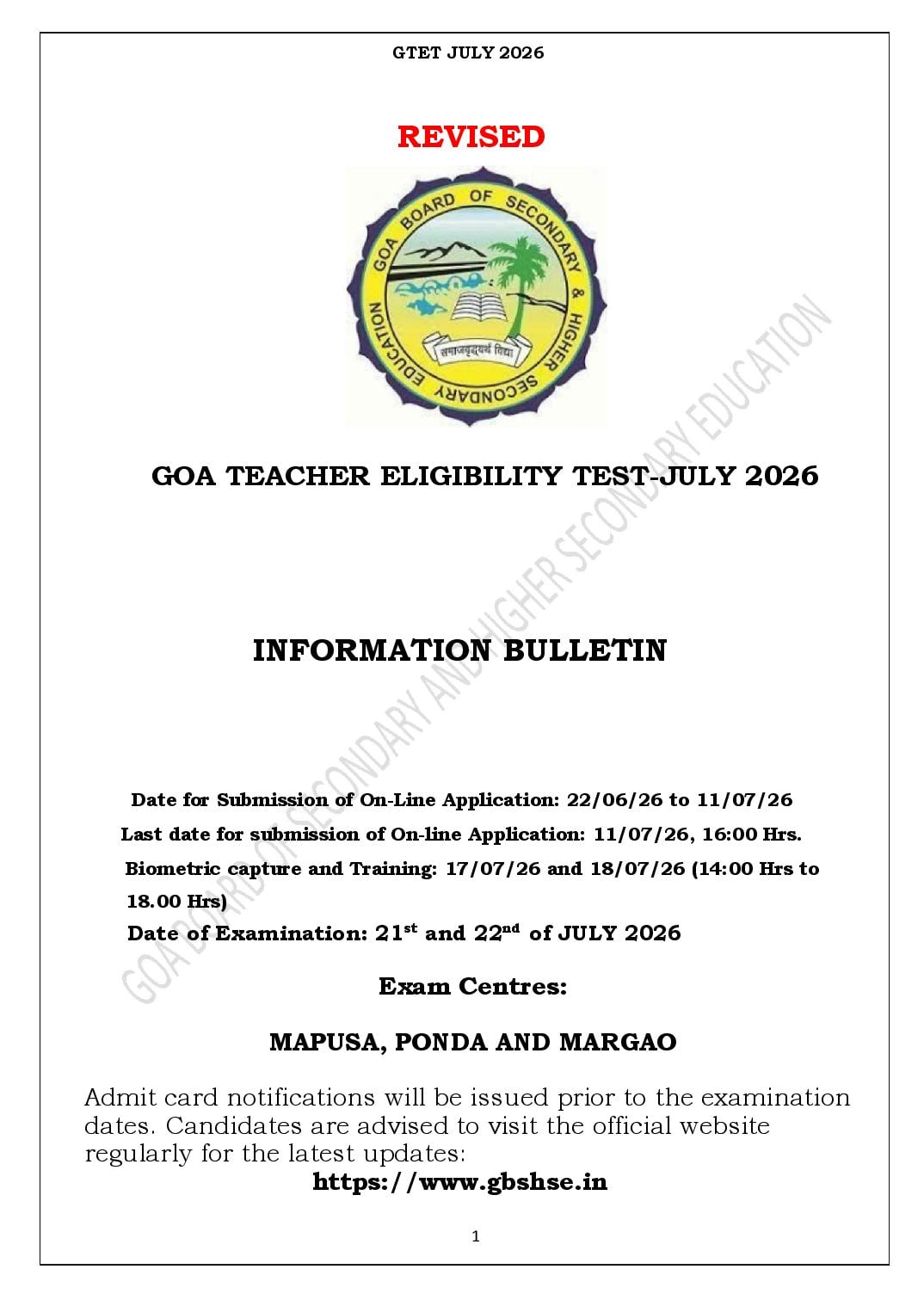
GOA TEACHER ELIGIBILITY TEST-JULY 2026
INFORMATION BULLETIN
Date for Submission of On-Line Application: 22/06/26 to 11/07/26
Last date for submission of On-line Application: 11/07/26, 16:00 Hrs.
Biometric capture and Training: 17/07/26 and 18/07/26 (14:00 Hrs to
18.00 Hrs)
Date of Examination: 21st and 22nd of JULY 2026
Exam Centres:
MAPUSA, PONDA AND MARGAO
Admit card notifications will be issued prior to the examination
dates. Candidates are advised to visit the official website
regularly for the latest updates:
https://www.gbshse.in
1
Page 2
INFORMATION BULLETIN.................................................................................................1
IMPORTANT NOTES.......................................................................................................3
1. DETAILED INSTRUCTIONS FOR APPLICATION AND EXAMINATION PROCESS..........4
A. REGISTRATION ......................................................................................................4
B. FILLING ONLINE APPLICATION FORM ...................................................................4
C. DOWNLOADING YOUR ADMIT CARD .....................................................................7
D. BIOMETRIC CAPTURE AND TRAINING...................................................................8
E. EXAM DAY INSTRUCTIONS:...................................................................................9
2. BACKGROUND AND RATIONALE .............................................................................10
3. SHORT TITLE ...........................................................................................................10
4. DEFINITIONS............................................................................................................10
5. SCHEDULE OF EXAMINATION.................................................................................11
6. MODE OF SUBMISSION OF APPLICATION...............................................................11
7. ELIGIBILITY..............................................................................................................11
8. STRUCTURE AND CONTENT OF GTET.....................................................................13
9. LANGUAGE OF THE QUESTION PAPER: ..................................................................16
10. QUALIFYING MARKS AND AWARD OF GTET CERTIFICATE.................................16
11. APPLICABILITY.....................................................................................................16
12. VALIDITY PERIOD OF GTET CERTIFICATE ..........................................................16
13. EXAMINATION CENTRES .....................................................................................16
14. ADMIT CARD........................................................................................................17
15. VERIFICATION OF ELIGIBILITY............................................................................17
16. FURNISHING OF FALSE, WRONG OR INACCURATE INFORMATION....................17
17. AMANUENSIS.......................................................................................................17
18. DISPATCH OF CERTIFICATE AND MARK STATEMENT ........................................18
19. LEGAL JURISDICTION .........................................................................................18
20. STRUCTURE AND CONTENT OF SYLLABUS .......................................................18
A. Paper I: Primary Stage (for classes I to V)..............................................................18
B. Paper II: Elementary Stage (for classes VI to VIII)..................................................22
2
Page 3
Candidates can apply for GTET JULY 2026 ‘ON-LINE’ through GOA BOARD
OF SECONDARY AND HIGHER SECONDARY EDUCATION (GBSHSE) website
https://www.gbshse.in from 22/06/26 to 04/07/26
The candidate applying for GTET is required to:
• To go through the entire Information Bulletin carefully.
• To self-ensure that he/she satisfies the eligibility condition to appear in GTET.
• To submit an Online application through GTET's website https://www.gbshse.in
• To furnish a complete mailing address with a Postal PIN Code at the time of applying.
• To make online payment of fee as instructed in the Fee Payment section.
• To download and keep the confirmation page and the fee receipt for future reference.
If a candidate submits more than one application, his/her candidature shall be
liable to be cancelled and fees paid will be forfeited further, the candidate may also
be debarred for future examination(s). No communication will be sent in this regard.
Qualifying for the GTET would not confer a right on
any person for Recruitment/Employment as it is only
One of the eligibility criteria for appointment.
3
Page 4
PROCESS.
A. REGISTRATION
B. FILLING ONLINE APPLICATION FORM
C. DOWNLOADING YOUR ADMIT CARD
D. BIOMETRIC CAPTURE AND TRAINING
E. EXAMINATION DAY INSTRUCTIONS
A. REGISTRATION
STEP 1: Visit the GBSHSE official website at https://www.gbshse.in Click on the "Services"
tab, then select the "GTET Application Form Filling – JULY 2026" link to be redirected to
the Application Form Filling System.
STEP 2: On the homepage, click the "Register" button to create your login credentials. Fill
in the required fields to set up your account.
STEP 3: Verify your mobile number and email address by entering the verification codes
sent to your registered mobile number and email.
a) Mobile No.
The candidate has to fill in his/her current working mobile number. All the
updates/alerts related to GTET shall be sent to the candidate’s mobile number. It is
the responsibility of candidates to put his/her mobile number operational to receive
information/notices related to the GTET Examination.
b) E-mail ID:
The candidate has to fill in his/her valid E-mail ID as the updates/alerts related to
GTET shall be sent to the candidate’s E-mail ID.
STEP 4: Once verified, you will be directed to the login page. Enter your credentials to log
in. After successful login, you will be taken to your Dashboard.
B. FILLING ONLINE APPLICATION FORM
Before applying online please ensure to have the following documents/files:
• Scanned image of latest photograph and signature in JPG format only, for
uploading.
• A copy of Class X Certificate.
• A copy of Class XII Certificate.
• A copy of the Mark sheet of Qualifying Examination 1 or/and 2.
4
Page 5
begin filling the online application form.
STEP 2: Personal Details. In the first section, provide your personal details (such as
Name, Father’s Name, Date of Birth, Caste, etc.) and click " Continue."
STEP 3: Adress. In the second section, provide your address with PIN code and click "
Continue."
STEP 4: Application Details. In the third section, please enter the details related to
position applied for:
1. Paper Applying for:
Select Paper I if you intend to apply to become a teacher for classes I to V
Select Paper II if you intend to apply to become a teacher for classes VI to VIII
Select Both (Paper I & Paper II) if you intend to apply to become a teacher for
both i.e., classes I to V and VI to VIII
2. Language II
Please choose the Language II. The options are Konkani and Marathi. Language I
is English.
3. Optional Subject
If applying for Paper II (classes VI to VIII) or BOTH, Candidates should
mention the choice of subject. The options for a subject are:
1. Mathematics / Science
OR
2. Social studies / Social Science.
Note: Candidates applying for Paper–II only, or for BOTH Papers, must
specify the optional subject. Applications that do not mention the subject
will be rejected, and the fee will be forfeited without further
communication.
4. Exam Centre
Please select the exam center of your choice from the options provided.
STEP 5: Educational Qualification. Candidates has to mention the college from
where they have obtained their B.Ed., Degree/Diploma in Education/ Elementary
Education etc. The candidate may mention the percentage of marks obtained in the
Degree/Diploma in Education/Elementary Education etc. The decimal part may be
ignored e.g., 55 for 55.32% or 66 for 65.69%. The Candidates who are appearing in
their final exam may mention the percentage of marks scored by them in their
previous years/semesters
1. Qualification code. (Please refer APPENDIX-III for details)
5
Page 6
Select the appropriate Code from the drop-down menu box if you intend to apply
for GTET, Paper-I (for classes I to V)
b) Minimum Educational Qualifications for GTET, Paper-II (for Classes VI-VIII)
Select the appropriate Code from the drop-down menu box if you intend to apply
for GTET, Paper-II (for classes VI to VIII)
Note: The candidate not having any of the above qualifications shall not be
eligible for appearing in the Goa Teacher Eligibility Test. The candidate
should satisfy his/her eligibility before applying and shall be personally
responsible in case he/she is not eligible to apply as per the given
eligibility criteria.
2. Educational Degree/Diploma Colleges details:
Candidates has to mention his college from where they have obtained their B.Ed.
Degree/Diploma in Education/ Elementary Education etc. The candidate may
mention the percentage of marks obtained by him/her in the Degree/Diploma
in Education/Elementary Education etc. The decimal part may be ignored e.g.,
55 for 55.32% or 66 for 65.69%. The Candidates who are appearing in their final
exam may mention the percentage of marks scored by them in their previous
years/semesters.
Click the "Add more Qualifications" button more qualifications if needed Click "Continue"
when done.
STEP 6: In this section, upload all required documents, including your photo, signature,
and certificates. Ensure the following:
• Photo and Signature: Upload recent photographs and authentic documents only.
• File Format and Size:
o Photograph: JPG/JPEG format, passport size, with dimensions of 100px x
130px, and a maximum size of 1 MB. o Signature: JPG format, with
dimensions of 140px x 60px, and a maximum size of 1 MB.
o Documents: PDF format, with each file not exceeding 1 MB.
• Note: Upload the latest photograph to avoid any inconvenience at the examination
center as it will be used for identification purposes.
Declaration: You have to give a declaration by clicking on the tick box against both the
statements.
STEP 7: You can click on ‘Preview’ button to preview all the details filled. If everything is in
order, click the "Initiate Payment" button and pay the examination fee using a debit card,
credit card, net banking, or UPI. Upon successful payment, a receipt will be generated.
Download and save this receipt for your records.
6
Page 7
CATEGORY Only Paper - Both Paper - I and
I or II II
1.General/OBC Rs.1800/- Rs.3000/-
2.SC/ST/ Rs.900/- Rs.1500/-
3. Person with Exempted Exempted
Disabilities
STEP 8: After completing the payment, your finalized application will be displayed on the
screen. Download the application form for your records.
STEP 9: Log out of the system to ensure your account's security.
C. DOWNLOADING YOUR ADMIT CARD
You will receive an email notification when your admit card is available for download. Follow
these steps to download it:
STEP 1: Visit the GBSHSE official website at https://www.gbshse.in Click on the "Services"
tab and select the " GTET Application Form Filling - JULY 2026" link to be redirected to
the Application Form Filling System.
STEP 2: Log in using the same credentials you created during registration before filling out
the application. After a successful login, you will be directed to your Dashboard.
STEP 3: Scroll down to the bottom of the Dashboard where you will find the "Admit Cards"
section. Click on the download button to obtain your admit card.
STEP 4: Once you have downloaded your admit card, log out of the system to ensure your
account's security.
Correction/Updating in Personal Details:
The candidate’s particulars cannot be changed /edited once the examination fee has
been submitted. Thereafter, corrections in some particulars may be considered from
12/07/26 to 15/07/26 only if the request is made by the candidate with satisfactory
reason and a copy of supporting document (required if any) on the official email ID of
GTET i.e., [email protected].
No further request for change in particulars will be entertained under any circumstances
after the above-referred period.
Permission may be granted to make corrections in their following particulars i.e., name,
father’s and mother’s name, date of birth, category, differently able category, and
Subject for Paper II. This facility will be provided only once.
The Council will not be responsible for any consequences arising out of
nonacceptance of any correction/addition/deletion in any particular whatsoever
7
Page 8
application form initially.
Fee once remitted shall not be refunded or adjusted for future tests under any
circumstances.
No change will be accepted through fax or application in person. No
correspondence in this regard will be entertained. Please note that no request for
any change, in particular, will be accepted under any circumstances after the
specified date for online correction is over.
Admit card notifications will be provided prior to the examination dates. Candidates are
advised to visit the official website regularly for the latest updates:
Website: https://www.gbshse.in
For any query:
Contact Number:1 8 0 0 1 0 2 5 0 1 2
Email: [email protected]
Technical Support Timing: 10 AM To 6 PM (Monday To Friday)
The candidate must retain the Confirmation Page and Candidate Copy of Fee
Receipt for record and future reference.
Qualifying for the GTET would not confer a right on any person for Recruitment/
Employment as it is only one of the eligibility criteria for appointment.
For the latest updates, please visit GTET’s official Website: https://www.gbshse.in
For any query, mail to this email ID: [email protected] mentioning
your Registration/ Application ID No.
D. BIOMETRIC CAPTURE AND TRAINING
All the candidates are expected to enrol their biometric data to attend the
examination. Biometric enrolment will be done tentatively as per the dates given
above in the same examination centres allotted. Time slot for enrolment will be
intimated to each candidate thru email/mobile.
Candidates must bring their Admit Card and ID proof on the day of Biometric
enrolment.
Candidates will be provided training on the exam environment on the day of biometric.
It’s strongly advised for all the candidates to attend the training session,
Please note: It is mandatory to enrol biometric data to attend the examination.
8
Page 9
1. Prepare Required Documents:
o Admit Card: Carry a printed copy of your GTET July 2026 admit card.
o ID Proof: Bring a valid photo ID (e.g., Aadhar card, Passport, Driver's License) for
identity verification.
2. At the Centre
1. The examination center will open 60mininutes before the commencement of the
examination. Candidates should take their seats immediately after the opening
of the examination hall. If the candidates do not report in time due to any reason
i.e. traffic jam, train/bus delay, etc., they are likely to miss some of the general
instructions to be announced in the Examination Hall.
2. Gates of the Examination centre will be closed 30 minutes before the
examination. Candidates won't be allowed to enter in the exam centre after
closing of the gate.
3. Candidates are expected to assemble for the security check point after opening
of the examination center.
4. The candidate must show, the Admit Card downloaded from the GTET official
website for admission in the examination room/hall. A candidate who does not
possess a valid Admit Card shall not be permitted for the examination under
any circumstances by the Centre Superintendent.
5. The Candidate must carry his identify proof for verification purposes.
6. The candidates are strictly not allowed to carry any items listed below inside the
Examination Hall. The test centre will not have any provision to store, protect
or handover any of these items carried by the candidates under any
circumstances:
a) Textual material, printed or written, envelope or any other material except
the Admit Card & ID Card.
b) Any form of snacks or beverages. (Proper drinking facilities will be available
inside the examination centre.)
c) Any stationery item like textual material (printed or written), bits of paper,
Geometry/Pencil Box, Plastic Pouch, Calculator, Scale, Writing Pad, Pen
drives, Eraser, Calculator, Log Table, Electronic Pen/scanner, Cardboard,
etc.
d) Any communication devices like Mobile phones, Bluetooth, Earphones,
microphones, Pagers, Health bands, etc.
e) Any Watch/Wristwatch, Camera, wallet, goggles, handbags, etc.
f) Any other item that could be used for unfair means and for hiding
communication devices/gadgets like Cameras, Bluetooth devices, etc.
7. The candidates will undergo initial security check before the commencement of
the examination, failing which; they will not be permitted to appear for the
Examination.
8. Smoking, chewing gutka, spitting, etc. in the Examination Hall/Room is strictly
prohibited.
9. Tea, coffee, cold drinks, or snacks are not allowed to be taken into the
examination rooms during examination hours.
9
Page 10
o Seating: Sit in the assigned seat as indicated by the invigilators.
o Instructions: Listen carefully to the instructions given by the exam supervisor.
o Conduct: Maintain silence and avoid any form of malpractice. Follow all rules and
guidelines provided.
4. Completion of Exam:
o Submission: At the end of the exam, ensure that you submit your answer sheet or
any exam materials as directed by the invigilators.
o Exit: Leave the exam hall quietly and promptly as instructed. Do not discuss the
exam content with other candidates.
2. BACKGROUND AND RATIONALE
Under the provisions of sub-section (1) of Section 23 of the RTE Act, the National
Council for Teacher Education (NCTE) vide Notification dated 23rd August 2010
and 29th DECEMBER, 2011 laid down the minimum qualifications for a person
to be eligible for appointment as a teacher for class I to VIII. It had been inter alia
provided that one of the essential qualifications for a person to be eligible for
appointment as a teacher in any of the schools referred to in Clause (n) of section
2 of the RTE Act is that he/she should pass the Teacher Eligibility Test (TET) which
will be conducted by the appropriate Government under the Guidelines framed by
the NCTE.
The Government of Goa has entrusted the responsibility of conducting the Goa
Teacher Eligibility Test (GTET) to the Goa Board Of Secondary And
Higher Secondary Education (GBSHSE) ALTO-PORVORIM, GOA- 403521
3. SHORT TITLE
“Goa Teacher Eligibility Test Rules, 2026” are already notified vide the Gazette
Notification dated 09-09-2021.
4. DEFINITIONS
1. “Government” means “Government of Goa”.
2. “Council” means “State Council of Educational Research and Training, Goa”.
3. “School” for this purpose means any school where GTET is applicable as per
RTE ACT 2009.
4. “GTET” means “Goa Teacher Eligibility Test”.
5. “Qualifying Examination” means “Examination based on which the candidate
becomes eligible to apply for the Goa Teacher Eligibility Test.
6. “Rules” mean “The rules framed by the Goa Board of Secondary and Higher
Secondary Education, Porvorim, Goa for the conduct of GTET under the directive of
the Government of Goa”.
10
Page 11
Government of Goa”.
8. “Scheduled Tribes” means “Scheduled Tribes as specified and laid down by the
Government of Goa”.
9. “Other Backward Classes (OBCs)” means “Other Backward Classes as specified
and lay down by the Government of Goa.
10. Differently able persons” means “Differently able persons as specified and laid
down by the Government of Goa”.
11. “Examining Body” means “Goa Board of Secondary and Higher Secondary
Education, Porvorim, Goa for conducting the Goa Teacher Eligibility Test on behalf of
the Government of Goa”.
5. SCHEDULE OF EXAMINATION
The examinations are scheduled to be held on the 21ST JULY and 22ND of JULY,
2026. Exam centers will be located across North Goa and South Goa. Admit card
notifications will be issued prior to the examination dates. Candidates are advised to
visit the official website regularly for the latest updates: https://www.gbshse.in
6. MODE OF SUBMISSION OF APPLICATION
A candidate can apply for the Goa Teacher Eligibility Test online by logging on to
GTET’s official website https://www.gbshse.in
Before applying online please ensure to have the following documents/files:
• Scanned image of latest photograph and signature in JPG format only, for
uploading.
• A copy of Class X Certificate.
• A copy of Class XII Certificate.
• A copy of the Mark sheet of Qualifying Examination 1 or/and 2.
7. ELIGIBILITY
Eligibility Criteria with Codes for Paper-I
Code Description of Eligibility Criteria
11 Senior Secondary (or its equivalent) with at least 50% marks and passed
or appearing in the final year of a 2-year Diploma in Elementary Education
(by whatever name known)
12 Senior Secondary (or its equivalent) with at least 45% marks and passed
or appearing in the final year of a 2-year Diploma in Elementary Education
(by whatever name known), under the NCTE (Recognition Norms and
Procedure), Regulations, 2002.
11
Page 12
or appearing in the final year of a 4-year Bachelor of Elementary Education
(B.EI.Ed).
14 Senior Secondary (or its equivalent) with at least 50% marks and passed
or appearing in the final year of a 2-year Diploma in Education (Special
Education).
15 Graduation with at least 50% marks and a Bachelor of Education (B.Ed.)
Eligibility Criteria with Codes for Paper-II
Code Description of Eligibility Criteria
21 Graduation and passed or appearing in the final year of a 2-year Diploma
in Elementary Education (by whatever name known).
22 Graduation with at least 50% marks and passing or appearing in Bachelor
of Education (B.Ed.).
23 Graduation with at least 45% marks and passing or appearing in Bachelor
of Education (B.Ed.), under the NCTE (Recognition Norms and Procedure)
Regulations issued from time to time in this regard.
24 Senior Secondary (or its equivalent) with at least 50% marks and passed
or appearing in the final year of a 4-year Bachelor in Elementary Education
(B.EI.Ed).
25 Senior Secondary (or its equivalent) with at least 50% marks and passed
or appearing in the final year of 4-year B.A/B.Sc. B.Ed. or B.A. Ed. /B.Sc.
Ed.
26 Graduation with at least 50% marks and passing or appearing in B.Ed.
(Special Education).
“ Anyone who has qualified as Bachelor of Education from any NCTE recognized
institution shall be considered for appointment as a teacher in classes I to V provide
the person so appointed as a teacher shall mandatorily undergo a six-month Bridge
Course in Elementary Education recognized by the NCTE, within two years of such
appointment as a primary teacher ”.
Any candidate having a qualified B.Ed. A program recognized by the NCTE is
eligible to appear in GTET. Moreover, as per the existing TET guidelines
circulated vide NCTE letter dated 11-02-2011, a person who is pursuing any of
the teacher education courses (recognized by the NCTE or the RCI, as the case
may be) specified in the NCTE Notification dated 23rd August 2010 is also
qualified to appear in the GTET.
12
Page 13
• Relaxation up to 5% in the qualifying marks in the minimum Educational
Qualification for eligibility shall be allowed to the candidates belonging to
reserved categories, such as SC/ST/OBC/Differently able.
• Diploma/Degree Course in Teacher Education: For this Notification, a
Diploma/Degree course in teacher education recognized by the National Council
for Teacher Education (NCTE) only shall be considered. However, in the case of
Diploma in Education (Special Education) and B.Ed. (Special Education), a
course recognized by the Rehabilitation Council of India (RCI) only shall be
considered.
• Training to be undergone: A person with a D.Ed. (Special Education) shall
undergo, after appointment, an NCTE-recognized 6-month Special Program in
Elementary Education.
• The minimum qualifications referred to above apply to teachers of Languages,
Social Studies/Social Science, Mathematics, Science, etc. In respect of teachers
for Physical Education, the minimum qualification norms for Physical Education
teachers referred to in NCTE Regulation, dated 3rd November 2001 (as amended
from time to time) shall be applicable. For teachers of Art Education, Craft
Education, Home Science, Work Education, etc. the existing eligibility norms
prescribed by the State Governments and other school managements shall be
applicable till such time the NCTE lays down the minimum qualifications in
respect of such teachers.
• A person who is pursuing any of the teacher education courses (recognized
by the NCTE or the RCI, as the case may be) specified in the NCTE
Notification dated 29th July 2011 shall be eligible for appearing in the
GTET.
• The candidate should satisfy his/her eligibility before applying and shall be
personally responsible in case he/she is not eligible to apply as per the
given eligibility criteria. It is to be noted that if a candidate has been
allowed to appear in the Goa Teacher Eligibility Test it does not
imply that the Candidate’s eligibility has been verified. Passing
GTET does not vest any right with the Candidate for appointment.
The eligibility shall be finally verified by the concerned recruiting
agency / appointing authority.
8. STRUCTURE AND CONTENT OF GTET
All questions in GTET will be Multiple Choice Questions (MCQs), with four
alternatives out of which one answer will be correct/most appropriate. Each question
will carry one mark and there will be no negative marking. There will be two
papers on GTET.
• Paper I will be for a person who intends to be a teacher for classes I to V.
• Paper II will be for a person who intends to be a teacher for classes VI to VIII.
Note: A person who intends to be a teacher for both levels (classes I to V and
Classes VI to VIII) will have to appear in both papers (Paper I and Paper II).
13
Page 14
Duration of Examination: Two-and-a-half hours
Structure and Content of Examination
Sr. Subject No. of MCQs Marks
No.
1 Child Development and 30 MCQs 30
Pedagogy (compulsory) Marks
2 Language I – English (Compulsory) 30 MCQs 30
Marks
3 Language II (Konkani/Marathi) 30 MCQs 30
Marks
4 Mathematics (compulsory) 30 MCQs 30
Marks
5 Environmental Studies 30 MCQs 30
(compulsory) Marks
Total 150 MCQs 150
Marks
Nature and standard of questions:
• The test items on Child Development and Pedagogy will focus on the educational
psychology of teaching and learning relevant to the age group of 6-11 years. They
will focus on understanding the characteristics and needs of diverse learners,
interaction with learners, and the attributes and qualities of a good facilitator of
learning.
• The test items in Language I will focus on the elements of language,
communication, and comprehension abilities.
• The test items in Language II will focus on the elements of language,
communication, and comprehension abilities.
• Language II will be a language other than Language I. English is treated as
Language I in GTET and for Language II a candidate may either choose Konkani
or Marathi.
• The test items in Mathematics and Environmental Studies will focus on the
concepts, problem-solving abilities, and pedagogical understanding and
applications of the subjects. In all these subject areas, the test items will be
evenly distributed over different divisions of the syllabus (Appendix I) of that
subject prescribed for classes’ I-V by the SCERT.
• The subject content questions will be based on the topics prescribed in the
syllabus of the SCERT for classes I - V but their difficulty level as well as linkages
could be up to the Secondary stage.
14
Page 15
Duration of Examination: Two-and-a-half hours
Structure and Content of Examination
Sr. Subject No. of MCQs Marks
No.
1 Child Development and Pedagogy 30 MCQs 30 Marks
(compulsory)
2 Language I – English (Compulsory) 30 MCQs 30 Marks
3 Language II - (Konkani/Marathi) 30 MCQs 30 Marks
4 Mathematics & Science 60 MCQs 60 MCQs
(For Mathematics / Science teacher)
OR
5 Social Studies/Social Science 60 MCQs 60 MCQs
(For Social Studies/Social Science
teacher)
For any other teacher - either (IV) or (V)
Total 150 MCQs 150 Marks
Nature and standard of questions:
• The test items on Child Development and Pedagogy will focus on the educational
psychology of teaching and learning, relevant to the age group of 11-14 years.
They will focus on understanding the characteristics, needs, and psychology of
diverse learners, interaction with learners, and the attributes and qualities of a
good facilitator of learning.
• The test items in Language I will focus on the elements of language,
communication, and comprehension abilities.
• The test items in Language II will focus on the elements of language,
communication, and comprehension abilities.
• Language II will be a language other than Language I. English is treated as
Language I in GTET and for Language II a candidate may choose either Konkani
or Marathi.
• The test items in Mathematics and Science, and Social Studies/Social Science
will focus on the concepts, problem-solving abilities, and pedagogical
understanding and applications of the subjects. The test items of Mathematics
and Science will be of 30 marks each. The test items will be evenly distributed
over different divisions of the syllabus of that subject as prescribed for classes
VI-VIII by the SCERT.
• The subject content questions will be based on the topics prescribed in the
syllabus of the SCERT for classes VI-VIII but their difficulty level as well as
linkages could be up to the Senior Secondary stage.
9. LANGUAGE OF THE QUESTION PAPER:
The question paper shall be in English except for language II. Language II
paper will be in the respective languages.
15
Page 16
As per NCTE revised guidelines (Elementary) 2016 for conducting TET and
for the GTET, rules approved by the Govt. of Goa:
a) a person belonging to the general category must score 60 % (90 out of
150) or more in aggregate to be declared as a GTET pass.
b) A person belonging to the SC, ST, OBC, differently able category must
score 55% (83 out of 150) or more in aggregate to be declared as a
GTET pass.
School management should give weight age to the GTET scores in the recruitment
process however; qualifying the GTET would not confer any right on any person
for recruitment/employment as it is only one of the eligibility criteria for
appointment.
11. APPLICABILITY
The GTET shall apply to schools of the Government of Goa, Schools aided by
the Government of Goa or other Local Bodies, and Private Schools under the
administrative control of the Government of Goa.
12. VALIDITY PERIOD OF GTET CERTIFICATE
11.1 Goa Board Of Secondary And Higher Secondary Education (GBSHSE) will issue
certificates to all successful candidates qualifying GTET and the certificate shall
be valid for a lifetime.
11.2 There is no restriction on the number of attempts to appear in theGTET
examination. A person who has passed GTET may also appear againto improve his/her
score.
11.3 A duplicate copy of the Marks Statement or GTET Pass Certificate may be issued
to desiring candidates in genuine cases by submitting an application
stating the cause and by remitting a fee of Rs. 1000/- per document
plus postal charges as applicable. An application fee shall be paid by way of Demand
Draft in favor of the “GOA BOARD OF SECONDARY AND HIGHER SECONDARY
EDUCATION ALTO PORVORIM GOA” from a nationalized bank, payable at Goa.
13. EXAMINATION CENTRES
Exam Centers will be in the North Goa & South Goa. Procedure to be followed during
the conduct of GTET JULY 2026 is given in APPENDIX-II.
16
Page 17
The candidates will be able to download the Admit Card from the GBSHSE official
website once it is uploaded there. In case of any discrepancy noticed in the admit
card regarding the particulars of the candidate, photograph and signature, or any
other information varying from the confirmation page, he/she may immediately
contact the GBSHSE Unit for necessary corrections.
In case the confirmation page is not generated after depositing the requisite fees, the
candidate should immediately mail at [email protected] OR Call on
02048555507.
The candidates shall report at the Examination Centre 60 minutes before the
commencement of the examination.
The candidates are advised to read the instructions on the admit card carefully and
follow them during the conduct of the examination.
15. VERIFICATION OF ELIGIBILITY
1. Goa Board Of Secondary And Higher Secondary Education (GBSHSE) will not
scrutinize/verify the eligibility of the candidates to appear in the GTET. The
candidate should satisfy his/her eligibility before applying and shall be personally
responsible in case he/she is not eligible to apply as per the given eligibility
criteria. The candidates have been allowed to appear in the GTET does not imply
that the candidate’s eligibility has been verified.
2. Qualifying in GTET does not vest any right with the candidate for appointment.
All eligibility criteria including the passing of GTET shall be finally verified, by the
concerned recruiting agency / appointing authority.
16. FURNISHING OF FALSE, WRONG OR INACCURATE INFORMATION
Furnishing of false, wrong, or inaccurate information may lead to cancellation of the
Test result, forfeiture of the certificate, and even prosecution in appropriate cases.
17. AMANUENSIS
Under the Government of India, Ministry of Social Justice and
Empowerment Department of Disability guidelines vide OM F. No. 16-
110/2003-DD.III dated 26.02.2013 the following instructions are applicable
regarding differently able candidates during the conduct of the GTET
Examination:
1. The differently able candidates may be given a compensatory time of 30 minutes
in each paper of the GTET Examination.
2. Proper seating arrangements preferably on the ground floor, should be made
before the commencement of the Examination to avoid confusion.
3. There will be no separate Question Paper for Visually Impaired candidates.
17
Page 18
Goa Board Of Secondary And Higher Secondary Education (GBSHSE) will provide
Goa Teacher Eligibility Test (GTET) Mark sheets to all candidates and Eligibility
Certificates to successful candidates only.
19. LEGAL JURISDICTION
All disputes about the conduct of GTET shall fall within the jurisdiction of Goa only.
20. STRUCTURE AND CONTENT OF SYLLABUS
1. Paper I: Primary Stage (for classes I to V)
I. Child Development and Pedagogy 30 Questions
(a) Child Development (Primary School)
10 Questions
• Concept of development and its relationship with learning
• Principles of growth and development of children (up to 11 years)
• Causes of individual differences Heredity & Environment
• Social and Emotional development, Piaget’s stages of cognitive development
• Concepts of child-centered and progressive education
• Concept and types of Intelligence, Multiple Intelligence, Emotional Intelligence
• Measurement of Intelligence
• Concept of Personality, Development of Personality in Childhood
• Adjustment and Mental Health
(b) Learning
10 Questions
• How children think and learn
• Concept and nature of learning, learning styles
• Theories and principles of Conditioning, Cognitivism, and Constructivism
• Factors affecting Learning: Motivation, Attention, Memory, Emotion, etc.
• Transfer of Learning: Concept, Types, Methods
• Information Processing and Thinking: Critical thinking, problem-solving,
divergent thinking, creativity, and innovation.
(c) Curriculum, Pedagogy, and Evaluation
7 Questions
• Concept and Principles of Curriculum
• Types of Curricula
• Factors Affecting Curriculum Transaction
• Concept and Forms of Evaluation
• Continuous & Comprehensive Evaluation: perspective and practice
• Different types of tests, Marking, and grading of scholastic and co-scholastic
achievement of children.
• Principles of test construction and characteristics of a good test
• Question Bank, Blue Print, and Item Analysis
18
Page 19
3 Questions
• Features, characteristics, and Educational Provision for:
• Gifted children, Slow Learners, physically challenged and children with Learning
Disabilities
• Concept and Strategies for Inclusive Education
II-Language I (English) 30 Questions
(a) Language Comprehension 15 Questions
• Reading unseen passage – two passages, one prose or drama and a poem with
questions on comprehension, inference, grammar, and verbal ability (Prose
passage may be literary, scientific, narrative, or discursive)
(b) Pedagogy of Language Development 15 Questions
• Principles aims, and objectives of English language teaching
• Approaches, Methods, and techniques of teaching English
• Learning and acquisition of English language skills: Pronunciations, Stress, and
Modulation
• Role of listening and speaking: function of language and how children use it as a
tool
• Communicative and writing skills in English
• Role of grammar in learning the English language for communicating ideas
verbally and in written form
• Challenges of teaching the English language: Prose, Poetry, Composition, Letter
Writing, creative writing, etc.
• Evaluating English language comprehension and proficiency: speaking, listening,
reading, and writing
• Teaching–learning materials: Textbook, multi-media materials, multilingual
resources of the classroom
• Diagnostics Test and Remedial Teaching
III. Language – II Marathi/Konkani 30 Questions
(a) Comprehension 15 Questions
• Reading unseen passages – two passages, a prose/ drama and a poem with
questions on comprehension, inference, grammar, and verbal ability (Prose
passage may be literary, scientific, narrative, or discursive
(b) Pedagogy of Language Development 15 Questions
• Principles, aims, and objectives of language teaching
• Approaches, Methods, and Techniques of Teaching Language
• Learning and acquisition of language skills: Pronunciations, Stress, and
Modulation
19
Page 20
tool
• Communicative and the Writing skills
• Role of grammar in learning a language for communicating ideas verbally and in
written form
• Challenges of teaching language: Prose, Poetry, Composition, letter writing,
creative writing, etc.
• Evaluating language comprehension and proficiency: speaking, listening,
reading, and writing
• Teaching–learning materials: Textbook, multi-media materials, multilingual
resources of the classroom
• Diagnostic Test and Remedial Teaching
IV. Mathematics 30 Questions
(a) Content 15 Questions
• Geometry
• Shapes & Spatial Understanding
• Solids around Us
• Numbers
• Addition and Subtraction
• Multiplication
• Division
• Measurement
• Weight
• Time
• Volume
• Data Handling
• Patterns
• Money
(b) Pedagogical issues 15 Questions
• Aims and objectives of teaching Mathematics
• Place of Mathematics in School Curriculum
• Methods of teaching Mathematics: inductive, deductive, analytic, synthetic,
heuristic
• Approaches and techniques involved in the teaching of Mathematics
• Competency-based mode of instruction in Mathematics (class-I-IV)
• Concept Attainment Model of instructions in Mathematics
20
Page 21
• Teaching–learning materials: Textbook, Mathematical Kit, Models, other aids
• Evaluation through formal and informal methods
• Error analysis and related aspects of learning and teaching
• Diagnostic Test and Remedial Teaching
V. Environmental Studies 30 Questions
(a) Content 15 Questions
• Family and Friends:
• Relationships
• Work and Play
• Animals
• Plants
• Food Shelter
• Water
• Travel
• Things We Make and Do
(b) Pedagogical Issues 15 Questions
• Meaning, scope, and purpose of EVS
• Significance of EVS as an integrated area of study at the primary level
• Environmental Studies concerning Science & Social Studies
• Methods of teaching EVS: Observation Method, Project Method, Role Play,
• Storytelling, Environmental Games, Exhibition, etc.
• Approaches to teaching EVS: Activity-based, Exploration, Discovery,
• Experimentation/ Practical Work, Reporting
• Teaching–learning materials: Textbook, computer-aided Learning, Models, other
locally relevant resources, etc.
• Evaluation of learning objectives of EVS: Achievement test, Environmental
• Awareness test, assessment of attitude towards Environment, Interest, etc. •
Diagnostic Test and Remedial Teaching in EVS
21
Page 22
I. Child Development and Pedagogy 30 Questions
(a) Child Development (Elementary School) 10 Questions
• Meaning and Nature and Scope of Educational Psychology
• Concept and Principles of Growth and Development and its relationship with
learning
• Characteristics of growth and development of children (Physical, Emotional,
Social)
• Causes of Individual differences: Heredity & Environment,
• Social and Emotional Development, Paget’s stages of cognitive development
• Concepts of child-centered and progressive education
• Concept and types of Intelligence, Multiple Intelligence, Emotional Intelligence
• Measurement of Intelligence
• Concept of Personality, Development of Personality in Childhood
• Adjustment and Mental Health at home and school
• Self-concept, attitude, interest, values
•
(b) Learning 10 Questions
• How children think and learn
• Concept and nature of Learning, Learning styles
• Laws of Learning
• Theories and principles of Conditioning, Cognitivism, and Constructivism •
Factors Affecting Learning: Concept, Types, Methods
•
(c) Curriculum, Pedagogy, and Evaluation 7 Questions
• Concept and Principles of Curriculum
• Bases of Curriculum Development: Models of Curriculum Development
• Types of Curriculum Development
• Factors Affecting Curriculum Transaction
• Concept and Forms of Evaluation
• Continuous & Comprehensive Evaluation: perspective and practice •
Different types of tests: Marking, grading of scholastic and co-scholastic
• Achievement of children.
• Principles of test construction and characteristics of a good test
• Question Bank, Blue Print, and Item Analysis
(d) Concept of Inclusive education and understanding children's special needs
3 Questions
• Features, Characteristics, and Educational Provision for:
• Gifted children, Slow Learners, physically challenged and children with Learning
Disabilities
• Concept and Strategies for Inclusive Education
22
Page 23
(a) Language Comprehension 15 Questions
• Reading unseen passage – two passages, one prose/drama and a poem with
questions on comprehension, inference, grammar, and verbal ability (Prose
passage may be literary, scientific, narrative, or discursive)
(b) Pedagogy of Language Development 15 Questions
• Principles aims, and objectives of English language teaching
• Approaches, Methods, and techniques of teaching English
• Learning and acquisition of English language skills: Pronunciations, Stress, and
Modulation
• Role of listening and speaking: function language and how children use it as a
tool
• Communicative and writing skills in English
• Role of grammar in learning the English language for communicating ideas
verbally and in written form
• Challenges of teaching the English language; Prose, Poetry, composition, letter
writing, creative writing, etc.
• Evaluating English language comprehension and proficiency: speaking, listening,
reading, and writing
• Teaching–learning materials: Textbook, multi-media materials, multilingual
resources of the classroom
• Diagnostic Test and Remedial Teaching
III. Language – II: Marathi/Konkani 30 Questions
a) Comprehension 15 Questions
• Reading unseen passage – two passages of prose or drama and a poem with
questions on comprehension, inference, grammar, and verbal ability (Prose
passage may be literary, scientific, narrative, or discursive)
b) Pedagogy of Language Development 15 Questions
• Principles, aims, and objectives of language teaching
• Approaches, Methods, and techniques of teaching language
• Learning and acquisition of language skills: Pronunciations, Stress, and
Modulation
• Role of listening and speaking: function of language and how children use it as a tool
• Communicative and writing skills
• Role of grammar in learning a language: Prose, Poetry, composition, letter writing,
creative writing, etc.
• Evaluating language comprehension and proficiency: speaking, listening,
reading, and writing
• Teaching–learning materials: Textbook, multi-media materials, multilingual
resources of the classroom
• Diagnostic Test and Remedial Teaching
23
Page 24
I Mathematics 30 Questions
(a) Content 20 Questions
Number System
• Knowing our Numbers
• Playing with Numbers
• Whole Numbers
• Negative Numbers and Integers
• Fractions
Algebra
• Introduction to Algebra
• Ratio and Proportion
Geometry
• Basic geometrical ideas (2-D)
• Understanding Elementary Shapes (2-D and 3-D)
• Symmetry: (reflection)
• Construction (Using Straight edge Scale, protractor, compasses)
Mensuration
Data handling
(b) Pedagogical issues 10 Questions
• Aims and objectives of teaching Mathematics
• Place of Mathematics in School Curriculum
• Methods of teaching Mathematics: inductive, deductive, analytic, synthetic,
heuristic
• Approaches and techniques involved in the teaching of Mathematics
• Competency-based teaching in Mathematics (class-I-IV)
• Concept Attainment Model of Teaching in Mathematics
• Challenges of Teaching Mathematics
• Teaching–learning materials: Textbook, Mathematical Kit, models, other aids
• Evaluation through formal and informal methods
• Error analysis and related aspects of learning and teaching
• Diagnostic Test and Remedial Teaching
II Science 30 Questions
24
Page 25
Food
• Sources of food
• Components of food
• Cleaning food
Material
Materials of daily use
The World of the Living
Moving Things People and Ideas
How things work
• Electric Current and Circuits
• Magnets
Natural Phenomena
Natural Resources
(b) Pedagogical issues 10 Questions
• Nature aims, and objectives of teaching Sciences
• Correlation of Science with other subjects in the curriculum • Methods and
Teaching Strategies of Science: Lecture, Demonstration.
• Heuristic, Inductive-deductive, Project, etc.
• Observation/Experiment/Discovery (Methods of Science)
• Teaching Resources: Textbooks, charts, models, specimens, use of mass media,
use of ICT
• Science Laboratory, Science Club, Science Exhibition
• Scientific Attitude
• Diagnostic Test and Remedial Teaching
•
V. Social Studies/ Social Science 60 Questions
History 20 Questions
• When, Where, and How
• The Earliest Societies
• The First Cities
• Early States
• New Ideas
• The First Empire
• Contacts with Distant lands
• Political Developments
• Culture and Science
• New Kings and Kingdom
• Sultans of Delhi
25
Page 26
• Creation of an Empire Social Change
• Regional Cultures
• The Establishment of Company Power
• Rural Life and Society
• Colonialism and Tribal Societies
• The Revolt of 1857-58
• Women and reform
• Challenging the Caste System
• The Nationalist Movement
• India After Independence
Geography 10 Questions
• Geography as a social study and as a science
• Planet: Earth in the Solar system
• Globe
• Environment in its totality: natural and human environment Air Water
• Human Environment: Settlement, Transport, and Communication
• Resources: Types- Natural and Human
• Agriculture
Social and Political Life 10 Questions
• Diversity
• Government
• Local Government
• Making a Living Democracy
• State Government
• Understanding media
• Unpacking Gender
• The Constitution
• Parliamentary Government
• The Judiciary
• Social Justice and the Marginalized
Pedagogical issues 20 Questions
• Nature, aims, and objectives of teaching Social Studies (History, Geography,
Social and Political Life)
• Correlation of Social Studies with other subjects in the curriculum
• Methods and Teaching Strategies of Social Studies: Lecture, Story Telling,
Dramatization, Discussion, Brain Storming, Field trips, project, methods, etc.
• Observation/Excursion/Regional (Method of social studies)
26
Page 27
Geography room, Museum, Exhibition
• Practical Geography
• Infusion of Local History
• Diagnostic Test and Remedial Teaching
27
Page 28
SECONDARY EDUCATION (GBSHSE)
ALTO BETIM, PORVORIM
28