HBSE Class 10 Sample Paper 2026 Answers Mathematics Basic
Finished viewing? Save it for later —
Download HBSE Class 10 Sample Paper 2026 Answers Mathematics Basic (PDF · 26 pages)About HBSE Class 10 Sample Paper 2026 Answers Mathematics Basic
HBSE Class 10 Sample Paper 2026 Answers Mathematics Basic is available here for free download. Published by Haryana Board for Class 10, this answer key can be viewed online or downloaded as a PDF (26 pages). Candidates preparing for Class 10 can use HBSE Class 10 Sample Paper 2026 Answers Mathematics Basic to understand the exam pattern, the type of questions asked, and the overall difficulty level.
Frequently Asked Questions
How can I download HBSE Class 10 Sample Paper 2026 Answers Mathematics Basic?
Open this page and click the Download button to save HBSE Class 10 Sample Paper 2026 Answers Mathematics Basic as a PDF. It is completely free on AglaSem Docs.
Is HBSE Class 10 Sample Paper 2026 Answers Mathematics Basic free to download?
Yes. HBSE Class 10 Sample Paper 2026 Answers Mathematics Basic can be viewed online and downloaded as a PDF free of cost on AglaSem Docs.
How many pages does HBSE Class 10 Sample Paper 2026 Answers Mathematics Basic have?
HBSE Class 10 Sample Paper 2026 Answers Mathematics Basic contains 26 pages, which you can read online or download together as a single PDF.
Where can I find more Class 10 study material?
You can find more Class 10 question papers, sample papers, syllabus, and answer keys on AglaSem Docs.
HBSE Class 10 Sample Paper 2026 Answers Mathematics Basic – Text
Read the full text of this answer key below — useful to quickly search, copy and reference the content online without downloading the PDF.
📄 View text version (26 pages)
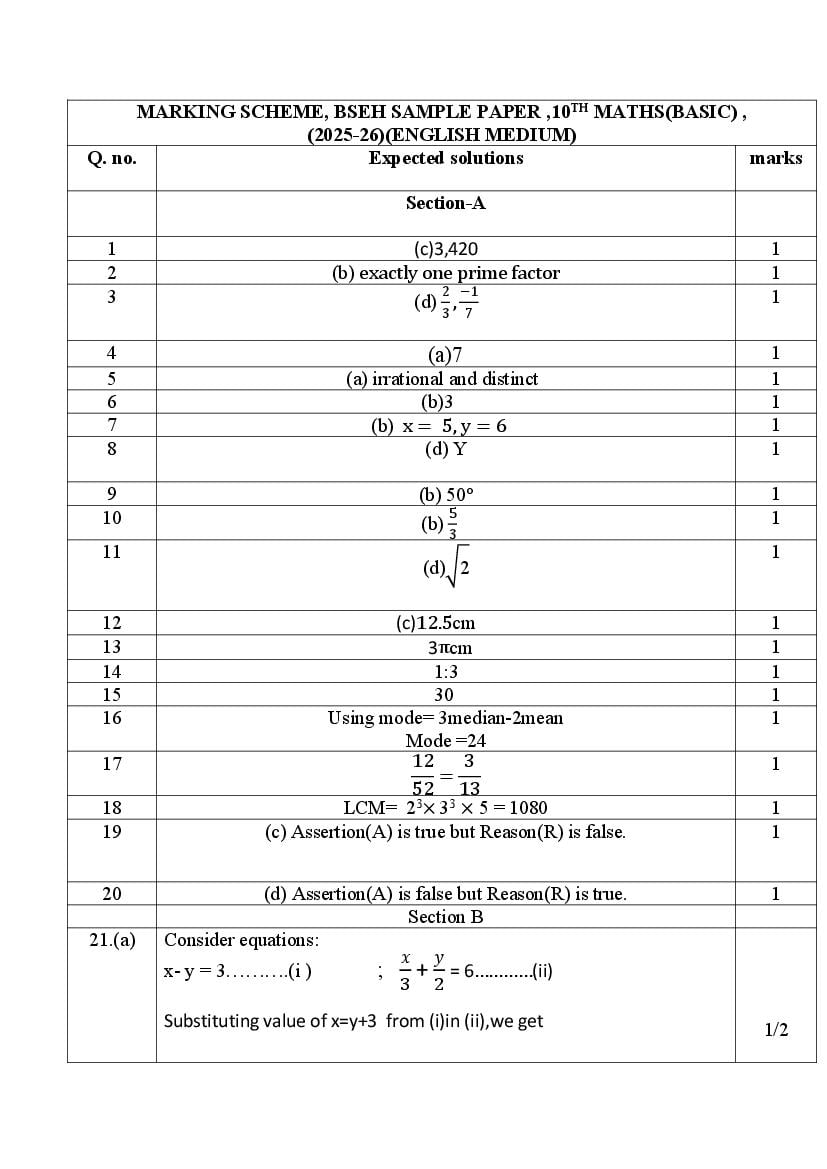
Page 1
(2025-26)(ENGLISH MEDIUM)
Q. no. Expected solutions marks
Section-A
1 (c)3,420 1
2 (b) exactly one prime factor 1
3 2 −1
(d) , 1
3 7
4 (a)7 1
5 (a) irrational and distinct 1
6 (b)3 1
7 (b) x = 5, y = 6 1
8 (d) Y 1
9 (b) 50° 1
10 5
(b) 3 1
11 1
(d) 2
12 (c)12.5cm 1
13 3πcm 1
14 1:3 1
15 30 1
16 Using mode= 3median-2mean 1
Mode =24
17 12 3 1
=
52 13
18 LCM= 23× 33 × 5 = 1080 1
19 (c) Assertion(A) is true but Reason(R) is false. 1
20 (d) Assertion(A) is false but Reason(R) is true. 1
Section B
21.(a) Consider equations:
� �
x- y = 3……….(i ) ; + = 6…………(ii)
3 2
Substituting value of x=y+3 from (i)in (ii),we get 1/2
Page 2
�+3 �
+ = 6 ⇒ 2� + 6 + 3� = 36 1/2
3 2
….……………………………………………………………………………………..
30 1/2
⇒�=
5
=6
….………………………………………………………………………………………..
Substituting value of y=6 in (i),we get x=9
1/2
22.(a) Given:
Height of the pole (h1) = 10 m
Shadow of the pole (s1) = 15 m
Shadow of the tower (s2) = 45 m
Let the height of the tower be h2. 1/2
….…………………………………………………………………………………………..
Since the triangles are similar, the ratios of corresponding sides are
equal:
ℎ1 ℎ 1/2
= 2
�1 �2
….………………………………………………………………………………
Page 3
Simplify the ratio: 2/3 =h2/45 1/2
….…………………………………………………………………………………………
Cross-multiply to solve for h2:
2 1/2
h2=3 ×45 =30m
The height of the tower =30 m.
OR22.(b)
We have,
In ΔPQR, ∠2= ∠1
⇒∠PQR = ∠PRQ
∴ PQ = PR .....(i) 1/2
….………………………………………………………
Given,
Using (i), we get,
1/2
….…………………………………………………………………………………….
In ΔPQS & In ΔTQR
Page 4
∠Q = ∠Q
….…………………………………………………………………………………….
∴ ΔPQS ~ ΔTQR [SAS similarity criterion]
1/2
23.(a)
tan(A+B) = 3 = tan60° ⇒A+B = 60°………….(i )
….………………………………………………………………….. 1/2
1
tan(A-B) = = tan30° ⇒A- B = 30°……………(ii )
3 1/2
….………………………………………………………………………………………………
Solving (i ) and ( ii ),we get A= 45°
1/2
….………………………………………………………………………………………………..
and B= 15°
1/2
OR23.(b) In ΔABC,tanA=BC/AB =1( see Figure)
1/2
i.e., BC=AB
….………………………………………………………………………………………………..
Let AB=BC=k, where k is a positive number.
Now,
AC= ��2 + ��2 = �2 + �2 = 2�2 = k 2 1/2
….…………………………………………………………………………………………
Page 5
Therefore, sinA=BC/AC= k/k 2 =1/ 2 1/2
and cosA=AB/AC= k/k 2 =1/ 2
….………………………………………………………………………………………………..
So, 2sinAcosA=2(1/ 2)(1/ 2)=1, which is the required value.
1/2
24. Let A be the area of sector OAPB.
�
∴A= × πr2 ,where r is the radius of the circle and θ is the angle of
360
sector in degrees.
1/2
Here radius = 4cm and θ = 30°
….……………………………………………………….
30
∴ A= × 3.14 × 4 × 4 ��2 = 4.19��2 1/2
360
….……………………………………………………………………………………………
1/2
Total area of circle= πr2 = 3.14 × 4 × 4 ��2 = 50.24��2
….……………………………………………………………………………………………..
∴ Area of corresponding major sector OACB = Area of circle- Area of
minor sector=
= 50.24-4.19= 46.05��2 1/2
Page 6
AP= AB+BP= AB+BD ………(1) 1/2
[tangents from B]
….……………………………………
AQ= AC+CQ= AC+CD………..(2) 1/2
[tangents from C]
….……………………………………………………………………..
Adding (1) and (2),
AP+ AQ= AB+AC +(BD+CD)=
1/2
= AB+AC+BC
….………………………………………………………………………
But AP=AQ
1/2
∴ 2AP = Perimeter of ∆ABC= 2(12)=24cm.
Section C
26. Prove that 5 − 3 is irrational. If 3 is given an irrational number.
Solution:
Let, if possible , 5 − 3 be a rational number
� 1
∴5− 3= , where p and q are co-prime integers and q≠ 0.
�
--------------------------------------------------------------------------------------
Page 7
⇒ 3= -5
�
�−5�
⇒ 3= 1
�
--------------------------------------------------------------------------------------
LHS= 3 = Irrational number given
�−5�
But RHS =
� = Rational number
which is not possible, therefore our assumption is wrong.
1
Hence 5 − 3 be a Irrational number.
27. Find the quadratic polynomial whose zeroes are 3 − 5 and 3 + 5.
Solution:
Sum of zeroes (α+β) = (3 − 5 ) + (3 + 5 )
=6 1
-----------------------------------------------------------------------------------
Product of zeroes = (α.β) = (3 − 5 ) × (3 + 5 )
= 32 – ( 5 )2 1
=9–5=4
--------------------------------------------------------------------------------------
Quadratic Polynomial = K( x2- (α+β)x + α.β)
K( x2- 6x + 4) 1
Taking K=1 ,we get ( x2- 6x + 4)
28.(a) Find the value(s) of K for which the following pair of linear equations
have infinite number of solutions.
10x + 5y – ( k-5) = 0 and 20x + 10y - k =0
Page 8
linear equations have infinite number of solutions given
�1 �1 �1
⇒ = =
�2 �2 �2 1
-----------------------------------------------------------------------------------
10 5 −�
⇒ = =
20 10 −(� − 5)
½
1 1 −�
⇒ = =
2 2 −(� − 5)
------------------------------------------------------------------------------------
From (ii) and (iii) ⇒ (K-5)= 2K 1
--------------------------------------------------------------------------------------
⇒ 2K-k = -5
⇒ K=-5 ½
--------------------------------------------------------------------------------------
OR
28(b) Five years hence, the age of Manav will be three times that of his
son. Five years ago Manav’s age was seven times that of his son. What
are their present ages?
Solution :
Let Manav’s present age = x years
Page 9
Five years hence(later),
x+ 5 = 3 (y + 5)
⇒ x+ 5 = 3 y + 15 1
⇒ x - 3 y = 10.......(1)
---------------------------------------------------------------------------------------
-
Also, five years ago(before),
x-5 = 7 (y –5 1
⇒ x-5 = 7y – 35
⇒ x-7y = -30........(2)
---------------------------------------------------------------------------------------
-
Subtracting equation (2) from (1),
x - 3 y = 10
-x +7y = 30 (∵ eq.(2) changes its sign)
4y = 40
½
∵ 4 y = 40
∴ y = 10
---------------------------------------------------------------------------------------
-
Put y = 10 in eq. (1),
½
x - 3(10) = 10 ⇒ x - 30 = 10
⇒ x = 40
Thus, present age of Manav = x=40 years and
present age of Manav's son=y=10 years.
Page 10
Given: A circle with centre o and AB is diameter where PQ is
tangent at A and RS is tangent at B. 1
To Prove: PQ II RS
------------------------------------------------------------------------------------------
-
Proof: Since PQ is tangent at A
OA ⊥ PQ
{Tangent at any pt. of the circle is perpendicular to the radius at the
pt. of contact}
½
∴ ∠PAO = 90°………………..(i)
------------------------------------------------------------------------------------------
Similarly RS is tangent at B.
½
OB ⊥ RS
∠OBS = 90°………………….(ii)
------------------------------------------------------------------------------------------
--
From (i) and (ii) ∠PAO = ∠OBS = 90°
But these are alternate interior angles.
1
If the alternate interior angles are equal, then lines PQ and RS
should be parallel.
Page 11
Hence, it is proved that tangents drawn at the ends of a diameter of
a circle are parallel.
30.(a) 1+sinA
Prove the identity
1−sinA = ���� + ����
Solution: Rationalising, we get 1
(1+����)(1+����)
LHS =
(1−����)(1+����)
--------------------------------------------------------------------------------------
(1+����)2
= 1−���2 � 1
(1+����)2
= ���2 �
( ∵ 1- sin2 θ = cos2 θ )
-------------------------------------------------------------------
(1+����)
= ����
1 ���� 1/2
= ���� + ����
--------------------------------------------------------------------------------------
= SecA+ tanA 1/2
--------------------------------------------------------------------------------------
Page 12
30(b) If Cosecθ – Sinθ = 5, then show that Cosecθ + Sinθ = 3
Solution: 1
Cosecθ – Sinθ = 5
Squaring on both sides, we get
(Cosecθ – Sinθ)2 = ( 5 )2
--------------------------------------------------------------------------------------------------------------------------------------
--
Cosec2 θ + Sin2 θ- 2 Cosecθ . Sinθ = 5
1
Cosec2 θ + Sin2 θ- 2 = 5
Cosec2 θ + Sin2 θ- 2+2-2 = 5
Cosec2 θ + Sin2 θ + 2-4 = 5
---------------------------------------------------------------------------------------
--
Cosec2 θ + Sin2 θ+2 = 5+4 1
(Cosecθ + Sinθ)2 = 9
Taking Sq. root on both sides, we get
Cosecθ + Sinθ = 3
31. A die is thrown once. Find the probability of getting
(i) A prime number (ii) A number greater than 4 (iii) A number less
than 6
Solution:
Total numbers on a die = 6
Number of prime nos on a die= 3
Numbers greater than 4 = 2
Page 13
no.of favourable outcomes to the event
P(E) = =
Total no.of possible outcomes
3 1
(i) Probability of getting prime no. = P(prime) = =
6 2 1
---------------------------------------------------------------------------------------
-
2
(ii)Probability of getting no. greater than 4=P(greater than 4) =
6
1
1
=
3
....................................................................................................................
5 1
(iii) Probability of getting no. less than 6 = P(less than 6) =
6
Section –D
32.(a) SECTION-D
Solution:
Let breadth of rectangular plot = x
Let length of rectangular plot = 2x + 1
1
Area of rectangular plot = 528 m2
---------------------------------------------------------------------------------------
Area of rectangular plot = Length × Breadth
1
528 m2 = � 2� + 1
---------------------------------------------------------------------------------------
2�2 + � = 528
2�2 + � − 528 = 0 1
2�2 + 33� − 32� − 528 = 0
Page 14
= x(2� + 33) − 16(2� + 33) = 0
=(2� + 33) = 0 or � − 16 = 0
� =− 33/2 or � = 16
As the breadth cannot be negative, x = � =− 33/2 1
Thus, the breadth of rectangular plot is 16 m
---------------------------------------------------------------------------------------
∴ the length of rectangular plot = � + 1
1
=2×16 + 1= 32 + 1= 33 m
---------------------------------------------------------------------------------------
OR
32(b) A Train travels a distance of 480 km at a uniform speed. If the
speed had been 8 km/h less, than it would have taken 3 hours more to
cover the same distance. Find the original speed of the train.
Solution : 1
Let original speed of the train be x km/h.
Then, time taken to travel 480 km with speed x km/h = 480/x hours
---------------------------------------------------------------------------------------
New speed = (x - 8) km/hr 1
Time taken to travel 480 km with speed (x - 8) km/hr = 480/(x - 8)
hours
--------------------------------------------------------------------------------------- 1
480 480
ATQ
�−8
−
�
=3
1 1
480 ( − )=3
�−8 �
Page 15
480 (
�−�+8
)= 3 1
�(�−8)
x2 - 8x - 1280 = 0
---------------------------------------------------------------------------------------
x2 - 40x + 32x- 1280 = 0
x(x-40) + 32(x-40) = 0
1
(x-40)(x+32)=0
x = 40 or x = -32
As the speed cannot be negative, x = -32
Thus, the original speed of the train is 40 km/hr.
33.(a)
In ∆PQR,DE || OQ and DF||OR. Show that EF || QR
Page 16
Given: In ΔPOQ, DE || OQ and DF||OR ½+½
To prove: EF || QR
….…………………………………………………………………………….
Proof: In ΔPOQ, DE || OQ
1
By basic proportionality theorem, we have
�� ��
��
=
��
……………(i)
….………………………………………………………………………..
Similarly in ΔPOQ, DF||OR
By basic proportionality theorem, we have 1
�� ��
= ………………(ii)
�� ��
….………………………………………………………………………
From (i) and (ii)
1+1
PE PF
=
EQ FR
⇒ EF || QR Hence proved[ By converse of Basic Proportionality
Theorem]
Page 17
33(b) Prove that if a line is drawn parallel to one side of a triangle
intersecting the other two sides in distinct points, then the other two
sides are divided in the same ratio.
Solution:
Given: In ΔABC, DE||BC
1/2
�� ��
To prove: =
�� ��
---------------------------------------------------------------------------------------
--
1/2
Construction : Draw EM⊥AB and DN⊥AC. Join B to E and C to D
---------------------------------------------------------------------------------------
Proof: In ΔADE and ΔBDE
Page 18
�
���� ������ ���� ��
���� �� ����
= �
� = �� --------------(i)
�
����
---------------------------------------------------------------------------------------
In ΔADE and ΔCDE
1
�
���� ������ ���� ��
���� �� ����
= �
� = ��
-----------------(ii)
�
����
---------------------------------------------------------------------------------------
Since, DE||BC [Given]
1
∴ ar (ΔBDE) = ar (ΔCDE) --------------------------------------- (iii)
[Δs on the same base and between the same parallel sides are equal in
area]
---------------------------------------------------------------------------------------
From eq. (i), (ii) and (iii) 1
�� ��
: = Hence proved.
�� ��
34.(a)
Solution:
Page 19
….………………………………………………………………………………………………………
Radius of the hemisphere, r = 14/2 cm = 7 cm
Height of the hemisphere = radius of the hemisphere 1
Radius of the cylinder, r = 7 cm
----------------------------------------------------------------------------------------
Height of the cylinder = Total height of the vessel - height of the
hemisphere
1
h = 13 cm - 7 cm = 6 cm
----------------------------------------------------------------------------------------
Inner surface area of the vessel = CSA of the hemisphere + CSA of the
cylinder
= 2πr2 + 2πrh 1
= 2πr (r + h)
= 2 × 22/7 × 7cm (7 cm + 6 cm)
----------------------------------------------------------------------------------------
= 2 × 22 × 13 cm2
= 572 cm2 1
Thus, the inner surface area of the vessel is 572 cm2.
Page 20
OR
34(b)
Solution:
3.5
Radius of hemisphere = 2 cm
½
-----------------------------------------------------------------------------------------
Height of the cone= height of the top – height of the hemisphere
112
3.5
= [5- 2 ] cm = 3.25 cm
---------------------------------------------------------------------------------------
--
3.5 2
� = �2 + ℎ2 = + 3.25 2 = 3.7 cm
2 112
TSA of the toy = CSA of hemisphere + CSA of cone
= 2πr2 + πrl
--------------------------------------------------------------------------------------
22 3.5 3.5 22 3.5
= 2× × 2 × 2 + × 2 ×3.7
7 7
Page 21
=7 × 2 3.5 + 3.7
11
= 2 × 3.5 + 3.7 cm2 = 39.6 cm2
112
----------------------------------------------------------------------------
35.(a)
Percetage of Number of(xi )
�� −� fi.ui
ui =
ℎ
female States/U.T. (fi )mid values
teachers
15-25 6 20 -3 -18
1+1
25-35 11 30 -2 -22
35-45 7 40 -1 -7
45-55 4 50 0 0
55-65 4 60 1 4
65-75 2 70 2 4
75-85 1 80 3 3
∑fi= 35 ∑ fi.ui = -36 1
-----------------------------------------------------------------------------------------
∑ fi.ui
Mean= � = a + Xh
∑ fi.
1
-----------------------------------------------------------------------------------------
−36
� =50 +[ 35 ] × 10
=39.71 1
-----------------------------------------------------------------------------------------
OR
35.(b)
Page 22
Monthly consumption Number of Cummulative Frequency
(in units) consumers (fi) (Cf)
65-85 5 5
1+1
85-105 4 9
105-125 13 22
125-145 20 42
145-165 14 56
165-185 8 64
185-205 4 68
∑fi= 68
�
n = 68 ⇒ = 34 ∴ Median class = 125-145
2 1
So, l = 125, f = 20, c f = 22, h = 20
--------------------------------------------------------------------------------------
n
−cf
Median = l + ( 2
)×h 1
f
---------------------------------------------------------------------------------------
34−22
= 125 + ( ) × 20
20 1
12
Median =125 + ( ) × 20 =125 + 12 =137
20
-----------------------------------------------------------------------------------
Section-E
36. 36.(i)First term,a=3,A.P. is 3,6,9,12,……..,24 1/2
Page 23
Common difference,d= 6-3=3 1/2
(ii)an= a +(n-1)d
⇒34 = 3+(n-1)3⇒ n=
34 1
= 113, which is not a positive integer. 1/2
3
….…………………………………………………………………………………………..
∴ it is not possible to have 34 jars in a layer if the given pattern is
continued.
1/2
….……………………………………………………………………………………………..
�
(iii) (a)Sn= [2� + (� − 1)�]=
2
� � 3�
= [2 × 3 + (� − 1)3]= [3 + 3�]= [1 + �] 1
2 2 2
….………………………………………………………………………………
3×8 1
S8 = 2 [1 + 8]=108
OR
(iii)(b)A.P. will be 6,9,12,………
Here,a=6,d=3
1
….……………………………………………………………………………………………….
an= a +(n-1)d
⇒a5=6 +(5-1)3= 18
1
37. (i) Clearly,student A is sitting in the 4th quadrant.So, his coordinates are
(2,-1). 1
Page 24
(ii)The coordinates of the sitting points of students A and B are (2,-1)
and (-2,-3) respectively.
∴ By distance formula,AB= −2 − 2 2 + −3 + 1 2 = 16 + 4= 20 =
2 5 units. 1
….………………………………………………………………………………….
(iii)(a)Clearly,the coordinates of the sitting points of students B and C
are (-2,-3) and (3,-4) respectively. 1
….………………………………………………………………….
Since student stands at a point which is mid-point of BC.
∴Coordinates of the position of student D are
−2+3 −3−4 1 −7
2
,
2
=
2
,
2
. 1
OR
(iii)(b)Let R( α, β) be the coordinates of the point R which divides the
join of A(2,-1) and C(3,-4) in the ratio 1:2. 1
….……………………………………………………………………………………….
1×3+2×2 1×−4+2×−1 7
∴ by section formula ,R(α, β)= , = ,−2
1+2 1+2 3
1
38.
Page 25
80 1
tan 45° = ⇒CB= 80 m.
CB
….……………………………………………………………………………….
(ii)(a)In right ∆DEC
1
80 1 80
tan 30° = ⇒ = ⇒CE= 80 3 m
CE 3 CE
….……………………………………………………………………………………………
1
Distance the bird flew = AD= BE= CE-CB= 80 3 - 80 = 80( 3-1)m
OR
(ii)(b)In right ∆FGC
Page 26
80 80 80
tan 60° = ⇒ 3= ⇒ CG =
CG CG 3
….………………………………………………………………………………
1
Distance the ball travelled after hitting the tree = FA= GB= CB-CG
80 1
GB= 80- 3
= 80(1- 3
)m
….……………………………………………………………………………………………..
Distance 20( 3+1) 20( 3+1)
(iii)Speed of the bird= Time taken = 2
m/sec= 2
× 60m/min= 1
600( 3 + 1)m/min
Document Details
| Board / Org | Haryana Board |
| Exam | Class 10 |
| Type | Sample Paper |
| Pages | 26 |
| Updated | 24 Sep 2026 |