Kerala SET 2019 Feb Question Paper Psychology
Finished viewing? Save it for later —
Download Kerala SET 2019 Feb Question Paper Psychology (PDF · 18 pages)About Kerala SET 2019 Feb Question Paper Psychology
Kerala SET 2019 Feb Question Paper Psychology is available here for free download. Published by Kerala Exams for Kerala SET, this question paper can be viewed online or downloaded as a PDF (18 pages). Candidates preparing for Kerala SET can use Kerala SET 2019 Feb Question Paper Psychology to understand the exam pattern, the type of questions asked, and the overall difficulty level.
Frequently Asked Questions
How can I download Kerala SET 2019 Feb Question Paper Psychology?
Open this page and click the Download button to save Kerala SET 2019 Feb Question Paper Psychology as a PDF. It is completely free on AglaSem Docs.
Is Kerala SET 2019 Feb Question Paper Psychology free to download?
Yes. Kerala SET 2019 Feb Question Paper Psychology can be viewed online and downloaded as a PDF free of cost on AglaSem Docs.
How many pages does Kerala SET 2019 Feb Question Paper Psychology have?
Kerala SET 2019 Feb Question Paper Psychology contains 18 pages, which you can read online or download together as a single PDF.
Where can I find more Kerala SET study material?
You can find more Kerala SET question papers, sample papers, syllabus, and answer keys on AglaSem Docs.
Kerala SET 2019 Feb Question Paper Psychology – Text
Read the full text of this question paper below — useful to quickly search, copy and reference the content online without downloading the PDF.
📄 View text version (18 pages)
Page 1
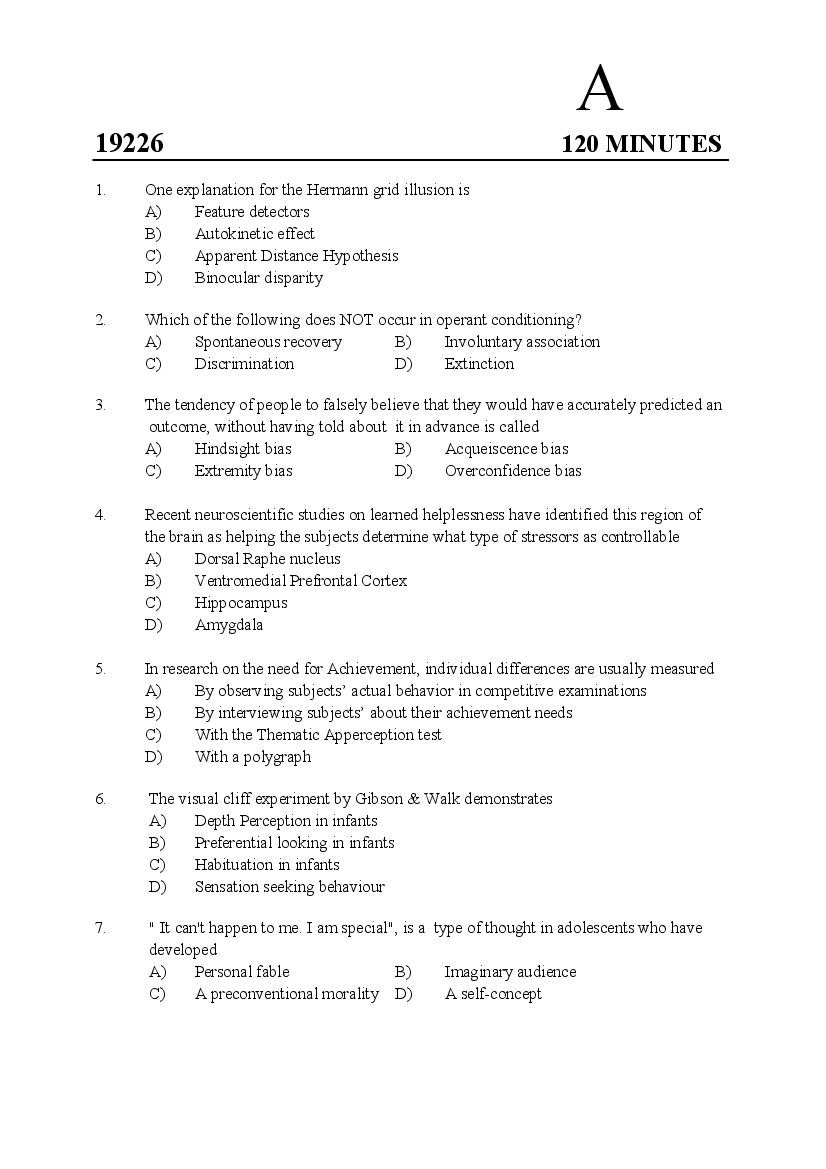
19226 120 MINUTES
1. One explanation for the Hermann grid illusion is
A) Feature detectors
B) Autokinetic effect
C) Apparent Distance Hypothesis
D) Binocular disparity
2. Which of the following does NOT occur in operant conditioning?
A) Spontaneous recovery B) Involuntary association
C) Discrimination D) Extinction
3. The tendency of people to falsely believe that they would have accurately predicted an
outcome, without having told about it in advance is called
A) Hindsight bias B) Acqueiscence bias
C) Extremity bias D) Overconfidence bias
4. Recent neuroscientific studies on learned helplessness have identified this region of
the brain as helping the subjects determine what type of stressors as controllable
A) Dorsal Raphe nucleus
B) Ventromedial Prefrontal Cortex
C) Hippocampus
D) Amygdala
5. In research on the need for Achievement, individual differences are usually measured
A) By observing subjects’ actual behavior in competitive examinations
B) By interviewing subjects’ about their achievement needs
C) With the Thematic Apperception test
D) With a polygraph
6. The visual cliff experiment by Gibson & Walk demonstrates
A) Depth Perception in infants
B) Preferential looking in infants
C) Habituation in infants
D) Sensation seeking behaviour
7. " It can't happen to me. I am special", is a type of thought in adolescents who have
developed
A) Personal fable B) Imaginary audience
C) A preconventional morality D) A self-concept
Page 2
that enable people to gain a complete sense of whole and healthy relationships with
others
A) Existence, Relatedness, Growth
B) Autonomy, Competence, Relatedness
C) Mastery, Relatedness, Competence
D) Intimacy, Autonomy, Security
9. The deficiency of this neurotransmitter may play a role in Alzheimer's disease
A) Serotonin B) Dopamine
C) Acetylcholine D) Nor-epinephrine
10. The movements similar to an embrace that an infant makes when startled is known as
A) Grasping reflex B) Adaptive reflex
C) Rooting reflex D) Moro reflex
11. Maintaining the body's set point for fat is closely linked with the amount of -------------
in the bloodstream
A) Hypothalamic factor-1 B) Ventromedial peptide
C) Neuropeptide Y ( NPY) D) Leptin
12. The personality theorist who preferred the label dialectic humanist
A) Erik Erikson B) Raymond Cattell
C) Erich Fromm D) Karen Horney
13. The term Lake Wobegon effect refers to
A) Consequence of intentional faking
B) Social desirability
C) Consequence of tests not being re-normed often enough
D) Aptitude scores decreasing with increasing grade level, when achievement
scores are held constant
14. Find out the answer from the codes given below:
Fundamental attribution error
I. Involves the tendency to underestimate the influence of other person’s internal
characteristics on behaviour and overestimate the external/situational factors
II. Older adults show a stronger bias towards attributing the actions of another to
internal causes than do younger people
III. Younger people fall a prey to fundamental attribution error more than older
ones
IV. Motive attribution asymmetry is one of the reasons for conflict between groups
Codes :
A) I, II, and III are correct B) II and IV are correct
C) I, II, III, and IV are correct D) I, III, and IV are correct
2
Page 3
Sigmund Freud
I. Explained human behavior in terms of sexual motivation
II. Kept verbatim record of what he and the patient said during the treatment hour
III. Followed the method of internal consistency for testing hypothesis
IV. Based his theory on the verbalizations and expressive behavior of patients
undergoing psychological treatment
Codes :
A) I, II and IV are correct B) II and III are correct
C) I, II, III and IV are correct D) I, III and IV are correct
16. Find out the answer from the codes given below:
For ‘Sleeper effect’ to manifest
I. The message itself should be persuasive
II. The discounting cue should initially suppress attitude change
III. The memory of cue and effect of the message decays at the same rate
IV. There is a differential decay of discounting cue and the message.
Codes :
A) I, II and III are correct B) II and III are correct
C) I, II, III and IV are correct D) I, II and IV are correct
17. Match List I with List II and choose your answer from the codes given below
List I List II
a. Dissociative state theory of hypnosis 1. Eric Kandell
b. Emerging adulthood 2. Calvin Hall
c. Dream theory 3. Ernest Hilgard
d. Transfer of memory 4. Jeffrey Arnett
5. Stanley Hall
Code:
A) a-3, b-5, c-4, d-1 B) a-3, b-4, c-2, d-1
C) a-3, b-1, c-4, d-5 D) a-5, b-2, c-4, d-3
18. Arrange the following statistics in the ascending order according to the scales of
measurement
A) Mode-Median- Standard Deviation- Coefficient of variation
B) Median-Mode- Coefficient of variation-Standard Deviation
C) Mode-Median-Coefficient of variation-Standard Deviation
D) Median-Mode-Standard Deviation-Coefficient of variation
19. Eustress can be considered as based on ------ of motivation.
A) Maslow’s theory B) The arousal theory
C) The biological theory D) The need affiliation theory
3
Page 4
A) Courage-challenge-control
B) Concern-courage-control
C) Concern-commitment-control
D) Commitment-control-challenge
21. Match List I with List II and choose your answer from the codes given below
List I List II
a. Robert Trivers 1. Full Primal Sketch
b. Gibson 2. Featural analysis
c. Hubel& Wiesel 3. Parental investment
d. David Marr 4. Feature detectors
5. Affordances
Code:
A) a-3, b-5, c-4, d-1 B) a-3, b-4, c-2, d-1
C) a-2, b-1, c-4, d-5 D) a-5, b-2, c-4, d-3
22. According to the cognitive development theory of Piaget, intrapropositional reasoning
is characteristic of
A) Sensorimotor period B) Pre-operational period
C) Concrete operational period D) Formal operational period
23. Find out the answer from the codes given below:
Spreading Activation Model of Semantic Memory
I. Assumes a hierarchical organizational structure
II. Accounts well the phenomenon called semantic priming
III. Has some characteristics of the Teachable Language Comprehender ( TLC) and
the feature-set model
IV. All relationships among concepts are equivalent in strength
Codes :
A) I, II and III are correct B) II and III are correct
C) I, II, III and IV are correct D) I, III and IV are correct
24. Julian Rotter’s social learning theory is based on a basic principle of motivation
derived from
A) Roger’s view of real self and ideal self
B) Cattell’s 16 PF
C) Thorndike’s law of effect
D) Eysenck’s Personality Theory
25. Which among the following personality inventories use two-point codes for assessing
personality?
A) MBTI B) MMPI C) EPI D) 16PF
4
Page 5
ability to get on with and influence colleagues in the work place, EXCEPT
A) The icebreaker B) Simulation of an event
C) In-Tray D) The discussion group
27. The split-half reliability of a test is 0.6. Its corresponding Spearman-Brown reliability is
A) 0.67 B) 0.75 C) 0.82 D) 0.89
28. Find out the answer from the codes given below:
Criterion referenced tests
I. Compare examinees’ performance to a standard
II. Items vary widely in difficulty level
III. Item contents cover narrow domain of skills with real world relevance
IV. Scores are usually expressed as standard score or percentile
Codes :
A) I, II and III are correct B) I and III are correct
C) II and IV are correct D) I, III and IV are correct
29. All the following are Thematic Apperception Tests for specific populations, EXCEPT
A) Blacky pictures
B) TEMAS
C) Michigan Picture Test Revised
D) L-TAT
30. Find out the answer from the codes given below:
The 16 PF
I. Is intended for high school seniors and adults
II. Can be interpreted on occupational variables corresponding to Holland’s
RIASEC themes
III. NEO PI-R and 16PF measure different aspects of personality
IV. Provide parallel results as NEO-PI R, with the exception of agreeableness
dimension
Codes :
A) I, II and IV are correct B) I and III are correct
C) II and IV are correct D) I, III and IV are correct
31. The statistic most useful if we want to know how many standard deviations from the
mean a single score in a data set falls
A) a t-score B) Z score
C) Deviation coefficient D) Variance Determination
32. All the following are human process techniques in Organizational Development
interventions, EXCEPT
A) Sensitivity training B) Survey feedback
C) Quality Circles D) Process consultation
5
Page 6
A) VI, VR B) FI, FR C) FI, VR D) VI, FR
34. The kind of qualitative research in which the inquirer ‘brackets off’ all assumptions
they might hold in the hope of finding something new and worthwhile at the end
A) Hermeneutics B) Action Research
C) Phenomenology D) Conversation analysis
35. Match List I with List II and choose your answer from the codes given below
List I List II
a. Analytical therapy 1. Subception
b. Person centred therapy 2. Body movement and dance
c. Gestalt therapy 3. Miracle question
d. Existential therapy 4. Contact boundary disturbance
5. Rippling
Code:
A) a-3, b-5, c-4, d-1 B) a-3, b-4, c-2, d-1
C) a-2, b-1, c-4, d-5 D) a-5, b-2, c-4, d-3
36. The pioneers of grounded theory research
A) Edmund Hussrel B) Glaser and Strauss
C) Epston and White D) Jerome Bruner
37. Assertion (A): Tasks can be performed more efficiently under serial processing
condition than under parallel processing condition.
Reason (R): The psychological refractory period affects efficiency of parallel
processing.
Code
A) Both (A) and (R) are true and (R) is the correct explanation of (A).
B) Both (A) and (R) are true, but (R) is not the correct explanation of (A).
C) (A) is true, but (R) is false.
D) (A) is false, but (R) is true
38. Which of the following is NOT a single subject experimental design?
A) A-B design B) A-B-A-B design
C) A-B-A-C-A design D) Case study
39. Assertion (A): Estimation of reliability using parallel forms of a test is a direct
application of Classical Test Theory.
Reason (R): Classical Test Theory considers that the total score on a test is
composed of true scores and error scores.
Code
A) Both (A) and (R) are true and (R) is the correct explanation of (A).
B) Both (A) and (R) are true, but (R) is not the correct explanation of (A).
C) (A) is true, but (R) is false.
D) (A) is false, but (R) is true
6
Page 7
hypothesis, it means that
A) There is no difference between the two groups
B) There is a difference between the two groups
C) Any difference between the two groups that do exist are not valid
D) Research hypothesis is rejected
41. Find out the answer from the codes given below:
The Mahayana tradition of Buddhism
I. The Mahayana tradition emphasizes enlightenment
II. The Bodhisatva path includes abandoning the world, but not the beings in it
III. The Bodhisatva is basically an unworldly ascetic
IV. The Bodhisatva path focusses on self discipline and work on oneself
Codes :
A) I, II and III are correct B) I and II are correct
C) II and III are correct D) I, III and IV are correct
42. The differential diagnosis of obsessive compulsive personality disorder includes all the
following conditions, EXCEPT
A) Depression B) Phobic states
C) Schizophrenia D) Impulse disorders
43. Which of the following signs or symptoms would best discriminate a person with an
organic brain syndrome from a person with schizophrenia?
A) Confusion B) Tangential thinking
C) Auditory hallucinations D) Visual hallucinations
44. Arrange in ascending series the seven centres of consciousness ( chakras) as explained
in Kundalini yoga and select your answer from the codes given below
A) Muladhara-svadisthana-manipura-anahata-visuddha-ajna-sahasrara
B) Muladhara-svadhistana-manipura-visuddha-anahata-ajna-sahasrara
C) Muladhara-manipura-svadhistana-anahata-ajna-visuddha-sahasrara
D) Muladhara-svadhistana-manipura-ajna-anahata-visuddha-sahasrara
45. Assertion (A): Events that occur subsequent to a specific event may affect the memory
of the previous event.
Reason (R): Recall of an event is better when the environmental conditions under which
the event occurred and the conditions under which recall occur are similar.
Code
A) Both (A) and (R) are true and (R) is the correct explanation of (A).
B) Both (A) and (R) are true, but (R) is not the correct explanation of (A).
C) (A) is true, but (R) is false.
D) (A) is false, but (R) is true
7
Page 8
Quasi experimental designs
I. Random assignment of subjects to treatment conditions often is not possible
II. Self selection of subjects into study groups poses a threat to internal reliability
III. Group equivalence can be maintained through random selection
IV. Pretest-posttest control group design is a quasi experimental design
Codes :
A) I, II and III are correct B) I and II are correct
C) II and III are correct D) I, III and IV are correct
47. Interval variable data can be analyzed with all of the following techniques, EXCEPT
A) Linear regression B) t Test
C) Chi-square D) Analysis of variance (ANOVA)
48. An item characteristic curve (ICC), with ability plotted on the horizontal axis and
probability of correct response on the Y axis, indicates a steep positive slope. This
indicates that
A) The probability of test takers of low ability responding correctly is high and
low for test takers of high ability
B) The test takers of moderate ability have the highest probability of answering
the item correctly
C) The discriminative ability of the item is good
D) The item discriminates at only one point on the continuum of ability
49. Assertion (A): Item analysis data obtained with speed test often yield misleading results.
Reason (R): The position of an item in the speed test affect its index of difficulty and
discrimination.
Code
A) Both (A) and (R) are true and (R) is the correct explanation of (A).
B) Both (A) and (R) are true, but (R) is not the correct explanation of (A).
C) (A) is true, but (R) is false.
D) (A) is false, but (R) is true
50. Match List I with List II and choose your answer from the codes given below
List I List II
a. The principal psychological task of first 1. Rapprochement crisis
year of life 2. Intimate differentiated attachment
b. A period marked by shadowing and 3. Practicing phase
moving away 4. Object permanence
c. The child explores the environment and 5. Individuation
returns to the mother for emotional
reinforcement
d. The child realizes that he/she is an entity
distinct from the mother
Code:
A) a-3, b-5, c-4, d-1 B) a-4, b-1, c-3, d-5
C) a-2, b-1, c-3, d-5 D) a-5, b-2, c-4, d-3
8
Page 9
anxiety drug. The mean pulse rate before the drug is given is 84, and after the drug
is given is 72. The appropriate statistical test to be used here is
A) Chi-square B) Unpaired t-test
C) Analysis of variance D) Paired t-test
52. An X- linked pattern of inheritance is associated with which of the following disorder?
A) Schizophrenia B) Bipolar disorder
C) Major depressive disorder D) Alcohol abuse
53. The “schema of apperception” is a concept in the theory put forward by
A) Henry Murray B) Alfred Adler
C) Carl Jung D) Harry Stack Sullivan
54. Find out the answer from the codes given below:
In which of the following hypothesis is a true experiment indicated?
I. Young offenders have poor impulse control than non-offending youth
II. Children who view a film promoting helping behaviour show more altruistic
behaviour than children who view a neutral film
III. Pegions on an intermittent schedule of reinforcement emit pecking behaviour
that is more resistant to extinction than pegions on a continuous schedule
IV. Women rate pornography as less interesting than men do.
Codes :
A) I, II and III B) I and II C) II and III D) I, III and IV
55. Which of the following statements are true of factor analysis?
I. In factor analysis (FA), the communality is represented in the diagonal
II. In factor analysis, the diagonals have 1’s as the total variance
III. In factor analysis, the total variance of the variables is focused upon
IV. Factor analysis represents a family of procedures defined by the way in which
factors are extracted
Codes :
A) I, II and III are correct B) I and IV are correct
C) II and III are correct D) I, III and IV are correct
56. Which theorist used a psychohistorical analysis while assessing personality?
A) Gordon Allport B) Erik Erikson
C) Raymond Cattell D) Henry Murray
57. The minimum stimulus intensity that an organism can detect 50% of the time is
A) Differential threshold B) Absolute threshold
C) Just Noticeable difference D) Weber’s law
9
Page 10
A) Children than adults
B) Men than women
C) People living in a western culture
D) Individuals living in poverty
59. A good example of automaticity in perception and failure of selective perception is.
A) Simultaneous sharing of Attention
B) Stroop Effect
C) Reduncy
D) Unconscious inference
60. The Attentuated Model of Filter theory was developed by
A) Anne Triesman B) Donald Broad bent
C) Michael Posner D) Cherry C
61. Identify the one that is not a monocular cue.
A) Accommodation B) Interposition Elevation
C) Shadowing D) Convergence
62. Remani is a graduate housewife. She came to the psychologist for help because of her
inability to venture out of her house alone. She had an intense and disabling fear of
being in public places or situations in which escape might be difficult or help might be
unavailable should any incapacitating symptoms appear. Remani is suffering from.
A) Claustrophobia B) Agoraphobia
C) Social Phobia D) Panic disorder
63. When we see a friend approaching from a distance we recognize him because his
features, his nose, his eyes, his hair and so on are sensed by our eyes and because we
have knowledge that he usually can be seen at this time, at this place. We are also able
to recognize him if he has made changes in his original style of dressing. This is
because we see as much with the brain and its rich supply of knowledge about the
world as with the eye which provides us with raw sensory input. This is the basis of
A) Direct Perception theory B) Constructive perception theory
C) Prototype theory D) Linear perspective
64. The desire for love, self esteem, Justice goodness and self – Actualization in Maslow’s
hierarchy of needs are based on growth and are the -----needs.
A) Basic needs B) Physiological needs
C) Meta Needs D) Psychological needs
65. In ------- pattern recognition occurs where a match is made between sensory stimuli
and a corresponding internal mental form.
A) Template matching B) Feature Analysis
C) Bottom – up processing D) Top down processing
66. Mnemonic Techniques are methods for
A) Effective Encoding B) Automatic cued Recall
C) Cued Recall D) Improving Memory
10
Page 11
their abilities to carry out actions required to master and control
different situations.
Reason (R) : Those who believe that they can master a task are willing to attempt
it and will persist in the face of initial failures. They will do this
independent of their actual skill at the task.
Codes
A) A and R are true and R is the correct explanation of A.
B) A and R are true but R is not the correct explanation of A.
C) A is true R is false.
D) A is false R is true.
68. A condition in which sensations usually experienced in a single modality are
experienced in two modalities is
A) Isomorphism B) Mental rotation
C) Synesthesia D) None of the above
69. When you watch a small stationary point of light in a totally dark room after a while
you tend to see the light as slowly moving about, even though it remains still. This is
called
A) Auto kinetic effect B) Relative motion
C) Stereoscopic motion D) Induced motion
70. The ACT associationistic Model Developed by Anderson has three types of memories.
A) Working, declarative, productive.
B) Temporal string, spatial image, Abstract proposition.
C) Declarative, procedural, semantic
D) Autobiographical, constructive, working
71. Match list I and list II and choose the answer from the codes given below.
a. Clustering Model 1. Knowledge is represented in the organization of
neuron reworks.
b. Network Model 2. Concepts are represented in memory as a set of
semantic features.
c. Semantic Feature 3. Knowledge exists in memory as independent
Comparison Model units connected in a network
d. Neuro Cognitive Model 4. Concepts tend to be organized in clusters.
Codes
A) a- 2, b-1, c-4, d-3 B) a-4, b-3,c-2, d-1
C) a-4, b-1, c-2, d-3 D) a-4, b-1, c-3, d-2
72. When trying to remember something the feeling that one is about to recall, it is called.
A) Primary effect
B) Eidetic Imaginary
C) Tip of the tongue Phenomenon
D) Recency effect
11
Page 12
A) Propositional or declarative knowledge
B) Iconic Memory
C) Semantic Knowledge
D) Episodic Knowledge
74. Match List I with List II and choose the answer from the codes given below.
List I List II
a Accommodation 1. Monocular cue for depth motion perception
b Motion Parallax 2. Linear perspective
c. Peripheral streaming 3. Monocular depth cues
d. Miller lyer illusion 4. Perception of motion
Codes
A) a-3, b-4, c-1, d-2 B) a-4, b-3, c-2, d-1
C) a-3, b-1, c-4, d-2 D) a-3, b-4, c-2, d-1
75. -------are our internal representation of the four aspects of a problem viz initial state,
goal state, operators and intermediate problem states.
A) Heuristics B) Algorithms
C) Mental set D) Problem space
76. Picture Arrangement, Picture Completion, Block design, Object Assembly, Digit
symbol are the subscales of the performance scale of
A) WAIS
B) Stanford – Binet Test
C) Bhatia’s Performance test of Intelligence
D) WISC (R)
77. A device that measures various changes in bodily responses such as that rate,
breathing rate, blood pressure and GSR and is commonly used for lie detection is.
A) EEG B) EGG
C) Polygraph D) None of the above
78. A limited time period during development when specific learning must occur if it is to
occur at all.
A) Relative refractory period B) Critical Period
C) Latency Period D) None of the above
79. The best known personality psychologist who described personality in terms of traits
and divided traits into two types common traits and personal trait is
A) Carl Rogers B) Abraham Maslow
C) Gordon Allport D) Alfred Adler.
80. An acquired motive that is not associated with the satisfaction of any basic biological
need but acts as a motive in its own right is
A) Primary motive
B) Functionally Autonomous motive
C) Secondary motive
D) Psychological motives.
12
Page 13
is considered to be an important determinant of abnormal behavior is
A) Cognitive therapy B) Behaviour Therapy
C) Client centered therapy D) Cognitive Behavioural therapy
82. In psychoanalysis, as therapy progresses patients begin to form irrational expectations
of the analysts and transfer love and other emotional attachment from another person
in his or her past to the therapist. This is called.
A) Transference B) Withdrawal
C) Counter transference D) None of the above.
83. A preconceived notion of how a group or individual will behave.
A) Stereotype B) Prejudice
C) Bias D) None of the above
84. Value theory, information exchange theory, diffusion of responsibility theory and
social identification theory are all theories proposed to explain
A) De individuation B) Determinants of Aggression
C) Prosocial behavior D) Group polarization effects
85. Match list I with List II and choose the answer from the codes given below
List I List II
a James – Lange theory 1. The physiological arousal get things going but the type
of emotion experienced depends on one’s cognitive
interpretation of the arousal.
b. The Cannon Bard theory 2. An emotion provoking stimulus first causes physiological
arousal which is experienced as emotion.
c. Schechter Juke box theory 3. Explains the sequence involved in the emotional
experience when a strong emotions is experienced an
opponent process or a kind of opposite emotion comes
into effect.
d. Opponent process theory 4. The experience of emotion as one in which physical
cues to emotion occurs simultaneously withthe
cognitive ones.
Codes
A) a-2, b-4, c-1, d-3 B) a-2, b-3, c-4, d-1
C) a-3, b-4, c-1, d-2 D) a-3, b-1, c-4, d-2
86. ------ refers to people’s conceptualization of their abilities to carry actions required to
master and control different situations and is coined by ------
A). Locus of control, Rotter B) Personal construct, Kelley
C) Self efficacy, Bandura D) Self Actualisation, Maslow
87. Meta components, performance components and knowledge acquisition skills are three sets
of subcomponents of----- proposed by ------.
A) Primary abilities, Thurstone
B) Seven intelligence, Gardner
C) Componential intelligence, Sternberg
D) General Intelligence, Guilford
13
Page 14
A) William stern B) Alfred Binet
C) Francis Galton D) Theo’pile Simon.
89. Match List I with List II and choose the answer from the codes given below.
List I List II
a) Automatic recall 1. A form of operant conditioning in which timely
performance of a specified response prevents the
occurrence of a otherwise inevitable aversive stimuli.
b) Spontaneous recovery 2. A fast and involuntary cued recall that is product
of learning.
c) Learned Helplessness 3. A return of a conditional response after extinction
and without further training trials.
d) Avoidance learning 4. An idea that an organism may learn to be helpless
as a result of the repeated demonstration that its
response have no effect on its surroundings.
Codes
A) a-3, b-4, c-2, d-1 B) a-3, b-1, c-4, d-2
C) a-2, b-1, c-4, d-3 D) a-2, b-3, c-4, d-1
90. A behavioural approach generally used with children and adolescents for overcoming
fears and train people in select social skills is
A) Coping Modelling B) Mastery modelling
C) Assertive Training D) Token Economies
91. How people come to know and understand their own relative abilities, strengths and
weakness by comparing themselves with others is explained by
A) Social learning theory B) Social facilitation theory
C) Social comparison theory D) None of the above.
92. Fear of enclosed space is
A) Agoraphobia B) Claustrophia
C) Social phobia D) None of the above
93. Identify the correct sequence of the levels of measurement from the lowest to the
highest in the given below arrangement –
A) Nominal scale, Interval scale, Ordinal scale, Ratio scale
B) Interval scale, Nominal scale, Ordinal scale, Ratio scale
C) Nominal scale, Ordinal scale, Ratio scale, Interval scale.
D) Nominal scale, Ordinal Scale, Interval scale, Ratio scale.
94. A non-parametric statistic for comparing two populations based on independent
random – samples from each is-----
A) Two tailed test B) One tailed test
C) Mann – Whitney U test D) Friedman test
95. A design consisting of a longitudinal study of several groups each from a different
generation is ------
A) Between group design B) Cohort design
C) Factorial design D) Matched group design
14
Page 15
manipulated in all possible combinations, So that their independent as well as
interactive effects upon the dependent variable may be studies is.
A) Randomized group design B) Factorial design
C) Matched group design D) Within groups design
97. The Homogeneity of the test is indicated by
A) Test – Retest reliability B) Internal consistency Reliability
C) Scorer Reliability D) Parallel form Reliability
98. An alternative work schedule arrangement which allows employees in the
organization greater autonomy by permitting them to choose their daily starting and
ending times within a given period called bandwidth is------
A) Flextime B) Compressed Weak
C) Job sharing D) Telecommuniting
99. A dimension ranging from intrinsic motivation to a motivation, along which a variety
of gradation of extrinsic motivation may be distinguished is the
A) Signature strengths B) Self determination continuum
C) Self direction D) Met motivational state
100. A hypothesis that makes numerical expressions of null hypotheses and research
hypothesis is the
A) Working hypothesis B) Descriptive hypothesis
C) Statistical hypothesis D) Casual hypothesis
101. Constancy of condition, Balancing, Counter balancing, Randomization are all
techniques of
A) Controlling demand characteristics
B) Selection of variables
C) Controlling extraneous variables
D) None of the above.
102. Assertion (A): Knowledge acquisition components, performance components, and
meta components are the three sets of information processing components
that constitute analytic intelligence in Sternberg’s Triarchic theory of
intelligence.
Reason (R) : Knowledge acquisition components include selective encoding, selective
combination and selective comparison of components.
Codes
A) A and R are true and R is the correct explanation of A
B) A and R are true and R is not the correct explanation of A
C) A is true, but R is false
D) A is false but R is true.
103. A derivative modelled after the Thematic Apperception Test is the -----developed by ------
A) The children’s Apperception test, Bellak.
B) Word Association Test, Galton
C) Sentence completion Test, Ebbinghaus
D) None of the above.
15
Page 16
individually, available in three different types of forms and can be applied across cultures is.
A) Kaufman Adolescent and Adult Intelligence Test
B) Wechsler Adult Intelligence Scale
C) Raven’s progressive matrices
D) Stanford Binet scales
105. Match List I with List II using the codes given below
List I List II
a. Content validity 1. Correlation of test scores and criterion scores
b. Criterion related validity 2. Obtained by establishing relationship or
discrimination
c. Predictive validity 3. Concerned with whether test measures the
intended context area
d. Concurrent validity 4. Obtained by correlating test scores with scores
obtained or criterion available in present future.
Codes
A) a-3, b-4, c-1, d-2 B) a-3, b-1, c-4, d-2
C) a-4, b-1, c-3, d-2 D) a-4, b-3, c-2, d-1
106 ----- proposed by ------ states that knowledge exists in memory as independent units
connected in a network
A) The conceptual propositional hypothesis, Anderson and Bower
B) Functional equivalency hypothesis, Shephard and Kosslyn
C) Network model, Collins and Quillian
D) Dual coding hypothesis, Paivio
107. Find the correct answer from the codes given below:-
According to Cannon Bard theory-
1. When an emotionally arousing stimulus is perceived the thalamus sends out
impulses to the sympathetic nervous system which produces physiological reaction.
2. The hypothesis is that the bodily changes and emotional feelings occurs
simultaneously
3. To experience emotion both a physiological response and a congnitive
interpretation of that response are required.
4. Emotion laden stimulus produces physiological changes and the subjective
experience of emotion separately and simultaneously
Codes
A) I & IV are only correct B) I, II & IV are only correct
C) I & II are only correct D) II & IV are only correct
108. A personality measures in which individuals are given a set of cards containing
adjectives or phrases to sort into groups based on the degree to which they describe
themselves or a target person
A) Q sort technique B) Rating
C) Self Report D) Self Rating
16
Page 17
that involve anxiety while practicing relaxation techniques until each situation loses
it’s threat is
A) Systematic desensitization B) In vivo desensitization
C) Flooding D) Implosion
110. Learning indirectly a social response by observing the actions of others and the
consequences of that action is:
A) Operant conditioning B) Observational Learning
C) Classical conditioning D) Vicarious conditioning
111. Which of the symptoms listed below is not required for a diagnosis of schizophrenia?
A) Delusions prominent Hallucinations
B) Catatonic Behaviour
C) Crossly inappropriate affect
D) An organic disturbance
112. Assertion (A): A syllogism has three steps a major premise, minor premise and a
conclusion
Reason (R) : A conclusion reached by means of syllogistic reasoning is considered
valid or true if the premise, are accurate and form is correct.
Codes
A) A is true R is false
B) A is false R is true
C) A and R are true and R is the correct explanation of A
D) A and R are true but R does not explain A
113. Procedure that guarantee a solution to a given kind of problem is
A) Algorithms B) Heuristics C) Syllogism D) Deductions
114. The therapeutic technique usually employed with school misbehavior is:
A) Flooding B) Aversive counter conditioning
C) Token economy D) Desensitization
115. Assertion (A) : Allport distinguished three levels of personal traits according to the
degree to which they govern personality: cardinal, central and secondary
Reason (R) : Central traits influence much of our behaviour. They are generally the
traits that can be thought of as basically describing an individual eg
reliable, trustworthy etc.
Codes
A) A and R are true and R is the correct explanation of A
B) A is true R is false
C) A and R are true but R is not the correct explanation of A
D) A is false R is true
116. A scientific study where investigator tries to trace an effect that has already been
produced and where no independent variables are manipulated is the,
A) Exploratory field studies B) Ex Post facts research
C) Field experiment D) Hypothesis testing studies
17
Page 18
you answer using the codes given below
List I List II
a. Objective tests 1.Purpose or objective
b. Power tests 2. Scoring
c. Teacher made test 3. Time limit in producing response
d. Personality test 4. Standardization
Code
A) a-2, b-3, c-4 , d-1 B) a-3, b-2, c-4, d-1
C) a-4, b-1, c-2, d-3 D) a-3, b-4, c-1, d-2
118. A mechanism of placing one own unacceptable thoughts into others as if the thoughts
belonged to them and not to oneself is:
A) Denial B) Projection
C) Sublimation D) Identification
119. Which of the following is not a derivative of Thematic Apperception test.
A) The Children’s Apperception Test
B) Rozenweig picture Frustration Test
C) Human Modification of the CAT
D) Object Relation Technique
120. Match List I with List II and indicate your answer using the codes given below.
List I List II
a Carl Rogers 1. Cardinal traits
b. Gordon Allport 2. Source traits
c. Raymond Cattel 3. Personality types
d. Hans Eysenck 4 Unconditional positive regard
Codes
A) a-2, b-4, c-1, d-3 B) a-4, b-1, c-2, d-3
C) a-4, b-3, c-2, d-1 D) a-1, b-2, c-4, d-3
------------------------------------
18
Document Details
| Board / Org | Kerala Exams |
| Exam | Kerala SET |
| Type | Question Paper |
| Pages | 18 |
| Updated | 23 Oct 2026 |