Kerala SET 2019 Feb Question Paper History
Finished viewing? Save it for later —
Download Kerala SET 2019 Feb Question Paper History (PDF · 12 pages)About Kerala SET 2019 Feb Question Paper History
Kerala SET 2019 Feb Question Paper History is available here for free download. Published by Kerala Exams for Kerala SET, this question paper can be viewed online or downloaded as a PDF (12 pages). Candidates preparing for Kerala SET can use Kerala SET 2019 Feb Question Paper History to understand the exam pattern, the type of questions asked, and the overall difficulty level.
Frequently Asked Questions
How can I download Kerala SET 2019 Feb Question Paper History?
Open this page and click the Download button to save Kerala SET 2019 Feb Question Paper History as a PDF. It is completely free on AglaSem Docs.
Is Kerala SET 2019 Feb Question Paper History free to download?
Yes. Kerala SET 2019 Feb Question Paper History can be viewed online and downloaded as a PDF free of cost on AglaSem Docs.
How many pages does Kerala SET 2019 Feb Question Paper History have?
Kerala SET 2019 Feb Question Paper History contains 12 pages, which you can read online or download together as a single PDF.
Where can I find more Kerala SET study material?
You can find more Kerala SET question papers, sample papers, syllabus, and answer keys on AglaSem Docs.
Kerala SET 2019 Feb Question Paper History – Text
Read the full text of this question paper below — useful to quickly search, copy and reference the content online without downloading the PDF.
📄 View text version (12 pages)
Page 1
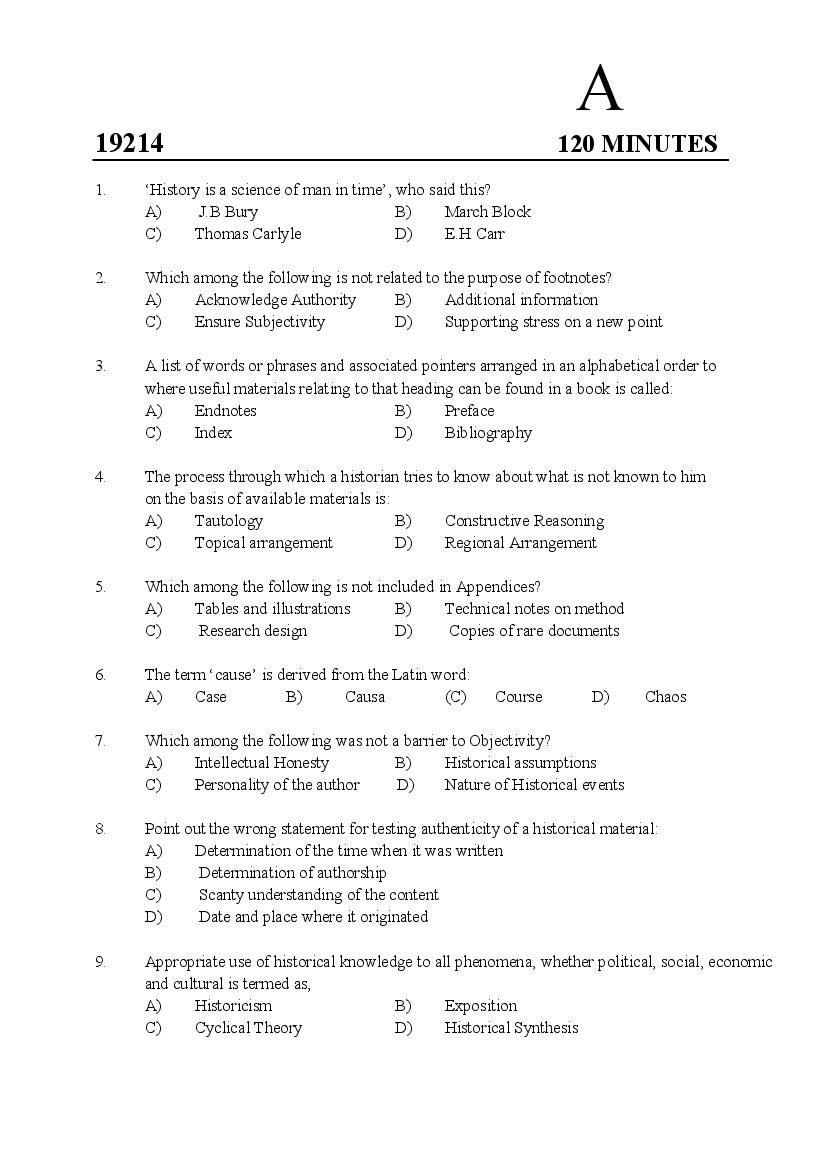
19214 120 MINUTES
1. ‘History is a science of man in time’, who said this?
A) J.B Bury B) March Block
C) Thomas Carlyle D) E.H Carr
2. Which among the following is not related to the purpose of footnotes?
A) Acknowledge Authority B) Additional information
C) Ensure Subjectivity D) Supporting stress on a new point
3. A list of words or phrases and associated pointers arranged in an alphabetical order to
where useful materials relating to that heading can be found in a book is called:
A) Endnotes B) Preface
C) Index D) Bibliography
4. The process through which a historian tries to know about what is not known to him
on the basis of available materials is:
A) Tautology B) Constructive Reasoning
C) Topical arrangement D) Regional Arrangement
5. Which among the following is not included in Appendices?
A) Tables and illustrations B) Technical notes on method
C) Research design D) Copies of rare documents
6. The term ‘cause’ is derived from the Latin word:
A) Case B) Causa (C) Course D) Chaos
7. Which among the following was not a barrier to Objectivity?
A) Intellectual Honesty B) Historical assumptions
C) Personality of the author D) Nature of Historical events
8. Point out the wrong statement for testing authenticity of a historical material:
A) Determination of the time when it was written
B) Determination of authorship
C) Scanty understanding of the content
D) Date and place where it originated
9. Appropriate use of historical knowledge to all phenomena, whether political, social, economic
and cultural is termed as,
A) Historicism B) Exposition
C) Cyclical Theory D) Historical Synthesis
Page 2
A) Epigraphy B) Paleo-Botany
C) Chronology D) Palaeography
11. Who is known as ‘father of Church Historiography’?
A) St. Augustine B) Eusebius Pamphili
C) Jerome D) Sextus Julius Africanus
12. Who translated Hitopadesha into English language?
A) William Jones B) Charles Wilkins
C) Max Muller D) Christian Lessen
13. Babur Nama was written in:
A) Persian B) Urdu
C) Arabic D) Chagatai Turkish
14. One among the pioneers of the study of South Indian history is
A) K.P Jayaswal B) S. Krishna Swami Iyengar
C) R.K. Mukherjee D) R.G. Bhandarker
15. Which among the following is not a work of Hegel?
A) Science of Logic B) Philosophy of Right
C) The Birth of Tragedy D) The Phenomenology of Mind
16. “The history of all hither-to existing societies is the history of class struggles” Who said this?
A) Karl Marx B) Immanuel Kant
C) Frederick Nietzsche D) Herder
17. Author of the book On ‘What is History’? From Carr and Elton to Rorty and White:
A) Keith Jenkins B) Hayden White
C) Sir Geoffrey Elton D) Edward Said
18. Who wrote the book The Wretched of the Earth?
A) Frantz Fanon B) Andre Gunter Frank
C) Vincent Harding D) Catherine Hall
19. King Solomon secured the support of whom to obtain spices and other products from the east.
A) Greeks B) Arabs C) Phoenicians D) Romans
20. Nazhikakottu was prevalent in Kerala even in the beginning of the 15th century is mentioned
in:
A) Unnunili Sandesam B) Kokasandesam
C) Mayura Sandesam D) Unniadi Charitham
2
Page 3
A) Vazhapalli Inscription B) Avittathur Inscription
C) Jewish Copper plate D) Mampalli Inscription
22. Mayan was the chief deity of the Tinai
A) Mullai B) Palai C) Marutham D) Neytal
23. Which among the following was the most important Jain centre in early medieval period in
South Kerala?
A) Srimulavasam B) Kinalur
C) Kallil D) Thirucharanam
24. One among the 32 Brahmin settlement of Kerala is.
A) Kurampala B) Aranmula C) Chennithala D) Cherthala
25. The day to day administration of the temple was handled by.
A) Atiyalar B) Poduval C) Perumal D) Chakyar
26. Famous astronomer Sankara Narayana, lived in Mahodayapuram during the period of:
A) Kula Shekhara Alwar B) Sthanu Ravi Varman
C) Bhaskara Ravi Varma D) Vijaya Rama Varma
27. The flood that devastated the Port of Kodungalloor occured in.
A) 1331 B) 1341 C) 1351 D) 1361
28. In Kerala first Factory of English East India Company was erected at:
A) Vizhinjam B) Thalasserry
C) Purakkad D) Cochin
29. Electricity agitation was a protest against the decision to entrust the distribution of
electric power in Trichur town to a private company by Cochin Diwan
A) R.K Shanmugham Chetty B) Sankara Warrier
C) Nanjappayya D) Govinda Menon
30. Travancore Lines or Nedumkotta was built on the initiative of:
A) Velu Thampy B) Raja Keshava Das
C) Madhava Rao D) Ramayyan Dalawa
31. Treaty of Mavelikkara was concluded between Marthanda Varma and the Dutch in the year.
A) 1743 B) 1753 C) 1763 D) 1733
32. First fully literate District in Kerala.
A) Kottayam B) Alappuzha C) Ernakulum D) Kozhikode
3
Page 4
wrote the poem ‘Marathinu Sthuthi’(Ode to a Tree).
A) K Ajitha B) Mandakini Narayanan
C) Sugatha Kumari D) Arya Pallam
34. Which of the following is not a reason for Ground water problem in coastal areas of Kerala?
A) Presence of excess salinity B) High iron content
C) High fluoride D) Higher concentration of Carbon Dioxide
35. The earliest Lower Palaeolithic site in India.
A) Didwana B) Chirki Nevasa C) Bori D) Chirand
36. In the following statements, ‘A’ is assertion and ‘R’ is reason. Choose the correct
answers from the codes given below.
Assertion(A): C.J Gadds discovered a number of Indus or Indus like seals at Ur
Mesopotamia
Reason(R): Trade with Mesopotamia was conducted through the coastal trading
towns of Lothal, Balakot etc.
A) A is correct, R is wrong.
B) Both A and R are correct
C) Both A and R are wrong
D) A is correct; R is not the correct explanation of A.
37. Match the List I with List II and select the answer from the Codes given below.
List I List II
1. Aranyakas a. Upaveda
2. Rig Veda b. Forest Books
3. Ayurveda c. Vedanga
4. Jyotisha d. Samhita
A) 1-b, 2-d, 3-c, 4-a B) 1-b, 2-d, 3-a, 4-c
C) 1-b, 2-a, 3-c, 4-d D) 1-c, 2-b, 3-d, 4-a
38. Major Rock Edict of Asoka also known as Kalinga Edict;
A) Rock Edict II B) Rock Edict VIII
C) Rock Edict III D) Rock Edict XIII
39. Greatest among early Chola rulers is;
A) Parantaka I B) Karikala Chola
C) Kulothunga I D) Rajaraja I
40. Parhapur Copper Plate is attributed to the Gupta ruler:
A) Skanda Gupta B) Chandra Gupta II
C) Samudra Gupta D) Buddha Gupta
4
Page 5
.
List I List II
1. Janaka a. Kasi
2. Asvasena b. Videha
3. Jaivali c. Panchala
4. Parikshit d. Kuru
A) 1-c, 2-d, 3-b, 4-a B) 1-b, 2-a, 3-c, 4-d
C) 1-a, 2-b, 3-c, 4-d D) 1-c, 2-b, 3-d, 4-a
42. Which one of the following pair(s) wrongly matched?
1. Bhaga - Spoils of war
2. Bali - Voluntary offerings
3. Vishti - Forced Labour
4. Vapta - Customary share of grain
A) 1&3 B) 2&3 C) 3 D) 4
43. Match the List I with List II and select the answer from the Codes given below.
List I List II
1. Buddha Charitha a. Bilhana
2. Vikramanga Devacharitha b. Hemachandra
3. Parisishta Parvan c. Atula
4. Mushaka Vamsa d. Asvaghosha
A) 1-d, 2-a, 3-b, 4-c B) 1-a, 2-b, 3-c, 4-d
C) 1-b, 2-a, 3-c, 4-d D) 1-c, 2-d, 3-b, 4-a
44. Which among the following is not included among the features of Harappan
architecture?
A) Town planning B) Drainage System
C) Huge Brick structures D) Painted Grey Ware pottery
45. Amaravati School of Architecture developed under the patronage of:
A) Sungas B) Satavahanas C) Cholas D) Guptas
46. Court language of the Mughals:
A) Turkish B) Hindi C) Persian D) Urdu
47. In 1539, Battle of Chausa was fought between.
A) Akbar and Hemu B) Aurangzeb and Dara Shikoh
C) Babar and Rana Sangha D) Humayun and Sher-Shah Suri
5
Page 6
A) Bahamani Kingdom B) Chola Empire
C) Vijaya Nagar Empire D) Pandyan Kingdom
49. In whose reign Central Bureaucracy started maximum interference in Iqta System?
A) Ilthumish B) Alauddin Khalji
C) Feroz-Shah-Tuglaq D) Balban
50. The Chola ruler Vijayaditya Chola was initially a feudatory of:
A) Chalukyas B) Pallavas C) Pandyas D) Rashtrakutas
51. Court astronomer of Emperor Firoz-Shah-Tuglaq who developed an astronomical instrument
called Yantraja.
A) Mahendra Suri B) Ayub Khan
C) Fath Khan D) Jinasena Suri
52. Akbar’s tomb was constructed at
A) Agra B) Sikandra C) Lahore D) Delhi
53. Tevaram were the songs of the Bhakti saints
A) Alwars B) Nayanars C) Virasaivaism D) Parsis
54. Match the List I with List II and select the answer from the Codes given below.
List I List II
1. Kittur Rebellion a. Bhagat Jawaharmal
2. Kuka Movement b. Haji Shariat Ullah
3. Farazi Movement c. Chennamma
4. Khond Uprising d. Chakra Bisoi
A) 1-c, 2-a, 3-b, 4-d B) 1-d, 2-b, 3-c, 4-a
C) 1-a, 2-c, 3-b, 4-d D) 1-a, 2-b, 3-c, 4-d
55. Which among the following was not a reform programme of Arya samaj?
A) It stared the campaign of Shuddhi or purification
B) A chain of DAV colleges were started
C) Opposition to Child marriage
D) Its headquarter was established at Bellur near Calcutta
56. In 1882 Hunter Commission was appointed by:
A) Lord Dalhousie B) Lord William Bentinck
C) Lord Ripon D) Lord Litton
57. Chairman of the First Famine Commission in India in the 19th century.
A) Sir James Lyall B) Sir George Campbell
C) Sir Richard Strachey D) Sir Antony Mac Donnell
6
Page 7
A) Sayyed Ahmed Khan B) Shaukat Ali
C) Aga Khan D) Liyakhat Ali Khan
59. Need Darpan, the famous play depicts the opposition of:
A) Handloom workers B) Mine workers
C) Indigo planters D) Artisans
60. Match the List I with List II and select the answer from the Codes given below.
List I List II
1. New India a. Dadabhai Naoroji
2. Bengal Gazette b. Annie Besant
3. Maratha c. James Augustus Hicky
4. Voice of India d. B G Tilak
A) 1-d, 2-c, 3-a, 4-b B) 1-a, 2-c, 3-b, 4-d
C) 1-b, 2-c, 3-a, 4-d D) 1-b, 2-c, 3-d, 4-a
61. Put in correct Chronological Order:
1. Lucknow Pact 2. Formation of Poona Sarvajanik Sabha
3. Pitt’s India Act 4. Wavell Plan
A) 1,3,4,2 B) 3,2,1,4 C) 4,2,3,1 D) 3,1,2,4
62. Arrange the following in correct Chronological order.
1. Mountbatten Plan 2. Communal Award 3. Wavell Plan 4. Cabinet Mission
A) 2,1,3,4 B) 1,2,4,3 C) 2,3,4,1 D) 1,2,3,4
63. Indian Defence Minister who was made to resign after Chinese attack:
A) Y. B Chavan B) Sardar Patel
C) S.K Patil D) V.K Krishna Menon
64. NABARD was established in the year.
A) 1981 B) 1982 C) 1983 D) 1984
65. Greek practice of exiling a person who proved to be dangerous to democracy:
A) Nihilism B) Ostracism C) Oligarchy D) Tyranny
66. Huns invaded Italy in AD 452, under the leadership of:
A) Alaric B) Attila C) Genseric D) Odocaes
67. The Crusade which is known by the name ‘Crusade of Kings’.
A) I Crusade B) II Crusade C) III Crusade D) IV Crusade
7
Page 8
A) Queen Victoria B) Queen Elizabeth
C) Queen Mary D) Queen Catherine
69. The Bourbon king who declared ‘I am the State’.
A) Louis XIV B) Louis XV C) Louis XVI D) Leo X
70. Which among the following is not included among the 13 colonies of America, established by
Pilgrim Fathers?
A) Virginia B) Pennsylvania
C) North Carolina D) Ivory Cost
71. Match the List I with List II and Select the answer from the Codes given below.
List I List II
1. Battle of Nile a. Napoleon & Britain
2. Battle of Trafalgar b. Napoleon & Egypt
3. Battle of Ulm c. Napoleon & Russia
4. Battle of Friedland d. Napoleon & Austria
A) 1-c, 2-d, 3-a, 4-b B) 1-c, 2-d, 3-b, 4-a
C) 1-b, 2-a, 3-d, 4–c D) 1-b, 2-c, 3-a, 4-d
72. The reason for the entry of United States to enter First World War.
A) Imperator Episode B) Lusitania Episode
C) Ku-Klux-Klan D) Carbonari
73. The Venezuelan revolutionary leader who is known as ‘Liberator’.
A) Miranda B) San Martin C) Hidalgo D) Simon Bolivar
74. The famous Iron Curtain speech of 1946 was made by:
A) Roosevelt B) Winston Churchill
C) Stalin D) Truman
75. Nations which formed Dual Alliance in 1879 comprised of:
A) Italy and Turkey B) Germany and Austria-Hungary
C) Austria and Italy D) Britain and France
76. Host country of 2016 BRICS Summit:
A) China B) India C) Brazil D) Russia
77. The International Monetary Fund had its Headquarter at:
A) Paris B) Geneva C) Manila D) Washington
78. May Fourth Movement was associated with the history of:
A) Vietnam B) China C) Africa D) Russia
8
Page 9
A) Edgar Thurston B) H.H. Risley
C) William Crooke D) Denzil Ibbetson
80. Find out the pair which is not correctly matched
A) Lala Lajpat Rai - The People
B) Gandhiji - Young India
C) Ram Mohan Roy - Sambad Kaumudi
D) Lala Hardayal - Bande Mataram
81. The nationalist leader to move a resolution for the eradication of untouchability in
Kerala at the Kakinada session of the Congress in 1923 was
A) T.K. Madhavan B) K. Kelappan
C) K. Madhavan Nair D) C. Krishnan
82. The freedom fighter and social reformer who served as the first Managing Director of
‘Mathrubhumi’ daily:
A) K. Kelappan B) K.P. Kesava Menon
C) K. Madhavan Nair D) M. Krishnan Nair
83. The publication of Gandhiji to issue a call for the help to rehabilitate the victims of
the Great Flood of 1924 in Malabar first appeared in
A) New India B) Young India C) Harijan D) Yugantar
84. The prison Notebooks was compiled by:
A) E.P. Thomson B) Antonio Gramsci
C) Karl Marx D) Beneditto Croce
85. ‘The Communist Manifesto’ was published in the year
A) 1850 B) 1849 C) 1848 D) 1862
86. The watch words of French Revolution-Liberty, Equality, Fraternity was contributed by:
A) Rousseau B) Voltaire C) John Locke D) Montesquieu
87. ‘Decline and Fall of Roman Empire’ was compiled by
A) Edward Gibbon B) Montesquieu
C) Voltaire D) Diderot
88. Physiocrats had their origin in
A) France B) England C) Germany D) Italy
89. ‘The Social Background of Indian Nationalism’, a detailed analysis of the socio-
economic factors leading to the emergence of nationalism was compiled by
A) Bipan Chaudra B) A R Desai
C) Sumit sarkar D) R.C. Majumdar
9
Page 10
in Medieval India was composed by
A) Khafikhan B) Abdul Khader Badouni
C) Muhammad Quasim D) Abdul Hamid Lahori
91. The father of Renaissance in Europe was
A) Dante B) Francis Petrarch
C) Boccaccio D) Nicolo Machiavelli
92. The Calvinists, the protestants of Europe had their origin in
A) France B) Italy C) Germany D) Spain
93. The ‘Nature of History’ was compiled by
A) Arthur Marwick B) A.L. Rowse
C) Allan Nevins D) E.H. Carr
94. Kalhana wrote his ‘Rajatharangini’ in
A) 11th century B) 12th century
th
C) 10 century D) 13th century
95. Who forwarded the concept of the ‘death of the author’ in linguistic theory?
A) Lacan B) Jacques Derrida
C) Roland Barthes D) Lucien Febvre
96. The ‘Arthasathra’ compiled by Kaudilya, during the Mauryan times was recovered in
Modern times largely by the effort of
A) Max mullar B) William Jones
C) Shama Sasthrikal D) R.G. Bhandarkar
97. The first fort constructed in Kerala by the Europeans was
A) Fort Angelo B) Tellicherry Fort
C) Bekal Fort D) Fort Manual
98. The ‘Das capital’ of Karl Marx was translated into Malayalam in 1912 by an eminent
freedom fighter and journalist named
A) E.V. Krishna Pillai B) EMS Nambuthiripad
C) Ramakrishna Pillai D) Abdul Quadir Maulavi
99. The British epigraphist to decipher Ashokan Brahmi script was
A) James Princep B) Alexander Cunningham
C) Mortimer Wheeler D) V.A. Smith
10
Page 11
A) The Minto-Morley Reforms of 1909
B) Montague-Chelmsford Reforms of 1919
C) The council Act of 1892
D) The Govt. of India Act of 1935
101. The educational reforms known as the Magna Carta of English education in India
A) Macaulay’s Minutes B) Sir Charles Wood’s Despatch
C) Hunter Commission Report D) Raleigh Commission Report
102. The military official responsible for the assassination of Rani of Jhansi was
A) Colin Campbell B) Hugh Rose
C) Hugh wheeler D) Major Havelock
103. The act which brought about legislative decentralization in the company territories of India:
A) The Charter Act of 1813 B) The Charter Act of 1833
C) The Charter Act of 1853 D) The Act of 1858
104. The young Bengal Movement aimed at socio-political reforms was organised by
A) Dayananda Saraswathi B) Hentry Vivan Derozeo
C) A O. Hume D) M.G.Ranade
105. Aristocles was a famous Greek philosopher. But in history his name is recorded as
A) Plato B) Socrates C) Aristotle D) Demostanese
106. The International economic institutions, IMF and IBRD came into existence in 1944
were popularly known was
A) European Economic Community (E.E.C)
B) Common Market
C) Britten wood sisters
D) World Economic Forum
107. In Ancient and Mcdieval Kerala, the ‘Cherikkal’ lands were
A) Land held by the lower castes
B) The royal lands
C) The lands preserved by the nobility
D) The lands held by the Brahmins.
108. “In colonial public sphere in India there always prevailed a conflict between material
world and spiritual world. The historian to forward this argument was
A) Jurgen Habermas B) Bernad S. Cohn
C) Partha Chatterjee D) Burten Stein
109. The Founder of Greek tragedy in fifth century B.C was
A) Sophocles B) Euripides C) Aeschilus D) Aristophanes
11
Page 12
A) Narmada Bachao Andolan - Medha Patkar
B) Plachimada - Mayilamma
C) Adivasi Gothra Mahasabha - C K. Janu
D) Silent Valley – Geethanandan
111. Who forwarded the concept of ‘Segmentary State’ of the Cholas?
A) Sewell B) Burton Stein
C) Neelakanda Sasthri D) K.M. Panikkar
112. The term used to denote compulsory labour in ancient India was
A) Begar B) Vishti C) Sreni D) Sangha
113. ‘Aihole Prasasthi’ a significant work to reconstruct the history of Chalukya rule was
compiled during the period of
A) Mahendra Varman I B) Pulikeshin II
C) Rajendra Chola D) Pulikeshin I
114. ‘Chaughan’ was the most important form of entertainment among the medieval
sultans. Its modern name is
A) Badminton B) Football C) Hockey D) Polo
115. ‘The intellectual Origins of the English Revolution’ was authored by
A) Christopher Hill B) E.H. Hobbsbawm
C) E.P. Thomson D) Marc Bloch
116. Tabaqat i-Akbari, the work that explain the reign of Akbar was compiled by his
‘Bakshi’ or military Secretary named
A) Hasan Nizami B) Nizam Ud-Din Ahmad
C) Minhaj-us-Siraj D) Abul Fazal
117. The first monograph on the history of Zamorin of Calicut was produced by
A) K.P. Padmanabha Menon B) K.V. Krishna Ayyar
C) M.G.S Narayanan D) Elamkulam P.N. Kunhan Pillai
118. The Sangam work ‘Pattinapalai’ was composed by
A) Palai Gautamanar B) Kannanar
C) Pananar D) Avvayar
119. Who presided over the Surat Session of the Indian National Congress leading to its
permanent split in 1907?
A) Tilak B) Gokhale C) Ranade D) Rash Behari Bose
120. One among the following was not a revolutionary- extremist publication during the
Indian national movement.
A) New India B) Yugantar C) Kal D) Sandhya
___________________________
12
Document Details
| Board / Org | Kerala Exams |
| Exam | Kerala SET |
| Type | Question Paper |
| Pages | 12 |
| Updated | 23 Oct 2026 |