PUMDET 2018 Question Paper Statistics
Finished viewing? Save it for later —
Download PUMDET 2018 Question Paper Statistics (PDF · 11 pages)About PUMDET 2018 Question Paper Statistics
PUMDET 2018 Question Paper Statistics is available here for free download. Published by WBJEEB for PUMDET, this question paper can be viewed online or downloaded as a PDF (11 pages). Candidates preparing for PUMDET can use PUMDET 2018 Question Paper Statistics to understand the exam pattern, the type of questions asked, and the overall difficulty level.
Frequently Asked Questions
How can I download PUMDET 2018 Question Paper Statistics?
Open this page and click the Download button to save PUMDET 2018 Question Paper Statistics as a PDF. It is completely free on AglaSem Docs.
Is PUMDET 2018 Question Paper Statistics free to download?
Yes. PUMDET 2018 Question Paper Statistics can be viewed online and downloaded as a PDF free of cost on AglaSem Docs.
How many pages does PUMDET 2018 Question Paper Statistics have?
PUMDET 2018 Question Paper Statistics contains 11 pages, which you can read online or download together as a single PDF.
Where can I find more PUMDET study material?
You can find more PUMDET question papers, sample papers, syllabus, and answer keys on AglaSem Docs.
PUMDET 2018 Question Paper Statistics – Text
Read the full text of this question paper below — useful to quickly search, copy and reference the content online without downloading the PDF.
📄 View text version (11 pages)
Page 1
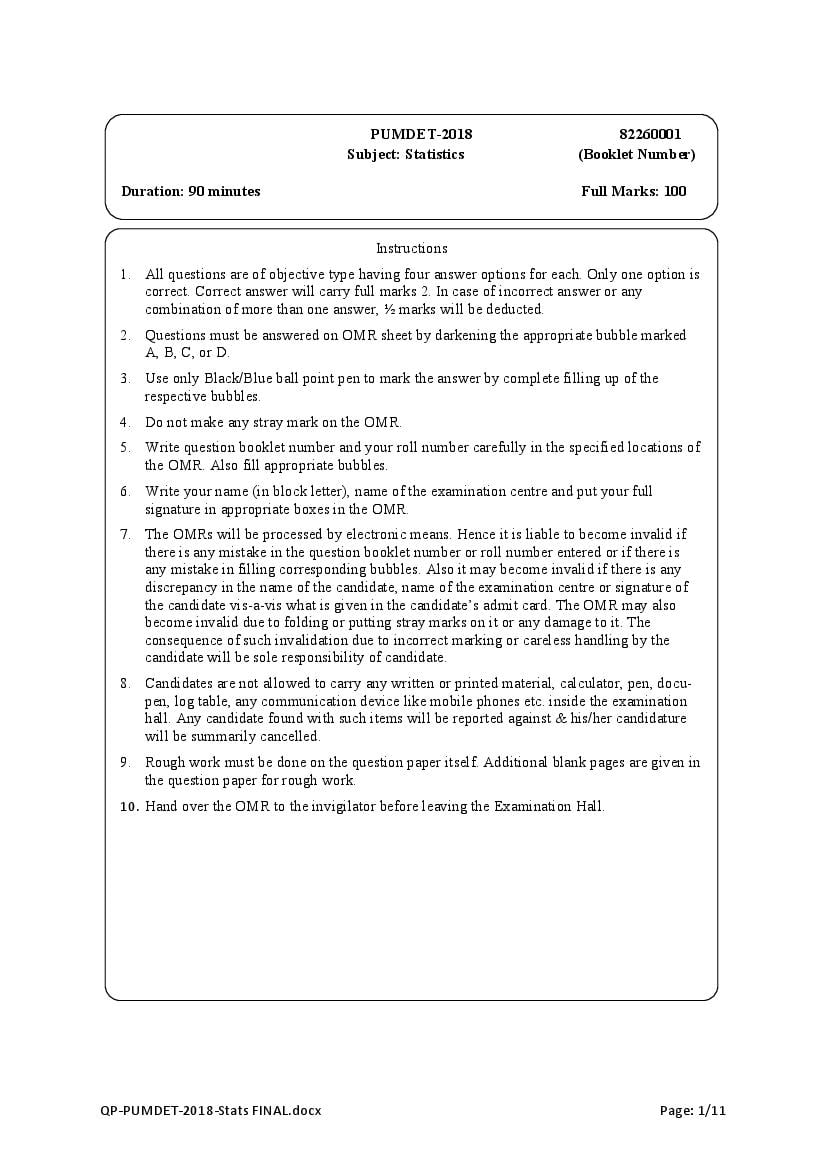
Subject: Statistics (Booklet Number)
Duration: 90 minutes Full Marks: 100
Instructions
1. All questions are of objective type having four answer options for each. Only one option is
correct. Correct answer will carry full marks 2. In case of incorrect answer or any
combination of more than one answer, ½ marks will be deducted.
2. Questions must be answered on OMR sheet by darkening the appropriate bubble marked
A, B, C, or D.
3. Use only Black/Blue ball point pen to mark the answer by complete filling up of the
respective bubbles.
4. Do not make any stray mark on the OMR.
5. Write question booklet number and your roll number carefully in the specified locations of
the OMR. Also fill appropriate bubbles.
6. Write your name (in block letter), name of the examination centre and put your full
signature in appropriate boxes in the OMR.
7. The OMRs will be processed by electronic means. Hence it is liable to become invalid if
there is any mistake in the question booklet number or roll number entered or if there is
any mistake in filling corresponding bubbles. Also it may become invalid if there is any
discrepancy in the name of the candidate, name of the examination centre or signature of
the candidate vis-a-vis what is given in the candidate’s admit card. The OMR may also
become invalid due to folding or putting stray marks on it or any damage to it. The
consequence of such invalidation due to incorrect marking or careless handling by the
candidate will be sole responsibility of candidate.
8. Candidates are not allowed to carry any written or printed material, calculator, pen, docu-
pen, log table, any communication device like mobile phones etc. inside the examination
hall. Any candidate found with such items will be reported against & his/her candidature
will be summarily cancelled.
9. Rough work must be done on the question paper itself. Additional blank pages are given in
the question paper for rough work.
10. Hand over the OMR to the invigilator before leaving the Examination Hall.
QP-PUMDET-2018-Stats FINAL.docx Page: 1/11
Page 2
Page 3
(A) 3 (B) 4 (C) 5 (D) 6
2. A Stem-Leaf display closely resembles
(A) an Ogive (B) a Pie Chart (C) a Histogram (D) a Divided bar chart
3. For a set of 8 observations, if 3 and 23 are the minimum and maximum values respectively, then
the minimum and maximum possible values of the variance are respectively
(A) 25 and 100 (B) 50 and 150 (C) 20 and 80 (D) 50 and 80
4. Suppose the standard deviations of two groups of observations having 100 and 400 observations
are 10 and 20, respectively. If S is the standard deviation of the combined group then
(A) 0 < S < 15.7 (B) 15.7 < S < 18 (C) 18 < S < 18.4 (D) S > 18.4
5. Given the regression lines of Y on X and X on Y, where X & Y represent the weight & height of a
randomly chosen individual respectively, one can find
(A) the variances of X and Y
(B) the product of the variances of X and Y
(C) the coefficient of variation of X
(D) the ratio of the coefficient of variations of X and Y
6. For two regression equations with two variables X and Y, given by 15x − 10y + 40 = 0 , and
10x − 6y − 20 = 0 the correlation coefficient between X and Y is approximately
(A) 0.95 (B) - 0.95 (C) 0.81 (D) - 0.81
7. Let pj i and qj i respectively stand for price and quantity for the ith commodity at the jth period,
where j = 0 and 1 correspond to base and current periods respectively. By choosing wi = p1i .q1i as
weights, Paasche’s price index number formula may be obtained as
(A) weighted arithmetic mean of price relatives
(B) weighted harmonic mean of price relatives
(C) weighted geometric mean of price relatives
(D) median of price relatives
QP-PUMDET-2018-Stats FINAL.docx Page: 3/11
Page 4
(in years) is
log e 3 log e 2
(A) 40 log e 2 (B) 40 log e 3 (C) 40 (D) 40
log e 2 log e 3
9. For detrending a time series with cubic trend, differencing should be carried out
(A) once (B) twice (C) thrice (D) four times
10. In a control chart, even though all the points are inside the control limits, indications of presence
of assignable causes of variation in the process are sometimes evidenced from unusual patterns
or arrangements of points corresponding to rational subgroups. Which of the following patterns
does not indicate such evidence?
(A) Alternate short series on either sides of the central line
(B) A series of points all falling close to one of the control limits
(C) A long series predominantly on one side of the central line
(D) A series of points exhibiting a trend or a cyclical pattern
11. If the letters of the word ARRANGE are permuted at random, the probability that all the vowels
will be together is
1 3 2 1
(A) (B) (C) (D)
7 35 35 35
12. 1 3
Let A and B be two events with probabilities P(A) = and P(B) = . Then which of the following is
3 4
a possible value of P ( A ∩ B ) ?
5 11 1 1
(A) (B) (C) (D)
24 24 24 13
13. The rules of a chess championship are as follows: in the title match, if the defending champion
loses to the challenger, then there is an immediate rematch; but otherwise he retains the title. The
challenger wins the title only if he beats the defending champion in the rematch too. The
probability of the challenger beating the defending champion in any match is ⅓ independently of
all other matches. If the defending champion retains his title, the probability that he did so in the
first match itself is
1 2 3 8
(A) (B) (C) (D)
2 3 4 9
14. If X has a binomial distribution with parameters n = 10, p = 0.4, then the distribution of 2X is
(A) binomial ( n = 20, p = 0.4) (B) binomial ( n = 10, p = 0.8)
(C) neither binomial nor truncated binomial (D) truncated binomial
QP-PUMDET-2018-Stats FINAL.docx Page: 4/11
Page 5
average, 1 % of passengers do not show up on time to board the flight and miss it. Assuming all
passengers travel independently of others, the probability that the airline will have to refuse a seat
to at least one passenger coming in time is best approximated by
1 1
(A) (B) (C) e−2.5 (D) 3.5e−2.5
251 250
16. Let X be a random variable and G(x) = P (X < x) for all real x. Then which of the following may not
be true?
(A) lim G(x) = 1 (B) lim G(x) = 0
x →∞ x →−∞
(C) G is monotonically non-decreasing (D) G is right continuous
17. Let X be a random variable with probability mass function
qpx −1 , x = 1,2,.....,
f(x) = , 0 < p < 1, p + q = 1 . Then which of the following is true?
0, otherwise
1 q q q
(A) Mean(X) = , Variance(X) = 2 (B) Mean(X) = , Variance(X) = 2
p p p p
1 p p p
(C) Mean(X) = ,Variance(X) = 2 (D) Mean(X) = , Variance(X) = 2
q q q q
18. 1
If X, Y are random variables, X Y = y follows binomial y, and Y follows Poisson( λ ) where λ > 2
2
, then the distribution of X is
1 2
(A) Geometric (B) Geometric
2λ λ
2 λ
(C) Poisson (D) Poisson
λ 2
19. Suppose X and Y are independent random variables each following F6, 1 distribution. Then the
distribution of X+Y is
(A) F12, 1 (B) F6, 2 (C) F12, 2 (D) not an F distribution
20. 1
Let X be an exponential random variable with mean . What is the median of X?
2
1
(A) (B) loge 2 (C) loge 2 (D) loge 4
2
QP-PUMDET-2018-Stats FINAL.docx Page: 5/11
Page 6
X
Then the distribution of is
X+Y
1 1 1 1
(A) Beta (1, 1) (B) Beta 1, (C) Beta ,1 (D) Beta ,
2 2 2 2
22. If the distribution of the maximum of a random sample of size 5 from a distribution is Uniform
(0,1), then the parent distribution is
1 1
(A) Uniform 0, (B) Uniform (0,5) (C) Beta (5, 1) (D) Beta ,1
5 5
23. If X has a Uniform distribution between 1 and 2, then the distribution of 2X+10 is
(A) Uniform (0, 10) (B) Uniform (10, 12) (C) not uniform (D) Uniform(12, 14)
24. If A, B are non empty subsets of ℝ (Real line) with A ⊆ [1,2] and B ⊆ [ −2, −1] , then
sup({a.b : a ∈ A,b ∈ B}) equals
(A) − inf(A).sup(B) (B) inf(A).sup(B)
(C) − inf(A).inf(B) (D) sup(A).inf(B)
25. ∞
nα + 1
The infinite series ∑
n =1 n
3α
+2
converges if and only if
1 1
(A) α < 0 (B) α > 0 (C) α > (D) α <
2 2
26. The equation x 7 + x 5 − 2017 = 0 has
(A) exactly one real root (B) exactly five real roots
(C) exactly seven real roots (D) no real root
27. The dimension of the null space of a 4 x 5 matrix of rank 3 is
(A) 1 (B) 2 (C) 3 (D) 4
28. If A and B are matrices of the same order and ranks 4 and 2 respectively, then the set of possible
ranks of A – 2B is
(A) {0, 2, 4} (B) {2, 4, 6} (C) {2, 3, 4, 5, 6} (D) {0, 1, 2, 3, 4, 5, 6}
QP-PUMDET-2018-Stats FINAL.docx Page: 6/11
Page 7
0 1 3 0
The determinant of the matrix is
0 4 1 0
4 0 0 1
(A) 0 (B) - 1 (C) - 11 (D) 121
30. If ρxy = 0, − 1 < ρyz < 0 and −1 < ρxz < 0 then the partial correlation coefficient ρxy.z
(A) is positive (B) is zero
(C) is negative (D) can be positive, negative or zero
31. The multiple correlation coefficient between X1 and (X2, X3, X4) and that between X1 and (X2, X3)
are respectively denoted as r1.234 and r1.23 . Which of the following is possible for a particular data
set?
(A) r1.23 = 0.86 and r1.234 = 0.72 (B) r1.23 = - 0.86 and r1.234 = 0.72
(C) r1.23 = 0.86 and r1.234 = - 0.72 (D) r1.23 = 0.72 and r1.234 = 0.86
32. Suppose X, Y and Z are jointly distributed non-degenerate random variables with finite second
moments, Z1 = α1 + β1 Z and Z 2 = α 2 + β2 Z are the linear regressions of X on Z and Y on Z
respectively, and R1 = X − Z1 , R2 = Y − Z2 . Then the partial correlation coefficient ρXY.Z is the
ordinary correlation coefficient between
(A) Z1 and Z2 (B) Z and a linear combination of X and Y
(C) R1 and R2 (D) Z and a linear combination of R1 and R2
33. 4 0 0
Suppose the variance –covariance matrix of a random vector X = ( X1 ,X 2 ,X 3 )′ is ∑ = 0 8 2
ɶ 0 2 8
Then covariance of X1 – X3 and X1 + 2X2 + 3X3 is
(A) 4 (B) - 16 (C) - 24 (D) - 32
34. Suppose the sample first quartile Q̂ 1 based on a random sample of size n is used to estimate the
population first quartile Q1 of a distribution with a strictly positive continuous density f. Then for
large n, the distribution of Q̂ 1 is approximately normal with variance
1 1 3 3
(A) (B) (C) (D)
16nf ( Q 1 )
2
4nf ( Q 1 )
2
16nf ( Q 1 )
2
4nf ( Q 1 )
2
QP-PUMDET-2018-Stats FINAL.docx Page: 7/11
Page 8
Poisson populations with respective parameters λ1 and λ2 , then for large m and n, an
asymptotic test for the null hypothesis H0 : λ1 = λ2 against H1 : λ 1 ≠ λ 2 can be carried out using
the statistic
(A) X − Y (B) m X − nY (C) X− Y (D) mX − nY
36. If Tn is consistent for estimating the parameter Ѳ, then which of the following is necessarily true?
(A) Tn is unbiased for Ѳ (B) Tn is the only estimator consistent for Ѳ
(C) Tn is asymptotically unbiased for Ѳ (D) 4Tn is consistent for estimating 4Ѳ
37. (
To estimate σ2 based on a random sample X1 ,X 2 ,....Xn , n ≥ 2 from Normal τ, σ2 with both)
n 2
parameters unknown, an estimator Tn of the form Tn = c. ( )
∑ X j − X is used where c is constant
j= 1
1 n
and X = ∑ X j . Among the following choices, the one with the smallest mean squared error is
n j=1
given by choosing
1 1 1 1
(A) c = (B) c = (C) c = (D) c =
n+2 n+1 n−1 n
38. Suppose X1 and X2 are independent normally distributed random variables with
X1 + X 2
E ( X1 ) = E ( X2 ) = µ and Var(X1 ) = 1,Var(X2 ) = 4 . Then is
2
(A) the minimum variance unbiased estimator of µ
(B) the best linear unbiased estimator of µ
(C) not an MLE
(D) not an unbiased estimator of µ
39. Suppose X has a binomial distribution with n = 10 but p unknown. Suppose one needs to test the
null hypothesis p = 0.5 against the alternatives that it is greater than 0.5. If the observed value of X
= 10, then the p-value of the UMP test is closest to
(A) 0.0001 (B) 0.05 (C) 0.00098 (D) 0.009
QP-PUMDET-2018-Stats FINAL.docx Page: 8/11
Page 9
λ α α−1 −λx
( α, λ ) population with density f ( x ) = x e , x > 0, where α is known, is given by
α
X α
(A) (B) λX (C) λX α (D) X λ
λ
41. Suppose you are testing the null hypothesis that a person is innocent against the alternative
hypothesis that the person is guilty. Also suppose the chance that you will conclude that the
person is guilty if she is innocent is 0.1 and the chance that you will conclude the person is
innocent if she is guilty is 0.6. Then which of the following is true?
(A) P [Type-Ι error ] = 0.1, P [Type-ΙΙ error] = 0.6
(B) P [Type-Ι error ] = 0.1, P [Type-ΙΙ error] = 0.4
(C) P [Type-Ι error ] = 0.9, P [Type-ΙΙ error] = 0.6
(D) P [Type-Ι error ] = 0.9, P [Type-ΙΙ error] = 0.4
42. Sign test is used for testing the hypothesis about the
(A) mean of the distribution
(B) median of the distribution
(C) comparison of the means of two distributions
(D) comparison of the medians of two distributions
43. Let X and Y be independent and identically distributed random variables according to the
1
exponential distribution with mean , θ > 0 . For testing H0 : θ = 1 against H1 : θ < 1 , which of the
θ
following is true?
(A) UMP test does not exist
1 1
(B) UMP test rejects H0 when + is small
X Y
(C) UMP test rejects H0 when X + Y is small
(D) UMP test rejects H0 when X + Y is large
QP-PUMDET-2018-Stats FINAL.docx Page: 9/11
Page 10
distribution of the test statistic is F under the null hypothesis if
(A) the observations at each level represent a random sample from a normal distribution.
(B) the variance of the normal distributions across levels should be equal.
(C) the observations across different levels are generated independently.
(D) the statements (A), (B) and (C) are all true.
45. The purpose of one-way analysis of covariance (ANCOVA) with one concomitant variable is to
examine
(A) whether population variances of the response variable are the same across levels of a
factor, adjusting for differences on the concomitant variable .
(B) whether population means of the response variable are the same across levels of a
factor, adjusting for differences on the concomitant variable.
(C) whether population variances of the response variable are the same across levels of a
factor, without adjusting for differences on the concomitant variable .
(D) whether population means of the response variable are the same across levels of a
factor, without adjusting for differences on the concomitant variable .
46. RBD is an improvement over CRD with respect to the principle of
(A) local control (B) randomization (C) replication (D) factorization
47. Suppose a 23 experiment with 3 factors (P, K, D) each at 2 levels are conducted in 4 replicates each
containing 2 blocks, where the principal blocks respectively contain the treatment combinations
((1), pkd, kd, p), (pd, (1), k pkd), (pkd, pk, d, (1)) and ((1), pk, kd, pd). Then in this design
(A) KD, PD, PK and PKD are all partially confounded
(B) KD, PD, PKD and D are all partially confounded
(C) PK, PKD, D and KD are all partially confounded
(D) KD, PKD, P and PK are all partially confounded
48. Suppose in a split plot design, we have a factor A at p levels, which are arranged in an RBD using r
blocks and a second factor B at q levels, which are applied to the plots of a block after subdividing
each whole plot into q subplots. Then the whole plot and subplot error degrees of freedom are
respectively given by
(A) (r - 1) (p - 1) and p (q – 1) ( r – 1) (B) (r - 1) (q - 1) and q (p – 1) ( r – 1)
(C) (p - 1) (q - 1) and p (q – 1) ( r – 1) (D) (r - 1) (p - 1) and q (p – 1) ( r – 1)
QP-PUMDET-2018-Stats FINAL.docx Page: 10/11
Page 11
(A) non-response
(B) under-coverage
(C) faulty questionnaire design
(D) selecting a subset of individuals from the population
50. A simple random sample of size 5 is drawn with replacement (SRSWR) from a population of 100
units. The expected number of distinct units in the sample is
99 5 98 5
(A) 100 1 − (B) 100 1 −
100 100
95 5 94 5
(C) 100 1 − (D) 100 1 −
100 100
QP-PUMDET-2018-Stats FINAL.docx Page: 11/11
Document Details
| Board / Org | WBJEEB |
| Exam | PUMDET |
| Type | Question Paper |
| Pages | 11 |
| Updated | 22 Jul 2026 |